REVIEW 2 major objections 6 minor 18 references
Sequences of closely spaced resonances and eigenvalues for bipartite complex potentials
T0 review · 2 major / 6 minor · reviewed 2026-08-14 · deepseek-v4-flash
Pith's one-line read Two separated complex potentials create equidistant wavenumber ladders
desk verdict Rigorous Fabry-Perot resonance ladder for two distant complex bumps; the main theorem overreaches slightly on uniqueness, but the substance is solid and worth refereeing. read the letter →
The pith
A machine-rendered reading of the paper's core claim, the machinery that carries it, and where it could break.
The reading
What carries the argument
The central object is the function $F(k)$, a product of two ratios built from the outgoing solutions $X_\pm$ of the separated potentials; it encodes the reflection data of each bump and satisfies $F(0)=1$ under the non-degeneracy condition. The proof reduces the existence of nontrivial solutions of the original problem to the equation $e^{4ik\ell}=F(k)$, whose roots are exactly the wavenumbers in question. Near $k=0$ the logarithm of $F$ is holomorphic, so the equation becomes a fixed-point problem $z=-(i/(4\ell))\ln F(z+a_n)$, and the contraction-mapping principle together with a combinatorial identity for iterated derivatives yields the uniqueness, iteration, and series expansions of Theorem 1. Thus the large-separation ladder is a consequence of the reflection product of the two bumps, independent of further details of $V_\pm$.
What would settle it
Take the two delta-interactions $V_\pm=\beta_\pm\delta(x)$ with $\beta_\pm\neq 0$, for which $F(k)=(2ik-\beta_+)(2ik-\beta_-)/(\beta_+\beta_-)$, and solve $e^{4ik\ell}=F(k)$ numerically for a moderately large $\ell$ such as 100; count the roots in each disk $|k-\pi n/(2\ell)|<\pi/(4\ell)$ for $|n|\le N_\ell$. A single disk with zero or two roots would falsify the theorem, as would a choice with $X'_-(0,0)=0$ or $X'_+(d_+,0)=0$ that still produced a well-defined ladder.
Extended reading notes
Core claim
Under the non-degeneracy assumptions $X'_-(0,0)\neq 0$ and $X'_+(d_+,0)\neq 0$, Theorem 1 asserts that for every integer $n$ with $|n|\le \lfloor 2\ell r/\pi - 1/2\rfloor$ the disk $|k-\pi n/(2\ell)|<\pi/(4\ell)$ contains exactly one wavenumber $k_n(\ell)$ for which problem (1) has a non-trivial solution. This $k_n$ is either a resonance or an eigenvalue, and it can be located by iterating the map $h_n(k)=-(i/(4\ell))\ln F(k+\pi n/(2\ell))$; the iteration error is bounded explicitly in (6), and the wavenumber has two absolutely convergent series expansions in powers of $1/\ell$ with the remainder estimates (8) and (9). The value $k_n$ is a root of $e^{4ik\ell}=F(k)$, where $F$ is a product of reflection coefficients for the two separate bumps, so the entire ladder is governed by scattering data of the two compact pieces alone.
Load-bearing premise
For the theorem to hold, the scattering data of each isolated bump must be non-degenerate at zero wavenumber, meaning two specific derivatives must be nonzero, and the bump separation must be large enough that the fixed-point iteration is a contraction; if either condition fails, the asserted one-root-per-disk ladder is not guaranteed.
Editorial extensions
If this is right
- For a real-valued bipartite potential the ladder consists only of resonances, lying in the lower complex half-plane of $k$; for a complex potential the same ladder can contain resonances and eigenvalues side by side, with the sign of $\Re\ln F$ deciding which is which.
- The number of wavenumbers grows linearly with $\ell$, roughly $2\ell r/\pi$, while the spacing $\pi/(2\ell)$ shrinks, so increasing the separation produces a progressively denser cluster of eigenvalues and resonances near the real axis.
- Each $k_n$ can be computed numerically by iterating $h_n$; the error bound in (6) is uniform in $n$, so the procedure remains reliable up to indices proportional to $\ell$.
- Because only $F$ matters, the theorem extends without change to more general localized perturbations, including delta-interactions $V_\pm=\beta_\pm\delta(x)$ and second-order differential operators with compactly supported coefficients, as long as the corresponding $F$ is well defined.
Reading between the lines
- The paper does not pursue it, but the sign of $\Re\ln F$ could be engineered by choosing bump parameters, which would allow designing mixed ladders with a prescribed alternation of resonances and eigenvalues.
- A natural testable extension would be to replace compact supports by rapidly decaying tails; the proof's reliance on $F$ near $k=0$ suggests similar ladders may survive, but this is not established here.
- The power-law rather than exponentially small dependence on $\ell$ of the eigenvalue corrections indicates that the mechanism is not conventional double-well tunneling despite the two separated bumps; comparing the ladder with tunneling asymptotics in a simple example could clarify the distinction.
Signed reviews
Editorial analysis
A structured set of objections, weighed in public.
Referee Report
Summary. The manuscript studies the one-dimensional Schrödinger operator H_ℓ = -d^2/dx^2 + V_+(x-ℓ)+V_-(x+ℓ), where V_± are bounded compactly supported complex-valued functions. The main result (Theorem 1) states that, under the non-degeneracy condition X'_-(0,0)≠0 and X'_+(d_+,0)≠0, each disk B_n = {|k - πn/(2ℓ)| < π/(4ℓ)} with |n| ≤ N_ℓ contains exactly one wavenumber k_n for which the scattering problem (1) has a nontrivial solution, and provides convergent iterative and series expansions for k_n with explicit error bounds. The proof reduces the resonance/eigenvalue condition to the exact equation e^{4ikℓ}=F(k), where F is constructed from the single-potential scattering data, and analyzes this equation by a fixed-point method. The paper also gives explicit examples for step-like potentials and delta interactions, and discusses the analogy with Fabry-Pérot interferometers.
Significance. If the main result is corrected as indicated below, the paper provides a rigorous and quantitative description of a Fabry-Pérot-type sequence of resonances and eigenvalues for a broad class of complex bipartite potentials, including non-self-adjoint cases. The reduction to the scalar equation (14) and the explicit error bounds (6)-(9) are valuable: they give constructive recipes for computing the wavenumbers and demonstrate a power-law (rather than exponential) asymptotics. The proof is largely standard (Volterra integral representation, scattering-coefficient factorization, Cauchy estimates), and the paper ships several concrete examples with numerical illustrations. These are genuine strengths.
major comments (2)
- [Section 5, Theorem 1] Theorem 1 includes n=0 in its range |n| ≤ N_ℓ. For n=0, the fixed-point equation (15) has the unique fixed point z=0 in B_0 (since F(0)=1), so the theorem asserts that k_0=0 is a wavenumber for which problem (1) has a nontrivial solution. This is incorrect. The derivation of equation (14) in Section 5 divides by b_-(k)b_+(-k); at k=0 these reflection coefficients are singular (formula (13) contains 1/(2ik)), so (14) is not equivalent to the existence of a nontrivial solution of (1) at k=0. A concrete counterexample is the bipartite potential with V_+ ≡ V_- ≡ 1 on intervals of length 1: condition (3) holds (X'_-(0,0) = sinh 1 ≠ 0), yet a direct zero-energy transfer-matrix computation gives T_{21} = sinh 2 ≠ 0, showing that the only solution of (1) at k=0 is trivial. The theorem should therefore restrict to non-zero n (e.g., 1 ≤ |n| ≤ N_ℓ) or treat the case n=0 separately.
- [Section 5, Theorem 1] The theorem states uniqueness of the wavenumber in every B_n under only assumption (3), but the proof's uniqueness step relies on the Banach contraction principle and explicitly invokes condition (5). Since (5) is not a hypothesis of the theorem, the proof does not establish the stated uniqueness for values of ℓ with N_ℓ ≥ 1 for which (5) fails. For the intended asymptotic regime (ℓ sufficiently large) condition (5) holds automatically, so the fix is to add a large-ℓ hypothesis or to include (5) as an assumption. Alternatively, the uniqueness could be proved via Rouché's theorem using the strict inequality |ln F| < π/2 on B, which would remove the need for (5); in that case the representation (6) would still require (5) for the convergence of the iteration.
minor comments (6)
- [Section 1] The phrase 'governed by by' should be 'governed by'.
- [Section 2, definition (2)] The asymptotic conditions for X_+ and Y_+ are stated with x>d_+ and x<-d_- for both signs; for V_+ (supported on [0,d_+]) the condition for X_+ should be on x<0. Please clarify the notation.
- [Section 5, after (11)] The inequality (16) bounds |ln F| by π/2, but because (11) is strict and B is compact, a strictly smaller bound holds; the proof would benefit from stating this, as the contraction argument uses only the weaker statement via (5).
- [Equation (18)] The displayed identity is hard to read (the notation for the m-fold sum is garbled); consider stating it as the standard Lagrange inversion formula and citing it.
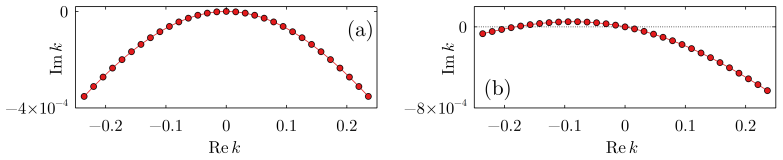
- [Figure 1 caption] The caption for panel (a), 'corresponding to resonances the self-adjoint step-function potential', is missing a word; it should read 'corresponding to resonances for the self-adjoint step-function potential'.
- [Section 3] The claim that V± can be replaced by more general operators on [−d_-,0] and [0,d_+] is vague; please specify the admissible class of operators.
Circularity Check
No circularity: the sequence of wavenumbers is derived from the exact resonance equation e^{4ikℓ}=F(k), with F built directly from the single-potential scattering data and no fitted parameters or load-bearing self-citations.
full rationale
The paper's central claim is obtained by an explicit derivation, not by assuming its conclusion. The resonance condition is reduced to equation (14), e^{4ikℓ}=F(k), where F is defined in Section 2 in terms of the solutions X± of the single-potential problems (2). The centers a_n=πn/(2ℓ) are not inputs; they are the leading-order solutions of e^{4ikℓ}=1, and the contraction argument in Section 5 locates exactly one root in each disk B_n. No parameter is fitted to any target spectrum, and no external empirical input is used. The cited works by the authors and their collaborators are used only for context and comparison, not as load-bearing support for Theorem 1. The only notable issue is that the proof of uniqueness invokes condition (5), e^{π/2}/(4ℓ) max_B|F'|<1, while the theorem statement may appear to assert uniqueness under only (3); this is a potential rigor or hypothesis-formulation concern, not a circularity, because the result is still derived from the exact equation and F is determined by the potentials V±. Thus the derivation is self-contained and the appropriate circularity score is 0.
Assumptions & free parameters
assumptions (5)
- standard math Solutions X± of the single-potential scattering problems (2) exist and are entire in k via Volterra integral equations.
- standard math The contraction mapping principle applies to the map z -> -i/(4L) ln F(z + a_n) on the disk |z| <= pi/(4L).
- standard math Lagrange inversion and the Faà di Bruno formula justify the series (7).
- domain assumption V± are bounded measurable complex-valued functions with compact support, defining an m-sectorial operator H_L in L2(R).
- domain assumption Non-degeneracy condition (3) holds: X'_-(0,0) is not 0 and X'_+(d_+,0) is not 0.
Cite this review
Pith. "Pith review of Sequences of closely spaced resonances and eigenvalues for bipartite complex potentials." pith.science (2026). https://pith.science/paper/GSXEJ57I
@misc{pith2026190806384,
  author       = {Pith},
  title        = {Pith review of: Sequences of closely spaced resonances and eigenvalues for bipartite complex potentials},
  year         = {2026},
  howpublished = {\url{https://pith.science/paper/GSXEJ57I}},
  note         = {Machine review of arXiv:1908.06384}
}
read the original abstract
We consider a Schroedinger operator on the axis with a bipartite potential consisting of two compactly supported complex-valued functions, whose supports are separated by a large distance. We show that this operator possesses a sequence of approximately equidistant complex-valued wavenumbers situated near the real axis. Depending on its imaginary part, each wavenumber corresponds to either a resonance or an eigenvalue. The obtained sequence of wavenumbers resembles transmission resonances in electromagnetic Fabry-P\'erot interferometers formed by parallel mirrors. Our result has potential applications in standard and non-hermitian quantum mechanics, physics of waveguides, photonics, and in other areas where the Schroedinger operator emerges as an effective Hamiltonian.
Figures
Reference graph
Works this paper leans on
-
[1]
J. R. Taylor, Scattering Theory, Wiley, New York, 1972
work page 1972
-
[2]
J. G. Muga, J. P. Palao, B. Navarro, and I. L. Egusquiza, Comple x absorbing potentials, Phys. Rep. 395 (2004) 357–426
work page 2004
-
[3]
C. M. Bender, Making sense of non-hermitian Hamiltonians, Rep. P rog. Phys. 70 (2007) 947–1018
work page 2007
-
[4]
Mostafazadeh, Pseudo-hermitian Representation of Quant um Mechanics
A. Mostafazadeh, Pseudo-hermitian Representation of Quant um Mechanics. Int. J. Geom. Methods Mod. Phys. 7 (2010) 1191-1306
work page 2010
-
[5]
Moiseyev, Non-Hermitian Quantum Mechanics, Cambridge Unive rsity Press, Cambridge, England, 2011
N. Moiseyev, Non-Hermitian Quantum Mechanics, Cambridge Unive rsity Press, Cambridge, England, 2011
work page 2011
-
[6]
A. Mostafazadeh, Spectral singularities of complex scattering potentials and infinite reflection and transmis- sion coefficients at real energies, Phys. Rev. Lett. 102 (2009) 220402
work page 2009
-
[7]
L. Feng, R. El-Ganainy, and L. Ge, Non-hermitian photonics base d on parity-time symmetry, Nat. Photonics 11 (2017) 752-762
work page 2017
-
[8]
V. V. Konotop, J. Yang, D. A. Zezyulin, Nonlinear waves in PT -symmetric systems, Rev. Mod. Phys. 88 (2016) 035002
work page 2016
Show all 18 references
-
[9]
Klopp, Resonances for large one-dimensional “ergodic” syst ems, Anal
F. Klopp, Resonances for large one-dimensional “ergodic” syst ems, Anal. PDE 9 (2016) 259–352
2016
-
[10]
Barra and P
F. Barra and P. Gaspard, Scattering in periodic systems: from resonances to band structure, J. Phys. A, 32 (1999) 3357–3375
1999
-
[11]
Born and E
M. Born and E. Wolf, Principles of Optics, 7th edition, Cambridge U niversity Press, 1999
1999
-
[12]
Cohen-Tannoudji, B
C. Cohen-Tannoudji, B. Diu, F. Lalo¨ e, Quantum Mechanics, Wile y, New York, 1977
1977
-
[13]
D. I. Borisov, Distant perturbations of the Laplacian in a multi-d imensional space, Ann. H. Poincar´ e. 8 (2007) 1371–1399
2007
-
[14]
E. M. Harrell, Double wells, Comm. Math. Phys. 75 (1980) 239–261
1980
-
[15]
Klaus and B
M. Klaus and B. Simon. Binding of Schr¨ odinger particles through conspiracy of potential wells, Ann. Ins. H. Poincar´ e. Sect. A.30 (1979) 83–87
1979
-
[16]
Borisov and A
D. Borisov and A. Golovina, On the resolvents of periodic operat ors with distant perturbaions, Ufa Math. J. 4 (2012) 65–73
2012
-
[17]
A. M. Golovina, On the spectrum of elliptic operators with distant perturbation in the space, St. Petersburg Math. J. 25 (2014) 735–754
2014
-
[18]
Albeverio, F
S. Albeverio, F. Gesztesy, R. Høegh-Krohn, H. Holden, Solvab le Models In Quantum Mechanics, AMS Chelsea Publ., Providence, RI, 2004. 9
2004
Reviewed August 14, 2026 · model on record in the stance chip above.
Discussion (0). Continue with ORCID to comment.