REVIEW 3 major objections 4 minor 25 references
Phototactic bioconvection under oblique collimated irradiation in a forward scattering suspension
T0 review · 3 major / 4 minor · reviewed 2026-08-06 · deepseek-v4-flash
Pith's one-line read Forward scattering delays the onset of phototactic bioconvection, a numerical stability model shows.
desk verdict The new oblique-irradiation/forward-scattering combination is a fair incremental idea, but the printed stability equations are internally inconsistent, so the central Rc(A) trend is not reproducible from the manuscript. read the letter →
The pith
A machine-rendered reading of the paper's core claim, the machinery that carries it, and where it could break.
The reading
What carries the argument
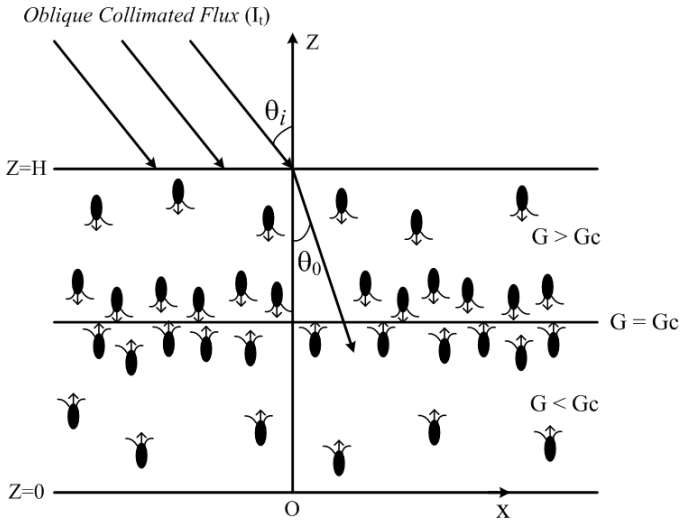
The argument runs on a radiative transfer equation with a linearly anisotropic scattering phase function $\Lambda(s',s) = 1 + A\cos\theta\cos\theta'$, where $A>0$ means forward scattering. This is coupled to the bioconvection equations: vorticity transport, cell conservation, and a phototactic swimming velocity $\langle p\rangle = -T(G)\mathbf{q}/|\mathbf{q}|$, with the phototaxis function $T(G) = 0.8\sin[1.5\pi\Xi(G)] - 0.1\sin[0.5\pi\Xi(G)]$ and $\Xi(G) = 0.4 G \exp[0.317(2.5-G)]$. The steady state is assembled from coupled Fredholm integral equations for intensity and radiative flux, and linear stability is turned into an eigenvalue problem for the growth rate $\gamma$, solved with fourth-order finite differences and Newton-Raphson-Kantorovich iterations. This machinery produces neutral curves in the $(k,R)$ plane and lets the paper track how $R_c$ moves with $A$.
What would settle it
Measure the critical Rayleigh number (or the onset depth and concentration) of a phototactic algal suspension under oblique collimated light while controlling forward-scattering strength—for instance by using cells of different sizes or adding non-absorbing scatterers—and check whether $R_c$ increases with the effective scattering coefficient $A$; alternatively, rerun the same linear stability calculation with an experimentally fitted phototaxis function and see whether the stabilization ordering survives.
Extended reading notes
Core claim
The paper claims that in a two-dimensional phototactic algal suspension illuminated by oblique collimated light, linearly anisotropic forward scattering has a net stabilizing effect. As the scattering coefficient $A$ increases from 0 (isotropic) through 0.4 to 0.8, the steady-state concentration peak moves downward from mid-height, and the critical Rayleigh number for the onset of convection rises. In the authors' words, the suspension becomes more stable for higher forward scattering coefficients. The linear analysis also shows both stationary and oscillatory instability modes, with oscillations most pronounced when the sublayer sits near three-quarters of the suspension depth.
Load-bearing premise
All quantitative thresholds depend on the uncalibrated phototaxis function $T(G) = 0.8\sin[1.5\pi\Xi(G)] - 0.1\sin[0.5\pi\Xi(G)]$ with $\Xi(G) = 0.4 G \exp[0.317(2.5-G)]$ and critical intensity $G_c=1$; if real phototaxis responds differently, the reported Rayleigh numbers and mode selection could shift.
Editorial extensions
If this is right
- When $A$ is increased from 0 to 0.8, the equilibrium cell layer moves from mid-depth toward the bottom, changing where bioconvection patterns would first appear.
- The critical Rayleigh number grows with $A$, meaning a stronger forward-scattering suspension needs a larger cell concentration or depth before convection sets in.
- Both stationary and oscillatory instabilities exist in the model, with oscillations strongest when the critical intensity places the sublayer near three-quarters of the suspension height.
- A reduction in light intensity lowers the maximum cell concentration at the sublayer and shifts the aggregation downward.
Reading between the lines
- If forward scattering stabilizes phototactic suspensions in real settings, then suspended particles that scatter light forward could suppress bioconvection patterns in natural waters, altering vertical mixing of phytoplankton; the paper does not explore this ecological consequence.
- Because the phototaxis function is not calibrated to experiments, the reported $R_c$ values should be read as model-dependent; a sensitivity study across different $T(G)$ forms would test whether the stabilization ordering persists.
- A testable extension would be to extract the critical wavelength $\lambda_c = 2\pi/k_c$ as a function of $A$; the paper focuses on $R_c$, but pattern-scale predictions could be compared with laboratory images.
- The model's two-dimensional domain and stress-free top surface may affect thresholds; repeating the stability analysis in three dimensions or with a no-slip top would clarify whether forward scattering remains stabilizing.
Signed reviews
Editorial analysis
A structured set of objections, weighed in public.
Referee Report
Summary. The paper studies the onset of bioconvection in a suspension of phototactic microorganisms illuminated by oblique collimated irradiation, with the suspension absorbing and anisotropically (forward) scattering light. The authors formulate a continuum model, solve for a horizontally uniform basic state, perform a linear stability analysis, and reduce the perturbation equations to an eigenvalue problem. The central quantitative claim, supported by one figure, is that increasing the forward-scattering coefficient A shifts the steady-state concentration peak downward and increases the critical Rayleigh number Rc, indicating enhanced stability. The paper also states in the conclusion that oscillatory modes become pronounced when the microorganism layer is at three-quarters height.
Significance. If the reported result were reproducible, the paper would meaningfully extend earlier phototactic bioconvection models (e.g., Vincent and Hill, Ghorai and Panda) to include oblique collimated irradiation combined with linearly anisotropic forward scattering. The treatment of the radiative transfer equation with both collimated and diffuse components is a relevant complication. However, the paper's central numerical prediction is not supported by the manuscript as written because the final eigenvalue system contains multiple sign and coefficient inconsistencies, and the numerical results section is too sparse to substantiate the stated conclusions. The work would require a corrected derivation and a substantially expanded numerical study to be significant.
major comments (3)
- [III.B, Eqs. (68)-(73)] The reduction leading to Eqs. (69)-(73) is internally inconsistent. With the definition phi = int_z^1 Theta (Eq. 68), one has Dphi = -Theta, so Eq. (64) becomes (gamma Sc^{-1}+k^2-D^2)(D^2-k^2)Psi = -R(ik)Dphi, not +R(ik)Dphi as printed in Eq. (69). Substituting Theta = -Dphi into Eq. (65) yields, after rearranging, an equation of the form D^3phi - Vc Tb D^2phi - [gamma+k^2+Gamma3]Dphi - Gamma2 phi - Gamma1 = +(ik)Dnb Psi, where Gamma3 = Vc T' DGd_b (the tau_H/cos(theta0) term cancels), and the right-hand side has the opposite sign to Eq. (70). The printed Gamma3 contains an extra 2(tau_H/cos(theta0))Vc nb Gc_b T' term. Moreover, the boundary conditions (71)-(72) also change sign under the substitution: they should read D^2phi - Vc Tb Dphi + Vc nb T' g1 = 0 on z=0,1, with a plus sign before the last term. Thus the eigenvalue problem actually solved numerically is not the one derived from the linearized equations, and the reported Rc and kc values cannot be checked against the manuscript as written.
- [IV, Numerical Results] The numerical results section is extremely sparse. It contains only one figure, Fig. 2, which shows the effect of the forward-scattering coefficient A on the concentration profile and neutral curves. The text lists theta_i, omega, tau_H, and Vc as parameters to be varied, but no results are presented for any of them, despite the abstract and introduction emphasizing oblique incidence and scattering. This omission prevents the reader from assessing the claimed dependence of the stability threshold on these parameters.
- [V, Conclusion] The conclusion states that oscillatory solutions become 'particularly pronounced' when the microorganism layer is positioned around three-quarters of the suspension height, but no oscillatory neutral curves, growth-rate spectra, or any quantitative evidence for this claim appear in Section IV. As the paper currently stands, this conclusion is unsupported by the presented data.
minor comments (4)
- [II.D, Eq. (46)] The cell conservation relation is printed as int_0^1 nb(z)(z) = 1; the integrand should be nb(z) dz.
- [II.B, Eq. (24)] The phototaxis function T(G) and the critical intensity Gc are prescribed with specific numerical constants (0.8, 0.1, 0.4, 0.317, 2.5) without experimental calibration or a sensitivity study. Since all stability thresholds are computed with this function, the authors should at least comment on how the results might depend on these choices.
- [I, Introduction] There is a typo in the phrase 'in responce to gravity' (should be 'in response'). Also, the paper lists reference [25] (Woods) but does not cite it in the text.
- [III.B, page 14] The sentence 'From Eq. 55, Phi^d satisfies' is followed by Eq. (62), but the derivation of the sign conventions in the perturbed radiative intensity equation is not explained, which makes the already inconsistent reduction harder to audit.
Circularity Check
No circularity: the reported dependence of the steady-state peak position and critical Rayleigh number on the forward scattering coefficient is a computed consequence of the stated model, not an input.
full rationale
I find no circular step in the derivation chain. The central claim that increasing the forward scattering coefficient A shifts the steady-state concentration peak downward and increases the critical Rayleigh number Rc is obtained by solving the stated equations numerically: the basic state through Eqs. (42)-(46) and the linearized eigenvalue problem through Eqs. (64)-(67), with neutral curves computed via the Newton-Raphson-Kantorovich scheme. The phototaxis function Eq. (24) and the critical intensity Gc = 1 are modeling assumptions adopted from the prior phototaxis-bioconvection literature; they are not fitted to the target result, and no equation defines Rc as a function of A in a way that would force the reported trend by construction. The paper relies on earlier work by the same group, notably Ghorai and Panda [13], for the forward-scattering continuum model and parameter choices, but the present stability calculation is self-contained from Eqs. (16)-(20) onward; no load-bearing conclusion is justified solely by an unverified self-citation or by a uniqueness theorem imported from the authors' prior papers. The skeptical observation that the reduction from Eq. (65) to Eqs. (69)-(73) appears internally inconsistent is a correctness and reproducibility risk, not a circularity risk: an inconsistent algebraic reduction would undermine confidence in the printed equations but does not make the reported conclusion an input of the calculation. The phototaxis function and critical intensity are untested assumptions, and the quantitative thresholds could change under different functional forms, but that is a modeling-sensitivity limitation rather than evidence that the derivation reduces to its own inputs. Overall circularity is minimal, with a small allowance only for the heavy reliance on the authors' own previous model framework.
Assumptions & free parameters
free parameters (2)
- Critical light intensity Gc =
1.0
- Phototaxis function constants (0.8, 0.1, 0.4, 0.317, 2.5)
assumptions (4)
- domain assumption The suspension is dilute and cells are treated as a continuous distribution with isotropic, constant diffusivity D.
- domain assumption The Boussinesq approximation holds and the only body force is negative buoyancy.
- domain assumption Light intensity obeys the RTE with linearly anisotropic scattering phase function Λ = 1 + A cosθ cosθ', and the intensity is decomposed into an unscattered collimated part and a diffuse part.
- ad hoc to paper The phototaxis function T(G) in Eq. (24) and critical intensity Gc = 1 are the correct response for the modeled species.
Cite this review
Pith. "Pith review of Phototactic bioconvection under oblique collimated irradiation in a forward scattering suspension." pith.science (2026). https://pith.science/paper/GTNTZIGR
@misc{pith2026250623233,
  author       = {Pith},
  title        = {Pith review of: Phototactic bioconvection under oblique collimated irradiation in a forward scattering suspension},
  year         = {2026},
  howpublished = {\url{https://pith.science/paper/GTNTZIGR}},
  note         = {Machine review of arXiv:2506.23233}
}
read the original abstract
Phototaxis, the process by which living organisms navigate toward optimal light conditions, is essential for motile photosynthetic microorganisms. Positive(negative) phototaxis denotes the motion directed towards(away from) the source of illumination. The main objective of this study is the numerical investigation of onset of bioconvection in a suspension of phototactic microorganisms illuminated by oblique collimated irradiation at the top. In this suspension, the algal cells absorb and anisotropically scatter incident light which influences the flow dynamics of the cells.
Figures

Reference graph
Works this paper leans on
-
[1]
J. R. Platt, Science 133, 1766 (1961)
work page 1961
-
[2]
T. J. Pedley and J. O. Kessler, Annual Review of Fluid Mech anics 24, 313 (1992)
work page 1992
-
[3]
N. A. Hill and T. J. Pedley, Fluid Dynamics Research 37, 1 (2005)
work page 2005
-
[4]
J. O. Kessler, Contemporary Physics 26, 147 (1985)
work page 1985
-
[5]
H. W. T. Wager, Philosophical Transactions of the Royal S ociety of London. Series B, Containing Papers of a Biological Character 201, 333 (1911)
work page 1911
-
[6]
R. V . Vincent, Mathematical modelling of phototaxis in motile microorgan isms, Ph.D. thesis, Univer- sity of Leeds (Department of Applied Mathematical Studies) (1995)
work page 1995
-
[7]
Häder, Archives of microbiology 147, 179 (1987)
D.-P . Häder, Archives of microbiology 147, 179 (1987)
work page 1987
-
[8]
Straughan, Mathematical aspects of penetrative convection (CRC Press, 1993)
B. Straughan, Mathematical aspects of penetrative convection (CRC Press, 1993)
work page 1993
Show all 25 references
-
[9]
C. R. Williams and M. A. Bees, Journal of Experimental Bio logy 214, 2398 (2011)
2011
-
[10]
R. V . Vincent and N. A. Hill, Journal of Fluid Mechanics 327, 343 (1996)
1996
-
[11]
Ghorai and N
S. Ghorai and N. A. Hill, Physics of fluids 17, 074101 (2005)
2005
-
[12]
Ghorai, M
S. Ghorai, M. K. Panda, and N. A. Hill, Physics of Fluids 22, 071901 (2010)
2010
-
[13]
Ghorai and M
S. Ghorai and M. Panda, European Journal of Mechanics-B /Fluids 41, 81 (2013)
2013
-
[14]
M. K. Panda and S. Ghorai, Physics of Fluids 25, 071902 (2013). 17
2013
-
[15]
M. K. Panda and R. Singh, Physics of Fluids 28, 054105 (2016)
2016
-
[16]
Panda, R
M. Panda, R. Singh, A. C. Mishra, and S. K. Mohanty, Physi cs of Fluids 28 (2016)
2016
-
[17]
M. K. Panda, Physics of Fluids 32, 091903 (2020)
2020
-
[18]
M. K. Panda, P . Sharma, and S. Kumar, Physics of Fluids 34, 024108 (2022)
2022
-
[19]
M. K. Panda and S. K. Rajput, Physics of Fluids 35 (2023)
2023
-
[20]
N. A. Hill and D.-P . Häder, Journal of theoretical biolo gy 186, 503 (1997)
1997
-
[21]
J. R. Cash and D. R. Moore, BIT Numerical Mathematics 20, 44 (1980)
1980
-
[22]
M. A. Bees, Annual Review of Fluid Mechanics 52, 449 (2020)
2020
-
[23]
Javadi, J
A. Javadi, J. Arrieta, I. Tuval, and M. Polin, Philosoph ical Transactions of the Royal Society A 378, 20190523 (2020)
2020
-
[24]
Ghorai, Bioconvection and plumes., Ph.D
S. Ghorai, Bioconvection and plumes., Ph.D. thesis, University of Leeds (1997)
1997
-
[25]
L. C. Woods, Aeronautical Quarterly 5, 176 (1954). 18
1954
Reviewed August 6, 2026 · model on record in the stance chip above.
Discussion (0). Continue with ORCID to comment.