REVIEW 3 major objections 6 minor 24 references
A Method for Analytical Solutions in the Lattice Boltzmann Method
T0 review · 3 major / 6 minor · reviewed 2026-08-07 · deepseek-v4-flash
Pith's one-line read One series gives analytical lattice Boltzmann solutions for known flows.
desk verdict A solid formal-solution method for LBM, with genuinely new quadratic Couette solutions, but the abstract overclaims the entropic aligned result that the body itself disclaims. read the letter →
The pith
A machine-rendered reading of the paper's core claim, the machinery that carries it, and where it could break.
The reading
What carries the argument
The central object is a formal expansion of the populations, $f_i = \sum_{n=0}^{\infty} P_n(\tau)(\partial_t + v_{i\alpha}\partial_{\alpha})^n f_i^{\mathrm{eq}}(\rho,u)$, obtained by substituting the lattice Boltzmann equation into itself to eliminate $f_i$ from the right-hand side. The coefficients $P_n(\tau)$ are polynomials satisfying the recurrence $P_0=1$ and $P_n = -\sum_{k=1}^{n} (\tau/k!)P_{n-k}$. For the quadratic equilibrium, derivatives beyond second order vanish because the distribution is quadratic in velocity, so the series truncates to a closed form that can be checked directly in the discrete equation; for the entropic equilibrium, the square roots keep the derivatives alive, giving an infinite series whose truncations are evaluated numerically. The explicit entropic term (A5) is built from derivative sums of $\sqrt{1+3u_x^2}$, and the paper uses these to compute momentum defects order by order.
What would settle it
Work symbolically with the infinite entropic series (A4) for aligned Couette flow: substitute the series into the discrete lattice Boltzmann equation (5) and test whether the residual vanishes as a formal power series in $\dot{\gamma}$ at each order. The paper only verifies truncated versions numerically, so a nonzero coefficient at any order would disprove the claim that (A4) is an analytical solution.
Extended reading notes
Core claim
The central claim is that when the macroscopic density and velocity are known, the discrete lattice Boltzmann populations can be reconstructed from the equilibrium distribution by the series $f_i = \sum_{n=0}^{\infty} P_n(\tau)(\partial_t + v_{i\alpha}\partial_{\alpha})^n f_i^{\mathrm{eq}}(\rho,u)$, with polynomials $P_n$ given by $P_0=1$ and $P_n = -\sum_{k=1}^n (\tau/k!) P_{n-k}$. Inserting this series into the lattice Boltzmann equation with BGK collision recovers known analytical solutions (correcting a misprint in an earlier derivation) and produces new ones: for the quadratic equilibrium it is proved to satisfy the discrete equation in both aligned and inclined Couette flow, and for the entropic equilibrium in the aligned case it matches direct simulation to machine accuracy for practical parameters. The method also identifies incompatibility: for the entropic equilibrium in inclined Couette flow, the momentum moments of even the first-order truncation deviate from $\rho u$ by a small relative error, and the paper concludes that inclined Couette flow is not a solution of entropic lattice Boltzmann. The explicit order-by-order term (A5) for the entropic case expresses the derivative structure through combinatorial sums over $\sqrt{1+3u_x^2}$.
Load-bearing premise
The load-bearing premise is that the Taylor expansion of the discrete lattice Boltzmann step can stand in for the exact discrete evolution, so that the infinite series (or a truncation) really approaches a solution of the original equation; the paper says the equality is formal and may not converge, and for the entropic case it is not known whether the series is an analytical solution.
Editorial extensions
If this is right
- For quadratic equilibria, any known flow whose velocity and density derivatives vanish above second order gets a closed-form population formula that can be proven by direct substitution into the discrete equation.
- The entropic-inclined Couette result implies that angled shear flow cannot be set up as an exact steady state of entropic lattice Boltzmann: boundary effects and secondary flows are unavoidable unless the flow is lattice-aligned.
- Truncated entropic solutions at small even orders (for example, order 4) give the best accuracy per unit compute time, and odd-order truncations should never be used.
- The method provides a direct test of boundary-condition implementations: inject the analytical populations at the boundary and check whether the bulk flow profile is reproduced exactly.
- At $\tau=1$, the method reduces to an earlier consistency check for known flow profiles, confirming that the new formalism contains the known special case and can flag incompatible flow–equilibrium combinations.
Reading between the lines
- The same elimination trick should extend to multi-relaxation-time and forcing-term collisions; the paper notes the algebra becomes more tedious, so an automated symbolic implementation of the $P_n$ recurrence would make such extensions practical.
- The error growth at high truncation order and extreme shear suggests the entropic series is asymptotic: if so, the honest reading is that entropic aligned Couette flow has approximate rather than exact solutions of this form.
- The momentum-defect magnitude $\|\Delta M\|$ for inclined flows could be used as a screening score for other equilibria, quantifying how rotationally compatible a given equilibrium is before running large simulations.
- For the inverse problem of inferring a lattice Boltzmann model from molecular-dynamics lattice-gas populations, this series gives a concrete consistency test: compare measured populations against the series coefficients computed from a candidate equilibrium.
Editorial analysis
A structured set of objections, weighed in public.
Referee Report
Summary. The paper presents a systematic method for constructing analytical solutions of the BGK lattice Boltzmann equation when the macroscopic density and velocity fields are known. The method is based on a formal Taylor expansion of the discrete streaming operator and an iterative elimination of the distribution function, yielding the representation f_i = sum_n P_n(τ) (∂t + v_iα∂α)^n f_i^eq(ρ,u), with coefficients P_n satisfying a simple recurrence. The authors apply this expansion to Couette flow, both aligned and inclined to the D2Q9 lattice, for two equilibrium distributions: the standard quadratic equilibrium and the entropic equilibrium. For the quadratic equilibrium, the series truncates; the authors prove by direct substitution that the resulting expressions satisfy the discrete lattice Boltzmann equation for both aligned and inclined Couette flow, and they recover and correct a previous result by Zou et al. For the entropic equilibrium, the series is infinite. The paper reports numerical tests based on one-step residual measurements of truncated series, showing machine-accuracy agreement for aligned Couette flow at practical relaxation times and shear rates, and identifies small even-order truncations as optimal in an accuracy-versus-compute-time sense.
Significance. The quadratic-equilibrium results are a solid, checkable contribution: the derived solutions are proven by substitution, the explicit formulas (Eqs. 20, A7) are directly usable, and the accompanying symbolic proof files strengthen reproducibility. The method of formal elimination, while related to prior work by Wagner and others, is presented in a general and systematic way and may be useful for other flow profiles and collision models. The entropic-equilibrium section is more exploratory: it provides valuable numerical evidence and a concrete expression for the truncated series, but it does not prove that the infinite series is an exact solution. The paper is commendably honest in the body, explicitly stating that it is not known whether the entropic aligned series is an analytical solution. However, the abstract and conclusions go beyond this by asserting that the method 'provides an analytical solution using the entropic distribution'; this overstatement is a load-bearing issue. The claim of incompatibility of entropic lattice Boltzmann with angled Couette flow is also stated more strongly than the evidence supports for general relaxation times.
major comments (3)
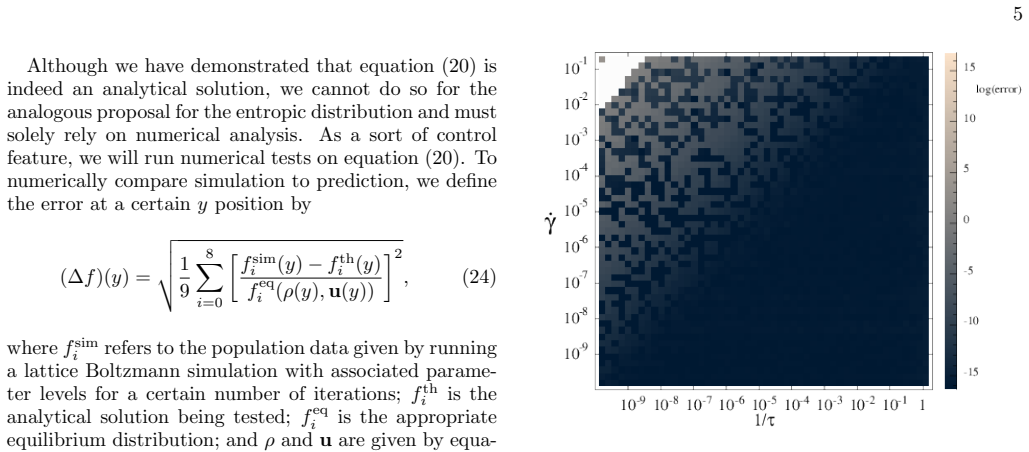
- [Abstract and §IV A 2] The abstract states that the method 'provides an analytical solution using the entropic distribution for practical relaxation times and shear rates,' but this is not established. In §IV A 2 the authors write 'we do not know if it is indeed an analytical solution' and rely solely on numerical one-step tests of finite truncations (f_th,ent_i)_N. Moreover, the generating function of the coefficients P_n is F(z)=1/(1-τ+τe^z); for τ=2 it has a pole at z=-ln2, so P_n grows exponentially and the infinite series in Eq. (A4) is not known to converge. Figures 5 and 6 show the residual decreasing with N but plateauing, which is consistent with an asymptotic expansion rather than convergence to an exact solution. Please temper the abstract and conclusion to say 'formal solution' or 'numerically verified to high accuracy,' or provide a proof that the infinite series actually satisfies the discrete lattice Boltzmann equation on the tested parameter range.
- [§IV B 2, Eqs. (43)-(44)] The conclusion that 'entropic lattice Boltzmann method is not compatible with the angled Couette flow' is too strong for general τ. The momentum non-conservation is demonstrated only for the first-order truncation of the formal series, not for the full infinite series; higher-order terms could in principle restore momentum conservation. For τ=1, the test based on Eq. (47) is a necessary condition and its failure is definitive for that case, but for τ≠1 the argument is incomplete. I recommend either restricting the incompatibility claim to τ=1 or to the formal solution method, or providing a proof that no analytical solution exists for all τ.
- [§III, Eq. (9)] The derivation of the formal series by iterative elimination assumes convergence or some summability of the infinite expansion. The paper acknowledges this possibility, but for the entropic case this assumption is central and is not analyzed. In particular, the finite radius of convergence of the generating function F(z)=1/(1-τ+τe^z) means the coefficients P_n grow exponentially for τ>1 (e.g., τ=2), so the infinite sum in Eq. (A4) likely diverges in the usual sense. The paper should include a discussion of the formal/asymptotic character of the series and the implications for calling it an 'analytical solution,' or provide a concrete convergence argument.
minor comments (6)
- [Introduction] There is a duplicated phrase in the outline: 'we explain the formal the formal analytical solution' should read 'we explain the formal analytical solution.'
- [Author affiliation] The affiliation line contains a typo: 'Lafayet te' should be 'Lafayette.'
- [Eq. (24)] The formula for the error contains LaTeX artifacts ('radicaltp', 'radicalvertex') and should be typeset with a proper square root symbol.
- [Figures 5 and 6] The captions and axis labels should specify precisely which quantities are plotted (e.g., whether Δf is on a logarithmic scale) and which parameters are fixed, so the claimed accuracy plateau can be evaluated by the reader.
- [§IV A 2] The statement that 'the mass and momentum moments of (f_th,ent_i)_1 replicate the correct macroscopic flow profile' is interesting but should be justified explicitly, since it is a nontrivial property of the first-order truncation.
- [References] Reference [14] is cited for a prior derivation up to n=4; the relation of that derivation to the present recurrence (10)-(11) and to the full nonlinear flow case should be stated more explicitly.
Circularity Check
No significant circularity: the formal series is derived from the LBE and independently verified; the few self-citations are not load-bearing.
full rationale
The paper's construction is self-contained and non-circular. Equations (5)-(11) derive the formal series f_i = Σ P_n(τ)(∂t+v_iα∂α)^n f_i^eq from the discrete LBE by Taylor expansion and algebraic elimination of f_i; the P_n recurrence is derived in the paper, and no parameter is fitted to the target flows. The quadratic-equilibrium results are genuine predictions: the truncated closed forms (20) and (A7) are verified by direct substitution into the LBE (eqs. 21-23; symbolic Python check in [16]), which is an independent check rather than a restatement of the input. The entropic-aligned claim is explicitly disclaimed in the paper ('Since equation (A4) has not been checked to satisfy equation (5), we do not know if it is indeed an analytical solution'), and the numerical test used (initializing with the candidate and comparing after one LBE update) is a legitimate fixed-point consistency test, not a fit. The self-citations (Wagner [14] for n ≤ 4, Blommel-Wagner [10] for the entropic distribution's provenance) are not load-bearing: the paper re-derives the recurrence and defines the entropic equilibrium explicitly in eq. (15). The abstract's phrasing 'provides an analytical solution using the entropic distribution' is stronger than the evidence, but that is a rigor/overclaim issue, not circularity.
Assumptions & free parameters
assumptions (4)
- domain assumption The discrete f_i can be replaced by a smooth function so the Taylor expansion (6) is justified.
- domain assumption The infinite series (8)-(9), and the entropic series (A4), converge or behave as a proper asymptotic expansion for the parameters tested.
- domain assumption The equilibrium distributions (13) and (15) are valid for the D2Q9 lattice and the BGK collision operator.
- standard math Derivatives of the equilibrium distribution are evaluated via the chain rule, assuming f_i^eq is differentiable in ρ and u.
Cite this review
Pith. "Pith review of A Method for Analytical Solutions in the Lattice Boltzmann Method." pith.science (2026). https://pith.science/paper/GVF4AUJ4
@misc{pith2026250524170,
  author       = {Pith},
  title        = {Pith review of: A Method for Analytical Solutions in the Lattice Boltzmann Method},
  year         = {2026},
  howpublished = {\url{https://pith.science/paper/GVF4AUJ4}},
  note         = {Machine review of arXiv:2505.24170}
}
read the original abstract
Analytical solutions to the lattice Boltzmann Equation make it possible to study the method itself, explore the properties of its collision operator, and identify implementations of boundary conditions. In this paper, we propose a method to find analytical solutions where the macroscopic flow profile is known. We test this method on bulk Couette flow aligned and inclined to the simulation lattice with the quadratic and entropic equilibrium distributions. Our method indeed provides an analytical solution to these flows when using the quadratic distribution. When the flow is aligned to the lattice, our method provides an analytical solution using the entropic distribution for practical relaxation times and shear rates. We show that a small even order truncation of the formal solution is optimal for accuracy-compute-time trade-off. In the inclined case, our method does not conserve momentum, by a small relative error, when using the entropic distribution. We also discover that entropic lattice Boltzmann method is not compatible with the angled Couette flow. We discuss the application of our method to more complicated flows.
Figures


Figures from the paper (3 more)


Reference graph
Works this paper leans on
-
[1]
Polynomial Equilibrium Using the quadratic equilibrium distribution, velocity derivatives of f eq, pol i of order greater than 2 vanish be- cause equation (13) is quadratic in uα. Equation (9) significantly simplifies, and we obtain the following solu- tion: f th, pol i (y) =wiρ ( 1 + 3vixux + 3 2 u2 x[3v2 ix − 1] ) − 3τ wiρviy ˙γ(vix + ux[3v2 ix − 1]) + 3τ...
-
[2]
Entropic Equilibrium The choice of equilibrium distribution has an essen- tial effect on the simplification of equation (9). Because the entropic equation uses square roots, the derivatives of f eq, ent i do not vanish and we require a formal infinite series. Equation (A4) is the proposed analytical solu- tion using the entropic equilibrium distribution, whi...
-
[3]
Because of its length, we provide it in the appendix as equation (A7)
Polynomial Equilibrium The solution proposed by equation (9) again truncates at order 2 for the inclined Couette flow and quadratic local equilibrium distribution. Because of its length, we provide it in the appendix as equation (A7). We use a symbolic calculation feature of Python to check the consistency of the insertion of this equation into equation
-
[4]
Irina Ginzburg, Goncalo Silva, Francesco Marson, Bastien Chopard, and Jonas Latt, “Unified directional parabolic-accurate lattice boltzmann boundary schemes for grid-rotated narrow gaps and curved walls in creep- ing and inertial fluid flows,” Phys. Rev. E 107, 025303 (2023)
work page 2023
-
[5]
Symbolic Proof of Solving LBE of Angled Quadratic Solution.py
The github repository [16] holds the relevant files. The python file named, “Symbolic Proof of Solving LBE of Angled Quadratic Solution.py” in [16] provides a proof that f th, angled, pol i is indeed an analytical solution to the inclined Couette flow. Since the lattice Boltzmann equation (5) is not in gen- eral rotationally symmetric, we in general cannot o...
-
[6]
Entropic Equilibrium Once again, equation (9) as applied to the inclined Couette flow using the entropic local equilibrium distri- bution requires a (formal) infinite series. Equation (9) gives the formal solution f th, angled, ent i tested in this sec- tion. Analogous to equation (25), we define the order N truncation to be [ f th, angled, ent i ]N =∑ N n=0...
-
[7]
Simulating the flow around a circular cylinder with a lattice boltzmann equation,
FJ Higuera and Sauro Succi, “Simulating the flow around a circular cylinder with a lattice boltzmann equation,” Europhysics letters 8, 517 (1989)
work page 1989
-
[8]
Boltzmann approach to lattice gas simulations,
FJ Higuera and Javier Jim´ enez, “Boltzmann approach to lattice gas simulations,” Europhysics letters 9, 663 (1989)
work page 1989
Show all 24 references
-
[9]
Lattice bgk models for navier-stokes equa- tion,
Yue-Hong Qian, Dominique d’Humi` eres, and Pierre Lallemand, “Lattice bgk models for navier-stokes equa- tion,” Europhysics letters 17, 479 (1992)
1992
-
[10]
Analytical solutions of the lattice boltzmann bgk model,
Qisu Zou, Shuling Hou, and Gary D Doolen, “Analytical solutions of the lattice boltzmann bgk model,” Journal of Statistical Physics 81, 319–334 (1995)
1995
-
[11]
Accuracy of the lattice boltzmann method based on analytical solutions,
G´ abor H´ azi, “Accuracy of the lattice boltzmann method based on analytical solutions,” Phys. Rev. E 67, 056705 (2003)
2003
-
[12]
Hydrodynamics beyond navier-stokes: Exact solution to the lattice boltzmann hierarchy,
S. Ansumali, I. V. Karlin, S. Arcidiacono, A. Abbas, and N. I. Prasianakis, “Hydrodynamics beyond navier-stokes: Exact solution to the lattice boltzmann hierarchy,” Phys. Rev. Lett. 98, 124502 (2007)
2007
-
[13]
Varia- tional solution to the lattice boltzmann method for cou- ette flow,
Joseph T. Johnson, Mahyar Madadi, Daniel R. Ladiges, Yong Shi, Barry D. Hughes, and John E. Sader, “Varia- tional solution to the lattice boltzmann method for cou- ette flow,” Phys. Rev. E 109, 055305 (2024)
2024
-
[14]
Minimal entropic kinetic models for hydrody- namics,
Santosh Ansumali, Iliya V Karlin, and Hans Christian ¨Ottinger, “Minimal entropic kinetic models for hydrody- namics,” Europhysics Letters 63, 798 (2003)
2003
-
[15]
Integer lat- tice gas with monte carlo collision operator recovers the lattice boltzmann method with poisson-distributed fluc- tuations,
Thomas Blommel and Alexander J Wagner, “Integer lat- tice gas with monte carlo collision operator recovers the lattice boltzmann method with poisson-distributed fluc- tuations,” Phys. Rev. E 97, 023310 (2018)
2018
-
[16]
Theory, analysis, and applications of the entropic lattice boltzmann model for compressible flows,
Nicol` o Frapolli, Shyam Chikatamarla, and Ilya Karlin, “Theory, analysis, and applications of the entropic lattice boltzmann model for compressible flows,” Entropy 22 (2020), 10.3390/E22030370
2020 doi
-
[17]
(Springer Charm, 2017) p
Kr¨ uger et al., The Lattice Boltzmann Method, 1st ed. (Springer Charm, 2017) p. 694
2017
-
[18]
Derivation of hydrodynamics for multi-relaxation time lattice boltz- 13 mann using the moment approach,
Goetz Kaehler and Alexander J Wagner, “Derivation of hydrodynamics for multi-relaxation time lattice boltz- 13 mann using the moment approach,” Communications in Computational Physics 13, 614–628 (2013)
2013
-
[19]
Thermodynamic consistency of liquid-gas lattice boltzmann simulations,
AJ Wagner, “Thermodynamic consistency of liquid-gas lattice boltzmann simulations,” Phys. Rev. E 74, 056703 (2006)
2006
-
[20]
Lees– edwards boundary conditions for lattice boltzmann,
Alexander J Wagner and Ignacio Pagonabarraga, “Lees– edwards boundary conditions for lattice boltzmann,” Journal of statistical physics 107, 521–537 (2002)
2002
-
[21]
Jordan Larson, https://github.com/JordanL541/ analytical-solutions/ (2025)
2025
-
[22]
Lattice gas with molecular dynamics collision operator,
M Reza Parsa and Alexander J Wagner, “Lattice gas with molecular dynamics collision operator,” Phys. Rev. E 96, 013314 (2017)
2017
-
[23]
Con- necting lattice boltzmann methods to physical reality by coarse-graining molecular dynamics simulations,
Aleksandra Pachalieva and Alexander J Wagner, “Con- necting lattice boltzmann methods to physical reality by coarse-graining molecular dynamics simulations,” arXiv preprint arXiv:2109.05009 (2021)
2021 arXiv
-
[24]
The following document provides a derivation of equation (A5) from the main text
See Supplemental Material at [URL will be inserted by publisher] for a derivation of equation (A5). The following document provides a derivation of equation (A5) from the main text. Bell Polynomials. Consider the special case of Bn,k(x, 1, 0, 0, ..., 0) where ( x, 1, ..., 0) i...
Reviewed August 7, 2026 · model on record in the stance chip above.
Discussion (0). Sign in to comment.