Twisted Gaussian Schell States in Quantum Optics: Twist-Assisted Nonclassicality and Entanglement
Pith reviewed 2026-07-02 12:09 UTC · model grok-4.3
The pith
A separable two-mode Gaussian state gains nonclassical global squeezing and entanglement-generating power from a nonzero twist parameter.
A machine-rendered reading of the paper's core claim, the machinery that carries it, and where it could break.
Core claim
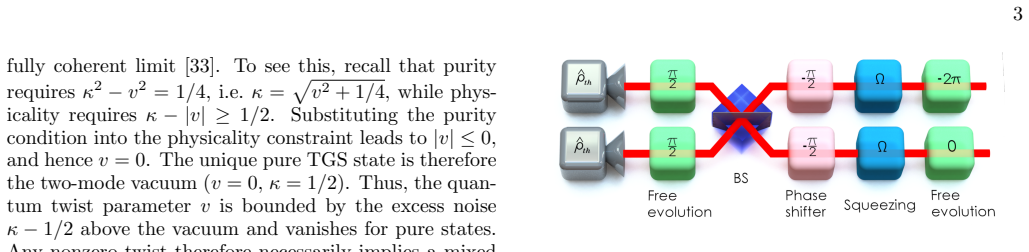
The twisted Gaussian Schell state is obtained by applying local squeezing to an asymmetric two-mode thermal state after phase shifters and a beam splitter. Although separable in the natural bipartition, a nonzero twist parameter produces squeezing of global quadratures below the shot-noise limit. The joint photon-number distribution is derived in closed form. Mixing each mode with an ancillary vacuum on balanced beam splitters creates a four-mode state whose local description consists of two TGS states; this state exhibits entanglement in selected 2x2 bipartitions and in all 1x3 bipartitions. For fixed input squeezing, larger twist activates entanglement where it would otherwise be absent an
What carries the argument
The twist parameter, generated by the sequence of phase shifters, beam splitter, and local squeezing applied to an asymmetric two-mode thermal state, which produces nonclassical global squeezing and controllable entanglement without direct two-mode entanglement.
If this is right
- Global quadratures exhibit squeezing below the shot-noise limit whenever the twist parameter is nonzero.
- The joint photon-number distribution of the TGS state takes a closed-form expression.
- The four-mode state obtained by coupling each mode to vacuum displays entanglement in select 2x2 bipartitions whose local description is two TGS states, plus entanglement in all 1x3 bipartitions.
- For any fixed input squeezing, increasing the twist activates entanglement in bipartitions that would otherwise be separable and deepens entanglement that is already present.
Where Pith is reading between the lines
- The twist could function as an independent control knob to turn entanglement on or off without altering the strength of the local squeezing operations.
- The construction suggests that other parameters from classical paraxial optics might be imported to generate or tune specific forms of multimode quantum entanglement.
- An optical experiment could test the activation of entanglement by varying only the twist while holding squeezing fixed, providing a direct check of the reported activation threshold.
- The coincidence of classical and quantum physicality bounds may allow classical beam-propagation calculations to predict the allowable range of twist in quantum implementations.
Load-bearing premise
The TGS state is produced exactly by local squeezing of an asymmetric two-mode thermal state after phase shifters and a beam splitter, with the classical physicality bound on the twist matching the quantum physicality condition.
What would settle it
Measure the variance of a global quadrature formed from both modes and check whether it falls below the shot-noise limit exactly when the twist parameter is nonzero but below the physicality bound; or verify the appearance of entanglement witnesses in the 2x2 bipartitions of the four-mode state for twist values that the formulas predict will activate entanglement.
Figures
read the original abstract
We introduce the Twisted Gaussian Schell (TGS) state, a two-mode mixed Gaussian state defined as the quantum-optical analog of the Twisted Gaussian Schell-model beam of classical paraxial optics, characterized by the so-called twist phase. In the TGS state, the twist parameter arises when an asymmetric two-mode thermal state is subject to local squeezing after the action of phase shifters and a beam splitter. Its defining quantum feature is nonclassicality: although the state is separable in its natural bipartition, when the twist parameter is nonzero there are global quadratures that can be squeezed below the shot-noise limit. The nonclassicality has also a direct signature in the joint photon-number distribution, which we obtain in closed form. Moreover, coupling each mode to an ancillary vacuum at a balanced beam splitter yields a four-mode state with entanglement in select $2\times2$ bipartitions, with local description given by two TGS states, and all $1\times3$ bipartitions. For fixed input squeezing, increasing the twist parameter activates entanglement where the state is otherwise separable and deepens it where already present. The classical physicality bound on the twist parameter coincides with the quantum physicality condition. These results advance the two-way bridge between classical beam engineering and quantum information.
Editorial analysis
A structured set of objections, weighed in public.
Referee Report
Summary. The paper introduces the Twisted Gaussian Schell (TGS) state as the quantum-optical analog of the classical twisted Gaussian Schell-model beam. The state is constructed from an asymmetric two-mode thermal state via phase shifters, a beam splitter, and local squeezing; the twist parameter is introduced by definition. Central claims include: (i) twist-assisted nonclassicality, in which the state remains separable in its natural bipartition yet exhibits global quadrature squeezing below the shot-noise limit for nonzero twist; (ii) a closed-form joint photon-number distribution; (iii) entanglement activation in a four-mode extension (each mode coupled to an ancillary vacuum at a balanced beam splitter), where increasing twist activates or deepens entanglement in selected 2x2 bipartitions while all 1x3 bipartitions are entangled; and (iv) exact coincidence between the classical physicality bound on the twist parameter and the quantum physicality condition.
Significance. If the construction and bound coincidence are verified, the work supplies an explicit Gaussian-state bridge between classical beam engineering and quantum information, demonstrating how a single twist parameter can induce nonclassicality without local squeezing in the natural modes and can control entanglement generation after ancillary coupling. The closed-form photon-number distribution is a concrete, potentially testable signature.
major comments (1)
- [Construction of the TGS state and physicality bounds] The assertion that the classical physicality bound on the twist parameter coincides exactly with the quantum physicality condition is load-bearing for the allowable range of the twist and therefore for both the nonclassicality claim and the entanglement-activation results. The manuscript states the coincidence but provides no explicit covariance-matrix verification under the symplectic transformations (phase shifters, beam splitter, local squeezing applied to the asymmetric thermal state). Any mismatch in the off-diagonal blocks arising from the quantum structure would restrict the twist range and weaken the central claims.
minor comments (1)
- [Abstract] The abstract states that closed-form results are obtained, yet the provided text does not include the explicit derivations or error analysis for the photon-number distribution or the covariance-matrix elements; these should be supplied or referenced to section numbers for reproducibility.
Simulated Author's Rebuttal
We thank the referee for their careful reading of the manuscript and for identifying the need for explicit verification of the physicality bounds. We address this point below and will revise the manuscript accordingly.
read point-by-point responses
-
Referee: [Construction of the TGS state and physicality bounds] The assertion that the classical physicality bound on the twist parameter coincides exactly with the quantum physicality condition is load-bearing for the allowable range of the twist and therefore for both the nonclassicality claim and the entanglement-activation results. The manuscript states the coincidence but provides no explicit covariance-matrix verification under the symplectic transformations (phase shifters, beam splitter, local squeezing applied to the asymmetric thermal state). Any mismatch in the off-diagonal blocks arising from the quantum structure would restrict the twist range and weaken the central claims.
Authors: We agree that the manuscript would be strengthened by an explicit derivation. In the revision we will add a dedicated calculation (new subsection or appendix) that starts from the covariance matrix of the asymmetric two-mode thermal state and applies the sequence of symplectic transformations corresponding to the phase shifters, beam splitter, and local squeezing. We will show that the resulting 4×4 covariance matrix satisfies the quantum physicality condition (positive symplectic eigenvalues) if and only if the twist parameter lies inside the classical bound, with the off-diagonal blocks transforming in a manner that introduces no additional restriction. This verification will be performed by direct matrix multiplication under each symplectic map and will confirm that the classical and quantum bounds coincide exactly, thereby supporting the reported range of the twist parameter and the associated nonclassicality and entanglement results. revision: yes
Circularity Check
No circularity: TGS state constructed explicitly from standard operations; physicality coincidence derived, not assumed
full rationale
The TGS state is defined via an explicit sequence of standard quantum-optical operations (asymmetric two-mode thermal state, phase shifters, beam splitter, then local squeezing), so the twist parameter enters by construction rather than by fitting or self-definition. The claimed coincidence between classical and quantum physicality bounds on the twist is presented as a calculational result on the resulting covariance matrix, not presupposed. Nonclassicality (global quadrature squeezing while separable) and entanglement activation under ancillary coupling are shown by direct computation on this constructed state. No load-bearing self-citations or uniqueness theorems from prior author work appear in the provided derivation chain; the central claims retain independent content from the explicit construction and calculations.
Axiom & Free-Parameter Ledger
free parameters (1)
- twist parameter
axioms (1)
- domain assumption TGS state arises from asymmetric two-mode thermal state after phase shifters, beam splitter, and local squeezing
invented entities (1)
-
twist parameter
no independent evidence
Reference graph
Works this paper leans on
-
[1]
[48]: a two-mode Gaussian state with block-structured covariance matrix V= A C C T B (15) is separable iff detC≥0
The symplectic eigenvalues of a 2n×2nco- variance matrix ˜Vare the moduli of the eigenvalues of ı˜VJ[4, 5], with J=⊕ n j=1Jj ;J j = 0 1 −1 0 .(14) However, for the TGS state it suffices to invoke the lemma of Ref. [48]: a two-mode Gaussian state with block-structured covariance matrix V= A C C T B (15) is separable iff detC≥0 . Inspecting the TGS covarian...
-
[2]
the bosonic entropy in bits.I G is independent of the squeez- ing Ω, vanishes atv= 0 and increases monotonically withv. B. Nonclassicality Separability does not, however, imply classicality. For a Gaussian state the relevant notion of classicality is the positivity of the Glauber–SudarshanPfunction [52], which holds if and only if all quadrature variances...
-
[3]
The same crossing turns on sub-shot- noise squeezing here and, after the four-mode embedding of Sec
Squeezing (Ω̸= 1) is required for any nonclassicality, but at fixed squeezing the twist is the trigger that carriesλ min across 5 the 1 2 threshold. The same crossing turns on sub-shot- noise squeezing here and, after the four-mode embedding of Sec. IV, entanglement, because both are monotone in λmin. See section IV and Fig. 5 for further discussion on no...
-
[4]
(31) imposes that 1< η <∞ while−∞ ≤A, B≤ ∞
Γ(k+ 1 2) π ,(33a) Sn(k, x) = 1 (n−k)!x! 2F1 −(n−k),−x; 1 2; A 4 , (33b) where Γ is the gamma function, 2F1(−p,−q; 1 2; A 4 ) =Pmin(p,q) j=0 (−p)j(−q)j ( 1 2)j j! A 4 j is the Gauss hypergeometric polynomial withpandqnon-negative integers, and we define η=b− c2 4a ,(34) B= 4ab−8b−c 2 4ab−8a−c 2 ,(35) A=B 64c2 (4ab−8b−c 2)2 .(36) The conditions in Eqs. (31...
-
[5]
Across the four squeezing values shown in Fig
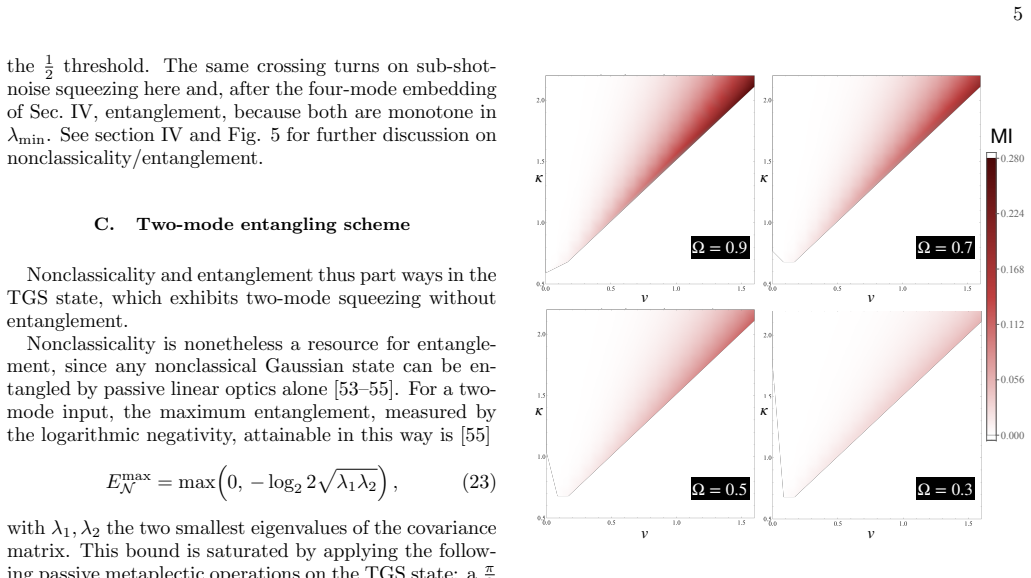
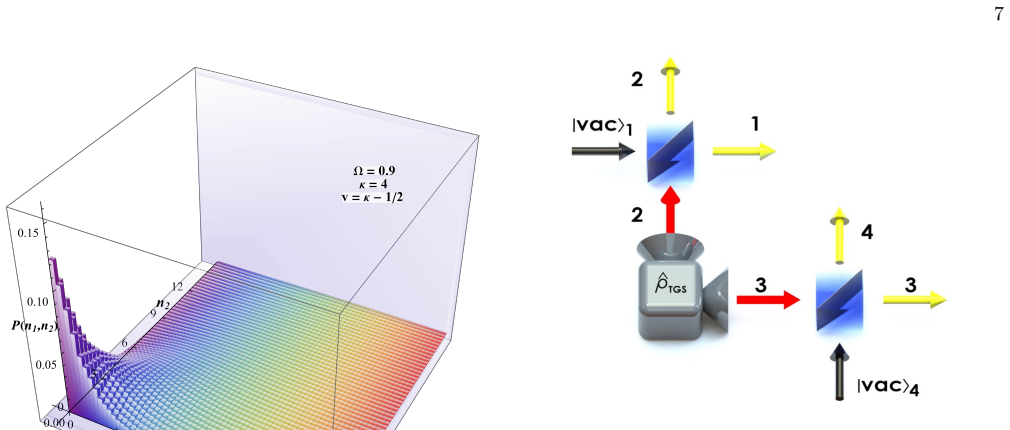
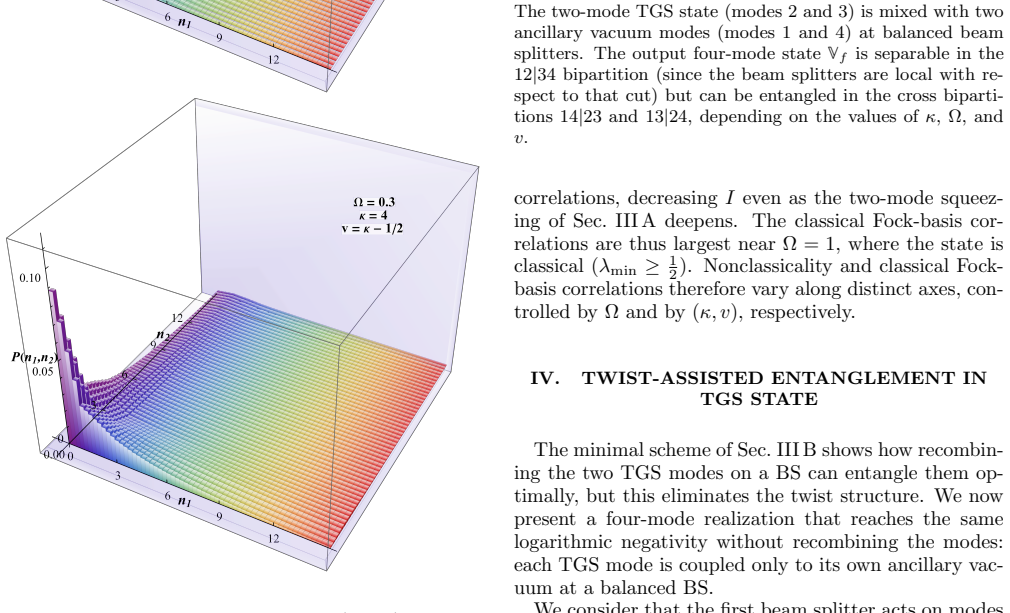
As can be observed from the grayscale on the right of the plots in Figure 2, for any fixed value ofκandv, the mutual information is greater for weaker squeezing (larger Ω). Across the four squeezing values shown in Fig. 2, ranging from Ω = 0.3 to Ω = 0.9, this trend is monotonic:Igrows as Ω approaches 1. The behavior of the joint photon number distributio...
-
[6]
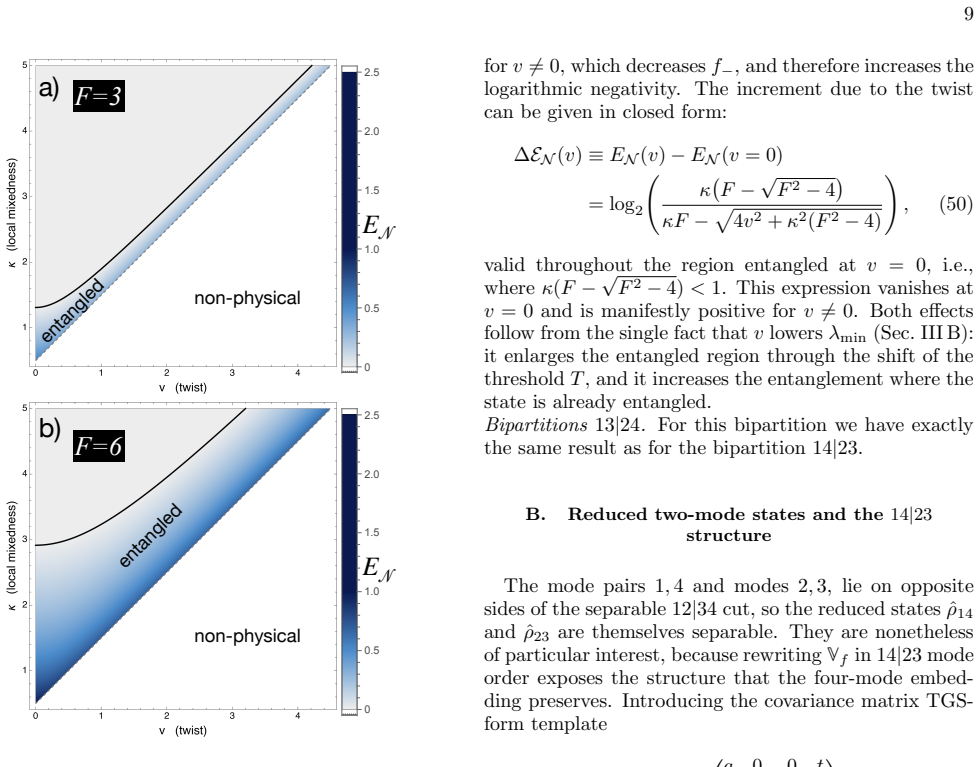
The solid black curve is the entanglement boundaryκF=Tof Eq. (48). Since f− < 1 2 ⇔λ min < 1 2, this boundary is identical to the non- classicality thresholdλ min = 1 2 of the input TGS state (see Eq. (19)). At fixed thermal noiseκand squeezing Ω (F), increasing the twistvdrives the state across the boundary. The shaded blue scale corresponds to the logar...
2014
-
[7]
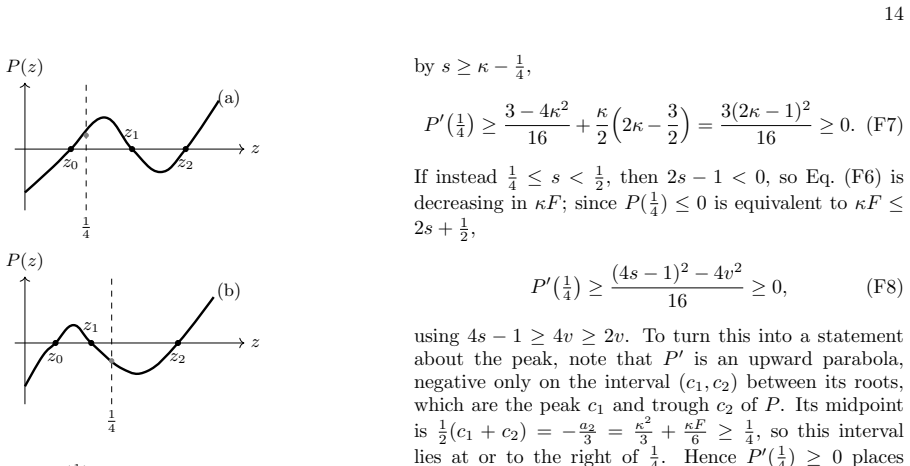
As its roots are real and non-negative,Phas the standard shape: it rises from P(0) =a 0 =− 1 4(κ2 −v 2)2 <0, crosses its smallest rootz 0, peaks, dips throughz 1, and rises throughz 2 (Fig. 6). EvaluatingPat the thresholdz= 1 4 gives the factorization P 1 4 = 1 64 4(κ2 −v 2)−1 2κF−4(κ 2 −v 2)−1 . (F5) Physicality (κ≥ 1 2 +v,v≥0) givesκ 2 −v 2 = (κ−v)(κ+ v...
-
[8]
We claim thatz min < 1 4 if and only ifP( 1 4)>0
is that of 2κF−4(κ 2 −v 2)−1. We claim thatz min < 1 4 if and only ifP( 1 4)>0. If P( 1 4)>0, then sinceP(0)<0 the cubic crosses zero in (0, 1 4), soz min < 1 4 [Fig. 6(a)]. For the converse we must exclude the only failure mode: thattworoots lie below 1 4 whileP( 1
-
[9]
double dip
is again negative [the “double dip” of Fig. 6(b)]. A direct computation froma 1 anda 2 gives P ′ 1 4 = 3−4κ 2 16 + κF 4 (2s−1), s≡κ 2 −v 2,(F6) 14 z P(z) 1 4 z0 z1 z2 (a) z P(z) 1 4 z0 z1 z2 (b) FIG. 6. The sign ofP( 1
-
[10]
double dip
decides entanglement, provided the situation in panel (b) cannot occur. Panel (a): the honest case, a single crossing before 1 4, withP( 1 4)>0. Panel (b): the “double dip”, in which the curve rises above the axis and back below it before 1 4, hiding two roots there whileP( 1 4)<0. The text shows panel (b) never happens, because the peak of Pcannot lie to...
-
[11]
The peak therefore sits at or beyond 1 4, soPis nondecreasing on [0, 1 4] and, withP(0)<0, stays≤0 there: the cubic has no root below 1 4, i.e.z min ≥ 1
HenceP ′( 1 4)≥0 places 1 4 outside the interval, and it can only be to theleft, 1 4 ≤c 1 (it cannot be to the right, since that side begins beyond the midpoint, already≥ 1 4). The peak therefore sits at or beyond 1 4, soPis nondecreasing on [0, 1 4] and, withP(0)<0, stays≤0 there: the cubic has no root below 1 4, i.e.z min ≥ 1
-
[12]
This excludes the double dip and establishes the equivalence. The bipartition 1|234 is therefore entangled if and only if κF > 1 2 + 2(κ2 −v 2) = 1 2 1 + 1 β =T,(F9) which is precisely the entanglement condition (48) ob- tained for the bipartition 14|23. By the beam-splitter symmetry, the fourW|XY Zbipartitions are entangled over the same region of parame...
-
[13]
Simon, E
R. Simon, E. C. G. Sudarshan, and N. Mukunda, Phys. Rev. A36, 3868 (1987)
1987
-
[14]
Simon, E
R. Simon, E. C. G. Sudarshan, and N. Mukunda, Phys. Rev. A37, 3028 (1988)
1988
-
[15]
Weedbrook, S
C. Weedbrook, S. Pirandola, R. Garc´ ıa-Patr´ on, N. J. Cerf, T. C. Ralph, J. H. Shapiro, and S. Lloyd, Rev. Mod. Phys.84, 621 (2012)
2012
-
[16]
Serafini,Quantum Continuous Variables: A Primer of Theoretical Methods, 1st ed
A. Serafini,Quantum Continuous Variables: A Primer of Theoretical Methods, 1st ed. (CRC Press, Boca Raton, FL, 2017)
2017
-
[17]
Continuous variable quantum information: Gaussian states and beyond
G. Adesso, S. Ragy, and A. R. Lee, Open Syst. Inf. Dyn. 21, 1440001 (2014), arXiv:1401.4679
work page internal anchor Pith review Pith/arXiv arXiv 2014
-
[18]
Dutta, N
Arvind, B. Dutta, N. Mukunda, and R. Simon, Pramana J. Phys.45, 471 (1995)
1995
-
[19]
R. J. C. Spreeuw, Physical Review A63, 062302 (2001)
2001
-
[20]
C. E. R. Souza, J. A. O. Huguenin, P. Milman, and A. Z. Khoury, Phys. Rev. Lett.99, 160401 (2007)
2007
-
[21]
Aiello, F
A. Aiello, F. T¨ oppel, C. Marquardt, E. Yao, and G. Leuchs, New Journal of Physics17, 043024 (2015)
2015
-
[22]
Forbes, A
A. Forbes, A. Aiello, and B. Ndagano (Elsevier, 2019) pp. 99–153
2019
-
[23]
Y. Shen and C. Rosales-Guzm´ an, Laser Photonics Rev. 16, 2100533 (2022), arXiv:2203.00994
-
[24]
Z. Wang, Z. Zhan, A. N. Vetlugin, J.-Y. Ou, Q. Liu, Y. Shen, and X. Fu, Light: Science & Applications13, 297 (2024)
2024
- [25]
-
[26]
R. M. Gomes, A. Salles, F. Toscano, P. H. S. Ribeiro, and S. P. Walborn, Phys. Rev. Lett.103, 033602 (2009)
2009
-
[27]
D. S. Tasca, R. M. Gomes, F. Toscano, P. H. Souto Ribeiro, and S. P. Walborn, Phys. Rev. A83, 052325 (2011)
2011
-
[28]
Boucher, T
G. Boucher, T. Douce, D. Bresteau, S. P. Walborn, A. Keller, T. Coudreau, S. Ducci, and P. Milman, Phys. Rev. A92, 023804 (2015)
2015
-
[29]
High-Dimensional Quantum Photonics: Roadmap
M. Malik, M. Kues, T. Ikuta, H. Takesue, D. Bajoni, D. J. Moss, R. Morandotti, A. Forbes, S. Walborn, E. Karimi, Y. Ding, S. Paesani, C. Vigliar, B. Brecht, C. Silberhorn, F. Bouchard, M. Karpi´ nski, B. Sussman, J. M. Lukens, Y. Bromberg, R. Fickler, T. Giordani, F. Sciarrino, Y. Zheng, J. Wang, M. Huber, A. Tavakoli, R. Uola, N. Brunner, N. Friis, N. H....
work page internal anchor Pith review Pith/arXiv arXiv 2026
-
[30]
A. N. de Oliveira, S. P. Walborn, and C. H. Monken, 15 Journal of Optics B: Quantum and Semiclassical Optics 7, 288 (2005)
2005
-
[31]
C. V. S. Borges, M. Hor-Meyll, J. A. O. Huguenin, and A. Z. Khoury, Phys. Rev. A82, 033833 (2010)
2010
-
[32]
Chowdhury, A
P. Chowdhury, A. S. Majumdar, and G. S. Agarwal, Phys. Rev. A88, 013830 (2013)
2013
-
[33]
W. F. Balthazar, C. E. R. Souza, D. P. Caetano, E. F. Galv˜ ao, J. A. O. Huguenin, and A. Z. Khoury, Opt. Lett. 41, 5797 (2016)
2016
-
[34]
G. S. Agarwal, R. R. Puri, and R. P. Singh, Phys. Rev. A56, 4207 (1997)
1997
-
[35]
G. S. Agarwal, New Journal of Physics13, 073008 (2011)
2011
-
[36]
Puentes and A
G. Puentes and A. Banerji, Frontiers in Physics9, 690721 (2021)
2021
-
[37]
K. Zhu, S. Li, X. Zheng, and Y. Zhou, Journal of Modern Optics59, 873 (2012)
2012
-
[38]
Kai-Cheng, L
Z. Kai-Cheng, L. Shao-Xin, T. Ying, Z. Xiao-Juan, , and T. Hui-Qin, Chinese Physics B21, 084204 (2012)
2012
-
[39]
Barral, J
D. Barral, J. Li˜ nares, and D. Balado, J. Opt. Soc. Am. B33, 2225 (2016)
2016
-
[40]
Y.-Z. Li, F. Jia, H.-L. Zhang, J.-H. Huang, and L.-Y. Hu, Laser Physics Letters12, 115203 (2015)
2015
-
[41]
Bandyopadhyay, S
A. Bandyopadhyay, S. Prabhakar, and R. P. Singh, Physics Letters A375, 1926 (2011)
1926
-
[42]
Bandyopadhyay and R
A. Bandyopadhyay and R. P. Singh, Optics Communica- tions284, 256 (2011)
2011
-
[43]
V. V. Dodonov, Journal of Physics A: Mathematical and Theoretical48, 435303 (2015)
2015
-
[44]
Reb´ on and R
L. Reb´ on and R. Rossignoli, Phys. Rev. A84, 052320 (2011)
2011
-
[45]
Simon and N
R. Simon and N. Mukunda, J. Opt. Soc. Am. A10, 95 (1993)
1993
-
[46]
Simon and N
R. Simon and N. Mukunda, J. Opt. Soc. Am. A15, 2373 (1998)
1998
-
[47]
A. T. Friberg, E. Tervonen, and J. Turunen, J. Opt. Soc. Am. A11, 1818 (1994)
1994
-
[48]
Serna and J
J. Serna and J. M. Movilla, Opt. Lett.26, 405 (2001)
2001
-
[49]
T. Ferreira, G. Santos, S. Ayala, L. Hutter, E. S. G´ omez, G. Lima, G. Ca˜ nas, and S. P. Walborn, Second- order moment equivalence of twisted gaussian schell model beams and orbital angular momentum eigenmodes (2026), arXiv:2605.15408 [physics.optics]
work page internal anchor Pith review Pith/arXiv arXiv 2026
-
[50]
Wang and Y
F. Wang and Y. Cai, Opt. Express18, 24661 (2010)
2010
-
[51]
F. Wang, Y. Cai, H. T. Eyyubo˘ glu, and Y. Baykal, Opt. Lett.37, 184 (2012)
2012
-
[52]
C. Zhao, Y. Cai, and O. Korotkova, Opt. Express17, 21472 (2009)
2009
-
[53]
Y. Cai, Q. Lin, and O. Korotkova, Opt. Express17, 2453 (2009)
2009
-
[54]
Tong and O
Z. Tong and O. Korotkova, Opt. Lett.37, 2595 (2012)
2012
-
[55]
M. G. de Oliveira, A. Santos, A. Barbosa, B. P. da Silva, G. dos Santos, G. Ca˜ nas, P. S. Ribeiro, S. Walborn, and A. Khoury, Optics & Laser Technology176, 110983 (2024)
2024
-
[56]
Hutter, G
L. Hutter, G. Lima, and S. P. Walborn, Phys. Rev. Lett. 125, 193602 (2020)
2020
-
[57]
Hutter, E
L. Hutter, E. S. Gomez, G. Lima, and S. P. Walborn, AVS Quantum Sci.3, 031401 (2021)
2021
-
[58]
G. H. dos Santos, A. G. de Oliveira, N. R. da Silva, G. Ca˜ nas, E. S. G´ omez, S. Joshi, Y. Ismail, P. H. S. Ribeiro, and S. P. Walborn, Nanophotonics11, 763 (2022)
2022
-
[59]
S. A. Ponomarenko, Opt. Lett.46, 5958 (2021)
2021
-
[60]
Simon, Phys
R. Simon, Phys. Rev. Lett.84, 2726 (2000)
2000
-
[61]
Simon, K
R. Simon, K. Sundar, and N. Mukunda, J. Opt. Soc. Am. A10, 2008 (1993)
2008
-
[62]
H. Wang, X. Peng, L. Liu, F. Wang, Y. Cai, and S. A. Ponomarenko, Opt. Lett.44, 3709 (2019)
2019
-
[63]
Williamson, Am
J. Williamson, Am. J. Math.58, 141 (1936)
1936
-
[64]
Vogel, Phys
W. Vogel, Phys. Rev. Lett.84, 1849 (2000)
2000
-
[65]
M. S. Kim, W. Son, V. Buˇ zek, and P. L. Knight, Phys. Rev. A65, 032323 (2002)
2002
-
[66]
J. K. Asb´ oth, J. Calsamiglia, and H. Ritsch, Phys. Rev. Lett.94, 173602 (2005)
2005
-
[67]
M. M. Wolf, J. Eisert, and M. B. Plenio, Phys. Rev. Lett. 90, 047904 (2003)
2003
-
[68]
Groenewold, Physica12, 405 (1946)
H. Groenewold, Physica12, 405 (1946)
1946
-
[69]
Lebedev,Special Functions and Their Applications- N.N
N. Lebedev,Special Functions and Their Applications- N.N. Lebedev(PRENTICE-HALL, INC., Englewood Cliffs, N.J., 1965)
1965
-
[70]
V. V. Dodonov, O. V. Man’ko, and V. I. Man’ko, Physical Review A49, 2993 (1994)
1994
-
[71]
M. A. Nielsen and I. L. Chuang,Quantum Computation and Quantum Information, 10th ed. (Cambridge Univer- sity Press, Cambridge, 2010)
2010
-
[72]
Toscano, A
F. Toscano, A. Saboia, A. T. Avelar, and S. P. Walborn, Phys. Rev. A92, 052316 (2015)
2015
-
[73]
Unitarily localizable entanglement of Gaussian states
A. Serafini, G. Adesso, and F. Illuminati, Phys. Rev. A 71, 032349 (2005), arXiv:quant-ph/0411109
work page internal anchor Pith review Pith/arXiv arXiv 2005
-
[74]
R. F. Werner and M. M. Wolf, Physical Review Letters 86, 3658–3661 (2001)
2001
-
[75]
The factor 2 2n is missing in the formula from page 251 of the book [64], but using Mathematica it seems that it is there
-
[76]
Magnus, F
W. Magnus, F. Oberhettinger, and R. P. Soni,Formulas and Theorems for the Special Functions of Mathematical Physics, 3rd ed. (Springer, Berlin, 1966)
1966
discussion (0)
Sign in with ORCID, Apple, or X to comment. Anyone can read and Pith papers without signing in.