LLM-Empowered Multimodal Fusion Framework for Autonomous Driving: Semantic Enhancement and Channel-Adaptive Design
Pith reviewed 2026-07-03 16:17 UTC · model grok-4.3
The pith
An LLM uses channel quality prompts to adaptively fuse vision and radar, cutting localization error by 40% versus vision-only on nuScenes.
A machine-rendered reading of the paper's core claim, the machinery that carries it, and where it could break.
Core claim
LM-SCIP couples a hierarchical radar-vision encoder with a Channel-Adaptive Semantic Module that maps link indicators into Channel Prompts, then routes the conditioned features through a LoRA-tuned LLM and heterogeneous Mixture-of-Experts for arbitration, followed by a decoupled multi-task decoder that produces localization, trajectory forecasts, and image reconstruction; on nuScenes this yields a 40.0% reduction in localization RMSE relative to a vision-only baseline under controlled radar toggle.
What carries the argument
The Channel-Adaptive Semantic Module (CASM), which translates link quality indicators into Channel Prompts that dynamically gate external radar features for the LLM.
If this is right
- The model maintains accuracy by defaulting to vision when radar quality is poor.
- The model improves accuracy by incorporating radar when channel conditions are good.
- A single model produces localization, trajectory forecasting, and image reconstruction outputs.
- Performance is demonstrated on both nuScenes and VIRAT datasets.
Where Pith is reading between the lines
- The prompt-based arbitration mechanism could be extended to other sensor pairs such as vision and LiDAR by defining modality-specific channel indicators.
- Because the LLM sits at the reasoning core, its intermediate outputs might be inspected to understand why a particular fusion decision was made.
Load-bearing premise
The Channel-Adaptive Semantic Module accurately translates link quality indicators into Channel Prompts that allow the LLM to correctly arbitrate between visual and radar features without introducing new errors.
What would settle it
Re-running the nuScenes experiments with radar input toggled at varying SNR levels and finding that localization RMSE does not drop by 40% or that the vision-dominant versus synergistic pattern fails to appear.
Figures


read the original abstract
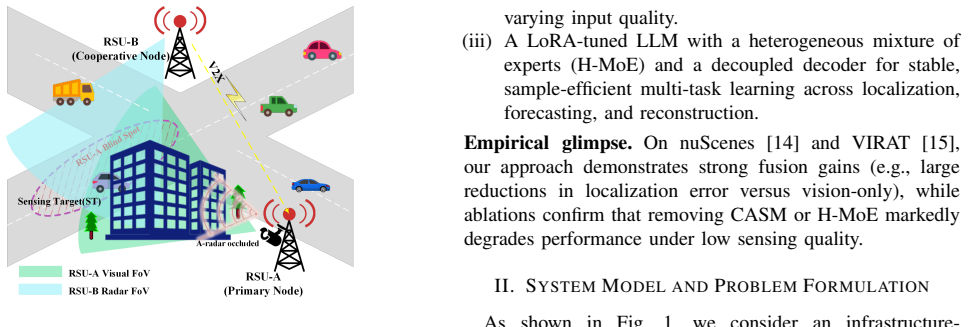
Vision-radar fusion is central to robust autonomous driving, combining dense visual semantics with precise range and velocity measurements from radar. However, real-world fusion quality is fundamentally challenged by dynamically varying input quality, stemming from occlusion, adverse weather, and channel noise. To address this, we re-frame the problem from static data fusion to channel-aware semantic reasoning and propose a Large Language Model-centric Semantic-layer Channel-aware Integrated Perception (LM-SCIP) framework. It places a Large Language Model (LLM) as a central reasoning core to fuse a local visual stream with a quality-varying external radar stream used to cover perception-blind spots. Concretely, LM-SCIP couples a hierarchical radar-vision encoder with a Channel-Adaptive Semantic Module (CASM) that maps link indicators into a "Channel Prompt" to dynamically gate external radar features. A parameter-efficient, LoRA-tuned LLM, in conjunction with a heterogeneous Mixture-of-Experts (H-MoE), then arbitrates between local visual cues and the channel-conditioned radar context. Finally, a decoupled multi-task decoder outputs localization, trajectory forecasting, and image reconstruction. Experiments on nuScenes and VIRAT validate our approach. On nuScenes, under a controlled toggle of radar input, LM-SCIP reduces localization RMSE by 40.0% versus a vision-only baseline. On VIRAT, the model attains a 0.214m localization RMSE and 0.179m minFDE (k=1). These results reveal that the proposed LM-SCIP enables a robust vision-dominant fallback at low SNR and synergistic fusion at high SNR.
Editorial analysis
A structured set of objections, weighed in public.
Referee Report
Summary. The paper proposes LM-SCIP, an LLM-centric framework for vision-radar fusion in autonomous driving. It introduces a Channel-Adaptive Semantic Module (CASM) that converts link quality indicators into Channel Prompts, which condition a LoRA-tuned LLM (with heterogeneous Mixture-of-Experts) to perform semantic arbitration between local visual features and external radar features. This is claimed to enable vision-dominant fallback at low SNR and synergistic fusion at high SNR. A decoupled decoder handles localization, trajectory forecasting, and reconstruction. On nuScenes, under controlled radar toggle, LM-SCIP reports 40% lower localization RMSE versus vision-only; on VIRAT it reports 0.214 m RMSE and 0.179 m minFDE (k=1).
Significance. If the core mechanism is validated, the work could demonstrate a practical route for LLMs to perform channel-aware multimodal reasoning in perception pipelines, moving beyond static fusion. The parameter-efficient design and explicit handling of varying input quality are potentially useful strengths for real-world deployment. However, without evidence isolating the contribution of the Channel Prompts and LLM arbitration, the significance remains provisional.
major comments (2)
- [Abstract] Abstract: the central claim that the LLM, conditioned on CASM-generated Channel Prompts, performs SNR-dependent arbitration (vision-dominant at low SNR, synergistic at high SNR) is not supported by the reported evidence. The 40% RMSE reduction is presented only as an aggregate result under binary radar toggle, with no per-SNR regime breakdowns, no ablation that removes the Channel Prompt, and no analysis (e.g., attention maps) showing that the LLM conditions on the prompt rather than treating radar features as an unconditional additive stream.
- [Experiments] Experiments (nuScenes and VIRAT results): no baseline comparisons beyond vision-only, no error bars, no ablation studies, and no quantitative isolation of CASM or H-MoE contributions are described. This makes it impossible to determine whether the reported gains arise from the claimed channel-aware LLM reasoning or from simpler heterogeneous fusion.
minor comments (2)
- [Abstract] The abstract refers to a 'controlled toggle of radar input' but provides no detail on how SNR is varied, measured, or simulated.
- Notation for the invented components (CASM, Channel Prompt, H-MoE) is introduced without a dedicated diagram or pseudocode showing data flow from link indicators to LLM input.
Simulated Author's Rebuttal
We thank the referee for the constructive feedback. The comments highlight the need for stronger empirical isolation of the channel-aware mechanisms, and we will revise the manuscript to address these points directly.
read point-by-point responses
-
Referee: [Abstract] Abstract: the central claim that the LLM, conditioned on CASM-generated Channel Prompts, performs SNR-dependent arbitration (vision-dominant at low SNR, synergistic at high SNR) is not supported by the reported evidence. The 40% RMSE reduction is presented only as an aggregate result under binary radar toggle, with no per-SNR regime breakdowns, no ablation that removes the Channel Prompt, and no analysis (e.g., attention maps) showing that the LLM conditions on the prompt rather than treating radar features as an unconditional additive stream.
Authors: We agree that the current aggregate results under binary toggle do not sufficiently demonstrate the SNR-dependent arbitration. In the revision we will add per-SNR regime breakdowns of localization RMSE, an ablation that removes the Channel Prompt, and attention-map analysis showing conditioning on the prompt. These additions will be included in the updated experiments section. revision: yes
-
Referee: [Experiments] Experiments (nuScenes and VIRAT results): no baseline comparisons beyond vision-only, no error bars, no ablation studies, and no quantitative isolation of CASM or H-MoE contributions are described. This makes it impossible to determine whether the reported gains arise from the claimed channel-aware LLM reasoning or from simpler heterogeneous fusion.
Authors: We acknowledge the absence of these elements in the current version. The revised manuscript will incorporate additional fusion baselines, error bars from repeated runs, and quantitative ablations isolating CASM and H-MoE to clarify the source of the gains. revision: yes
Circularity Check
No circularity: empirical framework evaluated on external datasets
full rationale
The paper presents an engineering design (LM-SCIP with CASM, LLM, H-MoE) whose central claims are performance numbers obtained by direct comparison against baselines on held-out nuScenes and VIRAT data. No equations, derivations, fitted-parameter predictions, or self-citation chains appear in the provided text; the 40% RMSE figure is an aggregate experimental outcome rather than a quantity forced by construction from the framework's own definitions or inputs.
Axiom & Free-Parameter Ledger
invented entities (3)
-
Channel Prompt
no independent evidence
-
Channel-Adaptive Semantic Module (CASM)
no independent evidence
-
heterogeneous Mixture-of-Experts (H-MoE)
no independent evidence
Reference graph
Works this paper leans on
-
[1]
Z. Li, W. Wang, H. Li, E. Xie, C. Sima, T. Lu, Q. Yu, and J. Dai, “BEVFormer: Learning Bird’s-Eye-View Representation From LiDAR– Camera via Spatiotemporal Transformers,”IEEE Trans. Pattern Anal. Mach. Intell., vol. 47, no. 3, pp. 2020–2036, 2025
work page 2020
-
[2]
S. Yao, R. Guan, X. Huang, Z. Li, X. Sha, Y . Yue, E. G. Lim, H. Seo, K. L. Man, X. Zhuet al., “Radar–Camera Fusion for Object Detection and Semantic Segmentation in Autonomous Driving: A Comprehensive Review,”IEEE Trans. Intell. V eh., vol. 9, no. 1, pp. 2094–2128, 2023
work page 2094
-
[3]
CRAFT: Camera–Radar 3D Object Detection with Spatio–Contextual Fusion Transformer,
Y . Kim, S. Kim, J. W. Choi, and D. Kum, “CRAFT: Camera–Radar 3D Object Detection with Spatio–Contextual Fusion Transformer,” in Proc. AAAI Conf. Artif. Intell., vol. 37, no. 1, 2023, pp. 1160–1168
work page 2023
-
[4]
CRN: Camera Radar Net for Accurate, Robust, Efficient 3D Perception,
Y . Kim, J. Shin, S. Kim, I.-J. Lee, J. W. Choi, and D. Kum, “CRN: Camera Radar Net for Accurate, Robust, Efficient 3D Perception,” in Proc. IEEE/CVF Int. Conf. Comput. Vis. (ICCV), 2023, pp. 17 569– 17 580
work page 2023
-
[5]
MVFusion: Multi- View 3D Object Detection with Semantic-Aligned Radar and Camera Fusion,
Z. Wu, G. Chen, Y . Gan, L. Wang, and J. Pu, “MVFusion: Multi- View 3D Object Detection with Semantic-Aligned Radar and Camera Fusion,” inProc. IEEE Int. Conf. Robot. Autom. (ICRA), 2023, pp. 2766–2773
work page 2023
-
[6]
Learning for Vehicle-to-Vehicle Cooperative Perception under Lossy Communica- tion,
J. Li, R. Xu, X. Liu, J. Ma, Z. Chi, J. Ma, and H. Yu, “Learning for Vehicle-to-Vehicle Cooperative Perception under Lossy Communica- tion,”IEEE Trans. Intell. V eh., vol. 8, no. 4, pp. 2650–2660, 2023
work page 2023
-
[7]
GPT-Driver: Learning to Drive with GPT,
J. Mao, Y . Qian, H. Zhao, and Y . Wang, “GPT-Driver: Learning to Drive with GPT,” inProc. NeurIPS F ound. Models for Decis. Making Workshop, 2023
work page 2023
-
[8]
DriveLLM: Charting the Path Toward Full Au- tonomous Driving with Large Language Models,
Y . Cui, S. Huang, J. Zhong, Z. Liu, Y . Wang, C. Sun, B. Li, X. Wang, and A. Khajepour, “DriveLLM: Charting the Path Toward Full Au- tonomous Driving with Large Language Models,”IEEE Trans. Intell. V eh., vol. 9, no. 1, pp. 1450–1464, 2023
work page 2023
-
[9]
A Unified Perception–Language–Action Framework for Adaptive Autonomous Driving,
Y . Zhang, E. L. Haß, K.-Y . Chao, N. Petrovic, Y . Song, C. Wu, and A. Knoll, “A Unified Perception–Language–Action Framework for Adaptive Autonomous Driving,”arXiv, 2025, arXiv:2507.23540
-
[10]
DriveVLM: The Convergence of Autonomous Driving and Large Vision–Language Models,
X. Tian, J. Gu, B. Li, Y . Liu, Y . Wang, Z. Zhao, K. Zhan, P. Jia, X. Lang, and H. Zhao, “DriveVLM: The Convergence of Autonomous Driving and Large Vision–Language Models,” inProc. Conf. Robot Learn. (CoRL), 2024
work page 2024
-
[11]
Planning-Oriented Autonomous Driving,
Y . Hu, J. Yang, L. Chen, K. Li, C. Sima, X. Zhu, S. Chai, S. Du, T. Lin, W. Wanget al., “Planning-Oriented Autonomous Driving,” in Proc. IEEE/CVF Conf. Comput. Vis. Pattern Recognit. (CVPR), 2023, pp. 17 853–17 862
work page 2023
-
[12]
LLM4Drive: A Survey of Large Language Models for Autonomous Driving,
Z. Yang, X. Jia, H. Li, and J. Yan, “LLM4Drive: A Survey of Large Language Models for Autonomous Driving,” inProc. NeurIPS Workshop on Open-World Agents, 2024
work page 2024
-
[13]
SIMAC: A Semantic-Driven Integrated Multimodal Sensing and Communication Framework,
Y . Peng, L. Xiang, K. Yang, F. Jiang, K. Wang, and D. O. Wu, “SIMAC: A Semantic-Driven Integrated Multimodal Sensing and Communication Framework,”IEEE J. Sel. Areas Commun., 2025
work page 2025
-
[14]
nuScenes: A Multimodal Dataset for Autonomous Driving,
H. Caesar, V . Bankiti, A. H. Lang, S. V ora, V . E. Liong, Q. Xu, A. Krishnan, Y . Pan, G. Baldan, and O. Beijbom, “nuScenes: A Multimodal Dataset for Autonomous Driving,” inProc. IEEE/CVF Conf. Comput. Vis. Pattern Recognit. (CVPR), 2020, pp. 11 621–11 631
work page 2020
-
[15]
A Large-Scale Benchmark Dataset for Event Recognition in Surveillance Video,
S. Oh, A. Hoogs, A. Perera, N. Cuntoor, C.-C. Chen, J. T. Lee, S. Mukherjee, J. K. Aggarwal, H. Lee, L. Daviset al., “A Large-Scale Benchmark Dataset for Event Recognition in Surveillance Video,” in Proc. IEEE/CVF Conf. Comput. Vis. Pattern Recognit. (CVPR), 2011, pp. 3153–3160
work page 2011
-
[16]
A Tutorial on 5G NR V2X Communications,
M. H. C. Garcia, A. Molina-Galan, M. Boban, J. Gozalvez, B. Coll- Perales, T. S ¸ahin, and A. Kousaridas, “A Tutorial on 5G NR V2X Communications,”IEEE Commun. Surveys Tuts., vol. 23, no. 3, pp. 1972–2026, 2021
work page 1972
-
[17]
Automotive Radars: A Review of Signal Processing Techniques,
S. M. Patole, M. Torlak, D. Wang, and M. Ali, “Automotive Radars: A Review of Signal Processing Techniques,”IEEE Signal Process. Mag., vol. 34, no. 2, pp. 22–35, 2017
work page 2017
-
[18]
WDMoE: Wireless Distributed Mixture of Experts for Large Language Models,
N. Xue, Y . Sun, Z. Chen, M. Tao, X. Xu, L. Qian, S. Cui, W. Zhang, and P. Zhang, “WDMoE: Wireless Distributed Mixture of Experts for Large Language Models,”IEEE Trans. Wireless Commun., 2025
work page 2025
-
[19]
The Garden of Forking Paths: Towards Multi-Future Trajectory Prediction,
J. Liang, L. Jiang, K. Murphy, T. Yu, and A. Hauptmann, “The Garden of Forking Paths: Towards Multi-Future Trajectory Prediction,” inProc. IEEE/CVF Conf. Comput. Vis. Pattern Recognit. (CVPR), 2020, pp. 10 508–10 518
work page 2020
-
[20]
L. Li, M. Pagnucco, and Y . Song, “Graph-Based Spatial Transformer with Memory Replay for Multi-Future Pedestrian Trajectory Predic- tion,” inProc. IEEE/CVF Conf. Comput. Vis. Pattern Recognit. (CVPR), 2022, pp. 2231–2241
work page 2022
-
[21]
SimAug: Learning Robust Representations from Simulation for Trajectory Prediction,
J. Liang, L. Jiang, and A. Hauptmann, “SimAug: Learning Robust Representations from Simulation for Trajectory Prediction,” inProc. Eur . Conf. Comput. Vis. (ECCV), 2020, pp. 275–292
work page 2020
-
[22]
CenterFusion: Center-Based Radar and Camera Fusion for 3D Object Detection,
R. Nabati and H. Qi, “CenterFusion: Center-Based Radar and Camera Fusion for 3D Object Detection,” inProc. IEEE/CVF Winter Conf. Appl. Comput. Vis. (WACV), 2021, pp. 1527–1536
work page 2021
discussion (0)
Sign in with ORCID, Apple, or X to comment. Anyone can read and Pith papers without signing in.