REVIEW 5 major objections 6 minor 2 references
Deep Camera: A Fully Convolutional Neural Network for Image Signal Processing
T0 review · 5 major / 6 minor · reviewed 2026-08-14 · deepseek-v4-flash
Pith's one-line read A fully convolutional network trained end-to-end can replace the entire camera image signal processing pipeline and beats sequential modular processing on synthetic raw images.
desk verdict A plausible learned-ISP network, but the 'first' and 'beats sequential pipelines' claims are not backed by the evaluation as designed. read the letter →
The pith
A machine-rendered reading of the paper's core claim, the machinery that carries it, and where it could break.
The reading
What carries the argument
The load-bearing object is a fully convolutional encoder-decoder network with one main path and three short connections, where each shortcut passes through a convolutional layer before being concatenated to the main path. This contrasts with residual connections that copy the input identically; the paper reports that identical-copy shortcuts did not learn the ISP mapping, while convolutional shortcuts did. The main path uses 2x2 max pooling and upsampling to force a compact latent representation, while the shortcut paths use 2x2 average pooling to preserve first-order statistics; 1x1 convolutions fuse the concatenated depth back to 64. Training minimizes a MAP-inspired loss that combines a weighted L2 likelihood term with a difference-of-Gaussians-weighted L1 regularization term, with the weighting fixed at $\alpha = 0.9$, and the output layer uses a sigmoid to keep pixel values in [0,1].
What would settle it
Feed the trained network real raw Bayer captures from a physical camera with a known scene, such as a color chart under controlled illumination, and compare its output PSNR against a conventional modular pipeline with the same ground truth; if the network no longer matches or beats the modular baseline, the claim of end-to-end superiority is falsified.
Extended reading notes
Core claim
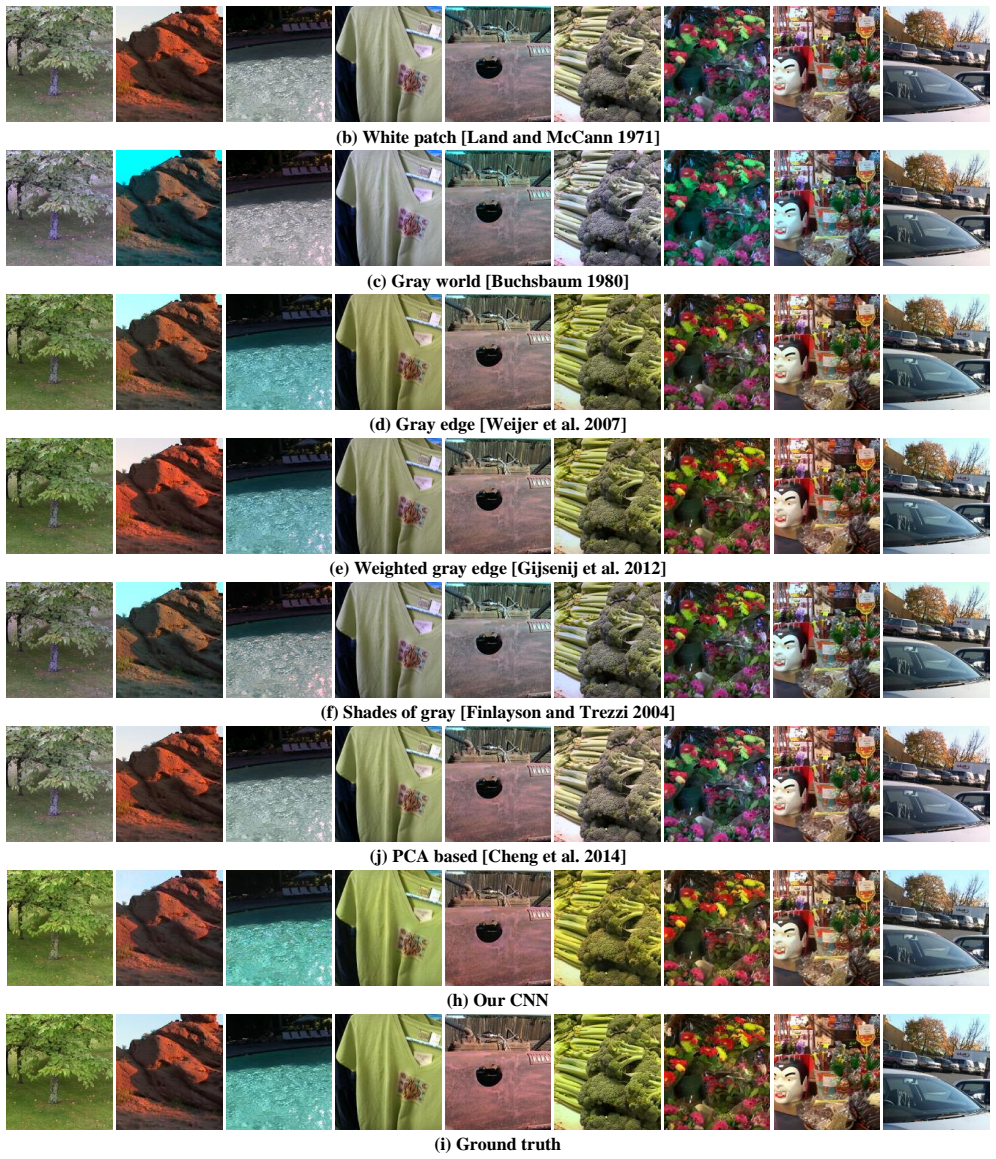
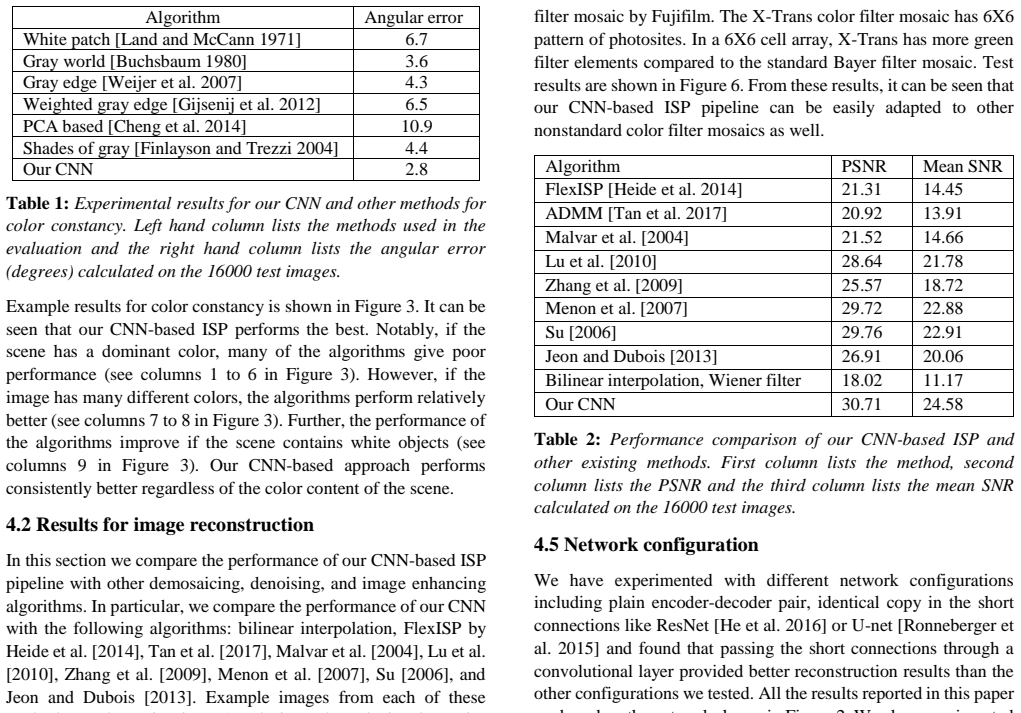
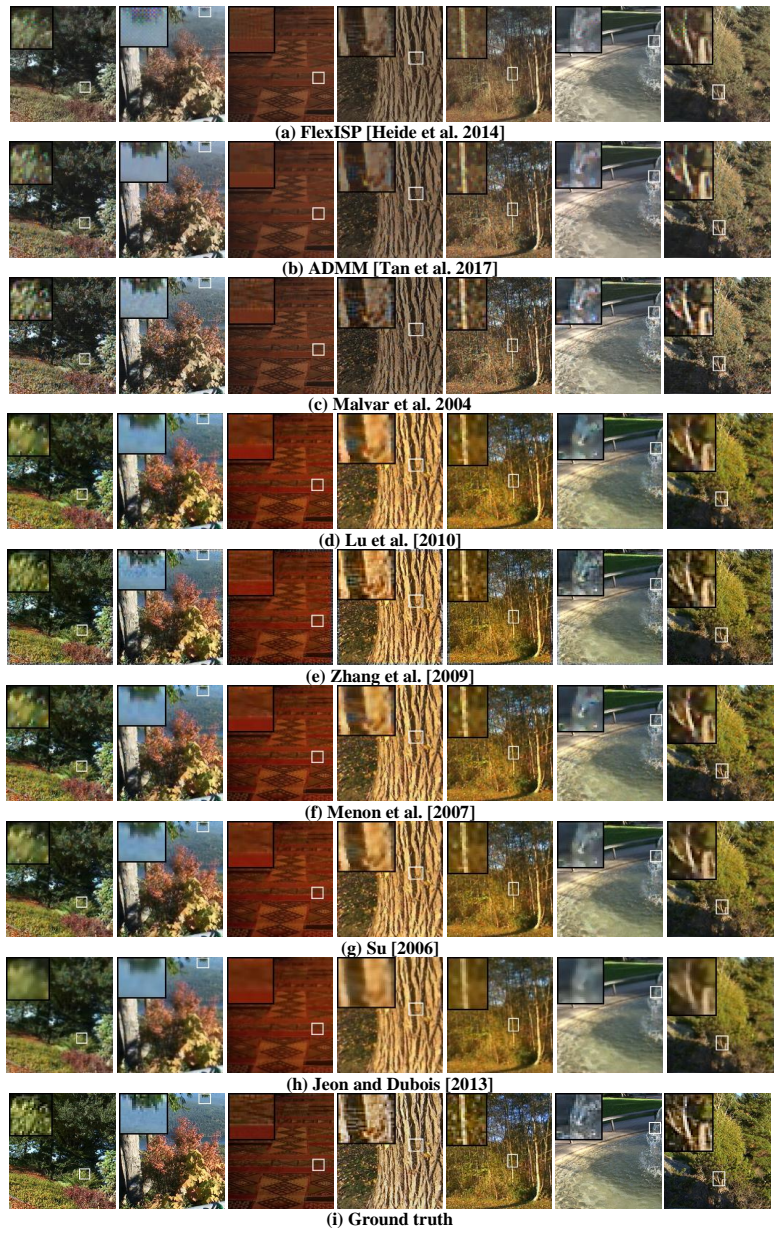
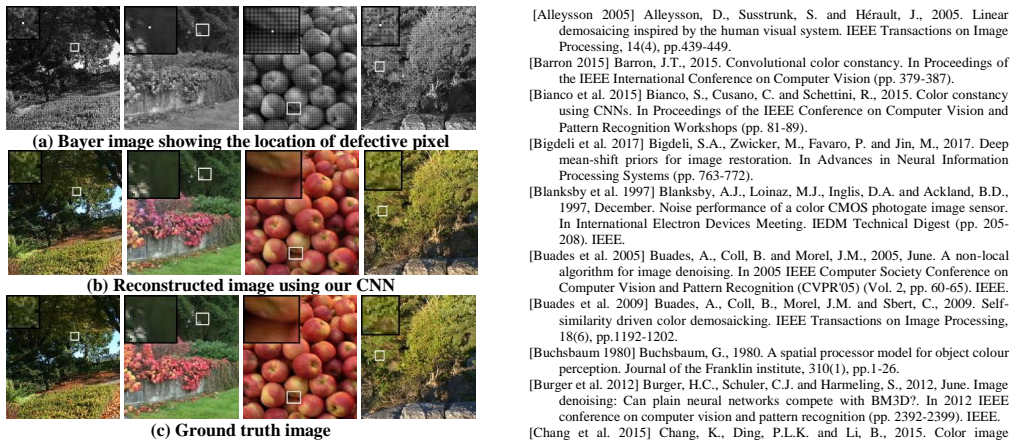
The central claim is that an end-to-end convolutional network can learn the entire inverse mapping from a raw Bayer sensor image to a display-ready sRGB image, including processes that are normally implemented as separate modules with their own hand-crafted assumptions. The paper reports that the resulting network outperforms every modular baseline it compares against on the synthetic test set: mean PSNR 30.71 dB versus 29.72 dB for the strongest partial baseline, mean SNR 24.58 versus 22.91, and a mean color-constancy angular error of 2.8 degrees versus 3.6 for the next best method. It also reports that the same network architecture trained on an X-Trans mosaic produces plausible reconstructions, and that injecting 0.01% dead or stuck pixels into the input does not visibly degrade the output. The paper states that this is, to its knowledge, the first CNN trained end-to-end to perform the entire ISP pipeline of a camera.
Load-bearing premise
All raw images, in training and testing, come from an in-house inverse ISP that simulates one CMOS sensor model, and the paper never evaluates a real camera raw file; if that simulator does not faithfully represent physical sensor raws, the reported superiority over sequential pipelines may not transfer to real cameras.
Editorial extensions
If this is right
- A camera firmware that currently runs a cascade of separate ISP modules could in principle be replaced by a single forward pass through a network of about 438,000 parameters.
- Because all stages are optimized under one loss evaluated on the final image, errors made early in the pipeline are corrected rather than compounded, so joint processing should scale better as more stages are integrated.
- The architecture is not tied to the Bayer pattern: retraining on a different color filter array, such as an X-Trans mosaic, yields working reconstructions, so a single learned ISP design could support multiple sensor layouts.
- End-to-end training from raw sensor data removes the need for hand-chosen processing order, such as whether to denoise before or after demosaicing.
Reading between the lines
- The paper never feeds a real camera raw file into the network, so a natural test is to retrain or fine-tune the same architecture on real raw-RGB pairs; until then the reported advantage over modular pipelines is established only for the simulator's noise and sensor model.
- The success of convolution-processed shortcuts suggests an architectural recipe for other end-to-end low-level vision tasks: instead of preserving the input by identity copy, let the shortcut itself be a learned feature map.
- An end-to-end ISP that outputs sRGB could be coupled with downstream networks such as object detection or segmentation and fine-tuned jointly from raw data, which modular pipelines cannot do without re-optimizing every stage.
- Because all training images come from one sensor model, the network may have implicitly memorized that sensor's color transform and noise statistics; testing across multiple sensors would reveal whether it learns generic ISP behavior or sensor-specific calibration.
Signed reviews
Editorial analysis
A structured set of objections, weighed in public.
Referee Report
Summary. The paper proposes a fully convolutional network that maps raw Bayer CFA sensor data directly to a display-ready sRGB image, jointly learning defect-pixel correction, denoising, white balancing, exposure correction, demosaicing, color transform, and gamma encoding. The network is trained and evaluated on raw images synthesized by an in-house inverse ISP pipeline built from one CMOS sensor model, using 272,000 crops derived from the Ciurea-Funt color-constancy database with ground-truth illuminants. On the synthetic test set the method reports PSNR 30.71 dB versus 29.72 dB for the best compared demosaicing/denoising method, and a mean angular color-constancy error of 2.8 degrees versus 3.6 degrees for gray world. The paper claims that this is the first CNN trained end-to-end for the entire ISP pipeline and that the learned pipeline outperforms conventional sequential ISP pipelines.
Significance. If the central claims were fully established, this would be a valuable contribution to computational photography: replacing the modular ISP chain with a single learned mapping is an important direction, and the reported compact 438k-parameter network and the extension to a non-Bayer CFA (X-Trans) are useful demonstrations. The paper also deserves credit for modeling signal-dependent shot noise and fixed-pattern noise in the synthetic data, and for promising public release of the raw Bayer dataset. However, the significance is currently limited by the experimental design: the headline comparison is not against any complete conventional ISP pipeline, and all training and test data come from a proprietary, unvalidated simulator. Because the abstract and conclusions make a strong superiority claim over sequential conventional pipelines, the missing full-pipeline baseline and the absence of real raw-sensor data are load-bearing gaps rather than presentation issues.
major comments (5)
- [Section 4, Table 2, and Abstract] The central outperform claim is not tested. The paper states in Section 4 that for competing methods 'we used the ground truth estimates to perform the missing processes,' so white balance, exposure correction, color transform, and gamma encoding are oracle-completed for every baseline. Table 2 therefore compares the CNN against demosaicing/denoising modules with error-free completion of all other stages, not against a conventional sequential ISP pipeline whose accumulated error motivates the paper. The claimed 30.71 dB versus 29.72 dB margin cannot support the abstract and Section 5 statements that the CNN 'performs better than the conventional signal processing pipelines that perform the processing sequentially.' A complete modular baseline that runs all ISP stages in sequence on the same synthetic raw data is needed before this claim is established.
- [Section 3.5] All training and test images are generated by an in-house inverse ISP pipeline based on one CMOS sensor model, and no real camera raw image is evaluated anywhere in the paper. The fidelity of this simulator to physical sensor behavior is therefore load-bearing, yet no validation of the inverse pipeline against real measurements is provided. The paper's own limitations subsection acknowledges the dependence on training data, but the evaluation cannot distinguish a genuine end-to-end advantage from an artifact of the simulator. At minimum, the authors should evaluate on publicly available real raw data and report how the inverse pipeline was calibrated against the sensor it models.
- [Sections 3.3 and 3.5] The train/test split may leak near-duplicate content. Each of the 11,347 source images is expanded to six exposure/noise versions and then to four 240x220 crops, and the 272,000 resulting images are said to be 'randomly' assigned to training, test, and validation sets. A random image-level split of augmented versions can place crops from the same source scene in both training and test sets, which would inflate the reported PSNR and angular-error numbers. The split should be made at the level of original scenes, or the authors should report whether any source scene contributes to both training and test.
- [Sections 3.2 and 3.6] The training loss is not specified consistently with the MAP derivation. Equation (4) proposes an objective with a weighted L2 data-fidelity term, a DOG-weighted L1 regularizer, and alpha = 0.9, but Section 3.6 says only that the network was trained end-to-end with the Adam optimizer and does not state which loss function was actually minimized. Since f(x) in Eq. (1) is never defined for the raw-to-RGB mapping, it is unclear how Eq. (4) is evaluated or backpropagated. The authors should state the exact implemented training loss (for example, L1, L2, or the Eq. (4) form with concrete definitions of f and DOG) because this is essential for reproducibility and for interpreting the claimed benefit of the regularizer.
- [Abstract and Section 2] The 'first CNN trained end-to-end to perform the entire image signal processing pipeline' claim is not robustly supported. The related-work section cites DeepISP (Schwartz et al. 2018), which also learns an end-to-end raw-to-sRGB mapping, and dismisses it on the ground that its input was already demosaiced by bilinear interpolation. This characterization needs to be verified and, if accurate, the novelty claim should be stated as a precise scoping difference (for example, including defect-pixel correction and exposure correction, and operating on true raw Bayer data) rather than as a categorical 'first.' Without this, the novelty claim risks being overstated.
minor comments (6)
- [Tables 1 and 2] Reported results are single numbers without standard deviations, confidence intervals, or any statistical significance assessment. Since the test set is large, the authors should report the distribution of per-image PSNR and angular error, not only the mean.
- [Section 4.5] The sentence 'reducing the depth from 64 to 32 or smaller value increases the PSNR of the reconstructed image' seems to contradict the choice of 64 filters in the reported architecture. If this is not a typo, the authors should explain why the lower-depth configuration was not used; if it is a typo, it should be corrected.
- [Section 4.2] The metric 'mean SNR' is not defined. The authors should specify how mean signal-to-noise ratio is computed and how it differs from PSNR.
- [References] There are several reference errors and inconsistencies, including 'Tan rt al. 2017,' 'Zhao al. 2017,' duplicate entries for Paliy et al. 2008 and Zhang et al. 2017, and the incomplete 'Chollet 2015' entry. These should be cleaned up.
- [Contributions and Section 3.3] The paper promises to release the raw Bayer image data in the public domain, but no repository, license, or availability statement is provided. A link or a clear statement of the release mechanism is needed.
- [Sections 4.3 and 4.4] Defective-pixel correction and X-Trans CFA adaptation are demonstrated only qualitatively. Quantitative results for these two claims would strengthen the paper, particularly because they are listed as contributions.
Circularity Check
No construction-level circularity; evaluation is synthetic and oracle-aided, but the CNN result is not forced by definition.
full rationale
I walked the claimed derivation chain. The central claim is that a fully convolutional network trained end-to-end on synthetic Bayer images outperforms modular ISP algorithms on the same synthetic test set. Nothing in the paper defines the CNN output in terms of the reported PSNR, nor fits a parameter to a subset and then 'predicts' a quantity that is algebraically identical to the fit. There are no load-bearing self-citations: the reference list contains no self-citations, and the cited Schwartz et al. architecture element (tanh on skip connections) is not the source of the paper's central claim. The inverse ISP pipeline used to synthesize Bayer images and ground-truth images is a data-generation mechanism, not a tautology; the network still must learn the inverse mapping from data. The oracle-completion of missing modules for competing methods (Section 4: 'we used the ground truth estimates to perform the missing processes of the competing methods') and the fact that training and test data come from the same simulator are experimental-validity concerns about whether results transfer to real cameras, but they do not make any prediction equal to its input by construction. Therefore the circularity score is 0.
Assumptions & free parameters
free parameters (3)
- CNN weights =
438k parameters
- Loss weighting alpha =
0.9
- Noise levels in synthetic data =
25 dB and 30 dB SNR plus additive fixed-pattern noise
assumptions (4)
- domain assumption Image formation model y = f(x) + n with x the reconstructed RGB image and y the raw Bayer observation.
- domain assumption The in-house inverse ISP pipeline produces realistic raw sensor data.
- ad hoc to paper The DOG-weighted L1 regularizer is an appropriate image prior.
- domain assumption Ground truth illuminants measured with the gray ball are correct and the gray ball was successfully cropped from training data.
Cite this review
Pith. "Pith review of Deep Camera: A Fully Convolutional Neural Network for Image Signal Processing." pith.science (2026). https://pith.science/paper/GWSG5RCA
@misc{pith2026190809191,
  author       = {Pith},
  title        = {Pith review of: Deep Camera: A Fully Convolutional Neural Network for Image Signal Processing},
  year         = {2026},
  howpublished = {\url{https://pith.science/paper/GWSG5RCA}},
  note         = {Machine review of arXiv:1908.09191}
}
read the original abstract
A conventional camera performs various signal processing steps sequentially to reconstruct an image from a raw Bayer image. When performing these processing in multiple stages the residual error from each stage accumulates in the image and degrades the quality of the final reconstructed image. In this paper, we present a fully convolutional neural network (CNN) to perform defect pixel correction, denoising, white balancing, exposure correction, demosaicing, color transform, and gamma encoding. To our knowledge, this is the first CNN trained end-to-end to perform the entire image signal processing pipeline in a camera. The neural network was trained using a large image database of raw Bayer images. Through extensive experiments, we show that the proposed CNN based image signal processing system performs better than the conventional signal processing pipelines that perform the processing sequentially.
Figures
Figures from the paper (1 more)
Reference graph
Works this paper leans on
-
[2014]
IEEE Transactions on Image Processing, 23(12), pp.4968 -4981
Joint demosaicing and denoising via learned nonparametric random fields. IEEE Transactions on Image Processing, 23(12), pp.4968 -4981. [Kim et al. 2016] Kim, J., Kwon Lee, J. and Mu Lee, K., 2016. Accurate image super- resolution using very deep convolut ional networks. In Proceedings of the IEEE conference on computer vision and pattern recognition (pp. ...
arXiv 2016
-
[2017]
DeepISP: Towards Learning an End-to-End Image Processing Pipeline
Recurr ent color constancy. In Proceedings of the IEEE International Conference on Computer Vision (pp. 5458-5466). [Romano et al. 2017] Romano, Y., Elad, M. and Milanfar, P., 2017. The little engine that could: Regularization by denoising (RED). SIAM Journal on Imaging Sciences, 10(4), pp.1804-1844. [Ronneberger et al. 2015] Ronneberger, O., Fischer, P. ...
work page Pith review arXiv 2017
Reviewed August 14, 2026 · model on record in the stance chip above.
Discussion (0). Continue with ORCID to comment.