REVIEW 3 major objections 5 minor 103 references
Exploring entanglement, Wigner negativity and Bell nonlocality for anisotropic two-qutrit states
T0 review · 3 major / 5 minor · reviewed 2026-08-07 · deepseek-v4-flash
Pith's one-line read This paper introduces a noisy two-qutrit family and argues that stronger entanglement does not imply stronger Wigner negativity or Bell nonlocality, with Bell nonlocality possible only for Schmidt-number-3 pure components.
desk verdict A natural two-qutrit family with a correct entanglement section, but the Wigner negativity section is built on a misimplemented discrete Wigner function and the Bell 'surprise' is a known result that is not cited. read the letter →
The pith
A machine-rendered reading of the paper's core claim, the machinery that carries it, and where it could break.
The reading
What carries the argument
The central object is the AITTS density matrix $\rho_{\mathrm{aiso}} = p|\psi_{(\theta,\varphi)}\rangle\langle\psi_{(\theta,\varphi)}| + (1-p)I_9/9$, whose pure component has Schmidt coefficients $(\sin\theta\cos\varphi, \sin\theta\sin\varphi, \cos\theta)$. The argument is carried by three witnesses: negativity of the partial transpose for entanglement, the negative phase-point volume of the discrete Wigner function (a quasi-probability distribution on the 81-point two-qutrit phase space) for Wigner negativity, and the CGLMP quantity $I_3$ for Bell nonlocality. The load-bearing identity is $I_3(\rho_{\mathrm{aiso}}) = p\,I_3(|\psi_{(\theta,\varphi)}\rangle)$, which follows from linearity of $I_3$ in the state and from the white-noise term having $I_3(\rho_{\mathrm{noise}})=0$; this identity turns the noisy family's Bell analysis into a statement about pure-state CGLMP values. For entanglement and Wigner negativity, the noise does not enter linearly, which is what produces thresholds in $p$ and the crossing of rankings.
What would settle it
Evaluate the discrete Wigner function of $|\Phi_3^+\rangle=(|00\rangle+|11\rangle+|22\rangle)/\sqrt{3}$ in the standard two-qutrit phase-space frame and check that the 81 values sum to 1. The stabilizer-state theorem requires this state to have non-negative Wigner values, so any negative entries or a sum below 1 would show the paper's $N=4/9$ is not the correct negativity; the same check on all eleven sample states would settle the Wigner-negativity claims.
Extended reading notes
Core claim
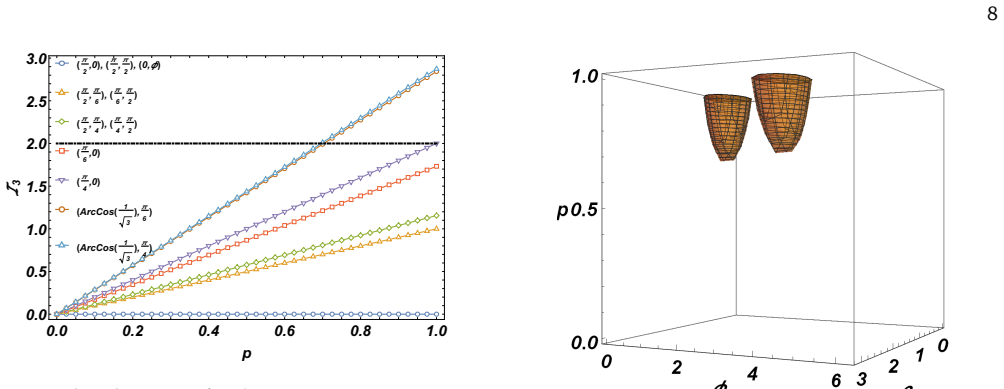
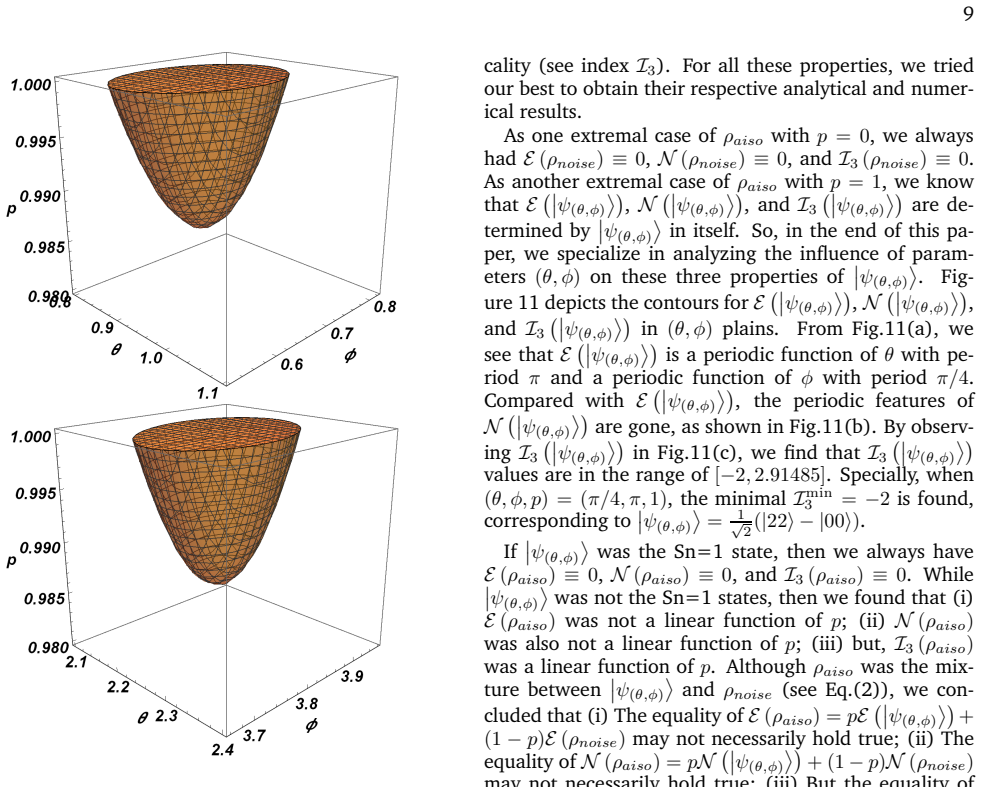
The core claim is that for the AITTS family the CGLMP value obeys the identity $I_3(\rho_{\mathrm{aiso}}) = p\, I_3(|\psi_{(\theta,\varphi)}\rangle)$ for every $(\theta,\varphi)$, so every Bell curve is a straight line through the origin. Since $I_3(|\psi\rangle) \le 2$ for Schmidt-number-1 and -2 components, only Schmidt-number-3 components can make $I_3 > 2$, and the family-wide maximum $I_3^{\max}=2.91485$ occurs at a non-maximally entangled pure state rather than at $|\Phi_3^+\rangle$, whose CGLMP value is $2.87293$. Alongside this, the paper reports that entanglement and Wigner negativity are nonlinear, thresholded functions of $p$, and that pure-state rankings disagree: the Schmidt-2 states $|S_2^{(1)}\rangle, |S_2^{(2)}\rangle, |S_2^{(3)}\rangle$ have Wigner negativity $13/27$, larger than the $4/9$ of the maximally entangled $|S_3^{(1)}\rangle$ despite having less entanglement. The paper concludes from these examples that, for qutrits, 'large entanglement' is neither necessary nor sufficient for the strongest Wigner negativity or Bell nonlocality.
Load-bearing premise
The Wigner-negativity rankings assume that the discrete Wigner values reported in Section IV are computed in the standard two-qutrit phase-space frame and satisfy the normalization the paper itself states; if that calculation is off, the negativity comparisons do not follow.
Editorial extensions
If this is right
- Bell nonlocality cannot be produced by mixing white noise with any two-qutrit pure state of Schmidt number 1 or 2; the family-wide threshold for possible violation, $p \gtrsim 0.686$, is set by the peak pure-state value $I_3^{\max}=2.91485$.
- Because $I_3(\rho_{\mathrm{aiso}})=p\,I_3(|\psi_{(\theta,\varphi)}\rangle)$, every AITTS Bell curve is exactly a straight line through the origin, so the pure-state CGLMP value determines the entire noisy family.
- Wigner negativity and entanglement are not linearly inherited from the pure state: both vanish below state-dependent noise thresholds, and the pure-state rankings disagree, for example $N(|S_2^{(1)}\rangle)=13/27 > N(|S_3^{(1)}\rangle)=4/9$ even though the entanglement order is reversed.
- The maximally entangled qutrit Bell state is not the optimal AITTS for Bell nonlocality: Schmidt-3 states near $\theta\approx 0.906$, $\varphi\approx 0.670$ give $I_3 = 2.91485$, exceeding the Bell-state value $2.87293$.
- AITTS with Schmidt-number-1 pure components have $E=N=I_3=0$ for every $p$, so the family contains a whole line of states that are free for all three quantifiers.
Reading between the lines
- Editorial extension: since $I_3(\rho)=pI_3(|\psi\rangle)$ only needs linearity of the witness plus a Bell-neutral noise term, the same threshold structure would apply to any convex mixture of a pure two-qutrit state with a noise term that gives $I_3=0$, not just to the AITTS family.
- Editorial extension: the $N$-versus-Schmidt-number ordering is computed in one particular discrete phase-space frame; a different valid frame would in general shift the numerical negativity values, so the ordering should be treated as frame-relative unless a frame-independent negativity witness is found.
- Editorial extension: the statement that the maximally entangled state is not maximally Bell-nonlocal is tied to this specific CGLMP expression and measurement setting; other Bell inequalities or optimized settings could place the maximum elsewhere.
- Editorial extension: a practical reading is that for noise-robust qutrit protocols, preparation should target specific Schmidt-3 or Schmidt-2 states rather than the maximally entangled state, depending on which resource--negativity or nonlocality--the task consumes.
Editorial analysis
A structured set of objections, weighed in public.
Referee Report
Summary. The paper introduces a one-parameter family of anisotropic two-qutrit states (AITTSs), defined as a convex combination of a pure two-qutrit state |ψ(θ,φ)> and white noise, and studies three quantum resources for this family: entanglement via partial-transposition negativity, Wigner negativity via the Gross–Wootters discrete Wigner function, and Bell nonlocality via the CGLMP inequality. The main claimed findings are that stronger entanglement need not imply greater Wigner negativity or Bell nonlocality, that a pure state with a larger Schmidt number need not have greater Wigner negativity (exemplified by N(|S_2>) > N(|S_3^(1)>)), and that Bell nonlocality is possible only when |ψ(θ,φ)> has Schmidt number 3, with the maximally entangled state not being the maximally nonlocal state.
Significance. If the results were correct, the AITTS family would provide a concrete two-qutrit testbed for comparing resource hierarchies, and several analytical thresholds (e.g., the p = 2/11 entanglement threshold for the Sn=2 case and the p = 1/4 threshold for the isotropic case) are clean and check out. The entanglement section is standard and its values are analytically verifiable. However, the Wigner-negativity section is demonstrably wrong for the maximally entangled state, and because the paper's cross-resource and Schmidt-number claims rest on those Wigner values, the central conclusions are unsupported. The Bell section, while mostly quantitatively sound, contains an 'astonishing' observation that is already known in the literature and is presented without citation. The paper's value as a standalone contribution is therefore severely undermined.
major comments (3)
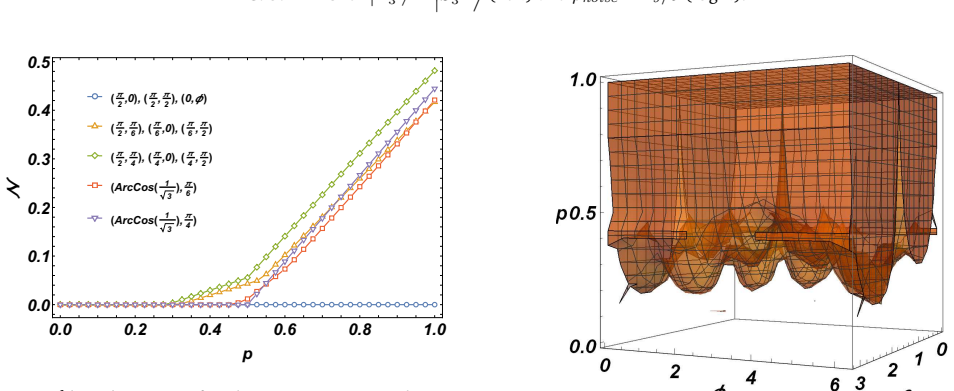
- [Section IV.B, Fig. 6 and Sec. VI] The reported discrete Wigner function for |Φ3+> = |S_3^(1)> is not a valid quasi-probability distribution and contradicts Eq. (12). The table {5/81 -> 8, 2/81 -> 36, -1/81 -> 36, 7/162 -> 1} sums to 53/54, not 1. Moreover, |Φ3+> is a stabilizer state (it is fixed, for example, by Z⊗Z and X⊗X^{-1}), so by Gross's theorem [47] its DWF in the frame defined by Eq. (8) must be non-negative, with nine phase points of value 1/9 and the rest zero. The negative entries reported in Fig. 5 and the associated N = 4/9 are therefore impossible in the claimed framework. This is not a minor typo: the same misimplementation gives the maximally mixed state a nonuniform DWF {0 -> 36, 1/54 -> 36, 1/27 -> 9} instead of 1/81 at every phase point, indicating a systematic error in the phase-point operators or the trace in Eq. (10).
- [Section V, Fig. 10] Because the DWF values for |Φ3+> are wrong, the Wigner-negativity curves (wL2–wL5 in Fig. 6), the feasibility region in Fig. 7, and the comparisons N(|S_3^(1)>) = 4/9 and N(|S_2>) = 13/27 are all invalid. Consequently, the abstract and Sec. VI claim that 'a pure state with a large Schmidt number does not necessarily have a greater Wigner negativity' is unsupported by the presented computations. The claim may or may not be true for the correct DWF, but it cannot be concluded from this manuscript.
- [Section V, Eq. (22)] The 'astonishing' observation that the maximally entangled two-qutrit state is not the maximally Bell-nonlocal state for CGLMP-type inequalities is not new: it was reported by Acin, Durt, Gisin, and Latorre (Phys. Rev. A 65, 052325 (2002)), which is not cited. The paper should cite this work and clarify what additional insight the AITTS family provides beyond the known result, rather than presenting the observation as a new discovery.
minor comments (5)
- [Section IV.A] In the paragraph after Eq. (4), 'The matrix of Eq.(14)' should refer to Eq. (4).
- [Section IV.A] The text refers to the 'Wiger operator' in Eq. (8); this is a typo for 'Wigner operator'.
- [Introduction] There are numerous grammatical errors ('Every knows', 'Combinating pure two-qutrit states', 'nonclassical maker'), which should be corrected in a revision.
- [Section V] The linearity I3(ρ_aiso) = p I3(|ψ(θ,φ)>) is a trivial consequence of the linearity of the Bell expression in the state and the fact that I3(ρ_noise) = 0; the paper should state this explicitly rather than presenting it as a numerical discovery.
- [Fig. 8] The figure caption lists 'I3 values are 0, 1, 1.1547, 1.73205, 2, 2.84399, 2.87293' but the text also assigns 1.1547 and 2 to different Sn=2 cases; the reader should be able to map these values to the (θ,φ) cases unambiguously.
Circularity Check
No circularity: results are direct evaluations of external criteria; Section IV errors are computational, not circular.
full rationale
The paper's claims are obtained by direct evaluation of standard external criteria: PPT negativity (Eq. 5), Gross-Wootters discrete Wigner function negativity (Eqs. 10 and 13), and the CGLMP Bell inequality (Eq. 22). No parameter in these evaluations is fitted to the target claims; the DWF and I3 values are computed from the density matrix rho_aiso defined in Eq. (2). The observed identity I3(rho_aiso) = p I3(|psi(theta,phi)>) follows immediately from linearity of the Bell expression and I3(rho_noise)=0, not from an imposed ansatz. There are no references to the authors' own prior work, so no self-citation chain is load-bearing. The maximum-violation result Imax3 = 2.91485 > I3(|Phi3+>) is a numerical optimization, not an input. The Wigner negativity values in Section IV do contain an apparent arithmetic defect (the DWF table for |Phi3+> sums to 53/54 rather than 1, contradicting Eq. (12) and Gross's stabilizer theorem), but this is a computational error, not a circular reduction: the reported N = 4/9 is extracted from the (misnormalized) table rather than being imposed as an input. Consequently, there is no significant circularity.
Assumptions & free parameters
free parameters (1)
- CGLMP measurement offsets (alpha1, alpha2, beta1, beta2) =
(0, 1/2, 1/4, -1/4)
assumptions (4)
- domain assumption The discrete Wigner formalism of Eqs. (8)-(10) is the standard Gross-Wootters frame for two qutrits, with the normalization of Eq. (12).
- domain assumption The CGLMP inequality of Eq. (22) with the fixed settings witnesses Bell nonlocality for the family.
- standard math Negativity under partial transposition (PPT) quantifies entanglement for 2 x 3 systems, where PPT is also sufficient for separability.
- standard math Gross's theorem: qutrit pure states have non-negative discrete Wigner functions if and only if they are stabilizer states.
Cite this review
Pith. "Pith review of Exploring entanglement, Wigner negativity and Bell nonlocality for anisotropic two-qutrit states." pith.science (2026). https://pith.science/paper/GWV3VQ5J
@misc{pith2026250603879,
  author       = {Pith},
  title        = {Pith review of: Exploring entanglement, Wigner negativity and Bell nonlocality for anisotropic two-qutrit states},
  year         = {2026},
  howpublished = {\url{https://pith.science/paper/GWV3VQ5J}},
  note         = {Machine review of arXiv:2506.03879}
}
abstract
We introduce a family of anisotropic two-qutrit states (AITTSs). These AITTSs are expressed as $\rho _{aiso}=p\left\vert \psi _{\left( \theta,\phi \right) }\right\rangle \left\langle \psi _{\left( \theta ,\phi \right)}\right\vert +(1-p)\frac{1_{9}}{9}$ with $\left\vert \psi _{\left( \theta,\phi \right) }\right\rangle =\sin \theta \cos \phi \left\vert00\right\rangle +\sin \theta \sin \phi \left\vert 11\right\rangle +\cos\theta \left\vert 22\right\rangle $ and $1_{9}=\sum_{j,k=0}^{2}\left\vert jk\right\rangle \left\langle jk\right\vert $. For a given $p\in \lbrack 0,1]$, these states are adjustable in different ($\theta ,\phi $) directions. In the case of ($\theta ,\phi $) = ($\arccos (1/\sqrt{3}),\pi /4$), the AITTS will reduce to the isotropic two-qutrit state $\rho _{iso}$. In addition, the AITTSs are severely affected by the white noise ($\rho _{noise}=1_{9}/9$). Three properties of the AITTSs, including entanglement, Wigner negativity and Bell nonlocality, are explored detailedly in the analytical and numerical ways. Each property is witnessed by an appropriate existing criterion. Some of our results are summarized as follows: (i) Large entanglement does not necessarily mean high Wigner negativity and strong Bell nonlocality. (ii) A pure state with a large Schmidt number does not necessarily have a greater Wigner negativity. (iii) Only when $\left\vert\psi _{\left( \theta ,\phi \right) }\right\rangle $ has the Schmidt number 3, the AITTS has the possibility of exhibiting Bell nonlocality in proper parameter range.
Figures


Figures from the paper (5 more)


Reference graph
Works this paper leans on
-
[47]
U. Chabaud and M. Walschaers, Resources for Bosonic Quantum Computational Advantage, Phys. Rev . Lett. 130 090602 (2023)
work page 2023
-
[1]
Chitambar and G
E. Chitambar and G. Gour , Quantum resource theories, Rev . Mod. Phys. 91, 025001 (2019)
2019
-
[2]
(11) Note that Wx1z1x2z2 ≡ W(x1,z1;x2,z2)
In this paper , we will arrange them as follows W0000 W0100 W0200 W0001 W0101 W0201 W0002 W0102 W0202 W1000 W1100 W1200 W1001 W1101 W1201 W1002 W1102 W1202 W2000 W2100 W2200 W2001 W2101 W2201 W2002 W2102 W2202 W0010 W0110 W0210 W0011 W0111 W0211 W0012 W0112 W0212 W1010 W1110 W1210 W1011 W1111 W1211 W1012 W1112 W1212 W2010 W2110 W2210 W2011 W2111 W2211 W20...
-
[3]
In our following work, we often use above mentioned eleven states (abbreviated the Sn=n state as ⏐ ⏐ ⏐S(i) n ⟩ ) as examples of ⏐ ⏐ψ(θ,φ) ⟩ to study our considered properties
≃ 0.955317 andπ/4 ≃ 0.785398. In our following work, we often use above mentioned eleven states (abbreviated the Sn=n state as ⏐ ⏐ ⏐S(i) n ⟩ ) as examples of ⏐ ⏐ψ(θ,φ) ⟩ to study our considered properties. III. ENT ANGLEMENT OF AITTSS In this section, we shall quantify entanglement for AITTSs by virtue of negativity under partial transposition[98, 99]. Pe...
-
[4]
Figure 6 depicts the variation of Wigner negativity N (ρaiso) versusp for eleven (θ,φ ) cases
Some of these values can be validated from our plot- ted DWFs. Figure 6 depicts the variation of Wigner negativity N (ρaiso) versusp for eleven (θ,φ ) cases. There are five curves in this figure. Each curve is illustrated as follows: (wL1) The first curve corresponds to the cases of (θ,φ ) = (π/2, 0), (π/2,π/ 2), (0,φ ). It satisfy N (ρaiso) ≡ 0 for any p ∈ ...
-
[5]
Chabaud and M
U. Chabaud and M. Walschaers, Resources for Bosonic Quantum Computational Advantage, Phys. Rev . Lett. 130, 090602 (2023)
2023
-
[6]
A. Mari, K. Kieling, B. Melholt Nielsen, E. S. Polzik, and J. Eisert, Directly Estimating Nonclassicality , Phys. Rev . Lett. 106, 010403 (2011)
2011
-
[7]
Gehrke, J
C. Gehrke, J. Sperling, and W. Vogel, Quantification of nonclassicality , Phys. Rev . A 86, 052118 (2012)
2012
Show all 103 references
-
[8]
Killoran, F
N. Killoran, F. E. S. Steinhoff, and M. B. Plenio, Convert - ing Nonclassicality into Entanglement, Phys. Rev . Lett. 116, 080402 (2016)
2016
-
[9]
S. Ryl, J. Sperling, E. Agudelo, M. Mraz, S. Kohnke, B. Hage, and W. Vogel, Unified nonclassicality criteria, Phys. Rev . A 92, 011801(R) (2015)
2015
-
[10]
Kuhn and W
B. Kuhn and W. Vogel, Quantum non-Gaussianity and quantification of nonclassicality , Phys. Rev . A 97, 053823 (2018)
2018
-
[11]
Zhuang, P
Q. Zhuang, P. W. Shor , and J. H. Shapiro, Resource the- ory of non-Gaussian operations, Phys. Rev . A 97, 052317 (2018)
2018
-
[12]
Albarelli, M
F. Albarelli, M. G. Genoni, M. G. A. Paris, and A. Fer- raro, Resource theory of quantum non-Gaussianity and Wigner negativity , Phys. Rev . A 98, 052350 (2018)
2018
-
[13]
Takagi and Q
R. Takagi and Q. Zhuang, Convex resource theory of non-Gaussianity , Phys. Rev . A 97, 062337 (2018)
2018
-
[14]
Z. S. Zhang, et al., Entanglement-based quantum infor- mation technology: a tutorial, Adv . Opt. Photon. 16, 60- 162 (2024)
2024
-
[15]
Friis, G
N. Friis, G. Vitagliano, M. Malik, and M. Huber , Entan- glement certification from theory to experiment, Nat. Rev . Phys. 1, 72-87 (2019)
2019
-
[17]
Y. Fan, C. Jia, and L. Qiu, Quantum steering as resource of quantum teleportation, Phys. Rev . A 106, 012433 (2022)
2022
-
[18]
Uola, A.C.S
R. Uola, A.C.S. Costa, H. C. Nguyen, and O. Guhne, Quantum steering, Rev . Mod. Phys. 92, 015001 (2020)
2020
-
[19]
Gallego and L
R. Gallego and L. Aolita, Resource Theory of Steering, Phys. Rev . X 5, 041008 (2015)
2015
-
[20]
Vieira, R
C. Vieira, R. Ramanathan and A. Cabello, Test of the physical significance of Bell non-locality , Nature Com- munications 16, 4390 (2025)
2025
-
[21]
Tavakoli, A
A. Tavakoli, A. Pozas-Kerstjens, M. X. Luo, M. O. Re- nou, Bell nonlocality in networks, Rep. Prog. Phys. 85, 056001 (2022)
2022
-
[22]
Chabaud, P
U. Chabaud, P. E. Emeriau, and F. Grosshans, Witnessing 12 Wigner Negativity , Quantum 5, 471 (2021)
2021
-
[23]
Veitch, C
V. Veitch, C. Ferrie, D. Gross and J. Emerson, Negative quasi-probability as a resource for quantum computa- tion, New J. Phys. 14, 113011 (2012)
2012
-
[24]
Budroni, A
C. Budroni, A. Cabello, O. Guhne, M. Kleinmann, and J. Larsson, Kochen-Specker contextuality , Rev . Mod. Phys. 94, 045007 (2022)
2022
-
[25]
Shahandeh Contextuality of General Probabilistic Theories, PRX Quantum 2, 010330 (2021)
F. Shahandeh Contextuality of General Probabilistic Theories, PRX Quantum 2, 010330 (2021)
2021
-
[26]
Grudka, K
A. Grudka, K. Horodecki, M. Horodecki, P. Horodecki, R. Horodecki, P. Joshi, W. Klobus, and A. Wojcik, Quantify- ing Contextuality , Phys. Rev . Lett. 112, 120401 (2014)
2014
-
[27]
R. I. Booth, U. Chabaud, and P. E. Emeriau, Con- textuality and Wigner Negativity Are Equivalent for Continuous-Variable Quantum Measurements, Phys. Rev . Lett. 129, 230401 (2022)
2022
-
[28]
Delfosse, P
N. Delfosse, P. A. Guerin, J. Bian, and R. Raussendorf, Wigner Function Negativity and Contextuality in Quan- tum Computation on Rebits, Phys. Rev . X 5, 021003 (2015)
2015
-
[29]
Raussendorf, D
R. Raussendorf, D. E. Browne, N. Delfosse, C. Okay , and J. Bermejo-Vega, Contextuality and Wigner-function negativity in qubit quantum computation, Phys. Rev . A 95, 052334 (2017)
2017
-
[30]
Walschaers, C
M. Walschaers, C. Fabre, V. Parigi, and N. Treps, En- tanglement and Wigner Function Negativity of Multi- mode Non-Gaussian States, Phys. Rev . Lett. 119, 183601 (2017)
2017
-
[31]
Cabello, Converting Contextuality into Nonlocalit y , Phys
A. Cabello, Converting Contextuality into Nonlocalit y , Phys. Rev . Lett. 127, 070401 (2021)
2021
-
[32]
Svozil, Converting nonlocality into contextuality , Phys
K. Svozil, Converting nonlocality into contextuality , Phys. Rev . A 110, 012215 (2024)
2024
-
[33]
Plavala and O
M. Plavala and O. Guhne, Contextuality as a Precondi- tion for Quantum Entanglement, Phys. Rev . Lett. 132, 100201 (2024)
2024
-
[34]
P. A. M. Dirac, The Principles of Quantum Mechanics, Oxford University Press, 1958
1958
-
[35]
Auletta, M
G. Auletta, M. Fortunato, and G. Parisi, Quantum Me- chanics, Cambridge University Press, 2009
2009
-
[36]
Wigner , On the Quantum Correction for Thermody- namic Equilibrium, Phys
E. Wigner , On the Quantum Correction for Thermody- namic Equilibrium, Phys. Rev . 40, 749-759 (1932)
1932
-
[37]
Tilma, M
T. Tilma, M. J. Everitt, J. H. Samson, W. J. Munro, and K. Nemoto, Wigner Functions for Arbitrary Quantum Sys- tems, Phys. Rev . Lett. 117, 180401 (2016)
2016
-
[38]
W. P. Schleich, Quantum Optics in Phase Space, Berlin: Wiley-VCH, 2001
2001
-
[39]
Chabaud, P
U. Chabaud, P. E. Emeriau, and F. Grosshans, Witnessing Wigner Negativity , Quantum 5, 471 (2021)
2021
-
[40]
Xiang, S
Y. Xiang, S. Liu, J. Guo, Q. Gong, N. Treps, Q. He, and M. Walschaers, Quantification of Wigner Negativity Re- motely Generated via Einstein-Podolsky-Rosen Steering, npj Quantum Information 8, 21 (2022)
2022
-
[41]
Walschaers, On Quantum Steering and Wigner Neg- ativity , Quantum 7, 1038 (2023)
M. Walschaers, On Quantum Steering and Wigner Neg- ativity , Quantum 7, 1038 (2023)
2023
-
[42]
Kenfack and K
A. Kenfack and K. Zyczkowski, Negativity of the Wigner function as an indicator of non-classicality , J. Opt. B: Quantum Semiclassical Opt. 6, 396 (2004)
2004
-
[43]
Walschaers, Non-gaussian quantum states and where to find them, PRX Quantum 2, 030204 (2021)
M. Walschaers, Non-gaussian quantum states and where to find them, PRX Quantum 2, 030204 (2021)
2021
-
[44]
F. X. Sun, Y. Q. Fang, Q. Y. He, Y. Q. Liu, Generating optical cat states via quantum interference of multi-path free-electron-photons interactions, Sci. Bull. 68, 1366- 1371 (2023)
2023
-
[45]
D. J. Wineland, Superposition, entanglement, and rais - ing Schrodinger’s cat, Ann. Phys. 525, 739-752 (2013)
2013
-
[46]
Mari and J
A. Mari and J. Eisert, Positive Wigner Functions Render Classical Simulation of Quantum Computation Efficient, Phys. Rev . Lett. 109, 230503 (2012)
2012
-
[48]
R. L. Hudson, When is the Wigner quasi-probability den- sity non-negative? Rep. Math. Phys. 6, 249-252 (1974)
1974
-
[49]
Soto and P
F. Soto and P. Claverie, When is the Wigner function of multidimensional systems nonnegative? J. Math. Phys. 24, 97 (1983)
1983
-
[50]
Gross, Hudson’s theorem for finite-dimensional quan - tum systems, J
D. Gross, Hudson’s theorem for finite-dimensional quan - tum systems, J. Math. Phys. 47, 122107 (2006)
2006
-
[51]
Dangniam, Y
N. Dangniam, Y. G. Han, and H. Zhu, Optimal verifica- tion of stabilizer states, Phys. Rev . Research 2, 043323 (2020)
2020
-
[52]
Koukoulekidis and D
N. Koukoulekidis and D. Jennings, Constraints on magic state protocols from the statistical mechanics of Wigner negativity , npj Quantum Information 8, 42 (2022)
2022
-
[53]
Casaccino, E
A. Casaccino, E. F. Galvao, and S. Severini, Extrema of discrete Wigner functions and applications, Phys. Rev . A 78, 022310 (2008)
2008
-
[54]
K. S. Gibbons, M. J. Hoffman, and W. K. Wootters, Dis- crete phase space based on finite fields, Phys. Rev . A 70, 062101 (2004)
2004
-
[55]
E. F. Galvao, Discrete Wigner functions and quan- tum computational speedup, Phys. Rev . A 71, 042302 (2005)
2005
-
[56]
Kocia and P
L. Kocia and P. Love, Discrete Wigner formalism for qubits and noncontextuality of Clifford gates on qubit stabilizer states, Phys. Rev . A 96, 062134 (2017)
2017
-
[57]
W. K. Wootters, Interpreting symplectic linear transf or- mations in a two-qubit phase space, Int. J. Quan. Inf. 22(05), 2440014 (2024)
2024
-
[58]
L. K. Antonopoulos, D. G. Lewis, J. Davis, N. Funai, and N. C. Menicucci, Grand Unification of All Dis- crete Wigner Functions on d × d Phase Space, arXiv: 2503.09353 (2025)
2025
-
[59]
Kok and B, W
P. Kok and B, W. Lovett, Introduction to Optical Quan- tum Information Processing, New York: Cambridge Un- oversity Press, 2010
2010
-
[60]
Erhard, M
M. Erhard, M. Krenn, and A. Zeilinger , Advances in high- dimensional quantum entanglement, Nat. Rev . Phys. 2, 365-381 (2020)
2020
-
[61]
Y. Li, Y. Xiang, X. D. Yu, H. Chau Nguyen, O. Guhne, Q. Y. He, Randomness Certification from Multipartite Quan- tum Steering for Arbitrary Dimensional Systems, Phys. Rev . Lett. 132, 080201 (2024)
2024
-
[62]
H. J. Kimble, The quantum internet, Nature 453 (7198), 1023-1030 (2008)
2008
-
[63]
Esposito, The quantum internet - the second quantum revolution, Contemp
S. Esposito, The quantum internet - the second quantum revolution, Contemp. Phys. 63 (4), 328-328 (2022)
2022
-
[64]
Wehner , D
S. Wehner , D. Elkouss, and R. Hanson, Quantum inter- net: A vision for the road ahead, Science 362, eaam9288 (2018)
2018
-
[65]
Xiang, F
Y. Xiang, F. X. Sun, Q. Y. He, Q. H. Gong, Advances in multipartite and high-dimensional Einstein-Podolsky- Rosen steering, Fundamental Research 1, 99-101 (2021)
2021
-
[66]
Cozzolino, B
D. Cozzolino, B. Da Lio, D. Bacco, and L. K. Oxenlowe, High-Dimensional Quantum Communication: Benefits, Progress, and Future Challenges, Adv . Quan. Tech. 2, 1900038 (2019
2019
-
[67]
D’Alessandro, C
N. D’Alessandro, C. R. Carceller , and A. Tavakoli, 13 Semidefinite Relaxations for High-Dimensional Entan- glement in the Steering Scenario, Phys. Rev . Lett. 134, 090802 (2025)
2025
-
[68]
N. K. H. Li, M. Huber and N. Friis, High-dimensional en- tanglement witnessed by correlations in arbitrary bases, npj Quantum Information 11, 50 (2025)
2025
-
[69]
Morelli, M
S. Morelli, M. Huber , and A. Tavakoli, Resource-Efficie nt High-Dimensional Entanglement Detection via Symmet- ric Projections, Phys. Rev . Lett. 131, 170201 (2023)
2023
-
[70]
Huang, L
Z. Huang, L. Maccone, A. Karim, C. Macchiavello, R. J. Chapman, and A. Peruzzo, High-dimensional entangle- ment certification, Sci. Rep. 6, 27637 (2016)
2016
-
[71]
Wang et al., Multidimensional quantum entanglement with large-scale integrated optics, Science 10.1126/sci- ence.arr7053 (2018)
J. Wang et al., Multidimensional quantum entanglement with large-scale integrated optics, Science 10.1126/sci- ence.arr7053 (2018)
2018 doi
-
[72]
O. Lib, S. Liu, R. Shekel, Q. He, M. Huber , Y. Bromberg, G. Vitagliano, Experimental certification of high-dimensional entanglement with randomized mea- surements, arxiv: 2412.04643 (2024)
2024
-
[73]
S. H. Liu, M. Fadel, Q. Y. He, M. Huber , G. Vitagliano, Bounding entanglement dimensionality from the covari- ance matrix, Quantum 8, 1236 (2024)
2024
-
[74]
Bell, On the Einstein podolsky rosen paradox, Physic s, 1, 195-199, (1964)
J. Bell, On the Einstein podolsky rosen paradox, Physic s, 1, 195-199, (1964)
1964
-
[75]
Karczewski, G
M. Karczewski, G. Scala, A. Mandarino, A. B. Sainz and M. Zukowski, Avenues to generalising Bell inequalities, J. Phys. A: Math. Theor . 55 384011 (2022)
2022
-
[76]
Kaniewski, I
J. Kaniewski, I. Supic, J. T ura, F. Baccari, A. Salavrak os, R. Augusiak, Maximal nonlocality from maximal entan- glement and mutually unbiased bases, and self-testing of two-qutrit quantum systems, Quantum 3, 198 (2019)
2019
-
[77]
Veltheim and E
O. Veltheim and E. Keski-Vakkuri, Optimizing Quantum Measurements by Partitioning Multisets of Observables, Phys. Rev . Lett. 134, 030801 (2025)
2025
-
[78]
Pandit, A
M. Pandit, A. Barasi´ nski, I. Marton, T. Vertesi and W. Laskowski, Optimal tests of genuine multipartite nonlo- cality , New J. Phys. 24 123017 (2022)
2022
-
[79]
Barasinski, Exploring nonlocal correlations in ar- bitrarily high-dimensional systems, New J
A. Barasinski, Exploring nonlocal correlations in ar- bitrarily high-dimensional systems, New J. Phys. 26 113013 (2024)
2024
-
[80]
Fonseca, A
A. Fonseca, A. de Rosier , T. Vertesi, W. Laskowski, and F . Parisio, Survey on the Bell nonlocality of a pair of entan- gled qudits, Phys. Rev . A 98, 042105 (2018)
2018
-
[81]
Collins, N
D. Collins, N. Gisin, N. Linden, S. Massar , and S. Popescu, Bell Inequalities for Arbitrarily High- Dimensional Systems, Phys. Rev . Lett. 88, 040404 (2002)
2002
-
[82]
Supic and J
I. Supic and J. Bowles, Self-testing of quantum systems : a review , Quantum 4, 337 (2020)
2020
-
[83]
Kaniewski, I
J. Kaniewski, I. Supic, J. T ura, F. Baccari, A. Salavrak os, and R. Augusiak, Maximal nonlocality from maximal entanglement and mutually unbiased bases, and self- testing of two-qutrit quantum systems, Quantum 3, 198 (2019)
2019
-
[84]
Z. Cai, C. Ren, T. Feng, X. Zhou, and J. Chen, A review of quantum correlation sharing: The recycling of quantum correlations triggered by quantum measurements, Phys. Rep. 1098 1 (2025)
2025
-
[85]
Zhang, Y
C. Zhang, Y. Li, X. M. Hu, Y. Xiang, C. F. Li, G. C. Guo, J. T ura, Q. Gong, Q. He, and B. H. Liu, Randomness ver- sus Nonlocality in Multiple-Input and Multiple-Output Quantum Scenario, Phys. Rev . Lett. 134 090201 (2025)
2025
-
[86]
Brukner , M
C. Brukner , M. Zukowski, and A. Zeilinger , Quantum Communication Complexity Protocol with Two Entan- gled Qutrits, Phys. Rev . Lett. 89, 197901 (2002)
2002
-
[87]
M. A. Yurtalan, J. Shi, M. Kononenko, A. Lupascu, and S. Ashhab, Implementation of a Walsh-Hadamard Gate in a Superconducting Qutrit, Phys. Rev . Lett. 125, 180504 (2020)
2020
-
[88]
T urro, I
F. T urro, I. A. Chernyshev , R. Bhaskar , and M. Illa, Qutrit and qubit circuits for three-flavor collective neutrino os- cillations, Phys. Rev . D 111, 043038 (2025)
2025
-
[89]
Amaro-Alcala, B
D. Amaro-Alcala, B. C. Sanders, and H. de Guise, Bench- marking of universal qutrit gates, Phys. Rev . A 109, 012621 (2024)
2024
-
[90]
A. B. Klimov , R. Guzman, J. C. Retamal, and C. Saavedra, Qutrit quantum computer with trapped ions, Phys. Rev . A 67, 062313 (2003)
2003
-
[91]
Gruca, W
J. Gruca, W. Laskowski, and M. Zukowski, Nonclassical- ity of pure two-qutrit entangled states, Phys. Rev . A 85, 022118 (2012)
2012
-
[92]
S. Roy , A. Kumari, S. Mal, and A. Sen(De), Robustness of higher-dimensional nonlocality against dual noise and sequential measurements, Phys. Rev . A 109, 062227 (2024)
2024
-
[93]
Lifshitz, Noise-Robust Self-Testing: Detecting No n- Locality in Noisy Non-Local Inputs, Master’s Thesis, Weizmann Institute of Science, arXiv: 2505.13537 (2025)
R. Lifshitz, Noise-Robust Self-Testing: Detecting No n- Locality in Noisy Non-Local Inputs, Master’s Thesis, Weizmann Institute of Science, arXiv: 2505.13537 (2025)
2025 arXiv
-
[94]
J. M. Liang, S. Imai, S. Liu, S. M. Fei, O. Guhne, Q. He, Real randomized measurements for analyzing properties of quantum states, arXiv: 2411.06013 (2024)
2024 arXiv
-
[95]
Kaszlikowski, P
D. Kaszlikowski, P. Gnacinski, M. Zukowski, W. Mik- laszewski, and A. Zeilinger , Violations of Local Realism by Two Entangled N-Dimensional Systems Are Stronger than for Two Qubits, Phys. Rev . Lett. 85, 4418 (2000)
2000
-
[96]
T. Durt, D. Kaszlikowski, and M. Zukowski, Violations of local realism with quantum systems described by N- dimensional Hilbert spaces up to N=16, Phys. Rev . A 64, 024101 (2001)
2001
-
[97]
B. M. Terhal and P. Horodecki, Schmidt number for den- sity matrices, Phys. Rev . A 61, 040301(R) (2000)
2000
-
[98]
Sanpera, D
A. Sanpera, D. Bru β and M. Lewenstein, Schmidt- number witnesses and bound entanglement, Phys. Rev . A 63, 050301(R) (2001)
2001
-
[99]
Sperling and W
J. Sperling and W. Vogel, The Schmidt number as a universal entanglement measure, Phys. Scr . 83 045002 (2011)
2011
-
[100]
Wang and S
H.-F. Wang and S. M. Fei, Schmidt number criterion via symmetric measurements, arXiv:2505.02297 (2005)
2005 arXiv
-
[101]
Vidal and R
G. Vidal and R. F. Werner , Computable measure of en- tanglement, Phys. Rev . A 65, 032314 (2002)
2002
-
[102]
Horodecki, P
M. Horodecki, P. Horodecki, and R. Horodecki, Separa- bility of mixed states: Necessary and sufficient condi- tions, Phys. Lett. A 223, 1-8 (1996)
1996
-
[103]
Delfosse, C
N. Delfosse, C. Okay , J. Bermejo-Vega, D. E. Browne and R. Raussendorf, Equivalence between contextuality and negativity of the Wigner function for qudits, New J. Phys. 19, 123024 (2017)
2017
-
[104]
U. I. Meyer , I. Supic, D. Markham, and F. Grosshans, Qudit Clauser-Horne-Shimony-Holt Inequality and Non- locality from Wigner Negativity , arXiv: 2405.14367 (2024)
2024 arXiv
Reviewed August 7, 2026 · model on record in the stance chip above.
Discussion (0). Continue with ORCID to comment.