REVIEW 2 major objections 6 minor 43 references
Josephson transistor and robust supercurrent enhancement with spin-split superconductors
T0 review · 2 major / 6 minor · reviewed 2026-08-12 · deepseek-v4-flash
Pith's one-line read A spin-splitting field more than doubles the critical supercurrent of a long SNS Josephson junction at low temperature, in both parallel and antiparallel configurations.
desk verdict Predicts a robust >100% supercurrent enhancement in long spin-split SNS junctions, but the headline number is computed with inelastic broadening equal to the Thouless energy, and no δ-dependence is shown. read the letter →
The pith
A machine-rendered reading of the paper's core claim, the machinery that carries it, and where it could break.
The reading
What carries the argument
The machinery is the Usadel equation for the diffusive normal metal, solved with a Riccati parametrization of the quasiclassical Green's function and coupled to the superconducting leads through interface boundary conditions. The spin-split leads are treated as reservoirs with an analytical Green's function that depends on the field $h_s$, and the supercurrent is extracted from the Keldysh component of the Green's function at the mid-point of the junction. The effect that carries the enhancement is a spin-splitting-induced increase of the low-energy spectral supercurrent in long junctions, reflecting a deeper superconducting proximity effect in the normal metal.
What would settle it
A self-consistent calculation that lets the order parameter adjust to the spin-splitting field at $T/T_c = 0.01$ and $h_s/\Delta_0 = 0.7$ would falsify the central claim if the more-than-100% enhancement disappears, as would an experimental measurement of the critical current of a long spin-split SNS junction versus in-plane field at dilution temperatures that shows no such rise before the Clogston limit.
Extended reading notes
Core claim
The central numerical result is that for a long junction with $L = 10\xi$ at $T/T_c = 0.01$, the critical supercurrent increases by more than 100% as the spin-splitting field is raised to $h_s/\Delta_0 \approx 0.7$, and this happens for both parallel and antiparallel alignments of the spin-splitting fields. The authors contrast this with an earlier tunneling-limit result for superconductor/ferromagnet structures, where the enhancement is limited to antiparallel alignment and is smaller. The same framework yields two additional results: applying a transverse voltage to the normal metal produces the familiar supercurrent suppression and pi-transition, with the transition voltage lowered by increasing the spin-splitting or the junction length, and applying a small temperature difference to a long junction suppresses the supercurrent sharply, with roughly a 50% drop at $\Delta T/\Delta_0 \approx 0.05$. The authors interpret the equilibrium enhancement as a strengthening of the proximity effect at low energies in the normal metal, visible in the local density of states.
Load-bearing premise
The headline enhancement is computed with the superconducting gap held at its zero-field value even when the spin-splitting field reaches about $0.7\Delta_0$ at $T/T_c = 0.01$, so the central result assumes the field does not itself weaken superconductivity.
Editorial extensions
If this is right
- A long SNS junction with spin-split leads can serve as a field-controlled supercurrent amplifier in equilibrium, with the critical current increasing by more than a factor of two near $h_s/\Delta_0 \approx 0.7$.
- The enhancement is insensitive to whether the two leads' spin-splitting fields are parallel or antiparallel, removing the need to switch or stabilize the relative magnetization orientation.
- Adding spin-splitting to a voltage-controlled SNS transistor lowers the voltage at which the supercurrent reverses sign, making the pi-transition more energy-efficient.
- A temperature bias of a few hundredths of the gap in a long junction can cut the supercurrent by about half in a sharp jump, suggesting a sensitive thermal switch.
- Applying a spin accumulation to the normal metal reproduces the voltage-control behavior at the center of the junction, so the transistor can be operated by a pure spin signal.
Reading between the lines
- Beyond the paper: if the enhancement mechanism is the low-energy proximity strengthening, the same spin-split leads should boost supercurrents in other long coherent junctions, such as multiterminal devices, which could be checked with existing magnetic-insulator/superconductor technology.
- Beyond the paper: the equivalence of voltage and spin accumulation at the junction center implies a transistor variant controlled by pure spin injection, which would avoid charge current in the control line.
- Beyond the paper: the position and sharpness of the temperature-bias supercurrent jump could serve as a calibrated probe of the spin-splitting field in the leads.
Editorial analysis
A structured set of objections, weighed in public.
Referee Report
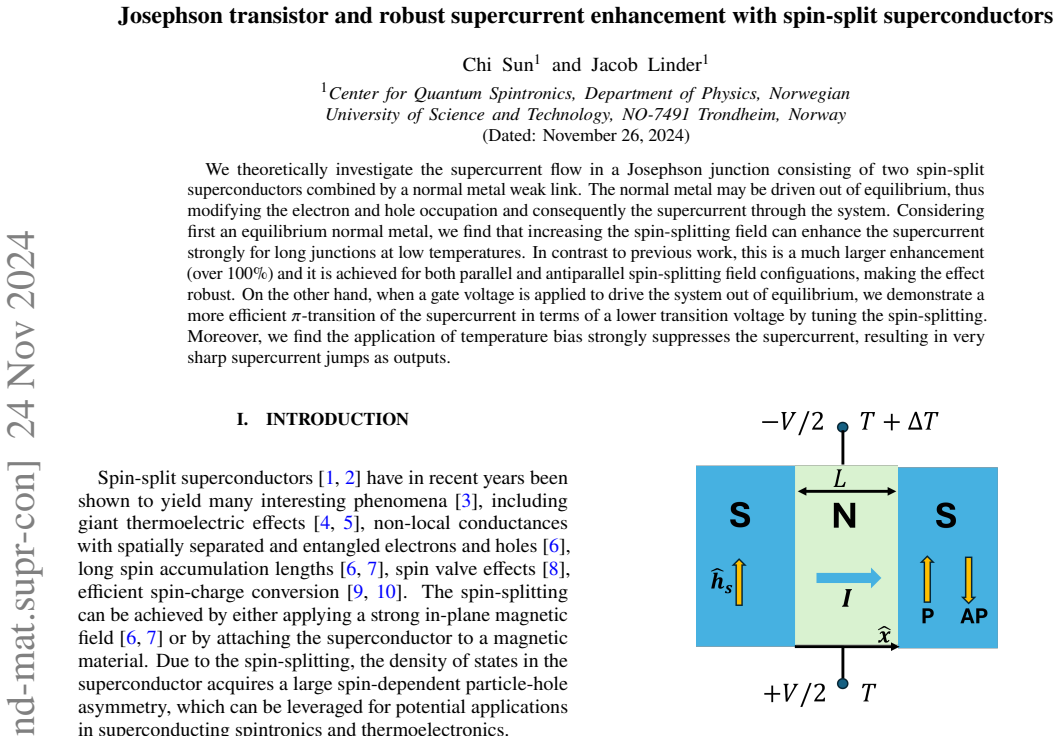
Summary. The manuscript theoretically studies Josephson transport in a diffusive SNS junction with spin-split superconducting electrodes. Using the Usadel equation in the Riccati parametrization, the authors compute the equilibrium and non-equilibrium supercurrent for parallel (P) and antiparallel (AP) spin-splitting alignments. The central equilibrium result is that for long junctions (L=10ξ) at low temperature (T/Tc=0.01) the critical supercurrent increases by more than 100% when the spin-splitting field approaches h_s/Δ0=0.7, for both P and AP configurations, in contrast to the short-junction limit where only AP shows enhancement and where the calculation recovers Ref. [28]. For non-equilibrium situations, the paper demonstrates a voltage-induced π-transition at lower voltages when spin-splitting is increased, and sharp supercurrent suppression under temperature bias. The paper is clearly written and the formalism is standard.
Significance. The predicted long-junction enhancement is a potentially interesting effect for superconducting spintronics and extends the short-junction result of Bergeret et al. to a regime where the effect is larger and configuration-independent. The use of the established Usadel/Riccati framework and the reproduction of the short-junction limit are strengths. However, the central claim rests on a numerical calculation with an inelastic broadening δ/Δ0=0.01 that coincides with the Thouless energy of the long junction, and the paper does not provide a convergence check with respect to δ. The lack of the current-phase relation data and the use of a fixed BCS gap at low temperature are additional points that need to be addressed before the quantitative enhancement claim is fully supported.
major comments (2)
- [Sec. III (after Eq. 13) and Fig. 2(e)] The inelastic broadening δ/Δ0=0.01 is equal to the Thouless energy E_Th/Δ0=(ξ/L)^2=0.01 for the L=10ξ junction. In this long-junction limit the spectral supercurrent at h_s=0 is concentrated at ε≈E_Th, so the artificial broadening δ is not a small parameter but rather sets the decay length sqrt(D/δ)=L of the proximity correlations. Since the zero-field supercurrent appears in the denominator of the enhancement ratio, the >100% enhancement in Fig. 2(e) may be overestimated if δ suppresses the h_s=0 current more than the h_s=0.7 current. The manuscript does not report any δ-dependence. Please provide a convergence study with δ/Δ0=10^-3 and 10^-4 (or an analytical argument for why δ=0.01 is small) and confirm that the enhancement persists. In addition, please verify that the supercurrent is conserved along the x direction with finite δ, since the equilibrium result is evaluated at x=L/2.
- [Sec. III A, paragraph before Eq. (13)] The authors state that 'We have verified numerically that the supercurrent-phase relation I(Δφ) approaches the generic sinusoidal dependence when the spin-splitting is included for both P and AP configurations (not shown here)' and thereafter define the critical current as I(Δφ=π/2). Because the enhancement ratio is a quantitative claim (over 100%), it is important to display the current-phase relation for the relevant parameter regime (e.g., L=10ξ, h_s/Δ0=0.7, T/Tc=0.01) or to provide a quantitative bound on the deviation from the sine law over the parameter ranges used in Figs. 2, 5, and 6.
minor comments (6)
- [Abstract and Introduction] There is a typo 'configuations' in the abstract; please correct it to 'configurations'.
- [Sec. III A] The sentence 'This only has practical consequence for the plots in the present manuscript where we have set T/Tc=0.5, causing us to consider a maximum value of h_s/Δ0≃0.5 in that case and thus not including selfconsistency' is difficult to parse; please clarify explicitly which panels are computed with a self-consistent Δ and which are not.
- [Eq. (10) and Fig. 2 caption] The numerical calculations set ζ_N=5, but the value of ζ_S used in the boundary condition is not specified; please state the values of all interface parameters used.
- [Fig. 3(d)] The density of states deviation from unity is shown on a scale (0.985 to 1) that makes it difficult to see the claimed enhancement of the proximity effect; please plot 1-DOS or use an enlarged inset.
- [Sec. III B] The claim that spin accumulation at the center of the N wire produces the same supercurrent modulation as electric voltage is not supported by any figure; either provide the corresponding data or state it as an analytical consequence of the distribution function in Eq. (16).
- [Sec. II] The paper does not mention the numerical method used to solve the Riccati equations (e.g., finite-difference scheme, iteration tolerance); a brief reproducibility note would be useful.
Circularity Check
No circularity found: the supercurrent enhancement is computed from stated inputs of the Usadel equations with no fitted parameter; the sole self-citation supplies an independently checkable bulk Green function and does not encode the target result.
full rationale
The derivation is self-contained and parameter-free with respect to the reported effect. The supercurrent is obtained by solving the Usadel equation (1)-(3) in N with Kupriyanov-Lukichev boundary conditions (9)-(10) and the bulk spin-split Green function (6), then evaluating the normalized current integral (13) with the equilibrium distribution (15). The inputs D, L, T, hs, Delta0, zetaN, delta, and phi are all stated external parameters; no quantity is fitted to produce the >100% enhancement, and no output is fed back into any equation that defines an input. The one self-citation that enters the calculation, Ref. [32] for Eq. (6), is an independently checkable solution of the bulk commutator equation (4) and does not contain the long-junction enhancement claim, so it is not a load-bearing appeal to authority. The paper explicitly acknowledges the non-self-consistent Delta limitation for T/Tc=0.5 and the Clogston bound, and the delta/Delta0=0.01 broadening is a stated model choice; both are correctness and parameter-regime concerns, not circular reductions, because changing them does not alter the fact that the reported current is computed from stated inputs. No circular step can be quoted or exhibited.
Assumptions & free parameters
free parameters (2)
- interface parameter ζ_N =
5
- inelastic broadening δ/Δ0 =
0.01
assumptions (5)
- standard math The Usadel equation with Riccati parametrization is a valid description of the diffusive SNS junction.
- domain assumption The spin-split superconducting leads can be treated as reservoirs with the analytical Green function of Eq. (6).
- domain assumption The current-phase relation is sinusoidal, so the critical current is I(Δφ = π/2).
- domain assumption The nonequilibrium distribution functions of Eqs. (16) and (17) are valid near the center of the N region, where the supercurrent is evaluated.
- domain assumption The order parameter Δ retains its BCS temperature dependence with Δ0/Tc = 1.76 and is not computed self-consistently at low T.
Cite this review
Pith. "Pith review of Josephson transistor and robust supercurrent enhancement with spin-split superconductors." pith.science (2026). https://pith.science/paper/GX6FRJSE
@misc{pith2026241115807,
  author       = {Pith},
  title        = {Pith review of: Josephson transistor and robust supercurrent enhancement with spin-split superconductors},
  year         = {2026},
  howpublished = {\url{https://pith.science/paper/GX6FRJSE}},
  note         = {Machine review of arXiv:2411.15807}
}
abstract
We theoretically investigate the supercurrent flow in a Josephson junction consisting of two spin-split superconductors combined by a normal metal weak link. The normal metal may be driven out of equilibrium, thus modifying the electron and hole occupation and consequently the supercurrent through the system. Considering first an equilibrium normal metal, we find that increasing the spin-splitting field can enhance the supercurrent strongly for long junctions at low temperatures. In contrast to previous work, this is a much larger enhancement (over 100%) and it is achieved for both parallel and antiparallel spin-splitting field configurations, making the effect robust. On the other hand, when a gate voltage is applied to drive the system out of equilibrium, we demonstrate a more efficient $\pi$-transition of the supercurrent in terms of a lower transition voltage by tuning the spin-splitting. Moreover, we find the application of temperature bias strongly suppresses the supercurrent, resulting in very sharp supercurrent jumps as outputs.
Figures


Figures from the paper (5 more)


Reference graph
Works this paper leans on
-
[28]
F. S. Bergeret, A. F. Volkov, and K. B. Efetov, Enhancement of the Josephson Current by an Exchange Field in Superconductor- Ferromagnet Structures, Phys. Rev. Lett.86, 3140 (2001)
work page 2001
-
[1]
R. Meservey, P. M. Tedrow, and P. Fulde, Magnetic field splitting of the quasiparticle states in superconducting aluminum films, Phys. Rev. Lett.25, 1270 (1970)
work page 1970
-
[2]
R. Meservey and P. M. Tedrow, Spin-polarized electron tunneling, Phys. Rep. 238, 173 (1994)
work page 1994
-
[3]
F. S. Bergeret, M. Silaev, P. Virtanen, and T. T. Heikkil¨a, Col- loquium: Nonequilibrium effects in superconductors with a spin-splitting field, Rev. Mod. Phys.90, 041001 (2018)
work page 2018
- [4]
-
[5]
M. E. Bathen and J. Linder, Spin Seebeck effect and thermo- electric phenomena in superconducting hybrids with magnetic textures or spin-orbit coupling, Sci. Rep. 7, 1 (2017)
work page 2017
-
[6]
F. H¨ ubler, M. J. Wolf, D. Beckmann, and H. v. L ¨ohneysen, Long-range spin-polarized quasiparticle transport in mesoscopic Al superconductors with a Zeeman splitting, Phys. Rev. Lett.109, 207001 (2012)
work page 2012
-
[7]
C. H. L. Quay, D. Chevallier, C. Bena, and M. Aprili, Spin imbal- ance and spin-charge separation in a mesoscopic superconductor, Nat. Phys. 9, 84 (2013)
work page 2013
Show all 43 references
-
[8]
De Simoni, E
G. De Simoni, E. Strambini, J. S. Moodera, F. S. Bergeret, and F. Giazotto, Toward the Absolute Spin-Valve Effect in Supercon- ducting Tunnel Junctions, Nano Lett. 18, 6369 (2018)
2018
-
[9]
K.-R. Jeon, K. Cho, A. Chakraborty, J.-C. Jeon, J. Yoon, H. Han, J.-K. Kim, and S. S. P. Parkin, Role of two-dimensional ising superconductivity in the nonequilibrium quasiparticle spin-to- charge conversion efficiency, ACS Nano15, 16819 (2021)
2021
-
[10]
L. J. Kamra and J. Linder, Inverse spin-hall effect and spin swapping in spin-split superconductors, Phys. Rev. Lett. 132, 226002 (2024)
2024
-
[11]
B. D. Josephson, Possible new effects in superconductive tun- nelling, Phys. Lett. 1, 251 (1962)
1962
-
[12]
F. K. Wilhelm, G. Sch ¨on, and A. D. Zaikin, Mesoscopic superconducting–normal metal–superconducting transistor, Phys. Rev. Lett.81, 1682 (1998)
1998
-
[13]
J. J. A. Baselmans, A. F. Morpurgo, B. J. van Wees, and T. M. Klapwijk, Reversing the direction of the supercurrent in a con- trollable Josephson junction, Nature 397, 43 (1999)
1999
- [14]
-
[15]
J. J. A. Baselmans, B. J. van Wees, and T. M. Klapwijk, Nonequi- librium supercurrent transport in controllable superconductor– normal-metal–superconductor junctions, Phys. Rev. B63, 094504 (2001)
2001
-
[16]
J. J. A. Baselmans, T. T. Heikkil ¨a, B. J. van Wees, and T. M. Klapwijk, Direct Observation of the Transition from the Con- ventional Superconducting State to the𝜋 State in a Controllable Josephson Junction, Phys. Rev. Lett.89, 207002 (2002)
2002
-
[17]
Giazotto, T
F. Giazotto, T. T. Heikkil¨a, F. Taddei, R. Fazio, J. P. Pekola, and F. Beltram, Mesoscopic Supercurrent Transistor Controlled by Nonequilibrium Cooling, J. Low Temp. Phys.136, 435 (2004)
2004
-
[18]
Tiira, E
J. Tiira, E. Strambini, M. Amado, S. Roddaro, P. San-Jose, R. Aguado, F. S. Bergeret, D. Ercolani, L. Sorba, and F. Giazotto, Magnetically-driven colossal supercurrent enhancement in InAs nanowire Josephson junctions, Nat. Commun. 8, 1 (2017)
2017
-
[19]
Y. Sato, K. Ueda, Y. Takeshige, H. Kamata, K. Li, L. Samuelson, H. Q. Xu, S. Matsuo, and S. Tarucha, Quasiparticle Trapping at Vortices Producing Josephson Supercurrent Enhancement, Phys. Rev. Lett.128, 207001 (2022)
2022
-
[20]
Rocci, D
M. Rocci, D. Suri, A. Kamra, G. Vilela, Y. Takamura, N. M. Nemes, J. L. Martinez, M. G. Hernandez, and J. S. Moodera, Large Enhancement of Critical Current in Superconducting Devices by Gate Voltage, Nano Lett.21, 216 (2021)
2021
-
[21]
D. D. Kuhn, N. M. Chtchelkatchev, G. B. Lesovik, and G. Blat- ter, Supercurrents through gated superconductor–normal-metal– superconductor contacts: The Josephson transistor, Phys. Rev. B 63, 054520 (2001)
2001
-
[22]
I. V. Bobkova and A. M. Bobkov, Triplet contribution to the josephson current in the nonequilibrium superconduc- tor/ferromagnet/superconductor junction, Phys. Rev. B 82, 024515 (2010)
2010
-
[23]
Sankar, J
S. Sankar, J. S. Meyer, and M. Houzet, Josephson effect in superconductor/normal-dot/superconductor junctions driven out of equilibrium by quasiparticle injection, Phys. Rev. B 105, 134515 (2022)
2022
-
[24]
Matsuo, T
S. Matsuo, T. Imoto, T. Yokoyama, Y. Sato, T. Lindemann, S. Gronin, G. C. Gardner, M. J. Manfra, and S. Tarucha, Joseph- son diode effect derived from short-range coherent coupling, Nat. Phys. 19, 1636 (2023)
2023
-
[25]
Fornieri, G
A. Fornieri, G. Timossi, P. Virtanen, P. Solinas, and F. Gia- zotto, 0–𝜋 phase-controllable thermal Josephson junction, Nat. Nanotechnol. 12, 425 (2017)
2017
-
[26]
J. A. Ouassou, J. W. A. Robinson, and J. Linder, Controlling spin supercurrents via nonequilibrium spin injection, Sci. Rep. 9, 1 (2019)
2019
-
[27]
Paolucci, G
F. Paolucci, G. De Simoni, and F. Giazotto, A gate- and flux- controlled supercurrent diode effect, Appl. Phys. Lett. 122, 042601 (2023)
2023
-
[29]
K. D. Usadel, Generalized diffusion equation for superconducting alloys, Phys. Rev. Lett.25, 507 (1970)
1970
-
[30]
Schopohl and K
N. Schopohl and K. Maki, Quasiparticle spectrum around a vortex line in a d-wave superconductor, Phys. Rev. B 52, 490 (1995)
1995
-
[31]
Belzig, F
W. Belzig, F. K. Wilhelm, C. Bruder, G. Sch ¨on, and A. D. Zaikin, Quasiclassical Green’s function approach to mesoscopic superconductivity, Superlattices Microstruct. 25, 1251 (1999). 8
1999
-
[32]
Linder and J
J. Linder and J. W. A. Robinson, Strong odd-frequency correla- tions in fully gapped Zeeman-split superconductors, Sci. Rep. 5, 1 (2015)
2015
-
[33]
M. Y. Kuprianov and V. F. Lukichev, Influence of boundary transparency on the critical current of dirty ss’s structures, Zh. Eksp. Teor. Fiz94, 149 (1988)
1988
-
[34]
F. K. Wilhelm, G. Sch ¨on, and A. D. Zaikin, Mesoscopic Superconducting–Normal Metal–Superconducting Transistor, Phys. Rev. Lett.81, 1682 (1998)
1998
-
[35]
B. S. Chandrasekhar, A note on the maximum critical field of high-field superconductors, Appl. Phys. Lett. 1, 7 (1962)
1962
-
[36]
A. M. Clogston, Upper limit for the critical field in hard super- conductors, Phys. Rev. Lett.9, 266 (1962)
1962
-
[37]
Fulde and R
P. Fulde and R. A. Ferrell, Superconductivity in a strong spin- exchange field, Phys. Rev. , A550 (1964)
1964
-
[38]
Y. N. Larkin and A. I. Ovchinnikov, Inhomogeneous state of superconductors, Sov. Phys. JETP20, 762 (1965)
1965
-
[39]
J. A. Ouassou, T. D. Vethaak, and J. Linder, Voltage-induced thin-film superconductivity in high magnetic fields, Phys. Rev. B 98, 144509 (2018)
2018
-
[40]
Tsymbal and D
E. Tsymbal and D. Pettifor, Perspectives of giant magnetoresis- tance, Solid State Physics, 56, 113 (2001)
2001
-
[41]
T. T. Heikkil¨a, F. K. Wilhelm, and G. Sch¨on, Non-equilibrium supercurrent through mesoscopic ferromagneticweak links, Eu- rophys. Lett. 51, 434 (2000)
2000
-
[42]
Strambini, V
E. Strambini, V. N. Golovach, G. De Simoni, J. S. Moodera, F. S. Bergeret, and F. Giazotto, Revealing the magnetic proximity effect in EuS/Al bilayers through superconducting tunneling spectroscopy, Phys. Rev. Mater.1, 054402 (2017)
2017
-
[43]
Y. M. Xiong, S. Stadler, P. W. Adams, and G. Catelani, Spin- Resolved Tunneling Studies of the Exchange Field in EuS/Al Bilayers, Phys. Rev. Lett.106, 247001 (2011)
2011
Reviewed August 12, 2026 · model on record in the stance chip above.
Discussion (0). Continue with ORCID to comment.