REVIEW 2 major objections 5 minor 32 references
An experimental test of the geodesic rule proposition for the non-cyclic geometric phase
T0 review · 2 major / 5 minor · reviewed 2026-08-14 · deepseek-v4-flash
Pith's one-line read A spatial SU(2) matter-wave interferometer confirms the geodesic rule for non-cyclic geometric phases, including the predicted sign change and pi jumps.
desk verdict A real experimental advance showing the predicted phase rigidity and pi jump, but the quantitative 'verification' of the geodesic rule is largely built into the fitting procedure and needs an independent Delta-phi calibration. read the letter →
The pith
A machine-rendered reading of the paper's core claim, the machinery that carries it, and where it could break.
The reading
What carries the argument
The load-bearing object is the geodesic rule on the Bloch sphere: for a non-cyclic evolution from $A$ to $B$, the geometric phase is half the oriented area bounded by the evolution curve and the shortest geodesic joining $A$ and $B$; when the curve lies on one hemisphere, the geodesic crosses the pole, and when the curve crosses the equator, the geodesic switches poles, producing the sign change and jump. The experimental carrier of the argument is a spatial SU(2) matter-wave interferometer: an atom-chip device that creates two spatially separated wave packets, rotates them with an RF pulse (setting $\theta$) and a magnetic gradient (setting $\Delta\varphi$), and lets them overlap in free flight to produce a single-shot interference pattern. Because both hemispheres share the same spatial phase $\phi_0$, the geometric phase can be extracted without a reference change; the paper also identifies the measured phase with the Pancharatnam phase, giving the $\pi$ jump a geometric interpretation as the geodesic snapping from one pole to the other.
What would settle it
Measure the geometric phase for $\Delta\varphi=0$ at a fixed $\theta$ away from the equator; the geodesic rule predicts $\Phi_G=0$, so a nonzero residual phase would falsify the rule. A second test is to reverse the polarity of the magnetic-gradient pulse, turning $\Delta\varphi$ into $-\Delta\varphi$; the rule predicts $\Phi_G$ changes sign exactly, whereas a spurious state-dependent phase would not.
Extended reading notes
Core claim
The central claim is that the geodesic rule—the non-cyclic geometric phase equals half the area enclosed by the trajectory and the shortest geodesic joining its end points on the Bloch sphere—is quantitatively correct, and that it can be verified without artificially changing the phase reference between hemispheres. The experiment realizes this by preparing two coherent wave packets in a superposition of two Zeeman sublevels, applying a radio-frequency pulse to set $\theta$, a magnetic-field gradient to set $\Delta\varphi$, and then letting the wave packets expand and overlap to form a single interference pattern. The measured total phase minus the dynamical phase gives the geometric phase $\Phi_G$ of Eq. (3), which is compared with the geodesic-rule prediction. The data confirm the predicted sign change of $\Phi_G$ as $\theta$ crosses $\pi/2$ and the $\pi$ phase jump at $\Delta\varphi=\pi$, with the phase reference held common across both hemispheres.
Load-bearing premise
The extraction of the geometric phase assumes that the measured interference-pattern phase is exactly the total phase $\arg\langle\Psi_A|\Psi_B\rangle$, with the same latitude $\theta$ for both wave packets and a common, hemisphere-independent spatial phase $\phi_0$, so that $\phi_0$ and any extra Zeeman or radio-frequency dynamical phases cancel out of $\Phi_G$.
Editorial extensions
If this is right
- Non-cyclic geometric phases can be measured and used without closing the evolution loop, supporting faster geometric quantum gates that do not require a return to the initial state.
- The confirmed sign change and $\pi$ jump provide a robust, high-precision signature that could be exploited in interferometric sensors, including a proposed gravitational-redshift sensor.
- The connection to the Pancharatnam phase explains the observed phase rigidity at $\Delta\varphi=\pi$ and places the measurement within the standard interference-based definition of geometric phase.
- The same subtraction of the dynamical phase can be applied to any two-level interferometer, making the geodesic rule testable in other physical platforms with common phase references.
Reading between the lines
- If the geodesic rule is as universal as proposed, the same interferometric method could be adapted to photonic, superconducting, or trapped-ion qubits, where non-cyclic geometric gates are already being developed; the key requirement would be a common phase reference across the parameter-space hemispheres.
- The common-phase-reference design suggests that earlier ambiguous results were likely caused by artificial reference changes, and that the geodesic rule, not a competing interpretation, is the correct account of non-cyclic SU(2) phases.
- A natural next experiment would scan $\theta$ through the singularity at $\Delta\varphi=\pi$ in fine steps to map the sharpness of the sign flip and jump, providing a stringent test of whether any residual non-geometric phase survives at the equator crossing.
Signed reviews
Editorial analysis
A structured set of objections, weighed in public.
Referee Report
Summary. The manuscript reports a cold-atom spatial SU(2) interferometer experiment intended to test the geodesic-rule proposition for non-cyclic geometric phases. Two wave packets are prepared in identical internal superpositions, given a relative SU(2) rotation Δφ, and then allowed to interfere; the measured fringe phase Φ is compared with the Pancharatnam phase of two spin-coherent states. The authors fit Eq. (2) to Φ(TR) to extract Δφ and φ0, subtract the dynamical phase Δφ/2(1−cosθ), and claim that the resulting ΦG reproduces Eq. (3) with the predicted sign change across the equator and a π jump at Δφ=π. The paper also interprets Φ as a Pancharatnam phase and sketches a possible application to gravitational redshift measurements.
Significance. If the geodesic-rule test were genuinely independent, this would be a valuable first unambiguous verification, with high fringe visibility, a common phase reference for both hemispheres, and an independent calibration of θ from population transfer. The raw data in Fig. 2 showing phase rigidity in each hemisphere and a sharp π jump are model-independent and constitute a useful experimental result. However, as explained in the major comments, the quantitative confirmation that is central to the paper is substantially built into the fitting procedure used to extract Δφ, so the significance of the claimed 'unambiguous confirmation' is not currently established.
major comments (2)
- [Eq. (3) and Fig. 4] The quantitative agreement between the measured ΦG and the geodesic-rule prediction is largely built in. The authors fit Φ(TR) to Eq. (2) with Δφ and φ0 as free parameters, then form the ΦG data points by subtracting the dynamical phase Δφ/2(1−cosθ) from the same fitted quantities. Eq. (3) is algebraically the same arctangent function as Eq. (2) with φ0 removed and with the fitted Δφ inserted into both the first and second terms. Consequently, the agreement between the symbols and the dashed lines in Figs. 4B and 4D mainly reflects the quality of the fit to Eq. (2); it does not provide an independent test of the geodesic rule. To support the claim of 'unambiguous experimental confirmation', the authors should determine Δφ through an independent calibration, for example from the known magnetic gradient and Zeeman energy shift, from a separate Ramsey or clock sequence, or from a measurement that does not use the same Φ(TR) dataset. Without such an independent Δφ, the sign change and π jump shown in Fig. 4 cannot be regarded as independent verifications of the geodesic rule.
- [Eq. (2), Eq. (S5), and Fig. 1] The derivation of Eq. (3) assumes that the two wave packets are described by exactly the same θ and that φ0 is a common, θ-independent phase offset. The paper does not report an independent measurement of φ0 as a function of TR, nor does it quantify possible θ-dependent dynamical phases accumulated during the RF pulse or the magnetic gradient pulse. If φ0 drifts with TR, the subtraction Φ−ΦD would absorb this drift into the extracted ΦG, and the apparent sign change could be mimicked by a non-geometric θ-dependent offset. The authors should either provide a control measurement demonstrating the stability of φ0 over the full TR scan or include a θ-dependent φ0 in the uncertainty analysis.
minor comments (5)
- [Eq. (3)] Please clarify that the first term on the right-hand side of Eq. (3) is the arctangent part of Eq. (2) after removal of the fitted φ0, not the directly measured Φ including φ0; as written, a reader may infer that φ0 cancels from the measured phase before the dynamical phase is subtracted.
- [Fig. 3 caption] The caption states the fitted values of Δφ but does not give their statistical uncertainties; providing confidence intervals would help the reader assess how tightly the fitted Δφ constrains the subsequent ΦG comparison.
- [Fig. 4 caption] The error bars on the ΦG data points are not visible or are not described; please state explicitly how uncertainties in θ, Δφ, and the fringe-phase fit propagate into the displayed ΦG values.
- [Abstract and conclusion] The phrases 'unambiguous experimental confirmation' and 'complete verification' are stronger than what the current analysis supports; if the independent-calibration issue is not resolved, these statements should be moderated to reflect that the model-independent evidence consists of the observed phase rigidity and π jump in the raw fringe phase.
- [Last paragraph (outlook)] The application of the geodesic rule to gravitational redshift is presented as an outlook; consider labeling it explicitly as speculative, since no experimental connection to general relativity is made in the present data.
Circularity Check
Quantitative confirmation of the geodesic rule is partially circular: Δφ is fitted from the same Φ(TR) data used to construct ΦG, so the agreement with Eq. (3) is mostly built in; only the raw π-jump and phase rigidity are model-independent.
-
fitted input called prediction
[Fig. 3 caption; Fig. 4 caption; main text after Eq. (3)]
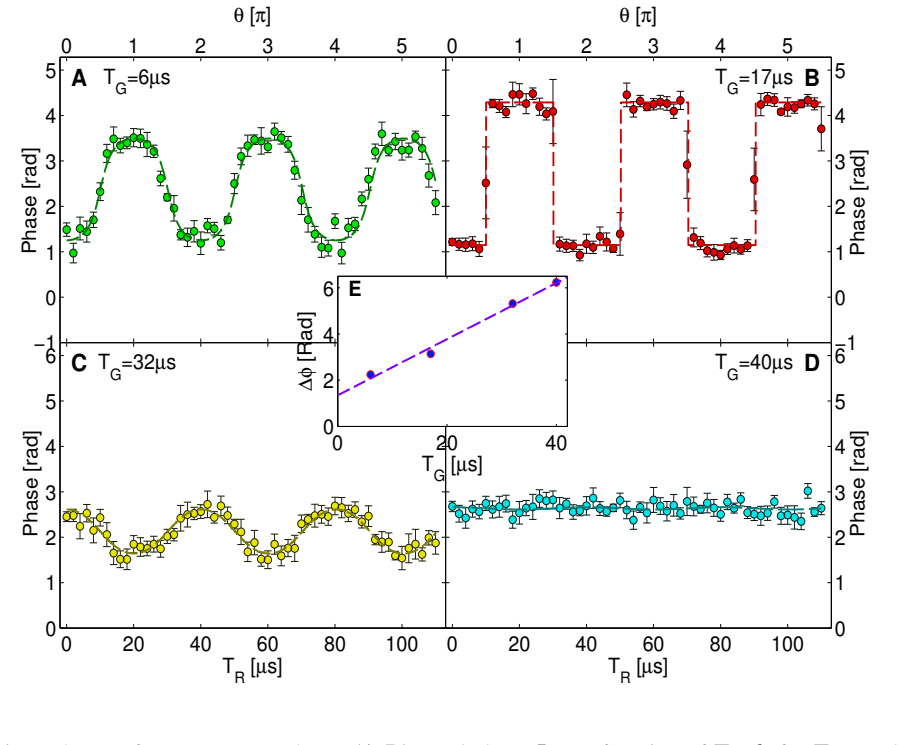
"The dashed lines are a fit to Eq. (2), which allows us to determine Δφ for our SU(2) operations. The fit returns the values Δφ = 2.24 (A), Δφ = 3.14 (B), Δφ = 5.31≡ 2π− 0.97 (C) and Δφ = 6.23≡ 2π− 0.05 (D) radians, respectively."
Δφ is not an independent input for the geometric-phase analysis: it is obtained by fitting the same Φ(TR) curves that are then converted into ΦG = Φ − Δφ/2(1−cosθ). Any data set consistent with Eq. (1) will, after this fit, automatically reproduce the plotted ΦG curve of Eq. (3). The Fig. 4 caption calls θ and Δφ "independently measured", but only θ is independently measured (from the population transfer); Δφ is a fit parameter of Eq. (2). Thus the quantitative comparison in Fig. 4 is partly built in rather than a free prediction.
-
self definitional
[Eq. (3) and Supplementary S4 (Eqs. S3–S5)]
"Fig. 4 displays Φ, ΦD and the resulting ΦG, for two values of Δφ, where the first term on the RHS of Eq. (3) is given by Φ, the phase of the interference pattern, while the second is evaluated for the experimentally determined values of θ and Δφ."
Eq. (3) is algebraically Eq. (2) minus the dynamical phase Δφ/2(1−cosθ), i.e. ΦG is defined as Φ − ΦD. Because the first term is taken from the measured Φ and the second from the same fitted Δφ, the dashed "geodesic-rule prediction" and the data are the same function up to fit residuals and the fitted offset φ0. The comparison therefore cannot independently confirm the geodesic rule for the geometric phase; it is a consistency check on the fit to Eq. (2), whose sole free parameters are φ0 and Δφ.
full rationale
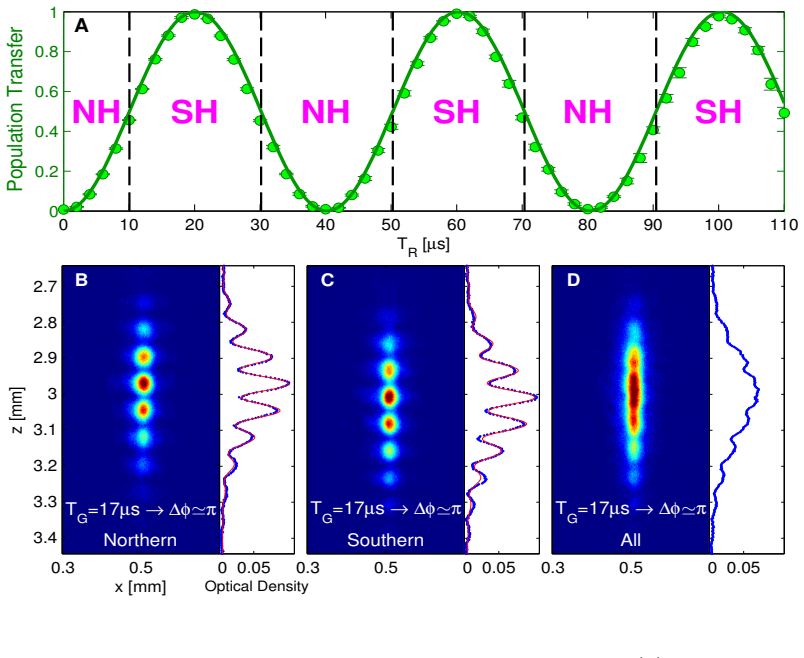
The paper's formal chain is: fit Φ(TR) data to Eq. (2) with free parameters φ0 and Δφ (Figs. 3A–D); then form ΦG = Φ − Δφ/2(1−cosθ), using the same fitted Δφ, and compare the result to Eq. (3). Since Eq. (3) is just Eq. (2) with the dynamical term subtracted, the "prediction" and the data are the same function by construction up to residuals and a constant offset. The abstract's claim of "unambiguous experimental confirmation... with high precision" is therefore stronger than the independent content supports. What remains genuinely model-independent is the raw fringe-phase observation: for TG=17 μs the interference phase is rigid within each hemisphere and jumps by about π as θ crosses the equator (Figs. 2B–D and 3B), and the TG→Δφ map is approximately linear (Fig. 3E). Those features are necessary consequences of a spin-coherent superposition with a common latitude and relative phase Δφ≈π, but they do not by themselves fix the sign change of ΦG or the quantitative area-law curve of Fig. 4, both of which are generated using Δφ and φ0 obtained from the same total-phase fits. No load-bearing self-citation chain is present; the circularity is confined to the quantitative ΦG comparison, which nevertheless underpins the paper's strongest wording.
Assumptions & free parameters
free parameters (2)
- delta-phi (relative SU(2) rotation angle) =
2.24, 3.14, 5.31, 6.23 rad for TG = 6, 17, 32, 40 microseconds (Fig. 3E)
- phi_0 (spatial phase offset) =
Not quoted numerically in the paper
assumptions (5)
- domain assumption The two internal states |1> and |2> form a closed two-level system under the RF and gradient pulses, giving an effective SU(2) evolution on the Bloch sphere.
- domain assumption The measured interference-pattern phase is the Pancharatnam phase arg<Psi_A|Psi_B>, with a spatial phase phi_0 common to both wave packets that cancels in the geometric phase.
- domain assumption The dynamical phase along the latitude path is Phi_D = delta-phi/2 (1-cos theta).
- domain assumption The geodesic rule proposition, that the geometric phase equals half the area enclosed by the trajectory and the shortest geodesic, is the theoretical prediction under test.
- standard math Standard quantum-mechanical overlap formula for fringe phase.
Cite this review
Pith. "Pith review of An experimental test of the geodesic rule proposition for the non-cyclic geometric phase." pith.science (2026). https://pith.science/paper/GXMAEIHA
@misc{pith2026190803008,
  author       = {Pith},
  title        = {Pith review of: An experimental test of the geodesic rule proposition for the non-cyclic geometric phase},
  year         = {2026},
  howpublished = {\url{https://pith.science/paper/GXMAEIHA}},
  note         = {Machine review of arXiv:1908.03008}
}
read the original abstract
The geometric phase due to the evolution of the Hamiltonian is a central concept in quantum physics, and may become advantageous for quantum technology. In non-cyclic evolutions, a proposition relates the geometric phase to the area bounded by the phase-space trajectory and the shortest geodesic connecting its end points. The experimental verification of this geodesic rule proposition has remained elusive for more than three decades. Here, we report an unambiguous experimental confirmation of the geodesic rule for a non-cyclic geometric phase by means of a spatial SU(2) matter-wave interferometer, demonstrating, with high precision, the predicted phase sign change and pi jumps. We show the connection between our results and the Pancharatnam phase. Finally, we point out that the geodesic rule can be applied to obtain the red-shift in general relativity, enabling a completely new quantum tool to measure gravity.
Figures

Figures from the paper (2 more)

Reference graph
Works this paper leans on
-
[1]
Pancharatnam, ’Generalized Theory of Interference and its Applications’, Proc
S. Pancharatnam, ’Generalized Theory of Interference and its Applications’, Proc. Indian Acad. of Sciences 44, 247 (1956). 7
work page 1956
-
[2]
Berry,’Quantal phase factors accompanying adiabatic changes’, Proc
M.V . Berry,’Quantal phase factors accompanying adiabatic changes’, Proc. Royal Soc. Lon- don A 392, 45 (1984)
work page 1984
-
[3]
G. Herzberg and H.C. Longuet-Higgins, ’Intersection of potential energy surfaces in poly- atomic molecules’, Discuss. Faraday Soc.35, 77 (1963)
work page 1963
-
[4]
B. Simon, ’Holonomy, the Quantum Adiabatic Theorem, and Berry’s Phase’, Physical Re- view Letters 51, 2167 (1983)
work page 1983
-
[5]
F. Wilczek and A. Zee, ’Appearance of Gauge Structure in Simple Dynamical Systems’, Physical Review Letters 52, 2111 (1984)
work page 1984
-
[6]
Y . Aharonov and J. Anandan, ’Phase Change during a Cyclic Quantum Evolution’, Physical Review Letters 58, 1593 (1987)
work page 1987
-
[7]
J. Samuel and R. Bhandari,’General Setting for Berry’s Phase’, Physical Review Letters60, 2339 (1988)
work page 1988
-
[8]
Berry, ’Anticipations of the geometric phase’, Physics Today43, 34 (1990)
M.V . Berry, ’Anticipations of the geometric phase’, Physics Today43, 34 (1990)
work page 1990
Show all 32 references
-
[9]
M. V . Berry, ’The Adiabatic Phase and Pancharatnam’s Phase for Polarized Light’, J. Mod. Opt. 34, 1401-1407 (1987)
1987
-
[10]
Bhandari, ’SU(2) phase jumps and geometric phases’, Physics Letters A 157, 221 (1991)
R. Bhandari, ’SU(2) phase jumps and geometric phases’, Physics Letters A 157, 221 (1991)
1991
-
[11]
Bitter and D
T. Bitter and D. Dubbers, ’Manifestation of Berry’s Topological Phase in Neutron Spin Rotation’, Physical Review Letters59, 251 (1987)
1987
-
[12]
Bhandari and J
R. Bhandari and J. Samuel, ’Observation of Topological Phase by Use of a Laser Interfer- ometer’, Physical Review Letters60, 1211 (1988). 8
1988
-
[13]
P. J. Leek, et al., ’Observation of Berry’s Phase in a Solid-State Qubit’, Science318, 1889 (2007)
2007
-
[14]
M. D. Schroer, et al., ’Measuring a Topological Transition in an Artificial Spin-1=2 Sys- tem’, Physical Review Letters113, 050402 (2014)
2014
-
[15]
Roushan, et al., ’Observation of topological transitions in interacting quantum circuits’, Nature 515, 241 (2014)
P. Roushan, et al., ’Observation of topological transitions in interacting quantum circuits’, Nature 515, 241 (2014)
2014
-
[16]
Wagh and V .C Rakhecha, ’Neutron Interferometric Observation of Non-cyclic Phase’, Physical Review Letters 81, 1992 (1998)
A.G. Wagh and V .C Rakhecha, ’Neutron Interferometric Observation of Non-cyclic Phase’, Physical Review Letters 81, 1992 (1998)
1998
-
[17]
Neutron Interferometric Observation of Non-cyclic Phase
R. Bhandari, ’Comment on “Neutron Interferometric Observation of Non-cyclic Phase”’, Physical Review Letters 83, 2089 (1999)
1999
-
[18]
Zu, W.-B
C. Zu, W.-B. Wang, L. He, W.-G. Zhang, C.-Y . Dai, F. Wang and L.-M. Duan, ’Experimen- tal realization of universal geometric quantum gates with solid-state spins’, Nature514, 72 (2014)
2014
-
[19]
C. W. Chou, D. B. Hume, T. Rosenband and D. J. Wineland, ’Optical Clocks and Relativ- ity’, Science329, 1630 (2010)
2010
-
[20]
Filipp, Y
A. Filipp, Y . Hasegawa, R. Loidl, and H. Rauch, ’Non-cyclic geometric phase due to spatial evolution in a neutron interferometer’, Physical Review A72, 021602 (R) (2005)
2005
-
[21]
Atsuo Morinaga and Kota Nanri, ’Noncyclic Berry phase and scalar Aharonov-Bohm phase for the spin-redirection evolution in an atom interferometer’, Phys. Rev. A 86, 022105 (2012). 9
2012
-
[22]
Atsuo Morinaga and Kota Nanri, Erratum: ’Noncyclic Berry phase and scalar Aharonov- Bohm phase for the spin-redirection evolution in an atom interferometer’, Phys. Rev. A94, 019907 (E) (2016)
2016
-
[23]
Takahashi, H
A. Takahashi, H. Imai, K. Numazaki, and A. Morinaga, ’Phase shift of an adiabatic rotating magnetic field in Ramsey atom interferometry for m=0 sodium-atom spin states’, Phys. Rev. A 80, 050102(R) (2009)
2009
-
[24]
Cronin, J ¨org Schmiedmayer, and David E
Alexander D. Cronin, J ¨org Schmiedmayer, and David E. Pritchard, ’Optics and interferom- etry with atoms and molecules’, Rev. Mod. Phys.81, 1051 (2009)
2009
-
[25]
Enrico Fermi
Atom Interferometry, Eds. Tino, G.M., Kasevich, M.A., Proceedings of the international school of physics “Enrico Fermi” vol.188 (2014)
2014
-
[26]
Machluf, Y
S. Machluf, Y . Japha and R. Folman, ’Coherent Stern-Gerlach momentum splitting on an atom chip’, Nat. Commun.4, 2424 (2013)
2013
-
[27]
which path
Y . Margalit, Z. Zhou, S. Machluf, D. Rohrlich, Y . Japha and R. Folman, ’A self-interfering clock as a “which path” witness’, Science349, 1205 (2015)
2015
-
[28]
Z. Zhou, Y . Margalit, D. Rohrlich, Y . Japha and R. Folman, ’Quantum complementarity of clocks in the context of general relativity’, Class. Quantum Grav.35, 185003 (2018)
2018
-
[29]
Materials and methods are available as supplementary materials on Science Online
-
[30]
Mukunda and R
N. Mukunda and R. Simon, ’Quantum Kinematic Approach to the Geometric Phase. I. general Formalism’, Annals of Physics228, 205 (1993)
1993
-
[31]
De Zela, ’The Pancharatnam-Berry Phase: Theoretical and Experimental Aspects’, The- oretical Concepts of Quantum Mechanics edited by M.R
F. De Zela, ’The Pancharatnam-Berry Phase: Theoretical and Experimental Aspects’, The- oretical Concepts of Quantum Mechanics edited by M.R. Pahlavani (InTech 2012). 10
2012
-
[32]
phase rigidity
Thomas van Dijk, Hugo F. Schouten, and Taco D. Visser, ’Geometric interpretation of the Pancharatnam connection and non-cyclic polarization changes’, J. Opt. Soc. Am. A 27, 1972 (2010). 11 |1〉 |2〉 𝜽 Δ𝝓 𝜽 B0 z A B A0 Latitude Geodesic A’ B’ Atom chip . . × B C Z |2〉 |1〉 Coheren...
2010
Reviewed August 14, 2026 · model on record in the stance chip above.
Discussion (0). Continue with ORCID to comment.