REVIEW 2 major objections 5 minor 29 references
Optimal Portfolio of Distinct Frequency-Response Services in Low-Inertia Systems
T0 review · 2 major / 5 minor · reviewed 2026-08-14 · deepseek-v4-flash
Pith's one-line read The paper derives closed-form, convex frequency-security constraints that let schedulers co-optimize any finite number of frequency-response services with activation delays, under uncertain demand-side inertia, as a globally solvable…
desk verdict Genuinely useful multi-service frequency-security formulation, but the delayed-service nadir constraint (11) is not the exact closed form the paper claims; it errs conservative and the authors should fix the algebra or soften the claim. read the letter →
The pith
A machine-rendered reading of the paper's core claim, the machinery that carries it, and where it could break.
The reading
What carries the argument
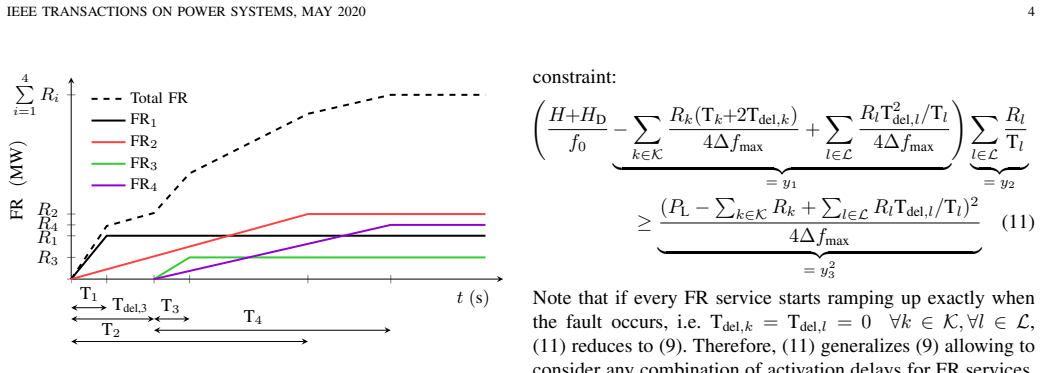
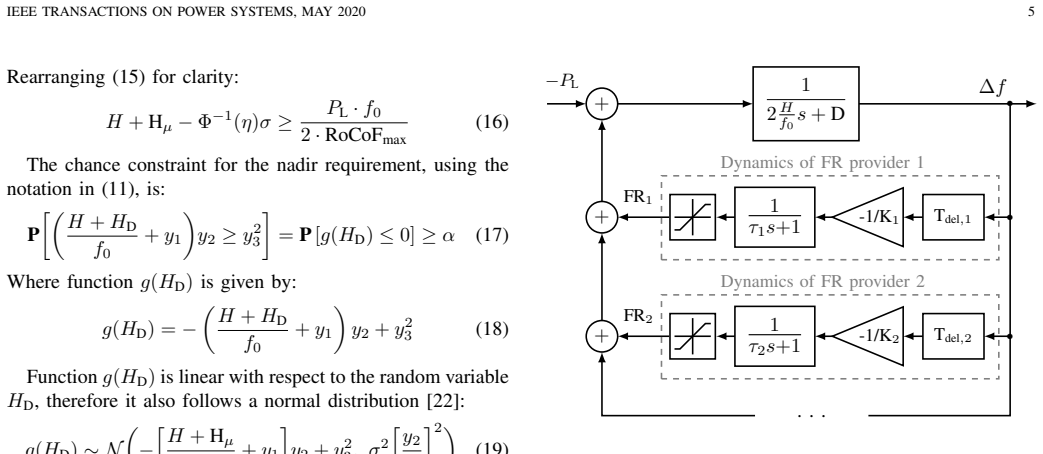
The load-bearing object is the closed-form solution of the uniform-frequency swing equation $\frac{2(H+H_D)}{f_0}\frac{d\Delta f}{dt} = FR(t) - P_L$, where the aggregated frequency response $FR(t)$ is modelled as a sum of piecewise-linear ramps, each service $s$ contributing a ramp of slope $R_s/T_s$ starting at time $T_{\mathrm{del},s}$ and saturating at $R_s$. Solving this equation on every interval between delivery times produces a nadir time $t_{\mathrm{nadir}}$ and a set of algebraic conditions; the nadir limit becomes the rotated second-order cone $\big(\frac{H+H_D}{f_0} + y_1\big) y_2 \ge y_3^2$, with $y_1,y_2,y_3$ linear expressions in the response variables. Conditional statements select the active interval through binary variables and a big-M formulation, which is why the final problem is mixed-integer conic. The chance-constraint reformulation uses the fact that $g(H_D)$ is linear in the Gaussian random variable $H_D$, so $P(g(H_D)\leq 0)\geq \alpha$ is exactly enforced by the deterministic cone after applying the inverse cumulative distribution function.
What would settle it
Run a dynamic simulation with a first-order droop-controlled generator whose actual power injection lags the linear ramp of (2) for the first few seconds, and feed it an operating point that exactly meets the proposed nadir constraint; if the simulated frequency nadir falls below $\Delta f_{\max}$, the conservative-ramp premise is falsified for that controller class. Conversely, the premise would be supported if a large sample of realistic controller models, including communication delays and deadbands, all produce nadirs no deeper than the constraint.
Extended reading notes
Core claim
The central claim is that the frequency-security region defined by the swing equation is exactly representable by a small set of algebraic constraints: a rate-of-change-of-frequency limit at $t=0$, a steady-state condition that total response covers the lost infeed $P_L$, and a family of conditional nadir constraints, one for each time interval in which the frequency minimum can occur. Solving the swing equation piecewise yields a closed-form expression for the time and depth of the nadir, and enforcing the limit $\Delta f_{\max}$ becomes a rotated second-order-cone constraint. Activation delays shift each service's ramp and preserve the conic structure. For uncertain demand-side inertia, the probabilistic nadir and RoCoF constraints are reassembled exactly as deterministic cone constraints using log-concavity of the error distribution, so no conservative approximation is introduced at this step. The resulting MISOCP is the paper's claimed contribution: the first frequency-secured scheduling formulation that can co-optimize any finite number of distinct frequency-response services, with arbitrary delays, to global optimality.
Load-bearing premise
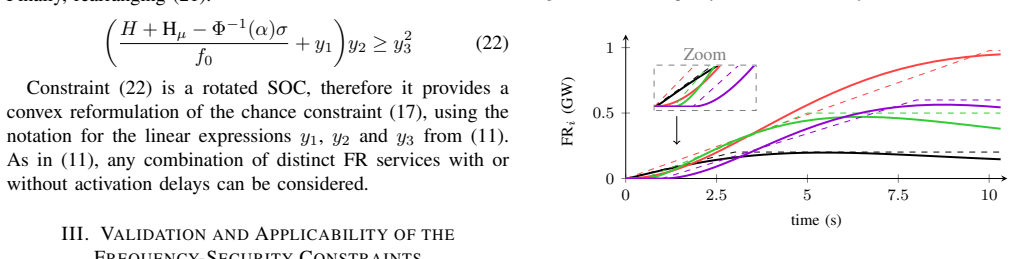
The whole construction assumes that the piecewise-linear ramp in (2) and (10) conservatively bounds any real frequency-responsive controller; if a real device delivers less response in the first seconds after a fault than the assumed ramp, the nadir constraint will understate the frequency drop and the scheduling solution may not be secure.
Editorial extensions
If this is right
- System operators can include any finite number of frequency-response services in a single unit-commitment optimization, each with its own delivery time and activation delay, while preserving global optimality of the MISOCP.
- Demand-side inertia uncertainty can be enforced through chance constraints with an exact convex reformulation, so the operator can fix the probability of meeting RoCoF and nadir limits without resorting to conservative heuristics.
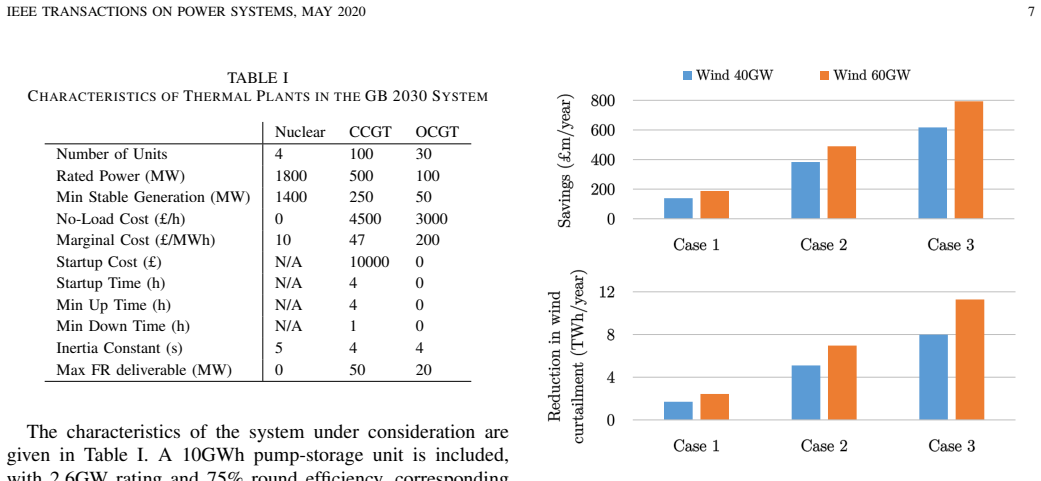
- The case studies show that defining faster frequency-response services reduces annual operating cost and wind curtailment, and that these savings grow with wind penetration.
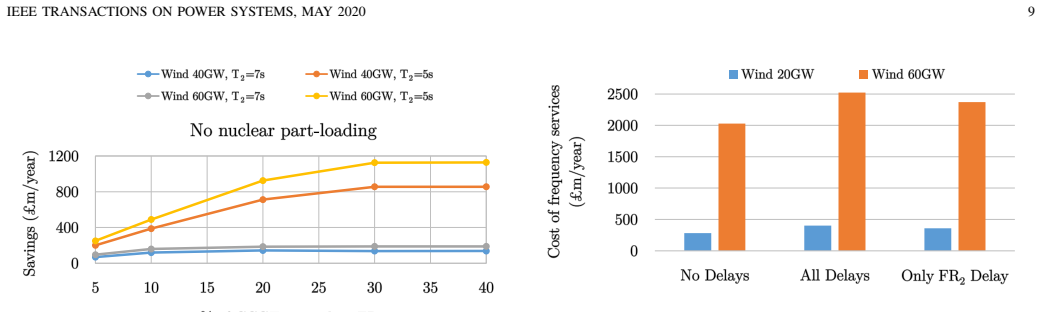
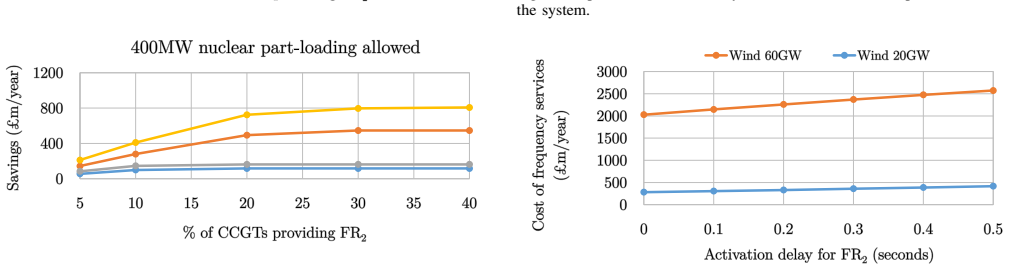
- Activation delays of a few tenths of a second materially reduce the value of a frequency service, so the framework quantifies the economic incentive to reduce communication or deadband delays.
- Co-optimizing the largest possible infeed loss together with inertia and response can substitute for part of the fast response requirement, as shown by the nuclear part-loading results.
Reading between the lines
- Because the feasible set is convex up to binary interval selection, the same constraints could be embedded in an ancillary-service market-clearing problem to derive marginal prices for inertia and for each distinct response service.
- The exact chance-constraint reformulation relies only on log-concavity, so any log-concave forecast-error distribution, not just Gaussian, could be used without leaving the conic framework.
- The closed-form nadir expression could be adapted to risk-based contingency sizing, treating the largest infeed $P_L$ as a random variable, since the constraints are algebraic in $P_L$; the resulting chance constraint may still admit a convex reformulation.
- A systematic procedure to map droop-control parameters and first-order lag dynamics onto conservative equivalent ramps $(T_s, T_{\mathrm{del},s})$ would remove the main source of conservativeness when the response fleet is dominated by synchronous generators.
Signed reviews
Editorial analysis
A structured set of objections, weighed in public.
Referee Report
Summary. The paper derives algebraic frequency-security constraints from a uniform-frequency swing equation for an arbitrary finite number of frequency-response services, each characterized by a delivery time and an optional activation delay. The resulting nadir, rate-of-change-of-frequency, and steady-state constraints are cast as a Mixed-Integer Second-Order Cone Program. Demand-side inertia uncertainty is modeled through chance constraints, for which an exact convex reformulation is provided under a Gaussian forecast-error assumption. The framework is embedded in a stochastic unit commitment model and tested on a GB 2030 case study, including sensitivity analyses for the number of services, activation delays, and inertia forecast quality.
Significance. If the claims held as stated, the paper would make a useful contribution to low-inertia system operation: it is the first formulation in this line of work that co-optimizes an arbitrary number of frequency-response services with different delivery times and activation delays, while preserving an MISOCP that can be solved to global optimality. The probability reformulations in Section II-C are genuinely exact under the stated Gaussian assumption, and the case studies are extensive, including a computational scaling study with ten services. The algebra from the swing equation to the no-delay nadir constraint (Eqs. (6)-(9)) is sound and machine-checkable. However, the treatment of activation delays in Eq. (10) and Eq. (11) contains an internal inconsistency and does not establish the claimed exactness; the manuscript needs a substantive correction or a clear restatement of Eq. (11) as a conservative approximation.
major comments (2)
- [§II-B, Eqs. (10) and (11)] The delayed-ramp model is internally inconsistent and Eq. (11) is not the exact closed-form characterization claimed for arbitrary delays. In Eq. (10.2), FR_i(T_i) = R_i(1 - T_del,i/T_i), so the service jumps from R_i(1 - T_del,i/T_i) to R_i at t = T_i; thus T_i is not the time by which full capacity is delivered. If the intended model is a continuous ramp over the duration T_i - T_del,i, Eq. (10.2) should use the denominator T_i - T_del,i. Under the literal Eq. (10), a direct integration for a service k in the fully-delivered set K gives the exact correction term R_k(T_k + 2T_del,k - T_del,k^2/T_k)/(4Δfmax), whereas Eq. (11) prints R_k(T_k + 2T_del,k)/(4Δfmax). The omitted -R_k T_del,k^2/(T_k·4Δfmax) term means Eq. (11) is conservative for delayed services in K, not exact. This must be fixed by correcting Eq. (11) or by explicitly stating and proving that Eq. (11) is a conservative inner approximation, and the exactness claims in the abstract and Section III must be revised accordingly.
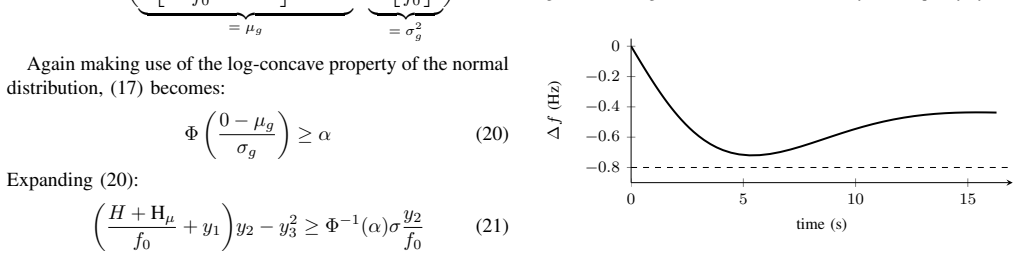
- [§III, Validation] The single validation case does not independently test the delayed-service algebraic form. The simulation uses droop-controlled providers with time constants (Fig. 2) and adds load damping D = 0.15 GW/Hz, so the observed 0.08 Hz margin cannot separate the effect of the linear-ramp assumption from any error or conservativeness in Eq. (11). I recommend validating Eq. (11) (or its corrected version) against numerical integration of Eq. (1) with the ramp model of Eq. (10) over a grid of parameter values, including cases with delayed services in both the fully-delivered set K and the ramping set L. Reporting the maximum deviation from the exact nadir would resolve whether the constraint is exact, conservative, or potentially optimistic.
minor comments (5)
- [§II-B, Eq. (11)] The right-hand side of Eq. (11) contains the typographical artifact '=y2 3'; it should be y3^2, and the underbraces should be aligned with the intended expressions y1, y2, and y3.
- [§II-B, Eq. (10)] The notation T_i is described as the delivery time, but under Eq. (10.2) full delivery is not reached at t = T_i; please clarify whether T_i denotes the end of the ramp or the end of the ramp plus delay, and make the piecewise definition consistent with the chosen interpretation.
- [§II-A, Eq. (2)] The final case in Eq. (2) should use t ≥ T_|S| rather than t > T_|S| to be consistent with the right endpoint of the preceding interval, and T_0 should be explicitly defined as 0 for the first interval.
- [§III, first paragraph] The sentence stating that the constraints are 'guaranteed to provide the security region entailing no approximation' is overstated: the linear-ramp assumption is itself an approximation, and the delayed-service constraint in Eq. (11) is at best conservative rather than exact. Please rephrase to distinguish exactness for the modeled ramp profile from conservativeness of the ramp model.
- [§III, Fig. 4] The dashed lines in Fig. 4 are described as the FR profile assumed in Eq. (2), but the comparison with the simulated FR curves is only qualitative; a quantitative comparison of the area under each curve would be more informative, since the nadir depends on the accumulated energy of the response.
Circularity Check
No significant circularity: frequency constraints are obtained by direct solution of the stated swing equation; validation is an independent dynamic simulation.
full rationale
The paper's derivation chain starts from the swing equation (1), the piecewise ramp model (2)/(10), and user-set delivery/delay/inertia inputs, and solves the ODE in closed form to obtain the RoCoF (3), steady-state (4), nadir (9)/(11), and chance constraints (22). None of these constraints is fitted to the case-study results: sigma, alpha, eta, Ts, and Tdel,s are stated inputs, and the MISOCP is solved rather than calibrated. The only empirical element is the validation in Section III, which feeds a binding operating condition into an independent MATLAB/Simulink dynamic simulation; that is a check of the model, not an input to the constraints. Self-citations ([11], [16], [23], [26]) are used for prior formulations, a partner pricing paper, and the stochastic unit commitment framework; they are not used to justify the algebraic derivations or to forbid alternatives. The conservativeness of the linear-ramp ansatz is attributed to an external source [5] and tested dynamically, so no load-bearing step reduces to a self-citation. The algebraic inconsistency between Eq. (10) and Eq. (11) noted in review is a correctness concern about the delayed-nadir formula, not a circularity, because the printed formula is not defined in terms of the result it is supposed to predict. Accordingly, no circular step can be exhibited under the required evidence standard.
Assumptions & free parameters
assumptions (4)
- domain assumption Post-fault frequency follows the uniform-frequency swing equation 2(H+HD)/f0 dΔf/dt = FR(t) - PL (eq. 1), with load damping neglected.
- domain assumption Each FR service is modeled as a piecewise linear ramp that starts at T_del,s and reaches full capacity R_s, as in eqs. (2) and (10); this is conservatively assumed to bound real droop controls.
- domain assumption Demand-side inertia forecast error HD is Gaussian with mean H_mu and variance sigma^2 (eq. 12).
- standard math Log-concavity of the normal distribution and linearity of g(HD) are used to convert chance constraints into deterministic SOC constraints.
Cite this review
Pith. "Pith review of Optimal Portfolio of Distinct Frequency-Response Services in Low-Inertia Systems." pith.science (2026). https://pith.science/paper/GXPYB24V
@misc{pith2026190807856,
  author       = {Pith},
  title        = {Pith review of: Optimal Portfolio of Distinct Frequency-Response Services in Low-Inertia Systems},
  year         = {2026},
  howpublished = {\url{https://pith.science/paper/GXPYB24V}},
  note         = {Machine review of arXiv:1908.07856}
}
read the original abstract
A reduced level of system inertia due to renewable integration increases the need for cost-effective provision of ancillary services, such as Frequency Response (FR). In this paper we propose a closed-form solution to the differential equation describing frequency dynamics, which allows to obtain frequency-security algebraic constraints to be implemented in optimisation routines. This is done while considering any finite number of FR services with distinguished characteristics, such as different delivery times and activation delays. The problem defined by these frequency-security constraints can be formulated as a Mixed-Integer Second-Order Cone Program (MISOCP), which can be efficiently handled by off-the-shelf conic optimisation solvers. This paper also takes into account the uncertainty in inertia contribution from the demand side by formulating the frequency-security conditions as chance constraints, for which an exact convex reformulation is provided. Finally, case studies highlighting the effectiveness of this frequency-secured formulation are presented.
Figures
Figures from the paper (6 more)


Reference graph
Works this paper leans on
-
[1]
Provision of ancillary services in future low-carbon UK electricity system,
F. Teng, M. Aunedi, G. Strbac, V . Trovato, and A. Dallagi, “Provision of ancillary services in future low-carbon UK electricity system,” in IEEE TRANSACTIONS ON POWER SYSTEMS, MAY 2020 11 2017 IEEE PES Innovative Smart Grid Technologies Conference Europe (ISGT-Europe), Conference Proceedings
work page 2020
-
[2]
Market designs for the primary frequency response ancillary service. Part I: Motivation and design,
E. Ela, V . Gevorgian, A. Tuohy, B. Kirby, M. Milligan, and M. O’Malley, “Market designs for the primary frequency response ancillary service. Part I: Motivation and design,” IEEE Transactions on Power Systems , vol. 29, no. 1, pp. 421–431, 2014
work page 2014
-
[3]
Design of a new primary frequency control market for hosting frequency response reserve offers from both generators and loads,
W. Li, P. Du, and N. Lu, “Design of a new primary frequency control market for hosting frequency response reserve offers from both generators and loads,” IEEE Transactions on Smart Grid , vol. 9, no. 5, pp. 4883–4892, 2018
2018
-
[4]
Cutting plane approaches for frequency constrained economic dispatch problems,
C. Cardozo, W. van Ackooij, and L. Capely, “Cutting plane approaches for frequency constrained economic dispatch problems,” Electric Power Systems Research, vol. 156, pp. 54–63, 2018
work page 2018
-
[5]
Governor rate-constrained OPF for primary frequency control adequacy,
H. Ch ´avez, R. Baldick, and S. Sharma, “Governor rate-constrained OPF for primary frequency control adequacy,” IEEE Transactions on Power Systems, vol. 29, no. 3, pp. 1473–1480, 2014
2014
-
[6]
G. Zhang, “New ancillary service market design to improve MW- frequency performance: reserve adequacy and resource flexibility,” PhD thesis, Iowa State University, United States, 2015
work page 2015
-
[7]
Stochastic scheduling with inertia- dependent fast frequency response requirements,
F. Teng, V . Trovato, and G. Strbac, “Stochastic scheduling with inertia- dependent fast frequency response requirements,” IEEE Transactions on Power Systems, vol. 31, no. 2, pp. 1557–1566, 2016
work page 2016
-
[8]
Security-constrained unit commitment with linearized system frequency limit constraints,
H. Ahmadi and H. Ghasemi, “Security-constrained unit commitment with linearized system frequency limit constraints,” IEEE Transactions on Power Systems, vol. 29, no. 4, pp. 1536–1545, 2014
work page 2014
Show all 29 references
-
[9]
Market scheduling and pricing for primary and secondary frequency reserve,
G. Zhang, E. Ela, and Q. Wang, “Market scheduling and pricing for primary and secondary frequency reserve,” IEEE Transactions on Power Systems, vol. 34, no. 4, pp. 2914–2924, 2019
2019
-
[10]
Unit commitment with inertia- dependent and multispeed allocation of frequency response services,
V . Trovato, A. Bialecki, and A. Dallagi, “Unit commitment with inertia- dependent and multispeed allocation of frequency response services,” IEEE Transactions on Power Systems , vol. 34, no. 2, pp. 1537–1548, 2019
2019
-
[11]
Simultaneous scheduling of multiple frequency services in stochastic unit commitment,
L. Badesa, F. Teng, and G. Strbac, “Simultaneous scheduling of multiple frequency services in stochastic unit commitment,” IEEE Transactions on Power Systems, vol. 34, no. 5, pp. 3858–3868, 2019
2019
-
[12]
Contingency-constrained unit commitment in meshed isolated power systems,
L. E. Sokoler, P. Vinter, R. Brentsen, K. Edlund, and J. B. Jørgensen, “Contingency-constrained unit commitment in meshed isolated power systems,”IEEE Transactions on Power Systems, vol. 31, no. 5, pp. 3516– 3526, 2016
2016
-
[13]
System needs and product strategy,
“System needs and product strategy,” National Grid, Report, 2017. [Online]. Available: https: //www.nationalgrid.com/sites/default/files/documents/8589940795- System%20Needs%20and%20Product%20Strategy%20-%20Final.pdf
2017
-
[14]
Fast frequency response for effective frequency control in power systems with low inertia,
Q. Hong, M. Nedd, S. Norris, I. Abdulhadi, M. Karimi, V . Terzija, B. Marshall, K. Bell, and C. Booth, “Fast frequency response for effective frequency control in power systems with low inertia,” The Journal of Engineering , vol. 2019, no. 16, pp. 1696–1702, 2019
2019
-
[15]
Frequency control in compet- itive electricity market dispatch,
R. Doherty, G. Lalor, and M. O’Malley, “Frequency control in compet- itive electricity market dispatch,” IEEE Transactions on Power Systems, vol. 20, no. 3, pp. 1588–1596, 2005
2005
-
[16]
Optimal scheduling of frequency services considering a variable largest-power-infeed-loss,
L. Badesa, F. Teng, and G. Strbac, “Optimal scheduling of frequency services considering a variable largest-power-infeed-loss,” in 2018 IEEE Power & Energy Society General Meeting (PESGM) , Conference Pro- ceedings
2018
-
[17]
Kundur, Power System Stability and Control , 1st ed
P. Kundur, Power System Stability and Control , 1st ed. McGraw-Hill Education, 1994
1994
-
[18]
System operability framework,
“System operability framework,” National Grid, Report,
-
[19]
Sioshansi and A
R. Sioshansi and A. Conejo, Optimization in Engineering . Springer International Publishing, 2017
2017
-
[20]
Boyd and L
S. Boyd and L. Vandenberghe, Convex Optimization . Cambridge University Press, 2004
2004
-
[21]
Convex approximations of chance constrained programs,
A. Nemirovski and A. Shapiro, “Convex approximations of chance constrained programs,” SIAM Journal on Optimization , vol. 17, no. 4, pp. 969–996, 2007
2007
-
[22]
Papoulis and S
A. Papoulis and S. U. Pillai, Probability, Random Variables and Stochas- tic Processes, 4th ed. McGraw-Hill Education, 2002
2002
-
[23]
Pricing inertia and frequency response with diverse dynamics in a Mixed-Integer Second-Order Cone Programming formulation,
L. Badesa, F. Teng, and G. Strbac, “Pricing inertia and frequency response with diverse dynamics in a Mixed-Integer Second-Order Cone Programming formulation,” Applied Energy, vol. 260, p. 114334, 2020
2020
-
[24]
Dynamic Containment FAQs,
“Dynamic Containment FAQs,” National Grid, Report, 2020. [On- line]. Available: https://www.nationalgrideso.com/document/164391/ download
2020
-
[25]
Stability Pathfinder for inertia, phase 1 tender results,
“Stability Pathfinder for inertia, phase 1 tender results,” National Grid, Report, 2020. [Online]. Available: https://www.nationalgrideso. com/document/162091/download
2020
-
[26]
Efficient stochastic scheduling for simulation of wind-integrated power systems,
A. Sturt and G. Strbac, “Efficient stochastic scheduling for simulation of wind-integrated power systems,” IEEE Transactions on Power Systems , vol. 27, no. 1, pp. 323–334, 2012
2012
-
[27]
Enhanced frequency control capability project,
“Enhanced frequency control capability project,” National Grid, Report,
-
[2016]
Available: https://www.nationalgrid.com/ sites/default/files/documents/8589937803-SOF%202016%20- %20Full%20Interactive%20Document.pdf
[Online]. Available: https://www.nationalgrid.com/ sites/default/files/documents/8589937803-SOF%202016%20- %20Full%20Interactive%20Document.pdf
-
[2017]
Available: https://www.nationalgrideso.com/innovation/ projects/enhanced-frequency-control-capability-efcc Luis Badesa (S’14) received the B.S
[Online]. Available: https://www.nationalgrideso.com/innovation/ projects/enhanced-frequency-control-capability-efcc Luis Badesa (S’14) received the B.S. in Industrial Engineering degree from the University of Zaragoza, Spain, in 2014, and the M.S. in Electrical Engineering de...
2014
Reviewed August 14, 2026 · model on record in the stance chip above.
Discussion (0). Continue with ORCID to comment.