REVIEW 5 major objections 6 minor 53 references
A Plug-and-Play Multi-Criteria Guidance for Diverse In-Betweening Human Motion Generation
T0 review · 5 major / 6 minor · reviewed 2026-08-06 · deepseek-v4-flash
Pith's one-line read Treating a frozen motion generator's sampling as a two-criteria Pareto search can raise the diversity of the motions it produces, with no retraining or added parameters, the paper argues.
desk verdict A genuinely new sampling-time evolutionary recipe for in-betweening motion, but the key conditioning step is unspecified and the evaluation is partly circular, so the claims outrun the evidence. read the letter →
The pith
A machine-rendered reading of the paper's core claim, the machinery that carries it, and where it could break.
The reading
What carries the argument
The central object is the multi-criteria optimization formulation with objectives $F_1(Y)=\alpha_1(Y)+\beta(Y)$ and $F_2(Y)=\alpha_2(Y)+\beta(Y)$, where $\alpha_1(Y)=\frac{1}{D}(C(Y)+P_c(Y))$, $\alpha_2(Y)=1-\alpha_1(Y)$, and $\beta(Y)=\|X_1[-1]-Y[0]\|+\|Y[-1]-X_2[0]\|$ measures endpoint smoothness. The diversity component $\alpha_1$ couples a classifier's category label $C(Y)$ with its class probabilities $P_c(Y)$, so that both inter-class and intra-class differences are rewarded. The theorems guarantee that minimizers of $\beta$ are Pareto-optimal and that separating solutions along the Pareto front in objective space separates them by action category, which is what turns an optimization loop into a diversity engine.
What would settle it
Apply MCG-IMM to a pretrained VAE or GAN backbone whose forward pass accepts only keyframe poses and has no conditioning pathway for a full previously generated sequence; if that backbone cannot produce the offspring described in the generation equation, the method's model-agnostic plug-and-play claim fails in practice.
Extended reading notes
Core claim
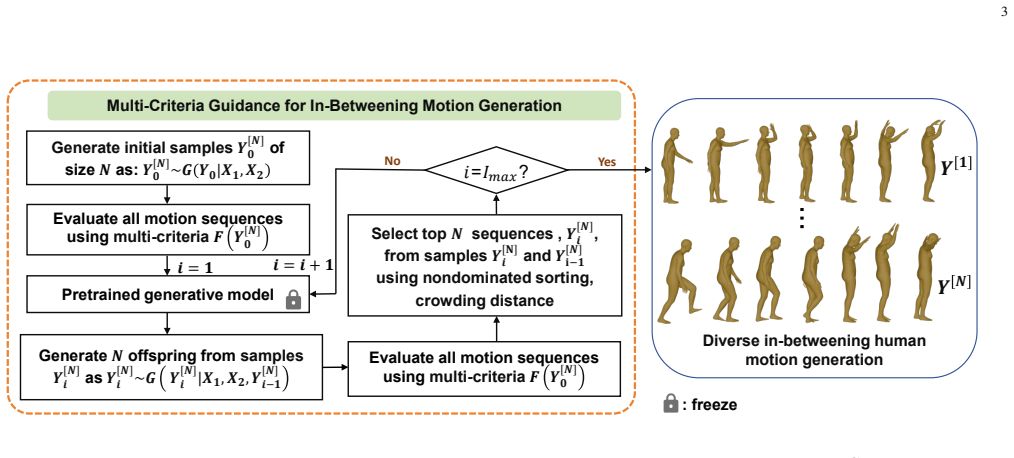
On the paper's own terms, the central claim is that any pretrained in-betweening motion generator can be steered toward more diverse and still smooth outputs by turning its sampling into a two-criteria search. The first criterion uses a frozen action classifier's labels and class probabilities to separate both different action categories and subtle variations within a category; the second measures the discontinuity at the two endpoints where the generated transition meets the user-provided sequences. Solving this two-objective problem with an evolutionary process—generating offspring motions from elite sequences via the frozen generator, then selecting by nondominated sorting and crowding distance—yields a batch of transitions that are mutually diverse and temporally coherent, with no additional training parameters. Two supporting theorems state that any motion minimizing the smoothness term is Pareto-optimal, and that two Pareto-optimal motions whose objective-space distance exceeds $4/D$ must belong to different action classes. The empirical claim is that this guidance consistently improves both diversity and accuracy over prior methods on BABEL, HumanAct12, NTU RGB-D, and GRAB, using DDPM, VAE, or GAN as the frozen backbone.
Load-bearing premise
The load-bearing premise is that the pretrained generative model can be conditioned on a full previously generated motion sequence in addition to the two keyframe sequences, and that the frozen classifier's category probabilities provide a meaningful signal for within-category diversity; the paper does not spell out how VAE or GAN backbones would accept that sequence conditioning.
Editorial extensions
If this is right
- Wrapping an existing pretrained in-betweening model with MCG-IMM should improve intra-batch diversity immediately, without the cost of fine-tuning or architectural changes.
- Diversity and smoothness become inference-time controls: adjusting the criteria or the number of optimization iterations tunes the output batch without touching the trained weights.
- The same Pareto-search wrapper could be dropped onto any conditional generative sequence model that accepts an additional conditioning sequence alongside the fixed keyframes, making the approach a general sampling-time plugin.
- The diversity ceiling is set by the classifier's granularity: a more fine-grained action classifier would let the optimizer separate motions that share a coarse action label.
- Variable-length transitions are handled by predicting the transition length from the cosine similarity of the endpoint poses, avoiding fixed-length assumptions in the backbone.
Reading between the lines
- The plug-and-play claim quietly depends on the backbone accepting a full previously generated sequence as a conditioning input; generative models that only condition on keyframes or latent codes would need a wrapper to satisfy the offspring-generation step, which the paper does not specify.
- Because the diversity term is driven by a classifier's category probabilities, the method's diversity ceiling is set by the classifier's ability to perceive differences; on noisy datasets such as NTU RGB-D, the guidance may struggle, which matches the weaker reported gains there.
- The evolutionary loop is essentially using the frozen generator as a mutation operator, an idea that could transfer to other autoregressive or diffusion-based sequence tasks where a pretrained conditional model plus a classifier are available.
- The two theorems rely on $\alpha_1+\alpha_2=1$ exactly, so any normalization change in the classifier probabilities would break the Pareto-optimality proof and the construction would need reworking.
Editorial analysis
A structured set of objections, weighed in public.
Referee Report
Summary. The paper proposes MCG-IMM, a plug-and-play multi-criteria guidance method for diverse in-betweening human motion generation. It reformulates the sampling process of pretrained generative models (DDPM, VAE, GAN) as a multi-criteria optimization problem with objectives for diversity and smoothness, and solves it using an evolutionary algorithm with nondominated sorting and crowding distance. Experiments on BABEL, HumanAct12, NTU RGB-D, and GRAB are reported, and the paper claims consistent state-of-the-art performance without retraining or additional parameters.
Significance. If the central claim were established, the method would be a valuable lightweight add-on to existing generative models for motion in-betweening, addressing a real need for intra-batch diversity. The paper's ambition to be model-agnostic is attractive, and the inclusion of ablations and the attempt at theoretical support are commendable. However, the manuscript as written does not provide the necessary specification of the conditioning mechanism, and the evaluation is confounded by using the same classifier in both the objective and the metrics.
major comments (5)
- [III.B, Eq. (8), Algorithm 1 line 4] The offspring generation step conditions the generative model on a full previously generated motion sequence Y_{i-1}^{[l']}. For DDPM this could be realized by inpainting or classifier guidance, but no such mechanism is specified; for VAE and GAN, a standard pretrained generator does not accept a full motion sequence as a conditioning input. The paper refers to "the Appendix" for details, but no appendix is included in v1. If the backbones are not conditioned on Y_{i-1}, the offspring distribution is independent of the elite parent and the evolutionary selection degenerates to repeated i.i.d. sampling; if they are, the backbone must have been trained or modified to accept this input, contradicting the "no retraining / no additional parameters" claim. Either way, the reported APD improvements are not attributable to the proposed multi-criteria guidance.
- [IV.C and Eq. (1)] The evaluation metrics ACC and FID are computed using the same pretrained action classifier that is used in the diversity objective via C(Y) and P_c(Y). This is circular: the optimization directly moves generated motions toward the classifier's preferred categories and feature distribution, so the reported ACC and FID gains are at least partly an artifact of optimizing the evaluation signal. An independent evaluation classifier or metrics not derived from the same model are needed.
- [III.A, Eq. (1)] The diversity component is ill-typed: C(Y) is an integer in {0,...,D-1}, while P_c(Y) is described as "the probability that a given motion sequence belongs to each categorized motion type," which would be a D-dimensional vector; adding them is undefined. If P_c(Y) is instead the scalar probability of the predicted class, the notation should say so explicitly. Moreover, both α1 and α2 are per-sample functions; minimizing F1 and F2 does not directly measure or encourage pairwise diversity within the batch, so the connection between the multi-criteria problem and the APD metric is not established.
- [III.A, Theorems 1 and 2] These results are near-tautological consequences of the definitions (α1+α2=1 and the form of β) and do not provide independent support for the diversity claim. Theorem 1 only asserts that minimizers of β are Pareto optimal, and Theorem 2 only states that two solutions in B with sufficiently distant objective vectors have different class labels. Neither theorem guarantees that the evolutionary algorithm will find such solutions or that the resulting batch will be diverse in the sense measured by APD.
- [Table I, Section V.A] The empirical evidence is incomplete and overstates the case for consistency. No error bars or multiple seeds are reported. On NTU RGB-D, MCG-IMM (VAE) has FIDtr 81.64 versus 75.46 for MoFusion; on GRAB, MCG-IMM (VAE) has ACC 78.5 versus 79.21 for MoFusion. Also, the underlying pretrained backbones for the three MCG-IMM variants are not identified, so the comparison across methods is not controlled; differences in base models may account for the reported improvements.
minor comments (6)
- [Section IV.B vs. Eq. (2)] The symbol β is used both for the diffusion noise schedule in Section IV.B and for the smoothness function in Eq. (2), which is confusing and should be disambiguated.
- [Section V.A] The phrase "within a bath process" appears to be a typo for "within a batch process."
- [Abstract] The final sentence of the abstract is grammatically incomplete; it should read something like "consistently outperforms state-of-the-art methods in the in-betweening motion generation task."
- [Eq. (11)] Equation (11) uses Y for the ground truth and Ŷ for the prediction, while elsewhere Y denotes generated sequences; the notation should be unified.
- [Remark 1, Section III.B] The text repeatedly refers to an appendix for details, but the v1 manuscript contains no appendix; this should be fixed before resubmission.
- [Abstract and Section I] The claim "without introducing additional parameters" should be qualified to "no additional trainable parameters," since the classifier C(Y) has its own parameters, even if they are frozen.
Circularity Check
Same pretrained classifier defines the diversity objective and the ACC/FID evaluation metrics; accuracy gains are partly by construction, while APD diversity is independently measured.
-
fitted input called prediction
[Section III.A (Eq. 1), Algorithm 1, Section IV.C (FID/ACC)]
"We assume the availability of a classifier C(Y) that can categorize the motion type represented by a generated motion sequence Y. ... To evaluate motion realism, we report the action recognition accuracy of the generated motions using the same pretrained action recognition model."
The diversity objective (Eq. 1) is built entirely from the outputs of classifier C(Y): α1(Y)=(C(Y)+P_c(Y))/D and α2(Y)=1−α1(Y). Algorithm 1 selects offspring using nondominated sorting on F1,F2, i.e., it explicitly spreads the classifier's predicted labels and probabilities across the batch. The evaluation then measures ACC with "the same pretrained action recognition model" and FID with features from "a pretrained motion classifier model." Since the same fitted classifier defines the search objective and the reported metrics, the ACC/FID improvements over baselines are partly by construction; these metrics are not independent tests of generated motion quality. The diversity metric APD (Eq.
full rationale
The most defensible circular step is the shared classifier. Section III.A defines the diversity component through a pretrained action classifier C(Y) (Eq. 1), and Algorithm 1's selection criterion (F1,F2) is a function of C(Y) and P_c(Y). Section IV.C then evaluates the same method with ACC computed by "the same pretrained action recognition model" and FID from features of "a pretrained motion classifier model." Because the optimizer is explicitly spreading classifier outputs, the reported ACC (and, to a lesser extent, FID) is not an independent measure of quality; this is a partial, evaluation-level circularity. It does not erase the main contribution: APD (Eq. 12) is a label-free pairwise L2 diversity metric, and the plug-and-play/no-retraining property is structurally realized by the sampling-loop design. The two theorems are deductive consequences of the definitions (α1+α2=1) and therefore are not circular, but they add little independent empirical support. A separate concern is the omitted appendix: Eq. (8) conditions offspring on Y_{i-1}, and Section III.B defers the per-backbone construction to "the Appendix"; no appendix is present in v1, so the plug-and-play claim for VAE/GAN rests on an unstated conditioning mechanism. This is missing support, not circularity. Author self-citations ([33], [38]-[41]) appear as related-work and differentiation only, and are not load-bearing for the central claim. Overall score 6: one evaluation metric reduces by construction, while the core diversity claim has independent content.
Assumptions & free parameters
free parameters (5)
- Y_min =
5
- Y_max =
15
- I_max =
20
- population size N =
20
- classifier parameters =
unknown
assumptions (3)
- domain assumption Availability of a pretrained classifier C(Y) that can classify motion types with probabilities.
- domain assumption The pretrained generative models can be conditioned on a full motion sequence Y_{i-1} plus the endpoints.
- domain assumption The distribution of generated motions is smooth enough that evolutionary selection on the two criteria yields realistic transitions.
Cite this review
Pith. "Pith review of A Plug-and-Play Multi-Criteria Guidance for Diverse In-Betweening Human Motion Generation." pith.science (2026). https://pith.science/paper/GXWDRJF2
@misc{pith2026250801590,
  author       = {Pith},
  title        = {Pith review of: A Plug-and-Play Multi-Criteria Guidance for Diverse In-Betweening Human Motion Generation},
  year         = {2026},
  howpublished = {\url{https://pith.science/paper/GXWDRJF2}},
  note         = {Machine review of arXiv:2508.01590}
}
read the original abstract
In-betweening human motion generation aims to synthesize intermediate motions that transition between user-specified keyframes. In addition to maintaining smooth transitions, a crucial requirement of this task is to generate diverse motion sequences. It is still challenging to maintain diversity, particularly when it is necessary for the motions within a generated batch sampling to differ meaningfully from one another due to complex motion dynamics. In this paper, we propose a novel method, termed the Multi-Criteria Guidance with In-Betweening Motion Model (MCG-IMM), for in-betweening human motion generation. A key strength of MCG-IMM lies in its plug-and-play nature: it enhances the diversity of motions generated by pretrained models without introducing additional parameters This is achieved by providing a sampling process of pretrained generative models with multi-criteria guidance. Specifically, MCG-IMM reformulates the sampling process of pretrained generative model as a multi-criteria optimization problem, and introduces an optimization process to explore motion sequences that satisfy multiple criteria, e.g., diversity and smoothness. Moreover, our proposed plug-and-play multi-criteria guidance is compatible with different families of generative models, including denoised diffusion probabilistic models, variational autoencoders, and generative adversarial networks. Experiments on four popular human motion datasets demonstrate that MCG-IMM consistently state-of-the-art methods in in-betweening motion generation task.
Figures


Figures from the paper (3 more)


Reference graph
Works this paper leans on
-
[1]
Denoising diffusion prob- abilistic models.Advances in neural information processing systems, 33:6840–6851, 2020
Jonathan Ho, Ajay Jain, and Pieter Abbeel. Denoising diffusion prob- abilistic models.Advances in neural information processing systems, 33:6840–6851, 2020
2020
-
[2]
Human motion diffusion as a generative prior
Yoni Shafir, Guy Tevet, Roy Kapon, and Amit Haim Bermano. Human motion diffusion as a generative prior. InThe Twelfth International Conference on Learning Representations, 2024
work page 2024
-
[3]
Diederik P Kingma, Max Welling, et al. An introduction to varia- tional autoencoders.Foundations and Trends® in Machine Learning, 12(4):307–392, 2019
work page 2019
-
[4]
Gen- erative adversarial networks.Communications of the ACM, 63(11):139– 144, 2020
Ian Goodfellow, Jean Pouget-Abadie, Mehdi Mirza, Bing Xu, David Warde-Farley, Sherjil Ozair, Aaron Courville, and Yoshua Bengio. Gen- erative adversarial networks.Communications of the ACM, 63(11):139– 144, 2020
work page 2020
-
[5]
Yang Song, Jascha Sohl-Dickstein, Diederik P Kingma, Abhishek Kumar, Stefano Ermon, and Ben Poole. Score-based generative modeling through stochastic differential equations.arXiv preprint arXiv:2011.13456, 2020
arXiv 2011
-
[6]
Ta2v: Text-audio guided video generation.IEEE Transactions on Multimedia, 26:7250–7264, 2024
Minglu Zhao, Wenmin Wang, Tongbao Chen, Rui Zhang, and Ruochen Li. Ta2v: Text-audio guided video generation.IEEE Transactions on Multimedia, 26:7250–7264, 2024
2024
-
[7]
Baptiste Chopin, Hao Tang, Naima Otberdout, Mohamed Daoudi, and Nicu Sebe. Interaction transformer for human reaction generation.IEEE Transactions on Multimedia, 25:8842–8854, 2023
work page 2023
-
[8]
Junyu Shi, Jianqi Zhong, and Wenming Cao. Multi-semantics aggrega- tion network based on the dynamic-attention mechanism for 3d human motion prediction.IEEE Transactions on Multimedia, 26:5194–5206, 2024
work page 2024
Show all 53 references
-
[9]
Fusepose: Imu-vision sensor fusion in kinematic space for parametric human pose estimation.IEEE Transactions on Multimedia, 25:7736–7746, 2023
Yiming Bao, Xu Zhao, and Dahong Qian. Fusepose: Imu-vision sensor fusion in kinematic space for parametric human pose estimation.IEEE Transactions on Multimedia, 25:7736–7746, 2023
2023
-
[10]
Cross- modal quantization for co-speech gesture generation.IEEE Transactions on Multimedia, 26:10251–10263, 2024
Zheng Wang, Wei Zhang, Long Ye, Dan Zeng, and Tao Mei. Cross- modal quantization for co-speech gesture generation.IEEE Transactions on Multimedia, 26:10251–10263, 2024
2024
-
[11]
I know how you move: Explicit motion estimation for human action recognition.IEEE Transactions on Multimedia, 27:1665–1676, 2025
Zhongwei Shen, Xiao-Jun Wu, Hui Li, Tianyang Xu, and Cong Wu. I know how you move: Explicit motion estimation for human action recognition.IEEE Transactions on Multimedia, 27:1665–1676, 2025
2025
-
[12]
Human motion diffusion model
Guy Tevet, Sigal Raab, Brian Gordon, Yoni Shafir, Daniel Cohen-or, and Amit Haim Bermano. Human motion diffusion model. InThe Eleventh International Conference on Learning Representations, 2023
2023
-
[13]
Xiaokai Yi, Hanli Wang, Sam Kwong, and C.-C. Jay Kuo. Task-driven video compression for humans and machines: Framework design and optimization.IEEE Transactions on Multimedia, 25:8091–8102, 2023
2023
-
[14]
Implicit compositional generative network for length-variable co-speech gesture synthesis.IEEE Transactions on Multimedia, 26:6325–6335, 2024
Chenghao Xu, Jiexi Yan, Yanhua Yang, and Cheng Deng. Implicit compositional generative network for length-variable co-speech gesture synthesis.IEEE Transactions on Multimedia, 26:6325–6335, 2024
2024
-
[15]
Co- herent image animation using spatial-temporal correspondence.IEEE Transactions on Multimedia, 25:3397–3408, 2023
Weilun Wang, Wengang Zhou, Jianmin Bao, and Houqiang Li. Co- herent image animation using spatial-temporal correspondence.IEEE Transactions on Multimedia, 25:3397–3408, 2023
2023
-
[16]
Attention is all you need.Advances in neural information processing systems, 30, 2017
Ashish Vaswani, Noam Shazeer, Niki Parmar, Jakob Uszkoreit, Llion Jones, Aidan N Gomez, Łukasz Kaiser, and Illia Polosukhin. Attention is all you need.Advances in neural information processing systems, 30, 2017
2017
-
[17]
Robust motion in-betweening.ACM Transactions on Graphics (TOG), 39(4):60–1, 2020
F ´elix G Harvey, Mike Yurick, Derek Nowrouzezahrai, and Christopher Pal. Robust motion in-betweening.ACM Transactions on Graphics (TOG), 39(4):60–1, 2020. 10
2020
-
[18]
Weakly-supervised action transition learning for stochastic human motion prediction
Wei Mao, Miaomiao Liu, and Mathieu Salzmann. Weakly-supervised action transition learning for stochastic human motion prediction. In Proceedings of the IEEE/CVF Conference on Computer Vision and Pattern Recognition, pages 8151–8160, 2022
2022
-
[19]
SCORE-BASED GEN- ERATIVE MODELING THROUGH STOCHASTIC DIFFERENTIAL EQUATIONS
Yang Song, Jascha Sohl-Dickstein, Diederik P Kingma, Abhishek Kumar, Stefano Ermon, and Ben Poole. SCORE-BASED GEN- ERATIVE MODELING THROUGH STOCHASTIC DIFFERENTIAL EQUATIONS. 2021
2021
-
[20]
Improved techniques for training score- based generative models.Advances in neural information processing systems, 33:12438–12448, 2020
Yang Song and Stefano Ermon. Improved techniques for training score- based generative models.Advances in neural information processing systems, 33:12438–12448, 2020
2020
-
[21]
Denoising diffusion implicit models
Jiaming Song, Chenlin Meng, and Stefano Ermon. Denoising diffusion implicit models. InInternational Conference on Learning Representa- tions, 2021
2021
-
[22]
Diffusion models already have a semantic latent space.arXiv preprint arXiv:2210.10960, 2022
Mingi Kwon, Jaeseok Jeong, and Youngjung Uh. Diffusion models already have a semantic latent space.arXiv preprint arXiv:2210.10960, 2022
2022 arXiv
-
[23]
Motiondiffuser: Controllable multi-agent motion prediction using diffusion
Chiyu Jiang, Andre Cornman, Cheolho Park, Benjamin Sapp, Yin Zhou, Dragomir Anguelov, et al. Motiondiffuser: Controllable multi-agent motion prediction using diffusion. InProceedings of the IEEE/CVF conference on computer vision and pattern recognition, pages 9644– 9653, 2023
2023
-
[24]
Action2motion: Conditioned generation of 3d human motions
Chuan Guo, Xinxin Zuo, Sen Wang, Shihao Zou, Qingyao Sun, Annan Deng, Minglun Gong, and Li Cheng. Action2motion: Conditioned generation of 3d human motions. InProceedings of the 28th ACM International Conference on Multimedia, pages 2021–2029, 2020
2021
-
[25]
Dlow: Diversifying latent flows for diverse human motion prediction
Ye Yuan and Kris Kitani. Dlow: Diversifying latent flows for diverse human motion prediction. InComputer Vision–ECCV 2020: 16th European Conference, Glasgow, UK, August 23–28, 2020, Proceedings, Part IX 16, pages 346–364. Springer, 2020
2020
-
[26]
Convolutional autoencoders for human motion infilling
Manuel Kaufmann, Emre Aksan, Jie Song, Fabrizio Pece, Remo Ziegler, and Otmar Hilliges. Convolutional autoencoders for human motion infilling. In2020 International Conference on 3D Vision (3DV), pages 918–927, 2020
2020
-
[27]
Sd-nerf: Towards lifelike talking head animation via spatially- adaptive dual-driven nerfs.IEEE Transactions on Multimedia, 26:3221– 3234, 2024
Shuai Shen, Wanhua Li, Xiaoke Huang, Zheng Zhu, Jie Zhou, and Jiwen Lu. Sd-nerf: Towards lifelike talking head animation via spatially- adaptive dual-driven nerfs.IEEE Transactions on Multimedia, 26:3221– 3234, 2024
2024
-
[28]
Recurrent network models for human dynamics
Katerina Fragkiadaki, Sergey Levine, Panna Felsen, and Jitendra Malik. Recurrent network models for human dynamics. InProceedings of the IEEE international conference on computer vision, pages 4346–4354, 2015
2015
-
[29]
Sequential texts driven cohesive motions synthesis with natural transitions
Shuai Li, Sisi Zhuang, Wenfeng Song, Xinyu Zhang, Hejia Chen, and Aimin Hao. Sequential texts driven cohesive motions synthesis with natural transitions. InProceedings of the IEEE/CVF International Conference on Computer Vision, pages 9498–9508, 2023
2023
-
[30]
Diverse motion variations for physics-based character animation
Shailen Agrawal, Shuo Shen, and Michiel Van de Panne. Diverse motion variations for physics-based character animation. InProceedings of the 12th ACM SIGGRAPH/Eurographics Symposium on Computer Animation, pages 37–44, 2013
2013
-
[31]
Real-time controllable motion transition for characters
Xiangjun Tang, He Wang, Bo Hu, Xu Gong, Ruifan Yi, Qilong Kou, and Xiaogang Jin. Real-time controllable motion transition for characters. ACM Transactions on Graphics (TOG), 41(4):1–10, 2022
2022
-
[32]
Generative tweening: Long-term inbetweening of 3d human motions
Yi Zhou, Jingwan Lu, Connelly Barnes, Jimei Yang, Sitao Xiang, et al. Generative tweening: Long-term inbetweening of 3d human motions. arXiv preprint arXiv:2005.08891, 2020
2005 arXiv
-
[33]
Towards efficient and diverse generative model for unconditional human motion synthesis
Hua Yu, Weiming Liu, Jiapeng Bai, Xu Gui, Yaqing Hou, YewSoon Ong, and Qiang Zhang. Towards efficient and diverse generative model for unconditional human motion synthesis. InProceedings of the 32nd ACM International Conference on Multimedia, MM ’24, page 2535–2544, New York, ...
2024
-
[34]
Multiact: Long- term 3d human motion generation from multiple action labels
Taeryung Lee, Gyeongsik Moon, and Kyoung Mu Lee. Multiact: Long- term 3d human motion generation from multiple action labels. InPro- ceedings of the AAAI Conference on Artificial Intelligence, volume 37, pages 1231–1239, 2023
2023
-
[35]
Omnicontrol: Control any joint at any time for human motion generation, 2024
Yiming Xie, Varun Jampani, Lei Zhong, Deqing Sun, and Huaizu Jiang. Omnicontrol: Control any joint at any time for human motion generation, 2024
2024
-
[36]
Mofusion: A framework for denoising-diffusion- based motion synthesis
Rishabh Dabral, Muhammad Hamza Mughal, Vladislav Golyanik, and Christian Theobalt. Mofusion: A framework for denoising-diffusion- based motion synthesis. InProceedings of the IEEE/CVF Conference on Computer Vision and Pattern Recognition, pages 9760–9770, 2023
2023
-
[37]
Flexible motion in-betweening with diffusion models
Setareh Cohan, Guy Tevet, Daniele Reda, Xue Bin Peng, and Michiel van de Panne. Flexible motion in-betweening with diffusion models. InACM SIGGRAPH 2024 Conference Papers, SIGGRAPH ’24, New York, NY , USA, 2024. Association for Computing Machinery
2024
-
[38]
Divdiff: A conditional diffusion model for diverse human motion pre- diction.IEEE Transactions on Multimedia, 27:1848–1859, 2025
Hua Yu, Yaqing Hou, Wenbin Pei, Yew-Soon Ong, and Qiang Zhang. Divdiff: A conditional diffusion model for diverse human motion pre- diction.IEEE Transactions on Multimedia, 27:1848–1859, 2025
2025
-
[39]
Deterministic-to-stochastic diverse latent feature mapping for human motion synthesis
Yu Hua, Weiming Liu, Gui Xu, Yaqing Hou, Yew-Soon Ong, and Qiang Zhang. Deterministic-to-stochastic diverse latent feature mapping for human motion synthesis. InProceedings of the Computer Vision and Pattern Recognition Conference (CVPR), pages 22724–22734, June 2025
2025
-
[40]
Fast direct: Query-efficient online black-box guidance for diffusion-model target generation
Kim Yong Tan, Yueming Lyu, Ivor Tsang, and Yew-Soon Ong. Fast direct: Query-efficient online black-box guidance for diffusion-model target generation. InThe Thirteenth International Conference on Learning Representations, 2025
2025
-
[41]
Evolvable conditional diffusion.arXiv preprint arXiv:2506.13834, 2025
Zhao Wei, Chin Chun Ooi, Abhishek Gupta, Jian Cheng Wong, Pao- Hsiung Chiu, Sheares Xue Wen Toh, and Yew-Soon Ong. Evolvable conditional diffusion.arXiv preprint arXiv:2506.13834, 2025
2025 arXiv
-
[42]
Empirical evaluation of gated recurrent neural networks on sequence modeling
Junyoung Chung, Caglar Gulcehre, Kyunghyun Cho, and Yoshua Ben- gio. Empirical evaluation of gated recurrent neural networks on sequence modeling. InNIPS 2014 Workshop on Deep Learning, December 2014, 2014
2014
-
[43]
A generator for multiobjective test problems with difficult-to-approximate pareto front boundaries.IEEE Transactions on Evolutionary Computation, 23(4):556–571, 2019
Zhenkun Wang, Yew-Soon Ong, Jianyong Sun, Abhishek Gupta, and Qingfu Zhang. A generator for multiobjective test problems with difficult-to-approximate pareto front boundaries.IEEE Transactions on Evolutionary Computation, 23(4):556–571, 2019
2019
-
[44]
Consistencies and contradictions of performance metrics in multiobjective optimiza- tion.IEEE Transactions on Cybernetics, 44(12):2391–2404, 2014
Siwei Jiang, Yew-Soon Ong, Jie Zhang, and Liang Feng. Consistencies and contradictions of performance metrics in multiobjective optimiza- tion.IEEE Transactions on Cybernetics, 44(12):2391–2404, 2014
2014
-
[45]
Prompt evolution for generative ai: A classifier- guided approach
Melvin Wong, Yew-Soon Ong, Abhishek Gupta, Kavitesh Kumar Bali, and Caishun Chen. Prompt evolution for generative ai: A classifier- guided approach. In2023 IEEE Conference on Artificial Intelligence (CAI), pages 226–229, 2023
2023
-
[46]
Motion in-betweening via two- stage transformers.ACM Transactions on Graphics (TOG), 41(6):1–16, 2022
Jia Qin, Youyi Zheng, and Kun Zhou. Motion in-betweening via two- stage transformers.ACM Transactions on Graphics (TOG), 41(6):1–16, 2022
2022
-
[47]
Action-conditioned 3d human motion synthesis with transformer vae
Mathis Petrovich, Michael J Black, and G ¨ul Varol. Action-conditioned 3d human motion synthesis with transformer vae. InProceedings of the IEEE/CVF International Conference on Computer Vision, pages 10985– 10995, 2021
2021
-
[48]
Babel: Bodies, action and behavior with english labels
Abhinanda R Punnakkal, Arjun Chandrasekaran, Nikos Athanasiou, Alejandra Quiros-Ramirez, and Michael J Black. Babel: Bodies, action and behavior with english labels. InProceedings of the IEEE/CVF Conference on Computer Vision and Pattern Recognition, pages 722– 731, 2021
2021
-
[49]
Ntu rgb+ d 120: A large-scale benchmark for 3d human activity understanding.IEEE transactions on pattern analysis and machine intelligence, 42(10):2684–2701, 2019
Jun Liu, Amir Shahroudy, Mauricio Perez, Gang Wang, Ling-Yu Duan, and Alex C Kot. Ntu rgb+ d 120: A large-scale benchmark for 3d human activity understanding.IEEE transactions on pattern analysis and machine intelligence, 42(10):2684–2701, 2019
2019
-
[50]
Grab: A dataset of whole-body human grasping of objects
Omid Taheri, Nima Ghorbani, Michael J Black, and Dimitrios Tzionas. Grab: A dataset of whole-body human grasping of objects. InComputer Vision–ECCV 2020: 16th European Conference, Glasgow, UK, August 23–28, 2020, Proceedings, Part IV 16, pages 581–600. Springer, 2020
2020
-
[51]
Vibe: Video inference for human body pose and shape estimation
Muhammed Kocabas, Nikos Athanasiou, and Michael J Black. Vibe: Video inference for human body pose and shape estimation. InPro- ceedings of the IEEE/CVF conference on computer vision and pattern recognition, pages 5253–5263, 2020
2020
-
[52]
A fast and elitist multiobjective genetic algorithm: Nsga-ii.IEEE transactions on evolutionary computation, 6(2):182–197, 2002
Kalyanmoy Deb, Amrit Pratap, Sameer Agarwal, and TAMT Meyarivan. A fast and elitist multiobjective genetic algorithm: Nsga-ii.IEEE transactions on evolutionary computation, 6(2):182–197, 2002
2002
-
[53]
Conditional motion in-betweening.Pattern Recognition, 132:108894, 2022
Jihoon Kim, Taehyun Byun, Seungyoun Shin, Jungdam Won, and Sungjoon Choi. Conditional motion in-betweening.Pattern Recognition, 132:108894, 2022
2022
Reviewed August 6, 2026 · model on record in the stance chip above.
Discussion (0). Continue with ORCID to comment.