Magnetic long-range order at finite temperature in two-dimensional hyperbolic lattices
Pith reviewed 2026-06-29 01:31 UTC · model grok-4.3
The pith
Spin-wave theory shows hyperbolic lattices lift the Mermin-Wagner obstruction, allowing finite-temperature magnetic order while preserving continuous spin symmetry.
A machine-rendered reading of the paper's core claim, the machinery that carries it, and where it could break.
Core claim
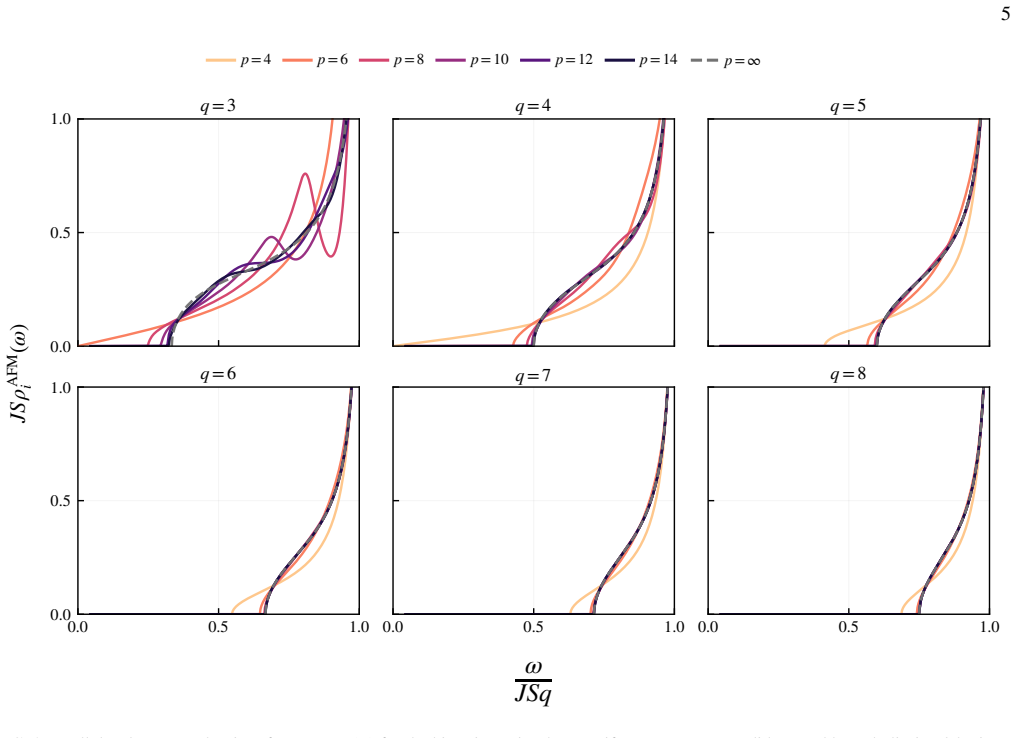
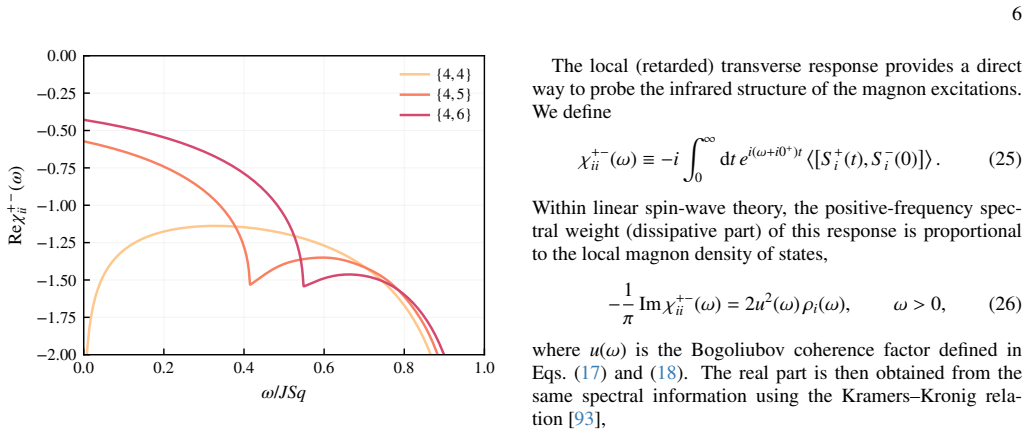
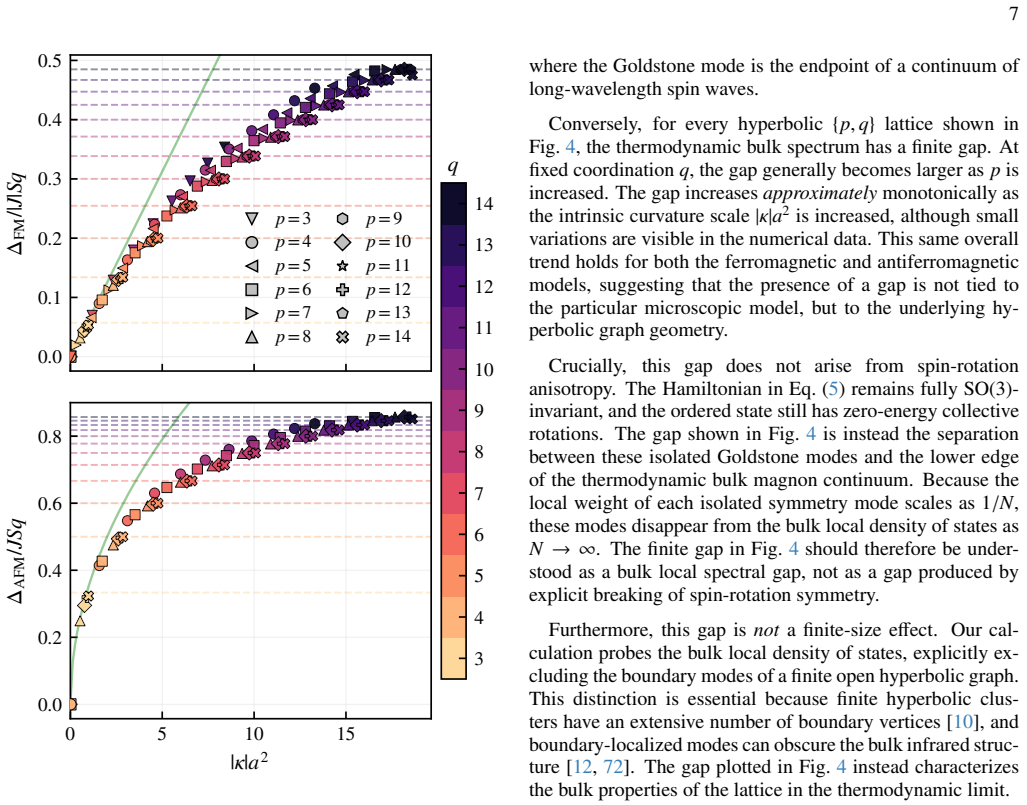
In the spin-S Heisenberg model on regular hyperbolic tilings the infrared singularities of Goldstone modes are absent from the local spectral density, which remains gapped at zero energy and separated from the thermodynamic bulk magnon continuum; as a result local transverse correlations stay short-ranged with finite correlation length despite the broken continuous symmetry.
What carries the argument
The local spectral density of Goldstone modes, which vanishes at zero energy and is separated by a finite gap from the bulk magnon continuum.
If this is right
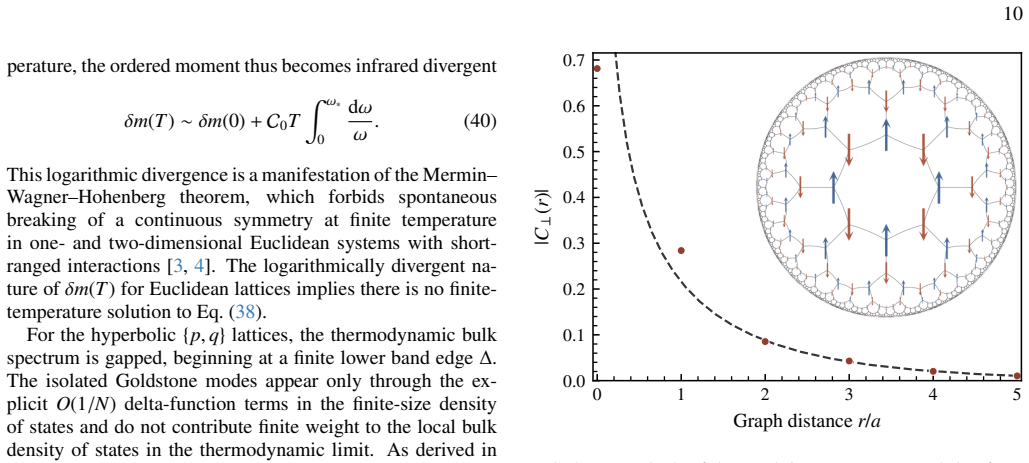
- Local transverse correlations remain short-ranged with a finite correlation length.
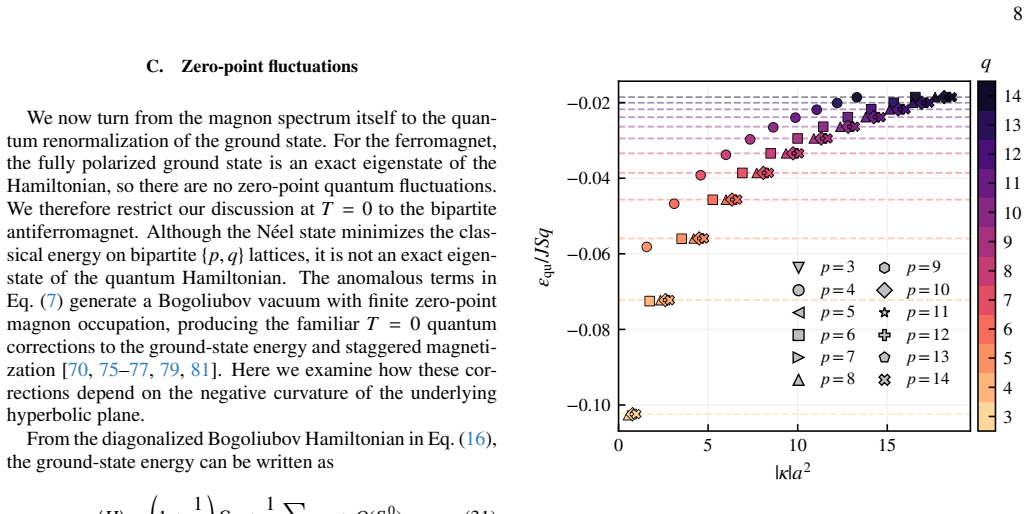
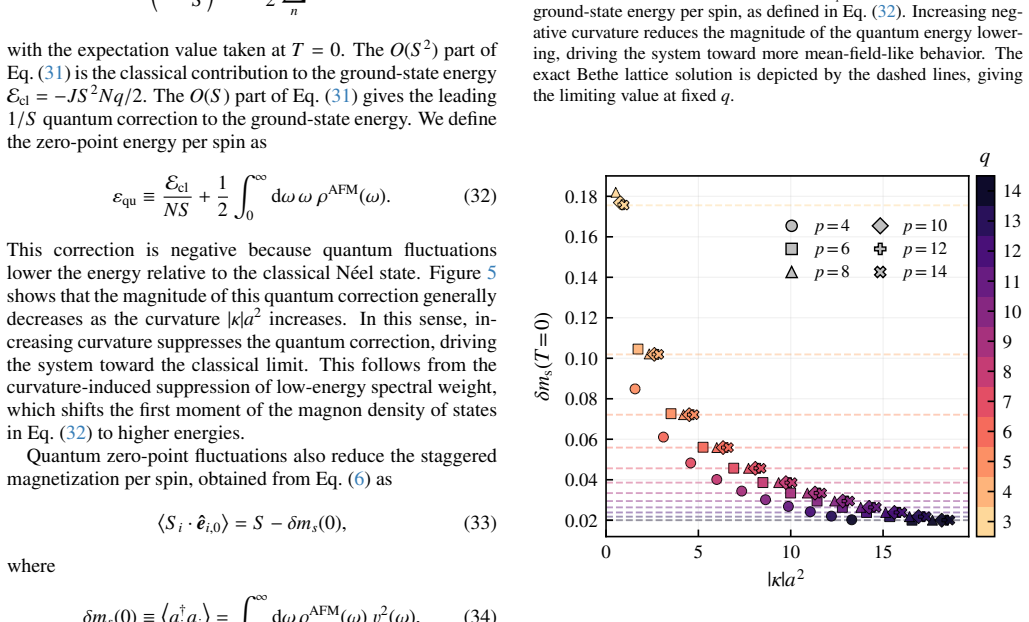
- Stronger negative curvature suppresses quantum fluctuations in bulk thermodynamic quantities.
- The ordered state is pushed toward mean-field-like behavior.
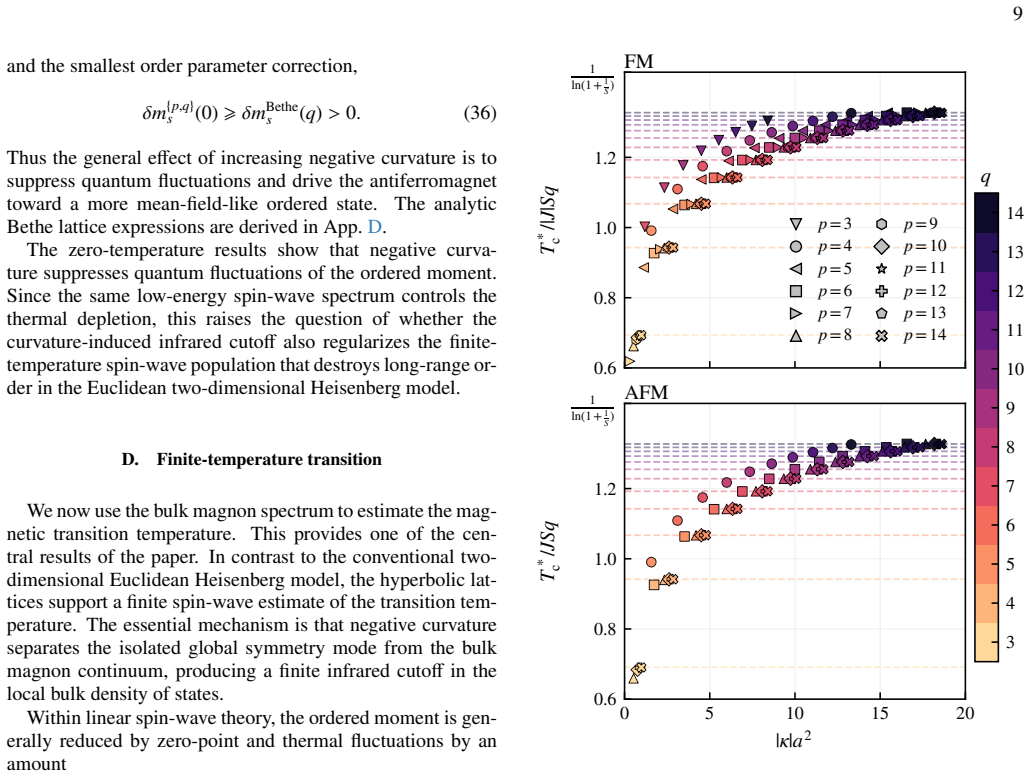
- An ordering temperature can be estimated from the thermal spin-wave correction to the ordered moment.
Where Pith is reading between the lines
- The same local-gap mechanism may allow other continuous-symmetry-breaking phases at finite temperature on hyperbolic lattices.
- Real-space curvature could be engineered in metamaterials or cold-atom arrays to test whether the ordering temperature rises with curvature strength.
- The result suggests that local spectral properties, rather than global mode counting, determine whether Goldstone modes destroy order in curved geometries.
Load-bearing premise
The local spectral density of the Goldstone modes controls the spatial decay of correlations and spin-wave theory remains quantitatively reliable on hyperbolic lattices at finite temperature.
What would settle it
A direct measurement of the local magnon spectral density on a hyperbolic lattice that shows a finite gap at zero energy, or a measurement of exponentially decaying local spin correlations at finite temperature above any putative ordering scale.
Figures
read the original abstract
Infrared singularities of gapless Goldstone modes preclude magnetic long-range order at finite temperature in conventional two-dimensional systems. By studying the spin-$S$ Heisenberg model on regular tilings of the hyperbolic plane, we show that this obstruction is absent in negatively curved space. Using spin-wave theory, we find that the zero-energy collective modes required by symmetry carry vanishing local spectral weight and are separated from the thermodynamic bulk magnon continuum by a finite gap in the bulk local spectral density. As a result, local transverse correlations remain short ranged, with a finite correlation length, despite the presence of Goldstone modes associated with the broken SO(3) spin-rotation symmetry. Stronger negative curvature is found to suppress quantum fluctuations in bulk thermodynamic quantities, pushing the ordered state toward "mean-field-like" behavior. We further estimate the ordering temperature from the thermal spin-wave correction to the ordered moment. These results establish hyperbolic geometry as a route to finite-temperature magnetic order that circumvents the Mermin-Wagner obstruction without breaking or modifying the continuous symmetry.
Editorial analysis
A structured set of objections, weighed in public.
Referee Report
Summary. The manuscript applies spin-wave theory to the spin-S Heisenberg model on regular hyperbolic tilings. It claims that Goldstone modes required by broken SO(3) symmetry carry vanishing local spectral weight and are separated from the bulk magnon continuum by a finite gap in the local spectral density. Consequently, local transverse spin correlations remain short-ranged with finite correlation length at finite temperature, permitting magnetic long-range order and thereby circumventing the Mermin-Wagner obstruction in two-dimensional negatively curved space. Stronger curvature is reported to suppress quantum fluctuations and drive mean-field-like behavior; an ordering temperature is estimated from the thermal correction to the ordered moment.
Significance. If the central spin-wave results hold, the work identifies hyperbolic geometry as a route to finite-temperature order with unbroken continuous symmetry, which would be of clear interest to the condensed-matter community studying quantum magnetism beyond Euclidean lattices. The parameter-free character of the local spectral-density analysis within the spin-wave framework is a technical strength.
major comments (1)
- [Spin-wave analysis (abstract and main derivation)] The central claim that local fluctuations remain finite rests on the local spectral density of Goldstone modes vanishing (or being gapped) in the bulk. This is obtained entirely within linear spin-wave theory; the manuscript provides no explicit argument or bound showing that higher-order corrections or non-perturbative effects cannot restore an infrared divergence in the local fluctuation integral when the mode density is altered by curvature. In flat 2D the same approximation correctly signals the absence of order, so the transfer of validity to hyperbolic geometry is load-bearing and requires justification.
minor comments (2)
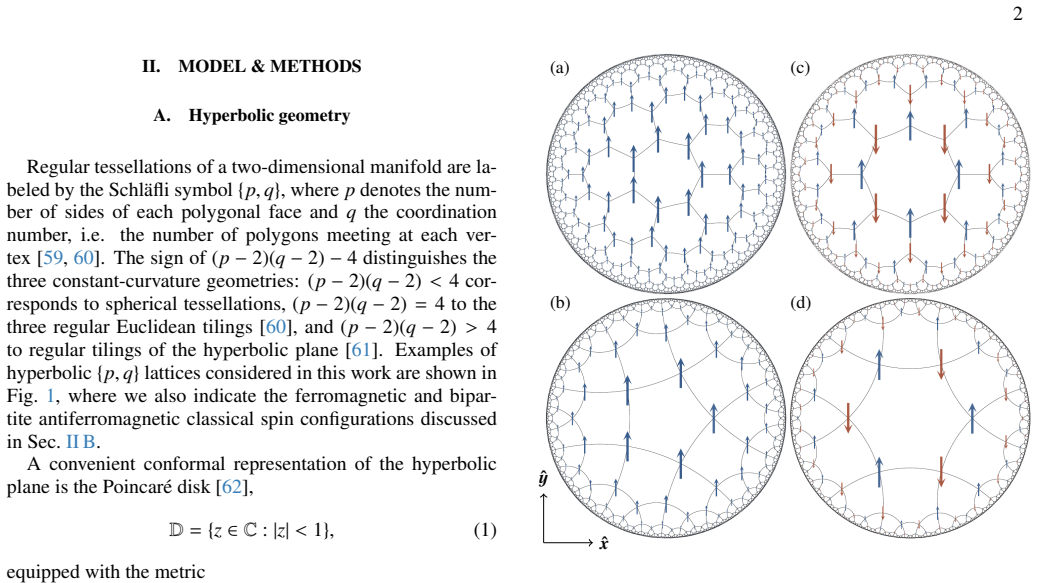
- Specify the concrete regular tilings (e.g., {7,3}, {5,4}) studied and whether results are qualitatively independent of the particular hyperbolic lattice.
- Clarify whether the ordering-temperature estimate is obtained from a self-consistent spin-wave equation or from a simpler perturbative correction.
Simulated Author's Rebuttal
We thank the referee for their careful reading, positive assessment of the work's significance, and constructive comment. We address the major concern below and indicate the planned revision.
read point-by-point responses
-
Referee: [Spin-wave analysis (abstract and main derivation)] The central claim that local fluctuations remain finite rests on the local spectral density of Goldstone modes vanishing (or being gapped) in the bulk. This is obtained entirely within linear spin-wave theory; the manuscript provides no explicit argument or bound showing that higher-order corrections or non-perturbative effects cannot restore an infrared divergence in the local fluctuation integral when the mode density is altered by curvature. In flat 2D the same approximation correctly signals the absence of order, so the transfer of validity to hyperbolic geometry is load-bearing and requires justification.
Authors: We agree that the central results are obtained within linear spin-wave theory (LSWT) and that the same framework correctly signals the absence of order in flat 2D via divergent local fluctuations. In the hyperbolic case the negative curvature alters the single-magnon spectrum such that the local spectral density of the Goldstone modes vanishes at zero energy, producing a finite local fluctuation integral; this geometric feature is captured exactly within the harmonic approximation. While a rigorous non-perturbative bound lies outside the present scope, the suppression is tied to the curvature-modified density of states rather than to details of the interaction. We will revise the manuscript to add an explicit discussion paragraph on the applicability of LSWT, emphasizing the geometric origin of the local gap and the expectation that 1/S corrections will not reintroduce a local infrared divergence. revision: yes
Circularity Check
No circularity: spin-wave calculation on hyperbolic geometry is independent of inputs
full rationale
The derivation applies linear spin-wave theory to the Heisenberg model on regular hyperbolic tilings. The key step computes the local spectral density of Goldstone modes from the lattice geometry and finds it vanishes in the bulk, yielding finite correlation length. This is a direct evaluation on the new manifold, not a redefinition or fit of the target quantity. No self-citations, fitted parameters renamed as predictions, or ansatze smuggled via prior work appear in the provided text. The ordering-temperature estimate follows from the same spin-wave correction without reducing to the input assumptions by construction. The result is therefore self-contained against external benchmarks.
Axiom & Free-Parameter Ledger
axioms (1)
- domain assumption Spin-wave theory provides a reliable description of the low-energy excitations and thermodynamics of the spin-S Heisenberg model on hyperbolic lattices
Reference graph
Works this paper leans on
-
[1]
Isometries We represent the hyperbolic plane by the Poincaré disk, D={z∈C:|z|<1},(A.1) with metric defined in Eq. (2). The complex coordinate z=x+iyis used to embed and visualize the lattice in hyper- bolic space. The spin Hamiltonian and the spin-wave spectra depend on the graph adjacency matrix, not on the particular disk embedding. Thus two embeddings ...
-
[2]
Curvature scale of a{p,q}lattice For a regular{p,q}tiling, the edge lengthaand Gaussian curvatureκ <0 are related by Eq. (4). This expression makes explicit that, once the microscopic edge lengthais fixed, the curvature scale is determined entirely by the corresponding Schläfli symbol. Figure A.1 shows the resulting intrinsic cur- vature scale for some of...
-
[3]
We use a vertex-inflation construction, closely related to the procedures used in Refs
Vertex inflation and finite open clusters The adjacency matrices used for numerical calculations in this work are generated from finite open clusters of the infinite {p,q}tiling. We use a vertex-inflation construction, closely related to the procedures used in Refs. [33, 91, 121]. The construction starts from a central regularp-gon. The graph is then grow...
-
[4]
(q−4)+ q (q−4) 2 −4 # ,(B.7a) λ4,q = 1 2
Graph distance and geodesic distance Two notions of distance appear in this work: the continu- ous geodesic distance from the Poincaré disk embedding used in Sec. II A, and the discrete graph distance counting nearest- neighbor bonds used in Sec. III E. The Poincaré disk embed- ding gives a continuous hyperbolic geodesic distance, Eq. (3), between the emb...
-
[5]
Adjacency local Green’s function LetAdenote the adjacency matrix of the{p,q}lattice. For a site-localized basis state |i⟩, we define the local Green’s func- tion of the adjacency matrix as gii(z)= ⟨i|(z−A )−1|i⟩ .(C.1) The corresponding adjacency local density of states is νi(λ)=− 1 π Img ii(λ+i0 +).(C.2) This is the local spectral measure that enters the...
-
[6]
We set |φ0⟩ = |i⟩ , |φ−1⟩ =0, β 0 =0.(C.3) Forn=0,1,2,
Continued-fraction method The continued-fraction method is a Lanczos recursion ini- tialized with the local state |i⟩. We set |φ0⟩ = |i⟩ , |φ−1⟩ =0, β 0 =0.(C.3) Forn=0,1,2, . . ., define αn = ⟨φn| A|φn⟩ ,(C.4) | ˜φn+1⟩ =A |φn⟩ −α n |φn⟩ −β n |φn−1⟩ ,(C.5) βn+1 = p ⟨ ˜φn+1| ˜φn+1⟩,(C.6) |φn+1⟩ = 1 βn+1 | ˜φn+1⟩ .(C.7) The recursion terminates only ifβ n+1...
-
[7]
The magnon frequency associated with an adjacency eigenvalue λis given by Eq
Ferromagnetic magnon density of states For the Heisenberg ferromagnet, the quadratic spin-wave Hamiltonian is diagonal in the adjacency eigenbasis. The magnon frequency associated with an adjacency eigenvalue λis given by Eq. (17). Changing variables fromλtoωgives the local ferromagnetic magnon density of states ρFM i (ω)= 1 S|J| νi q− ω S|J| ! .(C.14) Th...
-
[8]
The normal-mode frequencies are again determined by the adjacency eigenvalues
Antiferromagnetic magnon density of states For the bipartite Heisenberg antiferromagnet, the quadratic spin-wave Hamiltonian is diagonalized by a bosonic Bogoli- ubov transformation. The normal-mode frequencies are again determined by the adjacency eigenvalues. For an adjacency eigenvalueλ, the antiferromagnetic spin-wave frequency is given by Eq. (18). F...
-
[9]
III D is controlled by the lower band edge of the bulk magnon continuum and, in particular, by the power-law exponent with which the local density of states vanishes at that edge
Band-edge scaling and moment asymptotics The low-temperature thermodynamics discussed in Sec. III D is controlled by the lower band edge of the bulk magnon continuum and, in particular, by the power-law exponent with which the local density of states vanishes at that edge. For the continued fraction method described in App. C 2, the constant tail terminat...
-
[10]
Let gi j(z)≡ ⟨i| (z−A) −1 | j⟩ ,(D.1) whereAis the adjacency matrix
Bethe lattice Green’s function We first derive the adjacency resolvent of the Bethe lattice. Let gi j(z)≡ ⟨i| (z−A) −1 | j⟩ ,(D.1) whereAis the adjacency matrix. For fixed reference sitej, the matrix elementg i j(z) depends only on the graph distance n, which we denote byg n(z). The equation (z−A)g(z)=1(D.2) then gives zg0(z)−qg 1(z)=1,(D.3) zgn(z)−g n−1(...
-
[11]
Ferromagnetic solution For the Heisenberg ferromagnet, the spin-wave spectrum is obtained from Eq. (17). Substituting the Kesten–McKay measure in Eq. (D.11) into Eq. (23) gives ρFM(ω)= q 2π|J|S q 4(q−1)− q− ω |J|S 2 q2 − q− ω |J|S 2 ,(D.12) with support q−2 p q−1⩽ ω |J|S ⩽q+2 p q−1.(D.13) The isolated uniform mode atλ=qlies outside the thermo- dynamic bul...
-
[12]
Antiferromagnetic solution For the antiferromagnetJ>0, the spin-wave spectrum is obtained from Eq. (18). Using Eq. (20) with the Kesten– McKay measure in Eq. (D.11) gives ρAFM(ω)= q πω s ω2 −(JS) 2(q−2) 2 (JS) 2q2 −ω 2 ,(D.22) with support q−2⩽ ω JS ⩽q.(D.23) The corresponding bulk antiferromagnetic gap is ∆AFM =JS(q−2).(D.24) Equation (D.24) gives thep=∞...
-
[13]
Transverse correlations of the bipartite antiferromagnet We now derive the long-distance form of the equal-time transverse correlation function for the bipartite Heisenberg an- tiferromagnet on theq-regular Bethe lattice. We denote the graph distance between two sitesiandjby the integer n≡ ri j a .(D.41) Because the Bethe lattice is bipartite, the parity ...
-
[14]
Effective field theory of the hyperbolic antiferromagnet Here, we derive the effective Goldstone action in the con- tinuum limit for an antiferromagnetic Heisenberg model ind- dimensional hyperbolic space. We use Poincaré ball coordi- natesx∈R d with|x|<1, equipped with the metric ds2 = 4 |κ| |dx|2 (1− |x| 2)2 .(E.1) 25 Consider the partition function of ...
-
[15]
Then the imaginary-time action is S[n]= Z dτd d x p |g| " −i S Vv A(n)·∂ τn+ ρs 2 gab∂a n·∂ bn #
Effective field theory of the hyperbolic ferromagnet The ferromagnetic continuum action follows from the same coherent-state path integral, withL=0andη i =1. Then the imaginary-time action is S[n]= Z dτd d x p |g| " −i S Vv A(n)·∂ τn+ ρs 2 gab∂a n·∂ bn # . (E.27) Expanding about the order parameter n= π1, π2, p 1− |π| 2 ,(E.28) we obtain the quadratic act...
-
[16]
Goldstone, Field theories with « Superconductor » solutions, Nuovo Cimento19, 154 (1961)
J. Goldstone, Field theories with « Superconductor » solutions, Nuovo Cimento19, 154 (1961)
1961
-
[17]
Goldstone, A
J. Goldstone, A. Salam, and S. Weinberg, Broken Symmetries, Phys. Rev.127, 965 (1962)
1962
-
[18]
N. D. Mermin and H. Wagner, Absence of Ferromagnetism or Antiferromagnetism in One- or Two-Dimensional Isotropic Heisenberg Models, Phys. Rev. Lett.17, 1133 (1966), Erra- tum: Phys. Rev. Lett.17, 1307 (1966)
1966
-
[19]
P. C. Hohenberg, Existence of Long-Range Order in One and Two Dimensions, Phys. Rev.158, 383 (1967)
1967
-
[20]
Coleman, There are no Goldstone bosons in two dimen- sions, Commun
S. Coleman, There are no Goldstone bosons in two dimen- sions, Commun. Math. Phys.31, 259 (1973)
1973
-
[21]
Grass, D
T. Grass, D. Bercioux, U. Bhattacharya, M. Lewenstein, H. S. Nguyen, and C. Weitenberg, Colloquium: Synthetic quan- tum matter in nonstandard geometries, Rev. Mod. Phys.97, 011001 (2025)
2025
-
[22]
A. J. Kollár, M. Fitzpatrick, and A. A. Houck, Hyperbolic lattices in circuit quantum electrodynamics, Nature571, 45 (2019)
2019
-
[23]
Boettcher, P
I. Boettcher, P. Bienias, R. Belyansky, A. J. Kollár, and A. V . Gorshkov, Quantum simulation of hyperbolic space with cir- cuit quantum electrodynamics: From graphs to geometry, Phys. Rev. A102, 032208 (2020)
2020
-
[24]
Bienias, I
P. Bienias, I. Boettcher, R. Belyansky, A. J. Kollár, and A. V . Gorshkov, Circuit Quantum Electrodynamics in Hyperbolic Space: From Photon Bound States to Frustrated Spin Models, Phys. Rev. Lett.128, 013601 (2022)
2022
-
[25]
Zhang, H
W. Zhang, H. Yuan, N. Sun, H. Sun, and X. Zhang, Obser- vation of novel topological states in hyperbolic lattices, Nat. Commun.13, 2937 (2022)
2022
-
[26]
P. M. Lenggenhager, A. Stegmaier, L. K. Upreti, T. Hofmann, T. Helbig, A. V ollhardt, M. Greiter, C. H. Lee, S. Imhof, H. Brand, T. Kießling, I. Boettcher, T. Neupert, R. Thomale, and T. Bzdušek, Simulating hyperbolic space on a circuit board, Nat. Commun.13, 4373 (2022)
2022
-
[27]
A. Chen, H. Brand, T. Helbig, T. Hofmann, S. Imhof, A. Fritzsche, T. Kießling, A. Stegmaier, L. K. Upreti, T. Ne- upert, T. Bzdušek, M. Greiter, R. Thomale, and I. Boettcher, Hyperbolic matter in electrical circuits with tunable complex phases, Nat. Commun.14, 622 (2023)
2023
-
[28]
Huang, L
L. Huang, L. He, W. Zhang, H. Zhang, D. Liu, X. Feng, F. Liu, K. Cui, Y . Huang, W. Zhang, and X. Zhang, Hyperbolic pho- tonic topological insulators, Nat. Commun.15, 1647 (2024)
2024
-
[29]
Q. Chen, Z. Zhang, H. Qin, A. Bossart, Y . Yang, H. Chen, and R. Fleury, Anomalous and Chern topological waves in hyper- bolic networks, Nat. Commun.15, 2293 (2024)
2024
-
[30]
H. Yuan, W. Zhang, N. Sun, F. Di, W. Cao, and X. Zhang, Anomalous topological pumping in hyperbolic lattices, Sci. Bull.70, 3146 (2025). 28
2025
-
[31]
X. Xu, A. A. Mahmoud, N. Gorgichuk, R. Thomale, S. Rayan, and M. Mariantoni, A Scalable Superconducting Circuit Framework for Emulating Physics in Hyperbolic Space, arXiv:2510.23827 [quant-ph]
-
[32]
Boettcher, A
I. Boettcher, A. V . Gorshkov, A. J. Kollár, J. Maciejko, S. Rayan, and R. Thomale, Crystallography of hyperbolic lat- tices, Phys. Rev. B105, 125118 (2022)
2022
-
[33]
Maciejko and S
J. Maciejko and S. Rayan, Hyperbolic band theory, Sci. Adv. 7, eabe9170 (2021)
2021
-
[34]
Maciejko and S
J. Maciejko and S. Rayan, Automorphic Bloch theorems for hyperbolic lattices, Proc. Natl. Acad. Sci. U.S.A.119, e2116869119 (2022)
2022
-
[35]
Cheng, F
N. Cheng, F. Serafin, J. McInerney, Z. Rocklin, K. Sun, and X. Mao, Band Theory and Boundary Modes of High- Dimensional Representations of Infinite Hyperbolic Lattices, Phys. Rev. Lett.129, 088002 (2022)
2022
-
[36]
Kienzle and S
E. Kienzle and S. Rayan, Hyperbolic band theory through Higgs bundles, Adv. Math.409, 108664 (2022)
2022
-
[37]
Attar and I
A. Attar and I. Boettcher, Selberg trace formula in hyperbolic band theory, Phys. Rev. E106, 034114 (2022)
2022
-
[38]
P. M. Lenggenhager, J. Maciejko, and T. Bzdušek, Non- Abelian Hyperbolic Band Theory from Supercells, Phys. Rev. Lett.131, 226401 (2023)
2023
-
[39]
Shankar and J
G. Shankar and J. Maciejko, Hyperbolic Lattices and Two- Dimensional Yang-Mills Theory, Phys. Rev. Lett.133, 146601 (2024)
2024
-
[40]
Mosseri and J
R. Mosseri and J. Vidal, Density of states of tight-binding models in the hyperbolic plane, Phys. Rev. B108, 035154 (2023)
2023
-
[41]
F. R. Lux and E. Prodan, Converging Periodic Boundary Con- ditions and Detection of Topological Gaps on Regular Hyper- bolic Tessellations, Phys. Rev. Lett.131, 176603 (2023)
2023
-
[42]
A. Chen, Y . Guan, P. M. Lenggenhager, J. Maciejko, I. Boettcher, and T. Bzdušek, Symmetry and topology of hy- perbolic Haldane models, Phys. Rev. B108, 085114 (2023)
2023
-
[43]
Zhang, F
W. Zhang, F. Di, X. Zheng, H. Sun, and X. Zhang, Hyperbolic band topology with non-trivial second Chern numbers, Nat. Commun.14, 1083 (2023)
2023
-
[44]
F. R. Lux and E. Prodan, Spectral and Combinatorial Aspects of Cayley-Crystals, Ann. Henri Poincaré25, 3563 (2024)
2024
-
[45]
N. P. Breuckmann and B. M. Terhal, Constructions and Noise Threshold of Hyperbolic Surface Codes, IEEE Trans. Inf. The- ory62, 3731 (2016)
2016
-
[46]
Higgott and N
O. Higgott and N. P. Breuckmann, Constructions and Perfor- mance of Hyperbolic and Semi-Hyperbolic Floquet Codes, PRX Quantum5, 040327 (2024)
2024
-
[47]
Jahn and J
A. Jahn and J. Eisert, Holographic tensor network models and quantum error correction: A topical review, Quantum Sci. Technol.6, 033002 (2021)
2021
-
[48]
Boyle, M
L. Boyle, M. Dickens, and F. Flicker, Conformal Quasicrystals and Holography, Phys. Rev. X10, 011009 (2020)
2020
-
[49]
Asaduzzaman, S
M. Asaduzzaman, S. Catterall, J. Hubisz, R. Nelson, and J. Unmuth-Yockey, Holography on tessellations of hyperbolic space, Phys. Rev. D102, 034511 (2020)
2020
-
[50]
Basteiro, G
P. Basteiro, G. Di Giulio, J. Erdmenger, J. Karl, R. Meyer, and Z.-Y . Xian, Towards explicit discrete holography: Aperi- odic spin chains from hyperbolic tilings, SciPost Phys.13, 103 (2022)
2022
-
[51]
Basteiro, F
P. Basteiro, F. Dusel, J. Erdmenger, D. Herdt, H. Hinrichsen, R. Meyer, and M. Schrauth, Breitenlohner-Freedman Bound on Hyperbolic Tilings, Phys. Rev. Lett.130, 091604 (2023)
2023
-
[52]
S. Dey, A. Chen, P. Basteiro, A. Fritzsche, M. Greiter, M. Kaminski, P. M. Lenggenhager, R. Meyer, R. Sorbello, A. Stegmaier, R. Thomale, J. Erdmenger, and I. Boettcher, Simulating Holographic Conformal Field Theories on Hyper- bolic Lattices, Phys. Rev. Lett.133, 061603 (2024)
2024
-
[53]
Ebadi, T
S. Ebadi, T. T. Wang, H. Levine, A. Keesling, G. Semeghini, A. Omran, D. Bluvstein, R. Samajdar, H. Pichler, W. W. Ho, S. Choi, S. Sachdev, M. Greiner, V . Vuleti´c, and M. D. Lukin, Quantum phases of matter on a 256-atom programmable quan- tum simulator, Nature595, 227 (2021)
2021
-
[54]
Periwal, E
A. Periwal, E. S. Cooper, P. Kunkel, J. F. Wienand, E. J. Davis, and M. Schleier-Smith, Programmable interactions and emer- gent geometry in an array of atom clouds, Nature600, 630 (2021)
2021
-
[55]
M. Dede, G. Delfino, A. L. G. Mudry, J. Oh, A. P. Higgin- botham, C. Mudry, and C. Chamon, Graph-based emulation ofd-dimensional curved spaces with superconducting arrays, arXiv:2605.28942 [cond-mat.supr-con]
-
[56]
Dutkiewicz, M
K. Dutkiewicz, M. Płodzie ´n, A. Rojo-Francàs, B. Juliá-Díaz, M. Lewenstein, and T. Grass, Bose-Einstein condensation in exotic lattice geometries, Phys. Rev. A113, 013320 (2026)
2026
-
[57]
X. Zhu, J. Guo, N. P. Breuckmann, H. Guo, and S. Feng, Quantum phase transitions of interacting bosons on hyperbolic lattices, J. Phys.: Condens. Matter33, 335602 (2021)
2021
-
[58]
A. Götz, G. Rein, J. C. Inácio, and F. F. Assaad, Hubbard and Heisenberg models on hyperbolic lattices: Metal-insulator transitions, global antiferromagnetism, and enhanced bound- ary fluctuations, Phys. Rev. B110, 235105 (2024)
2024
-
[59]
Roy, Magnetic catalysis in weakly interacting hyperbolic Dirac materials, Phys
B. Roy, Magnetic catalysis in weakly interacting hyperbolic Dirac materials, Phys. Rev. B110, 245117 (2024)
2024
-
[60]
Gluscevich, A
N. Gluscevich, A. Samanta, S. Manna, and B. Roy, Dynamic mass generation on two-dimensional electronic hyperbolic lat- tices, Phys. Rev. B111, L121108 (2025)
2025
-
[61]
D. Wang, T. Zhu, and Z. Yang, Hyperbolic altermagnets with high-fold spin splitting, Phys. Rev. B113, 064424 (2026)
2026
-
[62]
E. Petermann, K. Mæland, H. Hinrichsen, and B. Trauzettel, Inherent Altermagnetism on regular hyperbolic lattices, arXiv:2605.10602 [cond-mat.mes-hall]
-
[63]
V . Bashmakov, A. Iliasov, T. Bzdušek, and A. A. Bagrov, Su- perconductivity in hyperbolic spaces: Regular hyperbolic lat- tices and Ginzburg-Landau theory, arXiv:2509.09330 [cond- mat.supr-con]
-
[64]
M. Pavliuk, T. Bzdušek, and A. Iliasov, Superconductivity in hyperbolic spaces: Cayley trees, hyperbolic continuum, and BCS theory, arXiv:2510.26528 [cond-mat.supr-con]
-
[65]
A.-L. He, L. Qi, Y . Liu, and Y .-F. Wang, Hyperbolic fractional Chern insulators, Phys. Rev. B110, 195113 (2024)
2024
-
[66]
He, X.-H
A.-L. He, X.-H. Yan, L. Qi, Y . Han, and Y . Liu, Fractional Chern insulators on hyperbolic lattices with singularity, Phys. Rev. B112, 115114 (2025)
2025
-
[67]
A.-L. He, L. Qi, W.-W. Luo, and Y . Liu, Non-Abelian frac- tional Chern insulator on a hyperbolic lattice, Phys. Rev. B 112, 245140 (2025)
2025
-
[68]
G. Shankar and J. Maciejko, Lieb-Schultz-Mattis constraints for hyperbolic lattices, arXiv:2605.15974 [cond-mat.str-el]
-
[69]
P. M. Lenggenhager, S. Dey, T. Bzdušek, and J. Maciejko, Hy- perbolic Spin Liquids, Phys. Rev. Lett.135, 076604 (2025)
2025
-
[70]
Dusel, T
F. Dusel, T. Hofmann, A. Maity, R. Mosseri, J. Vidal, Y . Iqbal, M. Greiter, and R. Thomale, Chiral Gapless Spin Liquid in Hyperbolic Space, Phys. Rev. Lett.134, 256604 (2025)
2025
-
[71]
Mosseri, Y
R. Mosseri, Y . Iqbal, R. V ogeler, and J. Vidal, Kitaev model on Hurwitz hyperbolic tilings: A non-Abelian gapped chiral spin liquid, Phys. Rev. B111, L060408 (2025)
2025
-
[72]
Vidal and R
J. Vidal and R. Mosseri, Kitaev model in regular hyperbolic tilings, Phys. Rev. B112, 195106 (2025)
2025
-
[73]
H. J. Changlani, S. Ghosh, C. L. Henley, and A. M. Läuchli, Heisenberg antiferromagnet on Cayley trees: Low-energy 29 spectrum and even/odd site imbalance, Phys. Rev. B87, 085107 (2013)
2013
-
[74]
H. S. M. Coxeter,Regular Polytopes, 3rd ed. (Dover Publica- tions, New York, 1973)
1973
-
[75]
Magnus,Noneuclidean Tesselations and Their Groups, Pure and Applied Mathematics, V ol
W. Magnus,Noneuclidean Tesselations and Their Groups, Pure and Applied Mathematics, V ol. 61 (Academic Press, New York, 1974)
1974
-
[76]
H. S. M. Coxeter,Non-Euclidean Geometry, 6th ed. (The Mathematical Association of America, Washington, D.C, 1998)
1998
-
[77]
Levy, ed.,Flavors of Geometry, Mathematical Sciences Re- search Institute Publications, V ol
S. Levy, ed.,Flavors of Geometry, Mathematical Sciences Re- search Institute Publications, V ol. 31 (Cambridge University Press, Cambridge, 1997)
1997
-
[78]
Mosseri and J
R. Mosseri and J. Sadoc, The Bethe lattice : A regular tiling of the hyperbolic plane, J. Phys. Lett. (Paris)43, 249 (1982)
1982
-
[79]
Söderberg, Bethe lattices in hyperbolic space, Phys
B. Söderberg, Bethe lattices in hyperbolic space, Phys. Rev. E 47, 4582 (1993)
1993
-
[80]
Sakaniwa and H
Y . Sakaniwa and H. Shima, Survival of short-range order in the Ising model on negatively curved surfaces, Phys. Rev. E 80, 021103 (2009)
2009
discussion (0)
Sign in with ORCID, Apple, or X to comment. Anyone can read and Pith papers without signing in.