Optimizing Image Preparation and Compression for Face Recognition within 1024 Bytes
Pith reviewed 2026-06-30 06:39 UTC · model grok-4.3
The pith
JPEG AI compression preserves face recognition accuracy best when fitting images into 1024 bytes.
A machine-rendered reading of the paper's core claim, the machinery that carries it, and where it could break.
Core claim
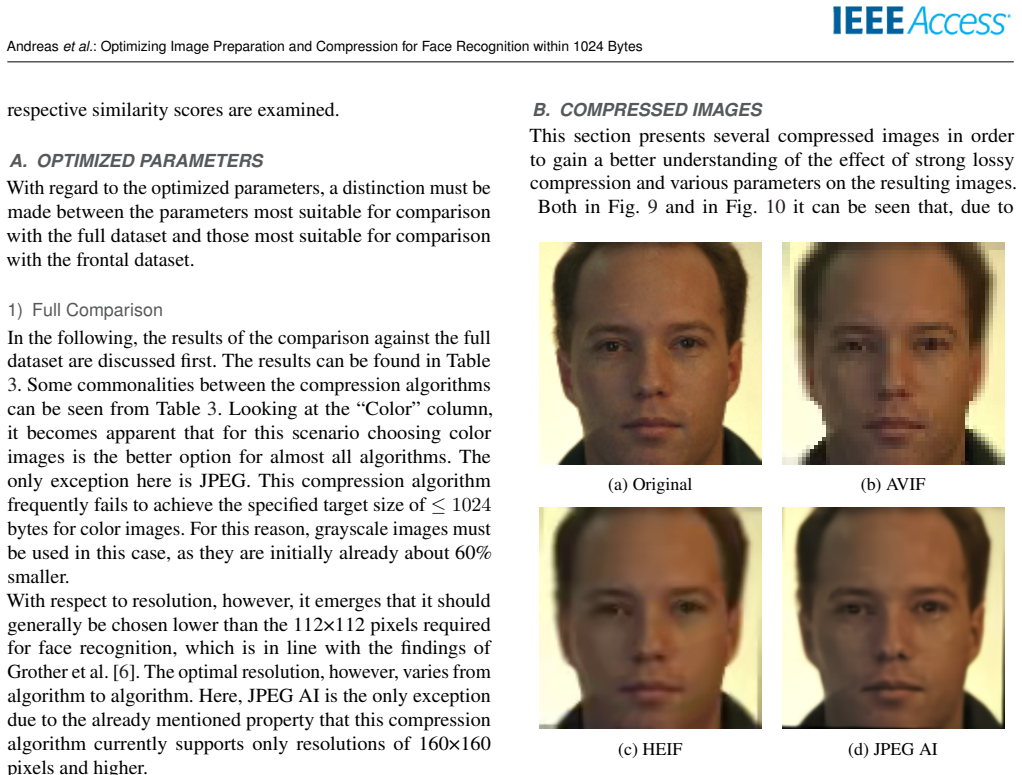
The recently standardised JPEG AI, when using optimized settings, provides the best face recognition performance for facial images compressed to a maximum of 1024 bytes, in particular when the comparison includes only images with high face image quality. AVIF and WebP also provide good results. The losses caused by the strong lossy compression are comparatively small. For the comparison of ICAO-compliant face images only, converting the images to grayscale proves to be a helpful preprocessing step, whereas for comparisons involving less suitable samples, preserving color is preferable. In addition, smoothing and resizing the images beforehand also turns out to be beneficial.
What carries the argument
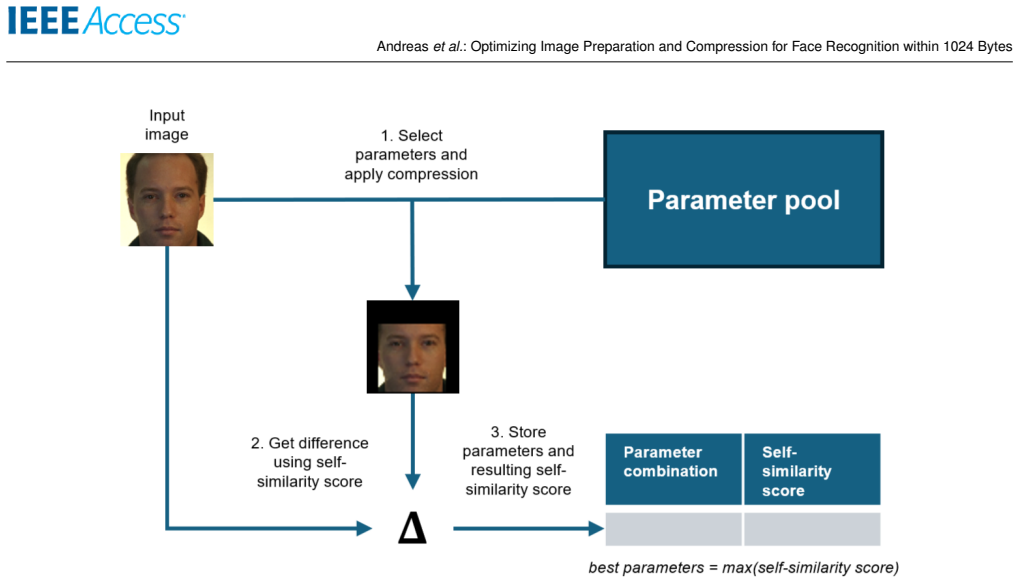
Optimization of preprocessing steps and compression configurations across multiple codecs to reach the 1024-byte target while minimizing impact on face recognition match scores.
Load-bearing premise
The face recognition performance measured on the chosen test images and algorithms will generalize to the range of real-world face images encountered in travel document applications.
What would settle it
Re-running the same compression and preprocessing pipeline on a new dataset of travel-document-style images captured under varied lighting and poses, using a different face recognition algorithm, would show whether JPEG AI retains its performance lead.
Figures
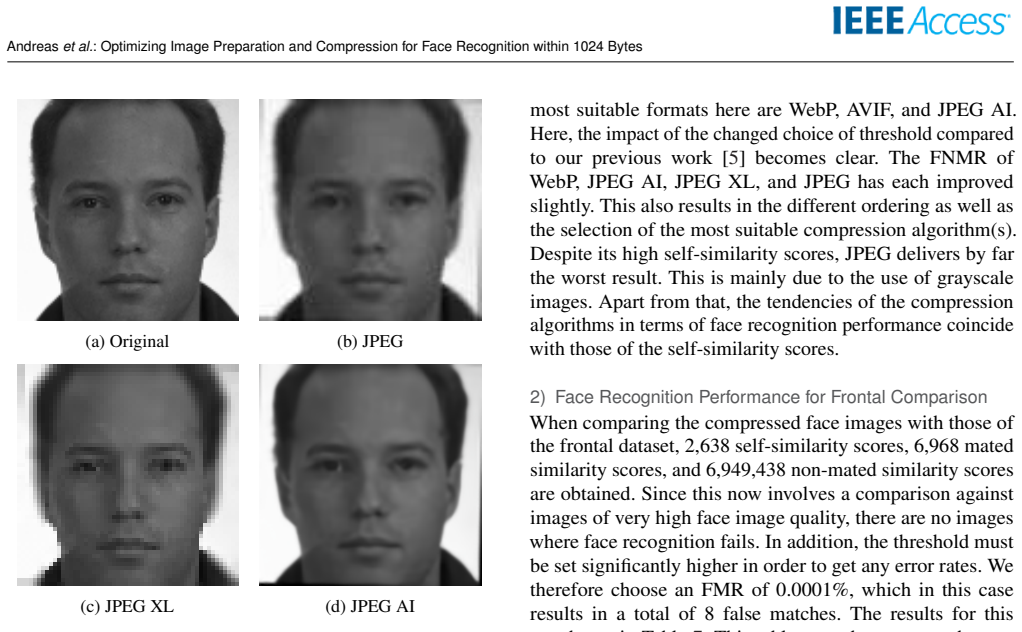
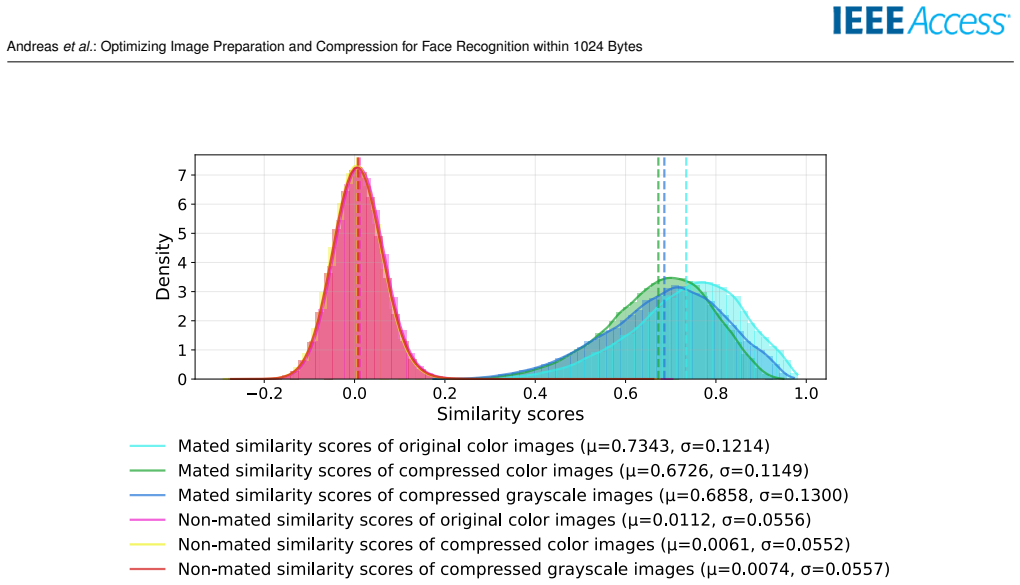
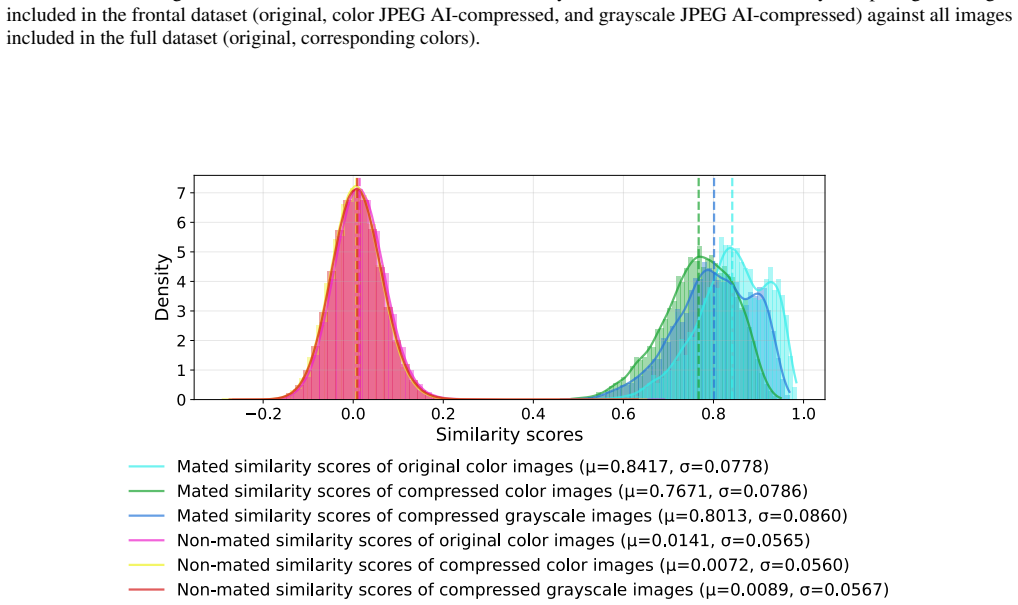
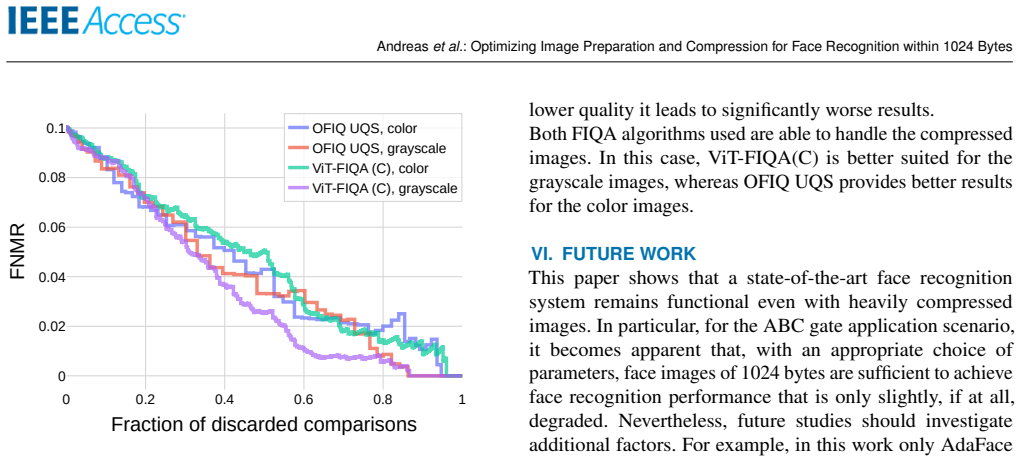
read the original abstract
ICAO-compliant machine readable travel documents enable automated biometric face verification. The biometric reference is stored on an RFID chip included in form of a JPEG or JPEG 2000 compressed facial image. In contrast, temporary travel documents lack of machine readability, which excludes the owner from such automated processes. This disadvantage could be solved by equipping such documents with 2D barcodes. This technology offers a resource-saving alternative to expensive RFID chips, while still offering machine readability and fast issuing processes. However, this solution introduces the challenge of storing the face images at significantly smaller storage capacities, creating the need for reducing the file size of the included facial image to a maximum of 1024 bytes. This study examines preprocessing steps and compression configurations, using JPEG, JPEG 2000, JPEG XL, JPEG AI, HEIF, AVIF, and WebP for image compression to this target size, while still preserving as much face recognition performance as possible. While the reference sample must always comply with ICAO specifications, the individual samples may or may not meet these requirements, depending on the application. This work optimizes compression steps for both of these prerequisites. It is shown that the recently standardised JPEG AI, when using optimized settings, provides the best face recognition performance, in particular when the comparison includes only images with high face image quality. AVIF and WebP also provide good results. The losses caused by the strong lossy compression are comparatively small. For the comparison of ICAO-compliant face images only, converting the images to grayscale proves to be a helpful preprocessing step, whereas for comparisons involving less suitable samples, preserving color is preferable. In addition, smoothing and resizing the images beforehand also turns out to be beneficial.
Editorial analysis
A structured set of objections, weighed in public.
Referee Report
Summary. The manuscript investigates preprocessing and compression techniques to store ICAO face images at a maximum of 1024 bytes for 2D barcodes on temporary travel documents, comparing JPEG, JPEG 2000, JPEG XL, JPEG AI, HEIF, AVIF, and WebP. It reports that JPEG AI with optimized settings yields the highest face recognition performance, especially when restricting comparisons to high-quality images, with AVIF and WebP also competitive; grayscale conversion aids ICAO-compliant samples while color preservation helps lower-quality ones, and smoothing/resizing is generally beneficial. The work addresses both strictly compliant and mixed-quality regimes.
Significance. If the empirical rankings hold under broader conditions, the results could enable machine-readable temporary travel documents without RFID hardware, supporting automated biometric verification in resource-constrained settings. The codec comparison across two quality regimes supplies concrete implementation guidance for the 1024-byte constraint.
major comments (3)
- [Results] Results section: the abstract and main findings assert JPEG AI superiority based on comparative face recognition performance, yet the manuscript provides no description of the datasets, exact metrics (e.g., verification rates at fixed FAR), error bars, statistical tests, or exclusion criteria for 'high face image quality' samples. This prevents verification of the central claim.
- [Experimental setup / Discussion] Experimental setup and discussion: no evidence is given that the test images span the relevant axes of real-world ICAO travel-document variability (demographics, pose, illumination, sensor noise, document degradation). The reported codec ranking therefore rests on an untested generalization assumption flagged in the abstract.
- [Methods] Methods: the optimization of codec-specific parameters is described only at a high level; without the exact parameter sets, preprocessing pipelines, or face recognition back-ends used, the 'optimized settings' result cannot be reproduced or stress-tested.
minor comments (1)
- [Abstract] Abstract: the specific face recognition performance metric (e.g., TAR at 0.01 FAR) and the number of images per regime should be stated explicitly rather than left as 'best performance.'
Simulated Author's Rebuttal
We thank the referee for the constructive and detailed comments. We address each major point below and indicate the revisions that will be incorporated to improve clarity, reproducibility, and transparency.
read point-by-point responses
-
Referee: [Results] Results section: the abstract and main findings assert JPEG AI superiority based on comparative face recognition performance, yet the manuscript provides no description of the datasets, exact metrics (e.g., verification rates at fixed FAR), error bars, statistical tests, or exclusion criteria for 'high face image quality' samples. This prevents verification of the central claim.
Authors: We agree that the manuscript would benefit from greater detail on these elements to allow independent verification. In the revised version we will add a dedicated experimental setup subsection describing the datasets, the exact metrics (including verification rates at fixed FAR), error bars, statistical tests performed, and the precise quality-assessment criteria used to select high-quality samples. revision: yes
-
Referee: [Experimental setup / Discussion] Experimental setup and discussion: no evidence is given that the test images span the relevant axes of real-world ICAO travel-document variability (demographics, pose, illumination, sensor noise, document degradation). The reported codec ranking therefore rests on an untested generalization assumption flagged in the abstract.
Authors: The datasets are drawn from established face-recognition benchmarks that include demographic, pose, and illumination variation. We will expand the Experimental Setup and Discussion sections to explicitly relate these characteristics to ICAO requirements, acknowledge the limits of the tested conditions, and more prominently flag the generalization assumption. Additional real-world ICAO-specific degradation data would strengthen the claims but is outside the present scope. revision: partial
-
Referee: [Methods] Methods: the optimization of codec-specific parameters is described only at a high level; without the exact parameter sets, preprocessing pipelines, or face recognition back-ends used, the 'optimized settings' result cannot be reproduced or stress-tested.
Authors: We concur that full reproducibility requires the concrete parameter values. The revised manuscript will include the exact codec parameter sets, the complete preprocessing pipelines (smoothing kernels, resizing factors, color/grayscale decisions), and the face-recognition back-end models and implementations, placed either in the main text or as supplementary material. revision: yes
Circularity Check
No circularity: purely empirical evaluation of codecs and preprocessing
full rationale
The paper reports experimental results from testing JPEG-family codecs and preprocessing steps (grayscale, smoothing, resizing) on face recognition accuracy at a 1024-byte target. No equations, fitted parameters, or derivations are present; performance rankings are measured directly on chosen test sets rather than predicted from any model whose inputs include the target metric. No self-citation chains or uniqueness theorems are invoked to support the central claims. The work is therefore self-contained against external benchmarks and receives the default non-circularity finding.
Axiom & Free-Parameter Ledger
free parameters (1)
- codec-specific compression parameters
Reference graph
Works this paper leans on
-
[1]
ICAO Doc 9303 — Machine Readable Travel Documents,
International Civil Aviation Organization (ICAO), “ICAO Doc 9303 — Machine Readable Travel Documents,” International Civil Aviation Organization (ICAO), 2021, international standard defining specifications for machine-readable travel documents, including layout, biometrics, and electronic storage; accessed May 09, 2026. [Online]. Available: https://www.ic...
2021
-
[2]
ISO/IEC 18004:2024 – information technology — automatic identification and data capture techniques — qr code bar code symbology specification,
ISO/IEC JTC 1/SC 31, “ISO/IEC 18004:2024 – information technology — automatic identification and data capture techniques — qr code bar code symbology specification,” International Organization for Standardization (ISO) and International Electrotechnical Commission (IEC), 8 2024, international standard specifying the QR Code symbology characteristics and e...
2024
-
[3]
ISO/IEC 16022:2024 – information technology — automatic identification and data capture techniques — data matrix bar code symbology specification,
——, “ISO/IEC 16022:2024 – information technology — automatic identification and data capture techniques — data matrix bar code symbology specification,” International Organization for Standardization (ISO) and International Electrotechnical Commission (IEC), 5 2024, international standard specifying the Data Matrix symbology format and encoding rules; acc...
2024
-
[4]
ISO/IEC 24778:2024 – information technology — automatic identification and data capture techniques — aztec code bar code symbology specification,
——, “ISO/IEC 24778:2024 – information technology — automatic identification and data capture techniques — aztec code bar code symbology specification,” International Organization for Standardization (ISO) and International Electrotechnical Commission (IEC), 4 2024, international standard defining the Aztec Code barcode symbology 14 VOLUME 4, 2016 Andrease...
2024
-
[5]
Optimizing lossy image compression for face recognition within 1024 bytes,
P. Andreas, T. Schlett, and C. Busch, “Optimizing lossy image compression for face recognition within 1024 bytes,” in Proceedings of the 14th International Workshop on Biometrics and Forensics (IWBF). Sophia Antipolis, France: IEEE, Apr. 2026
2026
-
[6]
Face Recognition Technology Evaluation (FRTE): Preparation of Compact Face Images for 2D Barcodes,
P. Grother, M. Ngan, and A. Hom, “Face Recognition Technology Evaluation (FRTE): Preparation of Compact Face Images for 2D Barcodes,” 9 2025. [Online]. Available: https://nvlpubs.nist.gov/nistpubs/SpecialPubli cations/NIST.SP.500-343.pdf
2025
-
[7]
Effect of lossy compression algorithms on face image quality and recognition,
T. Schlett, S. Schachner, C. Rathgeb, J. Tapia, and C. Busch, “Effect of lossy compression algorithms on face image quality and recognition,” 2023. [Online]. Available: https://arxiv.org/abs/2302.12593
-
[8]
Impact of conventional and ai -based image coding on ai -based face recognition performance,
N. Bousnina, J. Ascenso, P. L. Correia, and F. Pereira, “Impact of conventional and ai -based image coding on ai -based face recognition performance,” in Proceedings of the 10th European Workshop on Visual Information Processing (EUVIP), Lisbon, Portugal, 9 2022, examines how conventional and learned image codecs affect the performance of an AI -based fac...
2022
-
[9]
Variational image compression with a scale hyperprior
J. Ballé, D. Minnen, S. Singh, S. J. Hwang, and N. Johnston, “Variational image compression with a scale hyperprior,” 2018. [Online]. Available: https://arxiv.org/abs/1802.01436
work page internal anchor Pith review Pith/arXiv arXiv 2018
-
[10]
Learned image compression with discretized gaussian mixture likelihoods and attention modules,
Z. Cheng, H. Sun, M. Takeuchi, and J. Katto, “Learned image compression with discretized gaussian mixture likelihoods and attention modules,” in 2020 IEEE/CVF Conference on Computer Vision and Pattern Recognition (CVPR), 2020, pp. 7936–7945
2020
-
[11]
High-fidelity generative image compression,
F. Mentzer, G. D. Toderici, M. Tschannen, and E. Agustsson, “High-fidelity generative image compression,” Advances in Neural Information Processing Systems, vol. 33, 2020
2020
-
[12]
Finger vein image compression with uniform background,
B. Maser, J. Hämmerle -Uhl, T. Lipowski, and A. Uhl, “Finger vein image compression with uniform background,” in Proceedings of the 3rd International Conference on Biometric Engineering and Applications (ICBEA). Stockholm, Sweden: Association for Computing Machinery (ACM), 2019, pp. 23–27
2019
-
[13]
The FERET database and evaluation procedure for face recognition algorithms,
P. J. Phillips, H. Wechsler, J. Huang, and P. J. Rauss, “The FERET database and evaluation procedure for face recognition algorithms,” Image and Vision Computing, vol. 16, no. 5, pp. 295–306, 1998
1998
-
[14]
The FERET evaluation methodology for face recognition algorithms,
P. J. Phillips, H. Moon, S. A. Rizvi, and P. J. Rauss, “The FERET evaluation methodology for face recognition algorithms,” IEEE Transactions on Pattern Analysis and Machine Intelligence, vol. 22, no. 10, pp. 1090–1104, 2000
2000
-
[15]
ISO/IEC 19794-5:2011 – information technology — biometric data interchange formats — part 5: Face image data,
ISO/IEC JTC 1/SC 37, “ISO/IEC 19794-5:2011 – information technology — biometric data interchange formats — part 5: Face image data,” International Organization for Standardization (ISO) and International Electrotechnical Commission (IEC), 2011, international standard specifying biometric face image data formats and photo constraints for biometric systems;...
2011
-
[16]
ISO/IEC 39794-5:2019 – information technology — extensible biometric data interchange formats — part 5: Face image data,
——, “ISO/IEC 39794-5:2019 – information technology — extensible biometric data interchange formats — part 5: Face image data,” International Organization for Standardization (ISO) and International Electrotechnical Commission (IEC), 2019, international standard specifying extensible biometric data interchange formats for face image data, including binary ...
2019
-
[17]
Face image quality toolkit (fiqat),
T. Schlett, “Face image quality toolkit (fiqat),” https://code.fbi.h-da.de/hda 10196/face-image-quality-toolkit, 2024, gitLab repository, MIT License; Source: Face Image Quality Toolkit Project of Hochschule Darmstadt, accessed May 09, 2026
2024
-
[18]
Sample and computation redistribution for efficient face detection,
J. Guo, J. Deng, A. Lattas, and S. Zafeiriou, “Sample and computation redistribution for efficient face detection,” 2021. [Online]. Available: https://arxiv.org/abs/2105.04714
-
[19]
Insightface: Open source deep face analysis library for 2d & 3d face recognition and analysis,
InsightFace, “Insightface: Open source deep face analysis library for 2d & 3d face recognition and analysis,” https://www.insightface.ai/, 2026, official website of InsightFace, a state-of-the-art toolbox and ecosystem for face detection, alignment, recognition, and analysis; accessed May 09, 2026
2026
-
[20]
CVLFace: High-performance face recognition all-in-one toolkit,
M. Kim, “CVLFace: High-performance face recognition all-in-one toolkit,” https://github.com/mk-minchul/CVLface, 2024, gitHub repository, MIT License, accessed May 09, 2026
2024
-
[21]
Keypoint relative position encoding for face recognition,
M. Kim, Y . Su, F. Liu, A. Jain, and X. Liu, “Keypoint relative position encoding for face recognition,” 2024. [Online]. Available: https://arxiv.org/abs/2403.14852
-
[22]
AdaFace: Quality adaptive margin for face recognition,
M. Kim, A. K. Jain, and X. Liu, “AdaFace: Quality adaptive margin for face recognition,” 2023. [Online]. Available: https://arxiv.org/abs/2204.00964
-
[24]
Available: https://arxiv.org/abs/2103.04098
[Online]. Available: https://arxiv.org/abs/2103.04098
-
[25]
OFIQ: Open source face image quality library,
BSI-OFIQ, “OFIQ: Open source face image quality library,” GitHub repository, 2026, version v1.1.1 (or latest at time of use), reference implementation for facial image quality evaluation. [Online]. Available: https://github.com/BSI-OFIQ/OFIQ-Project
2026
-
[26]
Open source face image quality (OFIQ) - implementation and evaluation of algorithms,
J. Merkle, C. Rathgeb, B. Herdeanu, B. Tams, D. Lou, A. Dörsch, M. Schaubert, J. Dehen, L. Chen, X. Yin, D. Huang, A. Stratmann, M. Ginzler, M. Grimmer, and C. Busch, “Open source face image quality (OFIQ) - implementation and evaluation of algorithms,” https://www.bsi.bu nd.de/SharedDocs/Downloads/EN/BSI/OFIQ/Projektabschlussbericht_O FIQ_1_0.pdf, 9 2024...
2024
-
[27]
MagFace: A universal representation for face recognition and quality assessment,
Q. Meng, S. Zhao, Z. Huang, and F. Zhou, “MagFace: A universal representation for face recognition and quality assessment,” 2021. [Online]. Available: https://arxiv.org/abs/2103.06627
-
[28]
ViT-FIQA: Assessing face image quality using vision transformers,
A. Atzori, F. Boutros, and N. Damer, “ViT-FIQA: Assessing face image quality using vision transformers,” 2025. [Online]. Available: https://arxiv.org/abs/2508.13957
-
[29]
libjpeg-turbo: High-performance jpeg codec with simd acceleration,
libjpeg-turbo, “libjpeg-turbo: High-performance jpeg codec with simd acceleration,” GitHub repository, 2025, version 3.1.1 (or latest at time of use). [Online]. Available: https://github.com/libjpeg-turbo/libjpeg-turbo
2025
-
[30]
OpenJPEG: Open-source jpeg 2000 codec library and tools,
uclouvain/openjpeg, “OpenJPEG: Open-source jpeg 2000 codec library and tools,” GitHub repository, 2025, version 2.5.4 (or latest at time of use). [Online]. Available: https://github.com/uclouvain/openjpeg
2000
-
[31]
libjxl: Jpeg XL image format reference implementation,
libjxl, “libjxl: Jpeg XL image format reference implementation,” GitHub repository, 2026, version v0.11.1 (or latest at time of use). [Online]. Available: https://github.com/libjxl/libjxl
2026
-
[32]
JPEG AI Reference Software: Reference implementation for jpeg ai image compression,
WG1 JPEG Committee, “JPEG AI Reference Software: Reference implementation for jpeg ai image compression,” GitLab repository, 2024, created July 10, 2024, downloaded on October 18th, 2025. [Online]. Available: https://gitlab.com/wg1/jpeg-ai/jpeg-ai-reference-software
2024
-
[33]
libavif: Library for encoding and decoding avif image files,
AOMediaCodec, “libavif: Library for encoding and decoding avif image files,” GitHub repository, 2025, version v1.3.0 (or latest at time of use). [Online]. Available: https://github.com/AOMediaCodec/libavif
2025
-
[34]
aom: Av1 codec library reference implementation,
Alliance for Open Media / AOMedia, “aom: Av1 codec library reference implementation,” https://aomedia.googlesource.com/aom, 2026, official Git repository for the open-source A V1 codec (libaom) reference implementation; accessed May 09, 2026
2026
-
[35]
libheif: Heif and avif image format decoder and encoder,
strukturag, “libheif: Heif and avif image format decoder and encoder,” GitHub repository, 2026, version v1.21.0 (or latest at time of use). [Online]. Available: https://github.com/strukturag/libheif
2026
-
[36]
Ffmpeg- libavcodec/libx265.c,
FFmpeg Developers, “Ffmpeg- libavcodec/libx265.c,” https://github.com/F Fmpeg/FFmpeg/blob/master/libavcodec/libx265.c, 2026, source file in the FFmpeg project implementing integration with the x265 encoder; accessed May 09, 2026
2026
-
[37]
libwebp: Webp image codec library for encoding and decoding,
WebM Project, “libwebp: Webp image codec library for encoding and decoding,” Chromium Git repository, 2025, version v1.6.0 (or latest at time of use). [Online]. Available: https://chromium.googlesource.com/webm/lib webp
2025
-
[38]
Optuna: A Next-generation Hyperparameter Optimization Framework
T. Akiba, S. Sano, T. Yanase, T. Ohta, and M. Koyama, “Optuna: A next-generation hyperparameter optimization framework,” 2019. [Online]. Available: https://arxiv.org/abs/1907.10902
work page internal anchor Pith review Pith/arXiv arXiv 2019
-
[39]
Best practice technical guidelines for automated border control ABC systems,
FRONTEX, “Best practice technical guidelines for automated border control ABC systems,” 2015. VOLUME 4, 2016 15 Andreaset al.: Optimizing Image Preparation and Compression for Face Recognition within 1024 Bytes P AUL ANDREASreceived the B.S. degree in information science in 2024 and the M.S. degree in information science from Hochschule Darmstadt (HDA), D...
2015
discussion (0)
Sign in with ORCID, Apple, or X to comment. Anyone can read and Pith papers without signing in.