REVIEW 2 major objections 5 minor 1 cited by
Disentangling real space fluctuations: the diagnostics of metal-insulator transitions beyond single-particle spectral functions
T0 review · 2 major / 5 minor · reviewed 2026-08-09 · deepseek-v4-flash
Pith's one-line read The Mott gap in the square-lattice Hubbard model is opened by short-range, nearest-neighbor spin excitations, not by local ones.
desk verdict New real-space fluctuation diagnostics with an honest within-model result, slightly oversold by the abstract's 'unambiguously'. read the letter →
The pith
A machine-rendered reading of the paper's core claim, the machinery that carries it, and where it could break.
The reading
What carries the argument
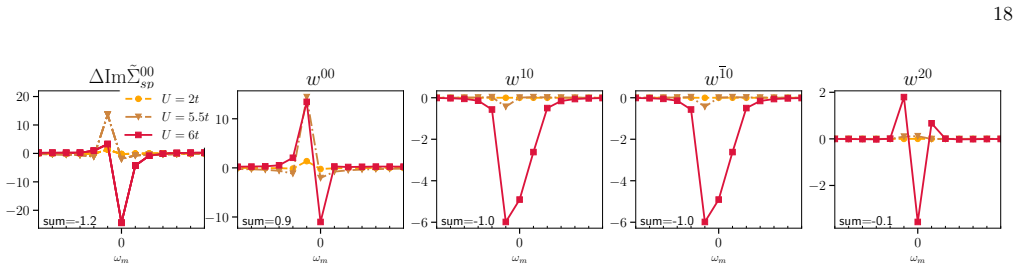
The central object is the real-space Hedin equation, Σ = ± U T Σ_{ω} Σ_{b,f} G_{s,f} w_{b,s} λ_{b,f,e} + const., which expresses the self-energy as a convolution of the fermionic propagator G, the renormalized bosonic (spin/charge) propagator w, and the three-point fermion-boson Hedin vertex λ. The new 'real-space fluctuation diagnostics' classifies each diagram by the distance covered by w (local w00, nearest-neighbor w10, second-neighbor w20) and by G (G00, G01, ...), and inspects the bosonic-frequency-resolved contribution ΔΣ̃(iω_m) to the self-energy difference between the first two fermionic Matsubara frequencies. The load-bearing combination is λ100 with G00 and w10, which produces the insulating pole.
What would settle it
Repeat the real-space fluctuation diagnostics on a 4×4 (or larger) CDMFT cluster for the half-filled Hubbard model at the same temperature: if the on-site self-energy's insulating pole no longer comes from the w10 + G00 spin-boson diagram, or if the local w00 diagram becomes the dominant negative contribution, the central claim is falsified. A less costly check: extend the Matsubara grid for the Hedin vertex (using more frequencies than the 82 fermionic and 81 bosonic points used here) and verify that the spin-channel overestimate of the self-energy (App. A4, Fig. 13) does not flip the sign of the w10 versus w00 decomposition.
Extended reading notes
Core claim
Using the Hedin equation with the three-point fermion-boson vertex λ computed in 2×2 CDMFT, the paper decomposes the on-site self-energy Σ00 into real-space classes. In the spin channel, the local bosonic diagram w00 with the local fermionic propagator G00 produces a metallic contribution (positive ΔΣ), whereas the nearest-neighbor bosonic diagram w10 with G00 produces the negative, pole-like contribution that drives the insulating self-energy at U=6t just above the transition. The pivotal mechanism is the frequency structure of the Hedin vertex λ100: in the insulator it develops a node along iω + iν = 0 that cancels the nodal structure of G00 w10, so the bosonic Matsubara sum no longer cancels, generating a large static self-energy. This behavior is opposite to single-site DMFT, where the local vertex changes sign at the transition.
Load-bearing premise
The argument assumes that the 2×2 cluster captures the mechanism of the Mott transition, so that larger clusters would not dethrone the nearest-neighbor spin-boson diagram, and that the finite Matsubara grid used for the Hedin vertex leaves the qualitative decomposition intact.
Editorial extensions
If this is right
- The Mott critical interaction in CDMFT (U_c ~ 6t versus ~9.3t in DMFT) is explained by the onset of the nearest-neighbor spin-boson contribution, connecting the reduced critical scale to a specific real-space process.
- The nodal/antinodal dichotomy of the momentum-resolved self-energy (periodized) is dominated by the w10 spin-boson contribution, which is insulating at the antinode and metallic at the node.
- The local spin-boson diagram alone would keep the system metallic; the Mott gap is misattributed if one analyzes only local fluctuations.
- The charge channel is essentially local and plays no role in the MIT, consistent with the bosonic charge propagator being local.
- The method is cheaper than full four-point fluctuation diagnostics because it uses the three-point Hedin vertex, enabling real-space analyses on clusters.
Reading between the lines
- If the 2×2 result survives larger clusters, the same decomposition could serve as a diagnostic to test whether the pseudogap in the doped Hubbard model has the same nearest-neighbor spin-boson origin as the half-filled Mott gap.
- The finding that the local Hedin vertex changes sign only for non-local distances suggests that cluster-size extrapolations of the MIT mechanism will need to track the frequency structure of λ at the Fermi node, not just the magnitude of the spin propagator.
- The method could be applied within the single-boson exchange decomposition to test whether the multi-boson diagrams in the spin channel, which the paper notes cancel part of the SBE contribution, remain subdominant at larger U.
- A direct extension would be to vary the Fierz parameter r to check whether the classification of 'local' versus 'nearest-neighbor' mechanisms is robust to the channel decomposition; the paper fixes to spin and charge channels.
Signed reviews
Editorial analysis
A structured set of objections, weighed in public.
Referee Report
Summary. The paper introduces a real-space fluctuation diagnostics (RFD) approach based on the Hedin equation, which expresses the self-energy as a sum over real-space bosonic propagators w, fermionic propagators G, and the fermion-boson vertex λ. Using CDMFT on a 2x2 cluster for the half-filled Hubbard model on the square lattice, the authors compute all ingredients and decompose the on-site and non-local self-energies across the Mott metal-insulator transition. They identify the nearest-neighbor bosonic spin propagator w10 combined with the local fermionic propagator G00 as the dominant diagram producing the insulating pole of the local self-energy, while the local spin diagram w00 remains metallic. The paper further analyzes the frequency structure of the Hedin vertex to explain the emergence of this insulating contribution, and connects the result to momentum-space antiferromagnetic fluctuations. The central claim is that nearest-neighbor, low-frequency dynamic antiferromagnetic spin-boson excitations are responsible for the occurrence of the MIT.
Significance. The RFD method is a useful addition to the fluctuation-diagnostics toolbox: it substitutes the three-point Hedin vertex for the computationally heavier four-point vertex, and it provides a real-space picture complementary to existing momentum-space diagnostics. The paper is careful in deriving the Hedin equation in real space (App. A), in documenting sources of error (App. A4), and in making raw data publicly available. The central conclusion—that nearest-neighbor low-frequency spin fluctuations drive the MIT within the 2x2 CDMFT solution—is plausible and consistent with earlier momentum-space studies, but its validity for the Hubbard model in larger clusters is not yet established. The method itself is a worthwhile contribution regardless of the eventual cluster-size fate of the specific mechanism.
major comments (2)
- [Sec. IV and Sec. VII C] The conclusion that nearest-neighbor spin-boson diagrams are 'responsible for the occurrence of the MIT' (Sec. VII C, Fig. 6) rests entirely on a single Nc=2x2 CDMFT solution. The paper explicitly restricts itself to this cluster size in Sec. IV and points to Refs. [31,69,70] for cluster-size dependence, but those references concern single-particle quantities. No evidence is presented that the RFD decomposition—in particular the dominance of the w10/G00 diagram over the local w00/G00 diagram—is stable when the cluster is enlarged to 4x4 or 8x8. Since the 2x2 plaquette can only capture the shortest non-local distance, the word 'unambiguously' in the abstract is not supported. Please provide a cluster-size check at the two-particle level, or qualify the claim to the 2x2 CDMFT approximation.
- [App. A4 and Fig. 13] The spin-channel Hedin self-energy systematically overestimates the directly measured self-energy because of the finite Matsubara grid (82 positive fermionic and 81 positive bosonic frequencies). The key insulating contribution in Fig. 6 (w10, sum=-1.0) belongs to this overestimated spin channel, so the reported balance between the metallic local diagram w00 (+0.9) and the insulating nearest-neighbor diagram w10 (-1.0) is potentially affected by grid truncation. The authors should demonstrate that the qualitative decomposition—specifically the sign and relative magnitude of ΔΣ from the w10 and w00 classes—is robust to increasing the number of Matsubara frequencies, or provide an explicit high-frequency tail extrapolation. Figure 13 shows that the overshoot is frequency-dependent, so it does not cancel in the difference ΔΣ by construction.
minor comments (5)
- [Sec. IV] The critical temperature is given as 'T_c^{2x2} ≈ 0.09/t'; the units appear to be wrong and should read 0.09t.
- [Sec. III B] The site labeling '0, 1, 1, 2' in the text and Fig. 2 is confusing; the figures use an overbar on one of the '1' sites (e.g., w10 vs w10). Please clarify the notation.
- [App. A2, Eq. (A18)] In the equation for Σs,e(iνn), the summation index 'd' in 'X d,f' appears to be a typo for the bosonic orbital index 'b' used in the preceding equations.
- [Abstract] The word 'unambiguously' is too strong given the limitations discussed above; consider replacing it with a more qualified formulation such as 'for the 2x2 CDMFT solution we identify...'.
- [App. A4] The first sentence says the finite Matsubara grid 'results underestimate correlations', but the charge channel underestimates while the spin channel overestimates; please rephrase to describe the opposite signs.
Circularity Check
No significant circularity: the Hedin decomposition is an exact identity and the leading w10 spin-boson contribution is a computed numerical result, not an input.
full rationale
The paper's central claim is that the w10/G00 spin-channel summand of the Hedin equation carries the insulating pole of the CDMFT self-energy. This is not circular: Eq. (2) is an exact identity relating Σ to independently computed G, w, and λ; λ is measured via CT-INT three-point correlators [Eq. (A23)] rather than fitted to reproduce Σ. The decomposition in Fig. 6 is a bookkeeping exercise whose outcome (w10 sum = -1.0, w00 sum = +0.9) is determined by the numerical data, not imposed by the definition of the MIT. The paper explicitly cross-checks against the single-boson-exchange decomposition in App. C3, which is an independent bookkeeping with a different prefactor and different bosonic propagator; the finding survives with only a 3/2 prefactor. The only caveats are robustness concerns—single 2x2 cluster and finite Matsubara grid (App. A4)—but these are accuracy/extrapolation issues, not circularity: no fitted parameter is renamed as a prediction, and no self-citation is load-bearing. Refs. [31,69,70] are cited only for cluster-size dependence, which qualifies rather than supports the main claim. Therefore the paper is self-contained against the exact Hedin identity and merits score 0.
Assumptions & free parameters
assumptions (5)
- domain assumption The paramagnetic CDMFT solution on a 2x2 cluster represents the essential physics of the Mott transition on the square lattice.
- standard math The spin-channel Hedin equation (r=0 in the Fierz decomposition) is an exact rewriting of the self-energy and can be used for the diagnostics.
- domain assumption Truncation at 82 positive fermionic and 81 positive bosonic Matsubara frequencies does not change the qualitative ordering of diagram contributions.
- domain assumption The pairing channel can be omitted because the system is particle-hole symmetric.
- domain assumption The Hedin vertex extracted from CT-INT data via matrix inversion (Eq. A23) is numerically stable enough for the diagnostics.
Cite this review
Pith. "Pith review of Disentangling real space fluctuations: the diagnostics of metal-insulator transitions beyond single-particle spectral functions." pith.science (2026). https://pith.science/paper/GZ7LARZM
@misc{pith2026250118325,
  author       = {Pith},
  title        = {Pith review of: Disentangling real space fluctuations: the diagnostics of metal-insulator transitions beyond single-particle spectral functions},
  year         = {2026},
  howpublished = {\url{https://pith.science/paper/GZ7LARZM}},
  note         = {Machine review of arXiv:2501.18325}
}
abstract
The destruction of metallicity due to the mutual Coulomb interaction of quasiparticles gives rise to fascinating phenomena of solid state physics such as the Mott metal-insulator transition and the pseudogap. A key observable characterizing their occurrences is the single-particle spectral function, determined by the fermionic self-energy. In this paper we investigate in detail how real space fluctuations are responsible for a self-energy that drives the Mott-Hubbard metal-insulator transition. To this aim we first introduce a real space fluctuation diagnostics approach to the Hedin equation, which connects the fermion-boson coupling vertex $\lambda$ to the self-energy $\Sigma$. Second, by using cellular dynamical mean-field theory calculations for $\lambda$ we identify the leading physical processes responsible for the destruction of metallicity across the transition.
Figures


Figures from the paper (13 more)



Forward citations
Cited by 1 Pith paper
-
Non-perturbative effects of short-range spatial correlations at the two-particle level
Short-range antiferromagnetic correlations lower the interaction at which the two-particle charge vertex diverges in CDMFT, and that sign change is the prerequisite for the Mott transition.
Reference graph
Works this paper leans on
-
[1]
This combination corresponds to the sketched Hedin equa- tion of Fig
Why does the nearest-neighbor spin-boson diagram result in an insulating self-energy? As discussed before, the nearest-neighbor spin-boson contributions to the self-energy increase strongly on the insulating side of the MIT, specifically the on-site self- energy being dominated by the w10, G00 diagram. This combination corresponds to the sketched Hedin eq...
-
[2]
First, when recalling the fluctuation diag- nostics of ∆ ˜Σ00 in Fig
Why does the on-site spin-boson diagram result in a metallic contribution to the self-energy? While we have just discussed the origin of the insulat- ing contribution from the nearest-neighbor spin-boson di- agrams to the on-site self-energy in detail, we now discuss why the purely localHedin vertex λ000 sp (iωm, iνn) does not result in an insulating cont...
-
[3]
This decomposition was used to reformulate the self-energy for the local (Anderson model) case [83] and momentum space case [40] into spin and charge channels
Derivation of the Hedin equation for bosonic fluctuations for the contour case The local Hubbard interaction can be written as a Fierz decomposition [82, 83]: Hint = U n↑n↓ = U rnn + (r − 1)mm 2 − r − 1 2 U n, (A1) where n = n↑ + n↓, m = n↑ − n↓ and r ∈ [0, 1]. This decomposition was used to reformulate the self-energy for the local (Anderson model) case ...
-
[4]
(A10) for r = 0 (sp) and r = 1 (ch), respectively: Σ(1; 2) =ΣCδ(1, 2) ± Z d34G(3; 1)wsp/ch(1; 4)λsp/ch(4; 2; 3) (A13) where 1, 2, 3, 4 are combined space time variables
Derivation of the Hedin equation in the Matsubara formalism for the lattice/orbital case We write the fermion-boson response function in terms of the bosonic legs wsp/ch = U ± U 2χsp/ch, (A11) the fermionic legs G and the fermion-boson scattering amplitude (Hedin vertex) λsp/ch [53]: χ3 sp/ch(1, 2, 3) = − Z d1′d2′d3′ wsp/ch(1; 1′)/U · λsp/ch(1′; 2′; 3′)G(...
-
[5]
The Hedin vertex and quantities as they are computed We compute the fermi-bose response with the continuous-time quantum Monte Carlo (CT-INT, [25, 90]) impurity solver, implemented using the TRIQS li- brary [47]. In the calculations we subtract the discon- nected contributions: χ3,b,f,e ph,σσ ′(iωm, iνn) = Z β 0 dτ2dτ3dτ4e−iνn(τ2−τ3)e−iωm(τ4−τ3) ⟨Tτ (ce)†...
-
[6]
Here, we used 82 positive fermionic frequencies and 81 positive bosonic frequencies
Error estimate for the self-energy from the Hedin equation Two major sources of errors can be determined: first, the finite grid of the Matsubara frequencies for the Hedin- vertex results underestimate correlations. Here, we used 82 positive fermionic frequencies and 81 positive bosonic frequencies. Fig. 13 displays the resulting self-energy for the charg...
-
[7]
Details of the CDMFT algorithm The CDMFT is a real space cluster extension [25, 64] of the dynamical mean-field theory (DMFT, [21, 23, 94]). In CDMFT the auxiliary impurity Anderson model does not correspond to a single lattice site but to a real space super-cell containing Nc lattice sites, which converges to the lattice problem in the limit of infinitel...
-
[8]
15 discusses the decay of the absolute values of the static bosonic and fermionic propagators throughout the cluster and for different interaction values
Decay of the bosonic and fermionic propagator throughout the cluster Fig. 15 discusses the decay of the absolute values of the static bosonic and fermionic propagators throughout the cluster and for different interaction values. Note that the local term of the bosonic propagator contains a bare in- teraction U . As becomes evident, the charge propagator i...
Show all 105 references
-
[9]
Detailed interaction evolution of the on-site self-energy Fig. 16 gives the evolution of the difference of the self- energy for data before and after the MIT for diagram classes distinguish the locality of the bosonic propagator in the Hedin equation. While for the non-local c...
-
[10]
Comparison to the single-boson irreducible self-energy decomposition Our approach exploits the fact, that the Hubbard in- teraction U can be arbitrarily split into a charge and spin interaction, which is the so-called Fierz-ambiguity [82, 95], see App. A 1. This way, the fluct...
-
[11]
Keimer, S
B. Keimer, S. A. Kivelson, M. R. Norman, S. Uchida, and J. Zaanen, From quantum matter to high-temperature superconductivity in copper oxides, Nature (London) 518, 179 (2015)
2015
-
[12]
D. J. Scalapino, A common thread: The pairing inter- action for unconventional superconductors, Rev. Mod. Phys. 84, 1383 (2012)
2012
-
[13]
Sachdev, Quantum Phase Transitions (Cambridge University Press, 1999)
S. Sachdev, Quantum Phase Transitions (Cambridge University Press, 1999)
1999
-
[14]
Coleman, Quantum criticality, Nature 433, 226 (2005)
P. Coleman, Quantum criticality, Nature 433, 226 (2005)
2005
-
[15]
Imada, A
M. Imada, A. Fujimori, and Y. Tokura, Metal-insulator transitions, Rev. Mod. Phys. 70, 1039 (1998)
1998
-
[16]
R. O. Jones and O. Gunnarsson, The density functional formalism, its applications and prospects, Rev. Mod. Phys. 61, 689 (1989)
1989
-
[17]
N. F. Mott, The basis of the electron theory of metals, with special reference to the transition metals, Proceed- ings of the Physical Society. Section A 62, 416 (1949)
1949
-
[18]
N. F. Mott, Metal-insulator transition, Rev. Mod. Phys. 40, 677 (1968)
1968
-
[19]
D. B. McWhan, T. M. Rice, and J. P. Remeika, Mott transition in cr-doped v 2o3, Phys. Rev. Lett. 23, 1384 (1969)
1969
-
[20]
D. B. McWhan and J. P. Remeika, Metal-insulator tran- sition in (v 1−xcrx)2o3, Phys. Rev. B 2, 3734 (1970)
1970
-
[21]
Kanoda and R
K. Kanoda and R. Kato, Mott Physics in Organic Con- ductors with Triangular Lattices, Annual Review of Con- densed Matter Physics 2, 167 (2011)
2011
-
[22]
B. J. Powell and R. H. McKenzie, TOPICAL REVIEW: Strong electronic correlations in superconducting organic charge transfer salts, Journal of Physics Condensed Mat- ter 18, R827 (2006), arXiv:cond-mat/0607078 [cond- mat.str-el]
2006 arXiv
-
[23]
Riedl, E
K. Riedl, E. Gati, and R. Valenti, Ingredients for Gener- alized Models of κ-Phase Organic Charge-Transfer Salts: A Review, Crystals 12, 1689 (2022). 19 0 ωm −75 −50 −25 0 sum=-10.1 ∆Im ˜Σ 00 sp U = 1t U = 4t U = 6t 0 ωm −40 −20 0 sum=-0.8 w00; U = 6t G00 G01 G01 G02 0 ωm −20 ...
2022
-
[24]
T. Li, S. Jiang, L. Li, Y. Zhang, K. Kang, J. Zhu, K. Watanabe, T. Taniguchi, D. Chowdhury, L. Fu, J. Shan, and K. F. Mak, Continuous Mott transition in semiconductor moir´ e superlattices, Nature 597, 350 (2021)
2021
-
[25]
Tscheppe, J
P. Tscheppe, J. Zang, M. Klett, S. Karakuzu, A. Celarier, Z. Cheng, C. A. Marianetti, T. A. Maier, M. Ferrero, A. J. Millis, and T. Sch¨ afer, Magnetism and metallicity in moir´ e transition metal dichalcogenides, Proceedings of the National Academy of Sciences 121, e231148612...
2024 doi
-
[26]
B. Lowe, B. Field, J. Hellerstedt, J. Ceddia, H. L. Nourse, B. J. Powell, N. V. Medhekar, and A. Schiffrin, Local gate control of Mott metal-insulator transition in a 2D metal-organic framework, Nature Communications 15, 3559 (2024)
2024
-
[27]
Menke, M
H. Menke, M. Klett, K. Kanoda, A. Georges, M. Ferrero, and T. Sch¨ afer, Superconductivity and Mott Physics in Organic Charge Transfer Materials, Phys. Rev. Lett. 133, 136501 (2024)
2024
-
[28]
P. A. Lee, N. Nagaosa, and X.-G. Wen, Doping a Mott in- sulator: Physics of high-temperature superconductivity, Rev. Mod. Phys. 78, 17 (2006)
2006
-
[29]
M. Qin, T. Sch¨ afer, S. Andergassen, P. Corboz, and E. Gull, The Hubbard Model: A Computational Per- spective, Annual Review of Condensed Matter Physics 13, 10.1146/annurev-conmatphys-090921-033948 (2022), https://doi.org/10.1146/annurev-conmatphys-090921- 033948
2022 doi
-
[30]
D. P. Arovas, E. Berg, S. A. Kivelson, and S. Raghu, The Hubbard Model, Annual Review of Condensed Matter Physics 13, 10.1146/annurev-conmatphys- 031620-102024 (2022), https://doi.org/10.1146/annurev- conmatphys-031620-102024
2022 doi
-
[31]
Metzner and D
W. Metzner and D. Vollhardt, Correlated Lattice Fermions in d = ∞ Dimensions, Phys. Rev. Lett. 62, 324 (1989)
1989
-
[32]
Georges and G
A. Georges and G. Kotliar, Hubbard model in infinite dimensions, Phys. Rev. B 45, 6479 (1992)
1992
-
[33]
Georges, G
A. Georges, G. Kotliar, W. Krauth, and M. J. Rozen- berg, Dynamical mean-field theory of strongly correlated fermion systems and the limit of infinite dimensions, Rev. Mod. Phys. 68, 13 (1996)
1996
-
[34]
Rohringer, A
G. Rohringer, A. Katanin, T. Sch¨ afer, A. Hau- soel, K. Held, and A. Toschi, LadderDΓA code, github.com/ladderDGA (2018)
2018
-
[35]
T. A. Maier, M. Jarrell, T. Pruschke, and M. Hettler, Quantum Cluster Theories, Rev. Mod. Phys. 77, 1027 (2005)
2005
-
[36]
A.-M. S. Tremblay, B. Kyung, and D. S´ en´ echal, Pseu- dogap and high-temperature superconductivity from weak to strong coupling. Towards a quantitative theory (Review Article), Low Temperature Physics 32, 424 (2006), https://pubs.aip.org/aip/ltp/article- pdf/32/4/424/1390187...
2006
-
[37]
Sch¨ afer, F
T. Sch¨ afer, F. Geles, D. Rost, G. Rohringer, E. Arrigoni, K. Held, N. Bl¨ umer, M. Aichhorn, and A. Toschi, Fate of the false Mott-Hubbard transition in two dimensions, Phys. Rev. B 91, 125109 (2015)
2015
-
[38]
Sch¨ afer, A
T. Sch¨ afer, A. Toschi, and K. Held, Dynamical vertex approximation for the two-dimensional Hubbard model, Journal of Magnetism and Magnetic Materials 400, 107 (2016)
2016
-
[39]
Klett, N
M. Klett, N. Wentzell, T. Sch¨ afer, F. Simkovic, O. Parcol- let, S. Andergassen, and P. Hansmann, Real-space cluster dynamical mean-field theory: Center-focused extrapola- tion on the one- and two particle-levels, Phys. Rev. Re- search 2, 033476 (2020)
2020
-
[40]
Sch¨ afer, N
T. Sch¨ afer, N. Wentzell, F.ˇSimkovic, Y.-Y. He, C. Hille, M. Klett, C. J. Eckhardt, B. Arzhang, V. Harkov, F. Le R´ egent, A. Kirsch, Y. Wang, A. J. Kim, E. Kozik, E. A. Stepanov, A. Kauch, S. Andergassen, P. Hans- mann, D. Rohe, Y. M. Vilk, J. P. F. LeBlanc, S. Zhang, A.-M....
2021
-
[41]
Meixner, H
M. Meixner, H. Menke, M. Klett, S. Heinzelmann, S. An- dergassen, P. Hansmann, and T. Sch¨ afer, Mott transition and pseudogap of the square-lattice Hubbard model: Re- sults from center-focused cellular dynamical mean-field theory, SciPost Phys. 16, 059 (2024)
2024
-
[42]
Sordi, P
G. Sordi, P. S´ emon, K. Haule, and A.-M. S. Trem- blay, Strong Coupling Superconductivity, Pseudogap, and Mott Transition, Phys. Rev. Lett. 108, 216401 (2012)
2012
-
[43]
Gunnarsson, T
O. Gunnarsson, T. Sch¨ afer, J. P. F. LeBlanc, E. Gull, J. Merino, G. Sangiovanni, G. Rohringer, and A. Toschi, Fluctuation Diagnostics of the Electron Self-Energy: Ori- gin of the Pseudogap Physics, Phys. Rev. Lett. 114, 236402 (2015)
2015
-
[44]
Sch¨ afer and A
T. Sch¨ afer and A. Toschi, How to read between the lines of electronic spectra: the diagnostics of fluctuations in 20 strongly correlated electron systems, Journal of Physics: Condensed Matter (2021)
2021
-
[45]
Gunnarsson, T
O. Gunnarsson, T. Sch¨ afer, J. P. F. LeBlanc, J. Merino, G. Sangiovanni, G. Rohringer, and A. Toschi, Parquet decomposition calculations of the electronic self-energy, Phys. Rev. B 93, 245102 (2016)
2016
-
[46]
W. Wu, M. Ferrero, A. Georges, and E. Kozik, Control- ling Feynman diagrammatic expansions: Physical nature of the pseudogap in the two-dimensional Hubbard model, Phys. Rev. B 96, 041105(R) (2017)
2017
-
[47]
Arzhang, A
B. Arzhang, A. E. Antipov, and J. P. F. LeBlanc, Fluctuation diagnostics of the finite-temperature quasi- antiferromagnetic regime of the two-dimensional Hub- bard model, Physical Review B 101, 014430 (2020)
2020
-
[48]
X. Dong, L. Del Re, A. Toschi, and E. Gull, Mechanism of superconductivity in the hubbard model at intermediate interaction strength, PNAS 13, e2205048119 (2022)
2022
-
[49]
Gunnarsson, J
O. Gunnarsson, J. Merino, T. Sch¨ afer, G. Sangiovanni, G. Rohringer, and A. Toschi, Complementary views on electron spectra: From fluctuation diagnostics to real- space correlations, Phys. Rev. B 97, 125134 (2018)
2018
-
[50]
Kiese, N
D. Kiese, N. Wentzell, I. Krivenko, O. Parcollet, K. Held, and F. Krien, Embedded multi-boson exchange: A step beyond quantum cluster theories, Phys. Rev. Res. 6, 043159 (2024)
2024
-
[51]
Meixner and T
M. Meixner and T. Sch¨ afer, Disentangling real space fluctuations: the diagnostics of metal-insulator transitions beyond single-particle spectral functions, https://doi.org/10.17617/3.BKGXQO (2025)
2025 doi
-
[52]
Hubbard, Electron Correlations in Narrow Energy Bands, Proceedings of the Royal Society of London
J. Hubbard, Electron Correlations in Narrow Energy Bands, Proceedings of the Royal Society of London. Se- ries A, Mathematical and Physical Sciences 276, 238 (1963)
1963
-
[53]
Hubbard, Electron Correlations in Narrow Energy Bands
J. Hubbard, Electron Correlations in Narrow Energy Bands. III. An Improved Solution, Proc R. Soc. London 281, 401 (1964)
1964
-
[54]
M. C. Gutzwiller, Effect of Correlation on the Ferromag- netism of Transition Metals, Phys. Rev. Lett. 10, 159 (1963)
1963
-
[55]
J. Kanamori, Electron Correlation and Ferromagnetism of Transition Metals, Progress of Theoretical Physics 30, 275 (1963), https://academic.oup.com/ptp/article- pdf/30/3/275/5278869/30-3-275.pdf
1963
-
[56]
Kotliar, S
G. Kotliar, S. Y. Savrasov, G. P´ alsson, and G. Biroli, Cel- lular Dynamical Mean Field Approach to Strongly Cor- related Systems, Phys. Rev. Lett. 87, 186401 (2001)
2001
-
[57]
Parcollet, M
O. Parcollet, M. Ferrero, T. Ayral, H. Hafermann, I. Krivenko, L. Messio, and P. Seth, Triqs: A toolbox for research on interacting quantum systems, Computer Physics Communications 196, 398 (2015)
2015
-
[58]
R. N. Silver, D. S. Sivia, and J. E. Gubernatis, Maximum- entropy method for analytic continuation of quantum Monte Carlo data, Phys. Rev. B 41, 2380 (1990)
1990
-
[59]
Bryan, Maximum entropy analysis of oversampled data problems, Eur Biophys J 18, 165 (1990)
R. Bryan, Maximum entropy analysis of oversampled data problems, Eur Biophys J 18, 165 (1990)
1990
-
[60]
G. J. Kraberger, R. Triebl, M. Zingl, and M. Aichhorn, Maximum entropy formalism for the analytic continua- tion of matrix-valued Green’s functions, Phys. Rev. B96, 155128 (2017)
2017
-
[61]
https://triqs.github.io/maxent/latest/guide/tau_ maxent.html; See: [47]
-
[62]
Tagliavini, S
A. Tagliavini, S. Hummel, N. Wentzell, S. Ander- gassen, A. Toschi, and G. Rohringer, Efficient Bethe- Salpeter equation treatment in dynamical mean-field the- ory, Physical Review B 97, 10.1103/physrevb.97.235140 (2018)
2018 doi
-
[63]
Hedin, New method for calculating the one-particle green’s function with application to the electron-gas problem, Phys
L. Hedin, New method for calculating the one-particle green’s function with application to the electron-gas problem, Phys. Rev. 139, A796 (1965)
1965
-
[64]
Aryasetiawan and S
F. Aryasetiawan and S. Biermann, Generalized hedin’s equations for quantum many-body systems with spin- dependent interactions, Phys. Rev. Lett. 100, 116402 (2008)
2008
-
[65]
Krien, Efficient evaluation of the polarization function in dynamical mean-field theory, Phys
F. Krien, Efficient evaluation of the polarization function in dynamical mean-field theory, Phys. Rev. B 99, 235106 (2019)
2019
-
[66]
Patricolo, M
M. Patricolo, M. Gievers, K. Fraboulet, A. Al-Eryani, S. Heinzelmann, P. M. Bonetti, A. Toschi, D. Vilardi, and S. Andergassen, Single-boson exchange formulation of the schwinger-dyson equation and its application to the func- tional renormalization group (2024), arXiv:2411.11...
2024
-
[67]
J. P. Ellis, Tikz-feynman: Feynman diagrams with tikz, Computer Physics Communications 210, 103 (2017)
2017
-
[68]
K. Held, C. Taranto, G. Rohringer, and A. Toschi, Hedin Equations, GW, GW+DMFT, and All That, Lecture Notes of the Autumn School 2011 - Hands-on LDA+DMFT (2011)
2011
-
[69]
M. Pelz, S. Adler, M. Reitner, and A. Toschi, Highly non- perturbative nature of the Mott metal-insulator transi- tion: Two-particle vertex divergences in the coexistence region, Phys. Rev. B 108, 155101 (2023)
2023
-
[70]
H. Park, K. Haule, and G. Kotliar, Cluster Dynamical Mean Field Theory of the Mott Transition, Phys. Rev. Lett. 101, 186403 (2008)
2008
-
[71]
Kotliar and D
G. Kotliar and D. Vollhardt, Strongly correlated materi- als: Insights from dynamical mean-field theory, Physics Today 57, 53 (2004)
2004
-
[72]
Georges and W
A. Georges and W. Krauth, Physical properties of the half-filled Hubbard model in infinite dimensions, Phys. Rev. B 48, 7167 (1993)
1993
-
[73]
Bl¨ umer,Mott-Hubbard Metal-Insulator Transition and Optical Conductivity in High Dimensions , Ph.D
N. Bl¨ umer,Mott-Hubbard Metal-Insulator Transition and Optical Conductivity in High Dimensions , Ph.D. thesis, Universit¨ at Augsburg (2002)
2002
-
[74]
Parcollet, G
O. Parcollet, G. Biroli, and G. Kotliar, Cluster Dynam- ical Mean Field Analysis of the Mott Transition, Phys. Rev. Lett. 92, 226402 (2004)
2004
-
[75]
T. D. Stanescu, M. Civelli, K. Haule, and G. Kotliar, A cellular dynamical mean field theory approach to Mot- tness, Annals of Physics 321, 1682 (2006), july 2006 Spe- cial Issue
2006
-
[76]
Fratino, P
L. Fratino, P. S´ emon, M. Charlebois, G. Sordi, and A.- M. S. Tremblay, Signatures of the Mott transition in the antiferromagnetic state of the two-dimensional Hubbard model, Phys. Rev. B 95, 235109 (2017)
2017
-
[77]
Walsh, P
C. Walsh, P. S´ emon, D. Poulin, G. Sordi, and A.- M. S. Tremblay, Local Entanglement Entropy and Mu- tual Information across the Mott Transition in the Two- Dimensional Hubbard Model, Phys. Rev. Lett. 122, 067203 (2019)
2019
-
[78]
Walsh, P
C. Walsh, P. S´ emon, D. Poulin, G. Sordi, and A.-M. S. Tremblay, Thermodynamic and information-theoretic de- scription of the Mott transition in the two-dimensional Hubbard model, Phys. Rev. B 99, 075122 (2019)
2019
-
[79]
Sakai, G
S. Sakai, G. Sangiovanni, M. Civelli, Y. Motome, K. Held, and M. Imada, Cluster-size dependence in cellular dy- namical mean-field theory, Phys. Rev. B 85, 035102 (2012). 21
2012
-
[80]
Downey, O
P.-O. Downey, O. Gingras, J. Fournier, C.-D. H´ ebert, M. Charlebois, and A.-M. S. Tremblay, Mott transition, Widom line, and pseudogap in the half-filled triangular lattice Hubbard model, Phys. Rev. B107, 125159 (2023)
2023
-
[81]
This is caused by a Mat- subara summation over a finite frequency grid
While the expression of the self-energy via the Hedin equation in different channels is formally equivalent, slight deviations can be noticed. This is caused by a Mat- subara summation over a finite frequency grid. However, the error made is not qualitative and only of small q...
-
[82]
ˇSimkovic, J
F. ˇSimkovic, J. P. F. LeBlanc, A. J. Kim, Y. Deng, N. V. Prokof’ev, B. V. Svistunov, and E. Kozik, Ex- tended Crossover from a Fermi Liquid to a Quasiantifer- romagnet in the Half-Filled 2D Hubbard Model, Phys. Rev. Lett. 124, 017003 (2020)
2020
-
[83]
As discussed prior, the charge diagrams are purely local and their further analysis is, hence, obsolete
-
[84]
E. G. C. P. van Loon, F. Krien, H. Hafermann, A. I. Lichtenstein, and M. I. Katsnelson, Fermion-boson vertex within dynamical mean-field theory, Phys. Rev. B 98, 205148 (2018)
2018
-
[85]
The second-next neighbor self-energy modulates the self-energy in the Brillouin zone as Σ( ⃗k) ∝ Σ02 · [cos(kx + ky) + cos(kx − ky)] [64]. Its positive, imaginary pole of Σ 02 acts thus as enlarging the imaginary part of the antinodal self-energy Σ(0 , π), Σ(π, 0), while no mo...
-
[86]
This can already be seen from the (non-interacting) Green function of the Hubbard dimer, where the diagonal elements are complex and the off-diagonal elements are real and negative. In the Lehmann representation of the Green function, this is a field-theoretic manifestation of...
-
[87]
Y. Yu, S. Iskakov, E. Gull, K. Held, and F. Krien, Unam- biguous Fluctuation Decomposition of the Self-Energy: Pseudogap Physics beyond Spin Fluctuations, Phys. Rev. Lett. 132, 216501 (2024)
2024
-
[88]
Krien, P
F. Krien, P. Worm, P. Chalupa-Gantner, A. Toschi, and K. Held, Explaining the pseudogap through damping and antidamping on the Fermi surface by imaginary spin scat- tering, Communications Physics 3, 10.1038/s42005-022- 01117-5 (2022)
2022 doi
-
[89]
P. M. Bonetti, A. Toschi, C. Hille, S. Andergassen, and D. Vilardi, Single-boson exchange representation of the functional renormalization group for strongly interacting many-electron systems, Phys. Rev. Res.4, 013034 (2022)
2022
-
[90]
Please note that the shape of w01(⃗ q) is given by the dis- persion relation, since we only consider nearest-neighbor hopping
-
[91]
P. W. Anderson, The resonating valence bond state in la2cuo4 and superconductivity, Science 235, 1196 (1987)
1987
-
[92]
Ayral, J
T. Ayral, J. Vuˇ ciˇ cevi´ c, and O. Parcollet, Fierz Conver- gence Criterion: A Controlled Approach to Strongly In- teracting Systems with Small Embedded Clusters, Phys. Rev. Lett. 119, 166401 (2017)
2017
-
[93]
Krien and A
F. Krien and A. Valli, Parquetlike equations for the Hedin three-leg vertex, Phys. Rev. B 100, 245147 (2019)
2019
-
[94]
F. B. Kugler, Renormalization group approaches to strongly correlated electron systems (LMU Munich, 2019)
2019
-
[95]
Kopietz, L
P. Kopietz, L. Bartosch, and F. Sch¨ utz, Introduction to the Functional Renormalization Group, Lecture Notes in Physics 798 (Springer-Verlag Berlin Heidelberg, 2010)
2010
-
[96]
Baier, E
T. Baier, E. Bick, and C. Wetterich, Temperature depen- dence of antiferromagnetic order in the Hubbard model, Phys. Rev. B 70, 125111 (2004)
2004
-
[97]
Consider, that functions of Grassmann variables can only depend on up to first order terms, due to Pauli principle
-
[98]
Ayral and O
T. Ayral and O. Parcollet, Mott physics and spin fluc- tuations: a unified framework, Phys Rev. B 92, 115109 (2015)
2015
-
[99]
Matsubara, A new approach to quantum-statistical mechanics, Prog
T. Matsubara, A new approach to quantum-statistical mechanics, Prog. Theor. Phys. 14, 351 (1955)
1955
-
[100]
A. N. Rubtsov, V. V. Savkin, and A. I. Lichten- stein, Continuous-time quantum Monte Carlo method for fermions, Phys. Rev. B 72, 035122 (2005)
2005
-
[101]
Rohringer, New routes towards a theoretical treatment of nonlocal electronic correlations , Ph.D
G. Rohringer, New routes towards a theoretical treatment of nonlocal electronic correlations , Ph.D. thesis, Vienna University of Technology (2013)
2013
-
[102]
Rohringer, A
G. Rohringer, A. Valli, and A. Toschi, Local electronic correlation at the two-particle level, Phys. Rev. B 86, 125114 (2012)
2012
-
[103]
Kr¨ amer,Cluster Extension of the Dynamical Mean Field Functional Renormalization Group, Masters Thesis (Eberhard-Karls Universit¨ at T¨ ubingen, 2024)
M. Kr¨ amer,Cluster Extension of the Dynamical Mean Field Functional Renormalization Group, Masters Thesis (Eberhard-Karls Universit¨ at T¨ ubingen, 2024)
2024
-
[104]
Georges and W
A. Georges and W. Krauth, Numerical solution of the d = ∞ hubbard model: Evidence for a mott transition, Phys. Rev. Lett. 69, 1240 (1992)
1992
-
[105]
Krien, A
F. Krien, A. I. Lichtenstein, and G. Rohringer, Fluc- tuation diagnostic of the nodal/antinodal dichotomy in the Hubbard model at weak coupling: A parquet dual fermion approach, Phys. Rev. B 102, 235133 (2020)
2020
Reviewed August 9, 2026 · model on record in the stance chip above.
Discussion (0). Continue with ORCID to comment.