REVIEW 2 major objections 5 minor 1 cited by
Winding number on 3D lattice
T0 review · 2 major / 5 minor · reviewed 2026-08-11 · deepseek-v4-flash
Pith's one-line read A tree-level improved discretization plus an over-improved gradient flow reproduces integer winding numbers for maps from a 3D torus to SU(2) even on coarse lattices.
desk verdict A clean, honest numerical methods paper: tree-level improved winding number plus over-improved gradient flow works on the tested one-parameter family, but generality is asserted more than demonstrated. read the letter →
The pith
A machine-rendered reading of the paper's core claim, the machinery that carries it, and where it could break.
The reading
What carries the argument
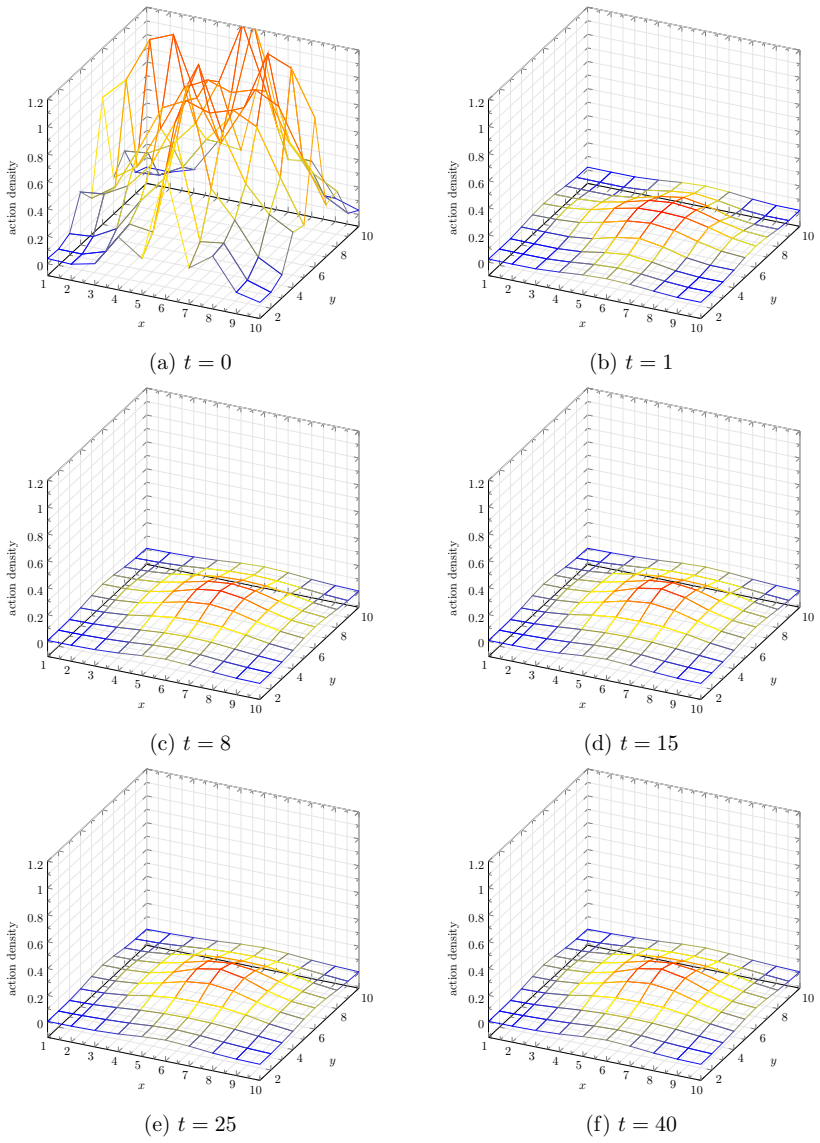
The central object is the combination $H(x,\mu)$, a 'tree-level improved' finite-difference replacement for $g^{-1}\partial_\mu g$ that includes a tunable parameter $\eta$; the improved discretization of the winding number is $W_3^{\rm lat} = \frac{1}{4^3\,24\pi^2}\sum_{x,\mu,\nu,\rho}\epsilon_{\mu\nu\rho}\mathrm{tr}[H(x,\mu)H(x,\nu)H(x,\rho)]$. The gradient flow is defined by $\partial_t g(t,x) = -g(t,x)\,\partial^a_x S_{\rm lat}T^a$ with $S_{\rm lat}=-\frac{1}{16}\sum_{x,\mu}\mathrm{tr}H(x,\mu)^2$, and is integrated by a Runge-Kutta scheme. The load-bearing mechanism is the dependence of $S_{\rm lat}$ on $\eta$: for negative, over-improved $\eta$ the action as a function of the parameter $m$ acquires local minima inside each topological sector (Fig. 5), so the flow settles into the correct sector instead of sliding to the trivial map, while for $\eta=0,1$ the action has no such minima and the flow erases the topological information.
What would settle it
Take a different family of maps from $T^3$ to $SU(2)$ with known winding numbers, add noise comparable to the paper's, and check whether the over-improved flow with $\eta=-20$ on an $L=10$ lattice produces a plateau of $W_3^{\rm lat}$ at the correct integer over flow times $t\simeq2$–$40$; if the plateau drifts, fails to reach an integer, or jumps between sectors, the claimed stabilization is not generic. A cheaper check is to compute $S_{\rm lat}$ along a two-parameter family and see whether sectors with nonzero winding number lack a local minimum.
Extended reading notes
Core claim
The paper claims that the continuum winding number $W_3=\frac{1}{24\pi^2}\int_{T^3}\mathrm{tr}(g^{-1}dg)^3$ can be approximated on a cubic lattice by replacing $g^{-1}\partial_\mu g$ with an improved difference operator $H(x,\mu)$ (Eq. (2.2)) containing a parameter $\eta$, and summing $\epsilon_{\mu\nu\rho}\mathrm{tr}(HHH)$ over the lattice (Eq. (2.3)). Setting $\eta=1$ removes the leading lattice-discretization error and already reproduces $W_3=0,1,-2$ accurately for $L\gtrsim20$. For coarse or noisy configurations, flowing $g(x)$ by the gradient equation $\partial_t g = -g\,\partial^a_x S_{\rm lat}T^a$ with the over-improved action $S_{\rm lat}=-\frac{1}{16}\sum_{x,\mu}\mathrm{tr}H(x,\mu)^2$ (using negative $\eta$ such as $-20$) stabilizes the lattice winding number around the correct integer; the paper shows that for negative $\eta$ the lattice action develops local minima in each topological sector, pinning the flow. The method requires neither diagonalization of $g(x)$ nor interpolation of the map.
Load-bearing premise
The method's reliability rests on the untested premise that the single one-parameter family tested is representative: for sufficiently negative $\eta$, the lattice action develops local minima in every topological sector for generic coarse or noisy configurations, not just for this family.
Editorial extensions
If this is right
- With tree-level improvement ($\eta=1$), the discretized winding number alone reaches essentially exact integers already at $L\simeq20$ for the tested family.
- For coarse lattices ($L=10$) with added random noise, an over-improved flow ($\eta=-10$ or $-20$) holds the lattice winding number near the correct integer over a range of flow times; for example, $W_3^{\rm lat}=-1.96797(4)$ at $t=2$ for $m=3$.
- Standard or tree-level flow ($\eta=0,1$) drives configurations toward the trivial sector, so the over-improved choice is essential for stabilization.
- The same construction works for $U(N)$ and extends trivially to higher-dimensional tori, with light computational cost.
Reading between the lines
- The mechanism suggests a practical tuning rule: choose $\eta$ negative enough that the lattice action has local minima in every sector of interest for the given lattice size; the required $\eta$ likely depends on $L$ and on the roughness of the configurations.
- Because the stabilization comes from discretization error, the method's over-improved flow is complementary to standard improvement: on fine lattices the improved discretization suffices, while on coarse lattices the flow provides the stability, potentially making the pair useful for Monte Carlo samples with noisy topological charge.
- One testable extension, not pursued in the paper, is to apply the method to configurations with multiple spatially separated topological structures, where pinning to a single integer is harder and the action landscape would need local minima in each sector separately.
Editorial analysis
A structured set of objections, weighed in public.
Referee Report
Summary. The paper proposes a numerical method for approximating the winding number of a map from T^3 to U(N) when the map is only known on a cubic lattice. The method combines a tree-level improved lattice discretization of the W3 functional, Eqs. (2.2)-(2.3), with gradient-flow smearing generated by an over-improved lattice action, Eqs. (3.4)-(3.9). Using a one-parameter family of SU(2) maps with known winding numbers, the authors show that the eta=1 discretization converges quickly (Tables 1-2), that gradient flow with negative eta stabilizes W_lat against random perturbations (Figs. 1-2), and that the lattice action restricted to the family develops local minima in the corresponding sectors for negative eta (Fig. 5). The paper also explains the stabilization mechanism in terms of discretization errors in the flow action and notes that the method avoids diagonalization or interpolation of g(x).
Significance. If the results generalize beyond the tested family, the method is a useful and computationally light tool for lattice computations of Chern-Simons-type invariants. The paper is transparent in an exemplary way: the benchmark uses analytically known winding numbers, the code and numerical data are publicly available on GitHub, and the authors explicitly disclose that the choice of eta and flow time is exploratory rather than derived from first principles. The tree-level improvement is shown to reduce discretization errors by large factors on the tested family, and the over-improved flow provides clear numerical stabilization in the shown cases, which are genuine assets of the manuscript.
major comments (2)
- [Sec. 3, Figs. 1-2 and 5; footnote 9] The load-bearing claim is that over-improved gradient flow stabilizes the lattice winding number for generic coarse or noisy configurations. The evidence, however, is restricted to the one-parameter family (2.4): Fig. 5 evaluates S_lat only along that slice, so it establishes local minima on a one-dimensional subspace of a high-dimensional configuration space, not the size of the basins of attraction. Footnote 9 explicitly concedes that a configuration could slip away from the family under flow. The noisy tests in Figs. 1 and 2 are also perturbations of the same family and cover only m=-1, 1, and 3. Because W_lat in Eq. (2.3) is not integer-valued on the lattice, the flow can cross between sectors, and stabilization is an empirical property of the chosen eta and t rather than a theorem. I would ask for at least one additional family of maps with known winding number, or a quantitative basin-size diagnostic, before the method is advertised as general; alternatively, the claims should be narrowed explicitly to the tested class.
- [Secs. 3-4] The method requires two tuning parameters, the over-improvement coefficient eta and the flow time t, and no concrete criterion for choosing them is provided. Figures 1 and 2 are shown for eta=-10 and eta=-20 and for t up to 40 or 80, with t=2 used in Fig. 6, but nowhere is there a rule such as a plateau-time selection or an automatic stopping condition. The conclusion states that real applications require exploratory tuning of eta. Since the central practical promise is a 'simple and versatile' method, a concrete protocol for choosing (eta, t), or at least a sharper statement of how sensitive the result is to these choices, is needed for the method to be reproducible in new settings.
minor comments (5)
- [Eq. (3.6)] The displayed equation d_t g(t,x) = -sum_x (d^a_x S_lat)(d^a_x S_lat) is not what is meant; the context shows that the derivative of the action should be d_t S_lat = -sum_x (d^a_x S_lat)^2 <= 0. Please correct this typo, since the monotonic decrease of S_lat is used in the subsequent explanation.
- [Abstract and Sec. 1] The abstract and introduction state that the method is 'simple and versatile' and can be generalized to higher-dimensional tori, but the numerical support is only for d=3 and for the SU(2) family (2.4). If no further tests are added, please qualify these statements, for example by saying 'for the class of maps studied here'.
- [Sec. 1, Refs. [5-8]] No comparison with the existing lattice winding-number algorithms of Refs. [5-8] is made. A brief numerical or conceptual comparison would help the reader assess the claimed advantage of the present method.
- [Figs. 1-2] The 15 trajectories per m value are plotted as separate lines, but no legend connects line style to m. A legend or distinctive line styles would improve readability.
- [Eq. (2.6)] The piecewise winding-number formula for the family (2.4) is stated without derivation or citation; please add a reference or a short justification.
Circularity Check
No significant circularity: the method is validated against analytically known external winding numbers, and the disclosed tuning of the improvement parameter is not disguised as a prediction.
full rationale
The paper's central claim is an empirical numerical proposal, not a derivation from first principles. The discretized winding number W_lat (Eq. 2.3) is a direct lattice transcription of the continuum integral (Eq. 1.1), with a tree-level improvement parameter eta in Eq. (2.2). The gradient flow (Eqs. 3.4-3.9) is a standard lattice transcription of the continuum flow (Eqs. 3.1-3.3). No equation is defined in terms of the target quantity in a way that makes the result true by construction: W_lat is not integer-valued, and the paper explicitly notes in footnote 9 that the configuration could in principle slip away from the tested one-parameter family, so the stabilization is an observed property rather than an imported theorem. The benchmark uses the family (2.4) whose exact winding numbers (2.6) are known analytically and are external to the paper's numerical scheme. The only adjustable inputs are the improvement parameter eta and the flow time t; their selection is disclosed, and the conclusion explicitly states that real applications require exploratory tuning of eta. This is a generality limitation, not circularity. Citations to prior work, including one article co-authored by H. Suzuki, are used for context or standard analytic results and do not form a self-citation chain that forces the paper's conclusion. The paper is therefore self-contained against an external benchmark and contains no circular step.
Assumptions & free parameters
free parameters (2)
- over-improvement coefficient eta in gradient flow action =
-10 and -20 chosen
- flow time t =
e.g., t=2 or 10
assumptions (4)
- standard math The continuum winding number W3 (1.1) is well defined and integer-valued for smooth maps g: T^3 -> U(N).
- domain assumption The known winding numbers (2.6) for the one-parameter family (2.4) are correct.
- domain assumption The lattice action Slat (3.7) monotonically decreases along the lattice flow, and the continuum flow preserves the topological sector.
- ad hoc to paper For sufficiently negative eta, the lattice action has local minima in each topological sector.
Cite this review
Pith. "Pith review of Winding number on 3D lattice." pith.science (2026). https://pith.science/paper/GZGGVP43
@misc{pith2026241203888,
  author       = {Pith},
  title        = {Pith review of: Winding number on 3D lattice},
  year         = {2026},
  howpublished = {\url{https://pith.science/paper/GZGGVP43}},
  note         = {Machine review of arXiv:2412.03888}
}
abstract
We propose a simple numerical method which computes an approximate value of the winding number of a mapping from 3D torus~$T^3$ to the unitary group~$U(N)$, when $T^3$ is approximated by discrete lattice points. Our method consists of a ``tree-level improved'' discretization of the winding number and the gradient flow associated with an ``over-improved'' lattice action. By employing a one-parameter family of mappings from $T^3$ to $SU(2)$ with known winding numbers, we demonstrate that the method works quite well even for coarse lattices, reproducing integer winding numbers in a good accuracy. Our method can trivially be generalized to the case of higher-dimensional tori.
Figures


Figures from the paper (3 more)


Forward citations
Cited by 1 Pith paper
-
A Discrete Formulation of Second Stiefel-Whitney Class for Band Theory
A discrete, gauge-fixing-free formula computes the Z2 second Stiefel-Whitney class from Bloch states on a mesh, verified on tight-binding models.
Reference graph
Works this paper leans on
-
[1]
D. Friedan, Commun. Math. Phys. 85, 481-490 (1982) doi:10.1007/BF01403500
-
[2]
M. L¨ uscher, Commun. Math. Phys. 85, 39 (1982) doi:10.1007/BF02029132
-
[3]
N. Seiberg, Phys. Lett. B 148, 456-460 (1984) doi:10.1016/0370-2693(84)90737-8
-
[4]
A. P. Schnyder, S. Ryu, A. Furusaki, and A. W. W. Ludwig Phys. Rev. B 78, 195125 (2008) doi:10.1103/PhysRevB.78.195125 [arXiv:0803.2786 [cond-mat.mes-hall]]
arXiv 2008
-
[5]
Shiozaki, [arXiv:2403.05291 [cond-mat.mes-hall]]
K. Shiozaki, [arXiv:2403.05291 [cond-mat.mes-hall]]
- [6]
-
[7]
J. Y. Chen, [arXiv:2406.06673 [hep-lat]]
- [8]
Show all 20 references
-
[9]
L¨ uscher, Nucl
M. L¨ uscher, Nucl. Phys. B 549, 295-334 (1999) doi:10.1016/S0550-3213(99)00115-7 [arXiv:hep-lat/9811032 [hep-lat]]
1999 arXiv
-
[10]
Fukui, Y
T. Fukui, Y. Hatsugai and H. Suzuki, J. Phys. Soc. Jap. 74, 1674-1677 (2005) doi:10.1143/JPSJ.74.1382 [arXiv:cond-mat/0503172 [cond-mat.mes-hall]]
2005 arXiv
-
[11]
L¨ uscher, JHEP 08, 071 (2010) [erratum: JHEP 03, 092 (2014)] doi:10.1007/JHEP08(2010)071 [arXiv:1006.4518 [hep-lat]]
M. L¨ uscher, JHEP 08, 071 (2010) [erratum: JHEP 03, 092 (2014)] doi:10.1007/JHEP08(2010)071 [arXiv:1006.4518 [hep-lat]]
2010 arXiv
- [12]
-
[13]
Garc ´ ıa P´ erez, A
M. Garc ´ ıa P´ erez, A. Gonz´ alez-Arroyo, J. R. Snippe and P. van Baal, Nucl. Phys. B 413, 535-552 (1994) doi:10.1016/0550-3213(94)90631-9 [arXiv:hep-lat/9309009 [hep-lat]]
1994 arXiv
-
[14]
de Forcrand and S
P. de Forcrand and S. Kim, Nucl. Phys. B Proc. Suppl. 47, 278-281 (1996) doi:10.1016/0920-5632(96)00056-4 [arXiv:hep-lat/9509081 [hep-lat]]
1996 arXiv
- [15]
-
[16]
Coste and M
A. Coste and M. L¨ uscher, Nucl. Phys. B 323, 631-659 (1989) doi:10.1016/0550-3213(89)90127-2
1989 doi
-
[17]
Fujiwara, K
T. Fujiwara, K. Nagao and H. Suzuki, JHEP 09, 025 (2002) doi:10.1088/1126-6708/2002/09/025 [arXiv:hep- lat/0208057 [hep-lat]]
2002
- [18]
-
[19]
Iwasaki and T
Y. Iwasaki and T. Yoshi` e, Phys. Lett. B 131, 159-164 (1983) doi:10.1016/0370-2693(83)91111-5
1983 doi
- [20]
Reviewed August 11, 2026 · model on record in the stance chip above.
Discussion (0). Continue with ORCID to comment.