REVIEW 4 major objections 5 minor 64 references
3D Rigid Motion Segmentation with Mixed and Unknown Number of Models
T0 review · 4 major / 5 minor · reviewed 2026-08-14 · deepseek-v4-flash
Pith's one-line read Fusing homography and fundamental-matrix affinity models, with a subset constraint inherited from their geometry, substantially improves 3D rigid motion segmentation and estimates the number of moving objects via a…
desk verdict The fusion experiments are real and the KT3DMoSeg benchmark is a genuine asset, but the NCRE model-selection derivation has an algebraic error in its normalized-cut term and needs a rewrite, not just a caveat. read the letter →
The pith
A machine-rendered reading of the paper's core claim, the machinery that carries it, and where it could break.
The reading
What carries the argument
The central objects are the affinity matrices $K_A$, $K_H$, and $K_F$ built from thousands of randomly sampled geometric hypotheses. Each hypothesis is fit by direct linear transform, and the ordered residual kernel (ORK) converts Sampson residuals into a threshold-free co-occurrence affinity, so no inlier threshold needs to be tuned and the kernel is resilient to sampling imbalance between background and foreground. The multi-model step solves a spectral clustering objective over several views, either by kernel addition, by co-regularization, or by a subset-constrained objective in which relaxed embeddings enforce the elementwise ordering $K_A \le K_H \le K_F$ on ideal affinities, using $F = [e]_\times H$ to justify the constraint. Model selection then minimizes the NCRE objective, $\mathrm{Ncut} + \delta \, \epsilon(W,K)$, where the normalized cut term penalizes over-segmentation and the normalized reconstruction error term penalizes partitions that deviate from the observed affinity matrix, by searching over candidate numbers of clusters from 1 to $N$.
What would settle it
Compute the NCRE cost curve on a KT3DMoSeg sequence with four or five labelled motions; if the curve's minimum occurs at a cluster count smaller than the labelled count while the segmentation error at the labelled count is lower than at the chosen count, the model-selection claim fails, and this is testable because the benchmark and its labels are released.
Extended reading notes
Core claim
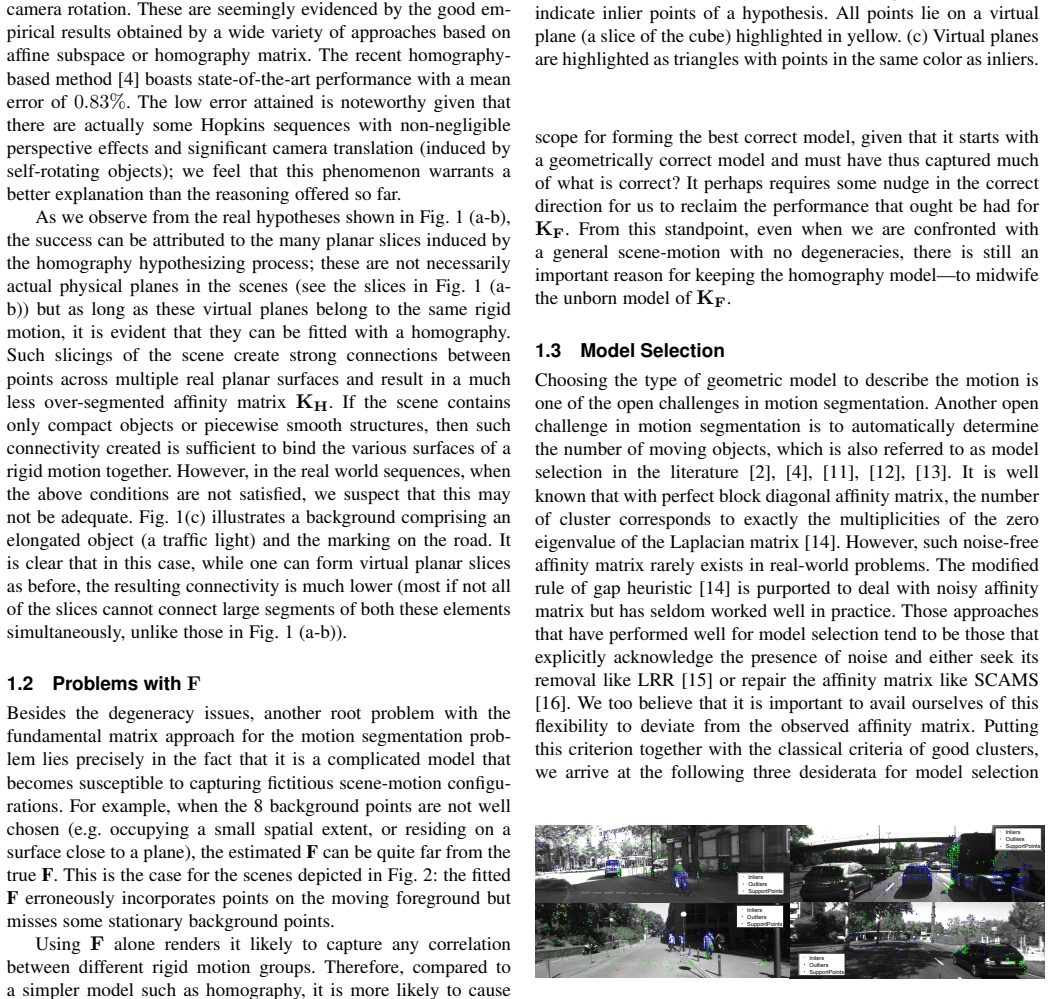
The paper's central claim is that the fundamental matrix's theoretical generality can be realized in practice only when a simpler model helps it along: fusing the affinities from affine, homography, and fundamental-matrix views yields better motion segmentation than any single model, because each model fails in different ways. The authors identify why homography succeeds on weak-perspective, rotation-dominant sequences, through virtual planar slices that create connectivity across surfaces of the same rigid motion, and they show why the fundamental matrix alone fails: it tends to capture fictitious correlations between different motion groups. Their subset-constrained fusion encodes the geometric hierarchy that on ideal affinities $K_A \le K_H \le K_F$ elementwise, using the relation $F = [e]_\times H$ from two-view geometry, so points already joined by a simpler model are encouraged to stay together in richer models, while points separated by the fundamental matrix are pushed apart elsewhere. Concretely, the paper reports a mean segmentation error of 0.31% on Hopkins155 with subset-constrained fusion, compared with 0.71% for homography alone and 1.79% for fundamental matrix alone, and consistent gains on Hopkins12, MTPV62, and the new KT3DMoSeg dataset. For the unknown-number-of-motions problem, NCRE combines a normalized cut term with a normalized reconstruction error term, and the paper reports it selects the correct number of motions on 87.10% of Hopkins155 sequences when candidates start at one cluster, and 92.26% when the trivial single-cluster case is excluded.
Load-bearing premise
The method for choosing how many moving objects there are assumes that as the number of candidate groups grows, the cleanliness cost always rises while the fit-to-data cost always falls, so their sum has one clear minimum; the authors acknowledge this is not proven for every data distribution.
Editorial extensions
If this is right
- On Hopkins155, the subset-constrained fused model reaches 0.31% mean segmentation error, down from 0.71% with homography alone and 1.79% with fundamental matrix alone.
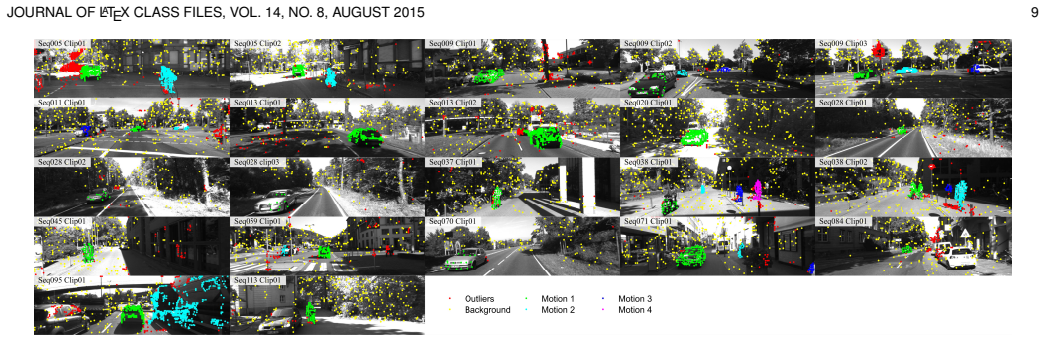
- On KT3DMoSeg, fusing homography with fundamental matrix reduces errors far below the affine-plus-homography combination, showing that the richer fundamental-matrix model contributes real information in outdoor scenes with strong perspective and forward translation.
- NCRE correctly estimates the number of moving objects on 87.10% of Hopkins155 sequences when candidates start at one cluster, and 92.26% when the trivial single-cluster case is excluded, both above the 85.81% reported for the best prior model-selection method.
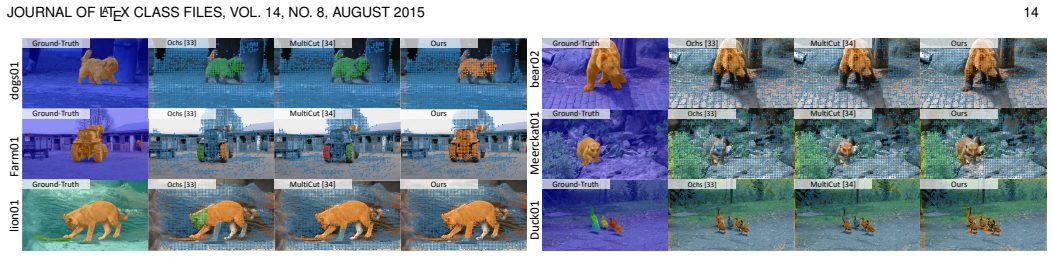
- On dense and articulated sequences from FBMS59 and ComplexBackground, the fused approach improves recall and F-measure over translational-model baselines, so its benefit is not restricted to sparse, rigid scenes.
- When the scene type is unknown, fusing all three models is robust: the optimal model pair changes by dataset, but three-way fusion remains competitive in both segmentation and model selection.
Reading between the lines
- Because simple kernel addition already captures most of the fusion gain, the improvement may come less from the custom subset constraint than from the complementarity of the affinity matrices themselves, which suggests the approach could transfer to other pairs of geometric models.
- The NCRE criterion is formulated in generic graph terms, so it could be tested as a model selector for spectral clustering outside motion segmentation, for instance on image or text affinity graphs, though the paper does not claim this.
- The KT3DMoSeg ground truth was cleaned with human-in-the-loop outlier removal; the authors publish the untrimmed trajectories, which would let a follow-up test whether the fusion gains survive in a fully automatic pipeline.
- The geometric hierarchy $K_A \le K_H \le K_F$ holds exactly only for ideal noiseless affinities; in practice errors can propagate through the constraints, so adaptively weighting the constraint strength per view could be a useful extension.
Signed reviews
Editorial analysis
A structured set of objections, weighed in public.
Referee Report
Summary. The paper proposes a multi-model spectral clustering framework for 3D rigid motion segmentation, fusing affinity matrices derived from affine, homography, and fundamental matrix models. Three fusion schemes are evaluated: kernel addition, co-regularized spectral clustering, and a novel subset-constrained scheme that exploits the hierarchical relationship H ⊆ F and A ⊆ H. For the case where the number of motions is unknown, the paper introduces a model selection criterion, NCRE, which combines a normalized cut term with a normalized reconstruction error term. The method is evaluated on Hopkins155, Hopkins12, MTPV62, a new KITTI-based dataset KT3DMoSeg introduced by the authors, and two dense/articulated motion datasets (FBMS59 and ComplexBackground), reporting state-of-the-art or competitive results. The paper also provides qualitative analysis of the complementary strengths of homography and fundamental matrix models.
Significance. If the empirical results are upheld, the paper makes two valuable contributions: it demonstrates that explicitly fusing simple (affine/homography) and complex (fundamental matrix) geometric models yields consistent gains across diverse datasets, and it provides a new public benchmark (KT3DMoSeg) with real-world effects such as strong perspective and forward translation. The paper is also unusually transparent about its limitations, explicitly acknowledging that the convergence of subset-constrained clustering is not guaranteed and that the monotonicity of the NCRE terms cannot be proven. However, the theoretical derivation of NCRE contains a load-bearing algebraic inconsistency that undermines the stated principled basis of the model selection criterion; the paper's model selection results may still hold empirically, but they must be reframed as heuristic.
major comments (4)
- [Section 4, Eq. (11)] The expression for the normalized cut in Eq. (11) is algebraically incorrect given the definition of L in Section 3.3.1. There, L is the symmetric normalized Laplacian L = I − D^{−1/2} K D^{−1/2}. For a binary indicator vector x of a cluster A, x^T L x / x^T x equals 1 − (Σ_{i,j∈A} K_ij / √(d_i d_j))/|A|, which is not cut(A, Ā)/vol(A). The standard Rayleigh form of the normalized cut requires y = D^{1/2} x, giving y^T L_sym y / y^T y, or, with the unnormalized Laplacian L = D − K, the quotient x^T L x / x^T D x. Consequently, Eq. (13) and Algorithm 2 compute a residual that is not the advertised normalized-cut-plus-reconstruction-error objective, and the information-theoretic complexity interpretation from [47] does not apply to the term actually computed. Because the paper's model selection results rely on this quantity, the theoretical framing of NCRE as a principled precision–complexity trade-off is not supported by the derivation. The authors should either correct the algebra and report whether the implemented objective matches the corrected form, or explicitly present NCRE as a heuristic objective whose empirical behavior is the justification.
- [Section 4.1, Eq. (10)] The cut interpretation in Eq. (10) also relies on the unnormalized Laplacian. The identity tr(X^T K X) = tr(X^T D X) − tr(X^T L X) = C − Σ_m cut(A_m, Ā_m) is valid only when L = D − K, but the paper defines L in Section 3.3.1 as the normalized Laplacian. This inconsistency means the reconstruction-error analysis, which uses this identity to argue that the error decreases with M, is not built on the same Laplacian used in the clustering objective. The reconstruction-error term's monotonic decrease with M is asserted rather than demonstrated; this is a secondary but related gap that should be addressed when the NCRE definition is revised.
- [Section 5.4] The model selection parameter δ is set separately for each dataset: 0.1 for Hopkins155, MTPV62, and Hopkins12, and 1 for KT3DMoSeg. Because KT3DMoSeg is a dataset introduced by the authors, the model selection accuracy on it is not a fully independent test of NCRE. The paper should justify the choice of δ, report sensitivity of the results to δ (e.g., a plot over a range of values), and describe the selection protocol (e.g., cross-validation on a subset) so that the reader can assess the risk of overfitting to the evaluation datasets. As written, the model selection claims rest on per-dataset tuning of the key free parameter.
- [Section 3.3.4] The subset-constrained clustering algorithm is not guaranteed to converge because the constraint matrix Q_v changes at every iteration, as acknowledged in the paper. The paper states that 'a proper selection of γ say, less than 1e−2, renders the problem amenable to convergence,' but no convergence criterion, iteration count, or typical behavior is reported. Since the subset-constrained scheme is one of the three proposed fusion methods and is used in the main results (e.g., Table 1), the authors should report the stopping condition and, ideally, the distribution of iterations across sequences, so that the empirical convergence claim can be verified.
minor comments (5)
- [Figure 6] The label '(j) Example Frame with Grount-Truth' contains a typo: 'Grount' should be 'Ground'.
- [Eq. (5)] The definition of Q_v uses indicator functions 1(·) applied elementwise to matrices; this should be stated explicitly for readers unfamiliar with the notation, and the conditions '1(hat K_{v+1} < 0)' should be clarified to indicate elementwise comparison.
- [Table 3] The Hopkins12 columns appear misaligned for several rows, making it difficult to determine which values correspond to which metric. Please reformat the table to clearly separate MeanErr and CorrectRate for each dataset.
- [Section 5.4] The comparison of NCRE with methods like GPCA, LBF, and self-tuning is complicated by the fact that those methods exclude the single-cluster case. The paper handles this by reporting results for 1-to-Mmax and 2-to-Mmax, which is commendable; however, the discussion would benefit from a sentence noting which existing methods correspond to which candidate range in each table.
- [Section 4.2] The statement that the normalized cut term 'does behave as a model complexity term' is supported only by a qualitative argument and a citation to [47]. Given the algebraic issue in Eq. (11), this citation should be revisited, and the argument should be restated in terms of the actual objective used.
Circularity Check
No derivation-level circularity: the segmentation and model-selection claims rest on explicit objectives and external benchmarks; the algebraic objection to Eq. (11) is a correctness gap, not a circular reduction.
full rationale
The core motion-segmentation derivation is self-contained: the affinities K_H and K_F are built from Sampson residuals over sampled geometric hypotheses (Sections 3.1-3.2), the fusion objectives (2)-(5) minimize explicit trace terms with lambda and gamma fixed at 1e-2 (Section 5.2), and the main benchmarks (Hopkins155, Hopkins12, MTPV62, FBMS59, ComplexBackground) are external, so the reported gains are not forced by construction. The subset-constraint scheme follows from the stated geometric identity F=[e]_x H (Section 3.3.3), which is an input relation, not an output label. For model selection, NCRE is an explicit cost (Eqs. 9-13) and Algorithm 2 enumerates M and selects the minimizer; no fitted parameter is renamed as a prediction. Two evaluation caveats weaken the model-selection claim but are not circularity: delta is set per dataset (0.1 for Hopkins155, MTPV62, Hopkins12; 1 for KT3DMoSeg, Section 5.4), and KT3DMoSeg is an author-created benchmark cited as [51]. These make the KT3DMoSeg model-selection numbers tuned rather than parameter-free, but they do not make Eq. (13)'s optimum equal to its input by construction. Separately, the identification in Eq. (11) of normalized cut with sum x^T L x / x^T x is algebraically incorrect for the normalized Laplacian defined in Section 3.3.1, so the cited information-theoretic support [47] does not apply to the term actually computed; that is a correctness/derivation gap, not a circular step.
Assumptions & free parameters
free parameters (6)
- delta (NCRE weight) =
0.1 for Hopkins155/MTPV62/Hopkins12; 1 for KT3DMoSeg
- lambda (co-regularization weight) =
1e-2
- gamma (subset constraint weight) =
1e-2
- h (top-h residual threshold in ORK) =
not stated
- epsilon-neighborhood sparsification threshold =
not stated
- Mmax (maximum number of clusters) =
10
assumptions (3)
- domain assumption For ideal binary affinity matrices, KA <= KH <= KF elementwise, reflecting the hierarchical relationship between affine, homography, and fundamental matrix models.
- domain assumption The normalized cut term increases with the number of clusters M and the reconstruction error decreases with M, so the NCRE objective in Eq (12) has a minimum at the true M.
- standard math Spectral graph theory results: the eigenvectors of the normalized Laplacian provide a useful embedding for clustering, and the minimum of the trace objective under orthonormal constraints is attained by the smallest eigenvectors.
Cite this review
Pith. "Pith review of 3D Rigid Motion Segmentation with Mixed and Unknown Number of Models." pith.science (2026). https://pith.science/paper/GZV6CPUP
@misc{pith2026190806087,
  author       = {Pith},
  title        = {Pith review of: 3D Rigid Motion Segmentation with Mixed and Unknown Number of Models},
  year         = {2026},
  howpublished = {\url{https://pith.science/paper/GZV6CPUP}},
  note         = {Machine review of arXiv:1908.06087}
}
read the original abstract
Many real-world video sequences cannot be conveniently categorized as general or degenerate; in such cases, imposing a false dichotomy in using the fundamental matrix or homography model for motion segmentation on video sequences would lead to difficulty. Even when we are confronted with a general scene-motion, the fundamental matrix approach as a model for motion segmentation still suffers from several defects, which we discuss in this paper. The full potential of the fundamental matrix approach could only be realized if we judiciously harness information from the simpler homography model. From these considerations, we propose a multi-model spectral clustering framework that synergistically combines multiple models (homography and fundamental matrix) together. We show that the performance can be substantially improved in this way. For general motion segmentation tasks, the number of independently moving objects is often unknown a priori and needs to be estimated from the observations. This is referred to as model selection and it is essentially still an open research problem. In this work, we propose a set of model selection criteria balancing data fidelity and model complexity. We perform extensive testing on existing motion segmentation datasets with both segmentation and model selection tasks, achieving state-of-the-art performance on all of them; we also put forth a more realistic and challenging dataset adapted from the KITTI benchmark, containing real-world effects such as strong perspectives and strong forward translations not seen in the traditional datasets.
Figures

Figures from the paper (5 more)



Reference graph
Works this paper leans on
-
[47]
An information-theoretic derivation of min- cut-based clustering,
A. Raj and C. H. Wiggins, “An information-theoretic derivation of min- cut-based clustering,” IEEE transactions on pattern analysis and machine intelligence, vol. 32, no. 6, pp. 988–995, 2010
work page 2010
-
[1]
Rigid Motion Segmentation Using Random- ized V oting,
H. Jung, J. Ju, and J. Kim, “Rigid Motion Segmentation Using Random- ized V oting,” inCVPR, 2014
work page 2014
-
[2]
Perspective motion segmentation via collaborative clustering,
Z. Li, J. Guo, L. F. Cheong, and S. Z. Zhou, “Perspective motion segmentation via collaborative clustering,” in ICCV, 2013
work page 2013
-
[3]
Multi-scale clustering of frame-to-frame correspondences for motion segmentation,
R. Dragon, B. Rosenhahn, and J. Ostermann, “Multi-scale clustering of frame-to-frame correspondences for motion segmentation,” in ECCV, 2012
work page 2012
-
[4]
Motion Segmentation Via a Sparsity Constraint,
T. Lai, H. Wang, Y . Yan, T. J. Chin, and W. L. Zhao, “Motion Segmentation Via a Sparsity Constraint,” IEEE Transactions on Intelligent Transporta- tion Systems, 2017
work page 2017
-
[5]
L. Goshen and I. Shimshoni, “Guided sampling via weak motion models and outlier sample generation for epipolar geometry estimation,” Interna- tional Journal of Computer Vision , 2008
work page 2008
-
[6]
Geometric structure of degeneracy for multi- body motion segmentation,
Y . Sugaya and K. Kanatani, “Geometric structure of degeneracy for multi- body motion segmentation,” in In Workshop on Statistical Methods in Video Processing, 2004
work page 2004
-
[7]
Robust Detection of Degenerate Configurations while Estimating the Fundamental Matrix,
P. Torr, A. Zisserman, and S. Maybank, “Robust Detection of Degenerate Configurations while Estimating the Fundamental Matrix,” Computer Vision and Image Understanding , 1998
work page 1998
Show all 64 references
-
[8]
A Benchmark for the Comparison of 3-D Motion Segmentation Algorithms,
R. Tron and R. Vidal, “A Benchmark for the Comparison of 3-D Motion Segmentation Algorithms,” in CVPR, 2007
2007
-
[9]
Hartley and A
R. Hartley and A. Zisserman, Multiple view geometry in computer vision . Cambridge university press, 2003
2003
-
[10]
Vision meets robotics: The kitti dataset,
A. Geiger, P. Lenz, C. Stiller, and R. Urtasun, “Vision meets robotics: The kitti dataset,” International Journal of Robotics Research , 2013
2013
-
[11]
Estimating the number of clusters in a data set via the gap statistic,
R. Tibshirani, G. Walther, and T. Hastie, “Estimating the number of clusters in a data set via the gap statistic,” Journal of the Royal Statistical Society: Series B (Statistical Methodology) , 2001
2001
-
[12]
Multi-structure model selection via kernel optimisation,
T. J. Chin, D. Suter, and H. Wang, “Multi-structure model selection via kernel optimisation,” in CVPR, 2010
2010
-
[13]
Simultaneous Clustering and Model Selection: Algorithm, Theory and Applications,
Z. Li, L.-F. Cheong, S. Yang, and K.-C. Toh, “Simultaneous Clustering and Model Selection: Algorithm, Theory and Applications,” IEEE Trans- actions on Pattern Analysis and Machine Intelligence , 2017
2017
-
[14]
A tutorial on spectral clustering,
U. V on Luxburg, “A tutorial on spectral clustering,” Statistics and computing, 2007
2007
-
[15]
Robust recovery of subspace structures by low-rank representation,
G. Liu, Z. Lin, S. Yan, J. Sun, Y . Yu, and Y . Ma, “Robust recovery of subspace structures by low-rank representation,” IEEE Transactions on Pattern Analysis and Machine Intelligence , 2013
2013
-
[16]
SCAMS: Simultaneous clustering and model selection,
Z. Li, L. F. Cheong, and S. Z. Zhou, “SCAMS: Simultaneous clustering and model selection,” in CVPR, 2014
2014
-
[17]
Factorization-based segmentation of motions,
T. E. Boult and L. G. Brown, “Factorization-based segmentation of motions,” in Visual Motion, 1991., Proceedings of the IEEE Workshop on, 1991
1991
-
[18]
A multibody factorization method for independently moving objects,
J. P. Costeira and T. Kanade, “A multibody factorization method for independently moving objects,”International Journal of Computer Vision, 1998
1998
-
[19]
Multibody grouping from motion images,
C. W. Gear, “Multibody grouping from motion images,” International Journal of Computer Vision , 1998
1998
-
[20]
Multibody factorization with uncertainty and missing data using the em algorithm,
A. Gruber and Y . Weiss, “Multibody factorization with uncertainty and missing data using the em algorithm,” in CVPR, 2004
2004
-
[21]
Shape and motion from image streams under orthography: a factorization method,
C. Tomasi and T. Kanade, “Shape and motion from image streams under orthography: a factorization method,” International Journal of Computer Vision, 1992
1992
-
[22]
Motion segmentation in the pres- ence of outlying, incomplete, or corrupted trajectories,
S. Rao, R. Tron, R. Vidal, and Y . Ma, “Motion segmentation in the pres- ence of outlying, incomplete, or corrupted trajectories,”IEEE Transactions on Pattern Analysis and Machine Intelligence , 2010
2010
-
[23]
Motion segmentation with missing data using powerfactorization and gpca,
R. Vidal and R. Hartley, “Motion segmentation with missing data using powerfactorization and gpca,” in CVPR, 2004
2004
-
[24]
Generalized principal component analysis (gpca),
R. Vidal, Y . Ma, and S. Sastry, “Generalized principal component analysis (gpca),” IEEE transactions on pattern analysis and machine intelligence, 2005. JOURNAL OF LATEX CLASS FILES, VOL. 14, NO. 8, AUGUST 2015 15
2005
-
[25]
Multiframe motion segmentation with missing data using PowerFactorization and GPCA,
R. Vidal, R. Tron, and R. Hartley, “Multiframe motion segmentation with missing data using PowerFactorization and GPCA,” International Journal of Computer Vision, 2008
2008
-
[26]
Spectral clustering of linear subspaces for motion segmentation,
F. Lauer and C. Schn ¨orr, “Spectral clustering of linear subspaces for motion segmentation,” in ICCV, 2009
2009
-
[27]
A general framework for motion segmentation: Independent, articulated, rigid, non-rigid, degenerate and non-degenerate,
J. Yan and M. Pollefeys, “A general framework for motion segmentation: Independent, articulated, rigid, non-rigid, degenerate and non-degenerate,” in ECCV, 2006
2006
-
[28]
Sparse subspace clustering: Algorithm, theory, and applications,
E. Elhamifar and R. Vidal, “Sparse subspace clustering: Algorithm, theory, and applications,” IEEE Transactions on Pattern Analysis and Machine Intelligence, 2013
2013
-
[29]
Segmenting motions of different types by unsupervised manifold clustering,
A. Goh and R. Vidal, “Segmenting motions of different types by unsupervised manifold clustering,” in CVPR, 2007
2007
-
[30]
The ordered residual kernel for robust motion subspace clustering,
T. Chin, H. Wang, and D. Suter, “The ordered residual kernel for robust motion subspace clustering,” in NIPS, 2009
2009
-
[31]
Accelerated hypothesis generation for multi-structure robust fitting,
T.-J. Chin, J. Yu, and D. Suter, “Accelerated hypothesis generation for multi-structure robust fitting,” in ECCV, 2010
2010
-
[32]
Floss: Facility location for subspace segmentation,
N. Lazic, I. Givoni, B. Frey, and P. Aarabi, “Floss: Facility location for subspace segmentation,” in ICCV, 2009
2009
-
[33]
Segmentation of moving objects by long term video analysis,
P. Ochs, J. Malik, and T. Brox, “Segmentation of moving objects by long term video analysis,” IEEE transactions on Pattern Analysis and Machine Intelligence, 2014
2014
-
[34]
Motion trajectory segmentation via minimum cost multicuts,
M. Keuper, B. Andres, and T. Brox, “Motion trajectory segmentation via minimum cost multicuts,” in CVPR, 2015
2015
-
[35]
Higher-order minimum cost lifted multicuts for motion segmentation,
M. Keuper, “Higher-order minimum cost lifted multicuts for motion segmentation,” in ICCV, 2017
2017
-
[36]
It’s moving! a probabilistic model for causal motion segmentation in moving camera videos,
P. Bideau and E. Learned-Miller, “It’s moving! a probabilistic model for causal motion segmentation in moving camera videos,” in ECCV, 2016
2016
-
[37]
The best of both worlds: Combining cnns and geometric constraints for hierarchical motion segmentation,
P. Bideau, A. RoyChowdhury, R. R. Menon, and E. Learned-Miller, “The best of both worlds: Combining cnns and geometric constraints for hierarchical motion segmentation,” in CVPR, 2018
2018
-
[38]
Background subtraction for the moving camera: A geometric approach,
D. Zamalieva and A. Yilmaz, “Background subtraction for the moving camera: A geometric approach,” Computer Vision and Image Understand- ing, 2014
2014
-
[39]
Multi-view learning overview: Recent progress and new challenges,
J. Zhao, X. Xie, X. Xu, and S. Sun, “Multi-view learning overview: Recent progress and new challenges,” Information Fusion, 2017
2017
-
[40]
Multiple Kernel Learning Algorithms,
M. G ¨onen and E. Alpaydn, “Multiple Kernel Learning Algorithms,” Journal of Machine Learning Research , 2011
2011
-
[41]
Affinity aggregation for spectral clustering,
H. C. Huang, Y . Y . Chuang, and C. S. Chen, “Affinity aggregation for spectral clustering,” in CVPR, 2012
2012
-
[42]
Fusion of similarity data in clustering,
T. Lange and J. M. Buhmann, “Fusion of similarity data in clustering,” in NIPS, 2006
2006
-
[43]
Multi-view clustering and feature learning via structured sparsity,
H. Wang, F. Nie, and H. Huang, “Multi-view clustering and feature learning via structured sparsity,” in ICML, 2013
2013
-
[44]
Co-regularized Multi-view Spectral Clustering,
A. Kumar, P. Rai, and H. Daume, “Co-regularized Multi-view Spectral Clustering,” in NIPS, 2011
2011
-
[45]
Silhouettes: a graphical aid to the interpretation and validation of cluster analysis,
P. J. Rousseeuw, “Silhouettes: a graphical aid to the interpretation and validation of cluster analysis,” Journal of computational and applied mathematics, 1987
1987
-
[46]
Normalized Cuts and Image Segmentation Nor- malized Cuts and Image Segmentation,
J. Shi and J. Malik, “Normalized Cuts and Image Segmentation Nor- malized Cuts and Image Segmentation,” IEEE Transactions on Pattern Analysis and Machine Intelligence (PAMI) , 2005
2005
-
[48]
Data clustering by markovian relaxation and the information bottleneck method,
N. Tishby and N. Slonim, “Data clustering by markovian relaxation and the information bottleneck method,” in NIPS, 2001
2001
-
[49]
On constrained spectral clustering and its applications,
X. Wang, B. Qian, and I. Davidson, “On constrained spectral clustering and its applications,” Data Mining and Knowledge Discovery , 2014
2014
-
[50]
R. A. Horn and C. R. Johnson, Matrix analysis. Cambridge university press, 1990
1990
-
[51]
Motion segmentation by exploiting complementary geometric models,
X. Xu, L.-F. Cheong, and Z. Li, “Motion segmentation by exploiting complementary geometric models,” in CVPR, 2018
2018
-
[52]
T-linkage: A continuous relaxation of J- linkage for multi-model fitting,
L. Magri and A. Fusiello, “T-linkage: A continuous relaxation of J- linkage for multi-model fitting,” in CVPR, 2014
2014
-
[53]
Structured Sparse Subspace Clustering: A unified optimization framework,
C. G. Li and R. Vidal, “Structured Sparse Subspace Clustering: A unified optimization framework,” in CVPR, 2015
2015
-
[54]
Dense point trajectories by GPU- accelerated large displacement optical flow,
N. Sundaram, T. Brox, and K. Keutzer, “Dense point trajectories by GPU- accelerated large displacement optical flow,” in ECCV, 2010
2010
-
[55]
Improvements in joint domain-range modeling for background subtraction
M. Narayana, A. R. Hanson, and E. G. Learned-Miller, “Improvements in joint domain-range modeling for background subtraction.” in BMVC, 2012
2012
-
[56]
Background modeling using adaptive pixelwise kernel variances in a hybrid feature space,
M. Narayana, A. Hanson, and E. Learned-Miller, “Background modeling using adaptive pixelwise kernel variances in a hybrid feature space,” in CVPR, 2012
2012
-
[57]
A detailed rubric for motion segmen- tation,
P. Bideau and E. Learned-Miller, “A detailed rubric for motion segmen- tation,” arXiv preprint arXiv:1610.10033, 2016
2016 arXiv
-
[58]
A General Framework for Motion Segmenta- tion : Degenerate and Non-degenerate,
J. Yan and M. Pollefeys, “A General Framework for Motion Segmenta- tion : Degenerate and Non-degenerate,” in ECCV, 2006
2006
-
[59]
Shape interaction matrix revisited and robustified: Efficient subspace clustering with corrupted and incomplete data,
P. Ji, M. Salzmann, and H. Li, “Shape interaction matrix revisited and robustified: Efficient subspace clustering with corrupted and incomplete data,” in ICCV, 2015
2015
-
[60]
Exploiting unsupervised and supervised constraints for subspace clustering,
H. Hu, J. Feng, and J. Zhou, “Exploiting unsupervised and supervised constraints for subspace clustering,” IEEE Transactions on Pattern Analy- sis and Machine Intelligence , 2015
2015
-
[61]
Optimization algorithms on subspaces: Revisiting missing data problem in low-rank matrix,
P. Chen, “Optimization algorithms on subspaces: Revisiting missing data problem in low-rank matrix,” International Journal of Computer Vision , 2008
2008
-
[62]
Self-tuning spectral clustering,
L. Zelnik-Manor and P. Perona, “Self-tuning spectral clustering,” in NIPS, 2005
2005
-
[63]
Hybrid linear modeling via local best-fit flats,
T. Zhang, A. Szlam, Y . Wang, and G. Lerman, “Hybrid linear modeling via local best-fit flats,” International Journal of Computer Vision , 2012
2012
-
[64]
Minimal basis facility location for subspace segmentation,
C. M. Lee and L. F. Cheong, “Minimal basis facility location for subspace segmentation,” ICCV, 2013. Xun Xu received the B.E. degree from Sichuan University, in 2010 and the PhD degree from Queen Mary University of London in 2016. He is currently a research fellow with the Ele...
2013
Reviewed August 14, 2026 · model on record in the stance chip above.
Discussion (0). Continue with ORCID to comment.