REVIEW 3 major objections 4 minor 45 references
Thermodynamics-informed graph neural networks for real-time simulation of digital human twins
T0 review · 3 major / 4 minor · reviewed 2026-08-11 · deepseek-v4-flash
Pith's one-line read A graph neural network constrained by the GENERIC metriplectic structure predicts the response of a previously unseen liver anatomy in about 1.65 milliseconds.
desk verdict Solid application paper with a serious evaluation leakage: early stopping on the test set undermines the headline accuracy claims, but the benchmark and architecture work may still be worth a careful revision. read the letter →
The pith
A machine-rendered reading of the paper's core claim, the machinery that carries it, and where it could break.
The reading
What carries the argument
The machinery is a multi-graph message-passing network combined with a nodal port-metriplectic implementation of GENERIC. GENERIC writes the time evolution of a dissipative system as $\dot z = L\,\partial E/\partial z + M\,\partial S/\partial z$, where $L$ is a skew-symmetric Poisson operator and $M$ a symmetric positive-semidefinite friction matrix; the paper reformulates this per node so each mesh node is an open subsystem exchanging energy with neighbours through graph edges. Instead of predicting $\dot z$ directly, the hybrid decoder outputs the local energy and entropy gradients and the flattened edge operators, then a reparametrization layer aggregates boundary contributions and assembles the update, with forward Euler integration rolling the state forward. This object carries the argument because thermodynamic consistency is built into the architecture itself rather than relying on the data alone.
What would settle it
Run the trained model on an ex vivo or in vivo liver under the same traction and compression protocols and compare measured surface displacement and stress with predictions; if positional or stress errors on the real organ exceed the reported 0.15% and 7% thresholds, then the accuracy claim is an artifact of the synthetic ground truth. A cheaper intermediate check is to rerun the finite element data with a heterogeneous, vascularized constitutive model and see whether the network's error on unseen anatomies stays below the reported bounds.
Extended reading notes
Core claim
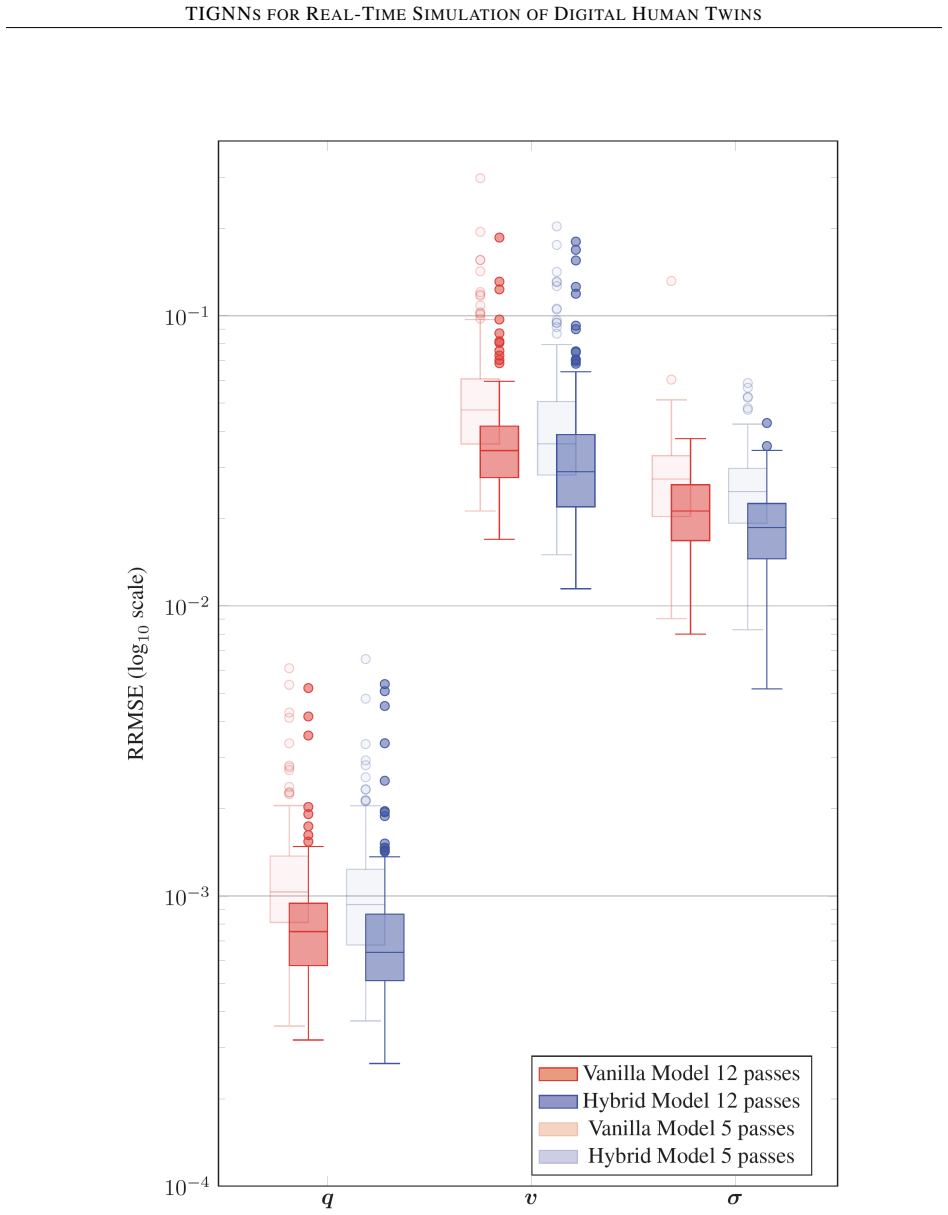
The central discovery claimed is that a graph neural network whose decoder is forced to output the local building blocks of the metriplectic GENERIC evolution equation, per-node energy and entropy gradients plus per-edge friction and Poisson operators, rather than raw state derivatives, learns a dissipative soft-tissue simulator that is both faster and more stable than a data-only network. The imposed structure is enforced twice: softly through a degeneracy loss term in training, and strongly through the reparametrization that assembles the nodal update from the decoded blocks. On a test set of 190 simulations on an unseen fifth liver geometry, the hybrid model lowers rollout RMSE and RRMSE for position, velocity, and Cauchy stress, suppresses error spikes near loaded nodes and stress concentrators, and runs at up to 600 Hz for one-pass configurations. The authors interpret this as evidence that thermodynamic inductive biases improve extrapolation to unseen anatomy and load states, making patient-specific real-time simulation feasible.
Load-bearing premise
The load-bearing premise is that the synthetic finite element data, produced with a homogeneous Ogden-Prony constitutive model whose parameters come from literature, captures the true mechanical response of a real human liver; the paper explicitly omits vascularization and other anatomical features.
Editorial extensions
If this is right
- Surgical simulators could get haptic feedback at more than 600 Hz, since one-pass models infer the full liver state in 1.65 ms.
- A twin trained on four anatomies transfers to a fifth unseen anatomy with lower rollout errors than a vanilla graph network, so patient-specific deployment may not require per-patient retraining.
- Imposing the metriplectic structure improves rollout stability, preventing stress-induced error spikes from corrupting position predictions over 20-time-step simulations.
- The port-metriplectic locality removes the need to assemble global matrices $L$ and $M$, so the method can scale to finer meshes as message passing and hardware allow.
Reading between the lines
- Because the synthetic ground truth is homogeneous and vascularization-free, the clinically relevant claim is untested; if real tissue response differs, the method still works as a simulator but not as a patient twin.
- The same architecture could be applied to other viscoelastic soft tissues, since its tissue-specific content is confined to the training data and constitutive parameters, not the network design.
- The observed quadratic scaling of inference time with message-passing steps suggests an adaptive scheme that varies pass count by region or required accuracy could push interactive rates on larger meshes.
- The noise-injection training strategy contributes to rollout stability independently of the physics bias; ablating it separately would clarify how much of the stability comes from thermodynamics versus data augmentation.
Editorial analysis
A structured set of objections, weighed in public.
Referee Report
Summary. The paper proposes a graph neural network surrogate for real-time simulation of human liver deformations. The architecture combines a central mesh graph with actuator subgraphs and augments a vanilla message-passing encoder-processor-decoder with a "metriplectic" decoder that outputs energy/entropy gradients and per-edge operators intended to realize a port-metriplectic (GENERIC) structure. Training uses synthetic finite element data from a homogeneous Ogden-Prony constitutive model, with noise-based data augmentation and both a vanilla and a hybrid (physics-informed) variant. On a test anatomy L5, the hybrid model reports lower RMSE/RRMSE than the vanilla baseline and inference times of about 1.65–7.3 ms in a forward pass. The abstract and conclusions claim generalization to previously unseen anatomies and thermodynamic consistency by construction.
Significance. If the accuracy and thermodynamic-compliance claims were rigorously established, this would be a valuable step toward real-time, patient-specific surgical simulation. The multi-graph scheme with actuator subgraphs and the explicit comparison against a parameter-matched vanilla baseline are well-targeted design choices, and reporting per-seed standard deviations in Tables 3–4 is good practice. However, the evaluation protocol uses the test set for early stopping and includes validation simulations in the test set, which invalidates the headline generalization numbers; the thermodynamic guarantee is neither formalized in the text nor empirically verified on test data; and the external validity is limited by the synthetic, homogeneous constitutive model. These issues are fixable in a revision, but they are central to the paper's claims.
major comments (3)
- [2.4] The evaluation protocol does not use a truly held-out test set. The text states that "the primary testing dataset is based on the 190 total simulations of L5, including those also used for validation to avoid biases" and that "weight selection for test inference is done through early stopping based on the mean relative rollout error across the complete test dataset." Because the test set is used for model selection, the RMSE/RRMSE values in Tables 3–4 and the rollout plots in Figures 7–10 are optimistically biased estimates of generalization to an unseen anatomy. Please re-run the evaluation with a disjoint validation split (for example, a subset of L5 simulations reserved for validation only) and report test metrics from the checkpoint selected on that validation split.
- [2.2.1 and 2.3.4] The claim that the metriplectic structure "ensures that the network satisfies thermodynamic principles during inference" is not supported by any formal guarantee or empirical verification. Equation (29) adds a soft loss Ldeg with lambda_d = 5, which encourages but does not enforce the degeneracy conditions (20)–(21), and the hard constraints mentioned in Figure 4 are not defined mathematically anywhere in the text: no explicit parameterization of L and M that guarantees skew-symmetry and positive semi-definiteness, nor any construction satisfying the degeneracy conditions, is provided. Please either specify the hard-constraint construction in detail or report test-time residuals of dE/dt, dS/dt, and the degeneracy conditions on the held-out anatomy; without this, the thermodynamic guarantee is not supported.
- [3.1, Eq. (34)] The RRMSE definition is ambiguous and potentially misleading. The denominator ||zref||^2_infinity is not defined; if it is the squared infinity norm of the entire reference state over all nodes and snapshots, then the metric is a global relative error and is not directly interpretable as a per-node relative error, which is how the abstract's "relative position errors below 0.15%" is phrased. Please clarify the normalization and, if appropriate, report per-snapshot or per-node relative errors as well.
minor comments (4)
- [Abstract] The phrase "soft and hard constrains" should be "soft and hard constraints."
- [Appendix A] There is a typo: "Terefore" should be "Therefore."
- [3.3, Figure 10] The label "Train" for rollout error on training data is not a generalization measure; consider renaming it (e.g., "Memorized (Train)") or removing it from the generalization comparison to avoid confusing memorization with extrapolation.
- [Appendix E, Table 5] Table 5 reports no standard deviations, unlike Tables 3–4; please add per-seed variation or state clearly that these are single-run results.
Circularity Check
Test set doubles as early-stopping selection set, so headline 'unseen anatomy' accuracy is a selection statistic; the 'thermodynamic guarantee' is inherited from same-group prior work.
-
fitted input called prediction
[Section 2.4 (Learning procedure and data properties); metrics reported in Section 3, Tables 3-4 and Figures 7-10]
"For validation, 20% of the simulations from the remaining geometry (L5) are used. The primary testing dataset is based on the 190 total simulations of L5, including those also used for validation to avoid biases. [...] Training takes approximately two days on an RTX 3090, while weight selection for test inference is done through early stopping based on the mean relative rollout error across the complete test dataset."
The reported 'Test' numbers are produced by a closed loop: the same L5 simulations that define the Test subset (explicitly including the validation simulations) are used to select the checkpoint via early stopping, and then the same simulations are reported as 'previously unseen' accuracy in Tables 3-4 and Figures 7-10. The paper's headline claim - 'relative position errors below 0.15%' on an 'entirely new anatomy' - is therefore a selection statistic (the minimum-over-training-trajectory of the test rollout error), not an out-of-sample prediction.
-
self citation load bearing
[Sections 2.2-2.2.1 (Eqs. 11-17) and Abstract]
"In this paper we consider a reformulation of the GENERIC formalism in which each of the nodes forming the discretisation of the system (the liver) is considered as an open system that exchanges energy with its neighbours. Therefore, a reformulation of GENERIC will be done through the port-Hamiltonian framework for open systems [27,28]. [...] This modification of the GENERIC formalism ensures compliance with the equations of thermodynamics."
The Abstract's central guarantee - 'This ensures that the network satisfies thermodynamic principles during inference, even for a previously unseen system' - is asserted rather than demonstrated in this manuscript. The load-bearing nodal port-metriplectic structure that the architecture actually implements (Eq. (17), the Ldeg loss in Eq. (29), and the claim that the modification 'ensures compliance with the equations of thermodynamics') is imported from refs. [27] and [28], both prior works by the same group (Tierz/Gonzalez/Chinesta/Cueto; Hernandez et al.). The classical GENERIC degeneracy conditions (Eqs.
full rationale
Verdict: partial circularity (5/10). The network is trained against independent finite-element ground truth generated from an Ogden-Prony constitutive model whose parameters come from external experimental literature (Table 2, ref. [7]), so the q/v/sigma error numbers are not defined by the network's own inputs, and the hybrid-vs-vanilla comparison is a genuine empirical measurement. The circularity burden concentrates in two places. First, the evaluation protocol: the L5 test set (which explicitly includes the validation simulations) is also the early-stopping criterion, so Tables 3-4 report the errors of checkpoints chosen to minimize exactly those same errors; the 'previously unseen anatomy' claim is a selection statistic rather than a holdout result, and the headline 0.15% / 7% figures are statistically forced by that closed loop. Second, the thermodynamic guarantee of the abstract is inherited from same-group prior work (refs. [23,27,28]) rather than demonstrated here; the classical GENERIC degeneracy conditions have external mathematical support, but the neural port-metriplectic implementation is self-cited, and the 'hard constraints' enforcing the structure are never specified, so the strength of the physics guarantee is unverifiable as reported. For the record (not circularity): the database accounting is internally inconsistent (190 simulations across five anatomies versus 760 training simulations versus '190 total simulations of L5'), and the homogeneous Ogden-Prony simplification means the synthetic ground truth is an idealization whose clinical validity is an external correctness risk, not a circularity. A clean re-evaluation with a disjoint validation/test split would settle whether the reported generalization accuracy survives.
Assumptions & free parameters
free parameters (4)
- lambda_d =
5
- nq =
1e-4
- nv =
1e-3
- message_passing_steps_M =
1, 5, or 12
assumptions (5)
- domain assumption GENERIC metriplectic evolution ˙z = L(z)∇E + M(z)∇S describes soft tissue dynamics.
- domain assumption The liver can be treated as a closed system at the timescale of seconds.
- domain assumption The nodal open-system decomposition with bulk and boundary brackets, Eq. 17, preserves the relevant thermodynamics.
- domain assumption The Ogden hyperelastic model with Prony series, with parameters in Table 2, is a valid ground truth for human liver.
- domain assumption Forward Euler integration with 20 time steps is adequate for training and rollout.
Cite this review
Pith. "Pith review of Thermodynamics-informed graph neural networks for real-time simulation of digital human twins." pith.science (2026). https://pith.science/paper/GZZFFYIH
@misc{pith2026241212034,
  author       = {Pith},
  title        = {Pith review of: Thermodynamics-informed graph neural networks for real-time simulation of digital human twins},
  year         = {2026},
  howpublished = {\url{https://pith.science/paper/GZZFFYIH}},
  note         = {Machine review of arXiv:2412.12034}
}
read the original abstract
The growing importance of real-time simulation in the medical field has exposed the limitations and bottlenecks inherent in the digital representation of complex biological systems. This paper presents a novel methodology aimed at advancing current lines of research in soft tissue simulation. The proposed approach introduces a hybrid model that integrates the geometric bias of graph neural networks with the physical bias derived from the imposition of a metriplectic structure as soft and hard constrains in the architecture, being able to simulate hepatic tissue with dissipative properties. This approach provides an efficient solution capable of generating predictions at high feedback rate while maintaining a remarkable generalization ability for previously unseen anatomies. This makes these features particularly relevant in the context of precision medicine and haptic rendering. Based on the adopted methodologies, we propose a model that predicts human liver responses to traction and compression loads in as little as 7.3 milliseconds for optimized configurations and as fast as 1.65 milliseconds in the most efficient cases, all in the forward pass. The model achieves relative position errors below 0.15\%, with stress tensor and velocity estimations maintaining relative errors under 7\%. This demonstrates the robustness of the approach developed, which is capable of handling diverse load states and anatomies effectively. This work highlights the feasibility of integrating real-time simulation with patient-specific geometries through deep learning, paving the way for more robust digital human twins in medical applications.
Figures


Figures from the paper (16 more)




Reference graph
Works this paper leans on
-
[1]
T. G. Ritto and F. A. Rochinha. Digital twin, physics-based model, and machine learning applied to damage detection in structures. Mechanical Systems and Signal Processing, 155:107614, 2021
work page 2021
-
[2]
R. Lam, A. Sanchez-Gonzalez, M. Willson, P. Wirnsberger, M. Fortunato, F. Alet, and P. Battaglia. Graphcast: Learning skillful medium-range global weather forecasting. arXiv preprint arXiv:2212.12794, 2022
arXiv 2022
-
[3]
Digital twins in health care: Ethical implications of an emerging engineering paradigm
Koen Bruynseels, Filippo Santoni de Sio, and Jeroen van den Hoven. Digital twins in health care: Ethical implications of an emerging engineering paradigm. Frontiers in Genetics, 9, 2018
work page 2018
- [4]
-
[5]
The ?digital twin?to enable the vision of precision cardiology
Jorge Corral-Acero, Francesca Margara, Maciej Marciniak, Cristobal Rodero, Filip Loncaric, Yingjing Feng, Andrew Gilbert, Joao F Fernandes, Hassaan A Bukhari, Ali Wajdan, et al. The ?digital twin?to enable the vision of precision cardiology. European heart journal, 41(48):4556–4564, 2020
work page 2020
-
[6]
Nonlinear biomechanical model of the liver
Stephanie Marchesseau, Simon Chatelin, and Herve Delingette. Nonlinear biomechanical model of the liver. In Yohan Payan and Jacques Ohayon, editors,Biomechanics of Living Organs, pages 243–265. Elsevier, 2017
work page 2017
-
[7]
F. Martinez Martinez. Determining the Biomechanical Behavior of the Liver Using Medical Image Analysis and Evolutionary Computation. PhD thesis, Universitat Politecnica de Valencia, 2014
work page 2014
-
[8]
Desarrollo de modelos biomecanicos del higado mediante metodo de elementos finitos, 2020
Roberto Tornero Costa and Sandra Martinez Sanchis. Desarrollo de modelos biomecanicos del higado mediante metodo de elementos finitos, 2020. 15 TIGNN S FOR REAL -T IME SIMULATION OF DIGITAL HUMAN TWINS
work page 2020
Show all 45 references
-
[9]
Zhou and J
F. Zhou and J. F. Molinari. Dynamic crack propagation with cohesive elements: a methodology to address mesh dependency. International Journal for Numerical Methods in Engineering, 59(1):1–24, 2004
2004
-
[10]
Ambati and H
R. Ambati and H. Yuan. Fem mesh-dependence in cutting process simulations. The International Journal of Advanced Manufacturing Technology, 53:313–323, 2011
2011
-
[11]
A survey of convolutional neural networks: analysis, applications, and prospects
Zhenxing Li, Fei Liu, Wei Yang, Shuo Peng, and Junping Zhou. A survey of convolutional neural networks: analysis, applications, and prospects. IEEE Transactions on Neural Networks and Learning Systems, 33(12):6999– 7019, 2021
2021
-
[12]
Bronstein, Joan Bruna, Yann LeCun, Arthur Szlam, and Pierre Vandergheynst
Michael M. Bronstein, Joan Bruna, Yann LeCun, Arthur Szlam, and Pierre Vandergheynst. Geometric deep learning: Going beyond euclidean data. IEEE Signal Processing Magazine, 34(4):18–42, 2017
2017
-
[13]
Medsker and Lakhmi C
Larry R. Medsker and Lakhmi C. Jain. Recurrent Neural Networks: Design and Applications, volume 5. CRC Press, 2001
2001
-
[14]
Battaglia
Tobias Pfaff, Meire Fortunato, Alvaro Sanchez-Gonzalez, and Peter W. Battaglia. Learning mesh-based simulation with graph networks, 2021
2021
-
[15]
Yu Philip
Zonghan Wu, Shirui Pan, Fengwen Chen, Guodong Long, Chengqi Zhang, and S. Yu Philip. A comprehensive survey on graph neural networks. IEEE Transactions on Neural Networks and Learning Systems, 32(1):4–24, 2020
2020
-
[16]
Karniadakis
Maziar Raissi, Paris Perdikaris, and George E. Karniadakis. Physics-informed neural networks: A deep learning framework for solving forward and inverse problems involving nonlinear partial differential equations. Journal of Computational Physics, 378:686–707, 2019
2019
-
[17]
Directions in hybrid intelligence: Complementing ai systems with human intelligence
Ece Kamar. Directions in hybrid intelligence: Complementing ai systems with human intelligence. In Proceedings of the Twenty-Fifth International Joint Conference on Artificial Intelligence (IJCAI), pages 4070–4073, July 2016
2016
-
[18]
A proposal on machine learning via dynamical systems.Communications in Mathematics and Statistics, 1(5):1–11, 2017
Weinan E. A proposal on machine learning via dynamical systems.Communications in Mathematics and Statistics, 1(5):1–11, 2017
2017
-
[19]
Hamiltonian neural networks
Samuel Greydanus, Misko Dzamba, and Jason Yosinski. Hamiltonian neural networks. In Advances in Neural Information Processing Systems, volume 32, 2019
2019
-
[20]
Hamiltonian deep neural networks guaranteeing nonvanishing gradients by design
Clara Lucia Galimberti, Luca Furieri, Liang Xu, and Giancarlo Ferrari-Trecate. Hamiltonian deep neural networks guaranteeing nonvanishing gradients by design. IEEE Transactions on Automatic Control, 68(5):3155–3162, 2023
2023
-
[21]
Ravinder Bhattoo, Sayan Ranu, and N. M. Anoop Krishnan. Learning the dynamics of particle-based systems with lagrangian graph neural networks. Machine Learning: Science and Technology, 4(1):015003, 2023
2023
-
[22]
Lagrangian neural networks
Miles Cranmer, Sam Greydanus, Stephan Hoyer, Peter Battaglia, David Spergel, and Shirley Ho. Lagrangian neural networks. arXiv preprint arXiv:2003.04630, 2020
2003 arXiv
-
[23]
Thermodynamics-informed graph neural networks
Quercus Hernandez, Alberto Badias, Francisco Chinesta, and Elias Cueto. Thermodynamics-informed graph neural networks. IEEE Transactions on Artificial Intelligence, 2022
2022
-
[24]
Structure-preserving neural networks
Quercus Hernández, Alberto Badías, David González, Francisco Chinesta, and Elías Cueto. Structure-preserving neural networks. Journal of Computational Physics, page 109950, 2020
2020
-
[25]
Thermodynamics-informed neural networks for physically realistic mixed reality
Quercus Hernandez, Alberto Badias, Francisco Chinesta, and Elias Cueto. Thermodynamics-informed neural networks for physically realistic mixed reality. Computer Methods in Applied Mechanics and Engineering , 407:115912, 2023
2023
-
[26]
Pfaller, Natalia L
Luca Pegolotti, Martin R. Pfaller, Natalia L. Rubio, Ke Ding, Rita Brugarolas Brufau, Eric Darve, and Alison L. Marsden. Learning reduced-order models for cardiovascular simulations with graph neural networks. Computers in Biology and Medicine, 168:107676, 2024
2024
-
[27]
Graph neural networks informed locally by thermodynamics
Alicia Tierz, Iciar Alfaro, David Gonzalez, Francisco Chinesta, and Elias Cueto. Graph neural networks informed locally by thermodynamics. arXiv preprint arXiv:2405.13093, May 2024
2024 arXiv
-
[28]
Port-metriplectic neural net- works: thermodynamics-informed machine learning of complex physical systems
Quercus Hernandez, Alberto Badias, Francisco Chinesta, and Elias Cueto. Port-metriplectic neural net- works: thermodynamics-informed machine learning of complex physical systems. Computational Mechanics, 72(3):553?561, March 2023
2023
-
[29]
Iparraguirre, Iciar Alfaro, David Gonzalez, Francisco Chinesta, and Elias Cueto
Alicia Tierz, Mikel M. Iparraguirre, Iciar Alfaro, David Gonzalez, Francisco Chinesta, and Elias Cueto. On the feasibility of foundational models for the simulation of physical phenomena. arXiv preprint arXiv:2410.14645, October 2024
-
[30]
Karniadakis
Shengze Cai, Zhiping Mao, Zhi Wang, Min Yang, and George E. Karniadakis. Physics-informed neural networks (pinns) for fluid mechanics: A review. Acta Mechanica Sinica, 37(12):1727–1738, 2021. 16 TIGNN S FOR REAL -T IME SIMULATION OF DIGITAL HUMAN TWINS
2021
-
[31]
Pawar, Cristiano Fernandes, Maziar Raissi, Subir Das, Negar K
Seyed Amir Hossein Faroughi, Nikhil M. Pawar, Cristiano Fernandes, Maziar Raissi, Subir Das, Negar K. Kalantari, and Saeed Kourosh Mahjour. Physics-guided, physics-informed, and physics-encoded neural networks and operators in scientific computing: Fluid and solid mechanics. J...
2024
-
[32]
Message passing all the way up, 2022
Petar Veli?kovi?. Message passing all the way up, 2022
2022
-
[33]
Dynamics and thermodynamics of complex fluids
Hans Christian Oettinger and Miroslav Grmela. Dynamics and thermodynamics of complex fluids. II. illustrations of a general formalism. Physical Review E, 56(6):6633, 1997
1997
-
[34]
Dynamics and thermodynamics of complex fluids
Miroslav Grmela and Hans Christian Oettinger. Dynamics and thermodynamics of complex fluids. I. development of a general formalism. Physical Review E, 56(6):6620, 1997
1997
-
[35]
Metriplectic structure, Leibniz dynamics and dissipative systems
Partha Guha. Metriplectic structure, Leibniz dynamics and dissipative systems. Journal of Mathematical Analysis and Applications, 326(1):121–136, 2007
2007
-
[36]
Morrison
Philip J. Morrison. A paradigm for joined hamiltonian and dissipative systems. Physica D: Nonlinear Phenomena, 18(1-3):410–419, 1986
1986
-
[37]
Nonequilibrium thermodynamics for open systems
Hans Christian Öttinger. Nonequilibrium thermodynamics for open systems. Phys. Rev. E, 73:036126, Mar 2006
2006
-
[38]
Li et al
J. Li et al. Medshapenet - a large-scale dataset of 3d medical shapes for computer vision. arXiv preprint, 2308.16139, 2023
2023 arXiv
-
[39]
R. W. Ogden. Non-linear Elastic Deformations. Courier Corporation, 1997
1997
-
[40]
S. W. Park and R. Schapery. Methods of interconversion between linear viscoelastic material functions. part i?a numerical method based on prony series. International Journal of Solids and Structures, 36(11):1653–1675, 1999
1999
-
[41]
Urdeitx, I
P. Urdeitx, I. Alfaro, D. Gonzalez, F. Chinesta, and E. Cueto. A comparison of single and double generator formalisms for thermodynamics-informed neural networks. Computational Mechanics, 2024
2024
-
[42]
Auto-encoding variational bayes, 2022
Diederik P Kingma and Max Welling. Auto-encoding variational bayes, 2022
2022
-
[43]
Mr-gnn: Multi-resolution and dual graph neural network for predicting structured entity interactions
Nuo Xu, Pinghui Wang, Long Chen, Jing Tao, and Junzhou Zhao. Mr-gnn: Multi-resolution and dual graph neural network for predicting structured entity interactions. In Proceedings of the Twenty-Eighth International Joint Conference on Artificial Intelligence, IJCAI-19, pages 396...
2019
-
[44]
Multiresolution equivariant graph variational autoencoder, 2022
Truong Son Hy and Risi Kondor. Multiresolution equivariant graph variational autoencoder, 2022
2022
-
[45]
Bronstein, Joan Bruna, Taco Cohen, and Petar Veli?kovi?
Michael M. Bronstein, Joan Bruna, Taco Cohen, and Petar Veli?kovi?. Geometric Deep Learning: Grids, Groups, Graphs, Geodesics, and Gauges, chapter GeometricDomains: the 5Gs, page 50. arXiv, 2021. 17 TIGNN S FOR REAL -T IME SIMULATION OF DIGITAL HUMAN TWINS A Noise data augment...
2021
Reviewed August 11, 2026 · model on record in the stance chip above.
Discussion (0). Continue with ORCID to comment.