REVIEW 3 major objections 4 minor 72 references
Is There Really a Camouflaged Object? Towards Realistic Camouflaged Object Detection
T0 review · 3 major / 4 minor · reviewed 2026-08-12 · deepseek-v4-flash
Pith's one-line read The paper argues that camouflaged-object detection must move beyond the closed-world assumption that every image contains a target, and presents a benchmark and network that explicitly decide whether a camouflaged object exists before…
desk verdict The benchmark is a genuine step for COD evaluation, but the paper's headline claim about false-positive suppression is contradicted by its own Table 3, so engagement should come with a demand for corrected numbers. read the letter →
The pith
A machine-rendered reading of the paper's core claim, the machinery that carries it, and where it could break.
The reading
What carries the argument
The load-bearing mechanism is a hierarchical two-stage decision. Stage one computes an object-presence probability $p_{obj}$ from global pooled features, separating pure backgrounds from images that contain any object. Stage two computes a camouflage-presence probability $p_{pres}$ using the Similarity-Aware Camouflage Relation Module (SACRM), which forms foreground and background prototypes from a rough localization mask, measures per-pixel similarity to the background prototype, and feeds foreground, background, similarity statistics, and foreground-background discrepancy into an MLP. The final label comes from thresholds on both probabilities: background if $p_{obj} \le \tau_{obj}$, camouflaged if both probabilities are high, and non-camouflaged otherwise. An existence-aware feature refinement module then multiplies a spatial gate by $p_{obj} \cdot p_{pres}$ to suppress segmentation responses on negative images.
What would settle it
Retrain a strong baseline such as RUN or USCNet with the same hierarchical existence-reasoning head used by OPCNet (or an equally capable two-stage head) on OPC16K and check whether OPCNet's margins in three-way accuracy, FPRbg, and FPRno persist; alternatively, test OPCNet on a new set of negative images deliberately drawn from categories and scenes outside OPC16K's aligned distribution and measure whether its false-positive advantage collapses.
Extended reading notes
Core claim
On its own OPC16K protocol, OPCNet achieves 90.5% three-way classification accuracy, a 5.0% false-positive rate on pure backgrounds, and an 18.1% false-positive rate on non-camouflaged-object images, outperforming five baselines that are retrained on the same benchmark. The central claim is that CAMOUFLAGED-object detection should be reformulated from pure segmentation into a joint problem of object localization and camouflage existence reasoning, so that the model can explicitly answer 'is there really a camouflaged object here?' before producing a mask.
Load-bearing premise
The comparison of negative-sample rejection rests on the fairness of adapting each baseline to the three-class setting: the paper says baseline prediction spaces were extended to CO, NOCOD, and BG with details deferred to the appendix, so if that adaptation handicaps any baseline, the reported superiority could be an artifact of the adaptation rather than of OPCNet itself.
Editorial extensions
If this is right
- Existing COD models, when retrained on OPC16K, can reduce false positives on negative samples while roughly maintaining segmentation quality on true camouflaged objects.
- The three-way classification protocol (CO, BG, NOCOD) provides a standard way to evaluate whether a COD method can say 'no camouflaged object here' rather than always segmenting something.
- The two-stage reasoning structure can be attached to any segmentation backbone, since it only adds a global classifier and a similarity-based relation module on top of existing features.
- The dataset's distribution alignment between positive and negative samples discourages shortcut learning through category or scene domain differences, making the benchmark a stricter test of camouflage-specific reasoning.
Reading between the lines
- The same two-stage 'is it present, then is it the target kind' recipe could transfer to other detection tasks where negatives dominate, such as rare-species monitoring or industrial defect inspection, by replacing the camouflage-existence stage with a task-specific discrimination cue.
- The thresholded decision rule implies an operating point that could be tuned per application; the reported 0.5 thresholds are a default, so a validation-set threshold search might widen or narrow the margin over baselines.
- Because the paper converts pixel masks of baselines into image-level labels by largest foreground area, a baseline whose segmentation is spatially scattered could be disadvantaged; a fairer comparison might use a dedicated image-level head trained directly on the three-class labels.
- If OPCNet is evaluated on negative images whose categories and scenes are deliberately shifted away from OPC16K's aligned distribution, the false-positive advantage may shrink, revealing how much of the gain comes from distribution matching rather than from camouflage reasoning itself.
Editorial analysis
A structured set of objections, weighed in public.
Referee Report
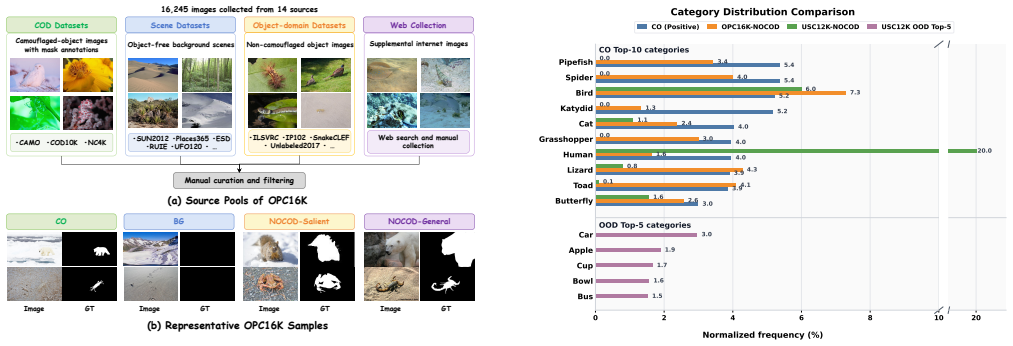
Summary. The paper addresses camouflaged object detection (COD) under a realistic open-world protocol, where inputs may contain a camouflaged object (CO), a pure background (BG), or a non-camouflaged object (NOCOD). It introduces OPC16K, a benchmark with over 16,000 images organized into these three classes with deliberate foreground-category and scene-level distribution alignment. It also proposes OPCNet, which adds hierarchical existence reasoning, similarity-aware camouflage relation modeling, and existence-aware feature refinement to a segmentation backbone, and it defines an evaluation protocol with three-way classification accuracy, negative-sample false positive rates, and segmentation metrics. The central empirical claim is that OPCNet achieves the best overall performance and, in particular, the lowest false positive rates on both BG and NOCOD inputs.
Significance. If the claims were fully supported, the paper would make a useful contribution: it identifies a real limitation of closed-world COD evaluation, proposes a benchmark that includes negative samples with distribution controls, and introduces an explicit existence-reasoning mechanism with an ablation study showing that each component contributes. The three-way evaluation protocol, although simple, is a reasonable step toward realistic deployment assessment. However, the headline empirical claim is internally contradicted by the paper's own Table 3, and the comparative evaluation rests on a baseline adaptation procedure that is deferred to an unpublished appendix. The paper also promises but does not currently provide the dataset or code, which limits independent verification. The benchmark and method ideas are valuable, but the presented evidence does not support the stated conclusion that OPCNet significantly reduces false positives on negative samples compared with existing methods.
major comments (3)
- [Main Results (Table 3)] The text states that 'OPCNet achieves the best overall performance under the proposed open-world COD protocol. It obtains the highest three-way classification accuracy and the lowest FPRbg and FPRno', and the Abstract claims 'significantly reducing false positives on negative samples'. Table 3 contradicts this on the NOCOD axis: OPCNet's FPRno is 0.181, whereas VSCode attains 0.093, so OPCNet is not the best on non-camouflaged-object rejection; its Accno (0.817) is also below VSCode's (0.907). Since false-positive suppression on negative samples is the paper's stated motivation and central advantage claim, this internal inconsistency directly undermines the headline result. The ablation in Table 4 confirms that even the full OPCNet (FPRno 0.181) does not reach VSCode's FPRno.
- [Compared Methods (Experimental Setup)] Every comparative claim in Table 3 depends on the adaptation of binary COD baselines to the proposed three-class setting, but the only description is that the baselines are adapted by 'extending their prediction space to three classes: CO, NOCOD, and BG', with details deferred to an appendix that is not part of the submitted manuscript. It is therefore impossible to verify whether the baselines received a comparable classification head, how image-level labels were derived from pixel predictions, whether thresholds were tuned for each baseline, or whether the adaptation is unbiased. If the adaptation handicaps the baselines, the reported superiority of OPCNet would be an artifact of the adaptation rather than of the method itself; this is a load-bearing reproducibility gap for the central comparison.
- [Evaluation Protocol] The overall segmentation metrics (oMAE, oSm, oEm, oFwβ) assign worst scores to misclassified samples, e.g., MAE = 1 and Sm = 0 for samples whose predicted scene label is wrong. This makes these 'overall COD segmentation quality' metrics a direct function of three-way classification accuracy, which is precisely the capability that OPCNet's hierarchical existence reasoning is explicitly designed to improve. The co-prefixed metrics provide a useful check, but the paper's headline open-world metrics therefore conflate classification performance with segmentation quality, and the reported margins on oMAE and oSm should be interpreted with this dependency in mind.
minor comments (4)
- [Dataset Construction] The heading 'The Proposed OPC16K Dataest' contains a typo; it should read 'Dataset'.
- [Table 3] In the provided text, some consecutive numeric entries in the OPCNet row appear without separating spaces (e.g., '0.8180.8750.701'); the camera-ready table should ensure clear column separation for all cells.
- [Conclusion] The conclusion repeats the claim that OPCNet reduces false positives on negative samples; this statement should be revised to match the actual FPRno numbers in Table 3 or be accompanied by a clear explanation of why the FPRno comparison with VSCode is not decisive.
- [Experimental Setup] The paper states that code and dataset 'will be released', but they are not currently available; independent verification of the benchmark statistics and of the baseline adaptation procedure is therefore not possible from the submission.
Circularity Check
No significant circularity: OPCNet's results are direct empirical measurements, not derived from fitted parameters; the main caveats are missing baseline-adaptation details and an internal Table 3 inconsistency on FPRno, which are correctness issues rather than circular reductions.
full rationale
The paper's method is an empirically trained network: the hierarchical existence reasoning is supervised by explicit losses (Eqs. 15-18) on a held-out split, and Table 3 reports measured test-set accuracy and false-positive rates. No equation in the method section defines a predicted quantity in terms of the quantity it is claimed to predict, and no parameter is fitted to a subset and then 'predicted' on a closely related quantity. The new benchmark, protocol, and method come from the same team, and the overall metrics (oMAE, oSm, etc.) intentionally assign worst scores to misclassified samples, which rewards the classification ability OPCNet is explicitly trained for; this is a benchmark-design choice that should be scrutinized for fairness, but it is not a circular reduction. The paper also defers the baseline adaptation details to an omitted appendix ('we adapt them to the proposed realistic COD setting by extending their prediction space to three classes... Detailed adaptation strategies are provided in the appendix'), so the comparison's fairness is not fully verifiable from the main text; this is a missing-support concern, not a circularity. Finally, Table 3 contradicts the stated claim that OPCNet has 'the lowest FPRbg and FPRno': VSCode's FPRno is 0.093 while OPCNet's is 0.181. This is an internal inconsistency in the empirical claim, not a circular step, but it should be corrected. Self-citations in the related work are not load-bearing for the core method. Overall, no step reduces, by construction or by self-citation, to its own input.
Assumptions & free parameters
free parameters (2)
- Decision thresholds tau_obj and tau_pres =
0.5 and 0.5
- Loss weights for L_loc, L_obj, L_pres =
1, 1, 1
assumptions (4)
- domain assumption OPC16K manual curation correctly distinguishes CO, BG, and NOCOD images.
- domain assumption SAM3 provides accurate object masks for NOCOD samples that are not taken from existing COD datasets.
- domain assumption The two-round supplementation makes the foreground-category and scene distributions of negative samples close enough to positive samples to prevent shortcut learning.
- ad hoc to paper Extending binary COD baselines to a three-class setting is an unbiased adaptation that does not handicap the baselines.
Cite this review
Pith. "Pith review of Is There Really a Camouflaged Object? Towards Realistic Camouflaged Object Detection." pith.science (2026). https://pith.science/paper/H2BOP42B
@misc{pith2026260811135,
  author       = {Pith},
  title        = {Pith review of: Is There Really a Camouflaged Object? Towards Realistic Camouflaged Object Detection},
  year         = {2026},
  howpublished = {\url{https://pith.science/paper/H2BOP42B}},
  note         = {Machine review of arXiv:2608.11135}
}
read the original abstract
Camouflaged object detection (COD) aims to segment objects that are visually concealed in their surroundings and has attracted increasing attention in recent years. However, most existing COD methods are developed under a closed-world assumption, where each input image is assumed to contain a camouflaged object. This assumption ignores realistic scenarios with pure backgrounds or non-camouflaged objects, causing existing models to produce severe false positives when deployed in open-world environments. To address this limitation, we propose OPC16K, a large-scale benchmark for realistic COD. OPC16K contains 16,245 images from 14 sources and is carefully organized into camouflaged-object images, pure background images, and non-camouflaged-object images, enabling comprehensive evaluation of both segmentation quality and negative-sample rejection. Based on this benchmark, we further propose OPCNet, a presence-aware camouflage network that reformulates COD from a pure segmentation task into a joint problem of object localization and camouflage existence reasoning. Specifically, OPCNet introduces hierarchical existence reasoning to distinguish CO, BG, and NOCOD scenarios, similarity-aware camouflage relation modeling to capture foreground-background camouflage cues, and existence-aware feature refinement to regulate segmentation features with existence predictions. Extensive experiments on OPC16K demonstrate that OPCNet achieves superior performance under the proposed realistic COD evaluation protocol, significantly reducing false positives on negative samples while maintaining accurate camouflaged-object segmentation. Code and dataset will be released at https://github.com/2231122/OPCOD.
Figures


Reference graph
Works this paper leans on
-
[1]
Proceedings of the IEEE/CVF international conference on computer vision , pages=
Segment anything , author=. Proceedings of the IEEE/CVF international conference on computer vision , pages=
-
[2]
SAM 2: Segment Anything in Images and Videos , year =
Ravi, Nikhila and Gabeur, Valentin and Hu, Yuan-Ting and Hu, Ronghang and Ryali, Chaitanya and Ma, Tengyu and Khedr, Haitham and R\". SAM 2: Segment Anything in Images and Videos , year =. International Conference on Representation Learning , pages =
-
[3]
IEEE Transactions on Pattern Analysis and Machine Intelligence , year=
Segment Concealed Objects with Incomplete Supervision , author=. IEEE Transactions on Pattern Analysis and Machine Intelligence , year=
-
[4]
European Conference on Computer Vision , pages=
SAM-COD: SAM-Guided Unified Framework for Weakly-Supervised Camouflaged Object Detection , author=. European Conference on Computer Vision , pages=. 2024 , organization=
work page 2024
-
[5]
Proceedings of the 32nd ACM international conference on multimedia , pages=
Chain of visual perception: Harnessing multimodal large language models for zero-shot camouflaged object detection , author=. Proceedings of the 32nd ACM international conference on multimedia , pages=
-
[6]
Proceedings of the Computer Vision and Pattern Recognition Conference , pages=
Segment Any-Quality Images with Generative Latent Space Enhancement , author=. Proceedings of the Computer Vision and Pattern Recognition Conference , pages=
-
[7]
Proceedings of the IEEE/CVF International Conference on Computer Vision , pages=
Textsam-eus: Text prompt learning for sam to accurately segment pancreatic tumor in endoscopic ultrasound , author=. Proceedings of the IEEE/CVF International Conference on Computer Vision , pages=
-
[8]
Proceedings of the IEEE/CVF International Conference on Computer Vision (ICCV) , year =
Liu, Jiaming and Kong, Linghe and Chen, Guihai , title =. Proceedings of the IEEE/CVF International Conference on Computer Vision (ICCV) , year =
Show all 72 references
-
[9]
Proceedings of the IEEE/CVF International Conference on Computer Vision , pages=
Sam-adapter: Adapting segment anything in underperformed scenes , author=. Proceedings of the IEEE/CVF International Conference on Computer Vision , pages=
-
[10]
arXiv preprint arXiv:2304.09148 , year=
SAM Fails to Segment Anything?--SAM-Adapter: Adapting SAM in Underperformed Scenes: Camouflage, Shadow, Medical Image Segmentation, and More , author=. arXiv preprint arXiv:2304.09148 , year=
-
[11]
Proceedings of the AAAI Conference on Artificial Intelligence , volume=
Relax image-specific prompt requirement in sam: A single generic prompt for segmenting camouflaged objects , author=. Proceedings of the AAAI Conference on Artificial Intelligence , volume=
-
[12]
Advances in Neural Information Processing Systems , volume=
Leveraging hallucinations to reduce manual prompt dependency in promptable segmentation , author=. Advances in Neural Information Processing Systems , volume=
-
[13]
Proceedings of the IEEE/CVF International Conference on Computer Vision , pages=
Enhancing Prompt Generation with Adaptive Refinement for Camouflaged Object Detection , author=. Proceedings of the IEEE/CVF International Conference on Computer Vision , pages=
-
[14]
Proceedings of the IEEE/CVF Conference on computer vision and pattern recognition , pages=
Zoom in and out: A mixed-scale triplet network for camouflaged object detection , author=. Proceedings of the IEEE/CVF Conference on computer vision and pattern recognition , pages=
-
[15]
Proceedings of the IEEE/CVF conference on computer vision and pattern recognition , pages=
Camouflaged object detection , author=. Proceedings of the IEEE/CVF conference on computer vision and pattern recognition , pages=
-
[16]
Proceedings of the IEEE/CVF Conference on Computer Vision and Pattern Recognition , pages=
Mutual graph learning for camouflaged object detection , author=. Proceedings of the IEEE/CVF Conference on Computer Vision and Pattern Recognition , pages=
-
[17]
Proceedings of the AAAI Conference on Artificial Intelligence , volume=
Weakly-supervised camouflaged object detection with scribble annotations , author=. Proceedings of the AAAI Conference on Artificial Intelligence , volume=
-
[18]
European Conference on Computer Vision , pages=
Just a Hint: Point-Supervised Camouflaged Object Detection , author=. European Conference on Computer Vision , pages=. 2024 , organization=
2024
-
[19]
Proceedings of the 33rd ACM International Conference on Multimedia , pages=
ST-SAM: SAM-Driven Self-Training Framework for Semi-Supervised Camouflaged Object Detection , author=. Proceedings of the 33rd ACM International Conference on Multimedia , pages=
-
[20]
European Conference on Computer Vision , pages=
CamoTeacher: Dual-Rotation Consistency Learning for Semi-supervised Camouflaged Object Detection , author=. European Conference on Computer Vision , pages=
-
[21]
Proceedings of the Thirty-Fourth International Joint Conference on Artificial Intelligence , pages =
SCOUT: Semi-supervised Camouflaged Object Detection by Utilizing Text and Adaptive Data Selection , author =. Proceedings of the Thirty-Fourth International Joint Conference on Artificial Intelligence , pages =
-
[22]
arXiv preprint arXiv:2303.08774 , year=
Gpt-4 technical report , author=. arXiv preprint arXiv:2303.08774 , year=
-
[23]
Proceedings of the IEEE/CVF conference on computer vision and pattern recognition , pages=
Improved baselines with visual instruction tuning , author=. Proceedings of the IEEE/CVF conference on computer vision and pattern recognition , pages=
-
[24]
5-vl technical report , author=
Qwen2. 5-vl technical report , author=. arXiv preprint arXiv:2502.13923 , year=
-
[25]
Proceedings of the Computer Vision and Pattern Recognition Conference , pages=
Shift the Lens: Environment-Aware Unsupervised Camouflaged Object Detection , author=. Proceedings of the Computer Vision and Pattern Recognition Conference , pages=
-
[26]
International conference on machine learning , pages=
Blip: Bootstrapping language-image pre-training for unified vision-language understanding and generation , author=. International conference on machine learning , pages=. 2022 , organization=
2022
-
[27]
arXiv preprint arXiv:2304.07193 , year=
Dinov2: Learning robust visual features without supervision , author=. arXiv preprint arXiv:2304.07193 , year=
-
[28]
International conference on machine learning , pages=
Learning transferable visual models from natural language supervision , author=. International conference on machine learning , pages=. 2021 , organization=
2021
-
[29]
Computer vision and image understanding , volume=
Anabranch network for camouflaged object segmentation , author=. Computer vision and image understanding , volume=. 2019 , publisher=
2019
-
[30]
Proceedings of the IEEE/CVF conference on computer vision and pattern recognition , pages=
Simultaneously localize, segment and rank the camouflaged objects , author=. Proceedings of the IEEE/CVF conference on computer vision and pattern recognition , pages=
-
[31]
Proceedings of the IEEE international conference on computer vision , pages=
Structure-measure: A new way to evaluate foreground maps , author=. Proceedings of the IEEE international conference on computer vision , pages=
-
[32]
arXiv preprint arXiv:1805.10421 , year=
Enhanced-alignment measure for binary foreground map evaluation , author=. arXiv preprint arXiv:1805.10421 , year=
-
[33]
Proceedings of the IEEE conference on computer vision and pattern recognition , pages=
How to evaluate foreground maps? , author=. Proceedings of the IEEE conference on computer vision and pattern recognition , pages=
-
[34]
Advances in Neural Information Processing Systems , volume=
Segment anything in high quality , author=. Advances in Neural Information Processing Systems , volume=
-
[35]
Proceedings of the IEEE/CVF Conference on Computer Vision and Pattern Recognition , pages=
Efficientsam: Leveraged masked image pretraining for efficient segment anything , author=. Proceedings of the IEEE/CVF Conference on Computer Vision and Pattern Recognition , pages=
-
[36]
Proceedings of the AAAI Conference on Artificial Intelligence , volume=
High-resolution iterative feedback network for camouflaged object detection , author=. Proceedings of the AAAI Conference on Artificial Intelligence , volume=
-
[37]
Proceedings of the IEEE/CVF Winter Conference on Applications of Computer Vision , pages=
CamoFocus: Enhancing camouflage object detection with split-feature focal modulation and context refinement , author=. Proceedings of the IEEE/CVF Winter Conference on Applications of Computer Vision , pages=
-
[38]
arXiv preprint arXiv:2501.18783 , year=
Run: Reversible unfolding network for concealed object segmentation , author=. arXiv preprint arXiv:2501.18783 , year=
-
[39]
European Conference on Computer Vision , pages=
Learning Camouflaged Object Detection from Noisy Pseudo Label , author=. European Conference on Computer Vision , pages=. 2024 , organization=
2024
-
[40]
IEEE transactions on pattern analysis and machine intelligence , volume=
Hierarchical image saliency detection on extended CSSD , author=. IEEE transactions on pattern analysis and machine intelligence , volume=. 2015 , publisher=
2015
-
[41]
International conference on multimedia modeling , pages=
Kvasir-seg: A segmented polyp dataset , author=. International conference on multimedia modeling , pages=. 2019 , organization=
2019
-
[42]
Visual Intelligence , volume=
Advances in deep concealed scene understanding , author=. Visual Intelligence , volume=. 2023 , publisher=
2023
-
[43]
IEEE transactions on pattern analysis and machine intelligence , volume=
Concealed object detection , author=. IEEE transactions on pattern analysis and machine intelligence , volume=. 2021 , publisher=
2021
-
[44]
IEEE Transactions on Image Processing , volume=
Feature aggregation and propagation network for camouflaged object detection , author=. IEEE Transactions on Image Processing , volume=. 2022 , publisher=
2022
-
[45]
IEEE Transactions on Image Processing , volume=
FSNet: Focus scanning network for camouflaged object detection , author=. IEEE Transactions on Image Processing , volume=. 2023 , publisher=
2023
-
[46]
Proceedings of the National Academy of Sciences , volume=
Early evolution and ecology of camouflage in insects , author=. Proceedings of the National Academy of Sciences , volume=. 2012 , publisher=
2012
-
[47]
IEEE Transactions on Image Processing , volume=
Nowhere to disguise: Spot camouflaged objects via saliency attribute transfer , author=. IEEE Transactions on Image Processing , volume=. 2023 , publisher=
2023
-
[48]
IEEE transactions on medical imaging , volume=
Inf-net: Automatic covid-19 lung infection segmentation from ct images , author=. IEEE transactions on medical imaging , volume=. 2020 , publisher=
2020
-
[49]
International conference on medical image computing and computer-assisted intervention , pages=
Pranet: Parallel reverse attention network for polyp segmentation , author=. International conference on medical image computing and computer-assisted intervention , pages=. 2020 , organization=
2020
-
[50]
Proceedings of the IEEE/CVF International Conference on Computer Vision , pages=
One Polyp Identifies All: One-Shot Polyp Segmentation with SAM via Cascaded Priors and Iterative Prompt Evolution , author=. Proceedings of the IEEE/CVF International Conference on Computer Vision , pages=
-
[51]
Pattern Recognition , pages=
COD-SAM: Camouflage object detection using SAM , author=. Pattern Recognition , pages=. 2025 , publisher=
2025
-
[52]
Computational visual media , volume=
Pvt v2: Improved baselines with pyramid vision transformer , author=. Computational visual media , volume=. 2022 , publisher=
2022
-
[53]
Proceedings of the IEEE/CVF conference on computer vision and pattern recognition , pages=
Camouflaged object detection with feature decomposition and edge reconstruction , author=. Proceedings of the IEEE/CVF conference on computer vision and pattern recognition , pages=
-
[54]
Proceedings of the IEEE/CVF International Conference on Computer Vision , pages=
Escnet: Edge-semantic collaborative network for camouflaged object detection , author=. Proceedings of the IEEE/CVF International Conference on Computer Vision , pages=
-
[55]
European Conference on Computer Vision , pages=
Unlocking attributes’ contribution to successful camouflage: A combined textual and visual analysis strategy , author=. European Conference on Computer Vision , pages=. 2024 , organization=
2024
-
[56]
Proceedings of the 31st ACM international conference on multimedia , pages=
Depth-aided camouflaged object detection , author=. Proceedings of the 31st ACM international conference on multimedia , pages=
-
[57]
Proceedings of the IEEE/CVF conference on computer vision and pattern recognition , pages=
Depth-aware concealed crop detection in dense agricultural scenes , author=. Proceedings of the IEEE/CVF conference on computer vision and pattern recognition , pages=
-
[58]
Proceedings of the IEEE/CVF International Conference on Computer Vision , pages=
Multi-modal Segment Anything Model for Camouflaged Scene Segmentation , author=. Proceedings of the IEEE/CVF International Conference on Computer Vision , pages=
-
[59]
Proceedings of the IEEE/CVF conference on computer vision and pattern recognition , pages=
Vscode: General visual salient and camouflaged object detection with 2d prompt learning , author=. Proceedings of the IEEE/CVF conference on computer vision and pattern recognition , pages=
-
[60]
Proceedings of the 41st International Conference on Machine Learning , pages=
Spider: a unified framework for context-dependent concept segmentation , author=. Proceedings of the 41st International Conference on Machine Learning , pages=
-
[61]
Proceedings of the IEEE/CVF conference on computer vision and pattern recognition , pages=
Uncertainty-aware joint salient object and camouflaged object detection , author=. Proceedings of the IEEE/CVF conference on computer vision and pattern recognition , pages=
-
[62]
Proceedings of the IEEE/CVF international conference on computer vision , pages=
EGNet: Edge guidance network for salient object detection , author=. Proceedings of the IEEE/CVF international conference on computer vision , pages=
-
[63]
Proceedings of the IEEE/CVF International Conference on Computer Vision , pages=
Rethinking Detecting Salient and Camouflaged Objects in Unconstrained Scenes , author=. Proceedings of the IEEE/CVF International Conference on Computer Vision , pages=
-
[64]
European Conference on Computer Vision , pages=
Open-vocabulary camouflaged object segmentation , author=. European Conference on Computer Vision , pages=. 2024 , organization=
2024
-
[65]
Proceedings of the IEEE/CVF International Conference on Computer Vision , pages=
Seeing the Unseen: A Semantic Alignment and Context-Aware Prompt Framework for Open-Vocabulary Camouflaged Object Segmentation , author=. Proceedings of the IEEE/CVF International Conference on Computer Vision , pages=
-
[66]
Proceedings of the AAAI Conference on Artificial Intelligence , volume=
CamoDiffusion: Camouflaged object detection via conditional diffusion models , author=. Proceedings of the AAAI Conference on Artificial Intelligence , volume=
-
[67]
IEEE Transactions on Pattern Analysis and Machine Intelligence , volume=
Conditional diffusion models for camouflaged and salient object detection , author=. IEEE Transactions on Pattern Analysis and Machine Intelligence , volume=. 2025 , publisher=
2025
-
[68]
arXiv preprint arXiv:2511.16719 , year=
Sam 3: Segment anything with concepts , author=. arXiv preprint arXiv:2511.16719 , year=
-
[69]
Conference and Labs of the Evaluation Forum , publisher=
Deep Learning and Gradient Boosting Ensembles for Classification of Snake Species , author=. Conference and Labs of the Evaluation Forum , publisher=. 2022 , ISSN=
2022
-
[70]
IEEE CVPR , pages=
IP102: A Large-Scale Benchmark Dataset for Insect Pest Recognition , author=. IEEE CVPR , pages=
-
[71]
CVPR , pages=
Beyond Weak Supervision: MLLMs-Guided Graded Knowledge Distillation for Unsupervised Camouflaged Object Detection , author=. CVPR , pages=
-
[72]
IEEE Transactions on Image Processing , year=
Boosting Segment Anything Model to Generalize Visually Non-Salient Scenarios , author=. IEEE Transactions on Image Processing , year=
Reviewed August 12, 2026 · model on record in the stance chip above.
Discussion (0). Continue with ORCID to comment.