REVIEW 1 major objections 4 minor 1 cited by
Best-of-Both-Worlds Guarantees with Fairer Endings
T0 review · 1 major / 4 minor · reviewed 2026-08-06 · deepseek-v4-flash
Pith's one-line read Randomized allocations can be almost envy-free in expectation while every realized outcome is EFX or EFX-with-charity, with algorithms for lexicographic, monotone, and subadditive valuations.
desk verdict Strong new BoBW results at EFX level, but Theorem 4 has an unproved monotonicity step that must be fixed. read the letter →
The pith
A machine-rendered reading of the paper's core claim, the machinery that carries it, and where it could break.
The reading
What carries the argument
Two mechanisms carry the results. For lexicographic preferences, the paper runs the simultaneous eating procedure for exactly one time unit; the goods still being eaten at the cutoff form the set of 'last consumed' goods, whose total mass $k$ is an integer. Those goods are merged into a single super-good, the resulting fractional matching is rounded (via the Birkhoff–von Neumann decomposition, or via dependent rounding when $k=2$), and the leftover goods are given as a tail to a uniformly random unenvied agent who received a last-consumed good. The guarantee is $3k/(3k+1)$-EF in general, exact EF when $k=1$, and $9/10$-EF for $k=2$ thanks to dependent rounding's negative correlation. For monotone and subadditive valuations, the central object is a randomized charity-swap loop: repeatedly choose an inclusion-minimal envied set of unallocated goods, pick a uniformly random agent who envies it, and swap that set with the agent's bundle. The equal opportunity of receiving each envied bundle gives the ex-ante $1/2$ guarantees, and an appended bounded-charity routine converts the ex-post support to EFX-with-bounded-charity.
What would settle it
Enumerate small subadditive instances, run the randomized charity-swap routine followed by the bounded-charity step, and record whether any agent's value for its own bundle decreases; a single such decrease would break the inequality chain used to prove the ex-ante guarantee of the subadditive result.
Extended reading notes
Core claim
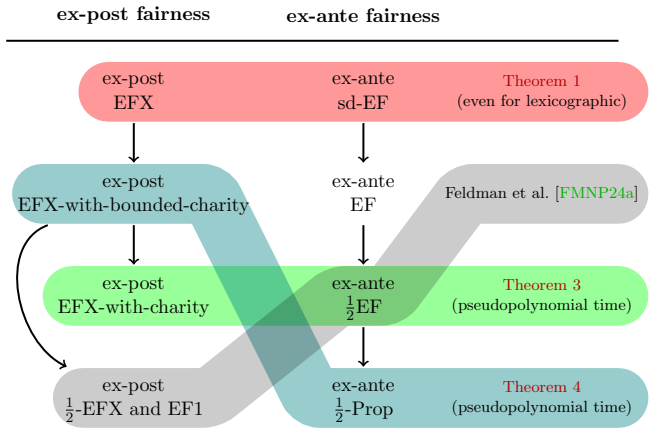
The central claim is that EFX-level ex-post fairness does not force giving up non-vacuous ex-ante fairness, once the ex-ante benchmark is relaxed suitably. For lexicographic preferences the construction is a one-unit run of the simultaneous eating procedure followed by decomposition (Birkhoff–von Neumann or dependent rounding) and a random tail assignment; it achieves $9/10$-EF in expectation and EFX plus Pareto optimality (no reallocation could improve one agent without hurting another) in every realization. For general monotone valuations the paper randomizes a charity-swap routine, selecting a uniformly random agent among those who envy a minimal envied set of unallocated goods at each step, which yields ex-ante $1/2$-EF and ex-post EFX-with-charity. For subadditive valuations the same randomized routine is followed by a bounded-charity step, giving ex-ante $1/2$-proportionality and ex-post EFX-with-bounded-charity (at most $n-1$ goods left unallocated). Together with a counterexample to ex-ante sd-EF with ex-post EFX, these constitute the first best-of-both-worlds guarantees at the EFX level for the three domains.
Load-bearing premise
The subadditive result assumes that the final bounded-charity step never lowers any agent's value for its own bundle; if that monotonicity fails, the argument that the expected allocation is half-proportional collapses.
Editorial extensions
If this is right
- For lexicographic preferences, instances now come with a polynomial-time lottery whose ex-ante fairness is $9/10$-EF while every realized allocation is EFX and Pareto-optimal, so the earlier EF1-level best-of-both-worlds guarantee is strengthened at the price of a small ex-ante loss.
- Because ex-ante sd-EF is incompatible with ex-post EFX already in the lexicographic domain, any future theorem that targets EFX ex-post must either relax the ex-ante benchmark or replace sd-EF by a weaker ordinal notion.
- For monotone valuations, the randomized charity-swap routine gives a best-of-both-worlds guarantee of ex-ante $1/2$-EF with ex-post EFX-with-charity, in a domain where purely EFX allocations are not known to exist.
- For subadditive valuations, the same routine can be composed with a bounded-charity step to leave at most $n-1$ goods unallocated while retaining ex-ante $1/2$-proportionality; such allocations can then be completed to $1/2$-EFX and EF1 allocations.
Reading between the lines
- The constant $9/10$ arises from the exceptional case $k=2$: the same construction gives $3k/(3k+1)$-EF, which exceeds $9/10$ for all $k \ge 3$ and equals exact EF at $k=1$, so a different rounding scheme for the two-agent super-good case could plausibly raise the worst-case guarantee.
- The randomized charity-swap loop is a template rather than a one-off algorithm: varying the distribution over envying agents, or the rule for choosing the minimal envied set, may yield better ex-ante factors or extend the construction beyond the monotone and subadditive classes considered here.
- Composing the randomized charity-swap output with other deterministic fair-division routines, not only the bounded-charity one, would give a family of best-of-both-worlds guarantees with different trade-offs between the size of the unallocated pool and the ex-ante ratio.
- The impossibility for sd-EF points toward a weaker ordinal benchmark, such as lexicographic sd-EF, as the right target for lexicographic preferences; if that notion is compatible with EFX, an exact ordinal best-of-both-worlds statement may exist.
Signed reviews
Editorial analysis
A structured set of objections, weighed in public.
Referee Report
Summary. The paper studies best-of-both-worlds (BoBW) guarantees in fair division of indivisible goods, aiming for ex-post EFX-type guarantees together with nontrivial ex-ante fairness. For lexicographic preferences it proves an impossibility result (Theorem 1): ex-ante sd-EF and ex-post EFX are incompatible. It then gives a polynomial-time algorithm (Theorem 2) achieving ex-ante 9/10-EF with ex-post EFX and Pareto optimality, using an early-terminated eating algorithm, Birkhoff-von Neumann decomposition, and, for the delicate k=2 case, dependent rounding. For monotone valuations it gives a pseudopolynomial-time algorithm (Theorem 3) achieving ex-ante 1/2-EF with ex-post EFX-with-charity, via a randomized version of the CKMS21 charity algorithm. For subadditive valuations it claims ex-ante 1/2-Prop with ex-post EFX-with-bounded-charity (Theorem 4), by post-processing the output of Algorithm 3 with the CKMS21 little charity algorithm.
Significance. If the theorems are correct, the paper makes a substantial contribution: it provides the first BoBW guarantees at the EFX level for lexicographic preferences, the first BoBW guarantee with EFX-with-charity for general monotone valuations, and the first with EFX-with-bounded-charity for subadditive valuations. The techniques are independently interesting: the randomized charity algorithm in Section 5.1 is simple and elegant, and its stochastic-dominance proof (Lemma 11) is sound and gives a genuine ex-ante 1/2-EF guarantee without any rounding. The lexicographic analysis is detailed, with a complete impossibility proof and a nontrivial dependent-rounding step for k=2. There are no fitted parameters or definitional shortcuts. The main caveat is that Theorem 4 relies on an unproved monotonicity assertion about the CKMS21 little charity algorithm, which is load-bearing for the ex-ante 1/2-Prop guarantee; this gap is localized and likely repairable, but it must be fixed before the result can be accepted.
major comments (1)
- [5.2, Lemma 12 (proof of Theorem 4)] The inequality E[vi(Yi)] ≤ E[vi(Xi)] is asserted with the justification "since the agent utilities are non-decreasing" when the little charity algorithm of [CKMS21] is applied to the output Y of Algorithm 3. This monotonicity is load-bearing: it supplies the last inequality in the chain vi(M) ≤ E[vi(P)] + E[vi(Yi)] + Σ_{j≠i} E[vi(Yj)] ≤ 2n·E[vi(Yi)] ≤ 2n·E[vi(Xi)], from which the ex-ante 1/2-Prop guarantee of Theorem 4 follows. No lemma in [CKMS21] is cited for this property, and it does not follow merely from the fact that X is EFX-with-bounded-charity, because the transformation from Y to X could in principle reallocate goods and lower the utility of a fixed agent. The authors should either prove that the little charity algorithm weakly increases every agent's utility, or cite the specific lemma in [CKMS21] that establishes this. Without such a proof or citation, the ex-ante guarantee of Theorem 4 is unsupported.
minor comments (4)
- [4.4, Lemma 10] The statement of Lemma 10 contains a confusing condition: after restricting to g ∈ L ∪ U \ {g_i}, it then says "if g ≠ g_i", which is redundant, and the second bound is for g = g_i. Please rephrase the statement to distinguish clearly between the two cases.
- [Abstract and Theorem 4] Theorem 4 is stated as "There exists an algorithm with pseudopolynomial running time algorithm that..." with a duplicated word; this should be corrected to "pseudopolynomial-time algorithm".
- [References] References [FMNP24a] and [FMNP24b] appear to refer to the same EC 2024 paper by Feldman et al.; they should be merged into a single entry to avoid confusion.
- [5.1, Lemma 11] In the proof of Lemma 11, the equality Pr[k_{r0} = i | E] = 1/2 is stated without justification. It is true because k_r is uniform over H_r and conditioning on k_r ∈ {i,j} makes i and j symmetric, but the authors should spell this out, since the conditioning on the first significant iteration could otherwise appear to affect the distribution.
Circularity Check
No circularity: the main theorems are derived from internal case analyses and independent black-box prior results, not from their own conclusions.
full rationale
I walked the derivation chains for Theorems 2, 3, and 4. For lexicographic preferences, the ex-post EFX+PO guarantee is imported from the external characterization of [HSVX21] (Propositions 3 and 4), while the ex-ante guarantee is proved by a fresh case analysis of the eating algorithm, B-vN decomposition, and dependent rounding (Theorems 6, 8, and 10; Lemmas 3 through 10). Nothing in these proofs defines the target guarantee in terms of itself, and no parameter is fitted and then reported as a prediction. For monotone valuations, Algorithm 3 is a randomized version of the known CKMS21 charity algorithm, but the ex-ante 1/2-EF guarantee is established by an approximate stochastic-dominance argument (Lemma 11) that does not assume its conclusion. For subadditive valuations, Theorem 4 calls the CKMS21 little charity algorithm as a black box; this is a legitimate use of an independent published result even though the author sets overlap. The only notable weakness is in Lemma 12, where the assertion "since the agent utilities are non-decreasing" is not proved or tied to a specific CKMS21 lemma; that is a possible correctness gap, but it is not circularity, because the assertion is not equivalent to the theorem being proved. The citations to [AFSV24], [FMNP24b], [GKPS06], and [HSVX21] are external evidence under the review rules. Overall, the derivation is self-contained modulo standard prior theorems, so the circularity score is 0.
Assumptions & free parameters
assumptions (8)
- standard math Birkhoff-von Neumann decomposition (Proposition 1) and its rectangular generalization (Proposition 2) can be computed in polynomial time.
- standard math Dependent rounding theorem of Gandhi et al. (Theorem 7) provides integral allocations with marginal probabilities preserved and negative correlation.
- domain assumption For lexicographic preferences, an allocation is EFX iff every envied agent receives exactly one good (Proposition 3 from [HSVX21]).
- domain assumption For lexicographic preferences, an allocation is EFX+PO iff it is induced by a sigma-unenvied picking sequence (Proposition 4 from [HSVX21]).
- domain assumption There exists a pseudopolynomial-time algorithm that computes an EFX-with-charity allocation for monotone valuations, and the algorithm can be randomized with arbitrary choice of envying agent (from [CKMS21]).
- domain assumption There exists an EFX-with-bounded-charity algorithm (the little charity algorithm of [CKMS21]) that, starting from an EFX-with-charity allocation, yields a bounded-charity allocation and preserves non-decreasing utilities for all agents.
- standard math The Probabilistic Serial (eating) algorithm satisfies anytime envy-freeness.
- standard math The fractional allocation of the eating algorithm run for one unit of time can be decomposed over picking sequences (Proposition 7, Appendix C).
Cite this review
Pith. "Pith review of Best-of-Both-Worlds Guarantees with Fairer Endings." pith.science (2026). https://pith.science/paper/H2WCTM4Q
@misc{pith2026250716209,
  author       = {Pith},
  title        = {Pith review of: Best-of-Both-Worlds Guarantees with Fairer Endings},
  year         = {2026},
  howpublished = {\url{https://pith.science/paper/H2WCTM4Q}},
  note         = {Machine review of arXiv:2507.16209}
}
read the original abstract
Fair allocation of indivisible goods is a fundamental problem at the interface of economics and computer science. Traditional approaches focus either on randomized allocations that are fair in expectation or deterministic allocations that are approximately fair. Recent work reconciles both these approaches via best-of-both-worlds guarantees, wherein one seeks randomized allocations that are fair in expectation (ex-ante fair) while being supported on approximately fair allocations (ex-post fair). Prior work has shown that under additive valuations, there always exists a randomized allocation that is ex-ante stochastic-dominance envy-free (sd-EF) and ex-post envy-free up to one good (EF1). Our work is motivated by the goal of achieving stronger ex-post fairness guarantees such as envy-freeness up to any good (EFX) along with meaningful ex-ante guarantees. We make the following contributions: 1) We first consider lexicographic preferences, a subdomain of additive valuations where ex-post EFX allocations always exist and can be computed efficiently. On the negative side, we show that ex-ante sd-EF is fundamentally incompatible with ex-post EFX, prompting a relaxation of the ex-ante benchmark. We then present a poly. time algorithm that achieves ex-post EFX and PO together with ex-ante 9/10-EF. Our algorithm uses dependent rounding and leverages structural properties of EFX and PO allocations. 2)For monotone valuations, we study EFX-with-charity: a relaxation of EFX where some goods remain unallocated, with no agent envying the unallocated pool. We show that ex-post EFX-with-charity can be achieved alongside ex-ante 0.5-EF. 3)Finally, for subadditive valuations, we strengthen our previous ex-post guarantee to EFX-with-bounded-charity, where at most n-1 goods (n= no. of agents) remain unallocated, at the price of weakening the ex-ante guarantee to 0.5-proportionality.
Figures


Figures from the paper (2 more)


Forward citations
Cited by 1 Pith paper
-
Best-of-Both-Worlds Fairness and Pareto Optimality
A lottery over two-agent allocations can be simultaneously ex-ante envy-free, ex-post EFX, and ex-post Pareto optimal, but this becomes impossible for three agents with four goods.
Reference graph
Works this paper leans on
-
[1]
Online Fair Division: Analysing a Food Bank Problem
Martin Damyanov Aleksandrov, Haris Aziz, Serge Gaspers, and Toby Walsh. Online Fair Division: Analysing a Food Bank Problem . In Proceedings of the 24th International Joint Conference on Artificial Intelligence , pages 2540--2546, 2015
work page 2015
-
[2]
Efficient Reallocation under Additive and Responsive Preferences
Haris Aziz, P \'e ter Bir \'o , J \'e r \^o me Lang, Julien Lesca, and J \'e r \^o me Monnot. Efficient Reallocation under Additive and Responsive Preferences . Theoretical Computer Science , 790:1--15, 2019
work page 2019
-
[3]
Best of Both Worlds: Ex-Ante and Ex-Post fairness in Resource Allocation
Haris Aziz, Rupert Freeman, Nisarg Shah, and Rohit Vaish. Best of Both Worlds: Ex-Ante and Ex-Post fairness in Resource Allocation . Operations Research , 72(4):1674--1688, 2024
work page 2024
-
[4]
Simultaneously Achieving Ex-Ante and Ex-Post Fairness
Haris Aziz. Simultaneously Achieving Ex-Ante and Ex-Post Fairness . In Proceedings of the 16th Conference on Web and Internet Economics , pages 341--355. Springer, 2020
work page 2020
-
[5]
Designing Random Allocation Mechanisms: Theory and Applications
Eric Budish, Yeon-Koo Che, Fuhito Kojima, and Paul Milgrom. Designing Random Allocation Mechanisms: Theory and Applications . American Economic Review , 103(2):585--623, 2013
work page 2013
-
[6]
Best-of-Both-Worlds Fair-Share Allocations
Moshe Babaioff, Tomer Ezra, and Uriel Feige. Best-of-Both-Worlds Fair-Share Allocations . arXiv preprint arXiv:2102.04909 , 2021
work page Pith review arXiv 2021
-
[7]
Fair and Truthful Mechanisms for Dichotomous Valuations
Moshe Babaioff, Tomer Ezra, and Uriel Feige. Fair and Truthful Mechanisms for Dichotomous Valuations . In Proceedings of the 35th AAAI Conference on Artificial Intelligence , volume 35, pages 5119--5126, 2021
work page 2021
-
[8]
Three Observations on Linear Algebra
Garrett Birkhoff. Three Observations on Linear Algebra . Universidad Nacional de Tucum\'an, Revista A , 5:147--151, 1946
work page 1946
Show all 29 references
-
[9]
A New Solution to the Random Assignment Problem
Anna Bogomolnaia and Herv \'e Moulin. A New Solution to the Random Assignment Problem . Journal of Economic Theory , 100(2):295--328, 2001
2001
-
[10]
The Combinatorial Assignment Problem: Approximate Competitive Equilibrium from Equal Incomes
Eric Budish. The Combinatorial Assignment Problem: Approximate Competitive Equilibrium from Equal Incomes . Journal of Political Economy , 119(6):1061--1103, 2011
2011
-
[11]
Envy-Freeness up to Any Item with High Nash Welfare: The Virtue of Donating Items
Ioannis Caragiannis, Nick Gravin, and Xin Huang. Envy-Freeness up to Any Item with High Nash Welfare: The Virtue of Donating Items . In Proceedings of the 20th ACM Conference on Economics and Computation , pages 527--545, 2019
2019
-
[12]
On Interim Envy-Free Allocation Lotteries
Ioannis Caragiannis, Panagiotis Kanellopoulos, and Maria Kyropoulou. On Interim Envy-Free Allocation Lotteries . In Proceedings of the 22nd ACM Conference on Economics and Computation , pages 264--284, 2021
2021
-
[13]
The Unreasonable Fairness of Maximum Nash Welfare
Ioannis Caragiannis, David Kurokawa, Herv \'e Moulin, Ariel D Procaccia, Nisarg Shah, and Junxing Wang. The Unreasonable Fairness of Maximum Nash Welfare . ACM Transactions on Economics and Computation , 7(3):12, 2019
2019
-
[14]
A Little Charity Guarantees Almost Envy-Freeness
Bhaskar Ray Chaudhury, Telikepalli Kavitha, Kurt Mehlhorn, and Alkmini Sgouritsa. A Little Charity Guarantees Almost Envy-Freeness . SIAM Journal on Computing , 50(4):1336--1358, 2021
2021
-
[15]
Breaking the Envy Cycle: Best-of-Both-Worlds Guarantees for Subadditive Valuations
Michal Feldman, Simon Mauras, Vishnu V Narayan, and Tomasz Ponitka. Breaking the Envy Cycle: Best-of-Both-Worlds Guarantees for Subadditive Valuations . In Proceedings of the 25th ACM Conference on Economics and Computation , pages 1236--1266, 2024
2024
-
[16]
Narayan, and Tomasz Ponitka
Michal Feldman, Simon Mauras, Vishnu V. Narayan, and Tomasz Ponitka. Breaking the Envy Cycle: Best-of-Both-Worlds Guarantees for Subadditive Valuations . In Proceedings of the 25th ACM Conference on Economics and Computation (EC'24) , pages 1236--1266, 2024
2024
-
[17]
Resource Allocation and the Public Sector
Duncan Foley. Resource Allocation and the Public Sector . Yale Economic Essays , pages 45--98, 1967
1967
-
[18]
Best of Both Worlds: Ex-Ante and Ex-Post Fairness in Resource Allocation
Rupert Freeman, Nisarg Shah, and Rohit Vaish. Best of Both Worlds: Ex-Ante and Ex-Post Fairness in Resource Allocation . In Proceedings of the 21st ACM Conference on Economics and Computation , pages 21--22, 2020
2020
-
[19]
Dependent Rounding and Its Applications to Approximation Algorithms
Rajiv Gandhi, Samir Khuller, Srinivasan Parthasarathy, and Aravind Srinivasan. Dependent Rounding and Its Applications to Approximation Algorithms . Journal of the ACM , 53(3):324--360, 2006
2006
-
[20]
Puzzle-Math , 1958
George Gamow and Marvin Stern. Puzzle-Math , 1958
1958
-
[21]
Fair Division with Binary Valuations: One Rule to Rule Them All
Daniel Halpern, Ariel D Procaccia, Alexandros Psomas, and Nisarg Shah. Fair Division with Binary Valuations: One Rule to Rule Them All . In Proceedings of the 16th Conference on Web and Internet Economics , pages 370--383, 2020
2020
-
[22]
Fair and Efficient Allocations under Lexicographic Preferences
Hadi Hosseini, Sujoy Sikdar, Rohit Vaish, and Lirong Xia. Fair and Efficient Allocations under Lexicographic Preferences . In Proceedings of the AAAI Conference on Artificial Intelligence , volume 35, pages 5472--5480, 2021
2021
-
[23]
The Efficient Allocation of Individuals to Positions
Aanund Hylland and Richard Zeckhauser. The Efficient Allocation of Individuals to Positions . Journal of Political Economy , 87(2):293--314, 1979
1979
-
[24]
Complexity of Computing Optimal Stackelberg Strategies in Security Resource Allocation Games
Dmytro Korzhyk, Vincent Conitzer, and Ronald Parr. Complexity of Computing Optimal Stackelberg Strategies in Security Resource Allocation Games . In Proceedings of the 24th AAAI Conference on Artificial Intelligence , volume 24, pages 805--810, 2010
2010
-
[25]
On Approximately Fair Allocations of Indivisible Goods
Richard J Lipton, Evangelos Markakis, Elchanan Mossel, and Amin Saberi. On Approximately Fair Allocations of Indivisible Goods . In Proceedings of the 5th ACM Conference on Electronic Commerce , pages 125--131, 2004
2004
-
[26]
Matching Theory , volume 367
L \'a szl \'o Lov \'a sz and Michael D Plummer. Matching Theory , volume 367. American Mathematical Society, 2009
2009
-
[27]
Fair Dynamic Rationing
Vahideh Manshadi, Rad Niazadeh, and Scott Rodilitz. Fair Dynamic Rationing . In Proceedings of the 22nd ACM Conference on Economics and Computation , pages 694--695, 2021
2021
-
[28]
The Problem of Fair Division
Hugo Steinhaus. The Problem of Fair Division . Econometrica , 16(1):101--104, 1948
1948
-
[29]
A Certain Zero-Sum Two-Person Game Equivalent to the Optimal Assignment Problem
John von Neumann. A Certain Zero-Sum Two-Person Game Equivalent to the Optimal Assignment Problem . Contributions to the Theory of Games (Volume 28 of Annals of Mathematics Studies) , pages 5--12, 1953
1953
Reviewed August 6, 2026 · model on record in the stance chip above.
Discussion (0). Continue with ORCID to comment.