The Sc, Ti, and V Abundance Discrepancy: Testing High-Mass IMF Variation and Massive-Star Rotation
Pith reviewed 2026-07-01 05:08 UTC · model grok-4.3
The pith
Rotating massive-star yields at 300 km/s bring Sc, Ti, and V model trends closer to metal-poor halo observations.
A machine-rendered reading of the paper's core claim, the machinery that carries it, and where it could break.
Core claim
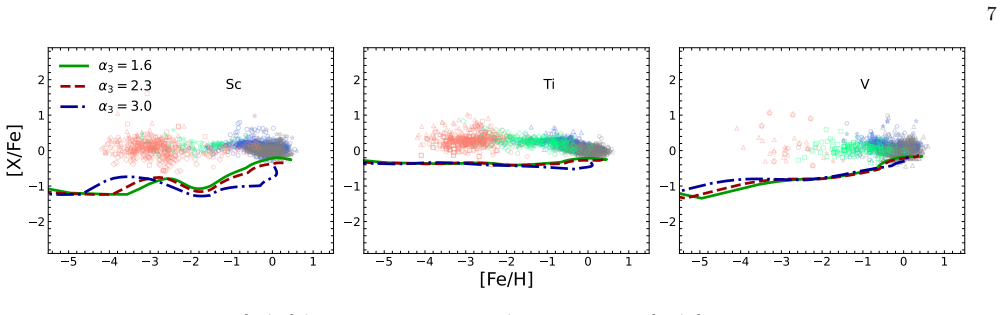
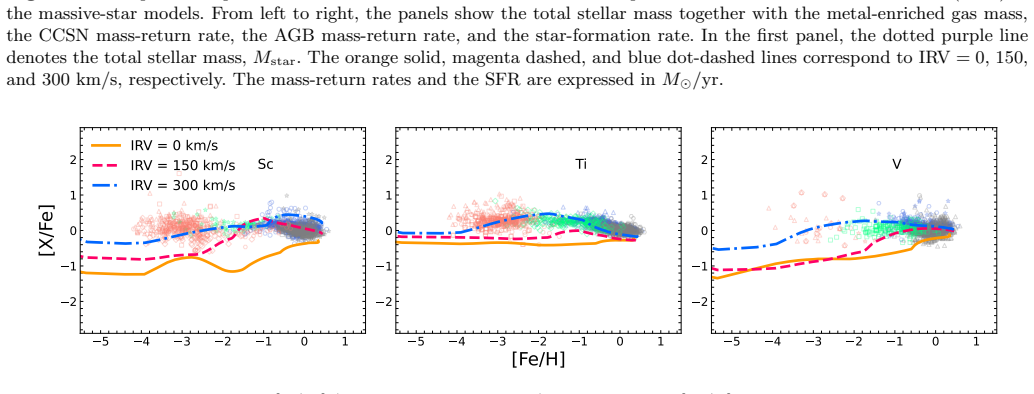
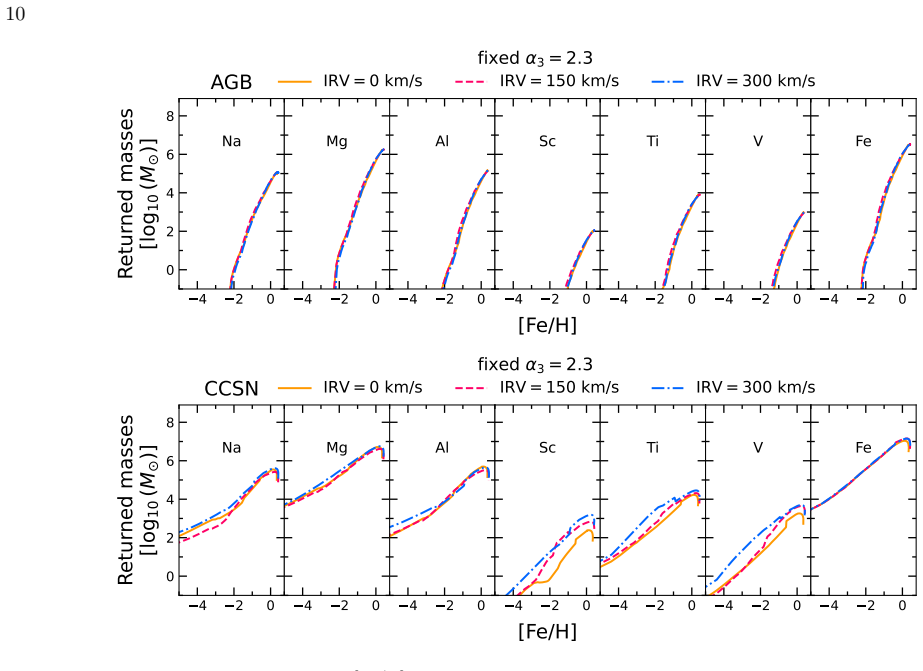
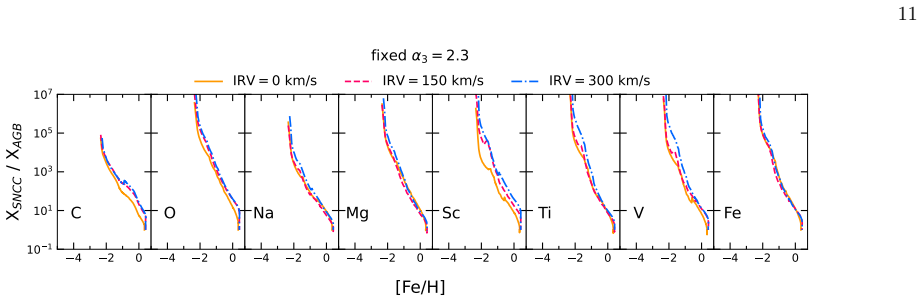
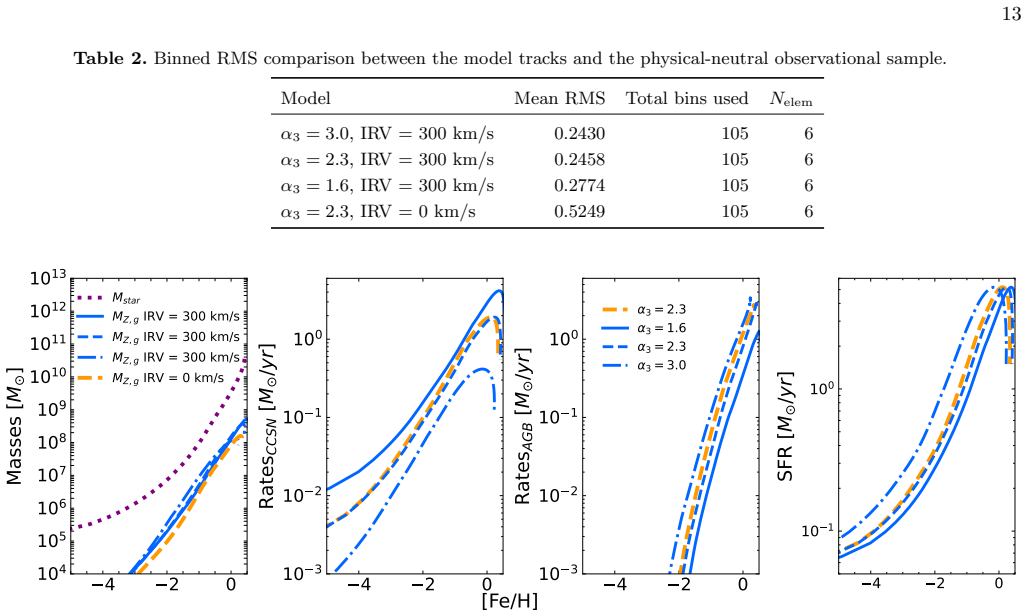
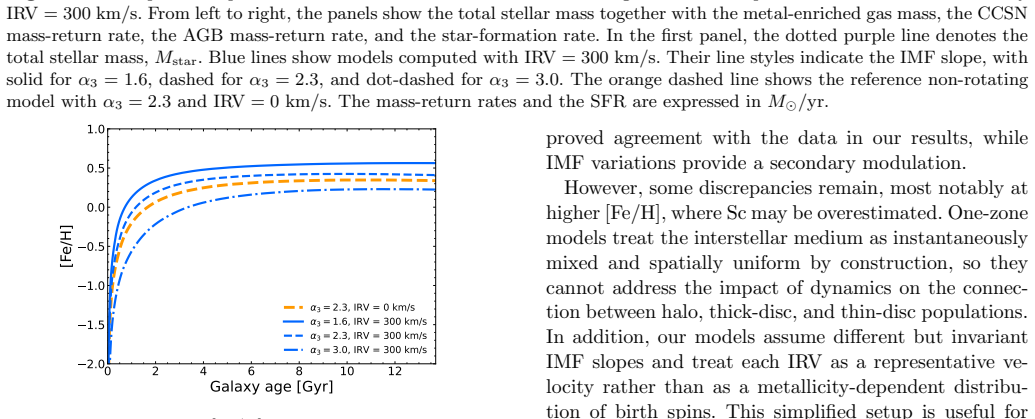
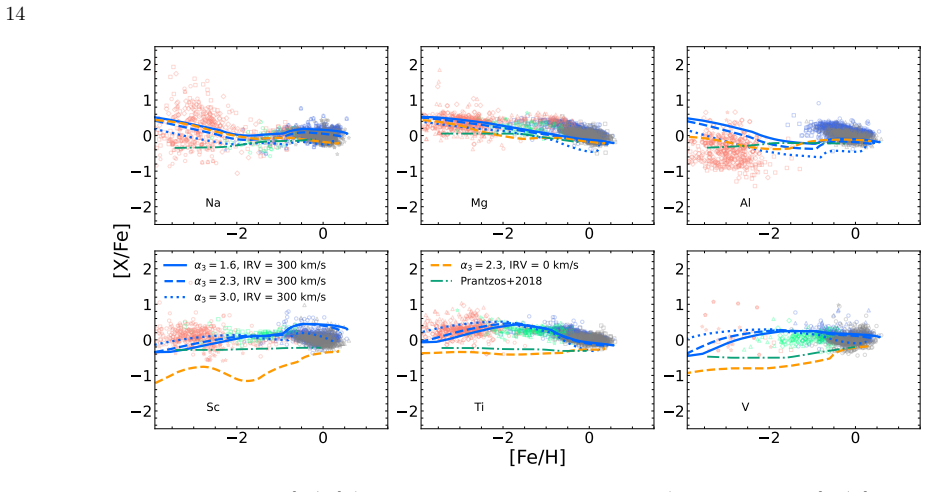
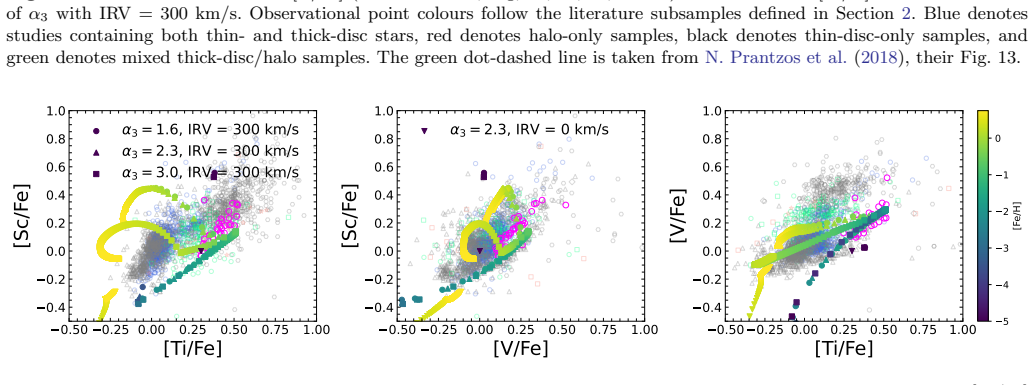
Adopting rotating massive-star yields with an initial rotational velocity of 300 km/s brings the model trends closer to metal-poor observations, especially for halo stars ([Fe/H] < -2), and improves the joint behavior of Sc, Ti, and V. Variations of the high-mass slope of the initial mass function produce a secondary modulation.
What carries the argument
A grid of one-zone Galactic chemical evolution models that varies massive-star initial rotational velocity and the high-mass IMF slope, then compares the resulting [X/Fe] versus [Fe/H] tracks and cross-element correlations to Galactic abundance data.
If this is right
- Rotating yields at 300 km/s improve agreement with halo-star data for all three elements simultaneously.
- IMF slope changes modulate the same trends but do not remove the main mismatch.
- Tensions persist at solar and super-solar metallicities, indicating missing physics beyond rotation and IMF shape.
- The joint Sc-Ti-V behavior is a stronger test than any single element.
Where Pith is reading between the lines
- Rotation may be a dominant factor in the earliest enrichment of the Galactic halo.
- Similar yield adjustments could affect predictions for neighboring elements produced in the same stars.
- Extending the models to include binary evolution or variable star-formation rates would test whether rotation remains the leading fix.
- Surveys that deliver uniform Sc-Ti-V data across metallicities could isolate the rotation signal from observational scatter.
Load-bearing premise
The Sc, Ti, and V abundance discrepancies are driven primarily by changes in massive-star yields rather than by other enrichment channels, selection effects, or the limits of the one-zone setup.
What would settle it
New high-precision abundance measurements for Sc, Ti, and V in a large sample of halo stars at [Fe/H] < -2 that still show the same underproduction even after the rotating yields are adopted.
Figures
read the original abstract
Scandium, titanium, and vanadium can be synthesized primarily in massive stars. Yet many of the current Galactic chemical evolution models under-produce these elements at early epochs. Motivated by evidence that the initial mass function varied in the past on the Galactic disc, we examine how assumptions about massive-star rotation and the initial mass function affect the inferred evolution of Sc, Ti, and V. We compute a grid of one-zone Galactic chemical evolution models that varies the initial rotational velocity of massive stars and the high-mass slope of the initial mass function. We compare the resulting [X/Fe] vs [Fe/H] for X= Sc, Ti, and V tracks and cross-element correlations with Galactic abundance data. We find that adopting rotating massive-star yields with an initial rotational velocity of 300 km/s brings the model trends closer to metal-poor observations, especially for halo stars ([Fe/H] $< -2$), and improves the joint behavior of Sc, Ti, and V. Variations of the high-mass slope of the initial mass function produce a secondary modulation. The remaining tensions, most apparent at solar to super-solar metallicities, motivate future work with a more complete treatment of the enrichment physics and model uncertainties.
Editorial analysis
A structured set of objections, weighed in public.
Referee Report
Summary. The manuscript uses a grid of one-zone Galactic chemical evolution models to test how massive-star initial rotational velocity and high-mass IMF slope affect the predicted evolution of Sc, Ti, and V. It reports that yields with 300 km/s rotation bring the model [X/Fe] vs [Fe/H] tracks and cross-element correlations closer to metal-poor observations, especially halo stars at [Fe/H] < -2, while IMF slope variations provide only secondary modulation; remaining tensions at higher metallicities are noted as motivation for future work.
Significance. If the central claim holds, the work would indicate that stellar rotation is a key missing ingredient in early enrichment models for these elements. The systematic parameter grid is a positive methodological feature. However, the significance is reduced by the absence of quantitative fit metrics and by the use of one-zone models whose instantaneous-mixing assumption is particularly questionable for the halo regime highlighted in the claim.
major comments (3)
- [Abstract] Abstract: the reported improvement from 300 km/s rotation is stated only qualitatively, with no fit statistics, error bars on the model tracks, specification of the observational datasets, or exclusion criteria. This is load-bearing because the central claim rests on the assertion that the 300 km/s tracks are meaningfully closer to the data.
- [Results / halo comparison] Comparison to halo stars ([Fe/H] < -2): the one-zone models enforce instantaneous mixing and a single star-formation history, yet the manuscript does not test whether the 300 km/s preference survives when this assumption is relaxed (e.g., via multi-zone or inhomogeneous enrichment calculations). This directly affects the load-bearing claim for halo-star trends.
- [Results / parameter variation] Parameter selection: the 300 km/s value is identified because it improves agreement with observations, introducing circularity; no independent prior or blind-grid demonstration is provided to show that this velocity would have been preferred without reference to the data.
minor comments (2)
- [Abstract] The abstract refers to 'Galactic abundance data' without citing the specific catalog or reference used for the comparison.
- [Model description] Notation for abundance ratios and the precise definition of the high-mass IMF slope should be stated explicitly in the model-setup section for reproducibility.
Simulated Author's Rebuttal
We thank the referee for their constructive comments on our manuscript. We provide point-by-point responses below and will revise the manuscript accordingly where feasible.
read point-by-point responses
-
Referee: [Abstract] Abstract: the reported improvement from 300 km/s rotation is stated only qualitatively, with no fit statistics, error bars on the model tracks, specification of the observational datasets, or exclusion criteria. This is load-bearing because the central claim rests on the assertion that the 300 km/s tracks are meaningfully closer to the data.
Authors: We agree that quantitative support would strengthen the abstract. In revision we will specify the observational datasets (e.g., the metal-poor halo samples), report simple fit statistics such as mean absolute deviations between model tracks and binned data, note any exclusion criteria applied to the observations, and clarify the model uncertainties. revision: yes
-
Referee: [Results / halo comparison] Comparison to halo stars ([Fe/H] < -2): the one-zone models enforce instantaneous mixing and a single star-formation history, yet the manuscript does not test whether the 300 km/s preference survives when this assumption is relaxed (e.g., via multi-zone or inhomogeneous enrichment calculations). This directly affects the load-bearing claim for halo-star trends.
Authors: We acknowledge that the instantaneous-mixing assumption of one-zone models is a limitation for the halo regime. Our grid is designed as a controlled test within the standard one-zone framework; we will add explicit discussion of this caveat and qualify the halo-star claims accordingly, while noting multi-zone explorations as future work. revision: partial
-
Referee: [Results / parameter variation] Parameter selection: the 300 km/s value is identified because it improves agreement with observations, introducing circularity; no independent prior or blind-grid demonstration is provided to show that this velocity would have been preferred without reference to the data.
Authors: The 300 km/s rotation rate is a standard value drawn from existing massive-star yield grids in the literature and was included a priori in our systematic parameter exploration alongside the IMF slope. We will revise the text to clarify the physical motivation for this choice and the structure of the grid to reduce any appearance of post-hoc selection. revision: yes
- Performing new multi-zone or inhomogeneous enrichment calculations to test whether the 300 km/s preference persists outside the one-zone assumption is outside the scope of the current study.
Circularity Check
300 km/s rotation velocity selected post-hoc to match data and reported as bringing trends closer
specific steps
-
fitted input called prediction
[Abstract]
"We find that adopting rotating massive-star yields with an initial rotational velocity of 300 km/s brings the model trends closer to metal-poor observations, especially for halo stars ([Fe/H] < -2), and improves the joint behavior of Sc, Ti, and V."
The 300 km/s value is identified from the grid precisely because it reduces the offset to observations; the reported 'improvement' therefore restates the selection criterion rather than deriving from independent first-principles yields or external constraints.
full rationale
The paper grids over initial rotational velocities and reports that 300 km/s improves agreement with metal-poor observations. This selection criterion makes the claimed improvement a direct consequence of choosing the parameter that minimizes the discrepancy, rather than an a priori prediction. No other circular steps (self-citation chains or definitional loops) are present in the provided text; the one-zone modeling assumptions are independent of this parameter choice.
Axiom & Free-Parameter Ledger
free parameters (2)
- initial rotational velocity of massive stars =
300 km/s
- high-mass slope of the initial mass function
axioms (2)
- domain assumption One-zone models sufficiently capture the enrichment history of the Milky Way
- domain assumption Massive stars dominate production of Sc, Ti, and V
Reference graph
Works this paper leans on
-
[1]
The Messenger , volume=
The Gaia-ESO public spectroscopic survey , author=. The Messenger , volume=
-
[2]
Publications of the Astronomical Society of the Pacific , volume=
The apache point observatory galactic evolution experiment (apogee) spectrographs , author=. Publications of the Astronomical Society of the Pacific , volume=. 2019 , publisher=
2019
-
[3]
Monthly Notices of the Royal Astronomical Society , volume=
The GALAH+ survey: Third data release , author=. Monthly Notices of the Royal Astronomical Society , volume=. 2021 , publisher=
2021
-
[4]
The Astronomical Journal , volume=
The radial velocity experiment (RAVE): first data release , author=. The Astronomical Journal , volume=. 2006 , publisher=
2006
-
[5]
The Astronomical Journal , volume=
SEGUE: A Spectroscopic Survey of 240,000 Stars with g= 14--20 , author=. The Astronomical Journal , volume=. 2009 , publisher=
2009
-
[6]
Research in Astronomy and Astrophysics , volume=
LAMOST Experiment for Galactic Understanding and Exploration (LEGUE)—The survey's science plan , author=. Research in Astronomy and Astrophysics , volume=. 2012 , publisher=
2012
-
[7]
Francesca Matteucci , title =
-
[8]
Chemical abundances of 1111 FGK stars from the HARPS GTO planet search program. Galactic stellar populations and planets. Astronomy & Astrophysics , keywords =. doi:10.1051/0004-6361/201219401 , archivePrefix =. 1207.2388 , primaryClass =
work page internal anchor Pith review Pith/arXiv arXiv doi:10.1051/0004-6361/201219401
-
[9]
The evolution of the C/O ratio in metal-poor halo stars
The evolution of the C/O ratio in metal-poor halo stars. Astronomy & Astrophysics , keywords =. doi:10.1051/0004-6361:20034188 , archivePrefix =. astro-ph/0310472 , primaryClass =
work page internal anchor Pith review Pith/arXiv arXiv doi:10.1051/0004-6361:20034188
-
[10]
NLTE determination of the sodium abundance in a homogeneous sample of extremely metal-poor stars
NLTE determination of the sodium abundance in a homogeneous sample of extremely metal-poor stars. Astronomy & Astrophysics , keywords =. doi:10.1051/0004-6361:20066232 , archivePrefix =. astro-ph/0701199 , primaryClass =
work page internal anchor Pith review Pith/arXiv arXiv doi:10.1051/0004-6361:20066232
-
[11]
NLTE determination of the aluminium abundance in a homogeneous sample of extremely metal-poor stars
NLTE determination of the aluminium abundance in a homogeneous sample of extremely metal-poor stars. Astronomy & Astrophysics , keywords =. doi:10.1051/0004-6361:20078837 , archivePrefix =. 0802.1519 , primaryClass =
work page internal anchor Pith review Pith/arXiv arXiv doi:10.1051/0004-6361:20078837
-
[12]
Non-LTE abundances of Mg and K in extremely metal-poor stars and the evolution of [O/Mg], [Na/Mg], [Al/Mg], and [K/Mg] in the Milky Way. Astronomy & Astrophysics , keywords =. doi:10.1051/0004-6361/200913223 , archivePrefix =. 1001.1207 , primaryClass =
work page internal anchor Pith review Pith/arXiv arXiv doi:10.1051/0004-6361/200913223
-
[13]
The origin and chemical evolution of carbon in the Galactic thin and thick discs ^ *. Monthly Notices of the Royal Astronomical Society , keywords =. doi:10.1111/j.1365-2966.2006.10037.x , archivePrefix =. astro-ph/0601130 , primaryClass =
-
[14]
Exploring the Milky Way stellar disk. A detailed elemental abundance study of 714 F and G dwarf stars in the solar neighbourhood. Astronomy & Astrophysics , keywords =. doi:10.1051/0004-6361/201322631 , archivePrefix =. 1309.2631 , primaryClass =
work page internal anchor Pith review Pith/arXiv arXiv doi:10.1051/0004-6361/201322631
-
[15]
Cu and Zn in the early Galaxy. Astronomy & Astrophysics , keywords =. doi:10.1051/0004-6361:20035913 , archivePrefix =. astro-ph/0405050 , primaryClass =
work page internal anchor Pith review Pith/arXiv arXiv doi:10.1051/0004-6361:20035913
-
[16]
Sulphur abundance in Galactic stars
Sulphur abundance in Galactic stars. Astronomy & Astrophysics , keywords =. doi:10.1051/0004-6361:20052905 , archivePrefix =. astro-ph/0507030 , primaryClass =
work page internal anchor Pith review Pith/arXiv arXiv doi:10.1051/0004-6361:20052905
-
[17]
The Galactic evolution of phosphorus
The Galactic evolution of phosphorus. Astronomy & Astrophysics , keywords =. doi:10.1051/0004-6361/201117313 , archivePrefix =. 1107.2657 , primaryClass =
work page internal anchor Pith review Pith/arXiv arXiv doi:10.1051/0004-6361/201117313
-
[18]
Abundances of light elements in metal-poor stars. III. Data analysis and results. Astronomy & Astrophysics , keywords =
-
[19]
First stars V - Abundance patterns from C to Zn and supernova yields in the early Galaxy
First stars V - Abundance patterns from C to Zn and supernova yields in the early Galaxy. Astronomy & Astrophysics , keywords =. doi:10.1051/0004-6361:20034074 , archivePrefix =. astro-ph/0311082 , primaryClass =
work page internal anchor Pith review Pith/arXiv arXiv doi:10.1051/0004-6361:20034074
-
[20]
The Chemical Evolution of the Draco Dwarf Spheroidal Galaxy
The Chemical Evolution of the Draco Dwarf Spheroidal Galaxy. The Astrophysical Journal , keywords =. doi:10.1088/0004-637X/701/2/1053 , archivePrefix =. 0906.1006 , primaryClass =
work page internal anchor Pith review Pith/arXiv arXiv doi:10.1088/0004-637x/701/2/1053
-
[21]
Normal and Outlying Populations of the Milky Way Stellar Halo at [Fe/H] < -2
Normal and Outlying Populations of the Milky Way Stellar Halo at [Fe/H] <-2. The Astrophysical Journal , keywords =. doi:10.1088/0004-637X/778/1/56 , archivePrefix =. 1310.1527 , primaryClass =
work page internal anchor Pith review Pith/arXiv arXiv doi:10.1088/0004-637x/778/1/56
-
[22]
High-Resolution Spectroscopy of Extremely Metal-Poor Stars in the Least Evolved Galaxies: Ursa Major II and Coma Berenices. The Astrophysical Journal , keywords =. doi:10.1088/0004-637X/708/1/560 , archivePrefix =. 0902.2395 , primaryClass =
work page internal anchor Pith review Pith/arXiv arXiv doi:10.1088/0004-637x/708/1/560
-
[23]
Segue 1: An Unevolved Fossil Galaxy from the Early Universe
Segue 1: An Unevolved Fossil Galaxy from the Early Universe. The Astrophysical Journal , keywords =. doi:10.1088/0004-637X/786/1/74 , archivePrefix =. 1403.6116 , primaryClass =
work page internal anchor Pith review Pith/arXiv arXiv doi:10.1088/0004-637x/786/1/74
-
[24]
Abundances for metal-poor stars with accurate parallaxes. II. alpha -elements in the halo. Astronomy & Astrophysics , keywords =. doi:10.1051/0004-6361:20030754 , archivePrefix =. astro-ph/0305358 , primaryClass =
work page internal anchor Pith review Pith/arXiv arXiv doi:10.1051/0004-6361:20030754
-
[25]
Silver and palladium help unveil the nature of a second r-process
Silver and palladium help unveil the nature of a second r-process. Astronomy & Astrophysics , keywords =. doi:10.1051/0004-6361/201118643 , archivePrefix =. 1205.4744 , primaryClass =
work page internal anchor Pith review Pith/arXiv arXiv doi:10.1051/0004-6361/201118643
-
[26]
Ages and heavy element abundances from very metal-poor stars in the Sagittarius dwarf galaxy
Ages and Heavy Element Abundances from Very Metal-poor Stars in the Sagittarius Dwarf Galaxy. The Astrophysical Journal , keywords =. doi:10.3847/1538-4357/aa978f , archivePrefix =. 1711.02101 , primaryClass =
work page internal anchor Pith review Pith/arXiv arXiv doi:10.3847/1538-4357/aa978f
-
[27]
VLT/FLAMES high-resolution chemical abundances in Sculptor: a textbook dwarf spheroidal galaxy
VLT/FLAMES high-resolution chemical abundances in Sculptor: a textbook dwarf spheroidal galaxy. Astronomy & Astrophysics , keywords =. doi:10.1051/0004-6361/201833950 , archivePrefix =. 1812.01486 , primaryClass =
work page internal anchor Pith review Pith/arXiv arXiv doi:10.1051/0004-6361/201833950
-
[28]
Chemical Abundances of the Milky Way Thick Disk and Stellar Halo. I. Implications of [ /Fe] for Star Formation Histories in Their Progenitors. The Astrophysical Journal , keywords =. doi:10.1088/0004-637X/753/1/64 , archivePrefix =. 1205.2406 , primaryClass =
work page internal anchor Pith review Pith/arXiv arXiv doi:10.1088/0004-637x/753/1/64
-
[29]
Chemical Abundances of the Milky Way Thick Disk and Stellar Halo. II. Sodium, Iron-peak, and Neutron-capture Elements. The Astrophysical Journal , keywords =. doi:10.1088/0004-637X/771/1/67 , archivePrefix =. 1306.0954 , primaryClass =
work page internal anchor Pith review Pith/arXiv arXiv doi:10.1088/0004-637x/771/1/67
-
[30]
High-Resolution Spectroscopic Study of Extremely Metal-Poor Star Candidates from the SkyMapper Survey. The Astrophysical Journal , keywords =. doi:10.1088/0004-637X/807/2/171 , archivePrefix =. 1504.03344 , primaryClass =
work page internal anchor Pith review Pith/arXiv arXiv doi:10.1088/0004-637x/807/2/171
-
[31]
Detailed Abundances for 28 Metal-poor Stars: Stellar Relics in the Milky Way
Detailed Abundances for 28 Metal-poor Stars: Stellar Relics in the Milky Way. The Astrophysical Journal , keywords =. doi:10.1086/588811 , archivePrefix =. 0804.1370 , primaryClass =
work page internal anchor Pith review Pith/arXiv arXiv doi:10.1086/588811
-
[32]
Astronomical Journal , keywords =
Phosphorus Abundances in the Hyades and Galactic Disk. Astronomical Journal , keywords =. doi:10.3847/1538-3881/ab4a1a , archivePrefix =. 1910.00044 , primaryClass =
-
[33]
Sulphur and zinc abundances in Galactic halo stars revisited
Sulphur and zinc abundances in Galactic halo stars revisited. Astronomy & Astrophysics , keywords =. doi:10.1051/0004-6361:20077344 , archivePrefix =. astro-ph/0702689 , primaryClass =
work page internal anchor Pith review Pith/arXiv arXiv doi:10.1051/0004-6361:20077344
-
[34]
Carbon and oxygen abundances in stellar populations
Carbon and oxygen abundances in stellar populations. Astronomy & Astrophysics , keywords =. doi:10.1051/0004-6361/201424184 , archivePrefix =. 1406.5218 , primaryClass =
work page internal anchor Pith review Pith/arXiv arXiv doi:10.1051/0004-6361/201424184
-
[35]
Astronomical Journal , keywords =
Carbon Abundances for Red Giants in the Draco Dwarf Spheroidal Galaxy. Astronomical Journal , keywords =. doi:10.1088/0004-6256/145/5/123 , adsurl =
-
[36]
First stars VI - Abundances of C, N, O, Li, and mixing in extremely metal-poor giants. Galactic evolution of the light elements. Astronomy & Astrophysics , keywords =. doi:10.1051/0004-6361:20041274 , archivePrefix =. astro-ph/0409536 , primaryClass =
work page internal anchor Pith review Pith/arXiv arXiv doi:10.1051/0004-6361:20041274
-
[37]
Oxygen Abundances in Nearby FGK Stars and the Galactic Chemical Evolution of the Local Disk and Halo
Oxygen Abundances in Nearby FGK Stars and the Galactic Chemical Evolution of the Local Disk and Halo. The Astrophysical Journal , keywords =. doi:10.1088/0004-637X/764/1/78 , archivePrefix =. 1301.1582 , primaryClass =
work page internal anchor Pith review Pith/arXiv arXiv doi:10.1088/0004-637x/764/1/78
-
[38]
The Astrophysical Journal , keywords =
Fluorine in the Solar Neighborhood: The Need for Several Cosmic Sources. The Astrophysical Journal , keywords =. doi:10.3847/1538-4357/ab7eb1 , archivePrefix =. 2003.04656 , primaryClass =
-
[39]
Nucleosynthesis and the Inhomogeneous Chemical Evolution of the Carina Dwarf Galaxy
Nucleosynthesis and the Inhomogeneous Chemical Evolution of the Carina Dwarf Galaxy. The Astrophysical Journal , keywords =. doi:10.1088/0004-637X/751/2/102 , archivePrefix =. 1204.0787 , primaryClass =
work page internal anchor Pith review Pith/arXiv arXiv doi:10.1088/0004-637x/751/2/102
-
[40]
and Roederer, Ian U
Sneden, Christopher and Boesgaard, Ann Merchant and Cowan, John J. and Roederer, Ian U. and Den Hartog, Elizabeth A. and Lawler, James E. , title =. The Astrophysical Journal , year =
-
[41]
Annual Review of Astronomy and Astrophysics , volume=
Star formation in galaxies along the Hubble sequence , author=. Annual Review of Astronomy and Astrophysics , volume=. 1998 , publisher=
1998
-
[42]
Astronomy & Astrophysics , volume=
Effects of the radial flows on the chemical evolution of the Milky Way disk , author=. Astronomy & Astrophysics , volume=. 2011 , publisher=
2011
-
[43]
Astronomy & Astrophysics , volume=
The G-dwarf distribution in star-forming galaxies: A tug of war between infall and outflow , author=. Astronomy & Astrophysics , volume=. 2021 , publisher=
2021
-
[44]
The high-redshift formation scenario , author=
Photochemical evolution of elliptical galaxies--I. The high-redshift formation scenario , author=. Monthly Notices of the Royal Astronomical Society , volume=. 2004 , publisher=
2004
-
[45]
The Astronomy and Astrophysics Review , volume=
Modelling the chemical evolution of the Milky Way , author=. The Astronomy and Astrophysics Review , volume=. 2021 , publisher=
2021
-
[46]
The solar vicinity , author=
Chemodynamical evolution of the Milky Way disk-I. The solar vicinity , author=. Astronomy & Astrophysics , volume=. 2013 , publisher=
2013
-
[47]
Kobayashi, Chiaki and Karakas, Amanda I. and Lugaro, Maria. The Origin of Elements from Carbon to Uranium. Astrophys. J. 2020. doi:10.3847/1538-4357/abae65. arXiv:2008.04660
-
[48]
The Astrophysical Journal Letters , volume=
Evolution of fluorine in the Galaxy with the -process , author=. The Astrophysical Journal Letters , volume=. 2011 , publisher=
2011
-
[49]
The Astrophysical Journal , volume=
Iron-group abundances in the metal-poor main-sequence turnoff star HD 84937 , author=. The Astrophysical Journal , volume=. 2016 , publisher=
2016
-
[50]
Limongi, Marco and Chieffi, Alessandro. Presupernova Evolution and Explosive Nucleosynthesis of Rotating Massive Stars in the Metallicity Range - 3 [Fe/H] 0. Astrophys. J. Suppl. 2018. doi:10.3847/1538-4365/aacb24. arXiv:1805.09640
work page internal anchor Pith review Pith/arXiv arXiv doi:10.3847/1538-4365/aacb24 2018
-
[51]
, author=
The luminosity function and stellar evolution. , author=. Astrophysical Journal, vol. 121, p. 161 , volume=
-
[52]
On the variation of the initial mass function. MNRAS , keywords =. doi:10.1046/j.1365-8711.2001.04022.x , archivePrefix =. astro-ph/0009005 , primaryClass =
-
[53]
Encyclopedia of Astrophysics , year = 2026, volume =
The initial mass function of stars. Encyclopedia of Astrophysics , year = 2026, volume =. doi:10.1016/B978-0-443-21439-4.00035-3 , adsurl =
-
[54]
The origin and evolution of the odd-Z iron-peak elements Sc, V, Mn, and Co in the Milky Way stellar disk. Astronomy & Astrophysics , keywords =. doi:10.1051/0004-6361/201425327 , archivePrefix =. 1502.01152 , primaryClass =
work page internal anchor Pith review Pith/arXiv arXiv doi:10.1051/0004-6361/201425327
-
[55]
alpha-, r-, and s-process element trends in the Galactic thin and thick disks
-, r-, and s-process element trends in the Galactic thin and thick disks. Astronomy & Astrophysics , keywords =. doi:10.1051/0004-6361:20040332 , archivePrefix =. astro-ph/0412132 , primaryClass =
work page internal anchor Pith review Pith/arXiv arXiv doi:10.1051/0004-6361:20040332
-
[56]
Stellar Abundances in the Solar Neighborhood: The Hypatia Catalog
Stellar Abundances in the Solar Neighborhood: The Hypatia Catalog. Astronomical Journal , keywords =. doi:10.1088/0004-6256/148/3/54 , archivePrefix =. 1405.6719 , primaryClass =
work page internal anchor Pith review Pith/arXiv arXiv doi:10.1088/0004-6256/148/3/54
-
[57]
Stellar migration and chemical enrichment in the milky way disc: a hybrid model. , keywords =. doi:10.1093/mnras/stab2718 , archivePrefix =. 2103.09838 , primaryClass =
-
[58]
Assessing stellar yields in Galaxy chemical evolution: Observational stellar abundance patterns. , keywords =. doi:10.1093/mnras/stad1013 , archivePrefix =. 2304.00208 , primaryClass =
-
[59]
Production of ^ 44 Ti and Iron-group Nuclei in the Ejecta of 3D Neutrino-driven Supernovae. , keywords =. doi:10.3847/2041-8213/ad045b , archivePrefix =. 2308.09659 , primaryClass =
-
[60]
Trends in Ti44 and Ni56 from Core-Collapse Supernovae
Trends in ^ 44 Ti and ^ 56 Ni from Core-collapse Supernovae. , keywords =. doi:10.1088/0067-0049/191/1/66 , archivePrefix =. 1009.3175 , primaryClass =
work page internal anchor Pith review Pith/arXiv arXiv doi:10.1088/0067-0049/191/1/66
-
[61]
Reaction Rate Sensitivity of the Production of -Ray Emitting Isotopes in Core-collapse Supernovae. , keywords =. doi:10.3847/1538-4357/abafb5 , adsurl =
-
[62]
Metallicity-dependent nucleosynthetic yields of Type Ia supernovae originating from double detonations of sub-M _ Ch white dwarfs. , keywords =. doi:10.1051/0004-6361/202140881 , archivePrefix =. 2103.14050 , primaryClass =
-
[63]
Stellar initial mass function varies with metallicity and time. , keywords =. doi:10.1038/s41586-022-05488-1 , archivePrefix =. 2301.07029 , primaryClass =
-
[64]
2003, MNRAS, 341, 1179, doi: 10.1046/j.1365-8711.2003.06473.x
The chemical compositions of Galactic disc F and G dwarfs. Monthly Notices of the Royal Astronomical Society , keywords =. doi:10.1046/j.1365-8711.2003.06305.x , archivePrefix =. astro-ph/0211551 , primaryClass =
-
[65]
Constraining cosmic scatter in the Galactic halo through a differential analysis of metal-poor stars
Constraining cosmic scatter in the Galactic halo through a differential analysis of metal-poor stars. Astronomy & Astrophysics , keywords =. doi:10.1051/0004-6361/201730750 , archivePrefix =. 1709.03750 , primaryClass =
work page internal anchor Pith review Pith/arXiv arXiv doi:10.1051/0004-6361/201730750
-
[66]
The Most Metal-poor Stars. II. Chemical Abundances of 190 Metal-poor Stars Including 10 New Stars with [Fe/H] <= -3.5. The Astrophysical Journal , keywords =. doi:10.1088/0004-637X/762/1/26 , archivePrefix =. 1208.3003 , primaryClass =
work page internal anchor Pith review Pith/arXiv arXiv doi:10.1088/0004-637x/762/1/26
-
[67]
Core-Collapse Supernovae from 9 to 120 Solar Masses Based on Neutrino-powered Explosions
Core-collapse Supernovae from 9 to 120 Solar Masses Based on Neutrino-powered Explosions. , keywords =. doi:10.3847/0004-637X/821/1/38 , archivePrefix =. 1510.04643 , primaryClass =
work page internal anchor Pith review Pith/arXiv arXiv doi:10.3847/0004-637x/821/1/38
-
[68]
Ken'ichi Nomoto and Nozomu Tominaga and Hideyuki Umeda and Chiaki Kobayashi and Keiichi Maeda , keywords =. Nucleosynthesis yields of core-collapse supernovae and hypernovae, and galactic chemical evolution , journal =. 2006 , note =. doi:https://doi.org/10.1016/j.nuclphysa.2006.05.008 , url =
-
[69]
Annual Review of Astronomy and Astrophysics , year =
Ken'ichi Nomoto and Chiaki Kobayashi and Nobuya Tominaga , title =. Annual Review of Astronomy and Astrophysics , year =
-
[70]
Galactic chemical enrichment with new metallicity dependent yields
Portinari, L. and Chiosi, C. and Bressan, A. Galactic chemical enrichment with new metallicity dependent yields. Astron. Astrophys. 1998. arXiv:astro-ph/9711337
work page internal anchor Pith review Pith/arXiv arXiv 1998
-
[71]
GalCEM. I. An Open-source Detailed Isotopic Chemical Evolution Code. , keywords =. doi:10.3847/1538-4365/aca7c7 , archivePrefix =. 2301.02257 , primaryClass =
-
[72]
, keywords =
Relative roles of type I and II supernovae in the chemical enrichment of the interstellar gas. , keywords =
-
[73]
doi:10.1007/978-3-642-22491-1 , adsurl =
Chemical Evolution of Galaxies. doi:10.1007/978-3-642-22491-1 , adsurl =
-
[74]
Chemical evolution with rotating massive star yields - I. The solar neighbourhood and the s-process elements. , keywords =. doi:10.1093/mnras/sty316 , archivePrefix =. 1802.02824 , primaryClass =
work page internal anchor Pith review Pith/arXiv arXiv doi:10.1093/mnras/sty316
-
[75]
Cristallo, S. and Straniero, O. and Piersanti, L. and Gobrecht, D. Evolution, nucleosynthesis and yields of AGB stars at different metallicities (III): intermediate mass models, revised low mass models and the ph-FRUITY interface. Astrophys. J. Suppl. 2015. doi:10.1088/0067-0049/219/2/40. arXiv:1507.07338
work page internal anchor Pith review Pith/arXiv arXiv doi:10.1088/0067-0049/219/2/40 2015
-
[76]
Iwamoto, Koichi and Brachwitz, Franziska and Nomoto, Ken'ichi and Kishimoto, Nobuhiro and Umeda, Hideyuki and Hix, W. Raphael and Thielemann, Friedrich-K. Nucleosynthesis in Chandrasekhar mass models for type Ia supernovae and constraints on progenitor systems and burning-front propagation. Astrophys. J. Suppl. 2000. doi:10.1086/313278. arXiv:astro-ph/0002337
work page internal anchor Pith review Pith/arXiv arXiv doi:10.1086/313278 2000
-
[77]
Do, Tuan and Kerzendorf, Wolfgang and Dehnen, Walter and Ghez, Andrea and Lu, Jessica and Sch \"o del, Rainer and Morris, Mark. Unusual [Sc/Fe], [V/Fe], and [Y/Fe] Abundance Ratios in the Galactic Center: Evidence for a Top-heavy Initial Mass Function?. The Astrophysical Journal Letters. 2018. doi:10.3847/2041-8213/aaaec3
-
[78]
Astronomy & Astrophysics , year =
Meynet, Georges and Maeder, Andre , title =. Astronomy & Astrophysics , year =
-
[79]
Monthly Notices of the Royal Astronomical Society , year =
Chiappini, Cristina and Romano, Donatella and Matteucci, Francesca , title =. Monthly Notices of the Royal Astronomical Society , year =
-
[80]
Astronomy & Astrophysics , year =
Chiappini, Cristina and Matteucci, Francesca and Meynet, Georges , title =. Astronomy & Astrophysics , year =
discussion (0)
Sign in with ORCID, Apple, or X to comment. Anyone can read and Pith papers without signing in.