REVIEW 4 major objections 5 minor 182 references
Compact Objects in Einstein-scalar-Gauss-Bonnet Theory and beyond
T0 review · 4 major / 5 minor · reviewed 2026-08-10 · deepseek-v4-flash
Pith's one-line read A minimal scalar-Gauss-Bonnet extension of general relativity produces scalarised black holes, traversable wormholes, and regular particle-like objects, and a disformal transformation of a known black hole yields a smooth wormhole beyond…
desk verdict A clear review of the EsGB solution space, but the 'always emerge' claim overreaches the evidence. read the letter →
The pith
A machine-rendered reading of the paper's core claim, the machinery that carries it, and where it could break.
The reading
What carries the argument
The machine at the centre is the coupling function $f(\phi)$ multiplying the Gauss-Bonnet invariant $R^2_{GB} = R^2 - 4R_{\mu\nu}R^{\mu\nu} + R_{\mu\nu\rho\sigma}R^{\mu\nu\rho\sigma}$. The near-horizon regularity constraint $\phi'_h = \frac{r_h}{4\dot{f}_h}\left(-1 \pm \sqrt{1 - 96\dot{f}_h^2/r_h^4}\right)$ fixes the scalar field's first derivative at the horizon, and together with the bound $\dot{f}_h^2 < r_h^4/96$ it lets the numerical integration start for any chosen coupling. The no-hair evasion is carried by the sign flip of the radial component of the energy-momentum tensor near the horizon, coming from the Gauss-Bonnet coupling. For wormholes, the flaring-out condition $b - r b' > 0$ is met through this geometry-coupling contribution, which violates the null energy condition without introducing a ghost field, while in the beyond-Horndeski part the disformal transformation converts a known Horndeski black hole into a smooth wormhole.
What would settle it
A concrete test: pick a smooth coupling function outside the tested families (for instance $f(\phi)=\alpha e^{-\phi^2}$ with a large coupling) and integrate the same boundary-value problem from horizon to infinity; if no regular interpolating solution exists, the 'always emerges' claim fails. For the particle-like solutions, the claim would be falsified by finding any curvature invariant or physical observable that diverges at the origin despite the reported finiteness of the standard invariants.
Extended reading notes
Core claim
On the paper's own terms, the central discovery is that the Einstein-scalar-Gauss-Bonnet action with an arbitrary coupling function $f(\phi)$ is a solution-generating mechanism: for every tested form of $f(\phi)$, numerical integration with the appropriate horizon regularity constraint produces scalarised black holes, wormholes with one or two throats, and particle-like solutions, and the scalarised black-hole line forms the boundary of the wormhole territory. Near the horizon, the Gauss-Bonnet term reverses the sign of the radial energy-momentum component, which the newer no-hair theorem would forbid, and this is why the theorem is evaded independently of the form of $f(\phi)$. For the particle-like solutions, the scalar field diverges as $1/r$ at the origin, but all curvature invariants and energy-momentum components stay finite, so the singularity is described as Coulomb-type and harmless. Beyond this class, a disformal transformation $g_{\mu\nu} = \bar{g}_{\mu\nu} - D(\bar{X})\nabla_\mu\phi\nabla_\nu\phi$ applied to a known Horndeski black-hole solution produces a traversable wormhole in beyond-Horndeski theory, with both metric functions regular and symmetric at the throat and no cusp or added matter.
Load-bearing premise
The central claim that scalarised solutions emerge for any coupling function is inferred from numerical integration for only a few chosen forms of $f(\phi)$, and the particle-like claim assumes that a scalar field diverging as $1/r$ at the origin is harmless because the usual invariants remain finite.
Editorial extensions
If this is right
- If scalarised black holes exist for arbitrary $f(\phi)$, then every EsGB theory of this form carries a one-parameter family of hairy black holes that reduce to Schwarzschild at large mass, have smaller horizon areas than their GR analogues, and possess a lower mass bound set by the regularity condition.
- Traversable wormholes can be built in EsGB theory without invoking a ghost scalar or other exotic matter, so the usual exotic-matter obstruction to wormhole physics is bypassed by the scalar–Gauss-Bonnet coupling.
- The particle-like solutions are ultra-compact, bubble-shaped objects with negative energy density at the centre and a fast-falling shell profile, and they generically produce light rings and echo trains in scalar wave signals.
- In beyond-Horndeski theory, disformally transformed black holes yield wormholes whose light rings all lie at radii smaller than $3M$, the Schwarzschild photon-sphere radius.
- The solution space is connected: the scalarised black-hole line bounds the wormhole region, and families of particle-like solutions with different node numbers occupy further parts of the domain of existence.
Reading between the lines
- A natural extension the review only gestures at is stability: the entropy comparison already used for black holes could be turned into a systematic criterion for which scalarised family is the thermodynamically preferred end state of collapse.
- If the universality claim holds, the observational burden shifts: echo signals and light rings below the Schwarzschild photon-sphere radius become generic signatures of EsGB compact objects, and current gravitational-wave ringdown data could in principle constrain the coupling constant—this is not claimed in the paper.
- The harmlessness of the Coulomb-type scalar divergence is supported by the finiteness of the standard invariants; a stricter test would be to check completeness of geodesics and higher-order curvature invariants, which the paper does not report.
- The disformal recipe suggests that every Horndeski black hole with an appropriate scalar profile can be dressed into a beyond-Horndeski wormhole, potentially making wormhole solutions as numerous as known Horndeski black holes.
Editorial analysis
A structured set of objections, weighed in public.
Referee Report
Summary. This manuscript is a review article on compact objects in Einstein-scalar-Gauss-Bonnet (EsGB) theory and in Horndeski/beyond-Horndeski theories. After a brief discussion of black holes, wormholes, and particle-like solutions in GR and Einstein-scalar theory, the paper summarizes a series of results, largely from the author and collaborators: scalarised black holes for various coupling functions, traversable wormholes obtained by a cut-and-paste construction near the throat, scalarised particle-like solutions with a 'Coulomb-type' scalar-field singularity, and wormholes obtained by disformal transformation of the Lu-Pang black hole in beyond-Horndeski theory. The stated central message is that scalarised black holes 'always emerge' in EsGB theory independently of the form of the coupling function, that the theory supports traversable wormholes without exotic matter, and that regular particle-like solutions arise with observable signatures such as photon rings and echoes.
Significance. If its claims are accepted, the review would be a useful consolidated reference for a substantial body of work on scalarised compact objects in higher-order scalar-tensor theories. The manuscript is clearly written, covers a wide literature (183 references), and presents a helpful taxonomy of black-hole, wormhole, and particle-like solutions, including domains of existence and phenomenological features such as light rings and echoes. The main value lies in its survey character, and several individual results (e.g., the analytic Horndeski black hole, the disformal wormhole construction, and the explicit form of the near-horizon regularity condition) are presented in enough detail to be informative. However, the review's universal and 'without exotic matter' claims go beyond what the presented arguments establish, and at least one regularity statement is in tension with the displayed expansions. These issues are local but affect the advertised scope of the paper.
major comments (4)
- [Section 5, first paragraph; Section 3.1] The Conclusions state that scalarised black-hole solutions 'always emerge, independently of the form of the coupling function, provided that appropriate boundary conditions are imposed.' This universal quantifier is not supported by the evidence in Section 3.1. Equation (14) is a local near-horizon regularity condition: it fixes phi'_h in terms of f'(phi_h) and r_h, but it does not guarantee that outward integration reaches the asymptotically flat regime (18)-(20) rather than encountering a singular point or failing to relax to phi_infinity. The paper reports numerical integration for a finite family of coupling functions (exponential, power-law, inverse-power-law, logarithmic, etc.), which is an inductive basis, not a proof. Moreover, the statement is literally false for f(phi)=const (e.g., f=0), for which f'(phi_h)=0 makes Eq. (14) degenerate and no nontrivial hair is expected; even for nonconstant f, Eq. (14) requires choosing phi_h with f'(phi_h)!=0 and satisfying the discriminant bound (15). The claim should be weakened to the classes of coupling functions for which complete numerical solutions have actually been constructed, and the f'(phi_h)!=0 requirement should be stated explicitly.
- [Abstract and Section 3.2, Eqs. (36)-(42)] The abstract and conclusions claim that EsGB theory supports traversable wormholes 'without the need for exotic matter.' In Section 3.2 the wormhole solutions are made regular by a cut-and-paste construction: the positive-l region is glued to a mirror image at l=0, and the cusps are 'justified' by introducing a thin shell described by Eq. (42). No analysis of the energy conditions of this shell is presented; the parenthetical claim that the perfect fluid is 'non-exotic' is asserted without derivation. In the Morris-Thorne framework, the flaring-out condition (36) combined with Eq. (38) gives rho+p_r<0 at the throat for a GR wormhole, and for EsGB the analogous statement must be checked with the full effective energy-momentum tensor including the scalar-GB coupling. As written, the review does not establish that the required shell matter satisfies any standard energy condition. The later disformal wormhole of Section 4 explicitly violates the NEC (Eq. (71)), with the text arguing that the violation arises from non-minimal couplings rather than exotic matter; this distinction between 'matter' and 'effective' energy conditions should be defined and applied consistently to the EsGB wormholes as well.
- [Section 3.3, Eqs. (44)-(48)] The paper advertises 'regular scalarised particle-like solutions,' but the displayed near-origin expansion (47) shows the scalar field behaving as phi ~ -c0/r + phi0 + ..., i.e., divergent at r=0. The text states that all gravitational scalar invariants and the components of T_mu_nu are finite 'despite the singularity in phi,' citing Refs. [166,167]. This is a nontrivial regularity claim that is not demonstrated in the review; a survey should at least specify which quantities were checked and in which of the cited papers the calculation appears. Without this, the word 'regular' in the abstract is misleading, because it refers only to the metric and derived invariants, not to the scalar field itself. The 'Coulomb-type' analogy is heuristic and should be labeled as such.
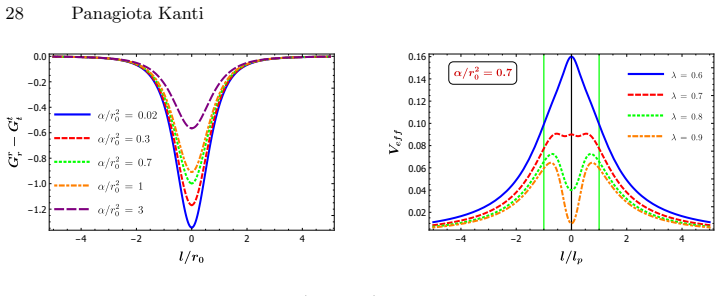
- [Section 4, Eqs. (64)-(70) and Fig. 12] The disformal wormhole construction is presented as giving a spacetime with r^2 = l^2 + r0^2, so the radial coordinate r is an even function of l. In that coordinate system the scalar field, which is a function of r through the seed solution (56), should be symmetric under l -> -l. The text, however, states that the profile of the scalar field 'is in fact asymmetric under the change l -> -l' (discussion following Eq. (70) and Fig. 12). This is an internal inconsistency in the presentation. If the two sides of the wormhole are obtained as two copies of the same r>=r0 solution, the scalar field must be even; if the asymmetry is intentional, the construction differs from what is described and the coordinate transformation needs to be clarified.
minor comments (5)
- [Equation (42)] The text introduces the shell action with constants (lambda1, lambda0), but immediately says '(lambda1, lambda2) are constants'. Please correct the label of the second constant.
- [Equation (20)] The 1/r^4 term in the scalar-field expansion is written in a way that is easy to misread: '12M^3D - 24M^2 \dot f - M D^3 / 6r^4' should probably be '(12M^3D - 24M^2 \dot f - M D^3)/(6r^4)' or an equivalent parenthesized form. Also, the dot on f is defined nowhere; please state that \dot f = df/d\phi.
- [Section 3.2, Fig. 6 caption] The caption refers to 'solutions for the scalar field for a family of dilatonic wormholes' but the plot axes are x and y and the curves appear to be trajectories; if the upper plot is indeed the scalar field and the lower plot the trajectories, the caption should be split or clarified.
- [Section 3.3, Eq. (49)] The geodesic Lagrangian is written as -epsilon, but for timelike particles the convention is usually 2L = -1 (or +1 depending on signature); please state the convention explicitly so that Eqs. (50) and the effective potential have a consistent sign.
- [References] Some references appear only as arXiv numbers without journal details (e.g., Refs. [68,69,116,117,121,122,123,124,125,126,127,128,129,146,147]); for a review, adding the final publication data would increase usability.
Circularity Check
No significant circularity: the review reports prior numerical constructions rather than deriving its conclusions from its own inputs.
full rationale
This is a review article that surveys previously published numerical constructions of scalarised black holes, wormholes and particle-like solutions in Einstein-scalar-Gauss-Bonnet theory. The central claims are presented as results obtained by integrating the field equations with near-horizon and asymptotic boundary conditions, not as quantities that are fitted and then relabeled as predictions. The regularity constraint (14) is derived by demanding finiteness of phi'' at the horizon, and the subsequent sign computation (22) is an algebraic consequence of that constraint, not a circular restatement. The photon rings and echoes are computed from the effective potentials of the constructed solutions rather than being inputs of the construction. The wormholes are built by explicit ansatz choices or by disformal transformations designed to produce a throat, and calling the resulting objects traversable wormholes is applying a definition, not a disguised prediction. The main weakness is the wording that scalarised solutions 'always emerge, independently of the form of the coupling function'; the evidence is numerical integration for a finite family of coupling functions, so this is an inductive extrapolation and an overstatement, but it is not a circular derivation. Similarly, the extensive self-citations are normal for a review of the author's own body of work; they refer to external numerical studies and do not constitute a self-citation chain that replaces independent evidence. No equation is shown to be equivalent to an input by construction, and no fitted parameter is renamed as a prediction. The circularity score is therefore 0.
Assumptions & free parameters
free parameters (4)
- alpha (coupling constant) =
Varies by plot, e.g., 0.0009 < alpha < 0.919 for f = alpha/phi
- phi_h (scalar field at horizon) =
e.g., phi_h = 3 in Fig. 2
- r_h (horizon radius) =
Set to 1 in Fig. 2
- lambda (disformal scale) =
Specified in Eq. (67)
assumptions (4)
- standard math The Gauss-Bonnet term yields field equations with at most second-order derivatives, avoiding Ostrogradski instabilities.
- domain assumption The regularity constraint (14) for phi'_h ensures finite phi'' at the horizon.
- domain assumption The numerical integration of the field equations (12) yields solutions that smoothly interpolate between the near-horizon and asymptotic expansions.
- ad hoc to paper The cut-and-paste construction at the wormhole throat can be supported by a thin shell described by action (42).
Cite this review
Pith. "Pith review of Compact Objects in Einstein-scalar-Gauss-Bonnet Theory and beyond." pith.science (2026). https://pith.science/paper/H3MFZREU
@misc{pith2026241220296,
  author       = {Pith},
  title        = {Pith review of: Compact Objects in Einstein-scalar-Gauss-Bonnet Theory and beyond},
  year         = {2026},
  howpublished = {\url{https://pith.science/paper/H3MFZREU}},
  note         = {Machine review of arXiv:2412.20296}
}
read the original abstract
In the context of General Relativity, black holes are not allowed to possess scalar hair, wormholes are not traversable and particle-like solutions are irregular. Therefore, in order to derive novel and physically interesting solutions that describe compact objects one needs to address generalised gravitational theories. One popular class of such theories is the Einstein-scalar-Gauss-Bonnet (EsGB) theory with a general coupling function between the scalar field of the theory and the quadratic Gauss-Bonnet term. Starting from black holes, we present a variety of spherically-symmetric solutions for several different forms of the coupling function and discuss their main features. We then proceed to wormhole solutions and demonstrate that the EsGB theory naturally supports traversable wormholes without the need for exotic matter. Regular scalarised particle-like solutions also emerge in the context of the same theory which also possess interesting observable features such as photon rings and echoes. Moving beyond this class of theories, we then address the more extended scalar-tensor Horndeski theory, briefly mention the types of black-hole solutions that arise, and demonstrate that an appropriately constructed disformal transformation of a black-hole solution, such as the Lu-Pang solution, results into a traversable wormhole in the context of the beyond-Horndeski theory.
Figures


Figures from the paper (11 more)



Reference graph
Works this paper leans on
-
[1]
Einstein, Sitzungsber
A. Einstein, Sitzungsber. Preuss. Akad. Wiss. Berlin (Math. Phys. ) 1915 (1915), 844-847; Sitzungsber. Preuss. Akad. Wiss. Berlin (Math. Phys. ) 1915 (1915), 831- 839; Sitzungsber. Preuss. Akad. Wiss. Berlin (Math. Phys. ) 1915 (1915), 778-786; Annalen Phys. 49 (1916) no.7, 769-822
1915
-
[2]
K. A. Bronnikov, Acta Phys. Polon. B 4 (1973), 251-266
1973
-
[3]
K. S. Stelle, Phys. Rev. D 16 (1977) 953
1977
-
[4]
T. P. Sotiriou, Lect. Notes Phys. 892 (2015) 3
2015
-
[5]
Berti et al., Class
E. Berti et al., Class. Quant. Grav. 32 (2015) 243001
2015
-
[6]
Charmousis, Lect
C. Charmousis, Lect. Notes Phys. 769 (2009) 299; Lect. Notes Phys. 892 (2015), 25-56
2009
-
[7]
C. G. Callan, Jr., I. R. Klebanov and M. J. Perry, Nucl. Phys. B 278 (1986), 78-90
1986
-
[8]
D. J. Gross and J. H. Sloan, Nucl. Phys. B 291 (1987), 41-89
1987
Show all 182 references
-
[9]
R. R. Metsaev and A. A. Tseytlin, Nucl. Phys. B 293 (1987), 385-419
1987
-
[10]
Lovelock, J
D. Lovelock, J. Math. Phys. 12 (1971), 498-501
1971
-
[11]
G. W. Horndeski, Int. J. Theor. Phys. 10 (1974), 363-384
1974
-
[12]
Schwarzschild, Sitzungsber
K. Schwarzschild, Sitzungsber. Preuss. Akad. Wiss. Berlin (Math. Phys. ) 1916 (1916), 189-196; Sitzungsber. Preuss. Akad. Wiss. Berlin (Math. Phys. ) 1916 (1916), 424-434
1916
-
[13]
Reissner, Annalen der Physik 50 (9) (1916), 106–120; G
H. Reissner, Annalen der Physik 50 (9) (1916), 106–120; G. Nordstr¨ om, Ver- handl. Koninkl. Ned. Akad. Wetenschap., Afdel. Natuurk., Amsterdam. 26 (1918), 1201–1208. 32 Panagiota Kanti
1916
-
[14]
R. P. Kerr, Phys. Rev. Lett. 11 (1963), 237-238
1963
-
[15]
J. D. Bekenstein, Phys. Rev. Lett. 28 (1972) 452; C. Teitelboim, Lett. Nuovo Cim. 3S2 (1972) 397
1972
-
[16]
C. A. R. Herdeiro and E. Radu, Int. J. Mod. Phys. D 24 (2015) no.09, 1542014
2015
-
[17]
C. W. Misner, K. S. Thorne and J. A. Wheeler, W. H. Freeman, 1973, ISBN 978-0-7167-0344-0, 978-0-691-17779-3
1973
-
[18]
Einstein and N
A. Einstein and N. Rosen, Phys. Rev. 48 (1935), 73-77
1935
-
[19]
C. W. Misner and J. A. Wheeler, Annals Phys. 2 (1957), 525-603
1957
-
[20]
Lorentzian wormholes: From Einstein to Hawking,
M. Visser, “Lorentzian wormholes: From Einstein to Hawking,” Computational and Mathematical Physcs, American Inst. of Physics, 1995
1995
-
[21]
M. S. Morris and K. S. Thorne, Am. J. Phys. 56 (1988), 395-412
1988
-
[22]
H. G. Ellis, Journal of Math. Physics. 14 (1973), 104–118
1973
-
[23]
K. A. Bronnikov, Acta Physica Polonica. B4 (1973), 251–266
1973
-
[24]
Fisher, Zh
I. Fisher, Zh. Eksp. Teor. Fiz. 18 (1948), 636
1948
-
[25]
A. I. Janis, E. T. Newman, and J. Winicour, Phys. Rev. Lett. 20 (1968), 878
1968
-
[26]
Wyman, Phys
M. Wyman, Phys. Rev. D 24 (1981), 839
1981
-
[27]
Motohashi and T
H. Motohashi and T. Suyama, Phys. Rev. D 91(2015), 085009
2015
-
[28]
Kanti, N
P. Kanti, N. E. Mavromatos, J. Rizos, K. Tamvakis and E. Winstanley, Phys. Rev. D 54 (1996) 5049
1996
-
[29]
Kanti, N
P. Kanti, N. E. Mavromatos, J. Rizos, K. Tamvakis and E. Winstanley, Phys. Rev. D 57 (1998) 6255
1998
-
[30]
G. W. Gibbons and K. i. Maeda, Nucl. Phys. B 298 (1988) 741
1988
-
[31]
C. G. Callan, Jr., R. C. Myers and M. J. Perry, Nucl. Phys. B 311 (1989) 673
1989
-
[32]
B. A. Campbell, M. J. Duncan, N. Kaloper and K. A. Olive, Phys. Lett. B 251 (1990) 34; B. A. Campbell, N. Kaloper and K. A. Olive, Phys. Lett. B 263 (1991) 364
1990
-
[33]
Mignemi and N
S. Mignemi and N. R. Stewart, Phys. Rev. D 47 (1993) 5259
1993
-
[34]
Kanti and K
P. Kanti and K. Tamvakis, Phys. Rev. D 52 (1995) 3506
1995
-
[35]
Torii, H
T. Torii, H. Yajima and K. i. Maeda, Phys. Rev. D 55 (1997) 739
1997
-
[36]
Kanti and K
P. Kanti and K. Tamvakis, Phys. Lett. B 392 (1997) 30
1997
-
[37]
Z. K. Guo, N. Ohta and T. Torii, Prog. Theor. Phys. 120 (2008) 581; N. Ohta and T. Torii, Prog. Theor. Phys. 122 (2009) 1477; K. i. Maeda, N. Ohta and Y. Sasagawa, Phys. Rev. D 80 (2009) 104032; N. Ohta and T. Torii, Prog. Theor. Phys. 124 (2010) 207
2008
-
[38]
Kleihaus, J
B. Kleihaus, J. Kunz and E. Radu, Phys. Rev. Lett. 106 (2011) 151104; B. Klei- haus, J. Kunz, S. Mojica and E. Radu, Phys. Rev. D 93 (2016) no.4, 044047
2011
-
[39]
P. Pani, C. F. B. Macedo, L. C. B. Crispino and V. Cardoso, Phys. Rev. D 84 (2011) 087501; P. Pani, E. Berti, V. Cardoso and J. Read, Phys. Rev. D 84 (2011) 104035
2011
-
[40]
Bardoux, M
Y. Bardoux, M. M. Caldarelli and C. Charmousis, JHEP 1205 (2012) 054
2012
-
[41]
K. Yagi, L. C. Stein, N. Yunes and T. Tanaka, Phys. Rev. D 85 (2012) 064022 Erratum: [Phys. Rev. D 93 (2016) no.2, 029902]
2012
-
[42]
Charmousis, T
C. Charmousis, T. Kolyvaris, E. Papantonopoulos and M. Tsoukalas, JHEP 1407 (2014) 085
2014
-
[43]
Correa, M
F. Correa, M. Hassaine and J. Oliva, Phys. Rev. D 89 (2014) no.12, 124005
2014
-
[44]
Ayzenberg and N
D. Ayzenberg and N. Yunes, Phys. Rev. D 90 (2014) 044066 Erratum: [Phys. Rev. D 91 (2015) no.6, 069905]
2014
-
[45]
J. L. Blazquez-Salcedo, C. F. B. Macedo, V. Cardoso, V. Ferrari, L. Gualtieri, F. S. Khoo, J. Kunz and P. Pani, Phys. Rev. D 94 (2016) no.10, 104024
2016
-
[46]
Bhattacharya and S
S. Bhattacharya and S. Chakraborty, Phys. Rev. D 95 (2017) no.4, 044037; I. Banerjee, S. Chakraborty and S. SenGupta, Phys. Rev. D96 (2017) no.8, 084035. Compact Objects in EsGB Theory and beyond 33
2017
-
[47]
J. L. Blazquez-Salcedo et al., IAU Symp. 324 (2016) 265
2016
-
[48]
T. P. Sotiriou and S. Y. Zhou, Phys. Rev. Lett. 112 (2014) 251102
2014
-
[49]
T. P. Sotiriou and S. Y. Zhou, Phys. Rev. D 90 (2014) 124063; R. Benkel, T. P. Sotiriou and H. Witek, Phys. Rev. D 94 (2016) no.12, 121503; Class. Quant. Grav. 34 (2017) no.6, 064001
2014
-
[50]
J. D. Bekenstein, Phys. Rev. D 51 (1995) no.12, R6608
1995
-
[51]
T. P. Sotiriou and V. Faraoni, Phys. Rev. Lett. 108 (2012) 081103
2012
-
[52]
Hui and A
L. Hui and A. Nicolis, Phys. Rev. Lett. 110 (2013) 241104
2013
-
[53]
C. A. R. Herdeiro and E. Radu, Phys. Rev. Lett. 112 (2014) 221101
2014
-
[54]
Babichev and C
E. Babichev and C. Charmousis, JHEP 1408 (2014) 106
2014
-
[55]
Antoniou, A
G. Antoniou, A. Bakopoulos and P. Kanti, Phys. Rev. Lett. 120 (2018) no.13, 131102
2018
-
[56]
Antoniou, A
G. Antoniou, A. Bakopoulos and P. Kanti, Phys. Rev. D 97 (2018) no.8, 084037
2018
-
[57]
Papageorgiou, C
A. Papageorgiou, C. Park and M. Park, Phys. Rev. D 106 (2022) no.8, 084024
2022
-
[58]
Bakopoulos, G
A. Bakopoulos, G. Antoniou and P. Kanti, Phys. Rev. D 99 (2019) no.6, 064003
2019
-
[59]
Brihaye, B
Y. Brihaye, B. Hartmann and J. Urrestilla, JHEP 1806 (2018) 074; Y. Brihaye and B. Hartmann, arXiv:1810.05108 [gr-qc]
2018 arXiv
-
[60]
Brihaye and B
Y. Brihaye and B. Hartmann, Phys. Lett. B 772 (2017), 476-482
2017
-
[61]
Bakopoulos, P
A. Bakopoulos, P. Kanti and N. Pappas, Phys. Rev. D 101 (2020) no.8, 084059
2020
-
[62]
D. D. Doneva and S. S. Yazadjiev, Phys. Rev. Lett. 120 (2018) no.13, 131103
2018
-
[63]
H. O. Silva, J. Sakstein, L. Gualtieri, T. P. Sotiriou and E. Berti, Phys. Rev. Lett. 120 (2018) no.13, 131104
2018
-
[64]
D. D. Doneva and S. S. Yazadjiev, JCAP 1804 (2018) no.04, 011
2018
-
[65]
Motohashi and M
H. Motohashi and M. Minamitsuji, Phys. Lett. B 781 (2018) 728; Phys. Rev. D 98 (2018) no.8, 084027
2018
-
[66]
C. A. R. Herdeiro, E. Radu, N. Sanchis-Gual and J. A. Font, Phys. Rev. Lett. 121 (2018) no.10, 101102; T. Delsate, C. Herdeiro and E. Radu, Phys. Lett. B 787 (2018) 8; Y. Brihaye, C. Herdeiro and E. Radu, Phys. Lett. B 788 (2019) 295
2018
-
[67]
D. D. Doneva, S. Kiorpelidi, P. G. Nedkova, E. Papantonopoulos and S. S. Yazad- jiev, Phys. Rev. D 98 (2018) no.10, 104056
2018
-
[68]
Butler, A
M. Butler, A. M. Ghezelbash, E. Massaeli and M. Motaharfar, arXiv:1808.03217 [hep-th]
- [69]
-
[70]
M. M. Stetsko, arXiv:1811.05030 [hep-th]
-
[71]
O. J. Tattersall, P. G. Ferreira and M. Lagos, Phys. Rev. D 97 (2018) no.8, 084005
2018
-
[72]
Mukherjee and S
S. Mukherjee and S. Chakraborty, Phys. Rev. D 97 (2018) no.12, 124007
2018
-
[73]
Chakrabarti, Eur
S. Chakrabarti, Eur. Phys. J. C 78 (2018) no.4, 296
2018
-
[74]
Berti, K
E. Berti, K. Yagi and N. Yunes, Gen. Rel. Grav. 50 (2018) no.4, 46
2018
-
[75]
Brihaye and B
Y. Brihaye and B. Hartmann, Class. Quant. Grav. 35 (2018) no.17, 175008
2018
-
[76]
Prabhu and L
K. Prabhu and L. C. Stein, Phys. Rev. D 98 (2018) no.2, 021503
2018
-
[77]
Y. S. Myung and D. C. Zou, Phys. Rev. D98 (2018) no.2, 024030; arXiv:1812.03604 [gr-qc]
2018 arXiv
-
[78]
J. L. Blazquez-Salcedo, D. D. Doneva, J. Kunz and S. S. Yazadjiev, Phys. Rev. D 98 (2018) no.8, 084011; J. L. Blazquez-Salcedo, Z. Altaha Motahar, D. D. Doneva, F. S. Khoo, J. Kunz, S. Mojica, K. V. Staykov and S. S. Yazadjiev, arXiv:1810.09432 [gr-qc]
2018 arXiv
-
[79]
Benkel, N
R. Benkel, N. Franchini, M. Saravani and T. P. Sotiriou, Phys. Rev. D 98 (2018) no.6, 064006
2018
-
[80]
B. H. Lee, W. Lee and D. Ro, Phys. Rev. D 99 (2019) no.2, 024002
2019
-
[81]
Witek, L
H. Witek, L. Gualtieri, P. Pani and T. P. Sotiriou, Phys. Rev. D 99 (2019) no.6, 064035. 34 Panagiota Kanti
2019
-
[82]
Motohashi and S
H. Motohashi and S. Mukohyama, Phys. Rev. D 99 (2019) no.4, 044030
2019
-
[83]
Sultana and D
J. Sultana and D. Kazanas, Gen. Rel. Grav. 50 (2018) no.11, 137
2018
-
[84]
Nojiri, S
S. Nojiri, S. D. Odintsov and V. K. Oikonomou, Phys. Rev. D 99 (2019) 044050
2019
-
[85]
Qolibikloo and A
S. Qolibikloo and A. Ghodsi, Eur. Phys. J. C 79 (2019) no.5, 406
2019
-
[86]
P. V. P. Cunha, C. A. R. Herdeiro and E. Radu, Phys. Rev. Lett. 123, no. 1, 011101 (2019)
2019
-
[87]
Bakopoulos, P
A. Bakopoulos, P. Kanti and N. Pappas, Phys. Rev. D 101 (2020) no.4, 044026
2020
-
[88]
Minamitsuji and T
M. Minamitsuji and T. Ikeda, Phys. Rev. D 99 (2019) 044017; Phys. Rev. D 99 (2019) 104069
2019
-
[89]
M. M. Stetsko, Phys. Rev. D 99 (2019) 044028
2019
-
[90]
Y. S. Myung and D.-C. Zou, Phys. Lett. B 790 (2019) 400
2019
-
[91]
Brihaye and L
Y. Brihaye and L. Ducobu, Phys. Lett. B 795 (2019) 135
2019
-
[92]
C. A. R. Herdeiro and E. Radu, Phys. Rev. D 99 (2019) 084039
2019
-
[93]
Kobayashi, Rept
T. Kobayashi, Rept. Prog. Phys. 82 (2019) 086901
2019
-
[94]
H. O. Silva, C. F. B. Macedo, T. P. Sotiriou, L. Gualtieri, J. Sakstein and E. Berti, Phys. Rev. D 99 (2019) 104041
2019
-
[95]
de la Cruz-Dombriz and F
A. de la Cruz-Dombriz and F. J.M. Torralba, JCAP 1903 (2019) 002
2019
-
[96]
Wang, Y.-F
C.-Y. Wang, Y.-F. Shen and Y. Xie, JCAP 1904 (2019) 022
2019
-
[97]
Cano and A
P.-A. Cano and A. Ruiperez, JHEP 1905 (2019) 189
2019
-
[98]
F. M. Ramazanoglu, Phys. Rev. D 99 (2019) 084015
2019
-
[99]
P. G. S. Fernandes, C. A. R. Herdeiro, A. M. Pombo, E. Radu and N. Sanchis-Gual, Class. Quant. Grav. 36 (2019) 134002
2019
-
[100]
Brihaye and B
Y. Brihaye and B. Hartmann, Phys. Lett. B 792 (2019) 244
2019
-
[101]
Saravani and T
M. Saravani and T. P. Sotiriou, Phys. Rev. D 99 (2019) 124004
2019
-
[102]
C. F. B. Macedo, J. Sakstein, E. Berti, L. Gualtieri, H. O. Silva and T. P. Sotiriou, Phys. Rev. D 99 (2019) 104041
2019
-
[103]
D. D. Doneva, K. V. Staykov and S. S. Yazadjiev, Phys. Rev. D 99 (2019) 104045
2019
-
[104]
Saffer, H
A. Saffer, H. O. Silva and N. Yunes, Phys. Rev. D 100 (2019) 044030
2019
-
[105]
Anson, E
T. Anson, E. Babichev, C. Charmousis and S. Ramazanov, JCAP 1906 (2019) 023
2019
-
[106]
Y. S. Myung and D.-C. Zou, Int. J. Mod. Phys. D 28 (2019) 1950114
2019
-
[107]
Brihaye and B
Y. Brihaye and B. Hartmann, JHEP 1909 (2019) 049
2019
-
[108]
O. J. Tattersall and P. G. Ferreira, Phys. Rev. D 99 (2019) 104082
2019
-
[109]
Andreou, N
N. Andreou, N. Franchini, G. Ventagli and T. P. Sotiriou, Phys. Rev. D 99 (2019) 124022
2019
-
[110]
Liang, J
Q. Liang, J. Sakstein and M. Trodden, Phys. Rev. D 100 (2019) 063518
2019
-
[111]
L. Hui, D. Kabat, X. Li, L. Santoni and S. S. C. Wong, JCAP 1906 (2019) 038
2019
-
[112]
D. Q. Tuan and S. H. Q. Nguyen, Commun. Phys. 29 (2019) 173
2019
-
[113]
Tuan Do et al, Science 365 (2019) 6454
2019
-
[114]
P. G. S. Fernandes, C. A. R. Herdeiro, A. M. Pombo, E. Radu and N. Sanchis- Gual, Phys. Rev. D 100 (2019) 084045
2019
-
[115]
R. A. Konoplya and A. Zhidenko, Phys. Rev. D 100 (2019) 044015
2019
- [116]
-
[117]
A. Hees, O. Minazzoli, E. Savalle, Y. V. Stadnik, P. Wolf and B. Roberts, arXiv:1905.08524 [gr-qc]
1905 arXiv
- [118]
-
[119]
Charmousis, M
C. Charmousis, M. Crisostomi, R. Gregory and N. Stergioulas, Phys. Rev. D 100 (2019) no.8, 084020
2019
- [120]
-
[121]
de Rham and J
C. de Rham and J. Zhang, arXiv:1907.006992 [hep-th]. Compact Objects in EsGB Theory and beyond 35
1907 arXiv
-
[122]
Aguilar-Perez, M
G. Aguilar-Perez, M. Cruz, S. Lepe and I. Moran-Rivera, arXiv:1907.06168 [gr- qc]
1907 arXiv
-
[123]
R. A. Konoplya, T. Pappas and A. Zhidenko, arXiv:1907.10112 [gr-qc]
1907 arXiv
- [124]
- [125]
- [126]
-
[127]
F. M. Ramazanoglu and K. I. Unluturk, arXiv:1910.02801 [gr-qc]
1910 arXiv
-
[128]
K. V. Aelst, E. Gourgoulhon, P. Grandclement and C. Charmousis, arXiv:1910.08451 [gr-qc]
1910 arXiv
-
[129]
Barrientos, F
J. Barrientos, F. Cordonier-Tello, C. Corral, F. Izaurieta, P. Medina, E. Rodriguez and O. Valdivia, arXiv:1910.00148 [gr-qc]
1910 arXiv
-
[130]
Martinez, R
C. Martinez, R. Troncoso and J. Zanelli, Phys. Rev. D 67 (2003) 024008
2003
-
[131]
T. J. T. Harper, P. A. Thomas, E. Winstanley and P. M. Young, Phys. Rev. D 70 (2004) 064023
2004
-
[132]
Torii, K
T. Torii, K. Maeda and M. Narita, Phys. Rev. D 59 (1999) 064027
1999
-
[133]
Winstanley, Found
E. Winstanley, Found. Phys. 33 (2003) 111; Class. Quant. Grav. 22 (2005) 2233
2003
-
[134]
Bhattacharya and A
S. Bhattacharya and A. Lahiri, Phys. Rev. Lett. 99 (2007) 201101
2007
-
[135]
Henneaux, C
M. Henneaux, C. Martinez, R. Troncoso and J. Zanelli, Phys. Rev. D 70 (2004) 044034; C. Martinez, R. Troncoso and J. Zanelli, Phys. Rev. D 70 (2004) 084035; C. Erices and C. Martinez, Phys. Rev. D 97 (2018) no.2, 024034
2004
-
[136]
Radu and E
E. Radu and E. Winstanley, Phys. Rev. D 72 (2005) 024017
2005
-
[137]
Anabalon and H
A. Anabalon and H. Maeda, Phys. Rev. D 81 (2010) 041501
2010
-
[138]
Hosler and E
D. Hosler and E. Winstanley, Phys. Rev. D 80 (2009) 104010
2009
-
[139]
Charmousis, T
C. Charmousis, T. Kolyvaris and E. Papantonopoulos, Class. Quant. Grav. 26 (2009) 175012; T. Kolyvaris, G. Koutsoumbas, E. Papantonopoulos and G. Siopsis, Gen. Rel. Grav. 43 (2011) 163
2009
-
[140]
K. i. Maeda, N. Ohta and Y. Sasagawa, Phys. Rev. D83 (2011) 044051; Z. K. Guo, N. Ohta and T. Torii, Prog. Theor. Phys. 121 (2009) 253; N. Ohta and T. Torii, Prog. Theor. Phys. 121 (2009) 959; N. Ohta and T. Torii, Prog. Theor. Phys. 122 (2009) 1477
2011
-
[141]
S. G. Saenz and C. Martinez, Phys. Rev. D 85 (2012) 104047
2012
-
[142]
M. M. Caldarelli, C. Charmousis and M. Hassaine, JHEP 1310 (2013) 015
2013
-
[143]
P. A. Gonzalez, E. Papantonopoulos, J. Saavedra and Y. Vasquez, JHEP 1312 (2013) 021
2013
-
[144]
Bravo Gaete and M
M. Bravo Gaete and M. Hassaine, Phys. Rev. D 88 (2013) 104011; M. Bravo Gaete and M. Hassaine, JHEP 1311 (2013) 177
2013
-
[145]
Giribet, M
G. Giribet, M. Leoni, J. Oliva and S. Ray, Phys. Rev. D 89 (2014) no.8, 085040
2014
- [146]
-
[147]
J. B. Achour and H. Liu, Phys. Rev. D 99 (2019) 064042
2019
-
[148]
Kanti, A
P. Kanti, A. Bakopoulos and N. Pappas, PoS CORFU2018 (2019) 091
2019
- [149]
-
[150]
D. D. Doneva, K. V. Staykov and S. S. Yazadjiev, Phys. Rev. D 99 (2019) no.10, 104045
2019
-
[151]
Brihaye, C
Y. Brihaye, C. Herdeiro and E. Radu, Phys. Lett. B 802 (2020) 135269
2020
-
[152]
Kanti, B
P. Kanti, B. Kleihaus and J. Kunz, Phys. Rev. Lett. 107 (2011), 271101
2011
-
[153]
Kanti, B
P. Kanti, B. Kleihaus and J. Kunz, Phys. Rev. D 85 (2012), 044007
2012
-
[154]
Antoniou, A
G. Antoniou, A. Bakopoulos, P. Kanti, B. Kleihaus and J. Kunz, Phys. Rev. D 101 (2020) no.2, 024033
2020
-
[155]
K. A. Bronnikov and J. C. Fabris, Class. Quant. Grav. 14 (1997), 831-842
1997
-
[156]
F. S. N. Lobo, Phys. Rev. D 71 (2005), 084011. 36 Panagiota Kanti
2005
-
[157]
S. V. Bolokhov, K. A. Bronnikov and M. V. Skvortsova, Class. Quant. Grav. 29 (2012), 245006
2012
-
[158]
Kleihaus and J
B. Kleihaus and J. Kunz, Phys. Rev. D 90, 121503 (2014)
2014
-
[159]
M. R. Mehdizadeh, M. Kord Zangeneh and F. S. N. Lobo, Phys. Rev. D 91 (2015) no.8, 084004
2015
-
[160]
K. A. Bronnikov, J. C. Fabris, O. F. Piattella and E. C. Santos, Gen. Rel. Grav. 48 (2016) no.12, 162
2016
-
[161]
Shaikh and S
R. Shaikh and S. Kar, Phys. Rev. D 94 (2016) no.2, 024011
2016
-
[162]
Ca˜ nate, J
P. Ca˜ nate, J. Sultana and D. Kazanas, Phys. Rev. D 100 (2019) no.6, 064007
2019
-
[163]
K. A. Bronnikov, S. V. Bolokhov and M. V. Skvortsova, Int. J. Mod. Phys. D 28 (2019) no.13, 1941008
2019
-
[164]
Ibadov, B
R. Ibadov, B. Kleihaus, J. Kunz and S. Murodov, Phys. Rev. D 102 (2020) no.6, 064010
2020
-
[165]
Ibadov, B
R. Ibadov, B. Kleihaus, J. Kunz and S. Murodov, Symmetry 13 (2021) no.1, 89
2021
-
[166]
Kleihaus, J
B. Kleihaus, J. Kunz and P. Kanti, Phys. Lett. B 804 (2020), 135401
2020
-
[167]
Kleihaus, J
B. Kleihaus, J. Kunz and P. Kanti, Phys. Rev. D 102 (2020), 024070
2020
-
[168]
Cardoso, L
V. Cardoso, L. C. B. Crispino, C. F. B. Macedo, H. Okawa and P. Pani, Phys. Rev. D 90 (2014) no.4, 044069
2014
-
[169]
Keir, Class
J. Keir, Class. Quant. Grav. 33 (2016) no.13, 135009
2016
-
[170]
Cunha, V.P., E
P. Cunha, V.P., E. Berti and C. A. R. Herdeiro, Phys. Rev. Lett. 119 (2017) no.25, 251102
2017
-
[171]
Brihaye and B
Y. Brihaye and B. Hartmann, JHEP 09 (2019), 049
2019
-
[172]
Lu and Y
H. Lu and Y. Pang, Phys. Lett. B 809 (2020), 135717
2020
-
[173]
R. A. Hennigar, D. Kubizˇ n´ ak, R. B. Mann and C. Pollack, JHEP07 (2020), 027
2020
-
[175]
Bakopoulos, C
A. Bakopoulos, C. Charmousis, P. Kanti and N. Lecoeur, JHEP 08 (2022), 055
2022
-
[176]
Babichev, C
E. Babichev, C. Charmousis and A. Leh´ ebel, Class. Quant. Grav.33 (2016) no.15, 154002
2016
-
[177]
Babichev, C
E. Babichev, C. Charmousis and A. Leh´ ebel, JCAP 04 (2017), 027
2017
-
[178]
Babichev, C
E. Babichev, C. Charmousis, M. Hassaine and N. Lecoeur, Phys. Rev. D 108 (2023) no.2, 024019
2023
-
[179]
Bakopoulos, C
A. Bakopoulos, C. Charmousis and P. Kanti, JCAP 05 (2022) no.05, 022
2022
-
[180]
Chatzifotis, E
N. Chatzifotis, E. Papantonopoulos and C. Vlachos, Phys. Rev. D 105 (2022) no.6, 064025
2022
-
[181]
Zumalac´ arregui and J
M. Zumalac´ arregui and J. Garc ´ ıa-Bellido, Phys. Rev. D89 (2014), 064046
2014
-
[182]
Crisostomi, M
M. Crisostomi, M. Hull, K. Koyama and G. Tasinato, JCAP 03 (2016), 038
2016
-
[183]
Ben Achour, M
J. Ben Achour, M. Crisostomi, K. Koyama, D. Langlois, K. Noui and G. Tasinato, JHEP 12 (2016), 100
2016
Reviewed August 10, 2026 · model on record in the stance chip above.
Discussion (0). Continue with ORCID to comment.