REVIEW 4 major objections 6 minor 32 references
Pulse engineering via projection of response functions at infinite nonlinear order
T0 review · 4 major / 6 minor · reviewed 2026-07-31 · grok-4.5
Pith's one-line read PEPRino finds high-fidelity multi-qubit control pulses without gradients or learning rates by resumming the fidelity response to infinite order from only the first two susceptibilities.
desk verdict Solid methods extension of PEPR: the Pauli resummation is real and useful; the “2-design” evaluation is mislabeled product-state averaging, which softens the fidelity claims but does not kill the algorithm. read the letter →
The pith
A machine-rendered reading of the paper's core claim, the machinery that carries it, and where it could break.
The reading
What carries the argument
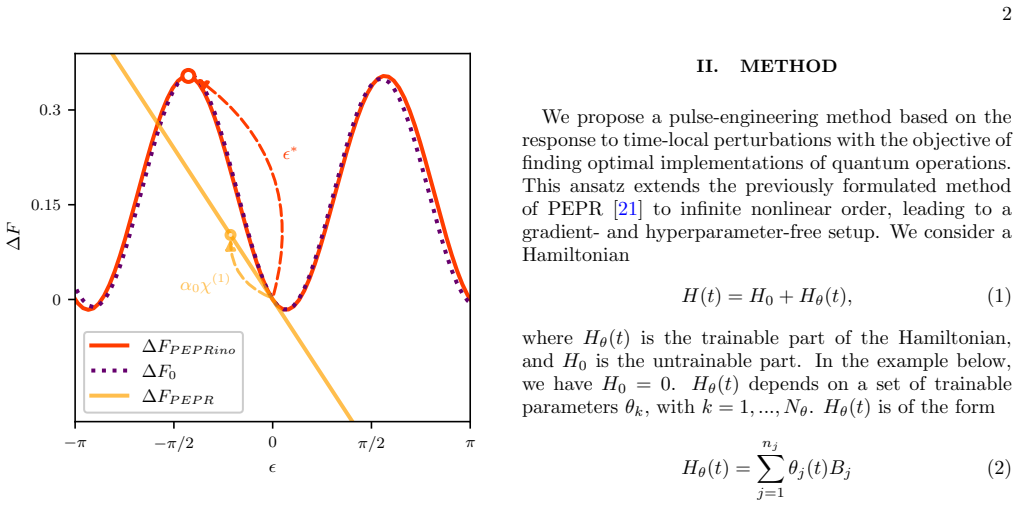
The infinite-order fidelity landscape ΔF_PEPRino = (1/2) χ^{(1)} sin(2ε) + (1/4) χ^{(2)} (1 − cos(2ε)), obtained by using the nested-commutator identities of Pauli operators that reduce every higher-order susceptibility to a multiple of χ^{(1)} or χ^{(2)}; the maximizing ε* is then projected onto the sine-mode control functions to give the hyperparameter-free update.
What would settle it
Replace the Pauli control operators with generic non-Pauli Hermitian generators and measure whether the two-term formula still matches the true fidelity change under a finite kick; if the predicted optimal kick no longer improves fidelity, the resummation claim fails.
Extended reading notes
Core claim
For multi-qubit systems whose control operators are Pauli matrices or tensor products of Paulis, the change in gate fidelity under a time-local perturbation can be resummed to all nonlinear orders as ΔF = (1/2) χ^{(1)} sin(2ε) + (1/4) χ^{(2)} (1 − cos(2ε)). Maximizing this expression for the kick strength ε and projecting the optimal kick onto a finite sine basis yields parameter updates that require neither gradients nor learning rates. The resulting optimizer produces high-fidelity implementations of the Quantum Fourier Transform on two and three qubits and converges faster than CRAB with Nelder-Mead on the two-qubit case.
Load-bearing premise
The closed-form landscape holds only when every control operator is built from Pauli matrices, so that nested commutators keep alternating between just two operators; if the controls are more general, the infinite series cannot be reduced to the first two terms.
Editorial extensions
If this is right
- High-fidelity QFT control pulses for two and three qubits can be obtained without any learning-rate schedule or gradient evaluation.
- Averaging susceptibilities over modest batches of initial states is already sufficient to drive global gate optimization.
- The same response-projection update applies equally to state preparation and to full unitary gate synthesis.
- Because each step needs only two response functions, the method remains computationally lighter than simplex methods whose cost scales with the full parameter dimension.
Reading between the lines
- The same low-dimensional commutator collapse may extend to any control Lie algebra whose adjoint representation stays two-dimensional, suggesting a route beyond pure qubit Paulis.
- Hybrid schemes that seed a gradient-based optimizer with PEPRino’s infinite-order step could escape flat regions of the control landscape more reliably.
- The wall-time gap versus CRAB is expected to widen with qubit number, because CRAB’s simplex size grows with every added mode while PEPRino’s per-step cost is set mainly by batch size.
Editorial analysis
A structured set of objections, weighed in public.
Referee Report
Summary. The manuscript introduces PEPRino, an extension of the authors' earlier PEPR optimal-control method [21], in which the fidelity response to a time-local control kick is resummed to infinite nonlinear order. For Pauli-product control operators, the nested-commutator hierarchy collapses (Eqs. 13–14, App. A), so the full landscape reduces to a closed form, ΔF_PEPRino = (1/2)χ⁽¹⁾ sin(2ε) + (1/4)χ⁽²⁾(1−cos(2ε)) (Eq. 15), whose maximizer ε* is obtained analytically (Eq. 16). The kick is then projected onto a sine-mode pulse basis, giving a multi-parameter update with no learning rate and no gradient computation. The method is benchmarked against CRAB/Nelder-Mead on the 2-qubit QFT (Figs. 3–4) and applied to the 3-qubit QFT (Fig. 5), showing convergence to ~10⁻⁸ infidelity in roughly one-third the iterations of CRAB.
Significance. If the results hold, the paper delivers a genuinely useful contribution: an analytic, closed-form resummation of the response series (not a fit), an update rule whose step size is determined by the landscape rather than a tuned learning rate, and a direct, controlled comparison against a standard baseline (CRAB/Nelder-Mead) with matched per-iteration resources (n_B = 41 vs. 41 simplex vertices). Appendices A–B give a clean, checkable derivation of the Pauli-algebra collapse and the sin/cos resummation, and Fig. 1 demonstrates that the approximate landscape tracks the true ΔF near the chosen ε*. The restriction to Pauli-type controls is honestly stated and is a reasonable domain for many qubit platforms. The main weaknesses are in the evaluation metric (a local-product "2-design" that is not a global 2-design) and in overstatement of the "hyperparameter-free" and wall-time claims, not in the central derivation.
major comments (4)
- [Appendix C; Eq. (23); Figs. 3–6] The N-qubit '2-design' constructed in App. C is a tensor product of one-qubit 2-designs (6^N product states), which is not a projective 2-design on the global d=2^N Hilbert space. For two qubits, the 36-state product ensemble has second moment (I+S_1)(I+S_2)/36, whereas a global two-qubit 2-design gives (I+S_global)/20; the sector odd under each local swap but even under the global swap is missed. Consequently Eq. (23), Figs. 3–6, and the CRAB objective all measure a local-product-state average, not the conventional Haar/average gate fidelity, and one- and two-local Pauli error components are weighted differently than under the Haar measure. The quoted ~10⁻⁸ floors and the 'high-fidelity QFT' claim therefore refer to a non-standard metric, and the 3-qubit evaluation (n_E=100 random product states) inherits the same issue. Since both PEPRino and CRAB were scored on the same metric, the re
- [Abstract; §I; Figs. 3, 5] The abstract and §I advertise the method as 'hyperparameter-free', but Figs. 3 and 5 demonstrate explicit dependence on the number of modes n_m and the batch size n_B, and the initialization scale θ ~ N(0, 1/(n_m√k)) and transformation time t_f are further choices the user must make. What the method actually eliminates is the learning rate α₀ of PEPR (Fig. 1) and the gradient computation — which is a real and worthwhile advance. The claim should be restated accordingly (e.g., 'learning-rate- and gradient-free'), and the remaining sensitivities to n_m and n_B acknowledged in the abstract/conclusion rather than only in §IV.
- [§IV.A, Fig. 4; Abstract] The abstract and §IV.A claim faster convergence 'regarding iteration steps and computational time', and §IV.A states PEPRino is 'demanding fewer computational resources', but no wall-clock or per-iteration cost data are reported anywhere. The iteration-count advantage is clear from Fig. 4, but per-iteration cost differs between the methods (PEPRino: n_B × two susceptibility evaluations; CRAB: ~41+ simplex evaluations over the 36-state ensemble), so the wall-time claim is plausible yet currently unsubstantiated. Please add a quantitative comparison (wall time per run, or an explicit count of time evolutions per iteration for both methods).
- [§II, Eqs. (13)–(15); Appendix A] The resummation in Eq. (15) and the convergence of the underlying series are exact only because ad_B³ = 4 ad_B for Pauli strings (App. A, Eqs. 13–14). App. A verifies this explicitly only for B = σ_z⊗σ_z and asserts the pattern 'extends to N qubits'. Since the whole method stands on this identity, please give the one-line general proof (any Pauli string B has B²=I, so ad_B² acts as 4·id on the anti-commuting Pauli components and 0 on the commuting ones, hence ad_B³ = 4 ad_B), and state at Eq. (15) precisely which class of control operators is admissible — e.g., whether sums of non-commuting Pauli terms as a single control operator are excluded.
minor comments (6)
- [Eqs. (10)–(12), (B18)–(B21)] Sign conventions are inconsistent across Eqs. (10), (11), (12) and (B18)–(B21): Eq. (10) has (−ε)ⁿ while Eq. (11) has +εⁿ, and Eq. (B19) has (iε/ℏ)ⁿ. The signs presumably get absorbed into the definition of χ⁽ⁿ⁾, but this should be made uniform or explicitly noted.
- [Fig. 1] In Fig. 1 the true fidelity change is labeled ΔF0 (and ΔF₀ in the text), which reads as 'zeroth-order' in a paper about response orders; a different symbol (e.g., ΔF_true or ΔF_exact) would avoid confusion with the perturbative orders.
- [Figs. 3, 6] Fig. 3 caption describes 'thin dotted lines' as individual runs while the main text describes 'thin solid lines with distinct line styles' as the per-batch-size logarithmic averages; please make caption and text consistent. Similarly check Fig. 6, whose legend lists n_B = 5–8 while the body text (§IV.A) discusses n_B ∈ {4,5,6,7} for the main 2-qubit runs.
- [Eq. (8) onward] ℏ appears explicitly in Eqs. (8), (12), (B11) etc., but the numerical simulations evidently use ℏ = 1; please state the units convention once.
- [Appendix C, references] Ref. [32] (Dankert et al.) concerns exact/approximate unitary 2-designs; when revising App. C per the major comment, it would help to cite standard references on average gate fidelity and state 2-designs (e.g., Nielsen; Horodecki et al.; Emerson et al. on gate-fidelity estimation) and to clarify which quantity the chosen ensemble actually estimates.
- [§II, Eq. (16)] The choice 'smallest |ε| among maxima' (Eq. 16) is reasonable but unmotivated in the text; a sentence noting that Fig. 1 shows the approximation degrades for |ε| ≳ π/2, hence the smallest-|ε| rule, would connect the criterion to the stated accuracy window.
Circularity Check
No significant circularity: infinite-order fidelity resummation is derived from response theory plus Pauli algebra; PEPR self-citation only supplies the prior projection template.
full rationale
The load-bearing formula ΔF_PEPRino = (1/2)χ⁽¹⁾ sin(2ε) + (1/4)χ⁽²⁾(1−cos(2ε)) is obtained in Sec. II and Apps. A–B by (i) writing the fidelity change as the Dyson/nested-commutator series under a time-local kick, (ii) using the SU(2)/Pauli identities that even- and odd-order nested commutators stay proportional to the first- and second-order ones, and (iii) resumming the resulting geometric series into sine/cosine. That chain does not define the output in terms of the target QFT, does not fit free parameters to the reported fidelities, and does not import a uniqueness theorem. The sine-mode projection and parameter-update skeleton are taken from the authors’ prior PEPR work [21], which is ordinary methodological inheritance rather than a self-citation that forces the new infinite-order claim. Empirical success is checked against an external baseline (CRAB/Nelder–Mead) and against an explicitly stated (if imperfect) state ensemble; those comparisons are not circular. The separate correctness issue that the paper’s “2-design” is only a product of local one-qubit designs does not create a definitional loop in the derivation. Hence circularity score 0.
Assumptions & free parameters
free parameters (5)
- n_m (number of sine modes) =
8 (main 2q); 30 (3q)
- n_B (batch size for averaged susceptibilities) =
varies; 41 for head-to-head
- initialization scale of θ =
1/(n_m √k)
- Nelder-Mead coefficients (CRAB baseline) =
α=1,γ=2,σ=0.5,β=0.5,ε_v=1
- transformation time t_f
assumptions (5)
- standard math Time-dependent perturbation theory / response expansion for Δ⟨A⟩ under a control kick is valid for the fidelities considered.
- domain assumption For B built from Pauli matrices (or Pauli products), even/odd nested commutators remain proportional to the first and second commutators with factors (−4)^n (Eqs. 13–14).
- ad hoc to paper Projecting a time-local δ-kick onto a finite sine basis via θ_{j,k} ← θ_{j,k} − (2ε*/t_f) sin(π k t_r / t_f) is a valid multi-parameter update.
- domain assumption Batch-averaged susceptibilities over a few random product states (or 2-design subsets) suffice to optimize the full gate.
- domain assumption Unconstrained Ising+Rabi Hamiltonian with H_0=0 and sine-parameterized drives can realize high-fidelity QFT without amplitude constraints for the cases studied.
invented entities (1)
-
PEPRino algorithm (infinite-order response-projection pulse updater)
Cite this review
Pith. "Pith review of Pulse engineering via projection of response functions at infinite nonlinear order." pith.science (2026). https://pith.science/paper/H44VATXN
@misc{pith2026260724725,
  author       = {Pith},
  title        = {Pith review of: Pulse engineering via projection of response functions at infinite nonlinear order},
  year         = {2026},
  howpublished = {\url{https://pith.science/paper/H44VATXN}},
  note         = {Machine review of arXiv:2607.24725}
}
read the original abstract
Optimal control problems arise in a wide range of scientific disciplines, but the corresponding optimization algorithms often display a strong dependence on hyperparameters that significantly influence performance and convergence. For the optimal implementation of quantum algorithms, these challenges are further amplified by high-dimensional control landscapes and the need for high-fidelity operations. Here, we propose an algorithm for optimal control problems in quantum computing to efficiently generate high-fidelity control protocols for multi-qubit systems in a hyperparameter and gradient free manner. The method, referred to as Pulse Engineering via Projection of response functions at infinite nonlinear order (PEPRino), leverages the framework of response theory to navigate the control landscape to find high-fidelity implementations. This is achieved by determining the control landscape via response functions to infinite order, efficiently evaluated by resummation in terms of the first and second order response function. To demonstrate the approach, we apply it to quantum systems consisting of two and three qubits for the optimal implementation of the Quantum Fourier Transform (QFT). We benchmark the proposed algorithm against the Chopped Random Basis (CRAB) algorithm utilizing the Nelder-Mead method, focusing on the 2-qubit scenario. The results indicate faster convergence regarding iteration steps and computational time, highlighting the advantages of our approach.
Figures


Figures from the paper (2 more)


Reference graph
Works this paper leans on
-
[21]
Heimann, L
N. Heimann, L. Broers, and L. Mathey, Pulse engineering via projection of response functions, Phys. Rev. Res.7, 013101 (2025)
2025
-
[1]
Doria, T
P. Doria, T. Calarco, and S. Montangero, Optimal control technique for many-body quantum dynamics, Physical review letters106, 190501 (2011)
2011
-
[2]
J. Li, X. Yang, X. Peng, and C.-P. Sun, Hybrid quantum- classical approach to quantum optimal control, Physical review letters118, 150503 (2017)
2017
-
[3]
C. P. Koch, U. Boscain, T. Calarco, G. Dirr, S. Fil- ipp, S. J. Glaser, R. Kosloff, S. Montangero, T. Schulte- Herbr¨ uggen, D. Sugny,et al., Quantum optimal control in quantum technologies. strategic report on current status, visions and goals for research in europe, EPJ Quantum Technology9, 19 (2022)
2022
-
[4]
Z.-J. Chen, H. Huang, L. Sun, Q.-X. Jie, J. Zhou, Z. Hua, Y. Xu, W. Wang, G.-C. Guo, C.-L. Zou,et al., Robust and optimal control of open quantum systems, Science Advances11, eadr0875 (2025)
2025
-
[5]
R. J. P. T. de Keijzer, L. Y. Visser, O. Tse, and S. J. J. M. F. Kokkelmans, Fidelity-enhanced variational quan- tum optimal control, Phys. Rev. A111, 052625 (2025)
2025
- [6]
-
[7]
MacLellan, P
B. MacLellan, P. Roztocki, S. Czischek, and R. G. Melko, End-to-end variational quantum sensing, npj Quantum Information10, 118 (2024)
2024
Show all 32 references
-
[8]
S. J. Evered, D. Bluvstein, M. Kalinowski, S. Ebadi, T. Manovitz, H. Zhou, S. H. Li, A. A. Geim, T. T. Wang, N. Maskara,et al., High-fidelity parallel entangling gates on a neutral-atom quantum computer, Nature622, 268 (2023)
2023
-
[9]
Peper, Y
M. Peper, Y. Li, D. Y. Knapp, M. Bileska, S. Ma, G. Liu, P. Peng, B. Zhang, S. P. Horvath, A. P. Burgers, and J. D. Thompson, Spectroscopy and modeling of 171Yb rydberg states for high-fidelity two-qubit gates, Phys. Rev. X15, 011009 (2025)
2025
-
[10]
R. Tao, M. Ammenwerth, F. Gyger, I. Bloch, and J. Zei- her, High-fidelity detection of large-scale atom arrays in an optical lattice, Phys. Rev. Lett.133, 013401 (2024). 8
2024
-
[11]
Zhou, R.-L
Y.-C. Zhou, R.-L. Ma, Z. Kong, A.-R. Li, C. Zhang, X. Zhang, Y. Liu, H.-T. Jiang, Z.-T. Wu, G.-L. Wang, et al., High-fidelity geometric quantum gates exceeding 99.9% in germanium quantum dots, Nature Communica- tions16, 7953 (2025)
2025
-
[12]
Bartling, J
H. Bartling, J. Yun, K. Schymik, M. Van Riggelen, L. Enthoven, H. Van Ommen, M. Babaie, F. Sebastiano, M. Markham, D. Twitchen,et al., Universal high-fidelity quantum gates for spin qubits in diamond, Physical Re- view Applied23, 034052 (2025)
2025
-
[13]
L¨ oschnauer, J
C. L¨ oschnauer, J. Mosca Toba, A. Hughes, S. King, M. Weber, R. Srinivas, R. Matt, R. Nourshargh, D. All- cock, C. Ballance,et al., Scalable, high-fidelity all- electronic control of trapped-ion qubits, PRX Quantum 6, 040313 (2025)
2025
-
[14]
J. R. McClean, S. Boixo, V. N. Smelyanskiy, R. Bab- bush, and H. Neven, Barren plateaus in quantum neural network training landscapes, Nature communications9, 4812 (2018)
2018
-
[15]
Ge, R.-B
X. Ge, R.-B. Wu, and H. Rabitz, The optimization landscape of hybrid quantum-classical algorithms: From quantum control to nisq applications, Annual Reviews in Control54, 10.1016/j.arcontrol.2022.06.001 (2022)
2022 doi
-
[16]
Cerezo, A
M. Cerezo, A. Arrasmith, R. Babbush, S. C. Benjamin, S. Endo, K. Fujii, J. R. McClean, K. Mitarai, X. Yuan, L. Cincio,et al., Variational quantum algorithms, Nature Reviews Physics3, 625 (2021)
2021
-
[17]
Wecker, M
D. Wecker, M. B. Hastings, and M. Troyer, Progress to- wards practical quantum variational algorithms, Phys. Rev. A92, 042303 (2015)
2015
-
[18]
Bharti, A
K. Bharti, A. Cervera-Lierta, T. H. Kyaw, T. Haug, S. Alperin-Lea, A. Anand, M. Degroote, H. Heimonen, J. S. Kottmann, T. Menke, W.-K. Mok, S. Sim, L.-C. Kwek, and A. Aspuru-Guzik, Noisy intermediate-scale quantum algorithms, Rev. Mod. Phys.94, 015004 (2022)
2022
-
[19]
Preskill, Quantum computing in the nisq era and be- yond, Quantum2, 79 (2018)
J. Preskill, Quantum computing in the nisq era and be- yond, Quantum2, 79 (2018)
2018
-
[20]
Khaneja, T
N. Khaneja, T. Reiss, C. Kehlet, T. Schulte-Herbr¨ uggen, and S. J. Glaser, Optimal control of coupled spin dy- namics: design of nmr pulse sequences by gradient as- cent algorithms, Journal of magnetic resonance172, 296 (2005)
2005
-
[22]
Caneva, T
T. Caneva, T. Calarco, and S. Montangero, Chopped random-basis quantum optimization, Phys. Rev. A84, 022326 (2011)
2011
-
[23]
J. A. Nelder and R. Mead, A simplex method for function minimization, The Computer Journal7, 308 (1965)
1965
- [24]
-
[25]
Broers and L
L. Broers and L. Mathey, Mitigated barren plateaus in the time-nonlocal optimization of analog quantum- algorithm protocols, Physical Review Research6, 013076 (2024)
2024
-
[26]
C. Brif, R. Chakrabarti, and H. Rabitz, Control of quan- tum phenomena: past, present and future, New Journal of Physics12, 075008 (2010)
2010
-
[27]
S. J. Glaser, U. Boscain, T. Calarco, C. P. Koch, W. K¨ ockenberger, R. Kosloff, I. Kuprov, B. Luy, S. Schirmer, T. Schulte-Herbr¨ uggen,et al., Training schr¨ odinger’s cat: Quantum optimal control: Strategic report on current status, visions and goals for research in europe,...
2015
-
[28]
Ekert and R
A. Ekert and R. Jozsa, Quantum computation and shor’s factoring algorithm, Rev. Mod. Phys.68, 733 (1996)
1996
-
[29]
J. C. Lagarias, J. A. Reeds, M. H. Wright, and P. E. Wright, Convergence properties of the nelder-mead sim- plex method in low dimensions, SIAM Journal on opti- mization9, 10.1137/S1052623496303470 (1998)
1998 doi
-
[30]
Stinchcombe, Ising model in a transverse field
R. Stinchcombe, Ising model in a transverse field. i. basic theory, Journal of Physics C: Solid State Physics6, 2459 (1973)
1973
-
[31]
Y. S. Weinstein, M. Pravia, E. Fortunato, S. Lloyd, and D. G. Cory, Implementation of the quantum fourier transform, Physical review letters86, 1889 (2001)
2001
-
[32]
B, " B, 1 4 3X a=0 3X b=0 ρa,b σa ⊗σ b ## (A12) =i
C. Dankert, R. Cleve, J. Emerson, and E. Livine, Exact and approximate unitary 2-designs and their application to fidelity estimation, Phys. Rev. A80, 012304 (2009). Appendix A: Nested Pauli commutators for two qubits The 2-qubit density matrix takes the form ρ= 1 4 3X a=0 3X ...
2009
Reviewed July 31, 2026 · model on record in the stance chip above.
Discussion (0). Continue with ORCID to comment.