REVIEW 3 major objections 4 minor 42 references
Violation of Leggett-Garg type inequalities in a driven two level atom interacting with a squeezed thermal reservoir
T0 review · 3 major / 4 minor · reviewed 2026-08-14 · deepseek-v4-flash
Pith's one-line read A driven two-level atom can violate Leggett-Garg type inequalities in the underdamped regime, approaching the quantum bound 3/2 as the spontaneous emission rate vanishes.
desk verdict A useful but sloppy application of Leggett-Garg-type inequalities to a squeezed thermal bath; the qualitative results are plausible, but the central equations contain typos and an unverified expression that need sorting out before the plots can be trusted. read the letter →
The pith
A machine-rendered reading of the paper's core claim, the machinery that carries it, and where it could break.
The reading
What carries the argument
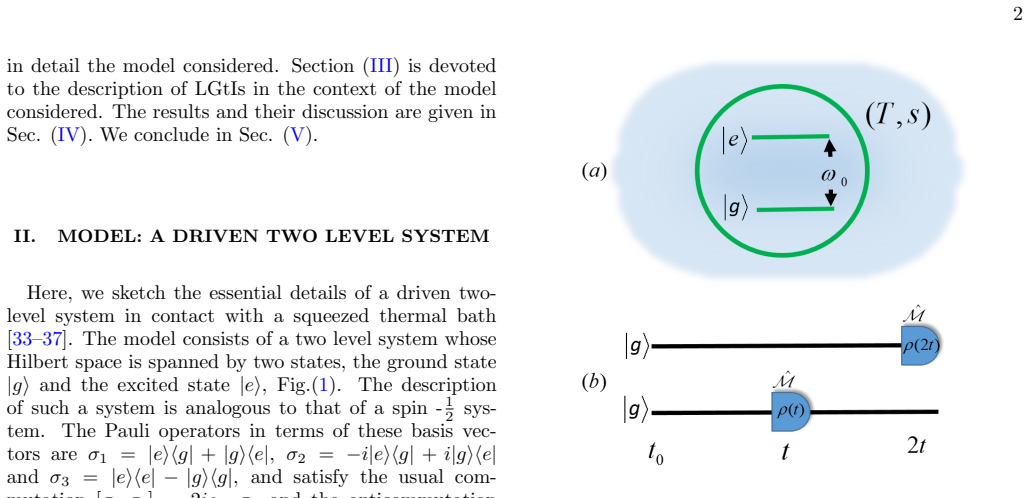
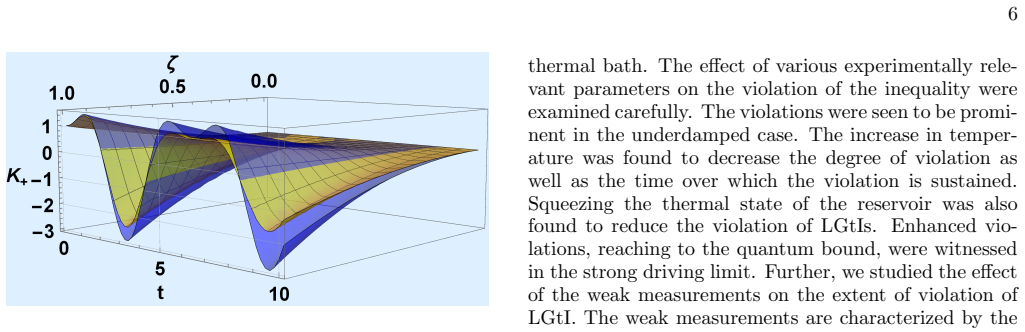
The machinery is the LGtI correlation function $C(t_i,t_j)$ built from the survival probability of the ground state: for the dichotomic observable $\hat M=|g\rangle\langle g|-|e\rangle\langle e|$, $C(t_0,t)=2p_g(t)-1$, leading to $K_{\pm}=\pm 2F(t)-F(2t)\mp 1$ with $F(t)$ given by a damped-oscillation expression. The behavior is governed by the effective frequency $\mu_s=\sqrt{\Omega^2-(\gamma_s/4)^2}$: real $\mu_s$ (underdamped) yields oscillatory correlations that overshoot the classical bound, imaginary $\mu_s$ (overdamped) yields monotone decay with no violation. In the strong-driving limit the expression reduces to $K_{\pm}\approx\pm 2\cos(\Omega t)-\cos(2\Omega t)$, which is the explicit source of the violation.
What would settle it
Measure $K_+$ and $K_-$ on a strongly driven two-level system in a squeezed thermal bath (e.g., a superconducting qubit or trapped ion). If $K_{\pm}$ never exceeds 1 even as the spontaneous emission rate $\gamma_0\to 0$ while the Rabi drive is kept large, or if violations appear when $\Omega<\gamma_s/4$, the central prediction fails. A direct quantitative check: in the underdamped regime the data should follow $K_{\pm}\approx\pm 2\cos(\Omega t)-\cos(2\Omega t)$, with the quantum bound $3/2$ reached only in the projective-measurement limit $\xi=1$.
Extended reading notes
Core claim
The paper's central claim is that the LG parameters $K_{\pm}=\pm 2C(t_0,t)-C(t_0,2t)$ exceed the classical upper bound 1 precisely when the driven atom is in the underdamped regime, i.e., when $\Omega>\gamma_s/4$ with $\gamma_s=\gamma+2\gamma_0 M$; in the limit $R=\gamma_0/\Omega\to 0$ they reach the quantum bound $3/2$. The violation is controlled by the single dimensionless ratio $R$ and by the reservoir parameters $\gamma$ and $M$ that enter through the squeezed thermal bath. Temperature and squeezing monotonically reduce the violation and shorten the time interval over which it lasts, while stronger driving favors it. The paper also claims that the violation is maximal for ideal projective measurements and scales as $\xi^2$ for weak measurements.
Load-bearing premise
Everything rests on treating the squeezed thermal reservoir as memoryless (Markovian) and on stationary conditional probabilities; if the reservoir has memory or its statistics vary in time, the tested inequalities no longer apply.
Editorial extensions
If this is right
- Crossing the threshold $\Omega=\gamma_s/4$ switches LGtI violation on: above it $K_{\pm}$ exceed 1, below it they do not.
- As $R=\gamma_0/\Omega\to 0$ in the strong-driving limit, $K_{\pm}$ reach the quantum bound $3/2$; finite $R$ degrades the violation.
- Raising temperature (lowering $\beta$) shortens the time window over which $K_{\pm}>1$ and reduces its peak value.
- Increasing reservoir squeezing $s$ suppresses the violation and can push the system into the overdamped regime.
- Weak measurements reduce the LG parameters by the factor $\xi^2$, so ideal projective measurements give the largest violation.
Reading between the lines
- The $\xi^2$ scaling suggests a metrological use: sweeping measurement strength $\xi$ could map the decoherence rate, since the measured $K_{\pm}$ versus $\xi$ curve carries the same information as the correlation decay.
- The condition $\Omega=\gamma_s/4$ defines a tunable quantum-classical crossover whose location depends on temperature and squeezing; one could use the same device to study how reservoir engineering shifts the boundary.
- Because $K_+$ and $K_-$ are complementary in the strong-driving limit, a combined witness (e.g., the maximum of the two) would detect violation over a wider time window than either alone; the paper plots them separately.
Signed reviews
Editorial analysis
A structured set of objections, weighed in public.
Referee Report
Summary. This manuscript studies Leggett-Garg-type inequalities (LGtIs) for a resonantly driven two-level atom coupled to a squeezed thermal reservoir. The authors write a Markovian Lindblad master equation, solve the resulting Bloch equations analytically, and construct the two-time correlation C(t0,t) from the ground-state survival probability. Their central claim, stated in Sec. IV, is that the LG parameters K± defined in Eq. (3) exceed the classical bound 1 in the underdamped regime Ω > γs/4 and approach the quantum bound 3/2 as R = γ0/Ω → 0. They further report that thermal effects and reservoir squeezing reduce the violation, that stronger driving favors violation, and that ideal projective measurements give the maximum violation. All numerical results in Figures 3–7 are based on the closed form F(t) in Eq. (25) and the strong-driving reduction in Eq. (27).
Significance. If the central derivation were correct, the paper would provide a simple, explicitly solvable open-quantum-system model in which LGtI violations appear in experimentally relevant parameters, with transparent dependence on temperature, squeezing, driving strength, and measurement strength. The calculation is self-contained: no free parameters are fitted, the master equation is standard, and the underdamped/overdamped boundary is given in closed form. The qualitative statement that temperature and squeezing suppress violations is physically plausible. However, the manuscript currently contains an algebraic inconsistency in the formula for K±, and the closed-form expression on which all figures rest is quoted without derivation. These issues affect every reported violation, so the central claim is not yet established.
major comments (3)
- [Sec. III, Eq. (24)] The formula K± = ±2F(t) − F(2t) ∓ 1 is inconsistent with the definition of K± in Eq. (3) and the expression for C(t0,t) in Eq. (23). Since Eq. (23) gives C(t0,t) = 2p_g(t) − 1, substitution into Eq. (3) yields K± = ±2C(t0,t) − C(t0,2t), i.e., K± = ±2F(t) − F(2t) when F(t) is identified with C(t0,t). The extra '∓1' term is absent. This is not a minor typo: in the strong-driving limit it changes the maximum of K+ from 3/2, as claimed in Eq. (27), to 1/2, so the reported violation and the approach to the quantum bound are not supported. The authors should correct Eq. (24) and recompute all results, or give an explicit reconciliation of Eq. (24) with Eq. (27).
- [Sec. II, Eq. (20)] The survival probability is written as p_g(t) = 1 − (⟨Σ3(t)⟩ + ⟨σ3⟩s)/2. With the initial condition in Eq. (17), ⟨Σ3(0)⟩ = −1 − ⟨σ3⟩s, which gives p_g(0) = 3/2, an unphysical result. The correct expression is p_g(t) = (1 − (⟨Σ3(t)⟩ + ⟨σ3⟩s))/2. Since Eq. (23) defines C(t0,t) = 2p_g(t) − 1, this error propagates into F(t) and all of the K± plots. The authors must re-derive the correlation function and the subsequent formulas with the corrected p_g.
- [Sec. III, Eqs. (25)–(27)] The closed form F(t) in Eq. (25) is quoted without derivation, and the strong-driving reduction to F(t) ∝ cos(Ωt) and hence Eq. (27) is asserted without showing the limit or the algebra. Because Eq. (25) is the sole basis for Figures 3–7, the paper should provide the explicit derivation starting from Eq. (19) and the corrected Eq. (20), or a machine-checkable supplement, confirming the coefficient formulas in Eq. (26). In particular, the stated approximations A ≈ Ω^{-3}, B ≈ C ≈ Ω^3, and D ≈ Ω^2 must be verified against the exact coefficients, since the claimed approach to the quantum bound 3/2 depends on them.
minor comments (4)
- [Throughout] There are several typographical errors, e.g., 'inequlalities' in Sec. I, 'paramter' and 'coherence paramter' in Sec. IV, and 'the two time correlation function becomes' in the weak-measurement paragraph. A careful proofread is recommended.
- [Sec. II, Eq. (21)] The expression for the off-diagonal element appears to double-count the stationary contribution: as written, ⟨σ+(t)⟩ = (⟨σ1(t)⟩ + i⟨σ2(t)⟩)/2 + ⟨σ+⟩s includes ⟨σ+⟩s twice if ⟨σ1⟩ and ⟨σ2⟩ are the full Bloch components. This equation is not used in the final results, but it should be corrected to avoid confusion, e.g., by writing it in terms of the deviation ⟨Σ⟩.
- [Sec. II, Eq. (8)] The paper would benefit from a brief statement of the validity regime of the Markovian Lindblad master equation for a squeezed reservoir with finite bandwidth. The stationarity assumption underlying the LGtI form is tied to Markovian dynamics, so a comment on this limitation would strengthen the experimental discussion.
- [Sec. III, Eq. (29)] The weak-measurement result K±|weak = ξ² K± is stated without showing the intermediate algebra. The derivation is short and should be included, since the section is otherwise self-contained.
Circularity Check
No significant circularity: the LGtI calculation is a self-contained application of a standard Lindblad master equation with free physical parameters, and the self-citations are not load-bearing.
full rationale
The paper's derivation chain is not circular. The input parameters (Ω, γ0, nth, s, θ) are physical reservoir and driving parameters; none of them are fitted to the LG parameter K± or to the violation plots. The master equation (7) is the standard Markovian Lindblad form for a driven two-level atom in a squeezed thermal reservoir, and the solution (19) and survival probability (20) are obtained by direct solution of the Bloch equations. The LGtI criterion (3) is an independent inequality based on stationarity, and the correlation function is computed from the dynamical map in Eq. (23). The subsequent evaluation of K± in Eq. (24) and the strong-driving reduction (27), while possibly underived or algebraically questionable, is not an instance of a fitted input being renamed a prediction, nor does it make the target result an input by construction. The self-citations [16–19] are cited as earlier studies of LGIs in other contexts; they are not used to justify the central formulas, to supply a uniqueness theorem, or to smuggle in an ansatz. Likewise, the weak-measurement scaling C_weak = ξ²C follows from the weak-projector definition in Eq. (28); even if one doubts its correctness, it is a stated consequence of the model rather than a circular equivalence. The possible inconsistency between Eq. (24) and Eq. (27) flagged in the reader's take is a correctness or verification issue, not a circularity issue: it does not reduce the prediction to its inputs. Therefore no circular step is exhibited, and the honest finding is a circularity score of 0.
Assumptions & free parameters
assumptions (4)
- domain assumption The reduced dynamics of the driven atom is Markovian and described by the Lindblad master equation (7).
- domain assumption The two-time correlation function is evaluated with ideal projective measurements and the map E_{tj←ti}.
- domain assumption Stationarity of the conditional probabilities, required for the LGtI form K± ≤ 1, holds for this Markovian system prepared in a definite state.
- standard math The standard quantum postulates (Born rule, collapse) underpin the measurement statistics.
Cite this review
Pith. "Pith review of Violation of Leggett-Garg type inequalities in a driven two level atom interacting with a squeezed thermal reservoir." pith.science (2026). https://pith.science/paper/H4FK4XLZ
@misc{pith2026190804054,
  author       = {Pith},
  title        = {Pith review of: Violation of Leggett-Garg type inequalities in a driven two level atom interacting with a squeezed thermal reservoir},
  year         = {2026},
  howpublished = {\url{https://pith.science/paper/H4FK4XLZ}},
  note         = {Machine review of arXiv:1908.04054}
}
read the original abstract
The violation of Leggett-Garg type inequalities (LGtIs) is studied on a two level atom, driven by an external field in the presence of a squeezed thermal reservoir. The violations are observed in the underdamped regime where the spontaneous transition rate is much smaller compared to the Rabi frequency. Increase in thermal effects is found to decrease the extent of violation as well as the time over which the violation lasts. With increase in the value squeezing parameter the extent of violation of LGtIs is seen to reduce. The violation of LGtIs is favored by increase in the driving frequency. Further, the interplay of the degree of violation and strength of the measurements is studied. It is found that the maximum violation occurs for ideal projective measurements.
Figures


Figures from the paper (3 more)


Reference graph
Works this paper leans on
-
[1]
Schr¨ odinger, Naturwissenschaften23, 823 (1935)
E. Schr¨ odinger, Naturwissenschaften23, 823 (1935)
work page 1935
-
[2]
Einstein, B
A. Einstein, B. Podolsky, and N. Rosen, Phys. Rev. 47, 777 (1935)
1935
-
[3]
J. S. Bell, Physics Physique Fizika 1, 195 (1964)
1964
-
[4]
Horodecki, P
R. Horodecki, P. Horodecki, M. Horodecki, and K. Horodecki, Reviews of Modern Physics81, 865 (2009)
2009
-
[5]
A. J. Leggett and A. Garg, Physical Review Letters 54, 857 (1985)
work page 1985
-
[6]
Emary, N
C. Emary, N. Lambert, and F. Nori, Reports on Progress in Physics 77, 016001 (2013)
2013
-
[7]
I. Chakrabarty, S. Banerjee, and N. Siddharth, Quantum Info. Comput. 11, 541 (2011)
work page 2011
-
[8]
Barbieri, Physical Review A 80, 034102 (2009)
M. Barbieri, Physical Review A 80, 034102 (2009)
work page 2009
Show all 42 references
-
[9]
D. Avis, P. Hayden, and M. M. Wilde, Physical Review A 82, 030102 (2010)
2010
-
[10]
Lambert, C
N. Lambert, C. Emary, Y.-N. Chen, and F. Nori, Phys- ical Review Letters 105, 176801 (2010)
2010
-
[11]
Lambert, R
N. Lambert, R. Johansson, and F. Nori, Physical Review B 84, 245421 (2011)
2011
-
[12]
Montina, Physical Review Letters 108, 160501 (2012)
A. Montina, Physical Review Letters 108, 160501 (2012)
2012
-
[13]
Kofler and ˇC
J. Kofler and ˇC. Brukner, Physical Review A 87, 052115 (2013)
2013
-
[14]
Budroni, T
C. Budroni, T. Moroder, M. Kleinmann, and O. G¨ uhne, Physical Review Letters 111, 020403 (2013)
2013
-
[15]
Kumari and A
S. Kumari and A. Pan, EPL (Europhysics Letters) 118, 50002 (2017)
2017
-
[16]
Naikoo, A
J. Naikoo, A. K. Alok, and S. Banerjee, Phys. Rev. D 97, 053008 (2018)
2018
-
[17]
Naikoo, A
J. Naikoo, A. K. Alok, S. Banerjee, and S. U. Sankar, Phys. Rev. D 99, 095001 (2019)
2019
-
[18]
Naikoo, S
J. Naikoo, S. Banerjee, and R. Srikanth, arXiv preprint arXiv:1806.00537 (2018)
2018 arXiv
-
[19]
Naikoo and S
J. Naikoo and S. Banerjee, The European Physical Jour- nal C 78, 602 (2018)
2018
-
[20]
Palacios-Laloy, F
A. Palacios-Laloy, F. Mallet, F. Nguyen, P. Bertet, D. Vion, D. Esteve, and A. N. Korotkov, Nature Physics 6, 442 (2010)
2010
-
[21]
Groen, D
J. Groen, D. Rist` e, L. Tornberg, J. Cramer, P. C. De Groot, T. Picot, G. Johansson, and L. DiCarlo, Phys- ical Review Letters 111, 090506 (2013)
2013
-
[22]
Goggin, M
M. Goggin, M. Almeida, M. Barbieri, B. Lanyon, J. O’Brien, A. White, and G. Pryde, Proceedings of the National Academy of Sciences 108, 1256 (2011)
2011
-
[23]
Dressel, C
J. Dressel, C. Broadbent, J. Howell, and A. N. Jordan, Physical Review Letters 106, 040402 (2011)
2011
-
[24]
Suzuki, M
Y. Suzuki, M. Iinuma, and H. F. Hofmann, New Journal of Physics 14, 103022 (2012)
2012
-
[25]
Athalye, S
V. Athalye, S. S. Roy, and T. Mahesh, Physical Review Letters 107, 130402 (2011)
2011
-
[26]
Souza, I
A. Souza, I. Oliveira, and R. Sarthour, New Journal of Physics 13, 053023 (2011)
2011
-
[27]
Katiyar, A
H. Katiyar, A. Shukla, K. R. K. Rao, and T. Mahesh, Physical Review A 87, 052102 (2013)
2013
-
[28]
S. F. Huelga, T. W. Marshall, and E. Santos, Phys. Rev. A 52, R2497 (1995)
1995
-
[29]
S. F. Huelga, T. W. Marshall, and E. Santos, Phys. Rev. A 54, 1798 (1996)
1996
-
[30]
Waldherr, P
G. Waldherr, P. Neumann, S. F. Huelga, F. Jelezko, and J. Wrachtrup, Phys. Rev. Lett. 107, 090401 (2011)
2011
-
[31]
Xu, C.-F
J.-S. Xu, C.-F. Li, X.-B. Zou, and G.-C. Guo, Scientific reports 1, 101 (2011)
2011
-
[32]
Z.-Q. Zhou, S. F. Huelga, C.-F. Li, and G.-C. Guo, Phys. Rev. Lett. 115, 113002 (2015)
2015
-
[33]
Srikanth and S
R. Srikanth and S. Banerjee, Phys. Rev. A 77, 012318 (2008)
2008
-
[34]
Banerjee and R
S. Banerjee and R. Srikanth, The European Physical Journal D 46, 335 (2008)
2008
-
[35]
Breuer, F
H.-P. Breuer, F. Petruccione, et al. , The theory of open 7 quantum systems (Oxford University Press on Demand, 2002)
2002
-
[36]
Banerjee, Open Quantum Systems: Dynamics of Non- classical Evolution, Vol
S. Banerjee, Open Quantum Systems: Dynamics of Non- classical Evolution, Vol. 20 (Springer, 2018)
2018
-
[37]
Omkar, R
S. Omkar, R. Srikanth, and S. Banerjee, Quantum In- formation Processing 12, 3725 (2013)
2013
-
[38]
Feynman, R
R. Feynman, R. Leighton, and M. Sands, The Feynman Lectures on Physics, Vol. III: The New Millennium Edi- tion: Quantum Mechanics , The Feynman Lectures on Physics (Basic Books, 2011)
2011
-
[39]
Busch, Phys
P. Busch, Phys. Rev. D 33, 2253 (1986)
1986
-
[40]
D. Saha, S. Mal, P. K. Panigrahi, and D. Home, Phys. Rev. A 91, 032117 (2015)
2015
-
[41]
A. K. Alok, S. Banerjee, and S. U. Sankar, Nuclear Physics B 909, 65 (2016)
2016
-
[42]
Bhattacharya, S
S. Bhattacharya, S. Banerjee, and A. K. Pati, Quantum Information Processing 17, 236 (2018)
2018
Reviewed August 14, 2026 · model on record in the stance chip above.
Discussion (0). Continue with ORCID to comment.