REVIEW 3 major objections 4 minor 19 references
Understanding CMB physics through the exploration of exotic cosmological models: a classroom study using CLASS
T0 review · 3 major / 4 minor · reviewed 2026-08-14 · deepseek-v4-flash
Pith's one-line read This paper reports that a computer-lab exercise comparing the CMB and matter power spectra of Lambda-CDM with three deliberately unrealistic models lets students directly grasp how baryons, dark matter, and the cosmological constant shape…
desk verdict A solid, reproducible teaching exercise with accurate CMB physics; the pedagogical effectiveness claim is anecdotal and should be softened or assessed. read the letter →
The pith
A machine-rendered reading of the paper's core claim, the machinery that carries it, and where it could break.
The reading
What carries the argument
The central object is the open-source Boltzmann code CLASS, the standard numerical solver that integrates the linearised Einstein-Boltzmann equations for a chosen set of cosmological parameters and outputs the background expansion history, the CMB temperature power spectrum $C_l$ as a function of multipole $l$, and the matter power spectrum $P(k)$ as a function of wavenumber $k$. The pedagogical machinery is the controlled comparison: four models are run with the same adiabatic initial conditions and Newtonian gauge, changing exactly one ingredient at a time, so that every difference in the spectra can be traced back to a specific physical component.
What would settle it
Recompute the three exotic models with an independent Boltzmann solver, or compare the CLASS outputs against the analytic fitting formulae for $z_{\rm rec}$, $z_{\rm bd}$, and the acoustic peak positions; if the predicted peak shifts or peak-height ratios disagree by more than a few percent on any exotic run, both the robustness claim and the pedagogical conclusions would need to be revised.
Extended reading notes
Core claim
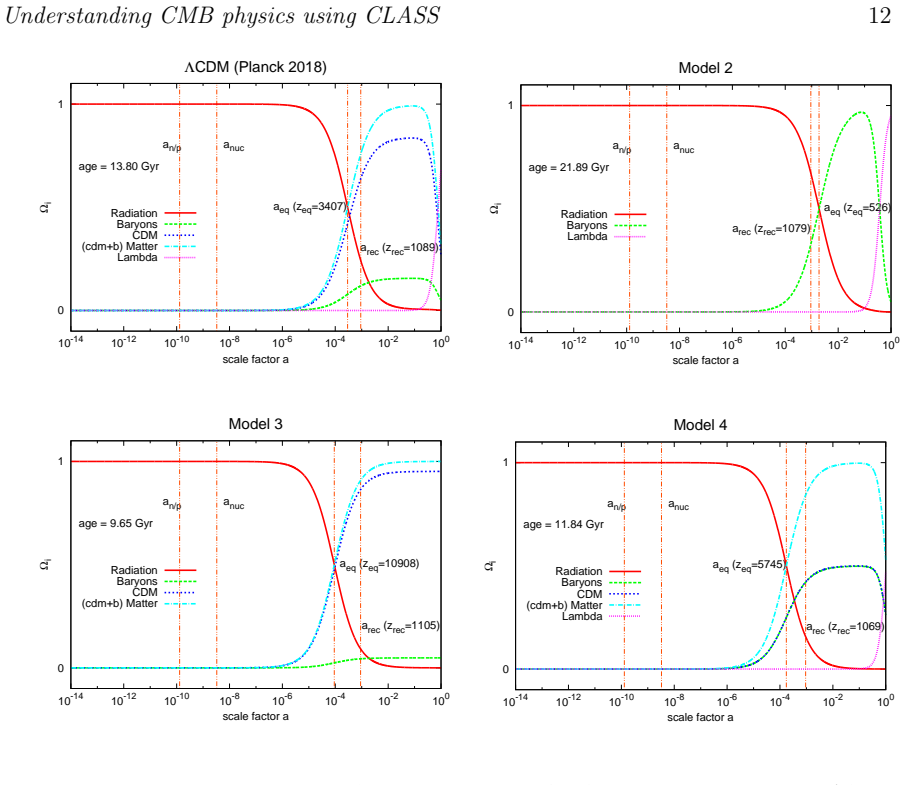
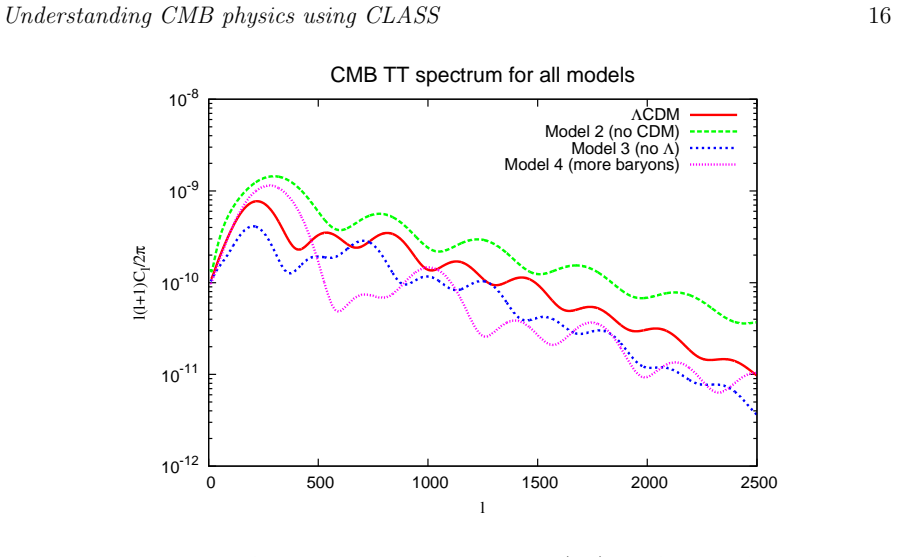
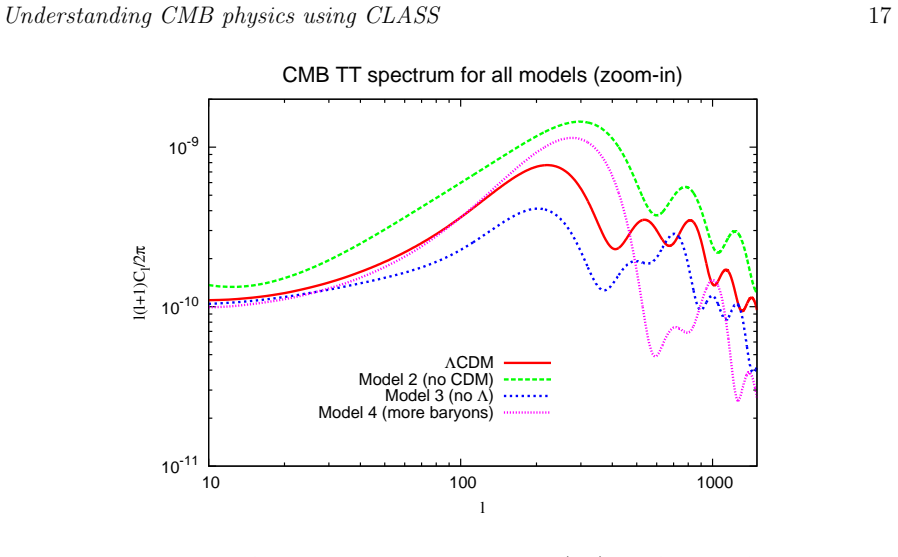
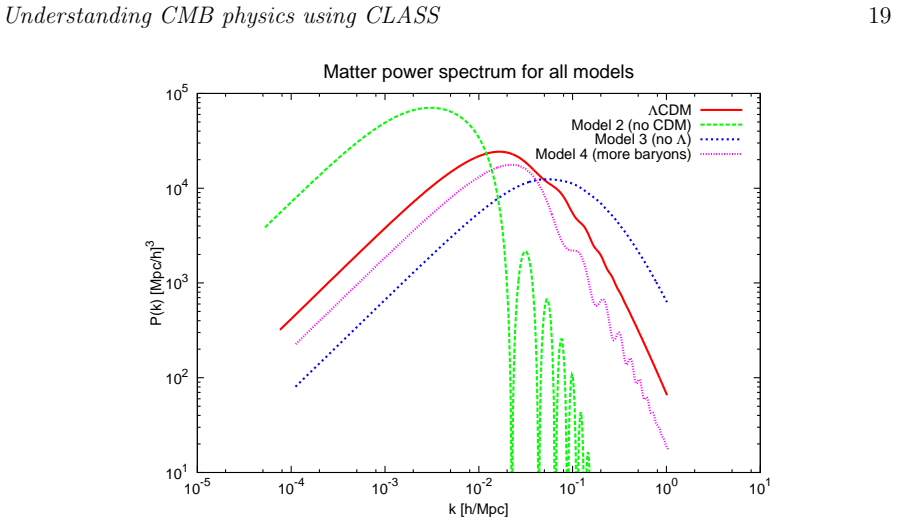
The central claim is that comparing theoretical spectra across models that differ by one cosmic ingredient is enough to make the physics of the CMB visible to learners. Removing dark matter leaves a pure baryon-photon fluid whose even-numbered acoustic peaks are suppressed almost to disappearance and whose structure growth is stunted; removing the cosmological constant while keeping the geometry flat creates a CDM-dominated, Einstein-de Sitter-like universe with suppressed first peaks and a smooth matter power spectrum; and boosting baryons to $\Omega_{\rm b,0}h^2=0.12$ shortens the sound horizon, shifting the first peak to higher $l$, enhances odd-numbered peaks, and raises the baryon drag redshift above the recombination redshift. These comparisons are the paper's evidence that students acquire a direct, physical grasp of the impacts of baryons, dark matter, and $\Lambda$ on CMB observables.
Load-bearing premise
The teaching conclusions rest on the assumption that CLASS remains numerically accurate and physically reliable for parameter values far outside its calibrated region, such as zero dark matter or $\Omega_{\rm b,0}h^2=0.12$ with $Y_{\rm He}=0.28$; the paper states this robustness as an opinion in Section 2 without an independent-code cross-check, and if it fails the comparisons would mislead.
Editorial extensions
If this is right
- The first acoustic peak is not a pure geometric probe: in the flat, baryon-rich Model 4 the peak shifts to higher $l$ because the sound horizon shrinks, so curvature can only be read off after the baryon density is pinned down.
- The odd-even peak height pattern is a direct baryon-versus-dark-matter diagnostic: it becomes extreme in the baryon-only Model 2 and is strongly enhanced in Model 4, while in the CDM-dominated Model 3 the third peak stands out as the clearest matter indicator.
- The recombination redshift $z_{\rm rec}$ changes by less than two percent across all four models, whereas the baryon drag redshift $z_{\rm bd}$ moves by up to ten percent, illustrating that recombination is a robustly predicted epoch while drag depends more strongly on parameters.
- The age of the universe printed by CLASS rules out the no-$\Lambda$ (9.65 Gyr) and baryon-rich (11.84 Gyr) models against known old stars, showing students how independent astrophysical data constrain cosmological models.
Reading between the lines
- The same four-model protocol could easily be extended to neutrino mass, $N_{\rm eff}$, running of the spectral index, or an open-geometry $\Omega_k\neq0$ model; the paper explicitly says its examples are not exhaustive, and CLASS's modular input files make such extensions natural homework.
- Running CLASS at these extreme parameter values already functions as an informal numerical stress test; a systematic cross-check against an independent Boltzmann code would turn the paper's robustness opinion into a verifiable validation.
- Because the exercise never fits real CMB data, it targets forward prediction and physical intuition rather than parameter estimation; a natural follow-up would ask students to compare the four spectra with actual CMB measurements to see quantitatively which models are excluded.
Signed reviews
Editorial analysis
A structured set of objections, weighed in public.
Referee Report
Summary. The paper reports on a graduate-level cosmology computer laboratory exercise in which students used the CLASS Boltzmann code to compute background evolution, CMB temperature power spectra, and matter power spectra for the ΛCDM model and for three deliberately exotic models: no CDM (Model 2), no Λ (Model 3), and a high-baryon model (Model 4). The manuscript presents the model parameters in Table 1, the resulting characteristic quantities in Table 2, and physical interpretations of the spectral differences in Section 4. The central claim, stated in the abstract and repeated in Section 5, is that by comparing these models the students 'were able to grasp' the impact of cosmological parameters on CMB observables and to understand CMB physics directly. The paper also asserts in Section 2 that the successful CLASS runs for extreme parameters 'speaks for the robustness and reliability of CLASS.'
Significance. If the pedagogical claim is taken at face value, the paper offers a useful, low-cost classroom template for teaching CMB physics through exploration of non-standard models, and it does so with openly available software and clearly tabulated input parameters. The physical explanations of peak shifts, odd-even peak alternation, and suppression effects are consistent with standard CMB physics and are supported by the classical analytic references cited by the author. The paper's value as a teaching resource is real: it provides a concrete, reproducible activity that other instructors can adapt, and it explicitly connects qualitative spectral features to underlying physics. However, the paper's headline claim about student learning is not supported by any assessment evidence, and the assertion of CLASS reliability in extreme parameter regimes is made without independent validation. These limitations currently place the paper's central contribution in the category of a descriptive course report rather than a demonstrated pedagogical study.
major comments (3)
- [§4.2 and §5] The central claim that 'all students were able to grasp the main changes and their causes' (Section 4.2) and the corresponding statement in the abstract and Section 5 are not supported by evidence. The manuscript mentions that 19 students completed the course and produced written reports (Section 3), but it provides no pre/post-test, rubric, independent scoring, comparison group, or even representative excerpts from student reports. Without such evidence, the paper cannot substantiate a learning-gain claim. I recommend either (a) presenting structured assessment data, or (b) reframing the paper explicitly as a descriptive account of a course activity, with claims about student understanding clearly labeled as instructor observations rather than measured outcomes.
- [§2 and Table 1] The statement that successful CLASS runs for parameters 'wildly different' from ΛCDM 'speaks for the robustness and reliability of CLASS' is an assertion, not a demonstrated result. The models in Table 1 include Ω_cdm,0 = 0 (Model 2) and Ω_b,0h² = 0.12 with Y_He = 0.28 (Model 4), regimes far from the Planck-calibrated region. Because the paper's physical interpretations of peak locations, peak heights, and suppression rely on quantitative CLASS output, a hidden numerical inaccuracy in these regimes would directly affect the teaching conclusions. I recommend adding a validation check against an independent code (e.g., CAMB) or against the analytic approximations already cited (e.g., Hu & Sugiyama 1995/1996, Eisenstein & Hu 1998) for at least the spectra shown in Figs. 2-4, or alternatively tempering the robustness claim with an explicit caveat that the numerical accuracy in exotic regimes has not been independently verified.
- [§4.1 and Table 2] The comparison of z_rec and z_bd across models is presented as 'numerical results' that illustrate known analytic dependencies, but the paper does not quantify how these values compare with the fitting formulae from Hu & Sugiyama (1996), which are cited in the same paragraph. Adding a direct comparison (e.g., CLASS output versus the fitting formula for each model) would strengthen the interpretation and provide a concrete check on the CLASS outputs in these exotic regimes. Without this, the claim that these numbers are 'evidence for the well-known fact' remains an appeal to authority rather than a verification.
minor comments (4)
- [§1] There are several typographical errors, including 'euqations' near the end of Section 1, 'multipol' in Section 4.2, and 'severly' in Section 4.2 and Section 4.3. These should be corrected.
- [Table 1 and §3] For reproducibility, the paper should provide the exact CLASS input files or a machine-readable listing of all parameter values. The statement in the note to Table 1 that the exact T_CMB value for ΛCDM (2018) 'could not be pinpointed' is a gap in reproducibility, since T_CMB enters the background and perturbation calculations. Please state the actual value used or specify the default in CLASS 2.7.1.
- [§4.2, Fig. 2 and Fig. 3] The figures would be more useful if the first acoustic peak position and the second/third peak heights were annotated for each model, as the text discusses them extensively. As it is, the reader must estimate these features by eye from overlapping curves; since the paper is intended as a teaching resource, clear annotation would enhance its pedagogical value.
- [Appendix A] The comparison of ΛCDM (2011) and ΛCDM (2018) in Fig. A1 is presented visually but without numerical differences in, for example, the peak location or the integrated TT power. A brief quantitative statement (e.g., 'the first peak positions agree to within Δl ≈ 2') would make the 'marginal differences' claim more precise and would help students calibrate what 'marginal' means.
Circularity Check
No significant circularity: the paper uses an external Boltzmann solver and makes no fitted-parameter or self-citation-dependent prediction.
full rationale
This paper reports a classroom exercise rather than a derivation chain. The central products are CLASS-generated background evolutions, CMB temperature power spectra, and matter power spectra for four parameter choices. The input parameters are specified in Table 1 and the outputs in Table 2 and Figures 1-4; no parameter is fitted to the spectra, and no output quantity is defined in terms of the learning claim. The claim that students 'were able to grasp the main changes and their causes' is an instructor observation, and the statement that CLASS's performance 'speaks for the robustness and reliability of CLASS' is an opinion; both are empirical or evaluative claims, not circular reductions. CLASS is an external code with independent methodology and validation references [14-17], and the qualitative interpretations are checked against external analytic treatments [9,10,18,19], none of which are the author's own prior results. Possible weaknesses, such as lack of formal learning-gain assessment or CLASS accuracy far outside Planck-calibrated parameter space, concern evidence quality and correctness risk, not circularity. The paper's conclusions therefore do not reduce to their own inputs by construction.
Assumptions & free parameters
free parameters (5)
- Model 4 baryon density Omega_b h^2 =
0.12
- Model 4 helium fraction Y_He =
0.28
- Model 2 curvature Omega_k =
-0.01
- Model 2 CDM density Omega_cdm h^2 =
0.0
- Model 3 CDM density Omega_cdm,0 =
0.951725
assumptions (4)
- domain assumption CLASS 2.7.1 correctly integrates the Einstein-Boltzmann equations for these extreme parameter values.
- standard math The FLRW metric and Friedmann equation describe the background for all models.
- domain assumption Adiabatic initial conditions and Newtonian gauge are valid and appropriate for all models.
- domain assumption Linear perturbation theory and the standard recombination and decoupling physics implemented in CLASS apply at extreme baryon densities and helium fractions.
Cite this review
Pith. "Pith review of Understanding CMB physics through the exploration of exotic cosmological models: a classroom study using CLASS." pith.science (2026). https://pith.science/paper/H4LM772B
@misc{pith2026190805042,
  author       = {Pith},
  title        = {Pith review of: Understanding CMB physics through the exploration of exotic cosmological models: a classroom study using CLASS},
  year         = {2026},
  howpublished = {\url{https://pith.science/paper/H4LM772B}},
  note         = {Machine review of arXiv:1908.05042}
}
abstract
Every cosmology lecturer these days is confronted with teaching the modern cosmological standard model $\Lambda$CDM, and there are many approaches to do this. However, the danger is imminent that it is presented to students as something set into stone, merely to be accepted as a fact based on the plenty of evidences we have. This is even more critical, given that the standard model of cosmology confronts us with entities not yet fully understood, namely a cosmological constant $\Lambda$ and cold dark matter. In this article, we report on an advanced cosmology course exercise, conducted in computer lab, which was conceived as a means to have students experience first-hand why the $\Lambda$CDM model has become so prevalent in the interpretation of modern cosmological data. To this end, we focused on the cosmic microwave background radiation (CMB) and calculated theoretical temperature and matter power spectra, using the modern Boltzmann code CLASS. By comparing and analyzing the outcome for $\Lambda$CDM, as well as for three other exotic cosmological models, the students were able to grasp the impact of cosmological parameters on CMB observables, and also to understand some of the complicated CMB physics in a direct way. Our chosen examples are not exhaustive and can be easily modified or expanded, so we express the hope that this article will serve as a valuable resource for interested students and lecturers.
Figures
Figures from the paper (3 more)

Reference graph
Works this paper leans on
-
[1]
S.Alam, M.Ata, S.Bailey et al, The clustering of galaxies in the completed SDSS-III Baryon Oscillation Spectroscopic Survey: cosmological analysis of the DR12 galaxy sample , MNRAS, 470, Issue 3, p.2617-2652 (2017)
work page 2017
-
[2]
M.Blomqvist, H. du Mas des Bourboux, N.G.Busca et al, Baryon acoustic oscillations from the cross-correlation of Ly-alpha absorption and quasars in eB OSS DR14 , A& A, 629, A86, 18pp. (2019)
work page 2019
-
[3]
Cosmological parameters, arXiv: 1807.06209
Planck Collaboration: N.Aghanim, Y.Akrami, M.Ashdown et al, Planck 2018 results.VI. Cosmological parameters, arXiv: 1807.06209
arXiv 2018
-
[4]
G.Simard, Y.Omori, K.Aylor et al, Constraints on Cosmological Parameters from the Angular Power Spectrum of a Combined 2500 deg2 SPT-SZ and Planck Grav itational Lensing Map , ApJ, 860, Issue 2, article id. 137, 9 pp. (2018) Understanding CMB physics using CLASS 21 10-12 10-11 10-10 10-9 10-8 0 500 1000 1500 2000 2500 3000 l(l+1)Cl/2π l CMB TT spectrum fo...
work page 2018
- [5]
-
[6]
A.G.Riess, S.Casertano, W.Yuan et al, Milky Way Cepheid Standards for Measuring Cosmic Distances and Application to Gaia DR2: Implications for the Hubble Constant , ApJ, 861, Issue 2, article id. 126, 13 pp. (2018)
work page 2018
- [7]
- [8]
Show all 19 references
-
[9]
W.Hu, N.Sugiyama, Anisotropies in the Cosmic Microwave Background: an Analyt ic Approach, ApJ, 444, 489, 18 pp. (1995)
1995
-
[10]
W.Hu, N.Sugiyama, Small-Scale Cosmological Perturbations: an Analytic Appr oach, ApJ, 471, 542-570 (1996)
1996
-
[11]
CMB-Slow
V.Mukhanov, “CMB-Slow” or How to Determine Cosmological Parameters by H and?, Intern.J.Theor.Phys., 43, issue 3, 623-668 (2004)
2004
-
[12]
N.Sugiyama, Introduction to temperature anisotropies of Cosmic Microw ave Background radiation, Prog.Theor.Exp.Phys., 2014, Issue 6, 13 pp. (2014)
2014
-
[13]
S.Staggs, J.Dunkley, L.Page, Recent discoveries from the cosmic microwave background: a review of recent progress, Rep.Progr.Phys., 81, Nr.4, 044901 (2018)
2018
-
[14]
J.Lesgourgues, The Cosmic Linear Anisotropy Solving System (CLASS) I: Over view, arXiv:1104.2932
-
[15]
D.Blas, J.Lesgourgues, T.Tram, The Cosmic Linear Anisotropy Solving System (CLASS) II: Approximation schemes , JCAP 07 (2011) 034
2011
-
[16]
J.Lesgourgues, The Cosmic Linear Anisotropy Solving System (CLASS) III: Co mparison with CAMB for Λ CDM, arXiv:1104.2934
-
[17]
J.Lesgourgues, T.Tram, The Cosmic Linear Anisotropy Solving System (CLASS) IV: Effic ient implementation of non-cold relics , JCAP 09 (2011) 032
2011
-
[18]
S.S.McGaugh, Distinguishing between CDM and MOND: Predictions for the Mi crowave Background, ApJ, 523, L99 (1999)
1999
-
[19]
D.J.Eisenstein, W.Hu, Baryonic Features in the Matter Transfer Function , ApJ, 496, 605 (1998)
1998
Reviewed August 14, 2026 · model on record in the stance chip above.
Discussion (0). Continue with ORCID to comment.