REVIEW 3 major objections 5 minor 1 cited by
Recursive KalmanNet: Deep Learning-Augmented Kalman Filtering for State Estimation with Consistent Uncertainty Quantification
T0 review · 3 major / 5 minor · reviewed 2026-08-07 · deepseek-v4-flash
Pith's one-line read A neural Kalman filter claims calibrated uncertainty without a tuning knob.
desk verdict A clean architectural idea for learning a Kalman gain and covariance, but the consistency claim is not established: the proof sketch is invalid and the experiment is too thin to carry it. read the letter →
The pith
A machine-rendered reading of the paper's core claim, the machinery that carries it, and where it could break.
The reading
What carries the argument
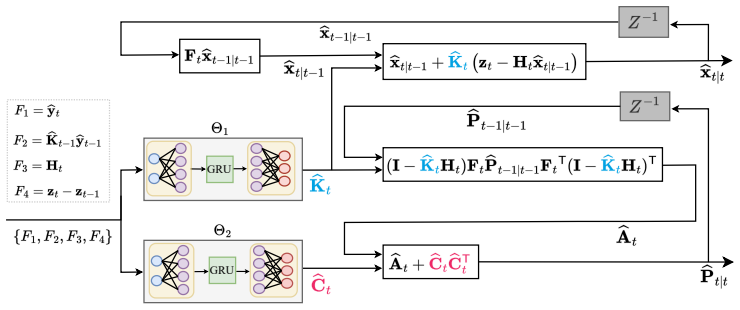
The load-bearing object is Joseph's formula for the corrected error covariance, written as $P_{t|t}=A_t+B_t$, with $A_t=(I-K_tH_t)F_tP_{t-1|t-1}F_t^T(I-K_tH_t)^T$ computed in closed form and $B_t=(I-K_tH_t)Q_t(I-K_tH_t)^T+K_tR_tK_t^T$ estimated through its Cholesky factor by a second RNN. The first RNN estimates the gain $K_t$, and the recursive dependence of $A_t$ on the previously estimated covariance gives the method its name. The Gaussian negative log-likelihood loss $L_t=e_t^T P_{t|t}^{-1}e_t + \log\det P_{t|t}$ is the mechanism claimed to drive the covariance toward consistency with the error.
What would settle it
Train RKN on the same constant-velocity model, then evaluate it on test series drawn with a different Bernoulli switching rate or a different noise heterogeneity level and compute the mean squared Mahalanobis distance. If the MSMD moves substantially away from the state dimension $m=2$ while the MSE stays close to the optimal Kalman filter, the covariance-consistency claim fails under distribution shift.
Extended reading notes
Core claim
The central claim is that a filter can learn both the Kalman gain and the error covariance with two separate recurrent networks while preserving the Kalman recursion, and that the Gaussian negative log-likelihood creates a critical-point regime in which the estimated covariance equals the outer product of the estimation error and the error is uncorrelated with the innovation. In the reported experiments, RKN produces state estimates with mean squared error close to the optimal Kalman filter and covariance estimates whose mean squared Mahalanobis distance is close to the theoretical value $m=2$, while the Cholesky-KalmanNet baseline, which balances state accuracy and covariance accuracy with a $0.95/0.05$ weighted loss, shows a much larger Mahalanobis distance. The paper interprets this as evidence that the learned covariance reflects the true error spread rather than an arbitrary scaling.
Load-bearing premise
The load-bearing premise is that training with the Gaussian log-likelihood drives the networks to a point where the reported covariance matches the true squared error, with no leftover correlation between errors and measurements, and that this balance still holds on test data the networks were not trained on.
Editorial extensions
If this is right
- RKN can be deployed when the noise covariances $Q_t$ and $R_t$ are unknown, because it learns their effect from innovation and measurement-difference features.
- The tuning-free Gaussian negative log-likelihood removes the need to balance state accuracy against covariance accuracy with a hyperparameter, a limitation the paper attributes to Cholesky-KalmanNet.
- Under bimodal Gaussian measurement noise, RKN tracks the time-varying optimal gain more closely than a fixed-covariance Kalman filter, and its estimated standard deviation tracks the empirical error spread.
- Because the recursive covariance structure only requires the transition and observation matrices, the same design can be carried into nonlinear extensions via linearization.
Reading between the lines
- The critical-point argument shows that the loss gradient vanishes when $P=e_te_t^T$ and $e_t\tilde{y}_t^T=0$, but it does not prove that gradient descent reaches that point; a natural test is to measure the deviation of these equalities on held-out data.
- Since the architecture never sees $Q_t$ or $R_t$ directly, its learned noise term could absorb model mismatch, so testing on state-space models with time-varying observation matrices would clarify whether the covariance stays calibrated or only fits the training distribution.
- The paper evaluates a single one-dimensional position measurement; applying RKN to vector measurements or to heavier-tailed noise than a two-mode Gaussian would test whether the consistency result is tied to the specific scenario.
- The authors note that the learned Cholesky factor and the learned gain are not guaranteed to be mutually consistent, so adding an explicit consistency constraint between the two recurrent outputs is a plausible next step.
Signed reviews
Editorial analysis
A structured set of objections, weighed in public.
Referee Report
Summary. The paper introduces Recursive KalmanNet (RKN), a Kalman-filter-informed recurrent estimator with two RNNs: one for the Kalman gain and one for a Cholesky factor of the noise-dependent term in Joseph's covariance update. The corrected covariance is propagated recursively from Joseph's formula, and training minimizes the Gaussian negative log-likelihood of the estimation error with no balancing hyperparameter. The method is evaluated on a single 1D constant-velocity linear model with bimodal Gaussian measurement noise, comparing MSE and MSMD against optimal KF, sub-optimal KF, and Cholesky-KalmanNet, and the paper claims RKN is the first neural Kalman filter variant with quantitatively consistent error covariance.
Significance. The architecture is natural and the use of Joseph's formula with a Cholesky parameterization is an appropriate way to keep the covariance symmetric positive semidefinite while avoiding explicit estimation of Q and R. Code is released, and the empirical comparison includes the relevant CKN baseline. If the consistency claim were established, this would be a useful, tuning-free contribution. However, the theoretical support in Sec. III-C is not a valid stationarity argument for the recurrently generated covariance, and the experimental evidence is a single synthetic scenario with no error bars; the consistency claim therefore needs substantial reworking and additional evidence before it can be accepted.
major comments (3)
- [Section III-C, Eqs. (10a)-(10b)] The claimed consistency result is not established by the stated gradient analysis. The derivatives in (10a)-(10b) are taken with respect to P_t^(i) and K_t^(i) as if they were free per-sample parameters, but in RKN P_t|t is deterministically produced from the shared parameters Θ2 and from P_{t-1|t-1} through (7)-(8); it cannot be varied independently at each sample to satisfy P_t^(i)=e_t^(i)(e_t^(i))^T. Furthermore, for m=2 that matrix is rank one and singular, so log det P and P^{-1} in (9) are undefined at the claimed critical point. The correct first-order condition for a covariance that is a function of available information concerns the conditional second moment E[e_t e_t^T | history], not a per-sample outer-product equality. The consistency guarantee central to the paper therefore remains unproven.
- [Section IV, Table I and Fig. 2] The empirical evidence for covariance consistency is too weak for the paper's central claim. MSMD≈m is necessary but not sufficient: for Gaussian errors it only enforces trace(P^{-1}Σ)=m, which many incorrect covariance matrices satisfy. Table I reports a single synthetic setting without error bars, confidence intervals, or multiple independent training runs, and Fig. 2b is a qualitative comparison of standard deviations. To support 'consistently reflect the actual error spread,' the paper needs quantitative calibration tests (e.g., coverage of ellipsoidal confidence regions, probability-integral-transform histograms, or chi-square goodness-of-fit on Mahalanobis distances) with uncertainty estimates.
- [Section IV, Table I and Section II-B] The comparison does not include the log-likelihood-trained uncertainty-aware baseline of [6], despite the paper claiming to outperform 'KalmanNet and its derived methods.' Only CKN, so-KF, and o-KF appear in Table I. Adding [6] and the original KalmanNet would make the comparative claim closer to what is stated.
minor comments (5)
- [Section IV] The statement 'Note that the observations discussed below also hold under different parameter settings' is not backed by any reported results; remove it or provide the supporting experiments.
- [Section IV] The bimodal Gaussian mixture described in Section IV is called heavy-tailed, but Gaussian components have light (exponential) tails; this terminology is misleading.
- [Table I] CKN's MSMD at ν=30 dB (27) is strikingly different from neighboring columns; the paper does not discuss whether this is a typo or a real effect.
- [Section V and Section IV-B] Typos: 'outperformes' in Section V and 'To further analyze into' at the start of Section IV-B.
- [Section III-C] Equation (9) defines L_t^(i), but the batch-average and ℓ2 regularization are only described in text; writing the full objective would clarify the optimization.
Circularity Check
No significant circularity: RKN's covariance consistency is empirically evaluated on held-out test data; no derivation step reduces to its inputs.
full rationale
The paper's central claim—consistent error covariance under non-Gaussian measurement noise—rests on the recursive Joseph-formula update (an external, standard result from Bucy and Joseph [8]) and on test-time metrics. Table I reports MSE and MSMD on 1000 held-out test series drawn from the same generator used for training; MSMD values near m=2 are measured outcomes, not identities imposed by the loss. Notably, CKN fails on the same metric (MSMD up to 27), so the result is not forced by construction. The Gaussian negative log-likelihood loss is statistically aligned with the MSMD consistency metric, but the held-out evaluation can fail and does fail for a baseline, so this is a legitimate empirical validation rather than a fitted input being renamed a prediction. The only self-citation is [9], used to explicitly defer generalization analysis to a separate paper; it is not load-bearing for the consistency claim. The Section III-C critical-point derivation (P=e e^T and e y^T=0) is mathematically questionable—treating the recurrently produced covariance as a free per-sample parameter, and yielding a rank-one singular matrix for the m=2 experiments—but this is a rigor/correctness concern, not circularity: the argument does not define the model's covariance to equal its inputs, and the empirical MSMD evidence stands independently of that derivation. Overall, no self-definitional step, no fitted parameter called a prediction, and no load-bearing self-citation chain are present.
Assumptions & free parameters
free parameters (2)
- Gain RNN parameters (Theta_1) =
Learned from training data (no values reported)
- Cholesky RNN parameters (Theta_2) =
Learned from training data (no values reported)
assumptions (4)
- standard math Joseph's formula (6) is a valid covariance update for any linear estimator with white noise, regardless of Gaussianity.
- domain assumption The state-space model (1) with known and constant F_t and H_t, and zero-mean white process noise, is correct for the test scenario.
- domain assumption Gaussian negative log-likelihood is an appropriate training objective to obtain a statistically consistent covariance estimate.
- domain assumption The training and test time series are independent samples from the same synthetic distribution.
Cite this review
Pith. "Pith review of Recursive KalmanNet: Deep Learning-Augmented Kalman Filtering for State Estimation with Consistent Uncertainty Quantification." pith.science (2026). https://pith.science/paper/H4PLUAGF
@misc{pith2026250611639,
  author       = {Pith},
  title        = {Pith review of: Recursive KalmanNet: Deep Learning-Augmented Kalman Filtering for State Estimation with Consistent Uncertainty Quantification},
  year         = {2026},
  howpublished = {\url{https://pith.science/paper/H4PLUAGF}},
  note         = {Machine review of arXiv:2506.11639}
}
read the original abstract
State estimation in stochastic dynamical systems with noisy measurements is a challenge. While the Kalman filter is optimal for linear systems with independent Gaussian white noise, real-world conditions often deviate from these assumptions, prompting the rise of data-driven filtering techniques. This paper introduces Recursive KalmanNet, a Kalman-filter-informed recurrent neural network designed for accurate state estimation with consistent error covariance quantification. Our approach propagates error covariance using the recursive Joseph's formula and optimizes the Gaussian negative log-likelihood. Experiments with non-Gaussian measurement white noise demonstrate that our model outperforms both the conventional Kalman filter and an existing state-of-the-art deep learning based estimator.
Figures

Forward citations
Cited by 1 Pith paper
-
Domain-Decomposition Neural Surrogates for Scalable Decentralized Ensemble Kalman Filter Based Parameter Identification in High-Dimensional Stochastic PDEs
Domain-decomposed neural surrogates with augmented-Lagrange coupling, paired with a block-preconditioned decentralized EnKF, match FEM-EnKF and approach MCMC posteriors on 3D elastic parameter ID at reduced forecast cost.
Reference graph
Works this paper leans on
-
[6]
G. Choi, J. Park, N. Shlezinger, Y. C. Eldar, and N. Lee, `` Split-KalmanNet: A Robust Model-Based Deep Learning Approach for State Estimation ,'' IEEE Trans. Veh. Technol., vol. 72, pp. 12\,326--12\,331, 2023
work page 2023
-
[1]
11em plus .33em minus .07em 4000 4000 100 4000 4000 500 `\.=1000 = #1 \@IEEEnotcompsoconly \@IEEEcompsoconly #1 * [1] 0pt [0pt][0pt] #1 * [1] 0pt [0pt][0pt] #1 * \| ** #1 \@IEEEauthorblockNstyle \@IEEEcompsocnotconfonly \@IEEEauthorblockAstyle \@IEEEcompsocnotconfonly \@IEEEcompsocconfonly \@IEEEauthordefaulttextstyle \@IEEEcompsocnotconfonly \@IEEEauthor...
-
[2]
R. E. Kalman, `` A New Approach to Linear Filtering and Prediction Problems ,'' J. Basic Eng., vol. 82, no. 1, pp. 35--45, 1960
work page 1960
-
[3]
S. F. Schmidt, `` Application of state-space methods to navigation problems ,'' in Advances in Control Systems, C. T. Leondes, Ed. 1em plus 0.5em minus 0.4em Elsevier, 1966, vol. 3, pp. 293--340
work page 1966
-
[4]
Chen, `` Kalman filter for robot vision: a survey ,'' IEEE Trans
S.-Y. Chen, `` Kalman filter for robot vision: a survey ,'' IEEE Trans. Ind. Electron., vol. 59, no. 11, pp. 4409--4420, 2011
work page 2011
- [5]
- [7]
- [8]
Show all 10 references
-
[9]
R. S. Bucy and P. D. Joseph, Filtering for stochastic processes with applications to guidance . 1em plus 0.5em minus 0.4em American Mathematical Soc., 2005, vol. 326
2005
-
[10]
Falcon, H
C. Falcon, H. Mortada, M. Clavaud, and J.-P. Michel, `` Recursive KalmanNet : Analyse des capacités de généralisation d’un réseau de neurones récurrent guidé par un filtre de Kalman ,'' in 30e Colloque sur le traitement du signal et des images . 1em plus 0.5em minus 0.4em GRETSI, 2025
2025
Reviewed August 7, 2026 · model on record in the stance chip above.
Discussion (0). Continue with ORCID to comment.