REVIEW 3 major objections 5 minor 81 references
In two VR driving studies, selectively blurring distracting scene elements, even with per-driver personalized settings, did not significantly improve objective driving performance compared to a no-blur baseline.
Reviewed by Pith at T0; open to challenge. T0 means a machine referee read the full paper against a public rubric. the ladder, T0–T4 →
T0 review · deepseek-v4-flash
2026-08-01 14:46 UTC pith:H4QYC7XL
load-bearing objection A careful, honest null-result study on personalized blur for driving; the central claim holds, but the broader conclusion leans a bit on low-sensitivity metrics. the 3 major comments →
BlurDriving: Investigating How Personalized Blur Techniques Impact Drivers' Performance in Virtual Reality
The pith
A machine-rendered reading of the paper's core claim, the machinery that carries it, and where it could break.
Core claim
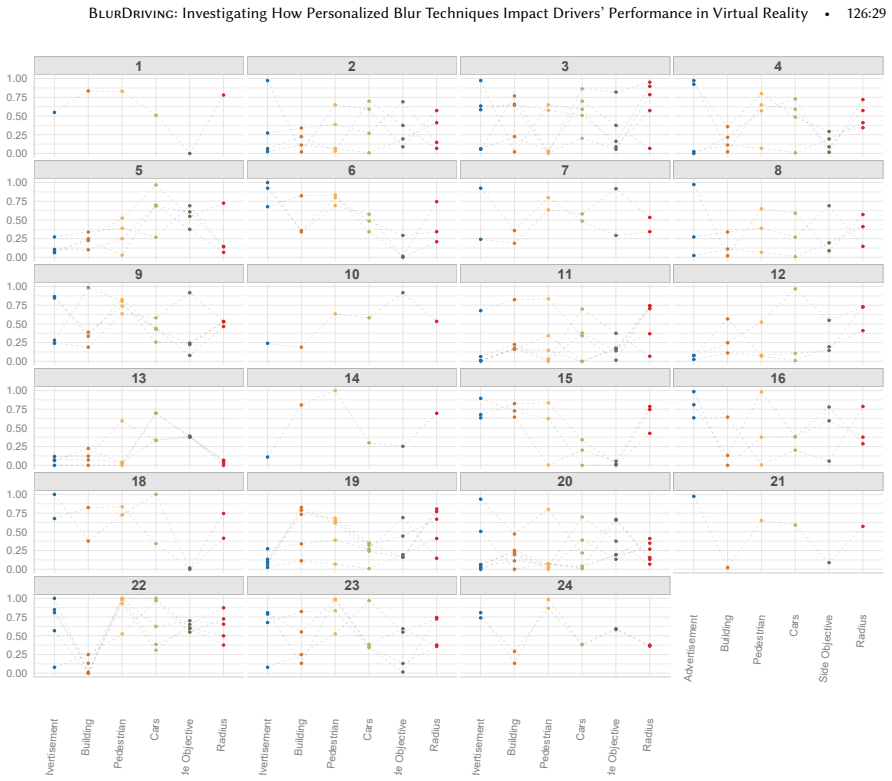
The central claim is that visual simplification via blur, even when optimized per driver, does not reliably improve driving performance. In both user studies, objective metrics (collisions, red-light violations, overspeed, longitudinal safety score, Fréchet distance, mean speed) showed no significant difference between blurred and non-blurred conditions. Subjective ratings of perceived safety and cognitive load also did not differ at the group level. However, the Pareto-front analyses revealed wide individual variation in preferred blur parameters, and qualitative feedback split participants into those who felt blur helped them focus and those who felt it caused uncertainty, fatigue, or disc
What carries the argument
The core mechanism is a distance-aware Gaussian blur applied selectively to object categories (buildings, advertisements, pedestrians, vehicles, roadside objects), gated by a safety radius so that nearby hazards stay sharp. A human-in-the-loop multi-objective Bayesian optimization framework iteratively searches the blur-parameter space using three objectives: perceived safety, cognitive demand (NASA-TLX), and a driving safety score derived from violations and longitudinal acceleration. The Pareto front of non-dominated designs is used to identify per-participant trade-offs.
Load-bearing premise
The conclusion that blur does not improve driving performance rests on the sensitivity of the objective performance metrics (safety score, violation counts, Fréchet distance) to detect real differences in safety-relevant behavior—the paper itself notes these metrics may lack sensitivity.
What would settle it
Replicate the study with eye tracking and a sudden-hazard event (e.g., a pedestrian stepping out unexpectedly) while measuring reaction time and gaze dwell. If drivers under personalized blur show faster hazard reactions or more focused gaze patterns compared to no blur, the null result on aggregate metrics would be exposed as a measurement artifact; if no difference appears even on these sensitive measures, the null conclusion is strengthened.
If this is right
- If blur does not improve objective safety, it should not be deployed as a default always-on visual simplification in vehicles.
- Personalization via optimization remains useful for identifying comfortable perceptual settings, but must be combined with online safety gating to avoid disrupting hazard perception.
- The null results indicate that subjective comfort and objective driving safety can be decoupled, so interface evaluations need sensitive behavioral metrics.
- Adaptive in-vehicle interfaces should treat blur as a conditional intervention, enabled or disabled based on task demand and driver state.
- Future work should incorporate eye tracking and sudden-hazard events to detect attentional effects that aggregate performance metrics may miss.
Where Pith is reading between the lines
- A more sensitive measurement suite—eye tracking, gaze allocation, and reaction time to unexpected hazards—might reveal attentional benefits or costs of blur that the coarse aggregate metrics in this study could not detect.
- The strong individual differences suggest a possible segmentation of drivers into 'blur-beneficiaries' and 'blur-averse' groups; a future study could pre-screen participants on tolerance for visual uncertainty and test whether the null effect hides opposing subgroup effects.
- The distance-aware gating could be made dynamic, increasing blur in high-clutter zones and disabling it near intersections or when risk proxies rise, rather than relying on a static personalized profile.
- Because the simulator used a fixed route and scripted traffic, testing in more dynamic or unpredictable environments (e.g., sudden pedestrian crossings) might produce different results.
Editorial analysis
A structured set of objections, weighed in public.
Referee Report
Summary. The paper presents BlurDriving, a VR driving simulator that applies selective, distance-aware Gaussian blur to scene elements (buildings, vehicles, pedestrians, advertisements, roadside objects) and uses Human-in-the-Loop Multi-Objective Bayesian Optimization (HITL-MOBO) to personalize blur parameters per driver. Two within-subject user studies (N=23 and N=24) compare personalized blur against no-blur (and a fixed 'defined blur' in Study 2) under normal and cognitively demanding (auditory n-back) conditions. The main result is that personalized blur did not produce statistically significant improvements in objective driving performance (safety score, collisions, red-light violations, overspeed duration, Fréchet distance, mean speed) compared to baseline, despite strong individual differences in Pareto-optimal parameter settings and polarized qualitative feedback. The authors conclude that blur is not a universal performance aid and that HITL-MOBO is useful diagnostically but not as a direct safety optimizer.
Significance. If the result is taken at face value, the paper provides a timely and valuable negative result for visual simplification in safety-critical interfaces and one of the first demonstrations of HITL-MOBO for personalized perceptual interventions in driving. The manuscript is methodical: two studies with appropriate statistical procedures (ART ANOVA, Wilcoxon/t-tests with effect sizes and CIs), open data, a clear manipulation check (blur perceived at ~6/7 on a 7-point scale), and unusually candid discussion of limitations and the distinction between statistical non-significance and evidence of absence. The Pareto-front analyses are a good use of MOBO outputs to reveal inter-individual heterogeneity, and the qualitative data illuminate the mechanisms behind the null result. The main weakness is that the central null claim rests on objective metrics whose sensitivity is questionable; the paper's own results show these metrics fail to register a strong cognitive-load manipulation, which is a serious threat to interpreting the null blur effect as a true absence of effect.
major comments (3)
- [§5.6.6 / Table 1] The 2-back distraction manipulation produced large, highly significant effects on all subjective measures (Perceived Safety, NASA-TLX and all subscales; p<0.001, η²_p≈0.4–0.6) but had no significant effect on any objective driving measure (Mean Speed p=0.963, Fréchet Distance p=0.593, Collisions p=0.570, Red Light Violations p=0.857, Overspeed p=0.615, Min Safety Score p=0.631). This is effectively a failed manipulation check for the objective metrics: if the metrics are insensitive to a well-documented effect of cognitive load on driving, they cannot be assumed sensitive enough to detect a blur effect. The paper should report this explicitly as a metric-sensitivity limitation in the Results and qualify the null conclusion accordingly.
- [§4.5.5 / Figure 12] The central null claims for safety-event counts rest on underpowered frequentist tests. Red-light violations show rank-biserial r=0.44 with p=0.17, a medium effect that is non-significant; collisions are identical in the two conditions (0.48 vs 0.48). The paper provides Bayes factors (log BF01) for NASA-TLX and Min Safety Score, but not for the count-based safety events. To support the claim that blur 'did not lead to significant improvements,' the authors should provide Bayesian equivalence tests or at least report BF01 with a default prior for all objective measures, and interpret the results in terms of the range of effects that are not excluded. This is essential because the abstract makes a claim about absence of effect, not merely non-significance.
- [§3.3.3, §4.5.4, Fig. 8/13] The personalized condition is selected by optimizing the same objectives (NASA-TLX, Perceived Safety, S_obj) that are later used in the baseline comparison, and the optimization traces show essentially flat progress for Objective Driving Safety (R²<0.01 in both studies). If the HITL-MOBO does not improve the objective it is optimizing, then the comparison is between baseline and a configuration that is not demonstrably better on that objective even during the optimization phase. This does not invalidate the study, but it weakens the inference from 'personalized blur did not improve performance' to 'blur personalization does not help.' The paper should report optimization convergence diagnostics (e.g., expected improvement, fraction of participants for whom the best found configuration dominated the optimization-phase mean of the baseline) and discuss how the flat objective trajectory aff
minor comments (5)
- [§3.1, Eq. (3)] The weighting function w(d) is a step function, but the text says a 'faded effect has been applied between each threshold.' Clarify how the fade is implemented; as written, Eq. (3) does not include a fade region.
- [§3.3.1] The mapping for R_blur (global blur radius) is not specified. For the sigma parameters the mapping is σ_i = 10·u_σ_i, but R_blur is described as 'stands for R_max' without an equivalent normalized-to-physical mapping. Provide the exact mapping used in the MOBO.
- [§5.3.1] The Defined Blur condition is described as 'high blur intensity' for advertisements, buildings, and side objects, but no concrete blur strength values are given. Provide the actual parameter values (e.g., σ, R_min, R_blur) for reproducibility.
- [§4.5.5] The selection of a Pareto-optimal configuration for each participant is described as 'the highest performance (i.e., the normalized sum of all objectives).' The formula for this normalized sum is not given; specify how the three objectives were normalized and combined.
- [Throughout] Typos and terminology: 'Subcales' (§4.2) should be 'Subscales'; 'Overspeeding' (§3.3.3) should be 'Overspeed event' or 'overspeeding violation'; Figure 4 caption says 'roadcars' (likely 'road cars'). Also, the labels 'Objective Driving Safety' in Figures 8/13 and 'Driving Safety Score' in the text should be unified.
Circularity Check
No significant circularity: the central null result is an empirical within-subjects comparison, not a derivation from its own inputs.
full rationale
The paper's central claim—that personalized blur did not lead to significant improvements in objective driving performance—is an empirical finding from direct comparisons against a no-blur baseline, not a derived quantity that reduces to its inputs. The MOBO procedure optimizes Perceived Safety, Driving Safety Score, and NASA-TLX, and the same metrics are later used in the comparison; however, this is not a circular reduction. Because the optimizer was trying to improve these very metrics, the observed null result is conservative: if anything, the design was biased toward finding an improvement, not toward forcing a null. The paper also explicitly avoids over-interpreting its Pareto-front diversity: 'This indicates substantial inter-individual variation in acceptable blur configurations, but, by itself, does not show that personalization improves driving performance.' The acknowledged sensitivity limitation—'the results of user study 1 suggest that our evaluation metrics lack sensitivity' (§5.2)—is a measurement-validity concern, not circularity. Several author self-citations exist ([35], [36]), but they are implementation and motivational references; the conclusions rest on the paper's own user data and statistical comparisons. No load-bearing step reduces to a fit, a self-citation, or a definitional equivalence.
Axiom & Free-Parameter Ledger
free parameters (4)
- R_min (safety distance threshold) =
30 m in Study 1; 40 m in Study 2
- Overspeed tolerance window =
50 km/h limit for >5 continuous seconds
- Gaussian blur strength mapping =
sigma_i = 10 * u_sigma_i
- HITL-MOBO settings =
13 sampling + 6 optimization iterations, q=1, 512 MC samples
axioms (4)
- domain assumption Blur preserves dorsal-stream visual processing enough for safe driving (Mann et al. [55])
- domain assumption The objective safety score S_obj and related metrics validly measure driving safety
- domain assumption VR simulator with HORI wheel and VIVE Focus Vision approximates real driving sufficiently
- standard math Auditory n-back task acts as a valid distracting cognitive load
Cite this review
Pith. "Pith review of BlurDriving: Investigating How Personalized Blur Techniques Impact Drivers' Performance in Virtual Reality." pith.science (2026). https://pith.science/paper/H4QYC7XL
@misc{pith2026260718628,
  author       = {Pith},
  title        = {Pith review of: BlurDriving: Investigating How Personalized Blur Techniques Impact Drivers' Performance in Virtual Reality},
  year         = {2026},
  howpublished = {\url{https://pith.science/paper/H4QYC7XL}},
  note         = {Machine review of arXiv:2607.18628}
}
read the original abstract
Distracted driving remains a major safety concern, motivating approaches that aim to reduce visual overload before attention breaks down. However, visual overload varies across individuals, making it difficult to determine appropriate interventions for each driver. We investigate whether controllable visual blur can simplify the driving scene and mitigate distraction. To address this challenge, we propose BlurDriving, a target-selective, distance-aware blur system in a Virtual Reality (VR) urban driving simulator, and employ a Human-in-the-Loop Multi-Objective Bayesian Optimization (HITL-MOBO) framework to personalize blur configurations. Across two VR user studies, we evaluated driving under normal conditions in Study 1 and under cognitively demanding conditions in Study 2. We found that personalization revealed strong individual differences in blur preference but did not lead to significant improvements in objective driving performance compared to a no-blur baseline. Qualitative feedback revealed polarized responses: some drivers reported improved focus, while others experienced uncertainty, fatigue, or discomfort. These findings suggest that visual blur is not universally effective. Instead, its benefits depend on individual perceptual strategies and tolerance for visual uncertainty. This work highlights the limits of personalized visual simplification in safety-critical driving and informs adaptive in-vehicle interface design.
Figures



Reference graph
Works this paper leans on
-
[1]
Development of NASA-TLX (Task Load Index): Results of Empirical and Theoretical Research
1988. Development of NASA-TLX (Task Load Index): Results of Empirical and Theoretical Research. InAdvances in Psychology. Vol. 52. Elsevier, 139–183. doi:10.1016/S0166-4115(08)62386-9
-
[2]
HORI Racing Wheel APEX for PlayStation®5
2023. HORI Racing Wheel APEX for PlayStation®5. https://hori.co.uk/spf-004u/
2023
-
[3]
NSW Government
2019.NSW Young Drivers Telematics Trial. NSW Government. https://www.sira.nsw.gov.au/__data/assets/pdf_file/0010/556264/NSW- Young-Drivers-Telematics-Trial.pdf
2019
-
[4]
2023.Road Traffic Injuries
World Health Organization . 2023.Road Traffic Injuries. Technical Report
2023
-
[5]
Karina Rollandovna Arutyunova, Anastasiia Vladimirovna Bakhchina, Daniil Igorevich Konovalov, Mane Margaryan, Andrei Viktorovich Filimonov, and Ivan Sergeevich Shishalov. 2024. Heart Rate Dynamics for Cognitive Load Estimation in a Driving Simulation Task. 14, 1 (2024), 31656. doi:10.1038/s41598-024-79728-x
-
[6]
Jiang, Samuel Daulton, Benjamin Letham, Andrew Gordon Wilson, and Eytan Bakshy
Maximilian Balandat, Brian Karrer, Daniel R. Jiang, Samuel Daulton, Benjamin Letham, Andrew Gordon Wilson, and Eytan Bakshy
-
[7]
Salaheddine Bendak and Khalid Al-Saleh. 2010. The Role of Roadside Advertising Signs in Distracting Drivers. 40, 3 (2010), 233–236. doi:10.1016/j.ergon.2009.12.001
-
[8]
Eric Brochu, Vlad M Cora, and Nando De Freitas. 2010. A tutorial on Bayesian optimization of expensive cost functions, with application to active user modeling and hierarchical reinforcement learning.arXiv preprint arXiv:1012.2599(2010)
Pith/arXiv arXiv 2010
-
[9]
Campbell, Liberty Hoekstra-Atwood, Chris Monk, Audra K
John L. Campbell, Liberty Hoekstra-Atwood, Chris Monk, Audra K. Fraser, Darren J. Torbic, Ingrid B. Potts, National Cooperative Highway Research Program, Behavioral Traffic Safety Cooperative Research Program, Transportation Research Board, and National Academies of Sciences, Engineering, and Medicine. 2024.Diagnostic Assessment and Countermeasure Selecti...
-
[10]
Liwei Chan, Yi-Chi Liao, George B Mo, John J Dudley, Chun-Lien Cheng, Per Ola Kristensson, and Antti Oulasvirta. 2022. Investigating Positive and Negative Qualities of Human-in-the-Loop Optimization for Designing Interaction Techniques. InCHI Conference on Human Factors in Computing Systems(New Orleans LA USA, 2022-04-27). ACM, 1–14. doi:10.1145/3491102.3501850
arXiv 2022
-
[11]
Samuel G Charlton, Nicola J Starkey, John A Perrone, and Robert B Isler. 2014. What’s the risk? A comparison of actual and perceived driving risk.Transportation research part F: traffic psychology and Behaviour25 (2014), 50–64
2014
-
[12]
Dongyao Chen and Kang G. Shin. 2019. TurnsMap: Enhancing Driving Safety at Intersections with Mobile Crowdsensing and Deep Learning.Proc. ACM Interact. Mob. Wearable Ubiquitous Technol.3, 3, Article 78 (Sept. 2019), 22 pages. doi:10.1145/3351236
-
[13]
Yi Fei Cheng, Hang Yin, Yukang Yan, Jan Gugenheimer, and David Lindlbauer. 2022. Towards Understanding Diminished Reality. InCHI Conference on Human Factors in Computing Systems(New Orleans LA USA, 2022-04-29). ACM, 1–16. doi:10.1145/3491102.3517452
arXiv 2022
-
[15]
Byoung Sun Chu, Joanne M Wood, and Michael J Collins. 2010. The effect of presbyopic vision corrections on nighttime driving performance.Investigative ophthalmology & visual science51, 9 (2010), 4861–4866
2010
-
[16]
Mark Colley, Julian Britten, Simon Demharter, Tolga Hisir, and Enrico Rukzio. 2022. Feedback Strategies for Crowded Intersections in Automated Traffic — A Desirable Future?. InProceedings of the 14th International Conference on Automotive User Interfaces and Interactive Proc. ACM Interact. Mob. Wearable Ubiquitous Technol., Vol. 10, No. 3, Article 126. Pu...
arXiv 2022
-
[17]
Mark Colley, Pascal Jansen, Mugdha Keskar, and Enrico Rukzio. 2025. Improving External Communication of Automated Vehicles Using Bayesian Optimization. InProceedings of the 2025 CHI Conference on Human Factors in Computing Systems (CHI ’25). Association for Computing Machinery, New York, NY, USA, Article 80, 16 pages. doi:10.1145/3706598.3714187
arXiv 2025
-
[18]
Mark Colley, Luca-Maxim Meinhardt, Alexander Fassbender, Michael Rietzler, and Enrico Rukzio. 2023. Come fly with me: Investigating the effects of path visualizations in automated urban air mobility.Proceedings of the ACM on Interactive, Mobile, Wearable and Ubiquitous Technologies7, 2 (2023), 1–23
2023
-
[19]
Yanchao Dong, Zhencheng Hu, Keiichi Uchimura, and Nobuki Murayama. 2011. Driver Inattention Monitoring System for Intelligent Vehicles: A Review.IEEE Transactions on Intelligent Transportation Systems12, 2 (June 2011), 596–614. doi:10.1109/TITS.2010.2092770
arXiv 2011
-
[20]
Tania Dukic, Christer Ahlstrom, Christopher Patten, Carmen Kettwich, and Katja Kircher. 2013. Effects of Electronic Billboards on Driver Distraction. 14, 5 (2013), 469–476. doi:10.1080/15389588.2012.731546
arXiv 2013
-
[21]
Jessica Edquist, Tim Horberry, Simon Hosking, and Ian Johnston. 2011. Effects of Advertising Billboards during Simulated Driving. 42, 4 (2011), 619–626. doi:10.1016/j.apergo.2010.08.013
-
[22]
Rune Elvik. 2018. How Can the Notion of Optimal Speed Limits Best Be Applied in Urban Areas? 68 (2018), 170–177. doi:10.1016/j. tranpol.2018.05.008
doi:10.1016/j 2018
-
[23]
Robin Eyraud, Elisabetta Zibetti, and Thierry Baccino. 2015. Allocation of Visual Attention While Driving with Simulated Augmented Reality.Transportation Research Part F: Traffic Psychology and Behaviour32 (July 2015), 46–55. doi:10.1016/j.trf.2015.04.011
-
[24]
Stefanie M. Faas, Andrea C. Kao, and Martin Baumann. 2020. A Longitudinal Video Study on Communicating Status and Intent for Self-Driving Vehicle Pedestrian Interaction. InProceedings of the 2020 CHI Conference on Human Factors in Computing Systems(Honolulu HI USA, 2020-04-21). ACM, 1–14. doi:10.1145/3313831.3376484
arXiv 2020
-
[25]
Michel Ferreira, Pedro Gomes, Michelle Kruger Silveria, and Fausto Vieira. 2013. Augmented Reality Driving Supported by Vehicular Ad Hoc Networking. In2013 IEEE International Symposium on Mixed and Augmented Reality (ISMAR). IEEE, Adelaide, Australia, 253–254. doi:10.1109/ISMAR.2013.6671791
arXiv 2013
-
[26]
Joseph L. Gabbard, Gregory M. Fitch, and Hyungil Kim. 2014. Behind the Glass: Driver Challenges and Opportunities for AR Automotive Applications.Proc. IEEE102, 2 (Feb. 2014), 124–136. doi:10.1109/JPROC.2013.2294642
arXiv 2014
-
[27]
R.A. Haddad and A.N. Akansu. 1991. A Class of Fast Gaussian Binomial Filters for Speech and Image Processing. 39, 3 (1991), 723–727. doi:10.1109/78.80892
-
[28]
Jessie Yang, Alicia Romo, William Horrey, Dawn Tilbury, Feng Zhou, Lionel Robert, and Lisa Molnar
Doo Won Han, Jundi Liu, X. Jessie Yang, Alicia Romo, William Horrey, Dawn Tilbury, Feng Zhou, Lionel Robert, and Lisa Molnar. 2024. Toward Integrated Takeover Performance Measurement: Validation of Fréchet Distance as a Takeover Performance Metric. 68, 1 (2024), 866–872. doi:10.1177/10711813241266831
-
[29]
David M Hoffman, Ahna R Girshick, Kurt Akeley, and Martin S Banks. 2008. Vergence–accommodation conflicts hinder visual performance and cause visual fatigue.Journal of vision8, 3 (2008), 33–33
2008
-
[30]
Junlei Hong, Tobias Langlotz, Jonathan Sutton, and Holger Regenbrecht. 2024. Visual Noise Cancellation: Exploring Visual Discomfort and Opportunities for Vision Augmentations.ACM Trans. Comput.-Hum. Interact.31, 2 (Jan. 2024), 22:1–22:26. doi:10.1145/3634699
doi:10.1145/3634699 2024
-
[31]
William J Horrey and Christopher D Wickens. 2007. In-vehicle glance duration: distributions, tails, and model of crash risk.Transportation research record2018, 1 (2007), 22–28
2007
-
[32]
Shaojia Huang, Caini Chen, Yuanqin Mo, Yihan Zhao, Yuge Zhu, Kangli Dong, and Tao Xu. 2025. Exploring the N-Back Task: Insights, Applications, and Future Directions. 19 (2025), 1721330. doi:10.3389/fnhum.2025.1721330
arXiv 2025
-
[33]
Seyed Mehdi Iranmanesh, Hossein Nourkhiz Mahjoub, Hadi Kazemi, and Yaser P. Fallah. 2018. An Adaptive Forward Collision Warning Framework Design Based on Driver Distraction.IEEE Transactions on Intelligent Transportation Systems19, 12 (Dec. 2018), 3925–3934. doi:10.1109/TITS.2018.2791437
arXiv 2018
-
[34]
Pascal Jansen, Julian Britten, Mark Colley, Markus Sasalovici, and Enrico Rukzio. 2026. MIRAGE: Enabling Real-Time Automotive Mediated Reality. InProceedings of the 2026 CHI Conference on Human Factors in Computing Systems(Barcelona, Spain)(CHI ’26). Association for Computing Machinery, New York, NY, USA, 20 pages. doi:10.1145/3772318.3791195
arXiv 2026
-
[35]
2025.Bayesian-Optimization-for-Unity
Pascal Jansen and Mark Colley. 2025.Bayesian-Optimization-for-Unity. doi:10.5281/zenodo.16849778
-
[36]
Pascal Jansen, Mark Colley, Svenja Krauß, Daniel Hirschle, and Enrico Rukzio. 2025. OptiCarVis: Improving Automated Vehicle Functionality Visualizations Using Bayesian Optimization to Enhance User Experience. InProceedings of the 2025 CHI Conference on Human Factors in Computing Systems. ACM, Yokohama Japan, 1–23. doi:10.1145/3706598.3713514
arXiv 2025
-
[37]
Pascal Jansen, Mark Colley, and Enrico Rukzio. 2022. A Design Space for Human Sensor and Actuator Focused In-Vehicle Interaction Based on a Systematic Literature Review.Proc. ACM Interact. Mob. Wearable Ubiquitous Technol.6, 2, Article 56 (July 2022), 51 pages. doi:10.1145/3534617
doi:10.1145/3534617 2022
-
[38]
Ishani Janveja, Akshay Nambi, Shruthi Bannur, Sanchit Gupta, and Venkat Padmanabhan. 2020. InSight: Monitoring the State of the Driver in Low-Light Using Smartphones.Proc. ACM Interact. Mob. Wearable Ubiquitous Technol.4, 3, Article 83 (Sept. 2020), 29 pages. doi:10.1145/3411819 Proc. ACM Interact. Mob. Wearable Ubiquitous Technol., Vol. 10, No. 3, Articl...
-
[39]
Wachtel Jerry. [n. d.]. Compendium of Recent Research Studies on Distraction from Commercial Electronic Variable Message Signs (CEVMS). https://www.scenic.org/wp-content/uploads/2019/09/billboard-safety-study-compendium-updated-february-2018.pdf
2019
-
[40]
Landu Jiang, Xinye Lin, Xue Liu, Chongguang Bi, and Guoliang Xing. 2018. SafeDrive: Detecting Distracted Driving Behaviors Using Wrist-Worn Devices.Proc. ACM Interact. Mob. Wearable Ubiquitous Technol.1, 4, Article 144 (Jan. 2018), 22 pages. doi:10.1145/3161179
-
[41]
Felipe Jiménez, José Eugenio Naranjo, José Javier Anaya, Fernando García, Aurelio Ponz, and José María Armingol. 2016. Advanced Driver Assistance System for Road Environments to Improve Safety and Efficiency.Transportation Research Procedia14 (2016), 2245–2254. doi:10.1016/j.trpro.2016.05.240
-
[42]
Jones, Judith Ungewiss, Peter Eichinger, Michael Wörner, David P
Pete R. Jones, Judith Ungewiss, Peter Eichinger, Michael Wörner, David P. Crabb, and Ulrich Schiefer. 2022. Contrast Sensitivity and Night Driving in Older People: Quantifying the Relationship Between Visual Acuity, Contrast Sensitivity, and Hazard Detection Distance in a Night-Time Driving Simulator.Frontiers in Human NeuroscienceVolume 16 - 2022 (2022)....
arXiv 2022
-
[43]
SeungJun Kim and Anind K. Dey. 2009. Simulated augmented reality windshield display as a cognitive mapping aid for elder driver navigation. InProceedings of the SIGCHI Conference on Human Factors in Computing Systems(Boston, MA, USA)(CHI ’09). Association for Computing Machinery, New York, NY, USA, 133–142. doi:10.1145/1518701.1518724
arXiv 2009
-
[44]
2006.The impact of driver inattention on near-crash/crash risk: An analysis using the 100-car naturalistic driving study data
Sheila G Klauer, Thomas A Dingus, Vicki L Neale, Jeremy D Sudweeks, David J Ramsey, et al. 2006.The impact of driver inattention on near-crash/crash risk: An analysis using the 100-car naturalistic driving study data. Technical Report. United States. Department of Transportation. National Highway Traffic Safety
2006
-
[45]
Arief Koesdwiady, Ridha Soua, Fakhreddine Karray, and Mohamed S. Kamel. 2017. Recent Trends in Driver Safety Monitoring Systems: State of the Art and Challenges.IEEE Transactions on Vehicular Technology66, 6 (June 2017), 4550–4563. doi:10.1109/TVT.2016.2631604
arXiv 2017
-
[46]
Yuki Koyama, Issei Sato, and Masataka Goto. 2020. Sequential Gallery for Interactive Visual Design Optimization.ACM Trans. Graph. 39, 4, Article 88 (aug 2020), 12 pages. doi:10.1145/3386569.3392444
arXiv 2020
- [47]
-
[48]
Johannes Langhorst, Kai Wah Chan, Christian Meerpohl, and Christof Büskens. 2024. Computing Safe Stop Trajectories for Autonomous Driving Utilizing Clustering and Parametric Optimization. 6, 2 (2024), 590–610. doi:10.3390/vehicles6020027
-
[49]
Tobias Langlotz, Jonathan Sutton, and Holger Regenbrecht. 2024. A Design Space for Vision Augmentations and Augmented Human Perception using Digital Eyewear. InProceedings of the 2024 CHI Conference on Human Factors in Computing Systems(Honolulu, HI, USA)(CHI ’24). Association for Computing Machinery, New York, NY, USA, Article 966, 16 pages. doi:10.1145/...
arXiv 2024
-
[50]
JangHyeon Lee and Lawrence H. Kim. 2025. DiminishAR: Diminishing Visual Distractions via Holographic AR Displays. InProceedings of the 2025 CHI Conference on Human Factors in Computing Systems. ACM, Yokohama Japan, 1–16. doi:10.1145/3706598.3713415
arXiv 2025
-
[51]
John D Lee. 2014. Dynamics of driver distraction: The process of engaging and disengaging.Annals of advances in automotive medicine 58 (2014), 24
2014
-
[52]
John D. Lee, Daniel V. McGehee, Timothy L. Brown, and Michelle L. Reyes. 2002. Collision Warning Timing, Driver Distraction, and Driver Response to Imminent Rear-End Collisions in a High-Fidelity Driving Simulator.Human Factors: The Journal of the Human Factors and Ergonomics Society44, 2 (June 2002), 314–334. doi:10.1518/0018720024497844
-
[53]
Patrick Lindemann and Gerhard Rigoll. 2017. A Diminished Reality Simulation for Driver-Car Interaction with Transparent Cockpits. In 2017 IEEE Virtual Reality (VR). IEEE, Los Angeles, CA, USA, 305–306. doi:10.1109/VR.2017.7892298
arXiv 2017
-
[54]
Qing-Long Lu, Moeid Qurashi, and Constantinos Antoniou. 2023. Simulation-Based Policy Analysis: The Case of Urban Speed Limits. 175 (2023), 103754. doi:10.1016/j.tra.2023.103754
arXiv 2023
-
[55]
Mann, Bruce Abernethy, and Damian Farrow
David L. Mann, Bruce Abernethy, and Damian Farrow. 2010. The Resilience of Natural Interceptive Actions to Refractive Blur.Human Movement Science29, 3 (June 2010), 386–400. doi:10.1016/j.humov.2010.02.007
-
[56]
R.T. Marler and J.S. Arora. 2004. Survey of multi-objective optimization methods for engineering.Structural and Multidisciplinary Optimization26, 6 (April 2004), 369–395. doi:10.1007/s00158-003-0368-6
-
[57]
2024.emoa: Evolutionary Multiobjective Optimization Algorithms
Olaf Mersmann. 2024.emoa: Evolutionary Multiobjective Optimization Algorithms. doi:10.32614/CRAN.package.emoa R package version 0.5-3
-
[58]
Shohei Mori, Sei Ikeda, and Hideo Saito. 2017. A Survey of Diminished Reality: Techniques for Visually Concealing, Eliminating, and Seeing through Real Objects.IPSJ Transactions on Computer Vision and Applications9, 1 (Dec. 2017), 17. doi:10.1186/s41074-017-0028-1
-
[59]
Nilsson, Jonas Bärgman, Mikael Ljung Aust, Gerald Matthews, and Bo Svanberg
Emma J. Nilsson, Jonas Bärgman, Mikael Ljung Aust, Gerald Matthews, and Bo Svanberg. 2022. Let Complexity Bring Clarity: A Multidimensional Assessment of Cognitive Load Using Physiological Measures. 3 (2022), 787295. doi:10.3389/fnrgo.2022.787295
arXiv 2022
-
[60]
Federico Orsini, Mariaelena Tagliabue, Giulia De Cet, Massimiliano Gastaldi, and Riccardo Rossi. 2021. Highway Deceleration Lane Safety: Effects of Real-Time Coaching Programs on Driving Behavior. 13, 16 (2021), 9089. doi:10.3390/su13169089
-
[61]
Oscar Oviedo-Trespalacios, Verity Truelove, Barry Watson, and Jane A. Hinton. 2019. The Impact of Road Advertising Signs on Driver Behaviour and Implications for Road Safety: A Critical Systematic Review. 122 (2019), 85–98. doi:10.1016/j.tra.2019.01.012
-
[62]
Indrajeet Patil. 2021. Visualizations with statistical details: The ’ggstatsplot’ approach.Journal of Open Source Software6, 61 (2021), 3167. doi:10.21105/joss.03167 Proc. ACM Interact. Mob. Wearable Ubiquitous Technol., Vol. 10, No. 3, Article 126. Publication date: September 2026. 126:28•Li et al
-
[63]
Lisa Rebenitsch and Charles Owen. 2016. Review on cybersickness in applications and visual displays.Virtual reality20, 2 (2016), 101–125
2016
-
[64]
Mann, Bruce Abernethy, and Jamie M
Donghyun Ryu, David L. Mann, Bruce Abernethy, and Jamie M. Poolton. 2016. Gaze-Contingent Training Enhances Perceptual Skill Acquisition.Journal of Vision16, 2 (Jan. 2016), 2. doi:10.1167/16.2.2
-
[65]
Aashish Shaju, Steve Southward, and Mehdi Ahmadian. 2024. Enhancing Autonomous Vehicle Navigation with a Clothoid-Based Lateral Controller. 14, 5 (2024), 1817. doi:10.3390/app14051817
-
[66]
Takashi Shibata, Joohwan Kim, David M Hoffman, and Martin S Banks. 2011. The zone of comfort: Predicting visual discomfort with stereo displays.Journal of vision11, 8 (2011), 11–11
2011
-
[67]
Ilya M Sobol. 1967. Distribution of points in a cube and approximate evaluation of integrals.USSR Computational mathematics and mathematical physics7 (1967), 86–112
1967
-
[68]
Despina Stavrinos, Jennifer L. Jones, Annie A. Garner, Russell Griffin, Crystal A. Franklin, David Ball, Sharon C. Welburn, Karlene K. Ball, Virginia P. Sisiopiku, and Philip R. Fine. 2013. Impact of Distracted Driving on Safety and Traffic Flow.Accident Analysis & Prevention 61 (Dec. 2013), 63–70. doi:10.1016/j.aap.2013.02.003
-
[69]
Gito Sugiyanto and Siti Malkhamah. 2018. DETERMINING THE MAXIMUM SPEED LIMIT IN URBAN ROAD TO INCREASE TRAFFIC SAFETY. 80, 5 (2018). doi:10.11113/jt.v80.10489
-
[70]
Meng Sun and Dengbo He. 2025. The Influence of Cognitive Distractions and Driving Experience on Hazard Perception Performance during Partially Automated Driving. 221 (2025), 108202. doi:10.1016/j.aap.2025.108202
arXiv 2025
-
[71]
Jonathan Sutton, Tobias Langlotz, Alexander Plopski, and Kasper Hornbæk. 2024. Flicker Augmentations: Rapid Brightness Modulation for Real-World Visual Guidance using Augmented Reality. InProceedings of the 2024 CHI Conference on Human Factors in Computing Systems(Honolulu, HI, USA)(CHI ’24). Association for Computing Machinery, New York, NY, USA, Article...
arXiv 2024
-
[72]
Junichi Tsurukawa, Mohammed Al-Sada, and Tatsuo Nakajima. 2015. Filtering Visual Information for Reducing Visual Cognitive Load. InProceedings of the 2015 ACM International Joint Conference on Pervasive and Ubiquitous Computing and Proceedings of the 2015 ACM International Symposium on Wearable Computers - UbiComp ’15. ACM Press, Osaka, Japan, 33–36. doi:...
arXiv 2015
-
[73]
Anirudh Unni, Klas Ihme, Meike Jipp, and Jochem W. Rieger. 2017. Assessing the Driver’s Current Level of Working Memory Load with High Density Functional Near-infrared Spectroscopy: A Realistic Driving Simulator Study. 11 (2017), 167. doi:10.3389/fnhum.2017.00167
arXiv 2017
-
[74]
William L.G. Verschuur and Karel Hurts. 2008. Modeling Safe and Unsafe Driving Behaviour.Accident Analysis & Prevention40, 2 (March 2008), 644–656. doi:10.1016/j.aap.2007.09.001
-
[75]
Joris C Verster and Thomas Roth. 2012. Drivers can poorly predict their own driving impairment: a comparison between measurements of subjective and objective driving quality.Psychopharmacology219, 3 (2012), 775–781
2012
-
[76]
Nikolai Von Janczewski, Jennifer Wittmann, Arnd Engeln, Martin Baumann, and Lutz Krauß. 2021. A Meta-Analysis of the n-Back Task While Driving and Its Effects on Cognitive Workload. 76 (2021), 269–285. doi:10.1016/j.trf.2020.11.014
-
[77]
Christopher D Wickens. 2008. Multiple resources and mental workload.Human factors50, 3 (2008), 449–455
2008
-
[78]
Jacob O. Wobbrock and Julie A. Kientz. 2016. Research Contributions in Human-Computer Interaction.Interactions23, 3 (apr 2016), 38–44. doi:10.1145/2907069
doi:10.1145/2907069 2016
-
[79]
Chongzhi Xu, Xiaolong Zheng, Zhiyuan Ren, Liang Liu, and Huadong Ma. 2024. UHead: Driver Attention Monitoring System Using UWB Radar.Proc. ACM Interact. Mob. Wearable Ubiquitous Technol.8, 1, Article 25 (March 2024), 28 pages. doi:10.1145/3643551
-
[80]
Lan Yang, Yipeng Yang, Guoyuan Wu, Xiangmo Zhao, Shan Fang, Xishun Liao, Runmin Wang, and Mengxiao Zhang. 2022. A Systematic Review of Autonomous Emergency Braking System: Impact Factor, Technology, and Performance Evaluation.Journal of Advanced Transportation2022 (April 2022), 1–13. doi:10.1155/2022/1188089
-
[81]
Kristie Young, Michael Regan, Mike Hammer, et al. 2007. Driver distraction: A review of the literature.Distracted driving2007 (2007), 379–405. Proc. ACM Interact. Mob. Wearable Ubiquitous Technol., Vol. 10, No. 3, Article 126. Publication date: September 2026. BlurDriving: Investigating How Personalized Blur Techniques Impact Drivers’ Performance in Virtu...
2007
discussion (0)
Sign in with ORCID, Apple, or X to comment. Anyone can read and Pith papers without signing in.