REVIEW 3 major objections 7 minor 109 references
LimitNet: Progressive, Content-Aware Image Offloading for Extremely Weak Devices & Networks
T0 review · 3 major / 7 minor · reviewed 2026-08-16 · deepseek-v4-flash
Pith's one-line read LimitNet claims that a 15K-parameter progressive encoder can send image data in importance order so cloud inference succeeds on partial data over weak links.
desk verdict Solid MCU systems paper whose 'content-aware' advantage is likely dominated by a fixed channel-index schedule; the ablation the claim needs is missing, but the engineering is real and worth refereeing. read the letter →
The pith
A machine-rendered reading of the paper's core claim, the machinery that carries it, and where it could break.
The reading
What carries the argument
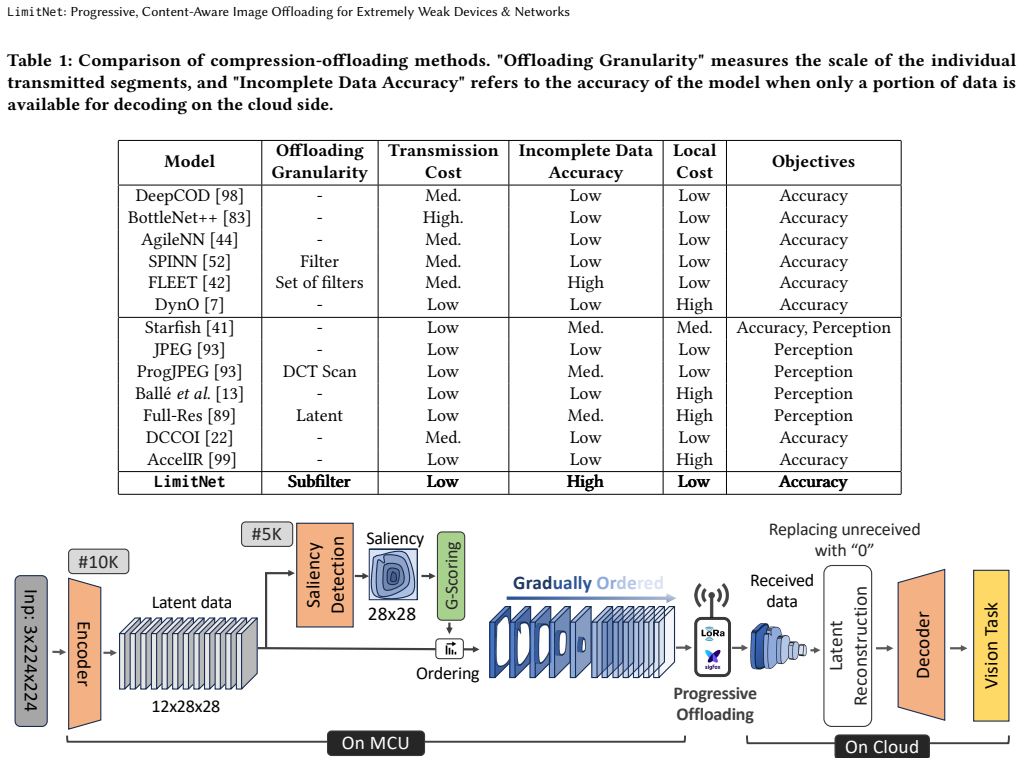
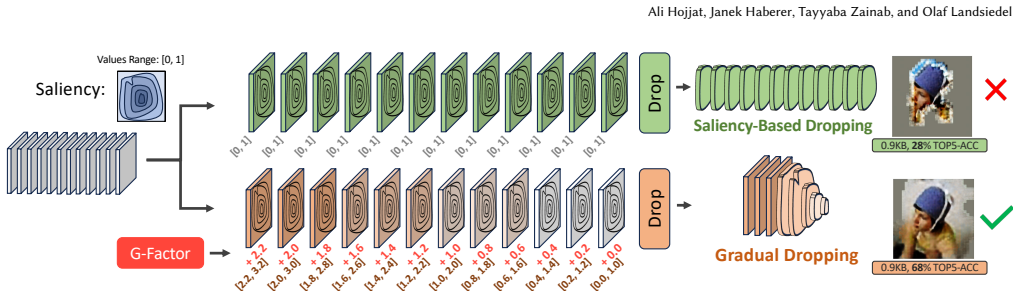
The central mechanism is Gradual Scoring: each latent element at channel i and spatial position (j,k) receives score S_{i,j,k} = I_{j,k} + G_FACTOR * i, where I is the saliency map. This adds a constant per-channel bonus so the model learns how much background, or context, it needs to keep; training randomly zeroes out the lowest-scored fraction of the latent, forcing the decoder and downstream classifier to work from partial data. The 5K-parameter saliency branch is trained by distillation from a large teacher, and the encoder itself is a 15K-parameter CNN, so the whole ordering can be computed on the microcontroller.
What would settle it
Re-tune G_FACTOR separately on CIFAR100 and COCO; if accuracy at a fixed data size improves materially over the ImageNet-tuned value, the fixed per-channel ordering does not generalise. Alternatively, compute per-image channel importance by ablating individual channels and measuring classifier accuracy; if the ranking varies widely across images, a single ordering cannot be the true cause of the gains.
Extended reading notes
Core claim
LimitNet claims that a 15K-parameter content-aware progressive encoder can outperform compared progressive codecs for offloaded vision: at a fixed amount of received data it reports 14.01 percentage points higher Top-1 accuracy on ImageNet1000, 18.01 percentage points on CIFAR100, and 0.1 higher mAP@0.5 on COCO than the progressive JPEG baseline, and at a fixed accuracy it reports 61.24%, 83.68%, and 42.25% bandwidth savings respectively. The encoder detects salient image regions with a 5K-parameter distilled branch, scores every latent element by saliency plus a per-channel bonus, and transmits elements in that order, so the cloud's decoder can reconstruct a usable image from whatever fraction arrives before the deadline. The paper also claims that this costs only about 4% more encoding time than JPEG on a Cortex-M7-class microcontroller, making the scheme deployable on weak IoT devices.
Load-bearing premise
The ordering of importance is assumed to be captured by one scalar bonus per latent channel, so lower-index channels are always worth more than higher-index channels for every image; if that ordering does not transfer across images or datasets, the reported gains would shrink.
Editorial extensions
If this is right
- At any transmission deadline, the cloud already holds the most decision-relevant data, so alarm and monitoring systems can act seconds earlier than with full-image offloading.
- On very low-bandwidth links, the same accuracy can be reached with roughly 61 to 84 percent less data than progressive JPEG on the evaluated classification tasks, which directly extends battery life and duty-cycle budgets.
- Because retransmission follows importance order, packet loss no longer removes arbitrary content; accuracy degrades gracefully as loss rises, from 82.06% at 10% loss to 71.4% at 70% loss on CIFAR100 in the paper's single-cycle evaluation.
- The encoder's small size and JPEG-comparable runtime mean progressive, content-aware offloading can be added to existing MCU-class cameras without a hardware upgrade.
Reading between the lines
- A natural next step the paper leaves open is to learn the per-channel bonus instead of tuning one scalar, which could make the ordering adapt per image or per dataset while staying within MCU memory.
- Because the cloud decoder is heavyweight, one could train a task-specific head to classify directly from the partial latent, skipping image reconstruction; the paper's numbers do not test this, but its own architecture points to it.
- The saliency map is transmitted first, at most 40 bytes, so in a multi-camera LPWAN the scheduling could be: all cameras send maps first, then the cloud decides which camera's remaining data matters most, an extension beyond the single-image setting the paper evaluates.
Signed reviews
Editorial analysis
A structured set of objections, weighed in public.
Referee Report
Summary. LimitNet is a progressive, content-aware image compression and offloading system for MCU-class devices (ARM Cortex-M33/M7) over LPWANs. A 15K-parameter encoder maps a 224×224 image to a 12×28×28 latent, and a 5K-parameter saliency branch, distilled from BASNet, produces a saliency map. 'Gradual Scoring' assigns each latent position a score S = I + G_FACTOR×i (Eq. 4), where i is the channel index, and the encoder transmits latent values in descending score order after first sending an 8×8 quantized saliency map (at most 40 bytes); on the cloud, unreceived values are zero-filled, the image is reconstructed by a larger decoder, and EfficientNet-B0 or YOLOv5 performs the vision task. The evaluation compares LimitNet against JPEG, progressive JPEG, Starfish, and Ballé et al. on ImageNet1000, CIFAR100, and COCO, reporting BD-Rate/BD-Acc/BD-mAP gains (14.01 and 18.01 p.p. BD-Acc on ImageNet and CIFAR; 61.24% and 83.68% BD-Rate), a full-data comparison with DeepCOD and BottleNet++, MCU benchmarks (260 ms encoding, 107 KB Flash, 360 KB RAM on STM32F7), and LoRaWAN and packet-loss simulations. The systems evaluation is substantial, but the contribution of per-image content to the gains is not isolated, and the main baselines are reconstruction codecs rather than task-aware ones.
Significance. If the results hold, LimitNet is a solid and genuinely deployable systems contribution: an MCU-scale progressive encoder with measured resource consumption (Table 5), energy traces (Fig. 12), network simulations under LoRaWAN dynamics (Fig. 13), and packet-loss behavior (Table 6), all backed by an open-source release. The graceful-degradation evidence (Fig. 10a), the use of knowledge distillation for a 5K-parameter saliency branch, and the candid Discussion section, which acknowledges that progressiveness limits full-data accuracy, are notable strengths. The main risk is attribution, not implementation: because the content-aware component is never ablated against a content-agnostic schedule and the baselines are not task-aware, the paper demonstrates a lightweight task-aware progressive codec more firmly than it demonstrates content-aware prioritization per se; this is a fixable gap. The claimed COCO advantage (0.1 mAP) is too small to carry weight without error bars.
major comments (3)
- [§3.4, Eq. (4); §4.3.2, Fig. 10b] The contribution of per-image content to the reported gains is not isolated. Computed from Eq. (4) with L=12, I∈[0,1] (Fig. 5), and G_FACTOR=0.2, the index bonus G_FACTOR×i spans [0,2.2]; channels whose indices differ by six or more are separated by more than the entire saliency range, so all of channels 6–11 are transmitted before any of channels 0–5, regardless of image content. For smaller index gaps the saliency map does influence cross-channel ordering (adjacent channels' score ranges overlap substantially), so I would not call the schedule purely content-agnostic, but the strict top-half-first structure is fixed and content-independent, and the marginal value of the saliency term is unquantified. The only relevant ablation (Fig. 10b) varies G_FACTOR, which changes the training dropout distribution and never removes the saliency term (G=1.0 still includes I), so it does not establish how much of the 14.01 p.p. and 18.01 p.p. BD-Acc gains comes from content awareness versus a fixed TailDrop-style index schedule. In addition, G_FACTOR=0.2 is tuned on ImageNet1000 (§4.3.2) and applied to CIFAR100 and COCO without any transfer analysis. Please add an I≡constant control at G_FACTOR=0.2 (at least at inference, ideally also in training), report accuracy-versus-data-size for all three datasets under that control, and provide per-image evidence of content-dependent ordering or state the limitation explicitly.
- [§4.2, Fig. 8, Table 4; §4.1.3, Table 2] The headline accuracy and bandwidth claims compare a task-aware codec against generic reconstruction codecs. LimitNet is trained in Phase 2 with a classification loss on the stitched decoder–classifier (§4.1.3, Table 2), whereas JPEG, ProgJPEG, Ballé et al., and Starfish are optimized for reconstruction only; the BD-Acc and BD-Rate numbers in Table 4 therefore conflate the benefit of task-aware training with the benefit of content-aware progressive ordering, and the abstract's 'compared to SOTA' should name the specific baseline (gains are 14.01 p.p. against ProgJPEG but 60.33 p.p. against Starfish on ImageNet1000). The COCO result illustrates the fragility of this comparison: a BD-mAP of 0.1 (Table 4) is at the level of evaluation noise, and no error bars, seed counts, or significance tests are reported for any of the Section 4.2 curves. Please report multiple seeds and error bars for the main curves, add at least one task-aware progressive baseline (the I≡constant variant of the previous comment is the minimal control, since it keeps the classification loss and removes only the saliency), and temper or better support the COCO claim.
- [§3.5, §3.5.1] The bitstream format and the receiver-side placement logic are underspecified, which matters for the bandwidth claims. The receiver is told to fill unreceived latent values with zero 'based on the saliency map', but the transmitter scores 12×28×28 = 9408 latent positions from Eq. (4) while only an 8×8, 5-bit saliency map is transmitted. If the ordering is computed from the full-resolution 28×28 saliency, the receiver cannot reproduce the transmission order from the 8×8 map alone; if the ordering is instead computed from the upsampled 8×8 map, then the effective ordering resolution is 8×8 rather than 28×28, and the relationship to Eq. (4) and Fig. 5 should be stated. Relatedly, if each packet must carry position metadata, the data sizes in Fig. 8 and Table 4 understate the protocol overhead. Please specify the packet format, the resolution at which scores are computed on both sides, and whether the reported data sizes include all metadata.
minor comments (7)
- [Fig. 1, Fig. 8, §4.2.1, §3.5] EfficientNet-B0 is cited as [60] in Fig. 1 and Fig. 8, but reference [60] is the paper 'Efficient and effective context-based convolutional entropy modeling for image compression' rather than Tan and Le's EfficientNet (reference [87]); YOLOv5 is cited as [78], which is the original YOLO paper by Redmon et al., not the YOLOv5 implementation. Please correct these citations.
- [Table 4 vs. Abstract and §1] The COCO BD-Rate is reported as 42.45 in Table 4 but as 42.25 in the abstract and in the Section 1 summary of results; the numbers should be reconciled.
- [§3.4, Eq. (4)] Equation (4) iterates i over {0,1,...,L}, but the latent has L channels (12 in Figs. 2 and 3); the index set should be {0,...,L−1}, consistent with the twelve additive values 0.0–2.2 shown in Fig. 5.
- [§3.4, Eq. (6)] The text around Eq. (6) first states that p% of the lowest-scoring latent values are zeroed out and then states that Z′ 'contains the p% of the highest important scores'; if the former is intended, Z′ contains the (100−p)% highest scores, and the wording should be corrected for reproducibility.
- [§4.1.3, Table 2] The note 'freezing the CLS' in Phase 2 of Table 2 is ambiguous; please specify exactly which weights are frozen in Phase 2 and state whether a pre-trained EfficientNet-B0 is used only as a fixed loss network.
- [§3.5, Table 1] Table 1 and Section 1 advertise offloading granularity 'as small as a subfilter'; please define the smallest transmitted unit and reconcile it with the 8×8 quantization of the saliency map, which bounds the spatial resolution of the ordering.
- [§3.3] Section 3.3 states the saliency branch has 0.001% of the teacher model's parameters; with 5K parameters this implies a teacher of roughly 500M parameters, which does not match BASNet's published size (about 87M parameters, implying 0.0057%); please state the teacher parameter count actually used.
Circularity Check
No significant circularity: LimitNet's claims rest on end-to-end empirical evaluation against external baselines, not on self-referential derivations.
full rationale
LimitNet is presented and evaluated as an empirical system. The ordering in Eq. 4 defines importance scores as S_i = I + G_FACTOR * i, and the model is trained end-to-end under random dropping; the reported accuracy-versus-data-size curves are measured against external baselines (JPEG, ProgJPEG, Starfish, Ballé et al., DeepCOD, BottleNet++) rather than derived from the scoring formula. The G_FACTOR hyperparameter is tuned on ImageNet1000 (Fig. 10b), and applying it to CIFAR100 and COCO is an empirical transfer assumption, not a fitted parameter renamed as a prediction; no equation in the paper makes the target accuracy a tautological function of the fitted value. The saliency detector is trained by knowledge distillation from BASNet and later qualitatively compared against BASNet as ground truth, but the central classification/detection claims use EfficientNet-B0 and YOLOv5, which are external and independent of the teacher model. The paper's self-citations (e.g., ProgDTD [38]) appear only as background examples of progressive compression and are not load-bearing for any claimed result. There is no imported uniqueness theorem, no ansatz smuggled via self-citation, and no renaming of a known result as a derivation. The reader's concern about G_FACTOR dominating the ordering is a potential limitation or missing ablation, but it is not a circularity: the paper does not claim to predict content-awareness from the formula; it claims empirical gains from the trained system. Overall, the derivation chain is self-contained against external benchmarks, and no circular step can be exhibited from the paper's equations or citation structure.
Assumptions & free parameters
free parameters (3)
- G_FACTOR =
0.2
- Latent quantization bit width =
6 bits
- Saliency map quantization and downsizing =
5 bits, 8x8
assumptions (3)
- domain assumption A lightweight 5K-parameter saliency detector distilled from BASNet produces useful importance maps for classification on unseen datasets.
- ad hoc to paper Fixed per-channel bonus ordering by filter index is a valid approximation of importance for progressive transmission.
- domain assumption LPWAN bandwidth, duty cycle, and loss characteristics are as described in Section 2.2.
Cite this review
Pith. "Pith review of LimitNet: Progressive, Content-Aware Image Offloading for Extremely Weak Devices & Networks." pith.science (2026). https://pith.science/paper/H4XPU33M
@misc{pith2026250413736,
  author       = {Pith},
  title        = {Pith review of: LimitNet: Progressive, Content-Aware Image Offloading for Extremely Weak Devices & Networks},
  year         = {2026},
  howpublished = {\url{https://pith.science/paper/H4XPU33M}},
  note         = {Machine review of arXiv:2504.13736}
}
read the original abstract
IoT devices have limited hardware capabilities and are often deployed in remote areas. Consequently, advanced vision models surpass such devices' processing and storage capabilities, requiring offloading of such tasks to the cloud. However, remote areas often rely on LPWANs technology with limited bandwidth, high packet loss rates, and extremely low duty cycles, which makes fast offloading for time-sensitive inference challenging. Today's approaches, which are deployable on weak devices, generate a non-progressive bit stream, and therefore, their decoding quality suffers strongly when data is only partially available on the cloud at a deadline due to limited bandwidth or packet losses. In this paper, we introduce LimitNet, a progressive, content-aware image compression model designed for extremely weak devices and networks. LimitNet's lightweight progressive encoder prioritizes critical data during transmission based on the content of the image, which gives the cloud the opportunity to run inference even with partial data availability. Experimental results demonstrate that LimitNet, on average, compared to SOTA, achieves 14.01 p.p. (percentage point) higher accuracy on ImageNet1000, 18.01 pp on CIFAR100, and 0.1 higher mAP@0.5 on COCO. Also, on average, LimitNet saves 61.24% bandwidth on ImageNet1000, 83.68% on CIFAR100, and 42.25% on the COCO dataset compared to SOTA, while it only has 4% more encoding time compared to JPEG (with a fixed quality) on STM32F7 (Cortex-M7).
Figures


Figures from the paper (10 more)



Reference graph
Works this paper leans on
-
[1]
[n. d.]. JPEGEncoder4Cortex. https://github.com/noritsuna/ JPEGEncoder4Cortex-M/tree/master
-
[2]
[n. d.]. TensorFlow Lite Micro. https://www.tensorflow.org/lite/micro. Accessed: [2023]
2023
-
[3]
[n. d.]. Zephyr Project RTOS. https://github.com/zephyrproject-rtos/zephyr. Accessed: [2023]
2023
-
[4]
JPEG XR Specification
2009. JPEG XR Specification. https://jpeg.org/jpegxr/ Joint Photographic Experts Group (JPEG)
2009
-
[5]
nRF5340 System-on-Chip
2023. nRF5340 System-on-Chip. https://www.nordicsemi.com/products/nrf5340
2023
-
[6]
STM32F7 Series Microcontrollers
2023. STM32F7 Series Microcontrollers. https://www.st.com/en/microcontrollers- microprocessors/stm32f7-series.html
2023
-
[7]
Mario Almeida, Stefanos Laskaridis, Stylianos I Venieris, Ilias Leontiadis, and Nicholas D Lane. 2022. Dyno: Dynamic onloading of deep neural networks from cloud to device. ACM Transactions on Embedded Computing Systems 21, 6 (2022), 1–24
2022
-
[8]
Apple Inc. n.d.. Use Emergency SOS via satellite on your iPhone . https://support. apple.com/en-us/HT213426 Accessed: November 11, 2023
2023
Show all 109 references
-
[9]
Juliano S Assine, Eduardo Valle, et al . 2021. Single-training collaborative object detectors adaptive to bandwidth and computation. arXiv preprint arXiv:2105.00591 (2021)
2021 arXiv
-
[10]
Kuldoshbay Avazov, An Eui Hyun, Alabdulwahab Abrar Sami S, Azizbek Khaitov, Akmalbek Bobomirzaevich Abdusalomov, and Young Im Cho. 2023. Forest Fire Detection and Notification Method Based on AI and IoT Approaches. Future Internet 15, 2 (2023), 61
2023
-
[11]
Johannes Ballé, Valero Laparra, and Eero P Simoncelli. 2015. Density modeling of images using a generalized normalization transformation. arXiv preprint arXiv:1511.06281 (2015)
2015 arXiv
-
[12]
Johannes Ballé, Valero Laparra, and Eero P Simoncelli. 2016. End-to-end opti- mized image compression. arXiv preprint arXiv:1611.01704 (2016)
2016 arXiv
-
[13]
Johannes Ballé, David Minnen, Saurabh Singh, Sung Jin Hwang, and Nick Johnston. 2018. Variational image compression with a scale hyperprior. arXiv preprint arXiv:1802.01436 (2018)
2018 arXiv
-
[14]
G Bjøtegaard. 2001. Calculation of average PSNR differences between RD-curves (vceg-m33). In VCEG Meeting (ITU-T SG16 Q. 6), Austin, Texas, USA„ Tech. Rep. M, Vol. 16090
2001
-
[15]
Martin Bor, John Edward Vidler, and Utz Roedig. 2016. LoRa for the Internet of Things. (2016)
2016
-
[16]
BPG [n. d.]. BPG Image format. https://bellard.org/bpg/. Accessed: 2023-02-14
2023
-
[17]
Chunlei Cai, Li Chen, Xiaoyun Zhang, and Zhiyong Gao. 2019. End-to-end optimized ROI image compression. IEEE Transactions on Image Processing 29 LimitNet: Progressive, Content-Aware Image Offloading for Extremely Weak Devices & Networks (2019), 3442–3457
2019
-
[18]
Chunlei Cai, Li Chen, Xiaoyun Zhang, Guo Lu, and Zhiyong Gao. 2019. A novel deep progressive image compression framework. In 2019 Picture Coding Symposium (PCS). IEEE, 1–5
2019
-
[19]
Luis Camal and Baris Aksanli. 2020. Building an energy-efficient ad-hoc network for wildlife observation. Electronics 9, 6 (2020), 984
2020
-
[20]
Aditya Chattopadhyay, Anirban Sarkar, Prantik Howlader, and Vineeth N Bal- asubramanian. 2020. Grad-CAM++: Improved Visual Explanations for Deep Convolutional Networks. IEEE Transactions on Image Processing 29 (2020), 4030–4043
2020
-
[21]
Bharat S Chaudhari, Marco Zennaro, and Suresh Borkar. 2020. LPWAN tech- nologies: Emerging application characteristics, requirements, and design con- siderations. Future Internet 12, 3 (2020), 46
2020
-
[22]
Bo Chen, Zhisheng Yan, Hongpeng Guo, Zhe Yang, Ahmed Ali-Eldin, Prashant Shenoy, and Klara Nahrstedt. 2021. Deep contextualized compressive offloading for images. In Proceedings of the 19th ACM Conference on Embedded Networked Sensor Systems. 467–473
2021
-
[23]
Zhengxue Cheng, Heming Sun, Masaru Takeuchi, and Jiro Katto. 2020. Learned image compression with discretized gaussian mixture likelihoods and attention modules. In Proceedings of the IEEE/CVF Conference on Computer Vision and Pattern Recognition. 7939–7948
2020
-
[24]
Hyomin Choi, Robert A Cohen, and Ivan V Bajić. 2020. Back-and-forth pre- diction for deep tensor compression. In ICASSP 2020-2020 IEEE International Conference on Acoustics, Speech and Signal Processing (ICASSP). IEEE, 4467–4471
2020
-
[25]
HeeSeok Choi, Heonchang Yu, and EunYoung Lee. 2019. Latency-classification- based deadline-aware task offloading algorithm in mobile edge computing environments. Applied Sciences 9, 21 (2019), 4696
2019
-
[26]
Jifeng Dai, Yi Li, Kaiming He, and Jian Sun. 2016. R-FCN: Object Detection via Region-based Fully Convolutional Networks. In Advances in Neural Information Processing Systems. 379–387
2016
-
[27]
Jia Deng, Wei Dong, Richard Socher, Li-Jia Li, Kai Li, and Li Fei-Fei. 2009. Imagenet: A large-scale hierarchical image database. In 2009 IEEE conference on computer vision and pattern recognition . Ieee, 248–255
2009
-
[28]
Enmao Diao, Jie Ding, and Vahid Tarokh. 2020. Drasic: Distributed recurrent au- toencoder for scalable image compression. In 2020 Data Compression Conference (DCC). IEEE, 3–12
2020
-
[29]
Alexey Dosovitskiy, Lucas Beyer, Alexander Kolesnikov, Dirk Weissenborn, Xiaohua Zhai, Thomas Unterthiner, Mostafa Dehghani, Matthias Minderer, Georg Heigold, Sylvain Gelly, Jakob Uszkoreit, and Neil Houlsby. 2021. An image is worth 16x16 words: Transformers for image recognit...
2021
-
[30]
Amir Erfan Eshratifar, Mohammad Saeed Abrishami, and Massoud Pedram
-
[31]
Amir Erfan Eshratifar, Amirhossein Esmaili, and Massoud Pedram. 2019. Bot- tlenet: A deep learning architecture for intelligent mobile cloud computing services. In 2019 IEEE/ACM International Symposium on Low Power Electronics and Design (ISLPED). IEEE, 1–6
2019
-
[32]
Fares Fourati and Mohamed-Slim Alouini. 2021. Artificial intelligence for satellite communication: A review. Intelligent and Converged Networks 2, 3 (2021), 213–243
2021
-
[33]
Ruigang Fu, Qingyong Hu, Xiaohu Dong, Yulan Guo, Yinghui Gao, and Biao Li
-
[34]
Karol Gregor, Frederic Besse, Danilo Jimenez Rezende, Ivo Danihelka, and Daan Wierstra. 2016. Towards conceptual compression. Advances In Neural Information Processing Systems 29 (2016)
2016
-
[35]
Kaiming He, Georgia Gkioxari, Piotr Dollar, and Ross Girshick. 2017. Mask R-CNN. In Proceedings of the IEEE International Conference on Computer Vision . IEEE, 2961–2969
2017
-
[36]
Kaiming He, Xiangyu Zhang, Shaoqing Ren, and Jian Sun. 2016. Deep residual learning for image recognition. InProceedings of the IEEE conference on computer vision and pattern recognition . 770–778
2016
-
[37]
Geoffrey Hinton, Oriol Vinyals, and Jeff Dean. 2015. Distilling the knowledge in a neural network. arXiv preprint arXiv:1503.02531 (2015)
2015 arXiv
-
[38]
Ali Hojjat, Janek Haberer, and Olaf Landsiedel. 2023. ProgDTD: Progressive Learned Image Compression With Double-Tail-Drop Training. In Proceedings of the IEEE/CVF Conference on Computer Vision and Pattern Recognition (CVPR) Workshops. 1130–1139
2023
-
[39]
Qibin Hou, Ming-Ming Cheng, Xiaowei Hu, Ali Borji, Zhuowen Tu, and Philip Torr. 2017. Deeply Supervised Salient Object Detection with Short Connections. In Proceedings of the IEEE Conference on Computer Vision and Pattern Recognition (CVPR)
2017
-
[40]
Diyi Hu and Bhaskar Krishnamachari. 2020. Fast and accurate streaming CNN inference via communication compression on the edge. In 2020 IEEE/ACM Fifth International Conference on Internet-of-Things Design and Implementation (IoTDI). IEEE, 157–163
2020
-
[41]
Pan Hu, Junha Im, Zain Asgar, and Sachin Katti. 2020. Starfish: resilient image compression for aiot cameras. InProceedings of the 18th Conference on Embedded Networked Sensor Systems. 395–408
2020
-
[42]
Jin Huang, Hui Guan, and Deepak Ganesan. 2023. Re-Thinking Computation Offload for Efficient Inference on IoT Devices with Duty-Cycled Radios. In Proceedings of the 29th Annual International Conference on Mobile Computing and Networking (Madrid, Spain) (ACM MobiCom ’23). Assoc...
2023
-
[43]
Jin Huang, Colin Samplawski, Deepak Ganesan, Benjamin Marlin, and Heesung Kwon. 2020. Clio: Enabling automatic compilation of deep learning pipelines across iot and cloud. In Proceedings of the 26th Annual International Conference on Mobile Computing and Networking . 1–12
2020
-
[44]
Kai Huang and Wei Gao. 2022. Real-time neural network inference on extremely weak devices: agile offloading with explainable AI. In Proceedings of the 28th Annual International Conference on Mobile Computing And Networking. 200–213
2022
-
[45]
Mikolaj Jankowski, Deniz Gündüz, and Krystian Mikolajczyk. 2020. Joint device- edge inference over wireless links with pruning. In 2020 IEEE 21st international workshop on signal processing advances in wireless communications (SPA WC) . IEEE, 1–5
2020
-
[46]
Seungmin Jeon, Kwang Pyo Choi, Youngo Park, and Chang-Su Kim. 2023. Context-Based Trit-Plane Coding for Progressive Image Compression. In Pro- ceedings of the IEEE/CVF Conference on Computer Vision and Pattern Recognition . 14348–14357
2023
-
[47]
Hyuk-Jin Jeong, InChang Jeong, Hyeon-Jae Lee, and Soo-Mook Moon. 2018. Computation offloading for machine learning web apps in the edge server envi- ronment. In 2018 IEEE 38th International Conference on Distributed Computing Systems (ICDCS). IEEE, 1492–1499
2018
-
[48]
Nick Johnston, Damien Vincent, David Minnen, Michele Covell, Saurabh Singh, Troy Chinen, Sung Jin Hwang, Joel Shor, and George Toderici. 2018. Improved lossy image compression with priming and spatially adaptive bit rates for recurrent networks. In Proceedings of the IEEE Conf...
2018
-
[49]
Toshiaki Koike-Akino and Ye Wang. 2020. Stochastic bottleneck: Rateless auto-encoder for flexible dimensionality reduction. In 2020 IEEE International Symposium on Information Theory (ISIT) . IEEE, 2735–2740
2020
-
[50]
Mark A Kramer. 1991. Nonlinear principal component analysis using autoasso- ciative neural networks. AIChE journal 37, 2 (1991), 233–243
1991
-
[51]
Krizhevsky
A. Krizhevsky. 2009. CIFAR-100 (Canadian Institute for Advanced Research) . Technical Report. University of Toronto. https://www.cs.toronto.edu/~kriz/ cifar.html
2009
-
[52]
Stefanos Laskaridis, Stylianos I Venieris, Mario Almeida, Ilias Leontiadis, and Nicholas D Lane. 2020. SPINN: synergistic progressive inference of neural networks over device and cloud. In Proceedings of the 26th annual international conference on mobile computing and networki...
2020
-
[53]
Alexandru Lavric, Adrian I Petrariu, and Valentin Popa. 2019. Sigfox communi- cation protocol: The new era of iot?. In 2019 international conference on sensing and instrumentation in IoT Era (ISSI) . IEEE, 1–4
2019
-
[54]
Jooyoung Lee, Seunghyun Cho, and Seung-Kwon Beack. 2018. Context-adaptive entropy model for end-to-end optimized image compression. arXiv preprint arXiv:1809.10452 (2018)
2018 arXiv
-
[55]
Joo Chan Lee, Yongwoo Kim, SungTae Moon, and Jong Hwan Ko. 2021. A splittable dnn-based object detector for edge-cloud collaborative real-time video inference. In 2021 17th IEEE International Conference on Advanced Video and Signal Based Surveillance (A VSS). IEEE, 1–8
2021
-
[56]
Jae-Han Lee, Seungmin Jeon, Kwang Pyo Choi, Youngo Park, and Chang-Su Kim. 2022. DPICT: Deep progressive image compression using trit-planes. In Proceedings of the IEEE/CVF Conference on Computer Vision and Pattern Recognition. 16113–16122
2022
-
[57]
Guangli Li, Lei Liu, Xueying Wang, Xiao Dong, Peng Zhao, and Xiaobing Feng
-
[58]
He Li, Kaoru Ota, and Mianxiong Dong. 2018. Learning IoT in edge: Deep learning for the Internet of Things with edge computing. IEEE network 32, 1 (2018), 96–101
2018
-
[59]
Jun Li, Yuhua Wang, Xin Qi, Xuming Hou, and Ming-Ming Liu. 2018. AMULET: Aggregated Multi-Level Feature U-Net for Salient Object Detection. In Proceed- ings of the European Conference on Computer Vision (ECCV)
2018
-
[60]
Mu Li, Kede Ma, Jane You, David Zhang, and Wangmeng Zuo. 2020. Efficient and effective context-based convolutional entropy modeling for image compression. IEEE Transactions on Image Processing 29 (2020), 5900–5911
2020
-
[61]
Weiping Li. 2001. Overview of fine granularity scalability in MPEG-4 video standard. IEEE Transactions on circuits and systems for video technology 11, 3 (2001), 301–317. Ali Hojjat, Janek Haberer, Tayyaba Zainab, and Olaf Landsiedel
2001
-
[62]
Jongseong Lim, Sunghun Jung, Chan JeGal, Gwanghoon Jung, Jung Ho Yoo, Jin Kyu Gahm, and Giltae Song. 2022. LEQNet: Light Earthquake Deep Neural Network for Earthquake Detection and Phase Picking. Frontiers in Earth Science 10 (2022), 848237
2022
-
[63]
Belongie, Lubomir D
Tsung-Yi Lin, Michael Maire, Serge J. Belongie, Lubomir D. Bourdev, Ross B. Girshick, James Hays, Pietro Perona, Deva Ramanan, Piotr Doll’a r, and C. Lawrence Zitnick. 2014. Microsoft COCO: Common Objects in Context. CoRR abs/1405.0312 (2014). arXiv:1405.0312 http://arxiv.org/...
2014 arXiv
-
[64]
Xueyang Liu, Li Zhang, Lei Zhang, Yuhao Zhang, Wen Ma, and Tieniu Huang
-
[65]
Ze Liu, Yutong Lin, Yue Cao, Han Hu, Yixuan Wei, Zheng Zhang, Stephen Lin, and Baining Guo. 2021. Swin transformer: Hierarchical vision transformer using shifted windows. In Proceedings of the IEEE/CVF international conference on computer vision. 10012–10022
2021
-
[66]
Yadong Lu, Yinhao Zhu, Yang Yang, Amir Said, and Taco S Cohen. 2021. Progres- sive neural image compression with nested quantization and latent ordering. In 2021 IEEE International Conference on Image Processing (ICIP) . IEEE, 539–543
2021
-
[67]
Yoshitomo Matsubara, Sabur Baidya, Davide Callegaro, Marco Levorato, and Sameer Singh. 2019. Distilled split deep neural networks for edge-assisted real-time systems. In Proceedings of the 2019 Workshop on Hot Topics in Video Analytics and Intelligent Edges. 21–26
2019
-
[68]
In Proceedings of the European Conference on Computer Vision (ECCV)
PiCANet: Learning Pixel-wise Contextual Attention for Saliency Detec- tion. In Proceedings of the European Conference on Computer Vision (ECCV)
-
[69]
Yoshitomo Matsubara and Marco Levorato. 2020. Split computing for com- plex object detectors: Challenges and preliminary results. arXiv preprint arXiv:2007.13312 (2020)
2020 arXiv
-
[70]
Yoshitomo Matsubara and Marco Levorato. 2021. Neural compression and filtering for edge-assisted real-time object detection in challenged networks. In 2020 25th International Conference on Pattern Recognition (ICPR) . IEEE, 2272– 2279
2021
-
[71]
Yoshitomo Matsubara, Marco Levorato, and Francesco Restuccia. 2022. Split computing and early exiting for deep learning applications: Survey and research challenges. Comput. Surveys 55, 5 (2022), 1–30
2022
-
[72]
Yoshitomo Matsubara, Davide Callegaro, Sabur Baidya, Marco Levorato, and Sameer Singh. 2020. Head network distillation: Splitting distilled deep neural networks for resource-constrained edge computing systems. IEEE Access 8 (2020), 212177–212193
2020
-
[73]
Yoshitomo Matsubara, Ruihan Yang, Marco Levorato, and Stephan Mandt. 2022. Supervised compression for resource-constrained edge computing systems. In Proceedings of the IEEE/CVF Winter Conference on Applications of Computer Vision. 2685–2695
2022
-
[74]
David Minnen, Johannes Ballé, and George D Toderici. 2018. Joint autoregressive and hierarchical priors for learned image compression. Advances in neural information processing systems 31 (2018)
2018
-
[75]
Daniele Jahier Pagliari, Roberta Chiaro, Enrico Macii, and Massimo Poncino
-
[76]
Yoshitomo Matsubara, Ruihan Yang, Marco Levorato, and Stephan Mandt
-
[77]
Anitha Ramachandran and Arun Kumar Sangaiah. 2021. A review on object detection in unmanned aerial vehicle surveillance. International Journal of Cognitive Computing in Engineering 2 (2021), 215–228
2021
-
[78]
Joseph Redmon, Santosh Divvala, Ross Girshick, and Ali Farhadi. 2016. You Only Look Once: Unified, Real-Time Object Detection. In Proceedings of the IEEE Conference on Computer Vision and Pattern Recognition . 779–788
2016
-
[79]
Joseph Redmon, Santosh Divvala, Ross Girshick, and Ali Farhadi. 2016. You Only Look Once: Unified, Real-Time Object Detection. Proceedings of the IEEE Conference on Computer Vision and Pattern Recognition (2016), 779–788
2016
-
[80]
Shaoqing Ren, Kaiming He, Ross Girshick, and Jian Sun. 2017. Faster R-CNN: Towards Real-Time Object Detection with Region Proposal Networks. IEEE Transactions on Pattern Analysis and Machine Intelligence 39, 6 (2017), 1137– 1149
2017
-
[81]
IEEE Trans
Crime: Input-dependent collaborative inference for recurrent neural networks. IEEE Trans. Comput. 70, 10 (2020), 1626–1639
2020
-
[82]
Xuebin Qin, Deng-Ping Fan, Chenyang Huang, Cyril Diagne, Zichen Zhang, Adrià Cabeza Sant’Anna, Albert Suarez, Martin Jagersand, and Ling Shao. 2021. Boundary-aware segmentation network for mobile and web applications. arXiv preprint arXiv:2101.04704 (2021)
2021 arXiv
-
[83]
Jiawei Shao and Jun Zhang. 2020. Bottlenet++: An end-to-end approach for fea- ture compression in device-edge co-inference systems. In2020 IEEE International Conference on Communications Workshops (ICC Workshops). IEEE, 1–6
2020
-
[84]
Axel Sikora, Manuel Schappacher, Zubair Amjad, et al. 2019. Test and measure- ment of LPWAN and cellular IoT networks in a unified testbed. In 2019 IEEE 17th International Conference on Industrial Informatics (INDIN) , Vol. 1. IEEE, 1521–1527
2019
-
[85]
Athanassios Skodras, Charilaos Christopoulos, and Touradj Ebrahimi. 2001. The JPEG 2000 still image compression standard. IEEE Signal processing magazine 18, 5 (2001), 36–58
2001
-
[86]
Rige Su, Zhengxue Cheng, Heming Sun, and Jiro Katto. 2020. Scalable learned image compression with a recurrent neural networks-based hyperprior. In 2020 IEEE International Conference on Image Processing (ICIP) . IEEE, 3369–3373
2020
-
[87]
Amir Said and William A Pearlman. 1996. A new, fast, and efficient image codec based on set partitioning in hierarchical trees. IEEE Transactions on circuits and systems for video technology 6, 3 (1996), 243–250
1996
-
[88]
Selvaraju, Michael Cogswell, Abhishek Das, Ramakrishna Vedantam, Devi Parikh, and Dhruv Batra
Ramprasaath R. Selvaraju, Michael Cogswell, Abhishek Das, Ramakrishna Vedantam, Devi Parikh, and Dhruv Batra. 2020. Grad-CAM: Visual Expla- nations from Deep Networks via Gradient-based Localization. International Journal of Computer Vision 128, 2 (2020), 336–359
2020
-
[89]
George Toderici, Damien Vincent, Nick Johnston, Sung Jin Hwang, David Min- nen, Joel Shor, and Michele Covell. 2017. Full resolution image compression with recurrent neural networks. In Proceedings of the IEEE conference on Computer Vision and Pattern Recognition . 5306–5314
2017
-
[90]
Jasper RR Uijlings, Koen EA van de Sande, Theo Gevers, and Arnold WM Smeulders. 2013. Selective Search for Object Recognition. In International Journal of Computer Vision , Vol. 104. Springer, 154–171
2013
-
[91]
Alpha Vijayan, B Meenaskshi, Aditya Pandey, Akshat Patel, and Arohi Jain
-
[92]
Gregory K Wallace. 1991. The JPEG still picture compression standard.Commun. ACM 34, 4 (1991), 30–44
1991
-
[93]
Mingxing Tan and Quoc Le. 2019. Efficientnet: Rethinking model scaling for convolutional neural networks. In International conference on machine learning . PMLR, 6105–6114
2019
-
[94]
George Toderici, Sean M O’Malley, Sung Jin Hwang, Damien Vincent, David Minnen, Shumeet Baluja, Michele Covell, and Rahul Sukthankar. 2015. Vari- able rate image compression with recurrent neural networks. arXiv preprint arXiv:1511.06085 (2015)
2015 arXiv
-
[95]
Lijun Wang, Huchuan Lu, Yifan Wang, Mengyang Feng, Dong Wang, and Baocai Yin. 2019. Bilateral Multi-Pooling with Bi-Directional Message Passing for Salient Object Detection. In Proceedings of the IEEE Conference on Computer Vision and Pattern Recognition (CVPR)
2019
-
[96]
Xinyu Wang, Xinyuan Cao, Chunhua Shen, and Liang Lin. 2018. Recurrent Residual Module for Fast Inference in Videos. In Proceedings of the IEEE Confer- ence on Computer Vision and Pattern Recognition (CVPR)
2018
-
[97]
WebP [n. d.]. WebP. https://developers.google.com/speed/webp/docs/ compression. Accessed: 2023-02-14
2023
-
[98]
In 2022 International Conference for Advancement in Technology (ICONAT)
Video anomaly detection in surveillance cameras. In 2022 International Conference for Advancement in Technology (ICONAT). IEEE, 1–4
2022
-
[99]
Juncheol Ye, Hyunho Yeo, Jinwoo Park, and Dongsu Han. 2023. AccelIR: Task- Aware Image Compression for Accelerating Neural Restoration. In Proceedings of the IEEE/CVF Conference on Computer Vision and Pattern Recognition . 18216– 18226
2023
-
[100]
Gregory K Wallace. 1992. The JPEG still picture compression standard. IEEE transactions on consumer electronics 38, 1 (1992), xviii–xxxiv
1992
-
[101]
Haofan Wang, Zifan Wang, Mengnan Du, Fan Yang, Zijian Zhang, Sirui Ding, Piotr Mardziel, Xia Hu, and Xia Hu. 2021. Score-CAM: Score-Weighted Visual Explanations for Convolutional Neural Networks. IEEE Transactions on Neural Networks and Learning Systems 32, 11 (2021), 5185–5198
2021
-
[102]
Dong Zhang, Yuchen Han, Ming-Hsuan Yang, Tong Zhang, Wei Liu, Xiaokang Yang, and Jing Guo. 2018. Nested Lateral Descriptive Features for Salient Object Detection. In Proceedings of the IEEE Conference on Computer Vision and Pattern Recognition (CVPR)
2018
-
[105]
Shuochao Yao, Jinyang Li, Dongxin Liu, Tianshi Wang, Shengzhong Liu, Huajie Shao, and Tarek Abdelzaher. 2020. Deep compressive offloading: Speeding up neural network inference by trading edge computation for network latency. In Proceedings of the 18th Conference on Embedded Ne...
2020
-
[107]
Tayyaba Zainab, Jens Karstens, and Olaf Landsiedel. 2023. LightEQ: On-Device Earthquake Detection with Embedded Machine Learning. In Proceedings of the 8th ACM/IEEE Conference on Internet of Things Design and Implementation . 130–143
2023
-
[108]
Liekang Zeng, En Li, Zhi Zhou, and Xu Chen. 2019. Boomerang: On-demand co- operative deep neural network inference for edge intelligence on the industrial Internet of Things. IEEE Network 33, 5 (2019), 96–103
2019
-
[2018]
Auto-tuning neural network quantization framework for collaborative inference between the cloud and edge. In Artificial Neural Networks and Ma- chine Learning–ICANN 2018: 27th International Conference on Artificial Neural Networks, Rhodes, Greece, October 4-7, 2018, Proceeding...
2018
-
[2019]
IEEE Transactions on Mobile Computing 20, 2 (2019), 565–576
JointDNN: An efficient training and inference engine for intelligent mobile cloud computing services. IEEE Transactions on Mobile Computing 20, 2 (2019), 565–576
2019
-
[2020]
arXiv preprint arXiv:2008.02312 (2020)
Axiom-based Grad-CAM: Towards Accurate Visualization and Explana- tion of CNNs. arXiv preprint arXiv:2008.02312 (2020)
2020 arXiv
-
[2022]
arXiv preprint arXiv:2203.08875 (2022)
SC2: Supervised compression for split computing. arXiv preprint arXiv:2203.08875 (2022)
2022 arXiv
Reviewed August 16, 2026 · model on record in the stance chip above.
Discussion (0). Continue with ORCID to comment.