REVIEW 2 minor 1 cited by
A framework for the benchmarking of transport-induced excitations in shuttling-based ion-trap quantum processors
T0 review · 0 major / 2 minor · reviewed 2026-06-30 · grok-4.3
Pith's one-line read Transport-induced heating in ion-trap shuttling can be predicted by algebraically combining the effects of individual primitive operations.
desk verdict The paper gives a practical way to estimate transport heating in ion traps by decomposing shuttling into primitives and combining their effects algebraically rather than full simulation. read the letter →
The pith
A machine-rendered reading of the paper's core claim, the machinery that carries it, and where it could break.
The reading
What carries the argument
Decomposition of shuttling protocols into primitive operations whose heating properties are measured separately and then combined by an algebraic expression.
What would settle it
A full numerical trajectory simulation of a multi-primitive shuttling sequence whose total heating deviates from the algebraic prediction by more than the stated uncertainty of the individual primitive measurements.
Extended reading notes
Core claim
By decomposing any shuttling protocol into primitive operations and determining the heating contribution of each primitive in isolation, the total motional excitation produced by an arbitrary sequence of transports and swaps follows directly from an algebraic combination of those individual contributions.
Load-bearing premise
The heating produced by one primitive does not depend on the sequence of other primitives that precede or follow it.
Editorial extensions
If this is right
- Heating rates for complete ion trajectories are obtained without repeated full-protocol simulations.
- Motional costs can be inserted directly into compiler cost functions for gate scheduling.
- Heating performance of each primitive can be benchmarked and optimized independently.
- The same algebraic rule applies to any processor design built from the same set of linear-transport and swap primitives.
Reading between the lines
- Compilers could use the per-primitive costs to explore trade-offs between shuttling depth and overall error rate in algorithm mapping.
- The framework supplies a way to compare the motional overhead of different connectivity graphs without resimulating every possible routing.
- If the algebraic rule holds across devices, it offers a standardized metric for ranking shuttling architectures by their transport-induced error.
Signed reviews
Editorial analysis
A structured set of objections, weighed in public.
Referee Report
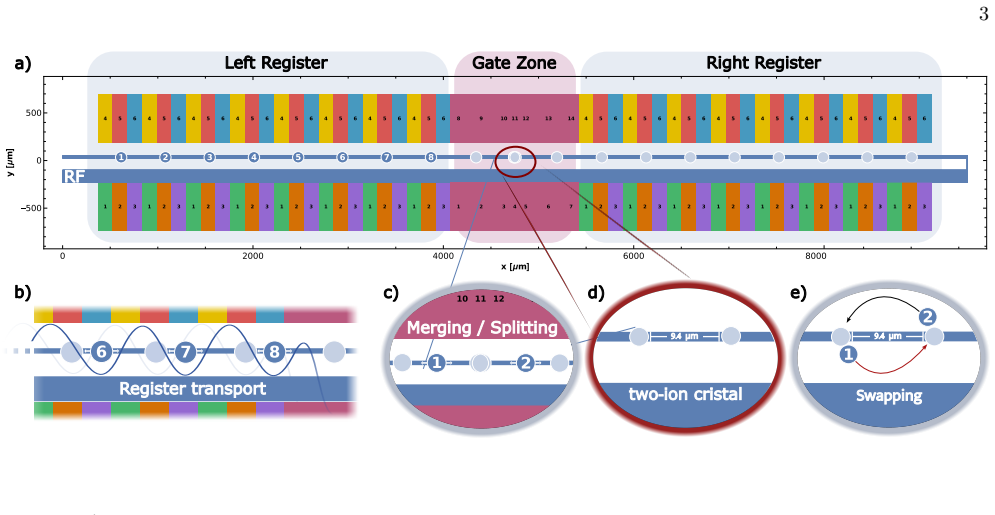
Summary. The paper develops a theoretical and numerical framework to analyze transport-induced excitations on motional states of ions in shuttling-based ion-trap processors. Shuttling protocols are decomposed into primitive operations that are individually characterized for heating performance; the global heating result for a full trajectory is then obtained via an algebraic expression rather than full end-to-end simulation. The framework is demonstrated on an 8-qubit linear-transport processor design that uses swap operations to realize all-to-all connectivity, and the motional-operation cost is incorporated into the compiler as an explicit cost function.
Significance. If the algebraic combination rule holds for the target device parameters, the framework offers a computationally efficient route to benchmark and optimize transport protocols in scaled ion-trap processors. The construction is presented with no free parameters and as a direct modeling choice whose validity is left to the specific hardware, which strengthens reproducibility. The explicit demonstration on an 8-qubit design together with compiler integration supplies a concrete, falsifiable use case.
minor comments (2)
- The precise algebraic expression that combines the primitive heating metrics should be stated explicitly (ideally as an equation) in the framework section so that readers can verify the claimed separation of primitives from global results.
- Figure captions and the 8-qubit demonstration section would benefit from a short statement of the numerical method used to extract the per-primitive heating values and any associated statistical uncertainty.
Simulated Author's Rebuttal
We thank the referee for the positive assessment of the manuscript, the clear summary of its contributions, and the recommendation for minor revision. No specific major comments were listed in the report.
Circularity Check
No significant circularity; framework is a new decomposition with algebraic combination presented as modeling choice
full rationale
The paper introduces a decomposition of shuttling protocols into primitive operations, characterizes each by heating metrics, and combines them via an algebraic expression to obtain global results without full trajectory simulation. This construction is self-contained as an empirical modeling framework applied to an 8-qubit design; the algebraic rule is stated as an assumption (linear or simple combination) rather than derived from or fitted to the target quantities. No self-definitional reductions, fitted inputs renamed as predictions, or load-bearing self-citations appear in the provided abstract or described derivation. The demonstration is an application of the framework, not a claim that forces the result by construction. The central claim remains independent of its inputs.
Assumptions & free parameters
Cite this review
Pith. "Pith review of A framework for the benchmarking of transport-induced excitations in shuttling-based ion-trap quantum processors." pith.science (2026). https://pith.science/paper/H52VUVR7
@misc{pith2026260525118,
  author       = {Pith},
  title        = {Pith review of: A framework for the benchmarking of transport-induced excitations in shuttling-based ion-trap quantum processors},
  year         = {2026},
  howpublished = {\url{https://pith.science/paper/H52VUVR7}},
  note         = {Machine review of arXiv:2605.25118}
}
read the original abstract
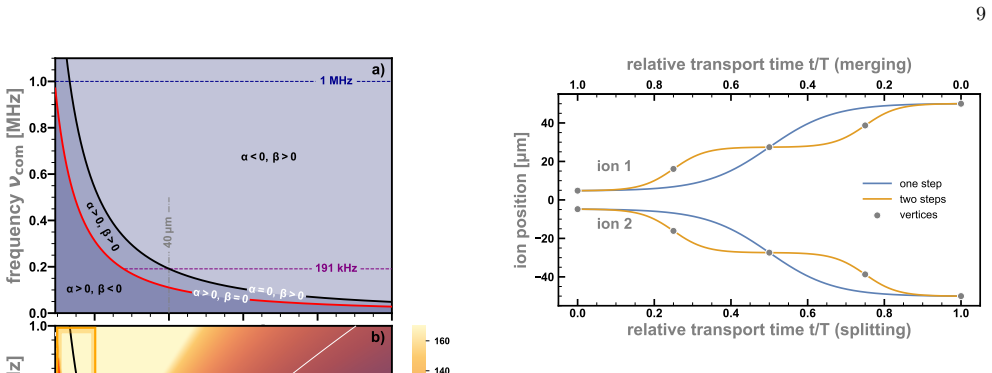
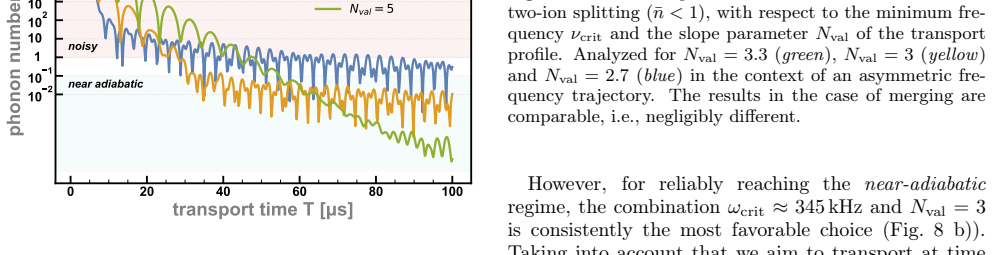
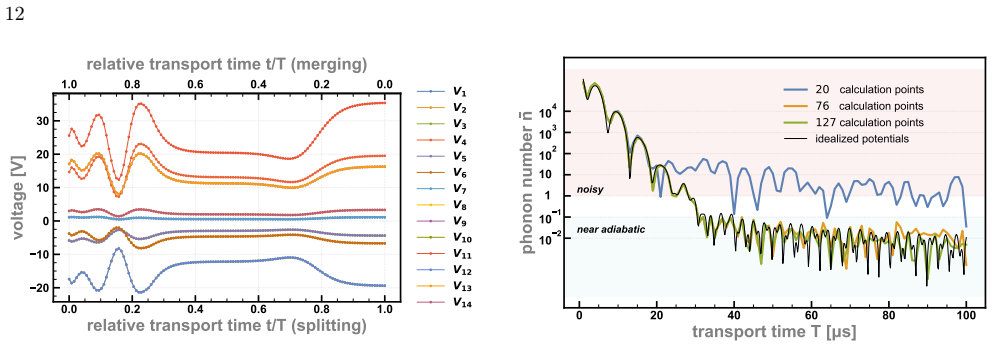
We develop a theoretical and numerical framework to analyze the effect of transport on the motional states of ions in a trapped-ion quantum processor. We decompose the shuttling protocol into primitive operations and characterize these in terms of their heating performance. Instead of having to simulate the whole transport protocol for each complete ion trajectory, the method allows us to determine the heating properties of each primitive operation separately and obtain the global result through an algebraic expression. We demonstrate our method by applying it to an 8-qubit quantum processor design based on linear transport and swap operations for all-to-all connectivity. We show how to incorporate the price of motional operations at the level of the compiler as a cost function.
Figures


Figures from the paper (15 more)





Forward citations
Cited by 1 Pith paper
-
Remote entanglement need not be the bottleneck for modular trapped-ion quantum computing
A projected architecture for trapped-ion quantum modules combines single-photon heralding, integrated photonics, recoil correction, and one distillation round to deliver 99.9%-fidelity remote Bell pairs at 10^5 s^-1 cm^-2.
Reference graph
Works this paper leans on
-
[1]
All of these quantities can be extracted from the heating analyses of the primitive operations. The only exception is the homogeneous contribution ¯ni,hom (¯ni−1,tot , ϑi−1), which must be evaluated based on the initial conditions — and therefore has to be re- calculated at each intermediate step of the full routine. However, this can be circumvented by c...
-
[2]
J. I. Cirac and P. Zoller, Physical Review Letters74, 4091 (1995)
1995
-
[3]
Bermudez, X
A. Bermudez, X. Xu, R. Nigmatullin, J. O’Gorman, V. Negnevitsky, P. Schindler, T. Monz, U. G. Poschinger, C. Hempel, J. Home, F. Schmidt-Kaler, M. Biercuk, R. Blatt, S. Benjamin, and M. Müller, Physical Review X7, 041061 (2017)
2017
-
[4]
Kielpinski, C
D. Kielpinski, C. Monroe, and D. J. Wineland, Nature 417, 709 (2002)
2002
-
[5]
Experimental issues in coherent quantum-state manipulation of trapped atomic ions
D. J. Wineland, C. Monroe, W. M. Itano, D. Leibfried, B. E. King, and D. M. Meekhof, “Experimental issues in coherent quantum-state manipulation of trapped atomic ions,” (1998), arXiv:quant-ph/9710025
work page Pith review arXiv 1998
-
[6]
N. M. Linke, D. Maslov, M. Roetteler, S. Debnath, C. Figgatt, K. A. Landsman, K. Wright, and C. Mon- roe, Proceedings of the National Academy of Sciences 114, 3305 (2017)
2017
- [7]
-
[8]
Sørensen and K
A. Sørensen and K. Mølmer, Physical Review Letters 82, 1971 (1999)
1971
Show all 47 references
-
[9]
Leibfried, B
D. Leibfried, B. DeMarco, V. Meyer, D. Lucas, M. Bar- rett, J. Britton, W. M. Itano, B. Jelenković, C. Langer, T. Rosenband, and D. J. Wineland, Nature422, 412 (2003)
2003
-
[10]
J. M. Pino, J. M. Dreiling, C. Figgatt, J. P. Gaebler, S.A.Moses, M.S.Allman, C.H.Baldwin, M.Foss-Feig, D. Hayes, K. Mayer, C. Ryan-Anderson, and B. Neyen- huis, Nature592, 209 (2021), arXiv:2003.01293 [quant- ph]
2021
-
[11]
Y. Wan, R. Jördens, S. D. Erickson, J. J. Wu, R. Bowler, T. R. Tan, P.-Y. Hou, D. J. Wineland, A. C. Wilson, and D. Leibfried, Advanced Quantum Tech- nologies3, 2000028 (2020), arXiv:2003.03520 [quant- ph]
2020
-
[12]
Husimi, Progress of Theoretical Physics9, 381 (1953)
K. Husimi, Progress of Theoretical Physics9, 381 (1953)
1953
-
[13]
On the Transport of Atomic Ions in Linear and Multidimensional Ion Trap Arrays,
D. Hucul, M. Yeo, W. K. Hensinger, J. Rabchuk, S. Olmschenk, and C. Monroe, “On the Transport of Atomic Ions in Linear and Multidimensional Ion Trap Arrays,” (2008), arXiv:quant-ph/0702175
2008 arXiv
-
[14]
Analysis of motional heating during ion- transport through RF junctions in a surface-electrode Paul trap,
P. Nuschke, “Analysis of motional heating during ion- transport through RF junctions in a surface-electrode Paul trap,” (2025)
2025
-
[15]
Kaufmann, T
H. Kaufmann, T. Ruster, C. T. Schmiegelow, M. A. Luda, V. Kaushal, J. Schulz, D. von Lindenfels, F. Schmidt-Kaler, and U. G. Poschinger, Physical Re- view A95, 052319 (2017), arXiv:1607.03734 [quant-ph]
2017 arXiv
-
[16]
Shortcuts to adiabatic rotation of a two-ion chain,
A. Tobalina, J. G. Muga, I. Lizuain, and M. Palmero, “Shortcuts to adiabatic rotation of a two-ion chain,” (2021), arXiv:2106.09293 [quant-ph]
2021
-
[17]
Ospelkaus, C
C. Ospelkaus, C. E. Langer, J. M. Amini, K. R. Brown, D. Leibfried, and D. J. Wineland, Physical Review Let- ters101, 090502 (2008)
2008
-
[18]
Ospelkaus, U
C. Ospelkaus, U. Warring, Y. Colombe, K. R. Brown, J. M. Amini, D. Leibfried, and D. J. Wineland, Nature 476, 181 (2011)
2011
-
[19]
Carsjens, M
M. Carsjens, M. Kohnen, T. Dubielzig, and C. Os- pelkaus, inCLEO: 2014 (2014), Paper JTu4A.42(Op- tica Publishing Group, 2014) p. JTu4A.42
2014
-
[20]
Wahnschaffe, H
M. Wahnschaffe, H. Hahn, G. Zarantonello, T. Du- bielzig, S. Grondkowski, A. Bautista-Salvador, M. Kohnen, and C. Ospelkaus, Applied Physics Let- ters110, 034103 (2017), arXiv:1601.06460 [quant-ph]
2017
-
[21]
H. Hahn, G. Zarantonello, M. Schulte, A. Bautista- Salvador, K. Hammerer, and C. Ospelkaus, npj Quan- tum Information5, 70 (2019), arXiv:1902.07028 [quant- ph]
2019
-
[22]
Zarantonello, H
G. Zarantonello, H. Hahn, J. Morgner, M. Schulte, A. Bautista-Salvador, R. F. Werner, K. Hammerer, and C. Ospelkaus, Physical Review Letters123, 260503 (2019)
2019
-
[23]
M. Duwe, G. Zarantonello, N. Pulido-Mateo, H. Mend- para, L. Krinner, A. Bautista-Salvador, N. V. Vi- tanov, K. Hammerer, R. F. Werner, and C. Ospelkaus, Quantum Science and Technology7, 045005 (2022), 21 arXiv:2112.07714 [quant-ph]
2022
-
[24]
Pulido-Mateo, H
N. Pulido-Mateo, H. Mendpara, M. Duwe, T. Dubielzig, G. Zarantonello, L. Krinner, and C. Ospelkaus, Physi- cal Review Research6, L022067 (2024)
2024
-
[25]
Srinivas, S
R. Srinivas, S. C. Burd, H. M. Knaack, R. T. Suther- land, A. Kwiatkowski, S. Glancy, E. Knill, D. J. Wineland, D. Leibfried, A. C. Wilson, D. T. C. All- cock, and D. H. Slichter, Nature597, 209 (2021)
2021
-
[26]
Harty and T
T. Harty and T. P. Harty,High-Fidelity Microwave- Driven Quantum Logic in Intermediate-Field 43Ca+, http://purl.org/dc/dcmitype/Text, Oxford University, UK (2013)
2013
-
[27]
Trapped-ion two-qubit gates with>99.99% fidelity without ground-state cool- ing,
A. C. Hughes, R. Srinivas, C. M. Löschnauer, H. M. Knaack, R. Matt, C. J. Ballance, M. Malinowski, T. P. Harty, and R. T. Sutherland, “Trapped-ion two-qubit gates with>99.99% fidelity without ground-state cool- ing,” (2025), arXiv:2510.17286 [quant-ph]
2025
-
[28]
P. C. Holz, S. Auchter, G. Stocker, M. Valentini, K. Lakhmanskiy, C. Rössler, P. Stampfer, S. Sgouridis, E. Aschauer, Y. Colombe, and R. Blatt, Advanced Quantum Technologies3, 2000031 (2020)
2020
-
[29]
J. H. Wesenberg, Physical Review A78, 063410 (2008), arXiv:0808.1623 [quant-ph]
2008 arXiv
-
[30]
ARTIQ Releases — ARTIQ 8.9024+a1bf0e1 documentation,
“ARTIQ Releases — ARTIQ 8.9024+a1bf0e1 documentation,” https://m- labs.hk/artiq/manual/releases.html
-
[31]
Guéry-Odelin, A
D. Guéry-Odelin, A. Ruschhaupt, A. Kiely, E. Tor- rontegui, S.Martínez-Garaot, andJ.G.Muga,Reviews of Modern Physics91, 045001 (2019), arXiv:1904.08448 [quant-ph]
2019
-
[32]
Walther, F
A. Walther, F. Ziesel, T. Ruster, S. T. Dawkins, K. Ott, M. Hettrich, K. Singer, F. Schmidt-Kaler, and U. Poschinger, Physical Review Letters109, 080501 (2012), arXiv:1206.0364 [physics]
2012 arXiv
-
[33]
Reichle, D
R. Reichle, D. Leibfried, R. B. Blakestad, J. Britton, J. D. Jost, E. Knill, C. Langer, R. Ozeri, S. Seidelin, and D. J. Wineland, Fortschritte der Physik54, 666 (2006), arXiv:quant-ph/0606237
2006 arXiv
-
[34]
Electrode Configura- tions for Fast Separation of Trapped Ions,
J. P. Home and A. M. Steane, “Electrode Configura- tions for Fast Separation of Trapped Ions,” (2005), arXiv:quant-ph/0411102
2005 arXiv
-
[35]
Towards Fast Separation of Trapped Ions with Inner Segmented Electrodes,
L. Savas, “Towards Fast Separation of Trapped Ions with Inner Segmented Electrodes,” (2026)
2026
-
[36]
Kaufmann,A Scalable Quantum Processor, Ph.D
H. Kaufmann,A Scalable Quantum Processor, Ph.D. thesis (2017)
2017
-
[37]
Negnevitsky (ETH Zurich, 2018) p
V. Negnevitsky (ETH Zurich, 2018) p. 165 p., 20.500.11850/295923
2018
-
[38]
A. H. Nizamani and W. K. Hensinger, Applied Physics B106, 327 (2012)
2012
-
[39]
von Boehn, J
M. von Boehn, J. Schaper, J. A. Coenders, J. Brom- bacher, T. Meiners, M. Niemann, J. M. Cornejo, S. Ul- mer, and C. Ospelkaus, Communications Physics8, 107 (2025)
2025
-
[40]
Qi,Optimizing Ion-Shuttling Operations in Trapped- Ion Quantum Computers, Thesis, Massachusetts Insti- tute of Technology (2021)
L. Qi,Optimizing Ion-Shuttling Operations in Trapped- Ion Quantum Computers, Thesis, Massachusetts Insti- tute of Technology (2021)
2021
-
[41]
Speeding up Ion Transport in Scalable Trapped-Ion Quantum Processors,
L. Krieger, “Speeding up Ion Transport in Scalable Trapped-Ion Quantum Processors,” (2026)
2026
-
[42]
R. D. Delaney, L. R. Sletten, M. J. Cich, B. Estey, M. I. Fabrikant, D. Hayes, I. M. Hoffman, J. Hostetter, C. Langer, S. A. Moses, A. R. Perry, T. A. Peterson, A. Schaffer, C. Volin, G. Vittorini, and W. C. Burton, Physical Review X14, 041028 (2024), arXiv:2403.00756 [quant-ph]
2024
-
[43]
Blakestad,Transport of Trapped-Ion Qubits within a Scalable Quantum Processor, Ph.D
R. Blakestad,Transport of Trapped-Ion Qubits within a Scalable Quantum Processor, Ph.D. thesis, University of Colorado (2010)
2010
-
[44]
J. P. Home, D. Hanneke, J. D. Jost, D. Leibfried, and D. J. Wineland, New Journal of Physics13, 073026 (2011), arXiv:1105.4752 [quant-ph]
2011 arXiv
-
[45]
Deslauriers, S
L. Deslauriers, S. Olmschenk, D. Stick, W. K. Hensinger, J. Sterk, and C. Monroe, Physical Review Letters97, 103007 (2006)
2006
-
[46]
Labaziewicz, Y
J. Labaziewicz, Y. Ge, P. Antohi, D. Leibrandt, K. R. Brown, and I. L. Chuang, Physical Review Letters100, 013001 (2008)
2008
-
[47]
Langer, R
C. Langer, R. Ozeri, J. D. Jost, J. Chiaverini, B. De- Marco, A. Ben-Kish, R. B. Blakestad, J. Britton, D. B. Hume, W. M. Itano, D. Leibfried, R. Reichle, T. Rosen- band, T. Schaetz, P. O. Schmidt, and D. J. Wineland, Physical Review Letters95, 060502 (2005). Appendix A: Trans...
2005
Reviewed June 30, 2026 · model on record in the stance chip above.
Discussion (0). Continue with ORCID to comment.