Steady-State Equilibrium and Nonequilibrium Noisy Network Dynamics
Pith reviewed 2026-05-10 16:00 UTC · model grok-4.3
The pith
Noisy networks reach equilibrium only when their connections and noise covariances satisfy several equivalent symmetry conditions, which also yield a general fluctuation-dissipation relation for non-equilibrium cases.
A machine-rendered reading of the paper's core claim, the machinery that carries it, and where it could break.
Core claim
By linearizing the fluctuating dynamics around a stable noise-free steady state, several equivalent conditions are derived for the noisy network to exhibit equilibrium behavior. These conditions involve symmetry properties of the network connections and the noise covariance matrices. For non-equilibrium steady states the dynamics are expressed through the steady-state probability current and the drift velocity relative to an effective potential surface. The framework shows that overdamped Brownian dynamics in physical systems is a special case of the general noisy directed network in a NESS, and a general fluctuation-dissipation relation is derived that holds for arbitrary non-equilibrium no
What carries the argument
The linearized fluctuating dynamics of the noisy network, analyzed via the steady-state probability current and drift velocity relative to an effective potential surface.
If this is right
- Equilibrium requires symmetry in both the connection matrix and the noise covariance matrix, with several equivalent formulations provided.
- Non-equilibrium steady states are characterized by non-vanishing probability currents and drift velocities away from the minimum of the effective potential.
- Overdamped Brownian dynamics of physical systems emerges as a special case of a general noisy directed network in NESS.
- A general fluctuation-dissipation relation holds for arbitrary non-equilibrium noisy network dynamics.
- The derived conditions connect to methods for reconstructing network structure from observed time-series fluctuations.
Where Pith is reading between the lines
- Observed time-series data from a network could be checked against the symmetry conditions to determine whether the underlying dynamics are at equilibrium or in NESS.
- The recovery of Brownian motion as a special case indicates that many physical fluctuation problems can be reinterpreted as instances of directed noisy networks.
- The general fluctuation-dissipation relation supplies a testable relation between fluctuations and dissipation that can be examined in driven systems where the equilibrium version fails.
Load-bearing premise
The network possesses a stable, noise-free steady state around which the fluctuating dynamics can be linearized, together with an effective potential surface for the non-equilibrium steady state case.
What would settle it
A concrete counterexample network in which one of the derived equivalent conditions is violated yet the probability current remains zero and the drift velocity matches the gradient of an effective potential would falsify the equivalence claims.
Figures
read the original abstract
The fluctuating dynamics of a network about its stable, noise-free steady state are theoretically investigated. Various causes of non-equilibrium dynamics are identified in terms of the properties and symmetry of the network connections and the noise covariance matrices. Several equivalent conditions are derived for the dynamics of the noisy network at equilibrium. In particular, non-equilibrium steady state (NESS) dynamics are analyzed in terms of the steady-state probability current and the drift velocity relative to the effective potential surface. Conventional physical Brownian dynamics for overdamped fluctuating dynamics is analyzed from the perspective of the linearized fluctuating noisy network dynamics. Connection with the network reconstruction from time-series data is discussed. It is demonstrated that the overdamped Brownian dynamics in the physical system is a special case of the general noisy directed network in a NESS. Furthermore, a general fluctuation-dissipation relation is derived for the general non-equilibrium noisy network dynamics. These theoretical results are verified by numerical simulations.
Editorial analysis
A structured set of objections, weighed in public.
Referee Report
Summary. The manuscript theoretically investigates the fluctuating dynamics of noisy networks about their stable, noise-free steady states. It identifies non-equilibrium causes via asymmetries in connection matrices and noise covariances, derives several equivalent conditions for equilibrium dynamics, analyzes NESS via steady-state probability currents and drift velocities on an effective potential, shows that overdamped physical Brownian dynamics is a special case of general noisy directed networks in NESS, derives a general fluctuation-dissipation relation for non-equilibrium cases, and verifies results via numerical simulations, with discussion of network reconstruction from time-series data.
Significance. If the derivations hold within their stated regime, the work offers a unified network-theoretic perspective on equilibrium versus nonequilibrium steady states, extending concepts from physical Brownian motion to arbitrary directed networks. The general FDR and equivalent conditions could aid analysis of driven systems in statistical mechanics, while the link to time-series reconstruction has applied value. Numerical verification strengthens the linear-regime results, but the paper's impact would increase with explicit scope clarification.
major comments (2)
- [Abstract and linearization step] Abstract and the linearization step (described as dynamics 'about its stable, noise-free steady state'): The equivalent equilibrium conditions, NESS decomposition into probability current plus drift on an effective potential, and the general FDR are all obtained after linearizing the noisy network equations about the deterministic fixed point. This assumption is load-bearing for the central claims of generality; the manuscript does not quantify the basin of attraction or noise-strength limits under which the effective potential remains scalar and the current is gradient-like. If the underlying network is nonlinear or noise pushes trajectories outside the linear regime, the claimed equivalences and FDR identity are at risk of failing, yet no such test or counterexample discussion is provided.
- [FDR derivation section] The section deriving the general FDR for non-equilibrium noisy network dynamics: The FDR is presented as holding for general non-equilibrium cases, but the derivation appears to rely on the same linearization and effective-potential construction used for the NESS analysis. The manuscript should show explicitly how the relation reduces to the equilibrium FDR when symmetries are restored and whether it survives beyond the linear approximation, as this is required to support the 'general' qualifier.
minor comments (2)
- [Abstract] The abstract is information-dense; separating the list of derived conditions from the NESS analysis and FDR would improve readability for readers.
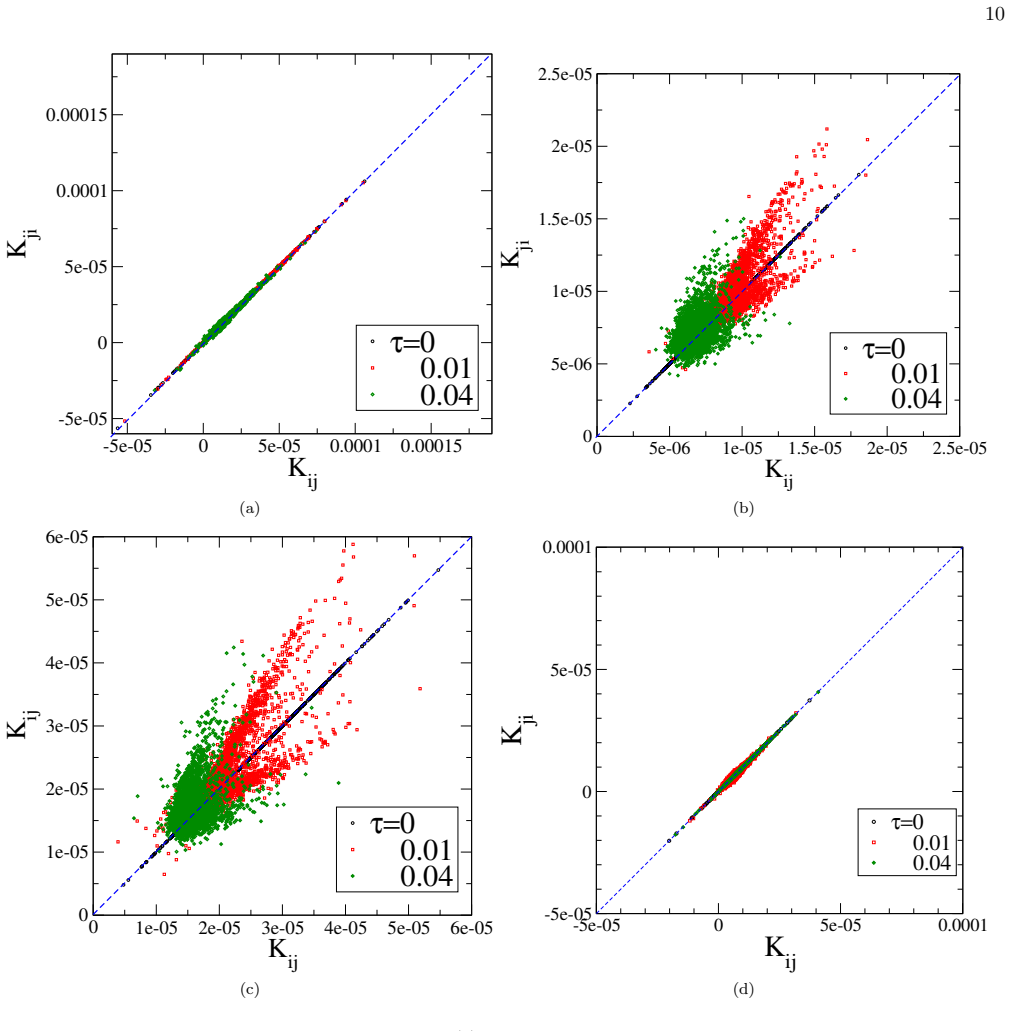
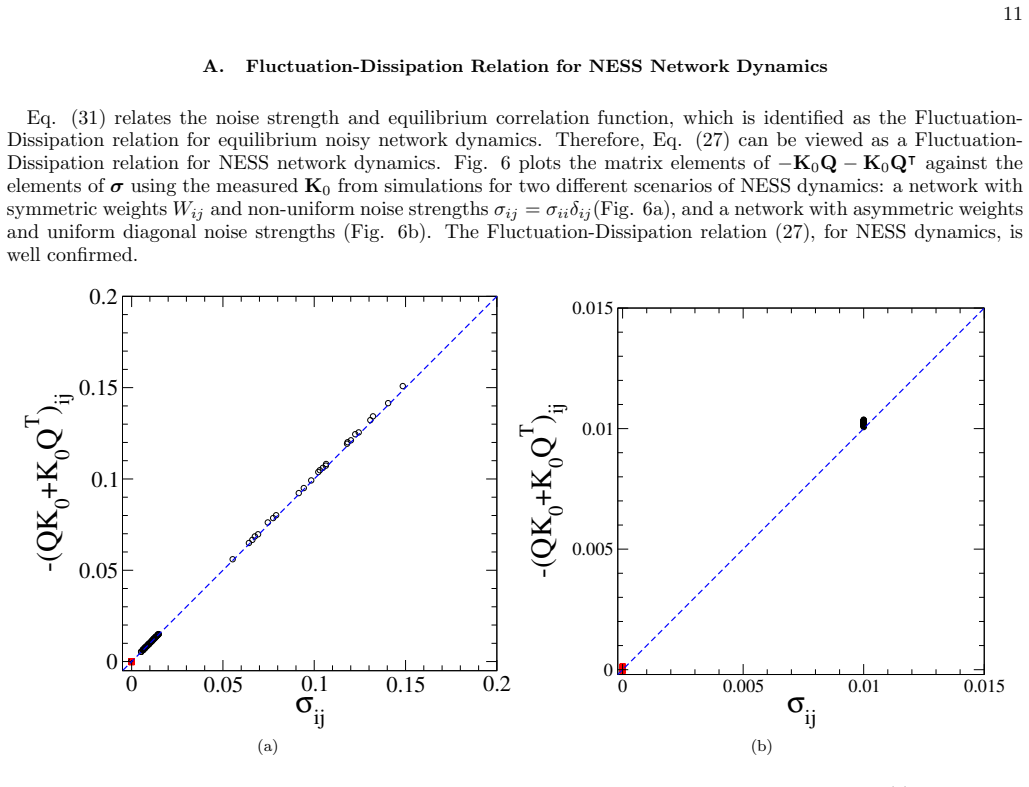
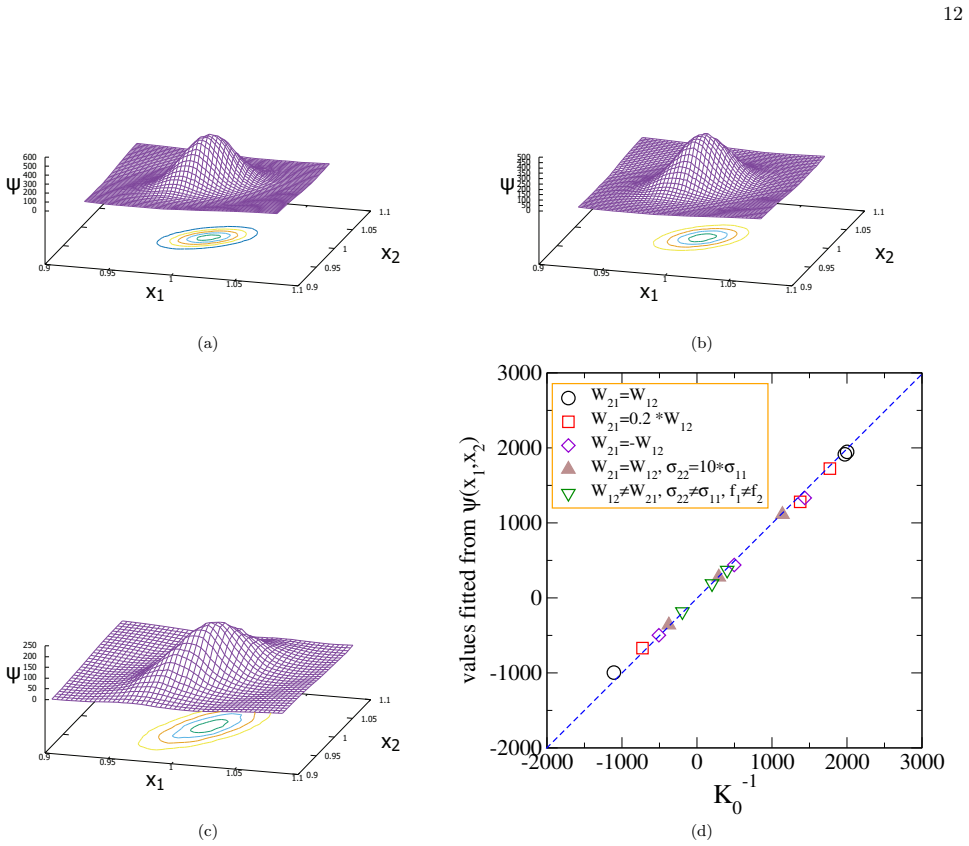
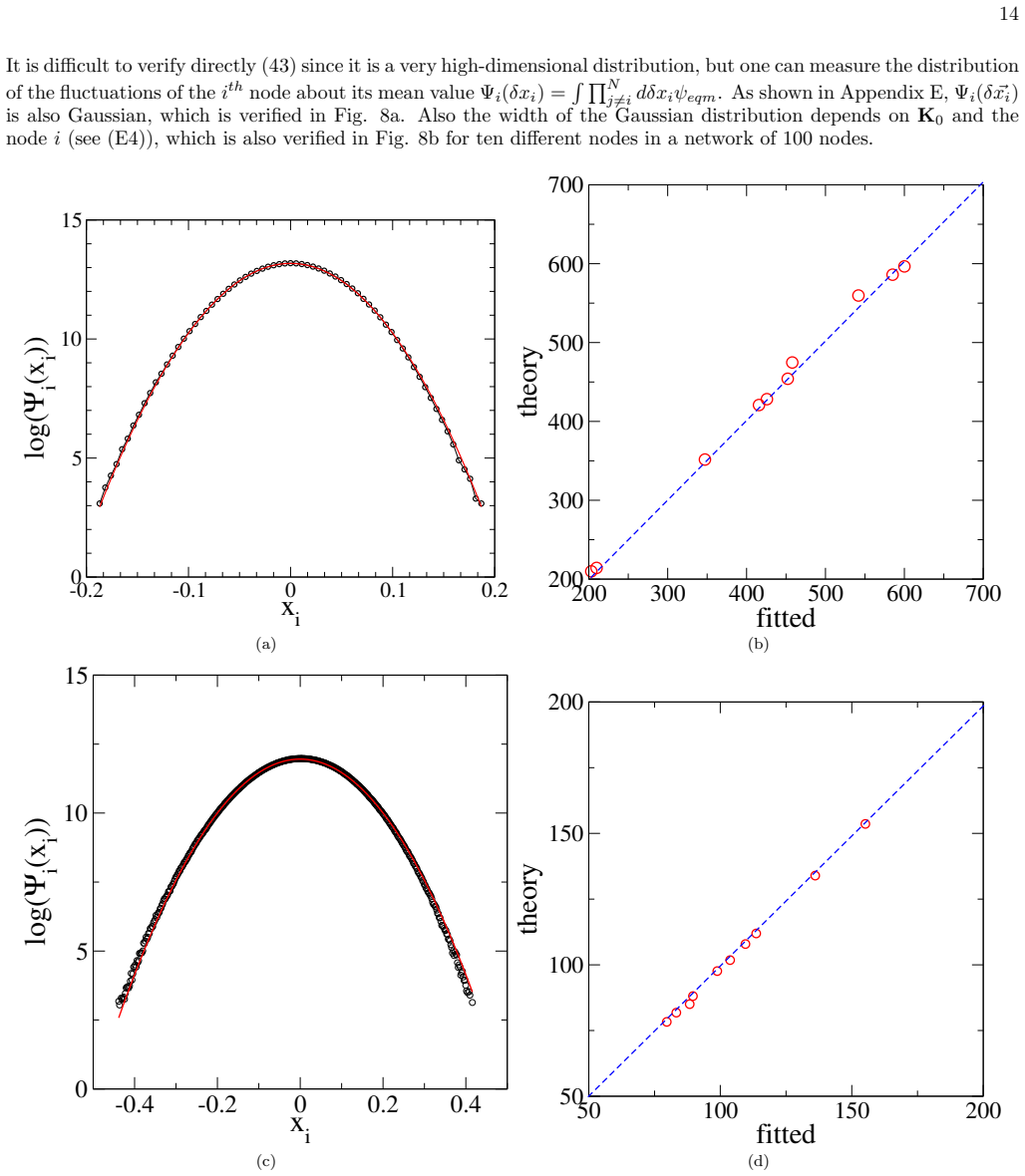
- [Numerical verification] Numerical simulations are cited as verification but no details on noise amplitudes, network sizes, or quantitative error metrics (e.g., deviation from predicted FDR) are mentioned in the provided summary; adding these would strengthen the evidence.
Simulated Author's Rebuttal
We thank the referee for the careful reading and constructive comments, which have helped us clarify the scope and limitations of our work. We address each major comment below and have revised the manuscript accordingly to improve precision regarding the linear regime.
read point-by-point responses
-
Referee: [Abstract and linearization step] The equivalent equilibrium conditions, NESS decomposition into probability current plus drift on an effective potential, and the general FDR are all obtained after linearizing the noisy network equations about the deterministic fixed point. This assumption is load-bearing for the central claims of generality; the manuscript does not quantify the basin of attraction or noise-strength limits under which the effective potential remains scalar and the current is gradient-like. If the underlying network is nonlinear or noise pushes trajectories outside the linear regime, the claimed equivalences and FDR identity are at risk of failing, yet no such test or counterexample discussion is provided.
Authors: We agree that the central results rely on linearization about the deterministic fixed point, as explicitly stated in the abstract and Section II. This is the standard regime for small fluctuations in network dynamics. In the revised manuscript we have added explicit statements in the abstract, introduction, and conclusion clarifying that the equivalences, NESS decomposition, and FDR hold within the linear approximation, valid when noise amplitudes are small enough that trajectories remain inside the basin of attraction of the fixed point. For general nonlinear networks or large noise, higher-order terms can invalidate the exact gradient-like structure of the effective potential; we now note this limitation and indicate that case-specific analysis would be required beyond the linear regime. No numerical counterexamples are added because the paper's scope is the linearized theory, but the added discussion addresses the concern. revision: yes
-
Referee: [FDR derivation section] The FDR is presented as holding for general non-equilibrium cases, but the derivation appears to rely on the same linearization and effective-potential construction used for the NESS analysis. The manuscript should show explicitly how the relation reduces to the equilibrium FDR when symmetries are restored and whether it survives beyond the linear approximation, as this is required to support the 'general' qualifier.
Authors: The FDR derivation begins from the linearized stochastic equations (Eq. (12) in the manuscript). We have added a new subsection (now Section IV.C) that explicitly substitutes the equilibrium symmetry conditions (vanishing probability current and symmetric noise covariance satisfying detailed balance) and shows that the general expression reduces to the standard equilibrium FDR relating the response function to the time derivative of the correlation function. The qualifier 'general' in the original text refers to arbitrary linear noisy directed networks (equilibrium or NESS); it does not claim validity for nonlinear dynamics. Extension beyond linearization would require different methods (e.g., path-integral or perturbative expansions) and is outside the present scope; we have revised the text and abstract to state this limitation clearly. revision: partial
Circularity Check
No circularity: derivations follow from linearization and stochastic analysis without reducing to self-definition or fitted inputs.
full rationale
The paper linearizes fluctuating network dynamics about a deterministic stable fixed point, then decomposes NESS behavior via probability current and an effective potential constructed from the drift; this is an analytical step, not a tautological redefinition. The general FDR is obtained inside the same linear regime as a direct consequence of the Fokker-Planck structure, without invoking fitted parameters later renamed as predictions. No self-citation chain is load-bearing for uniqueness or ansatz adoption, and the link to time-series reconstruction is only discussed, not used to define core quantities. Numerical checks remain within the stated assumptions and do not substitute for the derivation. The chain is therefore self-contained against external benchmarks.
Axiom & Free-Parameter Ledger
axioms (2)
- domain assumption The network possesses a stable, noise-free steady state around which fluctuations occur.
- domain assumption Fluctuations can be treated via linearization about the steady state.
discussion (0)
Sign in with ORCID, Apple, or X to comment. Anyone can read and Pith papers without signing in.