REGAIN: REconciliation GAIN-driven Auxiliary Direction Learning
Pith reviewed 2026-06-28 04:40 UTC · model grok-4.3
The pith
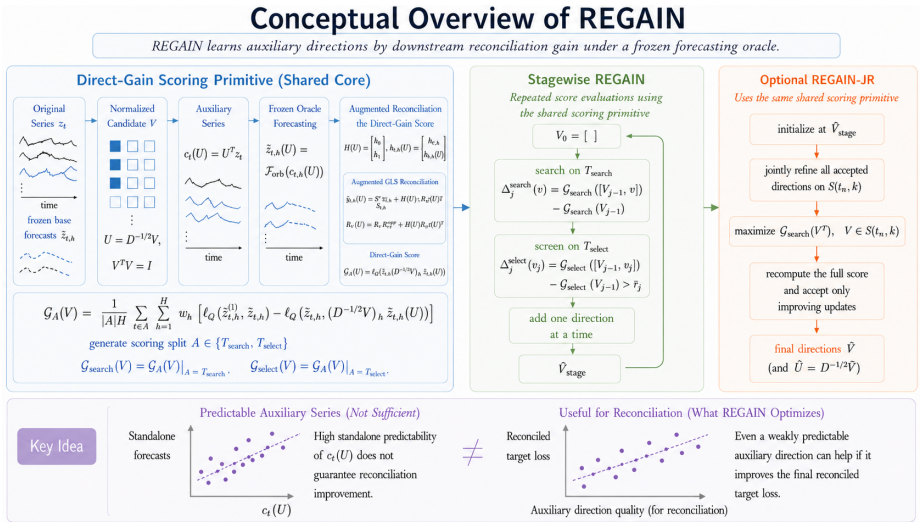
REGAIN selects auxiliary linear directions for reconciliation by the reduction they produce in reconciled target loss rather than by how easy they are to forecast.
A machine-rendered reading of the paper's core claim, the machinery that carries it, and where it could break.
Core claim
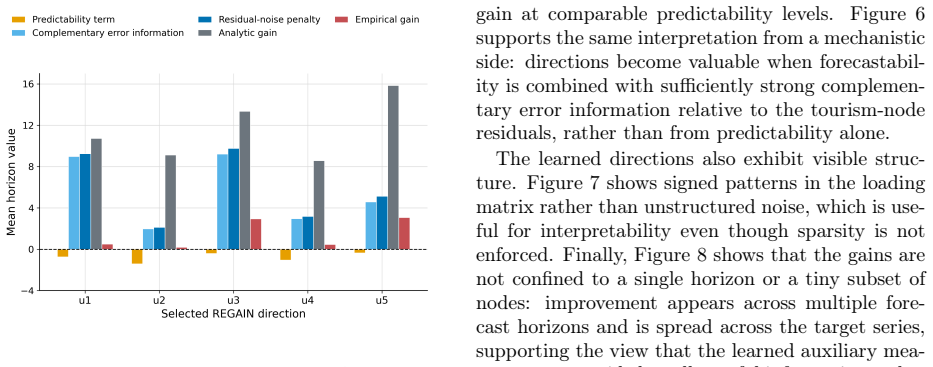
REGAIN learns normalized auxiliary directions, produces forecasts for the induced series with a frozen oracle, and retains directions according to the drop in target-weighted loss after they are folded into an augmented generalized least-squares reconciliation step; the accompanying analysis establishes that such directions succeed precisely when they capture complementary residual uncertainty about the targets.
What carries the argument
The reconciliation-gain screening step that ranks directions by the realized reduction in reconciled quadratic risk on held-out data after generalized least-squares projection.
If this is right
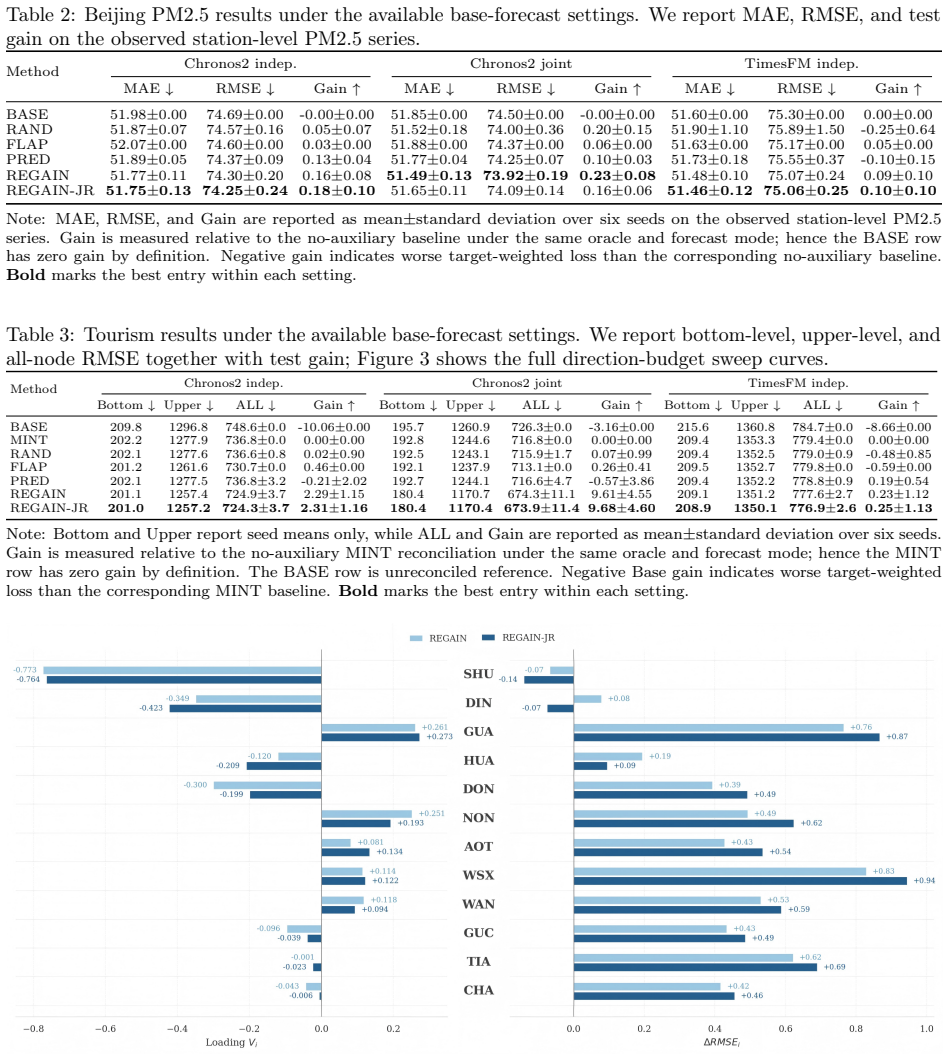
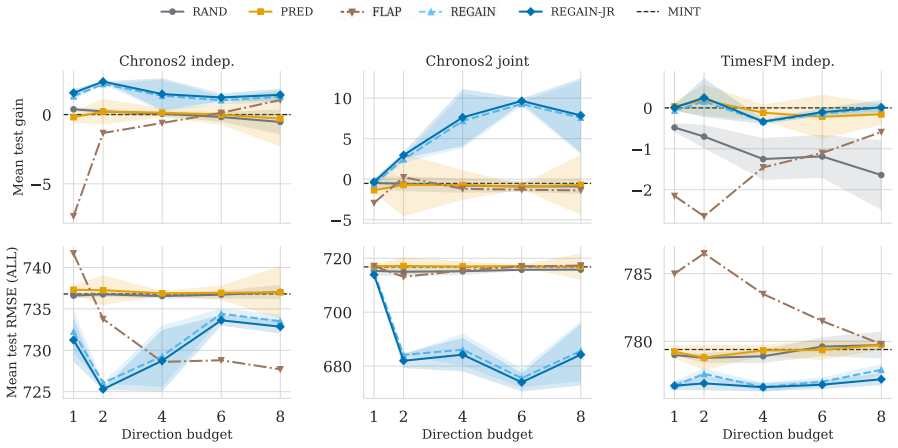
- Gain-selected auxiliaries improve accuracy in ordinary multivariate reconciliation on the Beijing PM2.5 series.
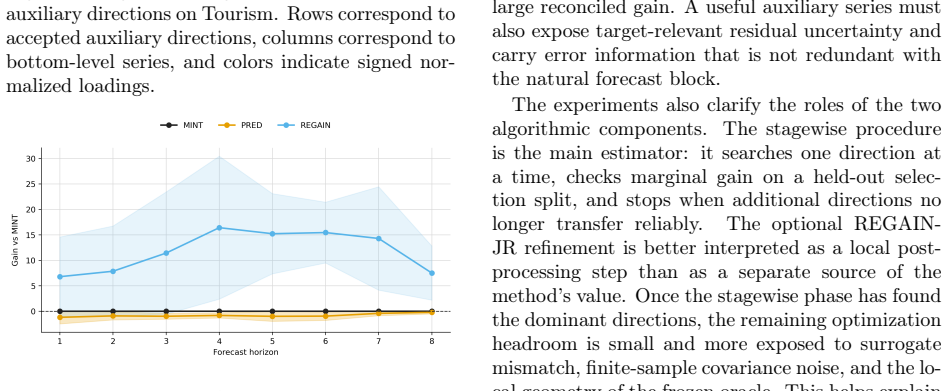
- The same selection procedure improves hierarchical reconciliation on the Australian Tourism data.
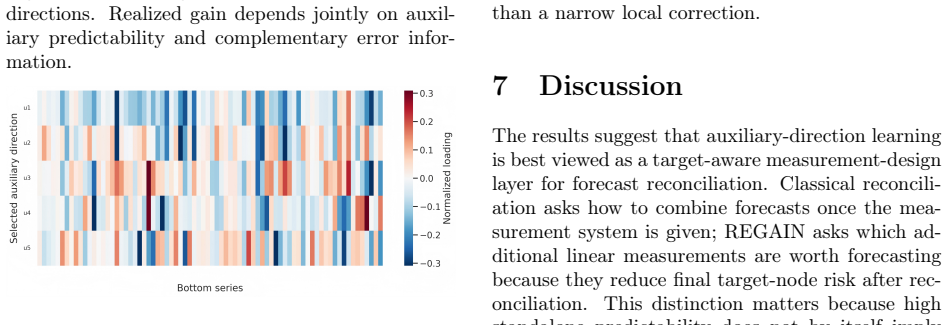
- Useful auxiliary directions must supply information about target uncertainty that remains after the original measurements are used.
- The covariance-risk reduction and bias-change mechanisms are characterized for the augmented reconciliation system.
Where Pith is reading between the lines
- The framework could be extended by replacing the linear measurement assumption with a search over a larger dictionary of possible transformations.
- In operational settings the method implies that measurement budgets might be allocated by solving a gain-maximization problem rather than by collecting the most predictable series.
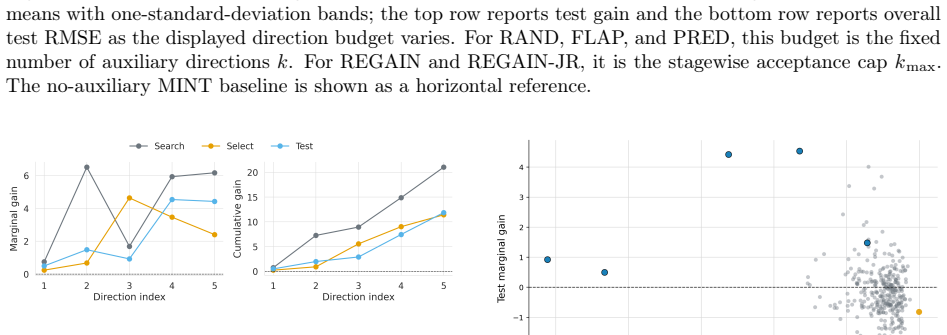
- The held-out screening step suggests a natural way to control overfitting when the candidate pool of directions grows large.
Load-bearing premise
A frozen forecasting oracle produces reliable forecasts for any induced auxiliary series and held-out gain screening stably identifies directions whose benefit carries over to new data without the selection step itself biasing the risk estimates.
What would settle it
Run the full pipeline on the same data but replace the gain-screening step with random direction selection or variance-based selection and observe whether reconciled accuracy on the targets improves, stays flat, or degrades.
Figures
read the original abstract
Forecast reconciliation usually starts from a fixed measurement system and asks how forecasts should be projected onto a coherent space. We ask a different question: which additional linear measurements should be forecast and included in the reconciliation system? We propose REGAIN, a reconciliation-gain framework that learns normalized auxiliary directions, forecasts the induced series with a frozen forecasting oracle, and selects directions by their target-weighted loss reduction after augmented generalized least-squares reconciliation. Unlike variance-based components or predictability-based auxiliary selection, REGAIN optimizes the downstream effect of an auxiliary measurement on the final reconciled forecasts. We provide a statistical characterization showing that useful auxiliary directions must provide complementary information about unresolved target uncertainty, rather than merely being easy to forecast. The analysis also clarifies the covariance-risk reduction mechanism, the role of bias changes in realized quadratic risk, and the stability of estimated gain signals. A stagewise learning algorithm with held-out gain screening is developed, together with an optional joint refinement step. Experiments on Beijing PM2.5 and Australian Tourism data show that gain-selected measurements can improve both ordinary multivariate and hierarchical forecasts, especially when they reveal residual uncertainty not captured by the original measurement system.
Editorial analysis
A structured set of objections, weighed in public.
Referee Report
Summary. The paper introduces REGAIN, a reconciliation-gain framework for learning normalized auxiliary directions in forecast reconciliation. Directions are selected by the reduction they induce in target-weighted loss after forecasts from a frozen oracle are incorporated via augmented generalized least-squares reconciliation. A statistical characterization is provided showing that useful directions supply complementary information about unresolved target uncertainty (rather than mere predictability), along with analysis of covariance-risk reduction and bias changes. A stagewise algorithm with held-out gain screening (plus optional joint refinement) is developed, and experiments on Beijing PM2.5 and Australian Tourism data report improvements for both ordinary multivariate and hierarchical forecasts.
Significance. If the central claims hold, the work shifts reconciliation research from projection onto a fixed coherent space to the principled augmentation of the measurement system itself, with selection explicitly optimized for downstream reconciled performance. The statistical characterization of the covariance mechanism and the distinction from variance- or predictability-based selection constitute a conceptual contribution. The two-dataset experiments provide initial evidence of practical utility when the original system leaves residual uncertainty.
major comments (3)
- [stagewise learning algorithm with held-out gain screening] The stagewise learning algorithm with held-out gain screening (described in the abstract) does not appear to include a formal bound, simulation study, or separated cross-validation scheme addressing finite-sample bias when the same held-out partition is used both to screen directions by empirical gain and (directly or indirectly) to report reconciled risk reduction; this selection-evaluation dependence risks overstating the reported gains on Beijing PM2.5 and Australian Tourism.
- [statistical characterization] The statistical characterization of useful auxiliary directions (abstract) establishes that they must supply complementary information about unresolved target uncertainty, but it is unclear whether the derivation accounts for the dependence introduced by the gain-based selection step itself when bounding or estimating the realized quadratic risk reduction.
- [Experiments on Beijing PM2.5 and Australian Tourism data] The experimental claims rest on improvements observed after gain-selected directions are added, yet the manuscript provides no explicit verification that post-hoc modeling choices (e.g., number of auxiliary directions, target weights) were fixed before screening or that data exclusion rules were pre-specified, leaving open the possibility that the reported gains on the two datasets are sensitive to these choices.
minor comments (2)
- Notation for the normalized auxiliary directions and the target-weighted loss should be introduced with explicit definitions before their use in the gain definition.
- The abstract states that the analysis 'clarifies the stability of estimated gain signals,' but no quantitative stability metric or sensitivity plot is referenced.
Simulated Author's Rebuttal
We thank the referee for the constructive comments, which highlight important aspects of finite-sample behavior and experimental rigor. We address each major comment below, providing clarifications on the methodology and indicating revisions to strengthen the manuscript.
read point-by-point responses
-
Referee: [stagewise learning algorithm with held-out gain screening] The stagewise learning algorithm with held-out gain screening (described in the abstract) does not appear to include a formal bound, simulation study, or separated cross-validation scheme addressing finite-sample bias when the same held-out partition is used both to screen directions by empirical gain and (directly or indirectly) to report reconciled risk reduction; this selection-evaluation dependence risks overstating the reported gains on Beijing PM2.5 and Australian Tourism.
Authors: The held-out partition is used exclusively for gain-based screening of directions, while reconciled performance is reported on a fully independent test partition that is never used for selection or screening. No formal finite-sample bound on the selection-induced bias is derived in the current manuscript. To address the concern, we will add a simulation study examining the finite-sample properties of the gain estimator under the stagewise procedure and will explicitly document the three-way data partitioning (training, screening, test) in the revised experimental section. revision: yes
-
Referee: [statistical characterization] The statistical characterization of useful auxiliary directions (abstract) establishes that they must supply complementary information about unresolved target uncertainty, but it is unclear whether the derivation accounts for the dependence introduced by the gain-based selection step itself when bounding or estimating the realized quadratic risk reduction.
Authors: The characterization in Section 3 is derived at the population level, showing that an auxiliary direction reduces reconciled quadratic risk precisely when it supplies complementary information about the unresolved component of target uncertainty. The derivation does not incorporate the finite-sample dependence induced by subsequent gain-based selection; the selection step is handled separately via the held-out screening procedure. We will revise the section to state this scope explicitly and to note that the population-level result motivates but does not bound the empirical gains. revision: partial
-
Referee: [Experiments on Beijing PM2.5 and Australian Tourism data] The experimental claims rest on improvements observed after gain-selected directions are added, yet the manuscript provides no explicit verification that post-hoc modeling choices (e.g., number of auxiliary directions, target weights) were fixed before screening or that data exclusion rules were pre-specified, leaving open the possibility that the reported gains on the two datasets are sensitive to these choices.
Authors: The number of auxiliary directions, target weights, and all other modeling hyperparameters were fixed on a validation partition prior to any gain screening on the held-out set; data exclusion follows the standard preprocessing pipelines published for these two public datasets. To make this protocol transparent, we will add a dedicated paragraph in the experimental section that lists the pre-specified choices and reports a brief sensitivity check with respect to the number of directions. revision: yes
Circularity Check
No significant circularity; derivation remains self-contained
full rationale
The abstract defines gain explicitly as target-weighted loss reduction after augmented GLS reconciliation and selects directions accordingly; the accompanying statistical characterization (that useful directions supply complementary unresolved uncertainty rather than mere predictability) is presented as following from the covariance-risk mechanism of the reconciliation step itself. No equations are supplied that would make any reported improvement or characterization equivalent to the selection criterion by construction. No self-citations, uniqueness theorems, or ansatzes imported from prior author work appear in the provided text, and the experimental results on Beijing PM2.5 and Australian Tourism data constitute external validation rather than a fitted-input prediction. The method is therefore not forced to its inputs by definition.
Axiom & Free-Parameter Ledger
free parameters (2)
- number of auxiliary directions
- target weights
axioms (2)
- domain assumption Frozen forecasting oracle produces forecasts for induced auxiliary series that can be treated as given inputs to reconciliation.
- domain assumption Augmented generalized least-squares reconciliation is the correct combiner for the original plus auxiliary forecasts.
invented entities (1)
-
normalized auxiliary directions
no independent evidence
Reference graph
Works this paper leans on
-
[1]
and Ahmed, Roman A
Hyndman, Rob J. and Ahmed, Roman A. and Athanasopoulos, George and Shang, Han Lin , title =. Computational Statistics & Data Analysis , year =
-
[2]
and Athanasopoulos, George and Hyndman, Rob J
Wickramasuriya, Shanika L. and Athanasopoulos, George and Hyndman, Rob J. , title =. Journal of the American Statistical Association , year =
-
[3]
, title =
Panagiotelis, Anastasios and Gamakumara, Puwasala and Athanasopoulos, George and Hyndman, Rob J. , title =. European Journal of Operational Research , year =
-
[4]
Proceedings of the 41st International Conference on Machine Learning , series =
Tsiourvas, Asterios and Sun, Wei and Perakis, Georgia and Chen, Pin-Yu and Zhu, Yada , title =. Proceedings of the 41st International Conference on Machine Learning , series =. 2024 , publisher =
2024
-
[5]
and Kourentzes, Nikolaos and Petropoulos, Fotios , title =
Athanasopoulos, George and Hyndman, Rob J. and Kourentzes, Nikolaos and Petropoulos, Fotios , title =. European Journal of Operational Research , year =
-
[6]
International Journal of Forecasting , year =
Di Fonzo, Tommaso and Girolimetto, Daniele , title =. International Journal of Forecasting , year =
-
[7]
, title =
Girolimetto, Daniele and Athanasopoulos, George and Di Fonzo, Tommaso and Hyndman, Rob J. , title =. International Journal of Forecasting , year =
-
[8]
International Journal of Forecasting , year =
Zhang, Bohan and Panagiotelis, Anastasios and Li, Han , title =. International Journal of Forecasting , year =
-
[10]
and Qin, Jing and Wang, Shujun , title =
Yu, Guoqi and Zou, Jing and Hu, Xiaowei and Aviles-Rivero, Angelica I. and Qin, Jing and Wang, Shujun , title =. Proceedings of the 41st International Conference on Machine Learning , series =. 2024 , publisher =
2024
-
[11]
Advances in Neural Information Processing Systems 36 , year =
Zhou, Tian and Niu, Peisong and Wang, Xue and Sun, Liang and Jin, Rong , title =. Advances in Neural Information Processing Systems 36 , year =
-
[12]
Advances in Neural Information Processing Systems 36 , year =
Ni, Zelin and Yu, Hang and Liu, Shizhan and Li, Jianguo and Lin, Weiyao , title =. Advances in Neural Information Processing Systems 36 , year =
-
[13]
and White, Colin , title =
Dooley, Samuel and Khurana, Gurnoor Singh and Mohapatra, Chirag and Naidu, Siddartha V. and White, Colin , title =. Advances in Neural Information Processing Systems 36 , year =
-
[14]
Advances in Neural Information Processing Systems 36 , year =
Gruver, Nate and Finzi, Marc and Qiu, Shikai and Wilson, Andrew Gordon , title =. Advances in Neural Information Processing Systems 36 , year =
-
[15]
and Gifford, Wesley M
Ekambaram, Vijay and Jati, Arindam and Dayama, Pankaj and Mukherjee, Sumanta and Nguyen, Nam H. and Gifford, Wesley M. and Reddy, Chandra and Kalagnanam, Jayant , title =. Advances in Neural Information Processing Systems 37 , year =
-
[16]
Advances in Neural Information Processing Systems 37 , year =
Wang, Yuxuan and Wu, Haixu and Dong, Jiaxiang and Qin, Guo and Zhang, Haoran and Liu, Yong and Qiu, Yunzhong and Wang, Jianmin and Long, Mingsheng , title =. Advances in Neural Information Processing Systems 37 , year =
-
[17]
Proceedings of the 42nd International Conference on Machine Learning , series =
Wang, Yihang and Qiu, Yuying and Chen, Peng and Zhao, Kai and Shu, Yang and Rao, Zhongwen and Pan, Lujia and Yang, Bin and Guo, Chenjuan , title =. Proceedings of the 42nd International Conference on Machine Learning , series =. 2025 , publisher =
2025
-
[18]
, title =
Goerg, Georg M. , title =. Proceedings of the 30th International Conference on Machine Learning , series =. 2013 , publisher =
2013
-
[19]
and Tsay, Ruey S
Matteson, David S. and Tsay, Ruey S. , title =. Journal of the American Statistical Association , year =
-
[20]
Proceedings of the 41st International Conference on Machine Learning , series =
Das, Abhimanyu and Kong, Weihao and Sen, Rajat and Zhou, Yichen , title =. Proceedings of the 41st International Conference on Machine Learning , series =. 2024 , publisher =
2024
-
[22]
and Lakra, Arjun , title =
Banerjee, Buddhananda and Laha, Arnab K. and Lakra, Arjun , title =. Statistical Analysis and Data Mining: The ASA Data Science Journal , year =
-
[23]
, title =
Liang, Jiaxi and Chenouri, Shoja'eddin and Small, Christopher G. , title =. Statistical Analysis and Data Mining: The ASA Data Science Journal , year =
-
[24]
Statistical Analysis and Data Mining: The ASA Data Science Journal , year =
Zhu, Zhengtian and Zhu, Liping , title =. Statistical Analysis and Data Mining: The ASA Data Science Journal , year =
-
[25]
Statistical Analysis and Data Mining: The ASA Data Science Journal , year =
Li, Linxi and Wang, Qin and Ke, Chenlu , title =. Statistical Analysis and Data Mining: The ASA Data Science Journal , year =
-
[26]
Statistical Analysis and Data Mining: The ASA Data Science Journal , year =
Liang, Jinwen and Tian, Maozai , title =. Statistical Analysis and Data Mining: The ASA Data Science Journal , year =
-
[27]
2008 , isbn =
Absil, Pierre-Antoine and Mahony, Robert and Sepulchre, Rodolphe , title =. 2008 , isbn =
2008
-
[28]
The Geometry of Algorithms with Orthogonality Constraints , journal =
Edelman, Alan and Arias, Tom. The Geometry of Algorithms with Orthogonality Constraints , journal =. 1998 , volume =
1998
-
[29]
and Gallivan, Kyle A
Absil, Pierre-Antoine and Baker, Christopher G. and Gallivan, Kyle A. , title =. Foundations of Computational Mathematics , year =
-
[30]
Journal of Multivariate Analysis , year =
Ledoit, Olivier and Wolf, Michael , title =. Journal of Multivariate Analysis , year =
-
[31]
A Shrinkage Approach to Large-Scale Covariance Matrix Estimation and Implications for Functional Genomics , journal =
Sch. A Shrinkage Approach to Large-Scale Covariance Matrix Estimation and Implications for Functional Genomics , journal =. 2005 , volume =
2005
-
[32]
and Koehler, Anne B
Hyndman, Rob J. and Koehler, Anne B. , title =. International Journal of Forecasting , year =
-
[33]
Advantages of the MAD/Mean Ratio over the MAPE , journal =
Kolassa, Stephan and Sch. Advantages of the MAD/Mean Ratio over the MAPE , journal =. 2007 , volume =
2007
-
[34]
and Song, Haiyan and Wu, Doris C
Athanasopoulos, George and Hyndman, Rob J. and Song, Haiyan and Wu, Doris C. , title =. International Journal of Forecasting , year =
-
[35]
Proceedings of the Royal Society A: Mathematical, Physical and Engineering Sciences , year =
Zhang, Shuyi and Guo, Bin and Dong, Anlan and He, Jing and Xu, Ziping and Chen, Song Xi , title =. Proceedings of the Royal Society A: Mathematical, Physical and Engineering Sciences , year =
-
[36]
International Journal of Forecasting , year =
Makridakis, Spyros and Spiliotis, Evangelos and Assimakopoulos, Vassilios , title =. International Journal of Forecasting , year =
-
[37]
Technometrics , volume=
Ridge Regression: Biased Estimation for Nonorthogonal Problems , author=. Technometrics , volume=
-
[38]
SIAM Journal on Matrix Analysis and Applications , volume=
Tikhonov Regularization and Total Least Squares , author=. SIAM Journal on Matrix Analysis and Applications , volume=
-
[39]
Journal of the Society for Industrial and Applied Mathematics , volume=
An Algorithm for Least-Squares Estimation of Nonlinear Parameters , author=. Journal of the Society for Industrial and Applied Mathematics , volume=
-
[40]
Baker, and Kyle A
Pierre-Antoine Absil, Christopher G. Baker, and Kyle A. Gallivan. Trust-region methods on riemannian manifolds. Foundations of Computational Mathematics, 7 0 (3): 0 303--330, 2007
2007
-
[41]
Optimization Algorithms on Matrix Manifolds
Pierre-Antoine Absil, Robert Mahony, and Rodolphe Sepulchre. Optimization Algorithms on Matrix Manifolds. Princeton University Press, 2008. ISBN 9780691132983
2008
-
[42]
Abdul Fatir Ansari, Lorenzo Stella, Ali Caner Turkmen, Xiyuan Zhang, Pedro Mercado, Huibin Shen, Oleksandr Shchur, Syama Sundar Rangapuram, Sebastian Pineda Arango, Shubham Kapoor, Jasper Zschiegner, Danielle C. Maddix, Hao Wang, Michael W. Mahoney, Kari Torkkola, Andrew Gordon Wilson, Michael Bohlke-Schneider, and Yuyang Wang. Chronos: Learning the langu...
Pith/arXiv arXiv 2024
-
[43]
Hyndman, Haiyan Song, and Doris C
George Athanasopoulos, Rob J. Hyndman, Haiyan Song, and Doris C. Wu. The tourism forecasting competition. International Journal of Forecasting, 27 0 (3): 0 822--844, 2011
2011
-
[44]
Hyndman, Nikolaos Kourentzes, and Fotios Petropoulos
George Athanasopoulos, Rob J. Hyndman, Nikolaos Kourentzes, and Fotios Petropoulos. Forecasting with temporal hierarchies. European Journal of Operational Research, 262 0 (1): 0 60--74, 2017
2017
-
[45]
Laha, and Arjun Lakra
Buddhananda Banerjee, Arnab K. Laha, and Arjun Lakra. Data-driven dimension reduction in functional principal component analysis identifying the change-point in functional data. Statistical Analysis and Data Mining: The ASA Data Science Journal, 13 0 (6): 0 529--536, 2020
2020
-
[46]
A decoder-only foundation model for time-series forecasting
Abhimanyu Das, Weihao Kong, Rajat Sen, and Yichen Zhou. A decoder-only foundation model for time-series forecasting. In Proceedings of the 41st International Conference on Machine Learning, volume 235 of Proceedings of Machine Learning Research, pages 10148--10167. PMLR, 2024
2024
-
[47]
Cross-temporal forecast reconciliation: Optimal combination method and heuristic alternatives
Tommaso Di Fonzo and Daniele Girolimetto. Cross-temporal forecast reconciliation: Optimal combination method and heuristic alternatives. International Journal of Forecasting, 39 0 (1): 0 39--57, 2023
2023
-
[48]
Naidu, and Colin White
Samuel Dooley, Gurnoor Singh Khurana, Chirag Mohapatra, Siddartha V. Naidu, and Colin White. Forecastpfn: Synthetically-trained zero-shot forecasting. In Advances in Neural Information Processing Systems 36, 2023
2023
-
[49]
Arias, and Steven T
Alan Edelman, Tom \'a s A. Arias, and Steven T. Smith. The geometry of algorithms with orthogonality constraints. SIAM Journal on Matrix Analysis and Applications, 20 0 (2): 0 303--353, 1998
1998
-
[50]
Nguyen, Wesley M
Vijay Ekambaram, Arindam Jati, Pankaj Dayama, Sumanta Mukherjee, Nam H. Nguyen, Wesley M. Gifford, Chandra Reddy, and Jayant Kalagnanam. Tiny time mixers (ttms): Fast pre-trained models for enhanced zero/few-shot forecasting of multivariate time series. In Advances in Neural Information Processing Systems 37, 2024
2024
-
[51]
Daniele Girolimetto, George Athanasopoulos, Tommaso Di Fonzo, and Rob J. Hyndman. Cross-temporal probabilistic forecast reconciliation: Methodological and practical issues. International Journal of Forecasting, 40 0 (3): 0 1134--1151, 2024
2024
-
[52]
Georg M. Goerg. Forecastable component analysis. In Proceedings of the 30th International Conference on Machine Learning, volume 28 of Proceedings of Machine Learning Research, pages 64--72. PMLR, 2013
2013
-
[53]
Golub, Per Christian Hansen, and Dianne P
Gene H. Golub, Per Christian Hansen, and Dianne P. O'Leary. Tikhonov regularization and total least squares. SIAM Journal on Matrix Analysis and Applications, 21 0 (1): 0 185--194, 1999
1999
-
[54]
Large language models are zero-shot time series forecasters
Nate Gruver, Marc Finzi, Shikai Qiu, and Andrew Gordon Wilson. Large language models are zero-shot time series forecasters. In Advances in Neural Information Processing Systems 36, 2023
2023
-
[55]
Hoerl and Robert W
Arthur E. Hoerl and Robert W. Kennard. Ridge regression: Biased estimation for nonorthogonal problems. Technometrics, 12 0 (1): 0 55--67, 1970
1970
-
[56]
Hyndman, Roman A
Rob J. Hyndman, Roman A. Ahmed, George Athanasopoulos, and Han Lin Shang. Optimal combination forecasts for hierarchical time series. Computational Statistics & Data Analysis, 55 0 (9): 0 2579--2589, 2011
2011
-
[57]
A well-conditioned estimator for large-dimensional covariance matrices
Olivier Ledoit and Michael Wolf. A well-conditioned estimator for large-dimensional covariance matrices. Journal of Multivariate Analysis, 88 0 (2): 0 365--411, 2004
2004
-
[58]
Local support vector machine based dimension reduction
Linxi Li, Qin Wang, and Chenlu Ke. Local support vector machine based dimension reduction. Statistical Analysis and Data Mining: The ASA Data Science Journal, 15 0 (6): 0 722--735, 2022
2022
-
[59]
Jiaxi Liang, Shoja'eddin Chenouri, and Christopher G. Small. A new method for performance analysis in nonlinear dimensionality reduction. Statistical Analysis and Data Mining: The ASA Data Science Journal, 13 0 (1): 0 98--108, 2020
2020
-
[60]
Imputed quantile vector autoregressive model for multivariate spatial-temporal data
Jinwen Liang and Maozai Tian. Imputed quantile vector autoregressive model for multivariate spatial-temporal data. Statistical Analysis and Data Mining: The ASA Data Science Journal, 17, 2024
2024
-
[61]
Marquardt
Donald W. Marquardt. An algorithm for least-squares estimation of nonlinear parameters. Journal of the Society for Industrial and Applied Mathematics, 11 0 (2): 0 431--441, 1963
1963
-
[62]
Matteson and Ruey S
David S. Matteson and Ruey S. Tsay. Dynamic orthogonal components for multivariate time series. Journal of the American Statistical Association, 106 0 (496): 0 1450--1463, 2011
2011
-
[63]
Basisformer: Attention-based time series forecasting with learnable and interpretable basis
Zelin Ni, Hang Yu, Shizhan Liu, Jianguo Li, and Weiyao Lin. Basisformer: Attention-based time series forecasting with learnable and interpretable basis. In Advances in Neural Information Processing Systems 36, 2023
2023
-
[64]
Anastasios Panagiotelis, Puwasala Gamakumara, George Athanasopoulos, and Rob J. Hyndman. Probabilistic forecast reconciliation: Properties, evaluation and score optimisation. European Journal of Operational Research, 306 0 (2): 0 693--706, 2023
2023
-
[65]
A shrinkage approach to large-scale covariance matrix estimation and implications for functional genomics
Juliane Sch \"a fer and Korbinian Strimmer. A shrinkage approach to large-scale covariance matrix estimation and implications for functional genomics. Statistical Applications in Genetics and Molecular Biology, 4 0 (1): 0 Article 32, 2005
2005
-
[66]
Learning optimal projection for forecast reconciliation of hierarchical time series
Asterios Tsiourvas, Wei Sun, Georgia Perakis, Pin-Yu Chen, and Yada Zhu. Learning optimal projection for forecast reconciliation of hierarchical time series. In Proceedings of the 41st International Conference on Machine Learning, volume 235 of Proceedings of Machine Learning Research, pages 48713--48727. PMLR, 2024
2024
-
[67]
Towards a general time series forecasting model with unified representation and adaptive transfer
Yihang Wang, Yuying Qiu, Peng Chen, Kai Zhao, Yang Shu, Zhongwen Rao, Lujia Pan, Bin Yang, and Chenjuan Guo. Towards a general time series forecasting model with unified representation and adaptive transfer. In Proceedings of the 42nd International Conference on Machine Learning, volume 267 of Proceedings of Machine Learning Research, pages 64127--64151. ...
2025
-
[68]
Timexer: Empowering transformers for time series forecasting with exogenous variables
Yuxuan Wang, Haixu Wu, Jiaxiang Dong, Guo Qin, Haoran Zhang, Yong Liu, Yunzhong Qiu, Jianmin Wang, and Mingsheng Long. Timexer: Empowering transformers for time series forecasting with exogenous variables. In Advances in Neural Information Processing Systems 37, 2024
2024
-
[69]
Wickramasuriya, George Athanasopoulos, and Rob J
Shanika L. Wickramasuriya, George Athanasopoulos, and Rob J. Hyndman. Optimal forecast reconciliation for hierarchical and grouped time series through trace minimization. Journal of the American Statistical Association, 114 0 (526): 0 804--819, 2019
2019
-
[70]
Hyndman, and Anastasios Panagiotelis
Yangzhuoran Fin Yang, George Athanasopoulos, Rob J. Hyndman, and Anastasios Panagiotelis. Forecast linear augmented projection (flap): A free lunch to reduce forecast error variance. arXiv preprint arXiv:2407.01868, 2024
arXiv 2024
-
[71]
Aviles-Rivero, Jing Qin, and Shujun Wang
Guoqi Yu, Jing Zou, Xiaowei Hu, Angelica I. Aviles-Rivero, Jing Qin, and Shujun Wang. Revitalizing multivariate time series forecasting: Learnable decomposition with inter-series dependencies and intra-series variations modeling. In Proceedings of the 41st International Conference on Machine Learning, volume 235 of Proceedings of Machine Learning Research...
2024
-
[72]
Constructing hierarchical time series through clustering: Is there an optimal way for forecasting? International Journal of Forecasting, 41 0 (3): 0 1022--1036, 2025
Bohan Zhang, Anastasios Panagiotelis, and Han Li. Constructing hierarchical time series through clustering: Is there an optimal way for forecasting? International Journal of Forecasting, 41 0 (3): 0 1022--1036, 2025
2025
-
[73]
Cautionary tales on air-quality improvement in beijing
Shuyi Zhang, Bin Guo, Anlan Dong, Jing He, Ziping Xu, and Song Xi Chen. Cautionary tales on air-quality improvement in beijing. Proceedings of the Royal Society A: Mathematical, Physical and Engineering Sciences, 473 0 (2205): 0 20170457, 2017
2017
-
[74]
One fits all: Power general time series analysis by pretrained LM
Tian Zhou, Peisong Niu, Xue Wang, Liang Sun, and Rong Jin. One fits all: Power general time series analysis by pretrained LM . In Advances in Neural Information Processing Systems 36, 2023
2023
-
[75]
Distributed dimension reduction with nearly oracle rate
Zhengtian Zhu and Liping Zhu. Distributed dimension reduction with nearly oracle rate. Statistical Analysis and Data Mining: The ASA Data Science Journal, 15 0 (6): 0 692--706, 2022
2022
discussion (0)
Sign in with ORCID, Apple, or X to comment. Anyone can read and Pith papers without signing in.