Mapping photon-number regimes in single-emitter lasers
Pith reviewed 2026-07-01 05:49 UTC · model grok-4.3
The pith
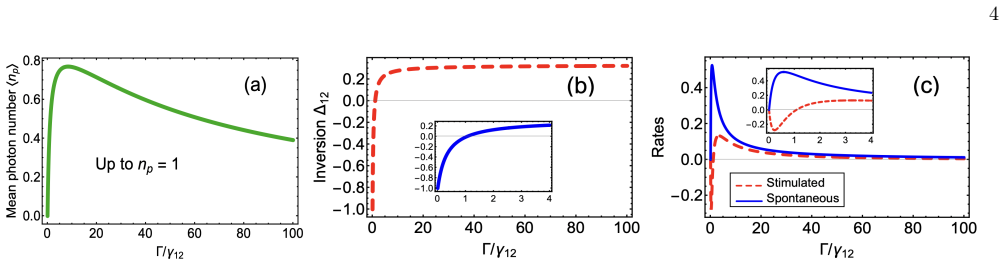
Lasing stabilizes in single-emitter systems at intermediate photon numbers from 2 to 50, producing sub-Poissonian light with incoherent pumping alone.
A machine-rendered reading of the paper's core claim, the machinery that carries it, and where it could break.
Core claim
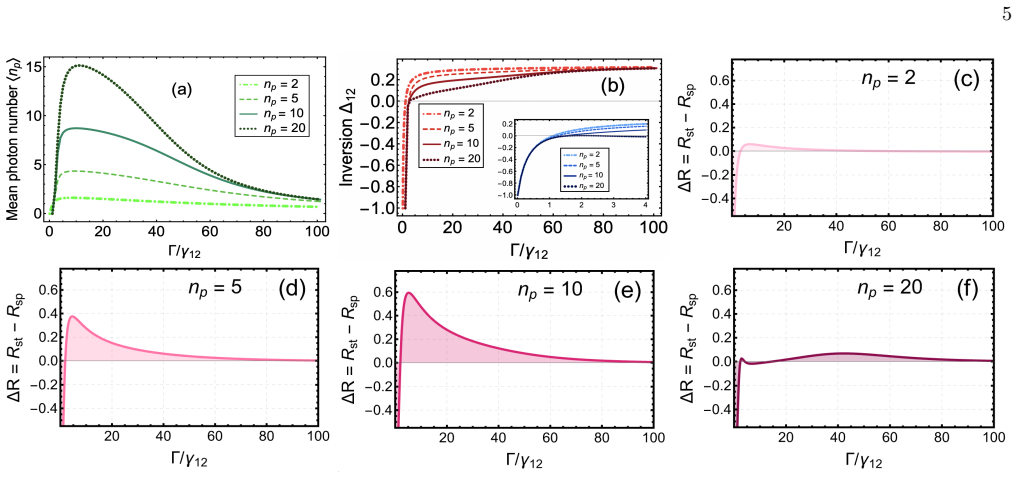
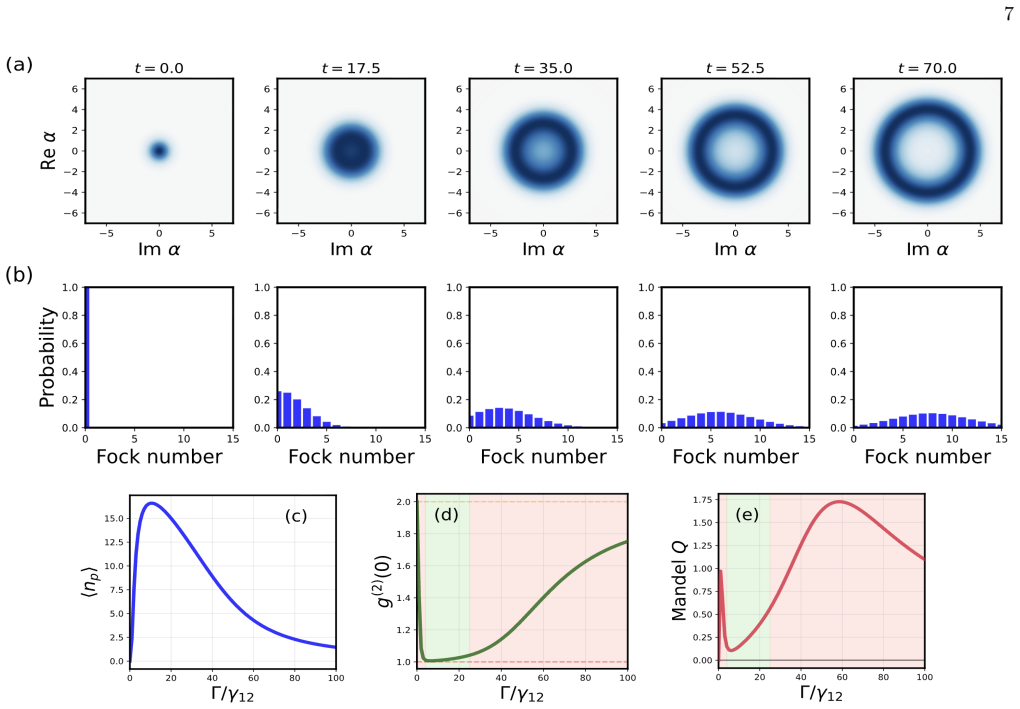
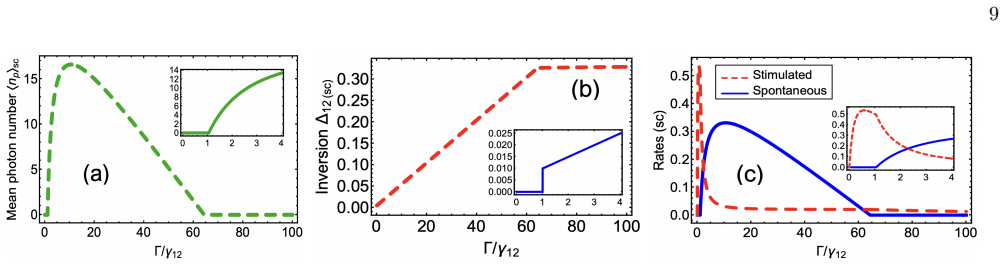
Numerical solution of the Lindblad master equation for the open quantum system reveals that lasing stabilizes in the intermediate quantum regime (2 ≤ n_p ≤ 50) where stimulated emission dominates spontaneous emission, producing sub-Poissonian statistics confirmed by g^{(2)}(0) ≈ 1 and minimized Mandel Q, while the semi-classical regime quenches at Γ ≈ 65 γ_{12} under the mean-field approximation.
What carries the argument
Division of cavity photon number into deep quantum (n_p ≤ 1), intermediate quantum (2 ≤ n_p ≤ 50), and semi-classical (n_p ≫ 50) regimes, analyzed via the Lindblad master equation in a truncated Hilbert space up to dimension 51.
If this is right
- Laser behavior can appear at minimal photon populations without any coherent drive.
- Sub-Poissonian photon statistics hold when stimulated emission dominates in the 2-50 photon window.
- Self-quenching of coherence occurs inside the intermediate regime at elevated incoherent pumping rates.
- Single-emitter sources have defined operational limits set by the transition between quantum and semi-classical regimes.
Where Pith is reading between the lines
- Device designs could target cavity parameters that keep average photon number inside the 2-50 window to maintain non-classical output.
- The observed quenching point supplies a concrete benchmark that future experiments can use to test the boundary between regimes.
Load-bearing premise
The mean-field approximation remains valid for photon numbers much larger than 50 under the chosen system parameters.
What would settle it
Direct measurement of the Mandel Q parameter reaching a clear minimum and g^{(2)}(0) staying near 1 for photon numbers between 2 and 50, or observation of laser quenching exactly when the incoherent pumping rate reaches 65 times the atomic decay rate γ_{12}.
Figures
read the original abstract
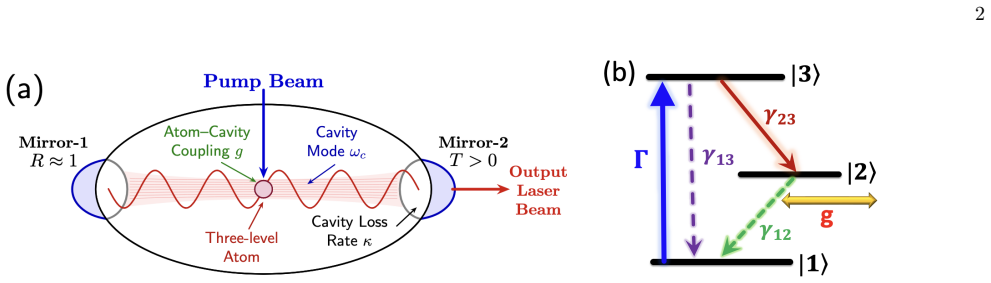
Cavity quantum electrodynamics (cQED) architectures are known to produce traditional laser signatures from a coherently driven single quantum emitter. In this paper, we present a numerical analysis of an open quantum system consisting of an incoherently pumped three-level emitter strongly coupled to a single cavity mode. In particular, we focus on three cavity photon-number ($n_p$) regimes modeled within a truncated Hilbert space of dimension up to $N=51$: deep quantum ($n_p \leq 1$), intermediate quantum ($2 \leq n_p \leq 50$), and semi-classical ($n_p \gg 50$). We investigate the photon threshold for entering the lasing regime while completely bypassing the requirement for a coherent drive, revealing that laser behavior can emerge from minimal photon populations. For example, by solving the Lindblad master equation, we find that lasing stabilizes in the intermediate quantum regime where stimulated emission dominates spontaneous emission. We further observe sub-Poissonian photon statistics in this regime, as confirmed by a donut-like Wigner distribution, near-unity second-order coherence function $g^{(2)}(0) \approx 1$, and a minimized Mandel $Q$-parameter. However, within the range $10 < n_p < 50$, we observe a loss of coherence at higher incoherent pumping rates, leading to self-quenching. In the semi-classical regime ($n_p \gg 50$), treated under a mean-field approximation for our choice of system parameters, we find that the laser quenches at an incoherent pumping rate of $\Gamma \approx 65$ (in units of the atomic decay rate $\gamma_{12}$). Our findings can be applied to define the operational limits of single-emitter light sources, thereby providing useful guidelines for the development of nanolasers and scalable quantum networks.
Editorial analysis
A structured set of objections, weighed in public.
Referee Report
Summary. The manuscript numerically analyzes an incoherently pumped three-level emitter strongly coupled to a single cavity mode, mapping three photon-number regimes (deep quantum n_p ≤1, intermediate quantum 2≤n_p≤50, semi-classical n_p≫50) via direct solution of the Lindblad master equation in a truncated Hilbert space of dimension N=51 for the quantum regimes and a mean-field approximation for the semi-classical regime. It claims that lasing stabilizes in the intermediate regime where stimulated emission dominates spontaneous emission, producing sub-Poissonian statistics (g^{(2)}(0)≈1, minimized Mandel Q, donut-like Wigner function), while the semi-classical regime exhibits quenching at an incoherent pumping rate Γ≈65 γ_{12}. The work positions these results as guidelines for operational limits of single-emitter light sources and nanolasers without requiring coherent drive.
Significance. If the central numerical results hold after validation of the mean-field step, the mapping of lasing onset and quenching thresholds across regimes would supply concrete operational guidelines for nanolasers and quantum networks. The direct Lindblad integration in the quantum regimes (avoiding any fitted parameters or circular reduction) is a methodological strength that supports the sub-Poissonian statistics claim in 2≤n_p≤50.
major comments (1)
- [semi-classical regime (n_p ≫50)] Semi-classical regime (n_p ≫50) paragraph: the reported quenching at Γ≈65 γ_{12} rests on an unverified mean-field approximation for the chosen rates; no cross-check against full Lindblad numerics, variance suppression, or consistency at the n_p≈50 boundary is supplied, which is load-bearing for the three-regime mapping and the quenching claim.
minor comments (2)
- The abstract and methods would benefit from an explicit table or list of all system parameters (including the chosen rates and the precise truncation N=51) together with any convergence tests performed on the Hilbert-space cutoff.
- No error bars or statistical uncertainty estimates are reported on the extracted quantities (thresholds, g^{(2)}(0), Q) despite the numerical nature of the work.
Simulated Author's Rebuttal
We thank the referee for their careful reading and constructive feedback on our manuscript. We address the single major comment below.
read point-by-point responses
-
Referee: [semi-classical regime (n_p ≫50)] Semi-classical regime (n_p ≫50) paragraph: the reported quenching at Γ≈65 γ_{12} rests on an unverified mean-field approximation for the chosen rates; no cross-check against full Lindblad numerics, variance suppression, or consistency at the n_p≈50 boundary is supplied, which is load-bearing for the three-regime mapping and the quenching claim.
Authors: We agree that explicit cross-validation would strengthen the presentation. Full Lindblad integration for n_p ≫ 50 is computationally prohibitive, as the required Hilbert-space truncation far exceeds the N=51 limit used for the quantum regimes; this is precisely why the mean-field treatment is adopted for the semi-classical regime. The approximation is standard in laser theory once relative number fluctuations become small. In the revised manuscript we will expand the semi-classical paragraph to (i) state the computational rationale for the mean-field choice, (ii) note that the quenching threshold is consistent with the loss of coherence already observed in the 10 < n_p < 50 window of the Lindblad data, and (iii) cite established validations of mean-field laser models at comparable photon numbers. This addition addresses the verification concern while preserving the three-regime structure. revision: partial
Circularity Check
No circularity: results obtained by direct numerical integration of Lindblad equation
full rationale
The paper derives its regime mappings, photon statistics, and quenching thresholds exclusively from numerical solution of the Lindblad master equation in a truncated space (N=51) for the quantum regimes and a mean-field approximation for the semi-classical regime. No load-bearing step reduces a claimed prediction to a fitted parameter by construction, nor does any result rely on self-citation chains or ansatzes imported from prior author work. All reported quantities (g^(2)(0), Mandel Q, Wigner function, quenching at Γ ≈ 65 γ12) are direct outputs of the chosen dynamical equations applied to the model parameters; the derivation chain is therefore self-contained and non-circular.
Axiom & Free-Parameter Ledger
free parameters (2)
- Hilbert-space truncation dimension N =
51
- Incoherent pumping rate at quenching =
65 γ_{12}
axioms (2)
- standard math Dynamics obey the Lindblad master equation for Markovian dissipation
- domain assumption Mean-field approximation is accurate for n_p ≫ 50 under the paper's parameter choice
Reference graph
Works this paper leans on
-
[1]
These parameters are : ◦Wigner distribution, ◦Occupation probability, ◦Second-order coherence functiong (2)(0), and ◦MandelQparameter
Further Evidence of Lasing To provide further evidence of lasing in the interme- diate quantum regime, we now go beyond the previ- ously studied parameters and discuss four additional pa- rameters within a truncated Hilbert space of dimension N= 51. These parameters are : ◦Wigner distribution, ◦Occupation probability, ◦Second-order coherence functiong (2)...
2025
-
[2]
One-atomlasers,
Y.MuandC.Savage, “One-atomlasers,”Physical Review A, vol. 46, no. 9, p. 5944, 1992
1992
-
[3]
Experimental realization of a one-atom laser in the regime of strong coupling,
J. McKeever, A. Boca, A. D. Boozer, J. R. Buck, and H. J. Kimble, “Experimental realization of a one-atom laser in the regime of strong coupling,”Nature, vol. 425, no. 6955, pp. 268–271, 2003
2003
-
[4]
H. J. Carmichael,Statistical methods in quantum op- tics 1: master equations and Fokker-Planck equations. Springer Science & Business Media, 2013
2013
-
[5]
H. J. Carmichael,Statistical methods in quantum optics 2: Non-classical fields. Springer, 2008
2008
-
[6]
Breuer and F
H.-P. Breuer and F. Petruccione,The theory of open quantum systems. OUP Oxford, 2002
2002
-
[7]
M. O. Scully and M. S. Zubairy,Quantum optics. Cam- bridge university press, 1997
1997
-
[8]
Cavity quantum electrodynamics,
H. Walther, B. T. Varcoe, B.-G. Englert, and T. Becker, “Cavity quantum electrodynamics,”Reports on Progress in Physics, vol. 69, no. 5, pp. 1325–1382, 2006
2006
-
[9]
Photon statistics of a cavity-QED laser: A comment on the laser–phase- transition analogy,
P. R. Rice and H. Carmichael, “Photon statistics of a cavity-QED laser: A comment on the laser–phase- transition analogy,”Physical Review A, vol. 50, no. 5, p. 4318, 1994. 10
1994
-
[10]
Observa- tion of sub-poissonian photon statistics in a micromaser,
G. Rempe, F. Schmidt-Kaler, and H. Walther, “Observa- tion of sub-poissonian photon statistics in a micromaser,” Physical review letters, vol. 64, no. 23, p. 2783, 1990
1990
-
[11]
The quantum internet,
H. J. Kimble, “The quantum internet,”Nature, vol. 453, no. 7198, pp. 1023–1030, 2008
2008
-
[12]
Quantum optical master equations: The one-atom laser,
C. Ginzel, H.-J. Briegel, U. Martini, B.-G. Englert, and A. Schenzle, “Quantum optical master equations: The one-atom laser,”Physical Review A, vol. 48, no. 1, p. 732, 1993
1993
-
[13]
Relation between the N-atom laser and the one-atom laser,
M. Fleischhauer, “Relation between the N-atom laser and the one-atom laser,”Physical Review A, vol. 50, no. 3, p. 2773, 1994
1994
-
[14]
Sin- gle artificial-atom lasing,
O. Astafiev, K. Inomata, A. Niskanen, T. Yamamoto, Y. A. Pashkin, Y. Nakamura, and J. Tsai, “Sin- gle artificial-atom lasing,”Nature, vol. 449, no. 7162, pp. 588–590, 2007
2007
-
[15]
Laserlike and atomlike regimes in a one-atom laser,
A. Boozer, “Laserlike and atomlike regimes in a one-atom laser,”Physical Review A, vol. 78, no. 5, p. 053814, 2008
2008
-
[16]
Single-artificial-atom lasing using a voltage-biased su- perconducting charge qubit,
S. Ashhab, J. Johansson, A. Zagoskin, and F. Nori, “Single-artificial-atom lasing using a voltage-biased su- perconducting charge qubit,”New Journal of Physics, vol. 11, no. 2, p. 023030, 2009
2009
-
[17]
Emission properties and photon statistics of a single quantum dot laser,
S. Ritter, P. Gartner, C. Gies, and F. Jahnke, “Emission properties and photon statistics of a single quantum dot laser,”Optics Express, vol. 18, no. 10, pp. 9909–9921, 2010
2010
-
[18]
Quantum to classical tran- sition in a single-ion laser,
F. Dubin, C. Russo, H. G. Barros, A. Stute, C. Becher, P. O. Schmidt, and R. Blatt, “Quantum to classical tran- sition in a single-ion laser,”Nature Physics, vol. 6, no. 5, pp. 350–353, 2010
2010
-
[19]
Two-level laser: Analytical results and the laser transition,
P. Gartner, “Two-level laser: Analytical results and the laser transition,”Physical Review A, vol. 84, no. 5, p. 053804, 2011
2011
-
[20]
Analytical results from the quantum theory of a single-emitter nanolaser,
N. V. Larionov and M. I. Kolobov, “Analytical results from the quantum theory of a single-emitter nanolaser,” Physical Review A, vol. 84, no. 5, p. 055801, 2011
2011
-
[21]
Single atom laser in normal-superconductor quantum dots,
G. Rastelli and M. Governale, “Single atom laser in normal-superconductor quantum dots,”Physical Review B, vol. 100, p. 085435, 2019
2019
-
[22]
Continuous generation of quantum light from a single ground-state atom in an optical cavity,
C. J. Villas-Boas, K. N. Tolazzi, B. Wang, C. Ianzano, and G. Rempe, “Continuous generation of quantum light from a single ground-state atom in an optical cavity,” Physical Review Letters, vol. 124, no. 9, p. 093603, 2020
2020
-
[23]
Nondegenerate two-photon lasing in a single quantum dot,
S. K. Hazra, L. Addepalli, P. Pathak, and T. N. Dey, “Nondegenerate two-photon lasing in a single quantum dot,”Physical Review B, vol. 109, no. 15, p. 155428, 2024
2024
-
[24]
Cooperativetwo-photonlas- ing in two quantum dots embedded inside a photonic mi- crocavity,
L.AddepalliandP.Pathak, “Cooperativetwo-photonlas- ing in two quantum dots embedded inside a photonic mi- crocavity,”Physical Review B, vol. 110, no. 8, p. 085408, 2024
2024
-
[25]
Single-photon time-dependent spectra in coupled cavity arrays,
I. M. Mirza, S. Van Enk, and H. Kimble, “Single-photon time-dependent spectra in coupled cavity arrays,”J. Opt. Soc. Amer. B, vol. 30, no. 10, pp. 2640–2649, 2013
2013
-
[26]
Metropolitan- scale heralded entanglement of solid-state qubits,
A. J. Stolk, K. L. van der Enden, M.-C. Slater, I. te Raa- Derckx, P. Botma, J. Van Rantwijk, J. B. Biemond, R. A. Hagen, R. W. Herfst, W. D. Koek,et al., “Metropolitan- scale heralded entanglement of solid-state qubits,”Sci- ence Advances, vol. 10, no. 44, p. eadp6442, 2024
2024
-
[27]
Enhancing ground-state interaction strength of neutral atoms via floquet stroboscopic dynamics,
Y. Wei, M. Artoni, G. La Rocca, J. Wu, and X. Shao, “Enhancing ground-state interaction strength of neutral atoms via floquet stroboscopic dynamics,”Physical Re- view A, vol. 113, no. 3, p. 032812, 2026
2026
-
[28]
Atomically-thin single-photon sources for quantum communication,
T. Gao, M. von Helversen, C. Antón-Solanas, C. Schnei- der, and T. Heindel, “Atomically-thin single-photon sources for quantum communication,”npj 2D Materials and Applications, vol. 7, no. 1, p. 4, 2023
2023
-
[29]
Scalable photonic quantum technologies,
H.Wang, T.C.Ralph, J.J.Renema, C.-Y.Lu, andJ.-W. Pan, “Scalable photonic quantum technologies,”Nature Materials, vol. 24, no. 12, pp. 1883–1897, 2025
2025
-
[30]
Comparisonofquan- tum and semiclassical radiation theories with application to the beam maser,
E.T.JaynesandF.W.Cummings, “Comparisonofquan- tum and semiclassical radiation theories with application to the beam maser,”Proceedings of the IEEE, vol. 51, no. 1, pp. 89–109, 1963
1963
-
[31]
Larson and T
J. Larson and T. Mavrogordatos,The Jaynes–Cummings model and its descendants: modern research directions. IoP Publishing, 2021
2021
-
[32]
Quan- tum master equations: Tips and tricks for quantum op- tics, quantum computing, and beyond,
F. Campaioli, J. H. Cole, and H. Hapuarachchi, “Quan- tum master equations: Tips and tricks for quantum op- tics, quantum computing, and beyond,”PRX Quantum, vol. 5, no. 2, p. 020202, 2024
2024
-
[33]
High cooperativity using a confocal- cavity–QED microscope,
R. M. Kroeze, B. P. Marsh, K.-Y. Lin, J. Keeling, and B. L. Lev, “High cooperativity using a confocal- cavity–QED microscope,”PRX Quantum, vol. 4, no. 2, p. 020326, 2023
2023
-
[34]
W. P. Schleich,Quantum optics in phase space. John Wiley & Sons, 2015
2015
-
[35]
Distribution functions in physics: Fundamen- tals,
M. Hillery, R. F. O’Connell, M. O. Scully, and E. P. Wigner, “Distribution functions in physics: Fundamen- tals,”Physics Reports, vol. 106, no. 3, pp. 121–167, 1984
1984
-
[36]
Qutip 5: The quantum toolbox in Python,
N. Lambert, E. Giguère, P. Menczel, B. Li, P. Hopf, G. Suárez, M. Gali, J. Lishman, R. Gadhvi, R. Agar- wal,et al., “Qutip 5: The quantum toolbox in Python,” Physics Reports, vol. 1153, pp. 1–62, 2026
2026
-
[37]
Overcoming photon blockade in a circuit-QED single- atom maser with engineered metastability and strong coupling,
A. Sokolova, D. Kalacheva, G. Fedorov, and O. Astafiev, “Overcoming photon blockade in a circuit-QED single- atom maser with engineered metastability and strong coupling,”Physical Review A, vol. 107, no. 3, p. L031701, 2023
2023
-
[38]
A. M. Fox,Quantum optics: an introduction, vol. 15. Oxford university press, 2006
2006
-
[39]
Sub-poissonian photon statistics in reso- nance fluorescence,
L. Mandel, “Sub-poissonian photon statistics in reso- nance fluorescence,”Optics Letters, vol. 4, no. 7, pp. 205– 207, 1979
1979
-
[40]
Quantum- Cumulants. jl: A Julia framework for generalized mean- field equations in open quantum systems,
D. Plankensteiner, C. Hotter, and H. Ritsch, “Quantum- Cumulants. jl: A Julia framework for generalized mean- field equations in open quantum systems,”Quantum, vol. 6, p. 617, 2022
2022
-
[41]
Effects of dipole- dipole interaction on the transmitted spectrum of two- level atoms trapped in an optical cavity,
Y.-Q. Zhang, L. Tan, and P. Barker, “Effects of dipole- dipole interaction on the transmitted spectrum of two- level atoms trapped in an optical cavity,”Physical Review A, vol. 89, no. 4, p. 043838, 2014
2014
-
[42]
Gardiner and P
C. Gardiner and P. Zoller,Quantum noise: a handbook of Markovian and non-Markovian quantum stochastic meth- ods with applications to quantum optics. Springer Science & Business Media, 2004
2004
discussion (0)
Sign in with ORCID, Apple, or X to comment. Anyone can read and Pith papers without signing in.