pith. sign in

arxiv: 2607.00032 · v2 · pith:H5U2ZT6Enew · submitted 2026-06-22 · 💻 cs.AI

The MMM Data Model -- A Normative Specification for Knowledge Interoperability in a Decentralisable Knowledge Commons

Pith reviewed 2026-07-02 21:30 UTC · model grok-4.3

classification 💻 cs.AI
keywords data modelknowledge interoperabilitynormative constraintsfree-text labelsdecentralisable knowledge commonsinformation systemsinterdisciplinary researchknowledge documentation
0
0 comments X

The pith

MMM combines a small set of normative constraints with free-text labels to enable knowledge interoperability across disciplines without requiring semantic convergence.

A machine-rendered reading of the paper's core claim, the machinery that carries it, and where it could break.

The paper introduces MMM as a data model for knowledge documentation that addresses limits of both traditional documents and formal systems. It pairs minimal normative constraints on structure with unrestricted free-text labels for content. This setup is intended to support sharing, updating, and reuse in interdisciplinary settings. The model is presented with a reference implementation and pilot deployment data to show it can be built and applied in practice.

Core claim

MMM is a data model that emerged from practical needs in interdisciplinary collaborative research. It specifies a small set of normative constraints on how knowledge units are documented while allowing full expressive freedom through free-text labels. The design supports interoperability across disciplines, applications, and deployments without requiring semantic convergence, positioning it as a normative specification for a decentralisable knowledge commons.

What carries the argument

The MMM data model, which applies a small set of normative constraints to knowledge units while relying on free-text labels to carry expressive content.

If this is right

  • Knowledge can be structured and updated in ways that overcome the linear and self-contained limits of documents.
  • Interoperability becomes possible across fields and systems without first achieving agreement on meanings.
  • The model supports decentralisable commons where contributions remain portable across different deployments.
  • Human usability and scope are maintained alongside the normative constraints, as shown in the pilot data.

Where Pith is reading between the lines

These are editorial extensions of the paper, not claims the author makes directly.

  • This structure could allow AI-generated content to be exchanged in a form that remains directly usable by humans without additional translation layers.
  • It offers a route for collaborative platforms to lower barriers to contribution by avoiding the need for full formal ontologies.
  • The approach invites direct tests in larger-scale settings to check whether the balance of constraints and freedom holds as user diversity increases.

Load-bearing premise

That a small set of normative constraints combined with free-text labels suffices to achieve interoperability without semantic convergence while preserving human usability and broad scope.

What would settle it

A documented case where users from different disciplines follow the MMM constraints yet still cannot effectively share or reuse knowledge units due to incompatible interpretations of the free-text labels.

Figures
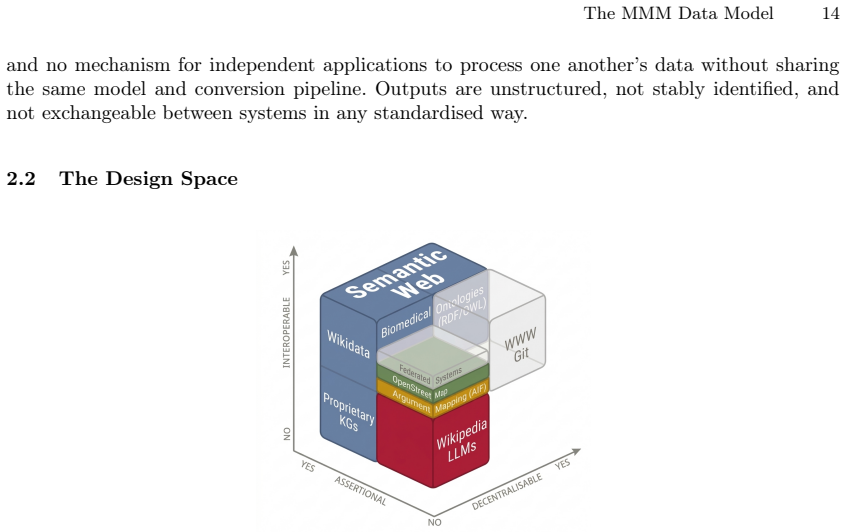
Figures reproduced from arXiv: 2607.00032 by Mathilde Noual.

Figure 1
Figure 1. Figure 1: The design space of information systems across three architectural dimensions: interoperability, decentralisability, and epistemic breadth (the non-assertional axis). The only existing systems so far that satisfy all three are not knowledge systems. Following the dimension definitions discussed above, no existing system is epistemically struc￾tured, epistemically broad (beyond assertional facts), write dec… view at source ↗
Figure 2
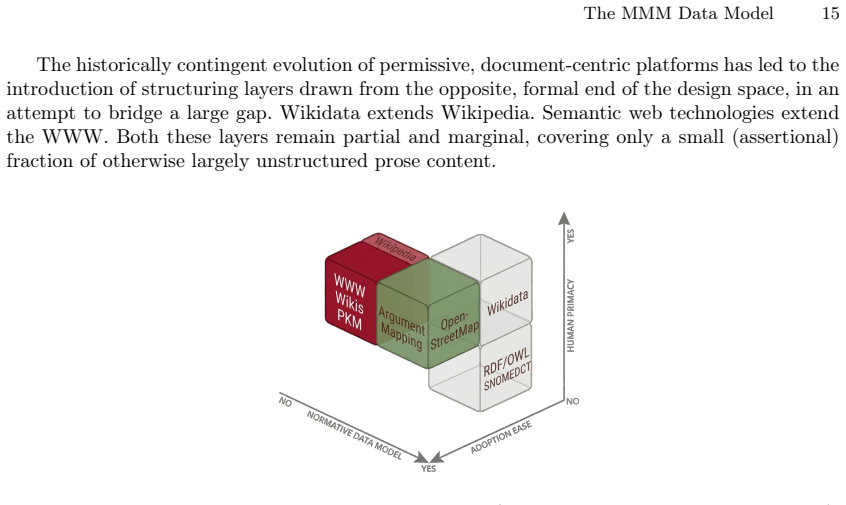
Figure 2. Figure 2: Human Primacy, Adoption Ease and Accessibility (whether the contribution barrier is low), and Normative Data Model across the design space. Semi-transparent: restricted scope (no Universal Scope). OSM challenges the assumption that the level of formalisation required by the Semantic Web stack [2,29,30] is a precondition for interoperability in general, rather than one powerful imple￾mentation suited specif… view at source ↗
Figure 3
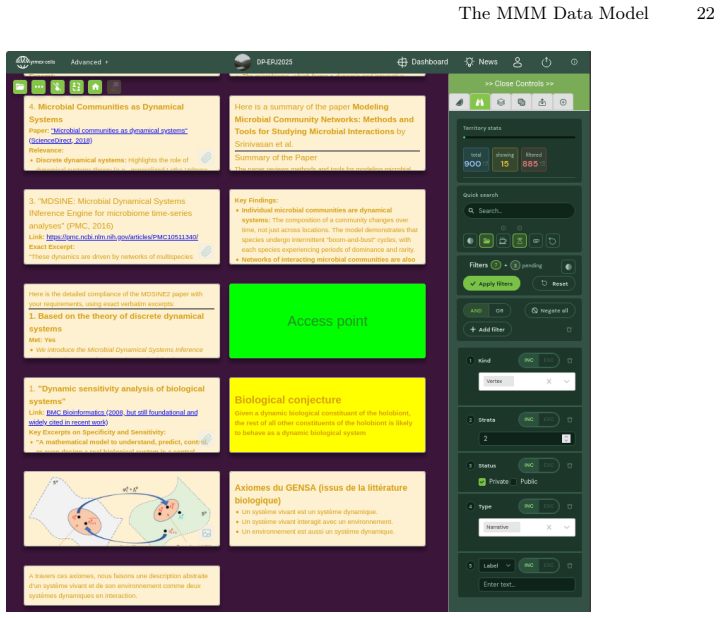
Figure 3. Figure 3: Illustration of MMM’s fine-grained filtering capabilities using a real researcher workspace on a MMM-based note-taking prototype application. Courtesy of D. Pastor and V. Thomas-Vaslin who turned their hundreds of MMM research notes into a peer-reviewed publication [59]. • Two bidirectional types (Equate and Differ) to express similarity (e.g. equivalence, equality, synonymy) and difference (e.g., oppositi… view at source ↗
Figure 4
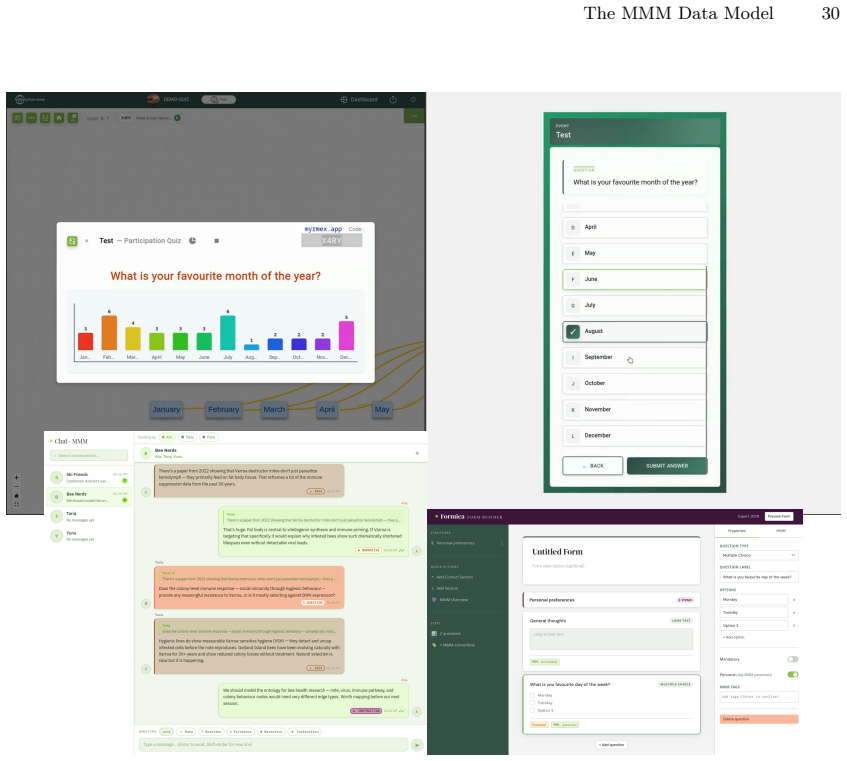
Figure 4. Figure 4: MMM-based prototype applications. Top: a functional interactive presentation research prototype (see also [PITH_FULL_IMAGE:figures/full_fig_p030_4.png] view at source ↗
Figure 5
Figure 5. Figure 5: CREPE 2026 group B1 workspace: an example of graph strongly relying on MMM edge types although not consistently relying on the normative semantics of typed edge directions. 4.3 Pedagogical usage setting The second usage context is a repeated educational exercise designed by higher education physics instructors, conducted over two consecutive years (2025 and 2026) within CapECL a satellite en￾gineering prog… view at source ↗
Figure 6
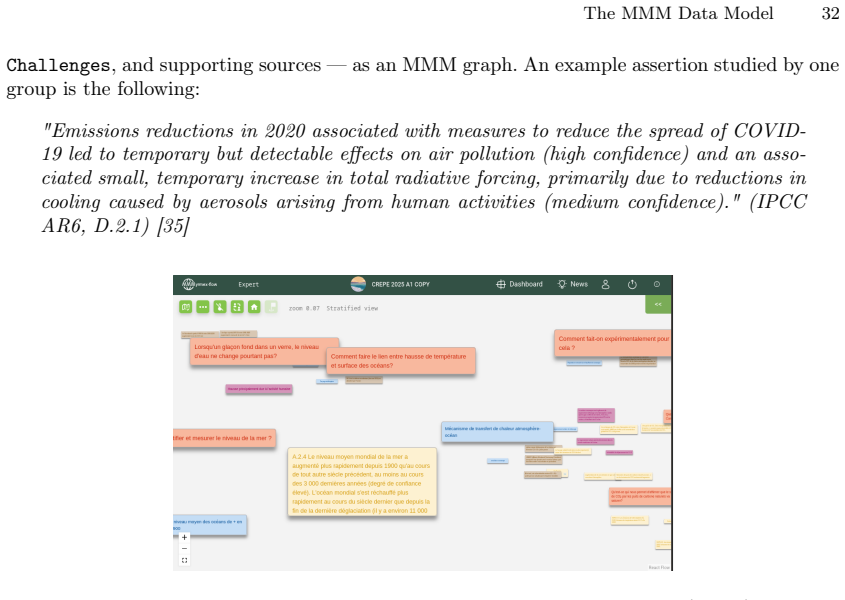
Figure 6. Figure 6: The stratified zooming in Myrmex makes use of Stratum marks (cf §3.3) The exercise has three phases. In the first, each group documents their chosen assertion. In the second, each group is assigned one or two other groups’ graphs and must formulate questions about that work based solely on what they can read in the MMM graph, without consulting the authors — a direct test of the Epistemic Structure and Pos… view at source ↗
Figure 7
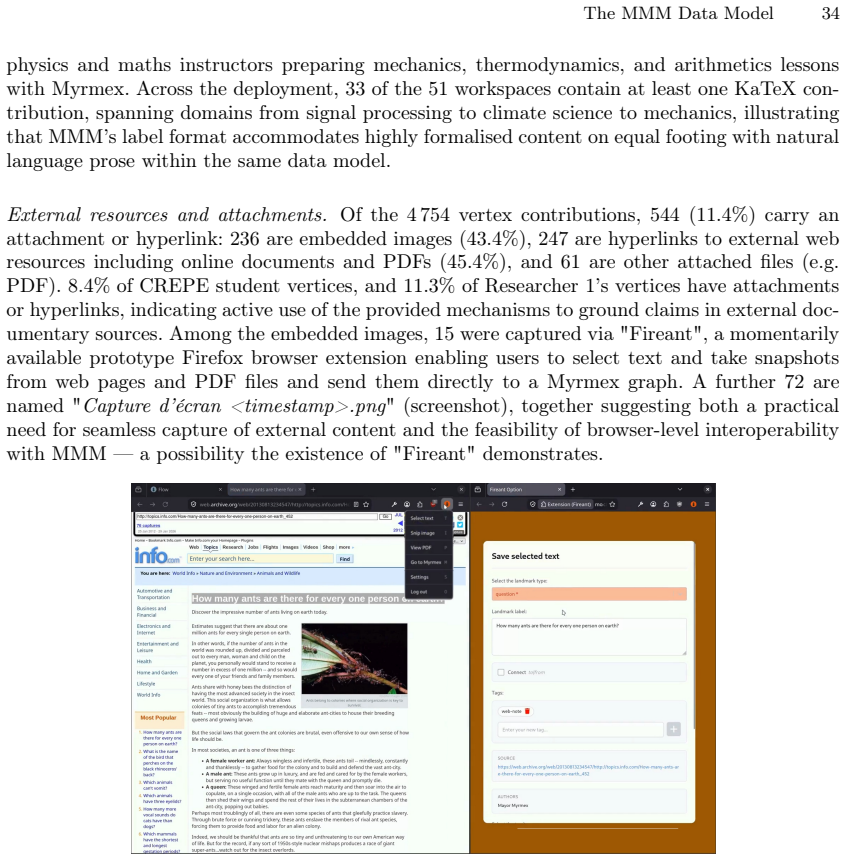
Figure 7. Figure 7: An MMM browser extension to extract text and images from external sources, keeping references to original sources embedded in the new MMM contributions. Questions. The CREPE student questions, including those produced during the cross-group phase illustrate the epistemic range the data model accommodates. They span formal mathe￾matical reasoning (“Why use a Poisson distribution here, and how is λ calculate… view at source ↗
Figure 8
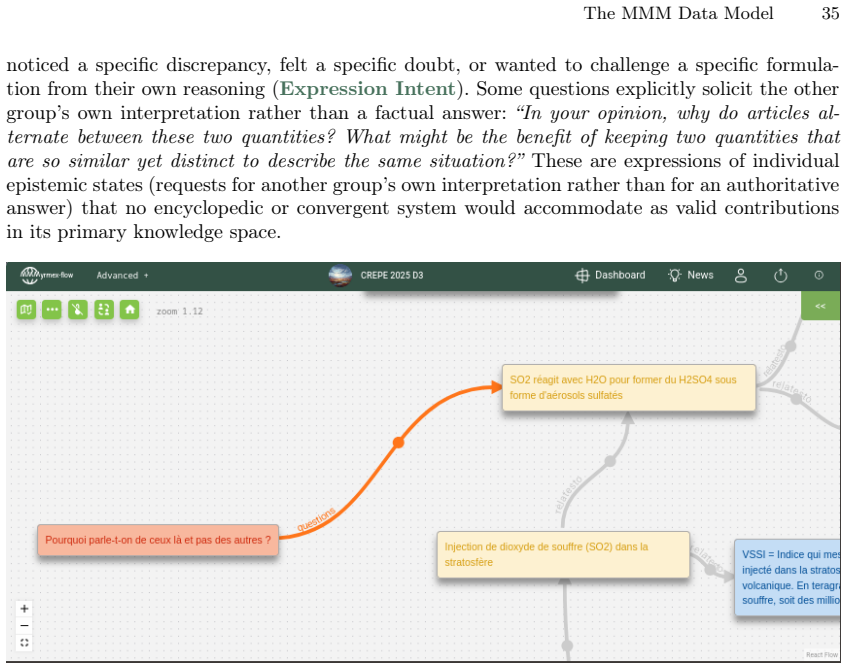
Figure 8. Figure 8: A student question asking "Why are we discussing those ones and not the others?". Redundancy. Two groups independently formulated near-identical questions about ice cube melt￾ing from slightly different angles (“When an ice cube melts in a glass, the water level doesn’t change, does it?” / “And yet, when an ice cube melets in a glass of water, the water level doesn’t rise from start to finish, does it?”) (… view at source ↗
Figure 9
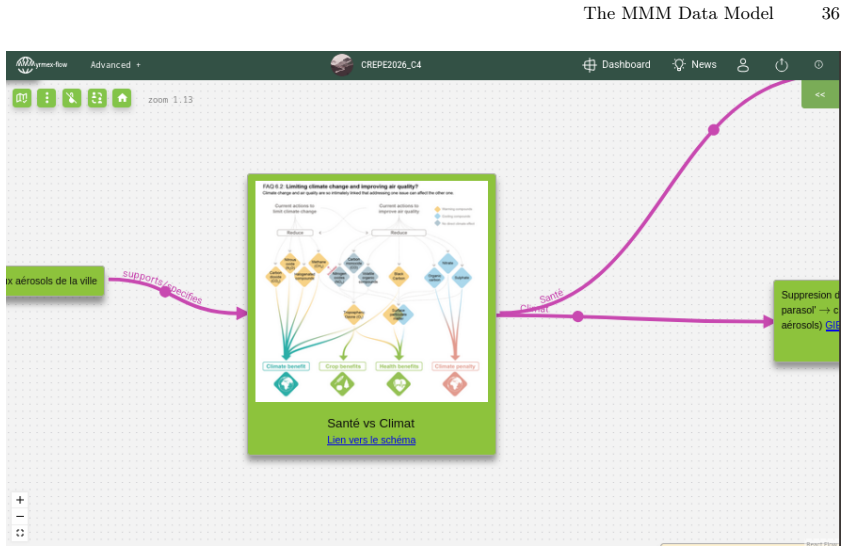
Figure 9. Figure 9: Detail of a CREPE 2026 student workspace illustrating voluntary enrichment beyond the assign￾ment requirements: image attachments and hyperlinks to original web sources added spontaneously by students, without instruction to do so. edges to the graph, or only added edges and Question vertices. Commentators used Questions, Challenges, and RelatesTo edge types. In the CREPE exercise, workspaces have up to 6 … view at source ↗
Figure 10
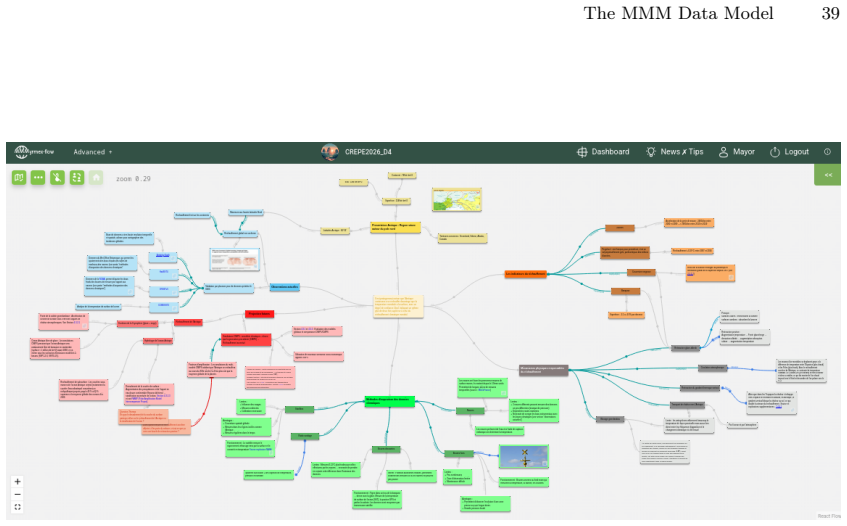
Figure 10. Figure 10: CREPE 2026 group D4 workspace: an example of epistemic structure expressed primarily through visual styling and layout rather than MMM edge type conventions [PITH_FULL_IMAGE:figures/full_fig_p039_10.png] view at source ↗
Figure 11
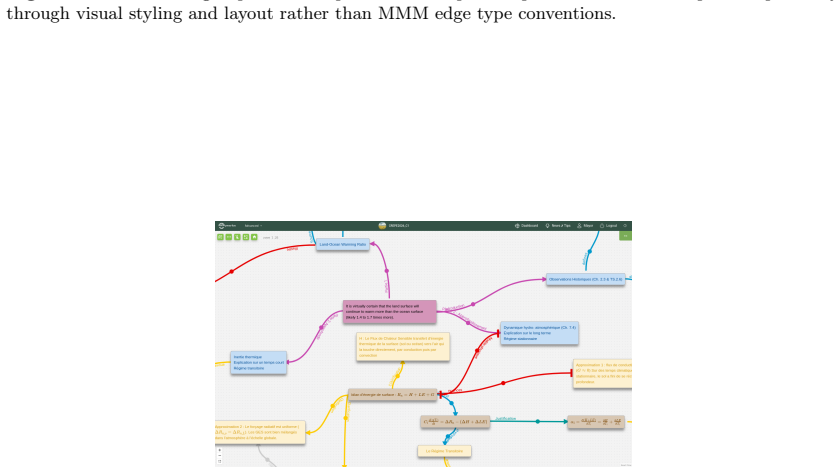
Figure 11. Figure 11: Detail of a CREPE 2026 student workspace centred on the primary IPCC claim, illustrating a common usage pattern in which edges radiate outward from the central assertion irrespective of the normative directional semantics of typed edges. Edge labels carry the relational meaning intended by the contributors [PITH_FULL_IMAGE:figures/full_fig_p039_11.png] view at source ↗
Figure 12
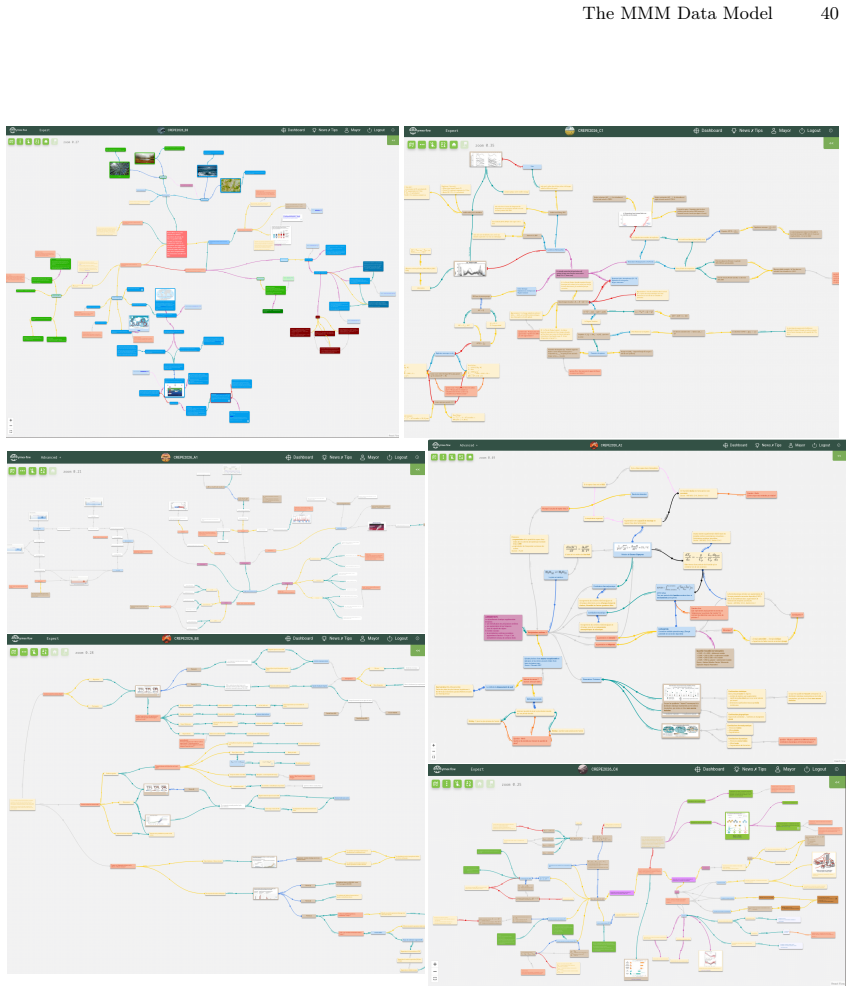
Figure 12. Figure 12: A selection of CREPE 2026 student group workspaces illustrating the diversity of documenta￾tion practices that emerge within a single MMM-based exercise, demonstrating that expressive visual organisation and MMM typing are not mutually exclusive. Groups vary in their use of spatial layout, colour coding, and epistemic typing to structure their graphs — all valid expressions within the data model’s flexibl… view at source ↗
Figure 13
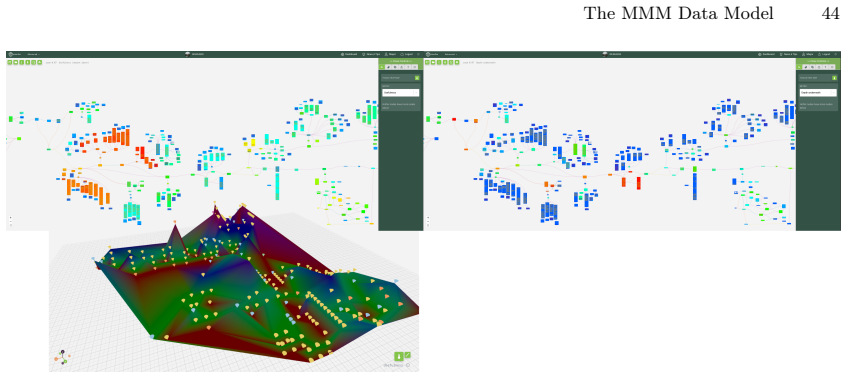
Figure 13. Figure 13: MMM formatted data can be qualified using formal metrics and visualised accordingly. Our reference app Myrmex demonstrates this through a small set of naive metrics including so-called "useful￾ness" and "depth" (number of contributions along an outgoing/incoming path). Courtesy of D. Pastor and V. Thomas-Vaslin who turned their MMM research notes into a peer-reviewed publication [59]. 6.4 Persistence and … view at source ↗
read the original abstract

Many information systems are built around documents: self-contained units optimised for print production and linear reading. While effective for large-scale dissemination, the document-centric organisation constrains how knowledge can be structured, updated, shared, and reused. Formal approaches address some of these limitations but struggle to achieve widespread contribution and adoption due to their prioritisation of formal structure over other system properties such as human usability and scope. AI systems are reshaping document production, but without providing a unified portable alternative to traditional documents for humans' expression and exchange of knowledge. This paper presents MMM, a data model for knowledge documentation that emerged from the practical needs of interdisciplinary collaborative research, and positioned here within a comparative analysis of the design space of information systems. MMM combines a small set of normative constraints with the expressive freedom of free-text labels. It is designed for interoperability across disciplines, applications and deployments without requiring semantic convergence. A reference implementation and pilot deployment data demonstrate implementability and early usability.

Editorial analysis

A structured set of objections, weighed in public.

Desk editor's note, referee report, simulated authors' rebuttal, and a circularity audit. Tearing a paper down is the easy half of reading it; the pith above is the substance, this is the friction.

Referee Report

0 major / 2 minor

Summary. The manuscript presents the MMM data model as a normative specification for knowledge documentation. It positions MMM within a comparative analysis of information system design spaces, arguing that a small set of normative constraints paired with free-text labels enables interoperability across disciplines, applications, and deployments without requiring semantic convergence. The design is motivated by practical needs in interdisciplinary research; support is provided via a reference implementation and pilot deployment data demonstrating implementability and early usability.

Significance. If the claims hold, MMM offers a pragmatic middle path between document-centric systems and rigid formalisms, potentially supporting decentralized knowledge commons with better human usability and scope. The reference implementation and pilot data constitute concrete strengths for a specification paper, as they allow direct assessment of the normative constraints' sufficiency.

minor comments (2)
  1. [Abstract] The abstract states that pilot deployment data demonstrate 'early usability,' but the main text should include explicit metrics or qualitative criteria used to evaluate interoperability and usability (e.g., contribution rates, cross-deployment consistency).
  2. Notation for the normative constraints and free-text label mechanism should be introduced with a single running example early in the paper to aid readability for readers unfamiliar with the design space.

Simulated Author's Rebuttal

0 responses · 0 unresolved

We thank the referee for their positive summary of the manuscript and for recommending minor revision. The report accurately captures the core positioning of MMM as a middle path in the design space of information systems. No specific major comments were raised in the report.

Circularity Check

0 steps flagged

No significant circularity in normative specification

full rationale

This is a design specification paper that introduces the MMM data model as a set of normative constraints paired with free-text labels. No equations, fitted parameters, predictions, or derivation chains are present in the abstract or described structure. Claims of interoperability are positioned as outcomes of the design choices themselves rather than derived from prior results or self-citations. The reference implementation is cited as external demonstration, not as a self-referential fit. The argument is self-contained as a normative proposal without reduction to its own inputs.

Axiom & Free-Parameter Ledger

0 free parameters · 1 axioms · 1 invented entities

Since only the abstract is available, the specific normative constraints are not detailed. The model itself is the main contribution.

axioms (1)
  • domain assumption A small set of normative constraints is sufficient for interoperability without semantic convergence
    The paper relies on this to achieve the design goals while allowing free-text labels.
invented entities (1)
  • MMM data model no independent evidence
    purpose: To enable knowledge documentation and interoperability across disciplines
    The model is introduced in the paper as a new specification emerging from practical needs.

pith-pipeline@v0.9.1-grok · 5690 in / 1261 out tokens · 38566 ms · 2026-07-02T21:30:57.136485+00:00 · methodology

discussion (0)

Sign in with ORCID, Apple, or X to comment. Anyone can read and Pith papers without signing in.