REVIEW 4 major objections 5 minor 23 references
A self-organizing fuzzy neural network for sequence learning
T0 review · 4 major / 5 minor · reviewed 2026-08-14 · deepseek-v4-flash
Pith's one-line read A self-organizing fuzzy neural network can identify a learned sequence from its first T samples, locate the current point, and generate the next sample, allowing one network to store several overlapping trajectories at once.
desk verdict A plausible but under-tested fuzzy architecture for multi-sequence reproduction; worth refereeing for the FNN subfield, with serious revision expected. read the letter →
The pith
A machine-rendered reading of the paper's core claim, the machinery that carries it, and where it could break.
The reading
What carries the argument
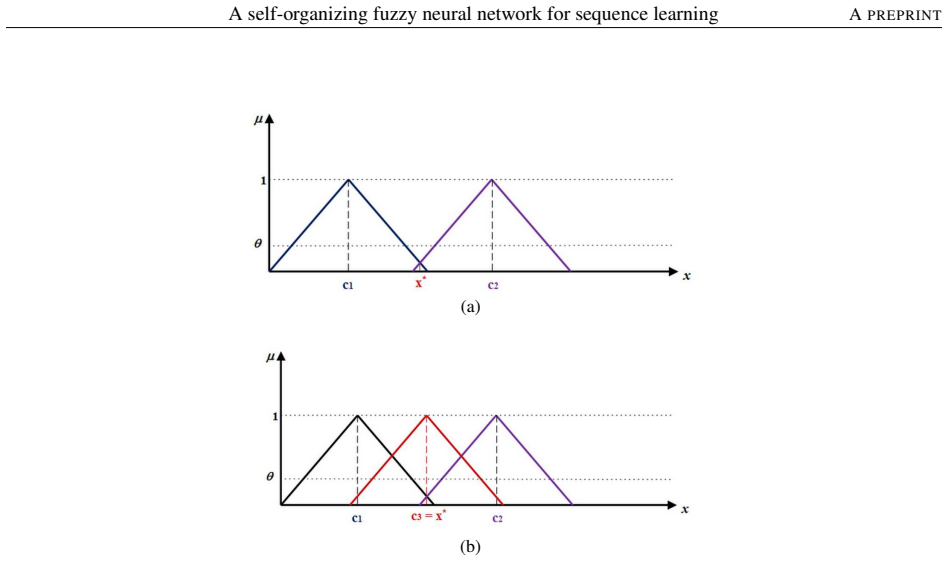
The load-bearing object is the two-part fuzzy rule: each rule joins one fuzzy set over sequence-identity vectors with one fuzzy set over locator-memory vectors. The identity vector comes from the discrimination layer, whose neurons implement a recurrent accumulator $o_i^{(1)}(t)=o_i^{(1)}(t-1)+x_i(t)$ for $t\le T$, so after T samples each neuron holds the coordinate-wise sum of the prefix. The locator vector comes from the memory layer, whose neurons are discrete low-pass filters with $\lambda_i=i/(i+1)$, representing current and delayed samples. A rule grows when the existing fuzzy sets do not cover a sample, and output weights are initialized to the desired next sample and then fine-tuned by gradient descent while the network's own output is fed back. The machinery's job is to make the same point in two different sequences fire different rules, so the network can generate different continuations from visually identical locations.
What would settle it
Build two distinct sequences A and B whose first T samples satisfy $\sum_{t=1}^T A_i(t)=\sum_{t=1}^T B_i(t)$ for every coordinate, train the network on both, then feed it the first T samples of A. If it generates B's continuation, or a blend of A and B, the identifier has failed; the paper's claim predicts that this collision cannot be resolved by the proposed identity value.
Extended reading notes
Core claim
The central claim is that a recurrent fuzzy neural network with two cooperating parts can identify which learned sequence is being presented and then continue it correctly. Identification uses a discriminative identity value: each coordinate accumulates the sum of the first T input samples, $\sum_{t=1}^T x_i(t)$, and fuzzy sets are placed on these identity vectors. Location is handled by a bank of low-pass filters with different time constants, so the locator's input is a short window of current and delayed samples. The product of the sequence-identity membership and the sample-location membership forms a fuzzy rule, and the normalized rule-firing strengths are linearly combined to output the predicted next sample. After T samples the network feeds its own prediction back as input, so it must reproduce the sequence from an internal state rather than from the teacher signal.
Load-bearing premise
The whole scheme rests on the assumption that the coordinate-wise sum of the first T samples uniquely identifies each learned sequence; if two different sequences have prefixes with the same per-coordinate sums, the network has no way to tell them apart.
Editorial extensions
If this is right
- Two sequences that overlap in a common stretch can both be learned: the identifier fixes which sequence is active before the overlap, so the shared samples do not blur into a single continuation.
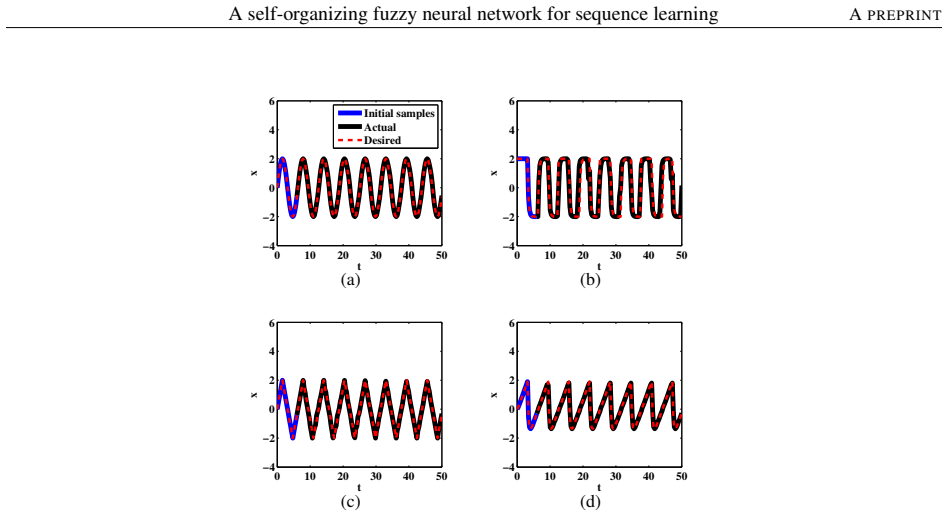
- The same trained network can act as a periodic pattern generator: after seeing one period it reproduces the pattern indefinitely, and because the identity sum over one period is shift-invariant, phase-shifted versions of a periodic sequence are also generated.
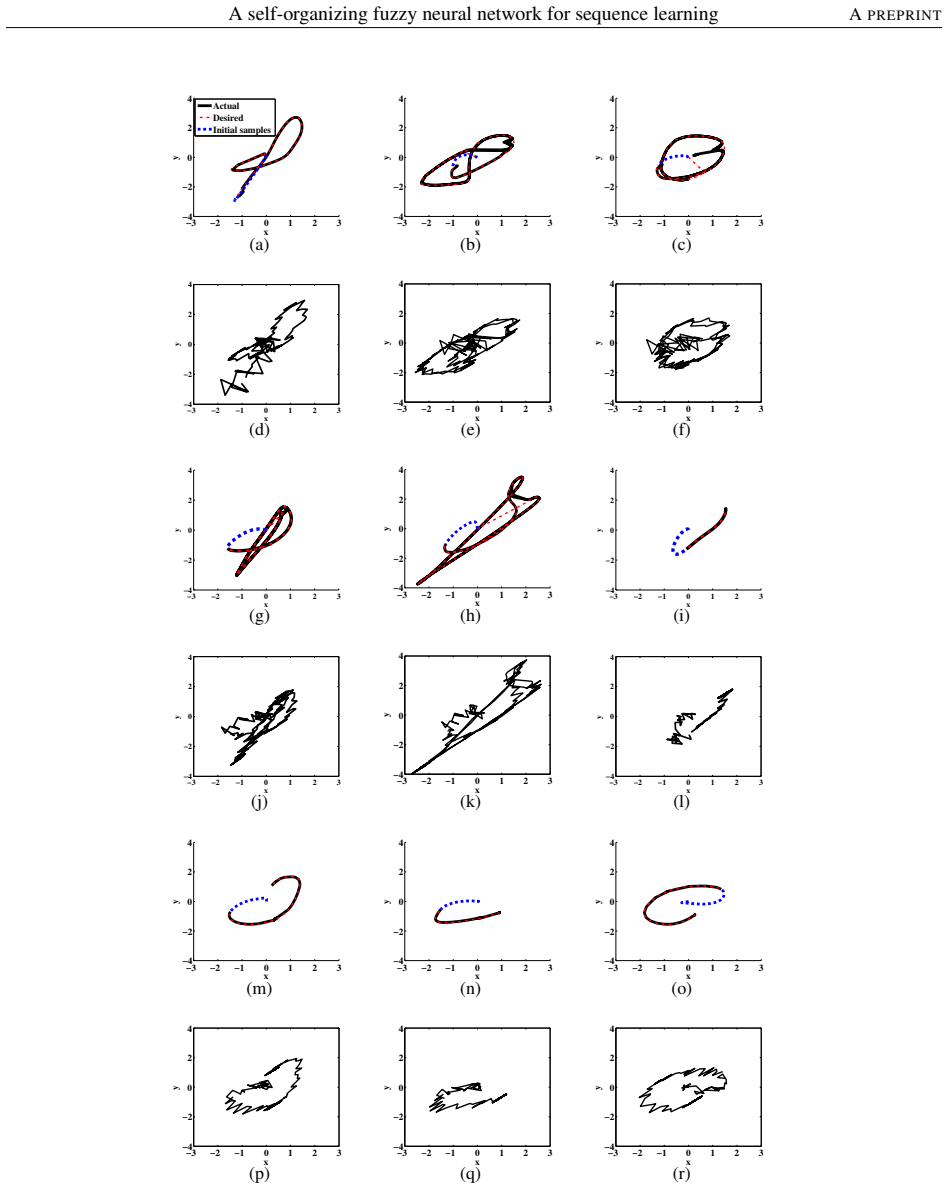
- Handwriting-like trajectories with similar opening curves can be stored together and regenerated, and the experiments report that adding noise to inputs does not prevent identification and generation.
- Because new fuzzy sets and rules are added on coverage failure, the structure can grow online when a new sequence is encountered, rather than retraining all sequences from scratch.
Reading between the lines
- The coordinate-wise sum identity discards the order of the first T samples, so sequences whose T-sample prefixes have the same per-coordinate totals will collide; this collision case is not analyzed in the paper, and a weighted sum or short temporal fingerprint would likely remove it without changing the architecture.
- The separation of identification from location suggests a general recipe for multi-regime dynamical systems: learn one locator vocabulary and one classifier over context statistics, then let rules arbitrate. The same trick could extend to speech gestures, robot trajectories, or any task where the same local movement appears in different global routines.
- Because the locator uses only a few delayed samples, the method can be expected to reproduce smooth, locally Markovian trajectories; sequences with long-range structure would need a larger memory or an explicit state variable. That boundary is a testable consequence, not a claim made in the paper.
Signed reviews
Editorial analysis
A structured set of objections, weighed in public.
Referee Report
Summary. The paper proposes a self-organizing fuzzy neural network for simultaneous learning and reproduction of multiple sequences. The architecture has two parts: a sequence identifier that computes a sequence identity from the first T samples as the coordinate-wise sum, and a sequence locator that encodes recent samples through a memory layer. Fuzzy rules combine the identifier and locator outputs, and the consequents are initialized to the exact next training sample and then fine-tuned by gradient descent. The method is evaluated on two intersecting sequences, four periodic waveforms, and handwriting character trajectories from the UCI data set.
Significance. If the technical problems were resolved, the two-part architecture combining a sequence identity and a current-location locator would be a plausible and interpretable mechanism for simultaneous multi-sequence learning, which is a genuine gap for evolving fuzzy neural networks. The experimental design includes a challenging shared-segment case and a realistic handwriting task. However, the paper provides no quantitative error measures, no code or data, and no analysis of when the sequence identity distinguishes sequences; the identified flaws currently prevent the results from being reproducible.
major comments (4)
- [Section 2.3, Algorithm 2] Algorithm 2 as printed cannot terminate under any condition. The inner loop condition is "while iter2≤itermax||E≤θ3", and iter2 is initialized to 1 but never incremented, so iter2≤itermax remains true. Even if iter2 were incremented, the OR logic keeps the loop running whenever E≤θ3, including the case where the error is already below threshold, leading to an infinite loop. The authors should correct the pseudocode (presumably an AND condition and an increment of iter2) and state the intended stopping criterion.
- [Section 3.2 and Eq. (1)] The sequence identity defined as the coordinate-wise sum of the first T samples (Eq. 1) collapses for zero-mean periodic sequences when T equals one period. The sine, square, and triangle waves in Fig. 5 appear centered at zero, and with T=20 (Table 2), the sum of one period is zero up to sampling alignment. In that case the coverage test in Algorithm 1 would not create four distinct sequence fuzzy sets, contradicting the reported count of 4 in this section. The paper provides no waveform definitions, no identity values, and no separation analysis, so the pattern-generator experiment and the central claim that the network identifies each learned sequence from T initial samples are unsupported.
- [Section 3, all experiments] The evaluation is entirely qualitative: Figs. 4–7 show visually overlapping curves, and the text states "negligible error" without reporting any numeric error metric or comparing to baselines other than one figure for the intersecting sequences. Without mean squared error or comparable quantitative measures, the claimed accuracy of the method and the superiority over the ordinary dynamic FNN are not substantiated.
- [Section 2.1, Eq. (1)] The sequence identifier is a lookup on a single scalar per input dimension, but the manuscript does not analyze how sensitive this identity is to noise, to the choice of T, or to the number of sequences. For the character trajectories, all characters start from (0,0), so the early samples are similar; the paper should demonstrate that the computed sums actually separate the nine identities, for instance by reporting the resulting centers or a distance matrix.
minor comments (5)
- [Section 2.3, paragraph after Eq. (9)] The text says "S2 is closed and S1 and S2 are open"; likely the second S2 should be S3. Please correct this switch description.
- [Tables 1–3] The parameter n is used in the tables but never defined; clarify that it is the number of outputs.
- [Section 2.1, layer 3] The memory layer description says it contains d previous samples, but Eq. (4) implements low-pass filters rather than explicit delay lines; clarify whether the memory vector corresponds to delayed samples or filtered samples.
- [Section 2.2 and Algorithm 1] The coverage check for sample fuzzy sets uses "coverage 2←∑i=1m o_i(5)" but the summation index should reference the sample fuzzy sets layer (o(4)), not the rules layer (o(5)); align the notation with the text.
- [Section 3] Figures 4, 5, and 7 use "Actual" and "Desired" curves that are visually indistinguishable; consider different line styles or markers, and report error bars or numeric errors.
Circularity Check
No circular derivation: the sequence identity is a hand-defined feature and the reproduction mechanism is memory-based, so the claims are empirical rather than circular.
full rationale
The proposed architecture does not derive its outputs from an input in a way that reduces to the target. The sequence identity in Eq. (1) is defined as a coordinate-wise sum of the first T samples; Algorithm 1 sets fuzzy-set centers to that identity and initializes each output weight to the desired next sample (w_R = x(t+1)). This is a constructive learning scheme, not a prediction from a fitted parameter that is then renamed. The claim that the network can identify and reproduce learned sequences is an empirical demonstration of the memory-based mechanism, not a derivation from a premise that already contains the conclusion. Self-citations (e.g., Ebadzadeh and Salimi-Badr 2015/2017 and Salimi-Badr et al. 2017) appear in related work, background on universal approximation, and baseline comparisons; they are not load-bearing, and no uniqueness theorem or ansatz is imported to force the network's design. The sum-identity collision concern for zero-mean periodic waveforms is a robustness or correctness limitation of the identifier, not circularity, because the identity is not claimed to be equivalent to the sequence by theorem. Thus no circular step is present.
Assumptions & free parameters
free parameters (8)
- theta1 (sequence coverage threshold) =
0.3 / 0.4 / 0.2 per experiment
- theta2 (sample coverage threshold) =
0.3 / 0.1 / 0.2 per experiment
- sigma (Gaussian width) =
0.1 / 0.1 / 0.2 per experiment
- T (number of initial samples) =
10 / 20 / 30 per experiment
- d (number of memory neurons) =
5 / 20 / 30 per experiment
- theta3 (fine-tuning error threshold) =
0.01
- itermax =
20
- learning rate eta0 and discount factor beta =
not specified
assumptions (4)
- domain assumption The coordinate-wise sum of the first T input samples uniquely identifies each learned sequence.
- domain assumption The memory layer's state vector, formed by exponentially weighted moving averages with time constants lambda_i = i/(i+1), uniquely determines the current position within each sequence.
- ad hoc to paper A fixed set of manually chosen coverage thresholds and Gaussian widths yields enough fuzzy rules to reproduce the sequences without excessive generalization error.
- domain assumption The network is always provided with T correct, noise-free initial samples before closed-loop generation begins.
Cite this review
Pith. "Pith review of A self-organizing fuzzy neural network for sequence learning." pith.science (2026). https://pith.science/paper/H5W5QCYV
@misc{pith2026190800617,
  author       = {Pith},
  title        = {Pith review of: A self-organizing fuzzy neural network for sequence learning},
  year         = {2026},
  howpublished = {\url{https://pith.science/paper/H5W5QCYV}},
  note         = {Machine review of arXiv:1908.00617}
}
read the original abstract
In this paper, a new self-organizing fuzzy neural network model is presented which is able to learn and reproduce different sequences accurately. Sequence learning is important in performing skillful tasks, such as writing and playing piano. The structure of the proposed network is composed of two parts: 1-sequence identifier which computes a novel sequence identity value based on initial samples of a sequence, and detects the sequence identity based on proper fuzzy rules, and 2-sequence locator, which locates the input sample in the sequence. Therefore, by integrating outputs of these two parts in fuzzy rules, the network is able to produce the proper output based on current state of the sequence. To learn the proposed structure, a gradual learning procedure is proposed. First, learning is performed by adding new fuzzy rules, based on coverage measure, using available correct data. Next, the initialized parameters are fine-tuned, by gradient descent algorithm, based on fed back approximated network output as the next input. The proposed method has a dynamic structure which is able to learn new sequences online. The proposed method is used to learn and reproduce different sequences simultaneously which is the novelty of this method.
Figures


Figures from the paper (4 more)


Reference graph
Works this paper leans on
-
[2]
URL http://dx.doi.org/10.1109/TFUZZ.2015.2403793
doi: 10.1109/TFUZZ.2015.2403793. URL http://dx.doi.org/10.1109/TFUZZ.2015.2403793. J. de Jesus Rubio. SOFMLS: Online self-organizing fuzzy modified least-squares network. IEEE Trans. Fuzzy Syst., 17 (6):1296–1309, dec
-
[4]
URL https://doi.org/10.1007%2Fs00500-015-1946-4
doi: 10.1007/s00500-015-1946-4. URL https://doi.org/10.1007%2Fs00500-015-1946-4 . Mohammad Mehdi Ebadzadeh and Armin Salimi-Badr. CFNN: correlated fuzzy neural network. Neurocomputing, 148: 430–444,
-
[5]
URL http://dx.doi.org/10.1016/j.neucom.2014.07
doi: 10.1016/j.neucom.2014.07.021. URL http://dx.doi.org/10.1016/j.neucom.2014.07
-
[11]
URL http://dx.doi.org/10.1016/j.neucom.2009.06.013
doi: 10.1016/j.neucom.2009.06.013. URL http://dx.doi.org/10.1016/j.neucom.2009.06.013. 11 A self-organizing fuzzy neural network for sequence learning A PREPRINT Ghazaleh Khodabandelou and Mohammad Mehdi Ebadzadeh. Fuzzy neural network with support vector-based learning for classification and regression. Soft Computing, pages 1–16,
-
[12]
URL http://dx.doi.org/10.1109/TFUZZ.2014.2321771
doi: 10.1109/tfuzz.2014.2321771. URL http://dx.doi.org/10.1109/TFUZZ.2014.2321771. B. Kosko. Fuzzy systems as universal approximators. IEEE Transactions on Computers, 43(11):1329–1333,
-
[16]
doi: 10.1109/tfuzz.2012.2193587. URL http://dx.doi. org/10.1109/TFUZZ.2012.2193587. Jun-Fei Qiao, Ying Hou, Lu Zhang, and Hong-Gui Han. Adaptive fuzzy neural network control of wastewater treatment process with multiobjective operation. Neurocomputing, 275:383–393,
arXiv 2012
-
[17]
doi: 10.1016/j.eswa.2008.10.043. URL http://dx.doi.org/10. 1016/j.eswa.2008.10.043. Armin Salimi-Badr, Mohammad M. Ebadzadeh, and Christian Darlot. Fuzzy neuronal model of motor control inspired by cerebellar pathways to online and gradually learn inverse biomechanical functions in the presence of delay. Biological Cybernetics, 111(5-6):421–438,
-
[19]
URL http://dx.doi.org/10.1016/j.neucom.2009.05.006
doi: 10.1016/j.neucom.2009.05.006. URL http://dx.doi.org/10.1016/j.neucom.2009.05.006. Ziteng Wen, Linbo Xie, Hongwei Feng, and Yong Tan. Infrared flame detection based on a self-organizing ts-type fuzzy neural network. Neurocomputing, 337:67–79,
Show all 23 references
-
[21]
URL https://doi.org/10.1109%2F91.940970
doi: 10.1109/91.940970. URL https://doi.org/10.1109%2F91.940970. Shaohua Xu, Kun Liu, and Xuegui Li. A fuzzy process neural network model and its application in process signal classification. Neurocomputing, 335:1–8,
-
[22]
URL http://dx.doi.org/10.1109/91.890337
doi: 10.1109/91.890337. URL http://dx.doi.org/10.1109/91.890337. Hao Ying. General SISO takagi-sugeno fuzzy systems with linear rule consequent are universal approximators. IEEE Trans. Fuzzy Syst., 6(4):582–587,
-
[1993]
URL http://dx.doi.org/10.1109/21.256541
doi: 10.1109/21.256541. URL http://dx.doi.org/10.1109/21.256541. Nikola K. Kasabov. On-line learning, reasoning, rule extraction and aggregation in locally optimized evolving fuzzy neural networks. Neurocomputing, 41(1-4):25–45, oct
-
[1994]
URL http://dx.doi.org/10.1109/12.324566
doi: 10.1109/12.324566. URL http://dx.doi.org/10.1109/12.324566. Zhiqiang Ma, Guanghui Sun, Di Liu, and Xing Xing. Dissipativity analysis for discrete-time fuzzy neural networks with leakage and time-varying delays. Neurocomputing, 175:579–584, jan
-
[1998]
URL http://dx.doi.org/10.1109/91
doi: 10.1109/91.728456. URL http://dx.doi.org/10.1109/91. 728456. 12
-
[2000]
URL http://dx.doi.org/10
doi: 10.1109/3477.836384. URL http://dx.doi.org/10. 1109/3477.836384. Shiqian Wu, Meng Joo Er, and Yang Gao. A fast approach for automatic generation of fuzzy rules by generalized dynamic fuzzy neural networks. IEEE Transactions on Fuzzy Systems, 9(4):578–594,
-
[2001]
URL http://dx.doi.org/10.1016/S0925-2312(00)00346-5
doi: 10.1016/s0925-2312(00)00346-5. URL http://dx.doi.org/10.1016/S0925-2312(00)00346-5 . N.K. Kasabov and Qun Song. DENFIS: dynamic evolving neural-fuzzy inference system and its application for time-series prediction. IEEE Trans. Fuzzy Syst., 10(2):144–154, apr
-
[2002]
URL http: //dx.doi.org/10.1109/91.995117
doi: 10.1109/91.995117. URL http: //dx.doi.org/10.1109/91.995117. Omid Khayat, Mohammad Mehdi Ebadzadeh, Hamid Reza Shahdoosti, Ramin Rajaei, and Iman Khajehnasiri. A novel hybrid algorithm for creating self-organizing fuzzy neural networks. Neurocomputing, 73(1-3):517–524, dec
-
[2009]
URL http://dx.doi.org/10.1109/TFUZZ.2009
doi: 10.1109/tfuzz.2009.2029569. URL http://dx.doi.org/10.1109/TFUZZ.2009. 2029569. José de Jesús Rubio and Abdelhamid Bouchachia. MSAFIS: an evolving fuzzy inference system. Soft Computing, nov
2009
-
[2010]
URL http://dx.doi
doi: 10.1109/tfuzz.2010.2070841. URL http://dx.doi. org/10.1109/TFUZZ.2010.2070841. Honggui Han, Xiao-Long Wu, and Jun-Fei Qiao. Nonlinear systems modeling based on self-organizing fuzzy-neural- network with adaptive computation algorithm. IEEE Trans. Cybern., 44(4):554–564, apr
2010
-
[2012]
URL http://dx.doi.org/10.1007/s10489-011-0327-7
doi: 10.1007/s10489-011-0327-7. URL http://dx.doi.org/10.1007/s10489-011-0327-7 . Hui Pang, Fan Liu, and Zeren Xu. Variable universe fuzzy control for vehicle semi-active suspension system with mr damper combining fuzzy neural network and particle swarm optimization. Neurocomp...
-
[2014]
2013.2260537
doi: 10.1109/tcyb. 2013.2260537. URL http://dx.doi.org/10.1109/TCYB.2013.2260537. Amin Torabi Jahromi, Meng Joo Er, Xiang Li, and Beng Siong Lim. Sequential fuzzy clustering based dynamic fuzzy neural network for fault diagnosis and prognosis. Neurocomputing, 196:31–41,
2013
-
[2015]
URL http://dx.doi.org/10.1007/ s00422-015-0661-7
doi: 10.1007/s00422-015-0661-7. URL http://dx.doi.org/10.1007/ s00422-015-0661-7 . Ankit Kumar Das, Kartick Subramanian, and Suresh Sundaram. An evolving interval type-2 neurofuzzy inference system and its metacognitive sequential learning algorithm. IEEE Trans. Fuzzy Systems,...
-
[2016]
URL https://doi.org/10.1016%2Fj.neucom.2015.10.098
doi: 10.1016/j.neucom.2015.10.098. URL https://doi.org/10.1016%2Fj.neucom.2015.10.098. Hamed Malek, Mohammad Mehdi Ebadzadeh, and Mohammad Rahmati. Three new fuzzy neural networks learning algorithms based on clustering, training error and genetic algorithm. Appl. Intell., 37(...
2015 doi
-
[2017]
Ning Wang, Meng Joo Er, and Xianyao Meng
doi: 10.1007/s00422-017-0735-9. Ning Wang, Meng Joo Er, and Xianyao Meng. A fast and accurate online self-organizing scheme for parsimonious fuzzy neural networks. Neurocomputing, 72(16-18):3818–3829, oct
Reviewed August 14, 2026 · model on record in the stance chip above.
Discussion (0). Continue with ORCID to comment.