REVIEW 4 major objections 6 minor 1 cited by
FeatureCuts: Feature Selection for Large Data by Optimizing the Cutoff
T0 review · 4 major / 6 minor · reviewed 2026-08-06 · deepseek-v4-flash
Pith's one-line read The paper claims that the optimal filter cutoff can be found automatically in about a minute with Bayesian Optimization or Golden Section Search, matching wrapper methods on performance while cutting far more features.
desk verdict Practical cutoff-optimization idea with credible speedups, but the evaluation split is ambiguous and one reference looks fabricated — needs careful revision before the numbers can be trusted. read the letter →
The pith
A machine-rendered reading of the paper's core claim, the machinery that carries it, and where it could break.
The reading
What carries the argument
The FS-score, a weighted harmonic mean of feature reduction and model performance, is the objective that carries the argument. It turns the cutoff decision into a one-dimensional black-box maximization over $k \in \{1,\dots,N\}$, so the paper can apply Bayesian Optimization and Golden Section Search with very few model trainings. The golden ratio conjugate $\varphi = (\sqrt{5}-1)/2$ sets the bracket widths in the Golden Section Search, and the adaptation to discrete integers picks $k^* = \arg\max_{k \in \{\lfloor a\rfloor, \lceil b\rceil\}} FSS(k)$ after ten iterations.
What would settle it
Take a synthetic dataset with 1,000 features where features 1–30 are strong predictors, features 400–450 are also strong predictors of a separate class pattern, and features 31–399 are noise, then run FeatureCuts (F-value ranking, GSS with 10 iterations and BO with 5 initial points and 5 iterations) and compare the selected $k^*$ to the brute-force argmax of FS-score over all $k$. If the optimizer reports a cutoff near 30 while the global FS-score peaks near 420, the unimodality assumption fails and the claimed near-optimal approximation breaks.
Extended reading notes
Core claim
The central discovery is that the optimal filter cutoff $k^* = \arg\max_k FSS(k)$ can be approximated with a handful of model evaluations, not thousands. The authors define the FS-score $FSS(k) = \frac{w_s + w_f}{w_s/S + w_f/(1 - F_r/F_b)}$ with weights 50 on model score and 1 on feature reduction, and show empirically that this score as a function of $k$ behaves like a smooth, nearly unimodal curve across their datasets. Both Bayesian Optimization (5 initial points, 5 iterations) and Golden Section Search (10 iterations, adapted to integer intervals) land close to the brute-force maximum FS-score on the validation plots, and the resulting feature subsets match or beat wrapper methods on feature reduction while keeping test scores within about 0.01 of the no-selection baseline. This is an extension claim: the cutoff-selection step that previous hybrid methods settled with fixed percentages or arbitrary feature counts can itself be optimized with negligible overhead.
Load-bearing premise
The whole speed advantage rests on the FS-score being a smooth, nearly unimodal function of the cutoff $k$, so that ten Golden Section iterations or five Bayesian Optimization iterations find the same peak a brute-force search would; if the score has two distant local maxima of similar height, the optimizer can stop at the wrong cutoff.
Editorial extensions
If this is right
- FeatureCuts alone can be used as a drop-in replacement for fixed-cutoff filter selection, giving about 67% average feature reduction in about a minute on datasets up to 5,000 features.
- As the filtering stage before PSO, it lifts feature reduction from 57% to 83% and cuts runtime from roughly 3 hours to about 1 hour while the test score moves only from 0.819 to 0.814.
- The method carries over to regression tasks, which use F-statistic ranking, and to features derived from LLM embeddings, where it matched the best test scores on the text datasets in the paper.
- The same optimization shell can host any filter metric and any wrapper algorithm, not just F-value and the four evolutionary methods tested.
Reading between the lines
- If the FS-score curvature is reliably unimodal, the same one-dimensional optimizer could be reused to tune other threshold decisions, such as variance thresholds or correlation cutoffs, with the same near-zero overhead.
- The unimodality assumption could be probed directly: on datasets with two well-separated blocks of informative features, the FS-score may become bimodal, and FeatureCuts would then need more than ten GSS iterations or a multi-start variant.
- The fixed weight ratio of 50:1 biases the cutoff toward performance; a user who values interpretability or deployment cost more could re-run the search with a higher feature-reduction weight and get the same speed advantage.
- A natural extension is to couple the cutoff search with a learning curve so that the model score at cutoff $k$ is estimated from a subsample, slashing the per-evaluation cost further on very large data.
Signed reviews
Editorial analysis
A structured set of objections, weighed in public.
Referee Report
Summary. The paper proposes FeatureCuts, a hybrid feature selection method for large datasets. After ranking features by an F-value filter, it selects the optimal cutoff number k by maximizing a weighted harmonic mean (FS-score) of the feature-reduction percentage and the model score, using Bayesian Optimization (5 initial points, 5 iterations) or a discrete adaptation of Golden Section Search (10 iterations). Optionally, the selected top-k features are fed into an evolutionary wrapper method (PSO, GWO, WOA, or SCA) for further reduction. The authors evaluate on 14 public datasets and one proprietary dataset, comparing against Boruta, ReliefF, and the four wrapper methods. They report that FeatureCuts achieves on average 67% feature reduction in about one minute, versus 3–4 hours for wrappers, while maintaining competitive test scores, and that using it before PSO improves feature reduction from 57% to 82% with one-third of the runtime.
Significance. The problem of choosing a cutoff after filter ranking is real and underexplored, and the proposed reformulation as black-box optimization is simple and potentially practical. The paper's strengths include a wide range of test datasets (including LLM-based embedding features), a comparison to a brute-force optimum, and the demonstration of large speedups over wrapper methods. However, the evaluation protocol currently does not establish that the reported test scores are unbiased: the FS-score used for cutoff selection may be computed on the same test set that is later reported, and several hyperparameters (FS-score weights, filter metric) are tuned on the evaluation datasets themselves. These issues, if confirmed, would invalidate the central empirical claims. The unimodality assumption behind the cutoff optimizers is also unverified. Should a proper nested validation protocol confirm the results, the method would be a useful contribution to the feature selection literature.
major comments (4)
- [Sections III.E and II.B] The manuscript does not specify which data split is used to compute the model score S that enters the FS-score during cutoff selection. Section II.B defines S as 'model score after feature selection' and Section III.E mentions 'nested, stratified 5-fold cross-validation and hold-out test set,' but it never states whether S is computed on the hold-out test set, on a validation fold, or on training data. If S is the same hold-out test score reported in Tables IV and VI, then the cutoff k is selected on the test set and the reported test scores are optimistically biased; the brute-force 'ground truth' optimum in Section IV.B would likewise be a test-set maximum, so Figure 2's alignment between the optimizers and the brute-force optimum would not demonstrate generalization. This issue is load-bearing for the central claim that FeatureCuts 'maintains model performance' while reducing features. The authors must clarify the exact data flow and, if the current protocol uses the test set for cutoff selection, repeat the experiments with a separate validation set for model selection and a fresh hold-out set for final reporting.
- [Sections II.B and IV.A] The FS-score weights (ws=50, wf=1) and the choice of F-value as the ranking metric are selected after observing results on the same 14 datasets that are later used to report the final evaluation. Section II.B states that these weights 'achieved a good balance between feature reduction and model performance on our evaluation datasets,' and Section IV.A selects the filter metric by comparing performance 'across each evaluation dataset.' This introduces selection bias: the reported averages in Tables III–VII are not independent of the hyperparameter choices, so the claimed cross-dataset generalizability is overstated. The paper should either reserve a portion of the data (or a separate set of datasets) for hyperparameter selection, use a nested cross-validation procedure that treats hyperparameters as part of the model, or at least acknowledge that the results are conditional on the chosen weights and metric.
- [Section II.C] The optimization methods assume that the FS-score as a function of k is sufficiently smooth and (for Golden Section Search) unimodal, but the paper does not test this assumption. The authors state that the automated cutoffs 'typically align closely' with the brute-force maximum (Section IV.B), but no quantitative metric (e.g., distance between selected k and k*, or FS-score gap) is reported, and no analysis of the number of local maxima in the FS-score curves is given. Without such evidence, the convergence and robustness of the 10-iteration Golden Section Search and 5-iteration Bayesian Optimization to the global optimum are not established, which is important because a suboptimal cutoff would weaken the feature-reduction and time-saving claims. The authors should report quantitative alignment with the brute-force optimum for all datasets and examine the landscape for multimodality, or alternatively use a multi-start heuristic and compare results.
- [Sections V.A and V.B] The claim that FeatureCuts 'maintains model performance' is supported only by point estimates of the average test score; no confidence intervals, per-dataset paired comparisons, or significance tests are provided. For example, Table III reports an average test score of 0.817 ± 0.17 for FC GS versus 0.825 ± 0.18 for Boruta, and Table V shows FC GS→PSO at 0.814 ± 0.18 versus PSO at 0.819 ± 0.18. Given the large standard deviations, these differences are not distinguishable from noise, and the conclusion that performance is 'maintained' (as opposed to degraded or improved) is not statistically supported. The authors should report per-dataset performance differences and a paired significance test (e.g., Wilcoxon signed-rank test) to support the performance-maintenance claim.
minor comments (6)
- [Table I] In the 'bss' row, the number of 'Used Samples' (20,000) exceeds the number of instances in the dataset (13,991); please verify the sampling procedure or correct the table.
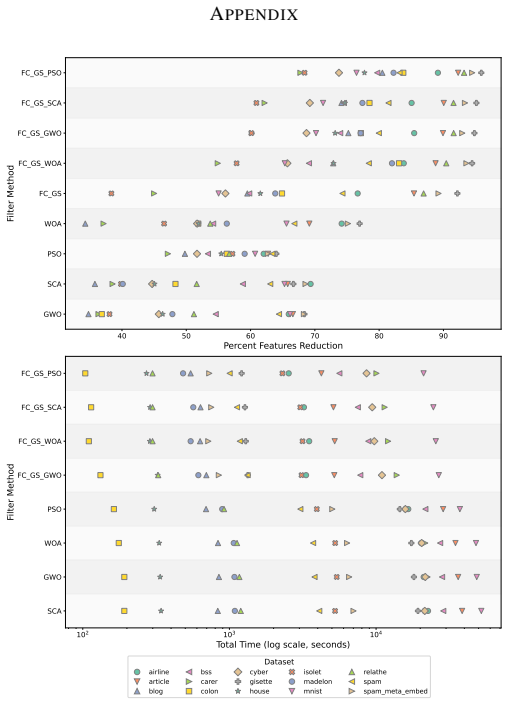
- [Figures 3 and 4] The legend lists a dataset 'rcv1_one_col_target,' but Table I and the text refer to this dataset as 'relathe'; the naming should be made consistent.
- [Table V] The header contains the typo 'REUSLTS' instead of 'RESULTS.'
- [Section III.E] The evaluation is described as using 'nested, stratified 5-fold cross-validation and hold-out test set,' but the number of outer folds and the construction of the hold-out set are not described; please provide details for reproducibility.
- [General] The paper does not include a link to the implementation or a description of the experimental environment (hardware, library versions); the computation-time comparisons would benefit from such information.
- [Section IV.A] The text refers to 'F-value (f-classif and f-regres),' but Table II uses the label 'F classif'; please unify the notation.
Circularity Check
The FS-score used to select the cutoff includes the 'model test score,' and that same test score is then reported as the evaluation; the performance-maintenance claim is therefore partly fitted, not predicted.
-
fitted input called prediction
[Section II.B (FS-score definition), Section II.C (cutoff objective), Section III.E (evaluation protocol), Section V.A (reported result)]
"As we are maximizing both feature set reduction and performance, we use the weighted harmonic mean of the percentage of features removed and the model test score after feature selection. ... We call this a feature selection score (FS-score) and apply this score to evaluate any cutoff after feature ranking and to evaluate the final set of features selected. ... The cutoff that returns the maximum FS-score is considered as the optimal cutoff."
The FS-score objective includes S = 'model test score after feature selection,' and the method chooses k* = argmax_k FSS(k). The paper's headline evaluation then reports 'Test Score' for FeatureCuts in Tables III, IV, and VI. Under the paper's own definition, S is a test score, and the paper never states that candidate cutoffs are scored only on inner validation folds inside the nested CV described in Section III.E. Consequently the reported test score is the same quantity being maximized when choosing k; presenting it as evidence of 'maintaining model performance' is fitting the evaluation metric rather than predicting it. Section IV.B reinforces this by recording 'the resulting FS-score' for every k across the test datasets.
-
self definitional
[Section IV.B (Brute Force Cutoff Comparison) and Figure 2]
"for every possible feature cutoff k, from 1 to N features, we trained a model using just the top k features and recorded the resulting FS-score. This exhaustive evaluation for each k enabled us to pinpoint, for each dataset, the cutoff which yielded the highest FS-score. We then treated this value as the 'ground truth optimal cutoff' for the purpose of benchmarking our method."
The 'ground truth optimal cutoff' is defined as the maximizer of the FS-score, which is exactly the objective that Bayesian Optimization and Golden Section Search are designed to optimize. Figure 2 therefore shows only that the optimizers converge toward the maximum of their own objective; it does not validate that this cutoff is optimal in any externally defined sense. The paper's earlier wording, 'we conducted a brute-force search to find the true optimal feature cutoff,' presents this self-defined maximum as an independent ground truth, but by construction the benchmark is the same function the algorithm optimizes.
1 more flagged steps
-
fitted input called prediction
[Section II.B (FS-score weights)]
"We observed that using these weights achieved a good balance between feature reduction and model performance on our evaluation datasets."
The weights ws=50 and wf=1 are selected by inspecting the FS-score balance on the same evaluation datasets that are later used to report the method's feature-reduction and performance results. The claimed 'good balance' is therefore partly a description of the tuning data rather than an independent, out-of-sample finding. This compounds the main leakage: both the weights and the cutoff are chosen with the evaluation data in view.
full rationale
The central performance-maintenance claim is not self-contained as stated. The FS-score objective in Section II.B includes S = 'model test score after feature selection,' and the method selects the cutoff that maximizes this FS-score. Section IV.B then defines the brute-force 'ground truth optimal cutoff' as the maximizer of the same FS-score, and Figure 2 plots FS-scores 'across the test datasets.' The paper does not state that candidate cutoffs are evaluated only on inner validation folds within the nested CV described in Section III.E, nor that the hold-out test set is reserved exclusively for the final tables. Under the paper's own definitions, the reported Test Score in Tables III, IV, and VI is the quantity being optimized when choosing k, so 'maintaining model performance' is partly forced by construction rather than demonstrated by independent prediction. The tuning of the FS-score weights 'on our evaluation datasets' adds a second in-sample selection step. The unimodality assumption underlying Golden Section Search is a separate correctness risk and is not itself circularity. There is no load-bearing self-citation chain or imported uniqueness theorem; the problem is the evaluation protocol, not citation practice. If the authors had explicitly computed FS-score on validation folds and reserved the hold-out test set for final evaluation, the leakage would disappear; the text as written does not make that separation.
Assumptions & free parameters
free parameters (4)
- FS-score weight ratio =
w_s=50, w_f=1
- Filter ranking metric =
ANOVA F-value (F-statistic)
- Bayesian Optimization budget =
5 initial points, 5 iterations
- Golden Section Search iterations =
10
assumptions (4)
- standard math Golden Section Search converges to the global maximum of a unimodal function on a bounded interval.
- domain assumption F-statistic ranking captures the features most relevant to the target for all datasets tested.
- ad hoc to paper The FS-score with 50:1 weights is a sensible objective for trading off feature reduction and model performance.
- ad hoc to paper The optimal cutoff for a dataset can be identified by maximizing FS-score, and the resulting test score generalizes to unseen data.
Cite this review
Pith. "Pith review of FeatureCuts: Feature Selection for Large Data by Optimizing the Cutoff." pith.science (2026). https://pith.science/paper/H6ASMTTA
@misc{pith2026250800954,
  author       = {Pith},
  title        = {Pith review of: FeatureCuts: Feature Selection for Large Data by Optimizing the Cutoff},
  year         = {2026},
  howpublished = {\url{https://pith.science/paper/H6ASMTTA}},
  note         = {Machine review of arXiv:2508.00954}
}
read the original abstract
In machine learning, the process of feature selection involves finding a reduced subset of features that captures most of the information required to train an accurate and efficient model. This work presents FeatureCuts, a novel feature selection algorithm that adaptively selects the optimal feature cutoff after performing filter ranking. Evaluated on 14 publicly available datasets and one industry dataset, FeatureCuts achieved, on average, 15 percentage points more feature reduction and up to 99.6% less computation time while maintaining model performance, compared to existing state-of-the-art methods. When the selected features are used in a wrapper method such as Particle Swarm Optimization (PSO), it enables 25 percentage points more feature reduction, requires 66% less computation time, and maintains model performance when compared to PSO alone. The minimal overhead of FeatureCuts makes it scalable for large datasets typically seen in enterprise applications.
Figures


Figures from the paper (1 more)
Forward citations
Cited by 1 Pith paper
-
FinKario: Event-Enhanced Automated Construction of Financial Knowledge Graph
FinKario combines an event-enhanced financial knowledge graph dataset with a two-stage graph retrieval method, reporting 18.81% better stock-trend prediction than financial LLM baselines.
Reference graph
Works this paper leans on
-
[27]
Feature selection using the sine cosine algorithm,
J. Smith and A. Doe, “Feature selection using the sine cosine algorithm,” Journal of Computational Intelligence , vol. 35, no. 4, pp. 1234–1245, 2021
work page 2021
-
[1]
S. Wang, J. Tang, and H. Liu, Feature Selection. Boston, MA: Springer US, 01 2016, pp. 1–9
work page 2016
-
[2]
Feature selection: A data perspective,
J. Li, K. Cheng, S. Wang, F. Morstatter, R. P. Trevino, J. Tang, and H. Liu, “Feature selection: A data perspective,” ACM Comput. Surv. , vol. 50, no. 6, Dec. 2017. [Online]. Available: https://doi.org/10.1145/3136625
doi:10.1145/3136625 2017
-
[3]
Language models are few-shot learners,
T. B. Brown, B. Mann, N. Ryder, M. Subbiah, J. D. Kaplan, P. Dhariwal, A. Neelakantan, P. Shyam, G. Sastry, A. Askell, S. Agarwal, A. Herbert-V oss, G. Krueger, T. Henighan, R. Child, A. Ramesh, D. M. Ziegler, J. Wu, C. Winter, C. Hesse, M. Chen, E. Sigler, M. Litwin, S. Gray, B. Chess, J. Clark, C. Berner, S. McCandlish, A. Radford, I. Sutskever, and D. ...
arXiv 2020
-
[4]
On the opportunities and risks of foundation models,
R. Bommasani, D. A. Hudson, E. Adeli, R. Altman, S. Arora, S. von Arx, M. S. Bernstein, J. Bohg, A. Bosselut, E. Brunskill et al. , “On the opportunities and risks of foundation models,” arXiv preprint arXiv:2108.07258 , 2021. [Online]. Available: https://arxiv.org/abs/2108.07258
arXiv 2021
-
[5]
Google’s neural machine translation system: Bridging the gap between human and machine translation,
Y . Wu, M. Schuster, Z. Chen, Q. V . Le, M. Norouzi, W. Macherey, M. Krikun, Y . Cao, Q. Gao, K. Macherey et al. , “Google’s neural machine translation system: Bridging the gap between human and machine translation,” arXiv preprint arXiv:1609.08144 , 2016. [Online]. Available: https://arxiv.org/abs/1609.08144
arXiv 2016
-
[6]
Feature selection: A data perspective,
J. Li, K. Cheng, S. Wang, F. Morstatter, R. P. Trevino, J. Tang, and H. Liu, “Feature selection: A data perspective,” CoRR, vol. abs/1601.07996, 2016. [Online]. Available: http://arxiv.org/abs/1601.07996
arXiv 2016
-
[7]
A review of feature selection and its methods,
B. Venkatesh and J. Anuradha, “A review of feature selection and its methods,” Cybernetics and Information Technologies , vol. 19, no. 1, pp. 3–26, 2019. [Online]. Available: https://doi.org/10.2478/cait-2019-0001
Show all 44 references
-
[8]
A review on feature selection methods for classification tasks,
M. Mwadulo, “A review on feature selection methods for classification tasks,” International Journal of Computer Applications Technology and Research, vol. 5, pp. 395–402, 06 2016
2016
-
[9]
Feature selection methods: Case of filter and wrapper approaches for maximising classifi- cation accuracy,
N. Ibrahim, H. Hamid, S. Rahman, and S. Fong, “Feature selection methods: Case of filter and wrapper approaches for maximising classifi- cation accuracy,” Pertanika Journal of Science and Technology , vol. 26, pp. 329–340, 01 2018
2018
-
[10]
A hybrid genetic algorithm with wrapper-embedded approaches for feature selection,
X.-y. Liu, Y . Liang, S. Wang, Z. Yang, and H.-s. Ye, “A hybrid genetic algorithm with wrapper-embedded approaches for feature selection,” IEEE Access , vol. PP, pp. 1–1, 03 2018
2018
-
[11]
Evolutionary computation for feature selection in classification: A comprehensive survey of solutions, applications and challenges,
X. Song, Y . Zhang, W. Zhang, C. He, Y . Hu, J. Wang, and D. Gong, “Evolutionary computation for feature selection in classification: A comprehensive survey of solutions, applications and challenges,” Swarm and Evolutionary Computation, vol. 90, p. 101661, 2024. [Online]. Avai...
2024
-
[12]
Feature selection algorithm based on optimized genetic algorithm and the application in high-dimensional data processing,
G. Feng, “Feature selection algorithm based on optimized genetic algorithm and the application in high-dimensional data processing,” PLOS ONE , vol. 19, no. 5, pp. 1–24, 05 2024. [Online]. Available: https://doi.org/10.1371/journal.pone.0303088
2024 doi
-
[13]
Feature selec- tion in high dimensional data by a filter-based genetic algorithm,
C. De Stefano, F. Fontanella, and A. Scotto di Freca, “Feature selec- tion in high dimensional data by a filter-based genetic algorithm,” in Applications of Evolutionary Computation: 20th European Conference, EvoApplications 2017, Amsterdam, The Netherlands, April 19-21, 2017,...
2017
-
[14]
Hybrid filter and genetic algorithm-based feature selection for improving cancer classification in high-dimensional microarray data,
W. Ali and F. Saeed, “Hybrid filter and genetic algorithm-based feature selection for improving cancer classification in high-dimensional microarray data,” Processes, vol. 11, no. 2, 2023. [Online]. Available: https://www.mdpi.com/2227-9717/11/2/562
2023
-
[15]
Practical challenges and recommendations of filter methods for feature selection,
M. Rajab and D. Wang, “Practical challenges and recommendations of filter methods for feature selection,” Journal of Information & Knowledge Management , vol. 19, no. 01, p. 2040019, 2020. [Online]. Available: https://doi.org/10.1142/S0219649220400195
2020 doi
-
[16]
uefs: An efficient and comprehensive ensemble-based feature selection methodology to select informative features,
M. Ali, S. I. Ali, D. Kim, T. Hur, J. Bang, S. Lee, B. H. Kang, and M. Hussain, “uefs: An efficient and comprehensive ensemble-based feature selection methodology to select informative features,” PLOS ONE, vol. 13, no. 8, pp. 1–28, 08 2018. [Online]. Available: https://doi.org...
2018 doi
-
[17]
A hybrid feature selection method for classification purposes,
S. Cateni, V . Colla, and M. Vannucci, “A hybrid feature selection method for classification purposes,” in Proceedings of the 2014 European Modelling Symposium , ser. EMS ’14. USA: IEEE Computer Society, 2014, p. 39–44. [Online]. Available: https://doi.org/10.1109/EMS.2014.44
2014 doi
-
[18]
Hybrid binary bat enhanced particle swarm optimization algorithm for solving feature selection problems,
M. A. Tawhid and K. B. Dsouza, “Hybrid binary bat enhanced particle swarm optimization algorithm for solving feature selection problems,” Applied Computing and Informatics , vol. 16, pp. 117–136, 2018
2018
-
[19]
A feature selection algorithm performance metric for comparative analysis,
W. Mostert, K. M. Malan, and A. P. Engelbrecht, “A feature selection algorithm performance metric for comparative analysis,” Algorithms, vol. 14, no. 3, 2021. [Online]. Available: https://www.mdpi.com/1999- 4893/14/3/100
2021
-
[20]
Hierarchical harris hawks optimizer for feature selection,
L. Peng, Z. Cai, A. A. Heidari, L. Zhang, and H. Chen, “Hierarchical harris hawks optimizer for feature selection,” Journal of Advanced Research , vol. 53, pp. 261–278, 2023. [Online]. Available: https://www.sciencedirect.com/science/article/pii/S2090123223000279
2023
-
[21]
Bayesian Optimization: Open source constrained global optimization tool for Python,
F. Nogueira, “Bayesian Optimization: Open source constrained global optimization tool for Python,” 2014–. [Online]. Available: https://github.com/bayesian-optimization/BayesianOptimization
2014
-
[22]
Golden-section search,
T. Dubail, “Golden-section search,” 2022, [On- line; accessed 2022-07-24]. [Online]. Available: https://www.kaggle.com/code/thomasdubail/golden-section-search
2022
-
[23]
Py fs: A python package for feature selection using meta-heuristic optimization algorithms,
R. Guha, B. Chatterjee, S. K. K. Hassan, S. Ahmed, T. Bhattacharyya, and R. Sarkar, “Py fs: A python package for feature selection using meta-heuristic optimization algorithms,” in Computational Intelligence in Pattern Recognition . Springer, Singapore, 2022, pp. 495–504
2022
-
[24]
Binary genetic swarm optimization: A combination of ga and pso for feature selection,
M. Ghosh, R. Guha, I. Alam, P. Lohariwal, D. Jalan, and R. Sarkar, “Binary genetic swarm optimization: A combination of ga and pso for feature selection,” Journal of Intelligent Systems , vol. 29, no. 1, pp. 1598–1610, 2019
2019
-
[25]
Selective oppo- sition based grey wolf optimization,
S. Dhargupta, M. Ghosh, S. Mirjalili, and R. Sarkar, “Selective oppo- sition based grey wolf optimization,” Expert Systems with Applications , vol. 113, p. 113389, 2020
2020
-
[26]
Embedded chaotic whale survival algorithm for filter–wrapper feature selection,
R. Guha, M. Ghosh, S. Mutsuddi, S. Roy, and N. Dey, “Embedded chaotic whale survival algorithm for filter–wrapper feature selection,” Soft Computing , vol. 24, pp. 12 821–12 843, 2020. [Online]. Available: https://doi.org/10.1007/s00500-020-05183-1
2020 doi
-
[28]
The uci machine learning repository,
M. Kelly, R. Longjohn, and K. Nottingham, “The uci machine learning repository,” 2024, accessed: 2024-06-01. [Online]. Available: https://archive.ics.uci.edu
2024
-
[29]
Kaggle: Your machine learning and data science community,
Kaggle, “Kaggle: Your machine learning and data science community,” 2024, accessed: 2024-06-08. [Online]. Available: https://www.kaggle.com
2024
-
[30]
Airline Dataset — kaggle.com,
B. o. T. S. Sourav Banerjee, “Airline Dataset — kaggle.com,” https://www.kaggle.com/datasets/iamsouravbanerjee/airline-dataset, 2020, [Accessed 13-01-2025]
2020
-
[31]
News Articles — kaggle.com,
ASADMAHMOOD, “News Articles — kaggle.com,” https://www.kaggle.com/datasets/asad1m9a9h6mood/news-articles, 2017, [Accessed 13-01-2025]
2017
-
[32]
BlogFeedback,
K. Buza, “BlogFeedback,” UCI Machine Learning Repository, 2014, DOI: https://doi.org/10.24432/C58S3F
2014 doi
-
[33]
CARER: Contextualized affect representations for emotion recognition,
E. Saravia, H.-C. T. Liu, Y .-H. Huang, J. Wu, and Y .-S. Chen, “CARER: Contextualized affect representations for emotion recognition,” in Proceedings of the 2018 Conference on Empirical Methods in Natural Language Processing . Brussels, Belgium: Association for Computational ...
2018
-
[34]
Markov blanket-embedded genetic algorithm for gene selection,
Z. Zhu, Y .-S. Ong, and M. Dash, “Markov blanket-embedded genetic algorithm for gene selection,” Pattern Recogn. , vol. 40, no. 11, p. 3236–3248, Nov. 2007. [Online]. Available: https://doi.org/10.1016/j.patcog.2007.02.007
2007 doi
-
[35]
Sosnet: A graph convolutional network approach to fine-grained cyberbullying detection,
J. Wang, K. Fu, and C.-T. Lu, “Sosnet: A graph convolutional network approach to fine-grained cyberbullying detection,” in 2020 IEEE International Conference on Big Data (Big Data) , 2020, pp. 1699–1708. [Online]. Available: https://www.kaggle.com/datasets/andrewmvd/cyberbully...
2020
-
[36]
Gisette,
Guyon, Isabelle, Gunn, Steve, Ben-Hur, Asa, Dror, and Gideon, “Gisette,” UCI Machine Learning Repository, 2004, DOI: https://doi.org/10.24432/C5HP5B
2004 doi
-
[37]
House prices - advanced regression techniques,
A. Montoya and DataCanary, “House prices - advanced regression techniques,” https://kaggle.com/competitions/house-prices-advanced- regression-techniques, 2016, kaggle
2016
-
[38]
Cole and M
R. Cole and M. Fanty, “ISOLET,” UCI Machine Learning Repository, 1991, DOI: https://doi.org/10.24432/C51G69
1991 doi
-
[39]
Madelon,
I. Guyon, “Madelon,” UCI Machine Learning Repository, 2004, DOI: https://doi.org/10.24432/C5602H
2004 doi
-
[40]
MNIST Dataset — kaggle.com,
Y . LeCun, C. Cortes, and C. J. Burges, “MNIST Dataset — kaggle.com,” https://www.kaggle.com/datasets/hojjatk/mnist-dataset, 1997, [Accessed 13-01-2025]
1997
-
[41]
Newsweeder: Learning to filter netnews,
K. Lang, “Newsweeder: Learning to filter netnews,” in Proceedings of the Twelfth International Conference on Machine Learning , 1995, pp. 331–339. [Online]. Available: https://jundongl.github.io/scikit- feature/datasets.html
1995
-
[42]
190k+ spam — ham email dataset for classifi- cation,
M. Likith, “190k+ spam — ham email dataset for classifi- cation,” https://www.kaggle.com/datasets/meruvulikith/190k-spam-ham- email-dataset-for-classification, 2024, [Accessed 13-01-2025]
2024
-
[43]
Feature selection with the boruta package,
M. Kursa and W. Rudnicki, “Feature selection with the boruta package,” Journal of Statistical Software , vol. 36, no. 11, pp. 1–13, Sep 2010. [Online]. Available: https://github.com/scikit-learn-contrib/boruta py
2010
-
[44]
Benchmarking relief-based feature selection methods,
R. J. Urbanowicz, R. S. Olson, P. Schmitt, M. Meeker, and J. H. Moore, “Benchmarking relief-based feature selection methods,” arXiv e-print. https://arxiv.org/abs/1711.08477, 2017. APPENDIX 40 50 60 70 80 90 Percent Features Reduction GWO SCA PSO WOA FC_GS FC_GS_WOA FC_GS_GWO ...
2017 arXiv
Reviewed August 6, 2026 · model on record in the stance chip above.
Discussion (0). Continue with ORCID to comment.