REVIEW 1 major objections 2 minor 5 cited by
NuSTAR Tests of Sterile-Neutrino Dark Matter: New Galactic Bulge Observations and Combined Impact
T0 review · 1 major / 2 minor · reviewed 2026-08-14 · deepseek-v4-flash
Pith's one-line read No sterile-neutrino dark-matter decay lines appear in 190 ks of dedicated NuSTAR observations, tightening the best limits at 10–12 keV masses by roughly a factor of two.
desk verdict A careful, transparent null result that improves the world-best sterile-neutrino DM limit at 10–12 keV by ~2x; the main caveat is the frozen internal background power-law, but the paper's own checks keep the central claim credible. read the letter →
The pith
A machine-rendered reading of the paper's core claim, the machinery that carries it, and where it could break.
The reading
What carries the argument
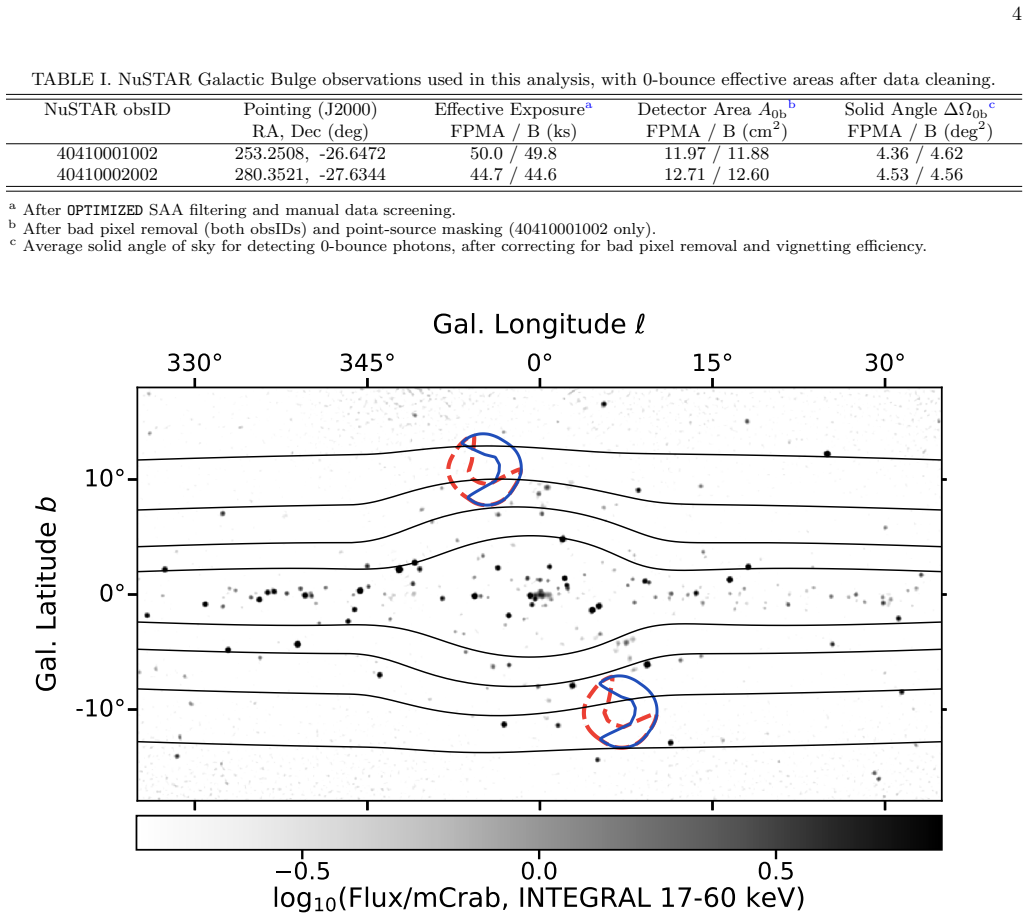
The mechanism that does the work is NuSTAR's 0-bounce aperture: unfocused x-rays reach the detector array over a large effective field of view of roughly 4.5 square degrees, and the predicted dark-matter signal is the line flux times the response $E_{\rm Be}(E) A_{0b}\Delta\Omega_{0b} J$, where $J$ is the line-of-sight integral of the dark-matter density in each field. The analysis chain scans a narrow Gaussian line at each mass bin, re-fits the full six-component spectral model, and combines the four spectra's $χ^2$ curves to set a 95% upper limit on the decay rate. The internal background's low-energy power-law is calibrated on Earth-occulted data and frozen in science-mode fits.
What would settle it
An independent re-analysis of the same observations with an updated NuSTAR background model should either reproduce the 8–9 and 15–20 keV excesses as statistical fluctuations or identify them as instrumental lines; if they are instrumental, the limits in the affected mass ranges are weaker than quoted, and a true dark-matter line in those regions could be hidden.
Extended reading notes
Core claim
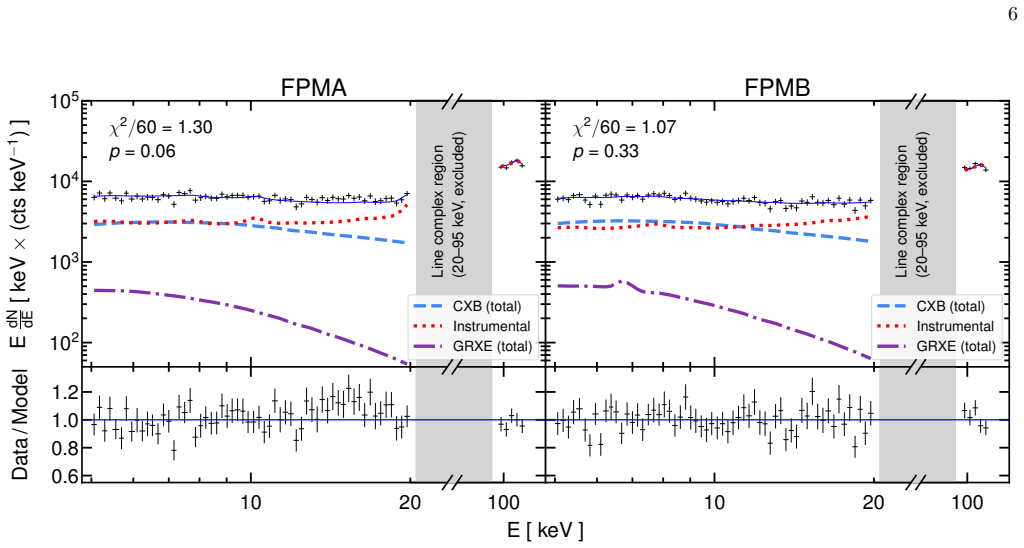
The central claim is that the radiative decay channel $χ \to \nu + \gamma$ does not produce a detectable monochromatic x-ray line in the 5–20 keV band of these observations, and the resulting upper limits on the decay rate are the leading constraints for sterile-neutrino dark matter in the 10–12 keV mass range. The two fields were modeled individually, combining 0-bounce and 2-bounce apertures, and the line search allowed a putative dark-matter line to absorb any background excess, a conservative choice. The limits are comparable to earlier NuSTAR searches across 10–40 keV despite a factor of roughly fifty less exposure, and Monte Carlo simulations indicate the observed limit fluctuations sit inside the expected statistical band, apart from known excesses at 8–9 and 15–20 keV that the authors treat as consistent with statistics.
Load-bearing premise
The paper assumes the NuSTAR instrumental background in the 5–20 keV search band is described by the default model with the low-energy power-law fixed from Earth-occulted data, and the residual excesses at 8–9 and 15–20 keV show that this assumption is only approximate.
Editorial extensions
If this is right
- Sterile neutrinos in the 10–12 keV mass range with mixing angles above the new limit are excluded, narrowing the parameter space left for the νMSM.
- Dedicated low-background fields near the bulge reach sensitivity comparable to searches with several megaseconds of exposure in only ~190 ks, validating the field-selection strategy.
- In the full 10–40 keV mass range the null result keeps the decay-rate limit comparable to previous NuSTAR blank-sky, Galactic-center, and M31 searches.
- Closing the remaining νMSM window above 10 keV will require roughly a fourfold sensitivity gain, or about 4 Ms of similar exposures, and an improved instrumental background model for energies below 5 keV.
Reading between the lines
- A repeat observation of these two fields, or a search that splits the exposure into time bins, could test whether the strong 10–12 keV limit is partly a downward statistical fluctuation, as the paper itself suggests.
- If the 8–9 and 15–20 keV excesses prove to be unmodeled instrumental lines, an updated background model could either strengthen the limits in those mass ranges or reveal that the current conservative procedure hides a real line.
- The same off-plane strategy could be extended to other high-$J$-factor, low-background targets or to lower energies once the 3–5 keV background is modeled, potentially testing the 3.5-keV line interpretation.
Signed reviews
Editorial analysis
A structured set of objections, weighed in public.
Referee Report
Summary. This paper presents a search for monoenergetic x-ray lines from the radiative decay of sterile-neutrino dark matter using two dedicated NuSTAR observations of the Galactic bulge region, with a combined cleaned exposure of approximately 190 ks. The fields are located approximately 10 degrees above and below the Galactic plane, chosen to reduce astrophysical backgrounds while remaining close to the dense dark-matter halo. The analysis models the instrumental and astrophysical backgrounds with a six-component spectral model, including a low-energy internal power-law calibrated from Earth-occulted data and frozen during science-mode fits. No significant line is found in the 5-20 keV band, and upper limits are set on the decay rate for sterile-neutrino masses 10-40 keV. The authors report that their constraints are the strongest to date in the 10-12 keV mass range, improving on previous NuSTAR limits by a factor of about two. Monte Carlo simulations are used to show that the observed limits are consistent with statistical fluctuations, and a flat 7.5% systematic is found to weaken the limits by a factor of about 1.5.
Significance. If the systematic treatment is adequate, this result provides a meaningful improvement in the sterile-neutrino dark-matter parameter space, specifically in the 10-12 keV mass range where the leading constraints are currently set by NuSTAR. The paper is careful in several respects: independent fits are performed for each focal-plane module, the line-search procedure conservatively allows a dark-matter line to absorb background lines, the internal power-law is calibrated on Earth-occulted data, and the Monte Carlo validation demonstrates that the observed limits are consistent with statistical expectations. The explicit discussion of model residuals and systematic tests, including a flat 7.5% systematic, is commendable and provides some confidence in the robustness of the no-detection claim. The result has implications for the νMSM and for future x-ray searches for decaying dark matter, and the paper clearly identifies the need for an improved NuSTAR background model, especially at lower energies.
major comments (1)
- [II D, III B] The internal power-law spectral index and normalization, which dominate the instrumental background below about 10 keV, are frozen to values derived from Earth-occulted data and are not allowed to vary in the science-mode fits. The paper itself reports residuals at 8-9 keV and 15-20 keV (Figs. 3 and 4), demonstrating that the model is imperfect. The Monte Carlo simulations in Sec. III B generate mock spectra from the same best-fit model, so they test the statistical coverage of the fitting procedure under the assumed background, not the absolute accuracy of that background. The flat 7.5% systematic test is a global normalization uncertainty and does not mimic a correlated shape error in the power-law normalization or index. Because the headline improvement in the 10-12 keV range is partly driven by negative residuals in three of the four spectra, a correlated background-shape bias could in principle alter the derived limits. I therefore request an additional robustness test in which the internal power-law normalization and index are allowed to vary, for example with Gaussian priors centered on the occultation values, and the resulting change in the 10-12 keV limits is reported. This would directly address whether the factor-of-two improvement is robust against plausible background-model uncertainties and would substantially strengthen the central claim.
minor comments (2)
- [III B] The Monte Carlo validation uses 100 mock spectra generated from a single best-fit spectrum (FPMA of obsID 40410001002) to set the expected limit bands, with only 10 full realizations used for a cross-check. It would be useful to state the statistical uncertainty on the quoted 68% and 95% bands arising from the finite number of simulations, and to clarify whether the full-realization cross-check was sufficient to ensure that the simplified procedure does not bias the expected bands.
- [II D and Table II] The GRXE component is described as absorbing contribution from un-modeled point sources, reflected Earth x-rays, and any low-energy instrumental backgrounds not captured by the default model. This is a sensible catch-all, but it would be clearer to the reader if the caption of Table II explicitly stated that the quoted GRXE flux is therefore an effective (background-inclusive) value and not a pure measurement of Galactic ridge emission, even though this is mentioned in the text.
Circularity Check
No circularity: the DM line limits come from a line scan over a background model calibrated on separate Earth-occulted data, with external benchmarks for the theory conversion.
full rationale
The central result is an upper limit on the sterile-neutrino decay rate obtained by adding a zero-width Gaussian line at E = m_chi/2 to a six-component background model and scanning the decay rate, refitting the model at each mass. The low-energy internal power-law is not fitted to the science-mode data used for the line search; its index and relative normalization are frozen from fits to Earth-occulted intervals of the same observations, where astrophysical flux is negligible. The DM line flux is thus the only free line parameter, so the upper limit is a direct measurement rather than a refitting of an input. The conversion from decay rate to mixing angle uses the standard formula of Refs. [17,18], and J-factors are taken from external halo profiles with several variants tested; no result is defined in terms of the quantity it is said to predict. The Monte Carlo sensitivity bands are generated from the best-fit model, so they validate the statistical coverage of the fitting procedure under that model, not the absolute accuracy of the background model; the paper acknowledges residuals at 8-9 and 15-20 keV and tests a flat 7.5% systematic, so the central no-line claim does not rest on a self-consistent fit. Self-citations to prior NuSTAR analyses [30,32,98,109] provide methodological background and instrument calibration, but the derivation is described in the paper and is externally benchmarked against HEAO-1/INTEGRAL cosmic X-ray background values and previous limits [31]. Overall, the analysis is self-contained against external benchmarks and exhibits no circular reasoning.
Assumptions & free parameters
free parameters (5)
- GRXE 3-20 keV flux =
Free in spectral fit
- GRXE abundance ratio =
Free, constrained to 0-1.2
- Internal power-law spectral index and normalization (per FPM/obsID) =
Frozen to Earth-occultation best fit
- Internal continuum normalization =
Free
- Internal line normalizations (10.2, 19.7, 104.5 keV) =
Free
assumptions (6)
- domain assumption The Milky Way dark matter halo follows a smooth density profile, with sNFW (γ=0.7, rs=20 kpc) as default and NFW, coreNFW, and Burkert variants also tested.
- standard math The sterile neutrino radiative decay rate is Γ = 1.38×10^-32 s^-1 (sin^2 2θ / 10^-10) (mχ/keV)^5.
- domain assumption The default NuSTAR instrumental background model of Wik+2014, with the apec plasma replaced by a power-law calibrated on Earth-occultation data, describes the science-mode background in 5-20 keV.
- domain assumption The cosmic X-ray background spectrum is fixed to HEAO-1/INTEGRAL measurements, with 3-20 keV flux 2.6×10^-11 erg/s/cm2/deg2, index 1.29, and folding energy 40 keV.
- domain assumption Astrophysical X-ray emission is negligible during Earth-occultation mode, isolating the instrumental background for calibration.
- domain assumption The GRXE is modeled as a single-temperature 8 keV plasma, with abundance ratio free in 0-1.2, and the 'GRXE' component absorbs all unmodeled low-energy background flux.
Cite this review
Pith. "Pith review of NuSTAR Tests of Sterile-Neutrino Dark Matter: New Galactic Bulge Observations and Combined Impact." pith.science (2026). https://pith.science/paper/H6BKA4K6
@misc{pith2026190809037,
  author       = {Pith},
  title        = {Pith review of: NuSTAR Tests of Sterile-Neutrino Dark Matter: New Galactic Bulge Observations and Combined Impact},
  year         = {2026},
  howpublished = {\url{https://pith.science/paper/H6BKA4K6}},
  note         = {Machine review of arXiv:1908.09037}
}
abstract
We analyze two dedicated NuSTAR observations with exposure ${\sim}190$ ks located ${\sim}10^\circ$ from the Galactic plane, one above and the other below, to search for x-ray lines from the radiative decay of sterile-neutrino dark matter. These fields were chosen to minimize astrophysical x-ray backgrounds while remaining near the densest region of the dark matter halo. We find no evidence of anomalous x-ray lines in the energy range 5--20 keV, corresponding to sterile neutrino masses 10--40 keV. Interpreted in the context of sterile neutrinos produced via neutrino mixing, these observations provide the leading constraints in the mass range 10--12 keV, improving upon previous constraints in this range by a factor ${\sim}2$. We also compare our results to Monte Carlo simulations, showing that the fluctuations in our derived limit are not dominated by systematic effects. An updated model of the instrumental background, which is currently under development, will improve NuSTAR's sensitivity to anomalous x-ray lines, particularly for energies 3--5 keV.
Figures

Figures from the paper (2 more)


Forward citations
Cited by 5 Pith papers
-
The Dark Dimension meets the Axiverse
Dark dimension dark matter can evade decay constraints if N≳50 axion KK towers share the tower energy, diluting Standard Model energy injection by roughly 1/N.
-
Universal Seesaw Leptogenesis
Leptogenesis can proceed from single-generation gauge-singlet mediator decays in a Universal Seesaw model if parity is broken in the neutrino sector; the lightest right-handed neutrino is a sub-eV dark-radiation relic.
-
Conformal Freeze-In from Neutrino Portal
A conformal freeze-in model with a neutrino portal can produce the observed dark matter abundance and, in part of its parameter space, the neutrino mass scale, while evading X-ray constraints for composite sterile-neu...
-
CPon Dark Matter
A light scalar from spontaneous CP violation, the CPon, can be a viable dark matter candidate with a mass between about 10 meV and 1 MeV and a suppression scale above 10^12 GeV.
-
Sterile neutrino Dark Matter in the minimal Dirac Seesaw
A minimal Dirac seesaw model yields viable sterile-neutrino dark matter via freeze-in, with the right-handed mixing angle θ_R bypassing X-ray bounds.
Reference graph
Works this paper leans on
-
[1]
Review of Particle Physics,
M. Tanabashi et al. (Particle Data Group), “Review of Particle Physics,” Phys. Rev. D 98, 030001 (2018)
2018
-
[2]
Particle Dark Matter: Evidence, Candidates and Constraints,
G. Bertone, D. Hooper, and J. Silk, “Particle Dark Matter: Evidence, Candidates and Constraints,” Phys. Rept. 405, 279 (2005), arXiv:hep-ph/0404175 [hep-ph]
arXiv 2005
-
[3]
Galactic Searches for Dark Matter,
L. E. Strigari, “Galactic Searches for Dark Matter,” Phys. Rept. 531, 1 (2013), arXiv:1211.7090 [astro- ph.CO]
arXiv 2013
-
[4]
M. S. Seigar, Dark Matter in the Universe (Morgan & Claypool Publishers, 2015)
2015
-
[5]
Gravitational Probes of Dark Matter Physics,
M. R. Buckley and A. H. G. Peter, “Gravitational Probes of Dark Matter Physics,” Phys. Rept. 761, 1 (2018), arXiv:1712.06615 [astro-ph.CO]
arXiv 2018
-
[6]
Planck 2018 Results. VI. Cosmological Parameters,
N. Aghanim et al. (Planck Collaboration), “Planck 2018 Results. VI. Cosmological Parameters,” (2018), arXiv:1807.06209 [astro-ph.CO]
arXiv 2018
-
[7]
The Connec- tion Between Galaxies and Their Dark Matter Ha- los,
R. H. Wechsler and J. L. Tinker, “The Connec- tion Between Galaxies and Their Dark Matter Ha- los,” Ann. Rev. Astron. Astrophys. 56, 435 (2018), arXiv:1804.03097 [astro-ph.GA]
arXiv 2018
-
[8]
A Review of Indirect Searches for Par- ticle Dark Matter,
J. M. Gaskins, “A Review of Indirect Searches for Par- ticle Dark Matter,” Contemp. Phys. 57, 496 (2016), arXiv:1604.00014 [astro-ph.HE]
arXiv 2016
Show all 134 references
-
[9]
The νMSM, Dark Matter and Neutrino Masses,
T. Asaka, S. Blanchet, and M. Shaposhnikov, “The νMSM, Dark Matter and Neutrino Masses,” Phys. Lett. B631, 151 (2005), arXiv:hep-ph/0503065 [hep-ph]
2005 arXiv
-
[10]
Light- est Sterile Neutrino Abundance within the νMSM,
T. Asaka, M. Laine, and M. Shaposhnikov, “Light- est Sterile Neutrino Abundance within the νMSM,” J. High Energy Phys. 01, 091 (2007), [Erratum: JHEP02,028(2015)], arXiv:hep-ph/0612182 [hep-ph]
2007 arXiv
-
[11]
Dark Matter, Baryogenesis and Neutrino Oscil- lations from Right Handed Neutrinos,
L. Canetti, M. Drewes, T. Frossard, and M. Shaposh- nikov, “Dark Matter, Baryogenesis and Neutrino Oscil- lations from Right Handed Neutrinos,” Phys. Rev.D87, 093006 (2013), arXiv:1208.4607 [hep-ph]
2013 arXiv
-
[12]
Sterile Neutrinos as the Origin of Dark and Baryonic Matter,
L. Canetti, M. Drewes, and M. Shaposhnikov, “Sterile Neutrinos as the Origin of Dark and Baryonic Matter,” Phys. Rev. Lett. 110, 061801 (2013), arXiv:1204.3902 [hep-ph]
2013 arXiv
-
[13]
Sterile Neutrinos: The Dark Side of the Light Fermions,
A. Kusenko, “Sterile Neutrinos: The Dark Side of the Light Fermions,” Phys. Rept. 481, 1 (2009), arXiv:0906.2968 [hep-ph]
2009 arXiv
-
[14]
A White Paper on keV Sterile Neu- trino Dark Matter,
M. Drewes et al. , “A White Paper on keV Sterile Neu- trino Dark Matter,” J. Cosmology Astroparticle Phys. 1701, 025 (2017), arXiv:1602.04816 [hep-ph]
2017 arXiv
-
[15]
Sterile Neutrinos in Cosmology,
K. N. Abazajian, “Sterile Neutrinos in Cosmology,” Phys. Rept. 711-712, 1 (2017), arXiv:1705.01837 [hep- ph]
2017 arXiv
-
[16]
Sterile Neutrino Dark Matter,
A. Boyarsky, M. Drewes, T. Lasserre, S. Mertens, and O. Ruchayskiy, “Sterile Neutrino Dark Matter,” Prog. Part. Nucl. Phys. 104, 1 (2019)
2019
-
[17]
Decay L0→νlγ in Gauge Theories of Weak and Electromagnetic Interactions,
R. Shrock, “Decay L0→νlγ in Gauge Theories of Weak and Electromagnetic Interactions,” Phys. Rev. D9, 743 (1974)
1974
-
[18]
Radiative Decays of Mas- sive Neutrinos,
P. B. Pal and L. Wolfenstein, “Radiative Decays of Mas- sive Neutrinos,” Phys. Rev. D25, 766 (1982)
1982
-
[19]
Massive Sterile Neu- trinos as Warm Dark Matter,
A. D. Dolgov and S. H. Hansen, “Massive Sterile Neu- trinos as Warm Dark Matter,” Astroparticle Phys. 16, 339 (2002), arXiv:hep-ph/0009083 [hep-ph]
2002 arXiv
-
[20]
Di- rect Detection of Warm Dark Matter in the X-Ray,
K. Abazajian, G. M. Fuller, and W. H. Tucker, “Di- rect Detection of Warm Dark Matter in the X-Ray,” Astrophys. J. 562, 593 (2001), arXiv:astro-ph/0106002 [astro-ph]
2001 arXiv
-
[21]
Sterile Neutrinos as Dark Matter,
S. Dodelson and L. M. Widrow, “Sterile Neutrinos as Dark Matter,” Phys. Rev. Lett. 72, 17 (1994), arXiv:hep-ph/9303287 [hep-ph]
1994 arXiv
-
[22]
A New Dark Matter Can- didate: Nonthermal Sterile Neutrinos,
X.-D. Shi and G. M. Fuller, “A New Dark Matter Can- didate: Nonthermal Sterile Neutrinos,” Phys. Rev. Lett. 82, 2832 (1999), arXiv:astro-ph/9810076 [astro-ph]
1999 arXiv
-
[23]
Cosmological Bounds on Neutrino Degeneracy Improved by Flavor Oscillations,
A. D. Dolgov, S. H. Hansen, S. Pastor, S. T. Pet- cov, G. G. Raffelt, and D. V. Semikoz, “Cosmological Bounds on Neutrino Degeneracy Improved by Flavor Oscillations,” Nucl. Phys. B632, 363 (2002), arXiv:hep- ph/0201287 [hep-ph]
2002
-
[24]
Lepton Asymme- try and Primordial Nucleosynthesis in the Era of Pre- cision Cosmology,
P. D. Serpico and G. G. Raffelt, “Lepton Asymme- try and Primordial Nucleosynthesis in the Era of Pre- cision Cosmology,” Phys. Rev. D71, 127301 (2005), arXiv:astro-ph/0506162 [astro-ph]
2005 arXiv
-
[25]
The Role of Sterile Neutrinos in Cosmology and As- trophysics,
A. Boyarsky, O. Ruchayskiy, and M. Shaposhnikov, “The Role of Sterile Neutrinos in Cosmology and As- trophysics,” Ann. Rev. Nucl. Part. Sci. 59, 191 (2009), arXiv:0901.0011 [hep-ph]
2009 arXiv
-
[26]
Sterile Neutrino Dark Matter: Weak Interactions in the Strong Coupling Epoch,
T. Venumadhav, F.-Y. Cyr-Racine, K. N. Abazajian, and C. M. Hirata, “Sterile Neutrino Dark Matter: Weak Interactions in the Strong Coupling Epoch,” Phys. Rev. D94, 043515 (2016), arXiv:1507.06655 [astro-ph.CO]
2016 arXiv
-
[27]
Sterile Neutrino Dark Matter as a Consequence of νMSM-Induced Lepton Asymmetry,
M. Laine and M. Shaposhnikov, “Sterile Neutrino Dark Matter as a Consequence of νMSM-Induced Lepton Asymmetry,” J. Cosmology Astroparticle Phys. 806, 031 (2008), arXiv:0804.4543 [hep-ph]
2008 arXiv
-
[28]
Closing in on Resonantly Produced Sterile Neutrino Dark Matter,
J. F. Cherry and S. Horiuchi, “Closing in on Resonantly Produced Sterile Neutrino Dark Matter,” Phys. Rev. D95, 083015 (2017), arXiv:1701.07874 [hep-ph]
2017 arXiv
-
[29]
Dark Matter Line Emis- sion Constraints from NuSTAR Observations of 13 the Bullet Cluster,
S. Riemer-Sørensen et al. , “Dark Matter Line Emis- sion Constraints from NuSTAR Observations of 13 the Bullet Cluster,” Astrophys. J. 810, 48 (2015), arXiv:1507.01378 [astro-ph.CO]
2015 arXiv
-
[30]
Almost Closing the νMSM Sterile Neutrino Dark Matter Window with NuSTAR,
K. Perez, K. C. Y. Ng, J. F. Beacom, C. Hersh, S. Ho- riuchi, and R. Krivonos, “Almost Closing the νMSM Sterile Neutrino Dark Matter Window with NuSTAR,” Phys. Rev. D95, 123002 (2017), arXiv:1609.00667 [astro-ph.HE]
2017 arXiv
-
[31]
De- caying Dark Matter Search with NuSTAR Deep Sky Observations,
A. Neronov, D. Malyshev, and D. Eckert, “De- caying Dark Matter Search with NuSTAR Deep Sky Observations,” Phys. Rev. D94, 123504 (2016), arXiv:1607.07328 [astro-ph.HE]
2016 arXiv
-
[32]
New Con- straints on Sterile Neutrino Dark Matter from NuSTAR M31 Observations,
K. C. Y. Ng, B. M. Roach, K. Perez, J. F. Beacom, S. Horiuchi, R. Krivonos, and D. R. Wik, “New Con- straints on Sterile Neutrino Dark Matter from NuSTAR M31 Observations,” Phys. Rev. D 99, 083005 (2019), arXiv:1901.01262 [astro-ph.HE]
2019 arXiv
-
[33]
Unidentified Line in X-Ray Spectra of the Andromeda Galaxy and Perseus Galaxy Cluster,
A. Boyarsky, O. Ruchayskiy, D. Iakubovskyi, and J. Franse, “Unidentified Line in X-Ray Spectra of the Andromeda Galaxy and Perseus Galaxy Cluster,” Phys. Rev. Lett. 113, 251301 (2014), arXiv:1402.4119 [astro- ph.CO]
2014 arXiv
-
[34]
Detection of an Unidentified Emission Line in the Stacked X-Ray Spec- trum of Galaxy Clusters,
E. Bulbul, M. Markevitch, A. Foster, R. K. Smith, M. Loewenstein, and S. W. Randall, “Detection of an Unidentified Emission Line in the Stacked X-Ray Spec- trum of Galaxy Clusters,” Astrophys. J. 789, 13 (2014), arXiv:1402.2301 [astro-ph.CO]
2014 arXiv
-
[35]
Checking the Dark Matter Origin of a 3.53 keV Line with the Milky Way Center,
A. Boyarsky, J. Franse, D. Iakubovskyi, and O. Ruchayskiy, “Checking the Dark Matter Origin of a 3.53 keV Line with the Milky Way Center,” Phys. Rev. Lett. 115, 161301 (2015), arXiv:1408.2503 [astro- ph.CO]
2015 arXiv
-
[36]
Properties of Resonantly Produced Ster- ile Neutrino Dark Matter Subhaloes,
S. Horiuchi, B. Bozek, K. N. Abazajian, M. Boylan- Kolchin, J. S. Bullock, S. Garrison-Kimmel, and J. Onorbe, “Properties of Resonantly Produced Ster- ile Neutrino Dark Matter Subhaloes,” Mon. Not. Roy. Astron. Soc. 456, 4346 (2016), arXiv:1512.04548 [astro- ph.CO]
2016 arXiv
-
[37]
Searching for Decaying Dark Mat- ter in Deep XMM–Newton Observation of the Draco Dwarf Spheroidal,
O. Ruchayskiy, A. Boyarsky, D. Iakubovskyi, E. Bul- bul, D. Eckert, J. Franse, D. Malyshev, M. Markevitch, and A. Neronov, “Searching for Decaying Dark Mat- ter in Deep XMM–Newton Observation of the Draco Dwarf Spheroidal,” Mon. Not. Roy. Astron. Soc. 460, 1390 (2016), arXiv:1...
2016 arXiv
-
[38]
An X-Ray Spectroscopic Search for Dark Matter in the Perseus Cluster with Suzaku,
T. Tamura, R. Iizuka, Y. Maeda, K. Mitsuda, and N. Y. Yamasaki, “An X-Ray Spectroscopic Search for Dark Matter in the Perseus Cluster with Suzaku,” Publ. As- tron. Soc. Japan 67, 23 (2015), arXiv:1412.1869 [astro- ph.HE]
2015 arXiv
-
[39]
Improved Limits on Sterile Neu- trino Dark Matter using Full-Sky Fermi Gamma-Ray Burst Monitor Data,
K. C. Y. Ng, S. Horiuchi, J. M. Gaskins, M. Smith, and R. Preece, “Improved Limits on Sterile Neu- trino Dark Matter using Full-Sky Fermi Gamma-Ray Burst Monitor Data,” Phys. Rev. D92, 043503 (2015), arXiv:1504.04027 [astro-ph.CO]
2015 arXiv
-
[40]
Constraining Dark Matter Properties with SPI,
A. Boyarsky, D. Malyshev, A. Neronov, and O. Ruchayskiy, “Constraining Dark Matter Properties with SPI,” Mon. Not. Roy. Astron. Soc. 387, 1345 (2008), arXiv:0710.4922 [astro-ph]
2008 arXiv
-
[41]
Improved Determination of Sterile Neutrino Dark Matter Spectrum,
J. Ghiglieri and M. Laine, “Improved Determination of Sterile Neutrino Dark Matter Spectrum,” J. High En- ergy Phys. 11, 171 (2015), arXiv:1506.06752 [hep-ph]
2015 arXiv
-
[42]
Miss- ing Satellites Problem: Completeness Corrections to the Number of Satellite Galaxies in the Milky Way are Consistent with Cold Dark Matter Predictions,
S. Y. Kim, A. H. G. Peter, and J. R. Hargis, “Miss- ing Satellites Problem: Completeness Corrections to the Number of Satellite Galaxies in the Milky Way are Consistent with Cold Dark Matter Predictions,” Phys. Rev. Lett. 121, 211302 (2018), arXiv:1711.06267 [astro- ph.CO]
2018 arXiv
-
[43]
The SAGA Survey. I. Satellite Galaxy Populations around Eight Milky Way Analogs,
M. Geha et al. , “The SAGA Survey. I. Satellite Galaxy Populations around Eight Milky Way Analogs,” Astro- phys. J. 847, 4 (2017), arXiv:1705.06743 [astro-ph.GA]
2017 arXiv
-
[44]
Gravitational Imaging of Cold Dark Matter Substructures,
L. V. E. Koopmans, “Gravitational Imaging of Cold Dark Matter Substructures,” Mon. Not. Roy. Astron. Soc. 363, 1136 (2005), arXiv:astro-ph/0501324
2005 arXiv
-
[45]
Bayesian Strong Gravitational-Lens Modelling on Adaptive Grids: Ob- jective Detection of Mass Substructure in Galax- ies,
S. Vegetti and L. V. E. Koopmans, “Bayesian Strong Gravitational-Lens Modelling on Adaptive Grids: Ob- jective Detection of Mass Substructure in Galax- ies,” Mon. Not. Roy. Astron. Soc. 392, 945 (2009), arXiv:0805.0201 [astro-ph]
2009 arXiv
-
[46]
Quan- tifying Dwarf Satellites Through Gravitational Imag- ing: The Case of SDSS J120602.09+514229.5,
S. Vegetti, O. Czoske, and L. V. E. Koopmans, “Quan- tifying Dwarf Satellites Through Gravitational Imag- ing: The Case of SDSS J120602.09+514229.5,” Mon. Not. Roy. Astron. Soc.407, 225 (2010), arXiv:1002.4708 [astro-ph.CO]
2010 arXiv
-
[47]
Detection of a Dark Substructure through Gravitational Imaging,
S. Vegetti, L. V. E. Koopmans, A. Bolton, T. Treu, and R. Gavazzi, “Detection of a Dark Substructure through Gravitational Imaging,” Mon. Not. Roy. Astron. Soc. 408, 1969 (2010), arXiv:0910.0760 [astro-ph.CO]
2010 arXiv
-
[48]
Gravita- tional Detection of a Low-Mass Dark Satellite Galaxy at Cosmological Distance,
S. Vegetti, D. Lagattuta, J. McKean, M. W. Auger, C. D. Fassnacht, and L. V. E. Koopmans, “Gravita- tional Detection of a Low-Mass Dark Satellite Galaxy at Cosmological Distance,” Nature 481, 341 (2012), arXiv:1201.3643 [astro-ph.CO]
2012 arXiv
-
[49]
Inference of the Cold Dark Matter Substructure Mass Function at z = 0.2 Using Strong Gravitational Lenses,
S. Vegetti, L. V. E. Koopmans, M. W. Auger, T. Treu, and A. S. Bolton, “Inference of the Cold Dark Matter Substructure Mass Function at z = 0.2 Using Strong Gravitational Lenses,” Mon. Not. Roy. Astron. Soc. 442, 2017 (2014), arXiv:1405.3666 [astro-ph.GA]
2014 arXiv
-
[50]
Lensing Sub- structure Quantification in RXJ1131-1231: A 2 keV Lower Bound on Dark Matter Thermal Relic Mass,
S. Birrer, A. Amara, and A. Refregier, “Lensing Sub- structure Quantification in RXJ1131-1231: A 2 keV Lower Bound on Dark Matter Thermal Relic Mass,” J. Cosmology Astroparticle Phys. 2017, 37 (2017), arXiv:1702.00009 [astro-ph.CO]
2017 arXiv
-
[51]
Constraining Sterile Neutrino Cosmologies with Strong Gravitational Lensing Observations at Redshift z∼ 0.2,
S. Vegetti, G. Despali, M. R. Lovell, and W. Enzi, “Constraining Sterile Neutrino Cosmologies with Strong Gravitational Lensing Observations at Redshift z∼ 0.2,” Mon. Not. Roy. Astron. Soc. 481, 3661 (2018), arXiv:1801.01505 [astro-ph.CO]
2018 arXiv
-
[52]
Probing Dark Matter Structure down to 107 Solar Masses: Flux Ratio Statistics in Gravitational Lenses with Line-of-Sight Haloes,
D. Gilman, S. Birrer, T. Treu, A. Nierenberg, and A. Benson, “Probing Dark Matter Structure down to 107 Solar Masses: Flux Ratio Statistics in Gravitational Lenses with Line-of-Sight Haloes,” Mon. Not. Roy. As- tron. Soc. 487, 5721 (2019), arXiv:1901.11031 [astro- ph.CO]
2019 arXiv
-
[53]
SHARP—VII. New Constraints on the Dark Matter Free-Streaming Properties and Substruc- ture Abundance from Gravitationally Lensed Quasars,
J.-W. Hsueh, W. Enzi, S. Vegetti, M. W. Auger, C. D. Fassnacht, G. Despali, L. V. E. Koopmans, and J. P. McKean, “SHARP—VII. New Constraints on the Dark Matter Free-Streaming Properties and Substruc- ture Abundance from Gravitationally Lensed Quasars,” Mon. Not. Roy. Astron. S...
2019 arXiv
-
[54]
Warm Dark Matter Chills Out: Constraints on the Halo Mass Func- tion and the Free-Streaming Length of Dark Mat- ter with Eight Quadruple-Image Strong Gravitational Lenses,
D. Gilman, S. Birrer, A. Nierenberg, T. Treu, X. Du, and A. Benson, “Warm Dark Matter Chills Out: Constraints on the Halo Mass Func- tion and the Free-Streaming Length of Dark Mat- ter with Eight Quadruple-Image Strong Gravitational Lenses,” Mon. Not. Roy. Astron. Soc. 491, 60...
2020 arXiv
-
[55]
Clustering Properties of a Sterile Neu- trino Dark Matter Candidate,
D. Boyanovsky, “Clustering Properties of a Sterile Neu- trino Dark Matter Candidate,” Phys. Rev.D78, 103505 14 (2008), arXiv:0807.0646 [astro-ph]
2008 arXiv
-
[56]
Small Scale Aspects of Warm Dark Matter: Power Spectra and Acous- tic Oscillations,
D. Boyanovsky and J. Wu, “Small Scale Aspects of Warm Dark Matter: Power Spectra and Acous- tic Oscillations,” Phys. Rev. D83, 043524 (2011), arXiv:1008.0992 [astro-ph.CO]
2011 arXiv
-
[57]
Decaying Warm Dark Matter and Structure For- mation,
J.-L. Kuo, M. Lattanzi, K. Cheung, and J. W. F. Valle, “Decaying Warm Dark Matter and Structure For- mation,” J. Cosmology Astroparticle Phys. 1812, 026 (2018), arXiv:1803.05650 [astro-ph.CO]
2018 arXiv
-
[58]
Galaxy Formation in Sterile Neutrino Dark Matter Models,
N. Menci, A. Grazian, A. Lamastra, F. Calura, M. Castellano, and P. Santini, “Galaxy Formation in Sterile Neutrino Dark Matter Models,” Astrophys. J. 854, 1 (2018), arXiv:1801.03697 [astro-ph.CO]
2018 arXiv
-
[59]
Constraints on Sterile Neutrinos as a Dark Matter Candidate from the Diffuse X-Ray Back- ground,
A. Boyarsky, A. Neronov, O. Ruchayskiy, and M. Sha- poshnikov, “Constraints on Sterile Neutrinos as a Dark Matter Candidate from the Diffuse X-Ray Back- ground,” Mon. Not. Roy. Astron. Soc. 370, 213 (2006), arXiv:astro-ph/0512509 [astro-ph]
2006 arXiv
-
[60]
Decaying Dark Matter in Draco,
S. Riemer-Sørensen and S. H. Hansen, “Decaying Dark Matter in Draco,” Astron. Astrophys. 500, L37 (2009), arXiv:0901.2569 [astro-ph.CO]
2009 arXiv
-
[61]
Ster- ile Neutrino Dark Matter Bounds from Galaxies of the Local Group,
S. Horiuchi, P. J. Humphrey, J. Onorbe, K. N. Abaza- jian, M. Kaplinghat, and S. Garrison-Kimmel, “Ster- ile Neutrino Dark Matter Bounds from Galaxies of the Local Group,” Phys. Rev. D89, 025017 (2014), arXiv:1311.0282 [astro-ph.CO]
2014 arXiv
-
[62]
Direct X-Ray Constraints on Sterile Neutrino Warm Dark Matter,
C. R. Watson, J. F. Beacom, H. Yuksel, and T. P. Walker, “Direct X-Ray Constraints on Sterile Neutrino Warm Dark Matter,” Phys. Rev. D74, 033009 (2006), arXiv:astro-ph/0605424 [astro-ph]
2006 arXiv
-
[63]
Constraints on 3.55 keV Line Emission from Stacked Observations of Dwarf Spheroidal Galaxies,
D. Malyshev, A. Neronov, and D. Eckert, “Constraints on 3.55 keV Line Emission from Stacked Observations of Dwarf Spheroidal Galaxies,” Phys. Rev.D90, 103506 (2014), arXiv:1408.3531 [astro-ph.HE]
2014 arXiv
-
[64]
Testing the Origin of ∼3.55 keV Line in Individual Galaxy Clusters Observed with XMM- Newton,
D. Iakubovskyi, E. Bulbul, A. R. Foster, D. Savchenko, and V. Sadova, “Testing the Origin of ∼3.55 keV Line in Individual Galaxy Clusters Observed with XMM- Newton,” (2015), arXiv:1508.05186 [astro-ph.HE]
2015 arXiv
-
[65]
New Limits on Sterile Neutrinos from Suzaku Obser- vations of the Ursa Minor Dwarf Spheroidal Galaxy,
M. Loewenstein, A. Kusenko, and P. L. Biermann, “New Limits on Sterile Neutrinos from Suzaku Obser- vations of the Ursa Minor Dwarf Spheroidal Galaxy,” Astrophys. J. 700, 426 (2009), arXiv:0812.2710 [astro- ph]
2009 arXiv
-
[66]
Strong Upper Limits on Sterile Neutrino Warm Dark Matter,
H. Yuksel, J. F. Beacom, and C. R. Watson, “Strong Upper Limits on Sterile Neutrino Warm Dark Matter,” Phys. Rev. Lett. 101, 121301 (2008), arXiv:0706.4084 [astro-ph]
2008 arXiv
-
[67]
Where Do the 3.5 keV Photons Come From? A Morphological Study of the Galactic Center and of Perseus,
E. Carlson, T. Jeltema, and S. Profumo, “Where Do the 3.5 keV Photons Come From? A Morphological Study of the Galactic Center and of Perseus,” J. Cosmology Astroparticle Phys. 2015, 009 (2015), arXiv:1411.1758 [astro-ph.HE]
2015 arXiv
-
[68]
Constraints on the Presence of a 3.5 keV Dark Matter Emission Line from Chandra Ob- servations of the Galactic Centre,
S. Riemer-Sørensen, “Constraints on the Presence of a 3.5 keV Dark Matter Emission Line from Chandra Ob- servations of the Galactic Centre,” Astron. Astrophys. 590, A71 (2016), arXiv:1405.7943 [astro-ph.CO]
2016 arXiv
-
[69]
Discovery of a 3.5 keV Line in the Galactic Centre and a Critical Look at the Origin of the Line Across Astronomical Tar- gets,
T. E. Jeltema and S. Profumo, “Discovery of a 3.5 keV Line in the Galactic Centre and a Critical Look at the Origin of the Line Across Astronomical Tar- gets,” Mon. Not. Roy. Astron. Soc. 450, 2143 (2015), arXiv:1408.1699 [astro-ph.HE]
2015 arXiv
-
[70]
Non-Detection of X-Ray Emission from Sterile Neutri- nos in Stacked Galaxy Spectra,
M. E. Anderson, E. Churazov, and J. N. Bregman, “Non-Detection of X-Ray Emission from Sterile Neutri- nos in Stacked Galaxy Spectra,” Mon. Not. Roy. Astron. Soc. 452, 3905 (2015), arXiv:1408.4115 [astro-ph.HE]
2015 arXiv
-
[71]
A Suzaku Search for Dark Matter Emission Lines in the X-Ray Brightest Galaxy Clusters,
O. Urban, N. Werner, S. W. Allen, A. Simionescu, J. S. Kaastra, and L. E. Strigari, “A Suzaku Search for Dark Matter Emission Lines in the X-Ray Brightest Galaxy Clusters,” Mon. Not. Roy. Astron. Soc. 451, 2447 (2015), arXiv:1411.0050 [astro-ph.CO]
2015 arXiv
-
[72]
A Search for a keV Signature of Radiatively Decaying Dark Mat- ter with Suzaku XIS Observations of the X-Ray Diffuse Background,
N. Sekiya, N. Y. Yamasaki, and K. Mitsuda, “A Search for a keV Signature of Radiatively Decaying Dark Mat- ter with Suzaku XIS Observations of the X-Ray Diffuse Background,” Publ. Astron. Soc. Jap. 68, S31 (2016), arXiv:1504.02826 [astro-ph.HE]
2016 arXiv
-
[73]
Searching for keV Sterile Neutrino Dark Matter with X-Ray Microcalorimeter Sounding Rockets,
E. Figueroa-Feliciano et al. (XQC Collaboration), “Searching for keV Sterile Neutrino Dark Matter with X-Ray Microcalorimeter Sounding Rockets,” As- trophys. J. 814, 82 (2015), arXiv:1506.05519 [astro- ph.CO]
2015 arXiv
-
[74]
Deep XMM Obser- vations of Draco Rule out at the 99% Confidence Level a Dark Matter Decay Origin for the 3.5 keV Line,
T. E. Jeltema and S. Profumo, “Deep XMM Obser- vations of Draco Rule out at the 99% Confidence Level a Dark Matter Decay Origin for the 3.5 keV Line,” Mon. Not. Roy. Astron. Soc. 458, 3592 (2016), arXiv:1512.01239 [astro-ph.HE]
2016 arXiv
-
[75]
Radial Profile of the 3.55 keV Line out toR200 in the Perseus Cluster,
J. Franse et al., “Radial Profile of the 3.55 keV Line out toR200 in the Perseus Cluster,” Astrophys. J. 829, 124 (2016), arXiv:1604.01759 [astro-ph.CO]
2016 arXiv
-
[76]
Searching for the 3.5 keV Line in the Stacked Suzaku Observations of Galaxy Clusters,
E. Bulbul, M. Markevitch, A. Foster, E. Miller, M. Bautz, M. Loewenstein, S. W. Randall, and R. K. Smith, “Searching for the 3.5 keV Line in the Stacked Suzaku Observations of Galaxy Clusters,” Astrophys. J. 831, 55 (2016), arXiv:1605.02034 [astro-ph.HE]
2016 arXiv
-
[77]
7.1 keV Sterile Neutrino Constraints from X-Ray Observations of 33 Clusters of Galaxies with Chandra ACIS,
F. Hofmann, J. S. Sanders, K. Nandra, N. Clerc, and M. Gaspari, “7.1 keV Sterile Neutrino Constraints from X-Ray Observations of 33 Clusters of Galaxies with Chandra ACIS,” Astron. Astrophys. 592, A112 (2016), arXiv:1606.04091 [astro-ph.CO]
2016 arXiv
-
[78]
Hit- omi Constraints on the 3.5 keV Line in the Perseus Galaxy Cluster,
F. A. Aharonian et al. (Hitomi Collaboration), “Hit- omi Constraints on the 3.5 keV Line in the Perseus Galaxy Cluster,” Astrophys. J. 837, L15 (2017), arXiv:1607.07420 [astro-ph.HE]
2017 arXiv
-
[79]
Searching for the 3.5 keV Line in the Deep Fields with Chandra: The 10 Ms Observations,
N. Cappelluti, E. Bulbul, A. Foster, P. Natarajan, M. C. Urry, M. W. Bautz, F. Civano, E. Miller, and R. K. Smith, “Searching for the 3.5 keV Line in the Deep Fields with Chandra: The 10 Ms Observations,” As- trophys. J. 854, 179 (2018), arXiv:1701.07932 [astro- ph.CO]
2018 arXiv
-
[80]
Surface Brightness Profile of the 3.5 keV Line in the Milky Way Halo,
A. Boyarsky, D. Iakubovskyi, O. Ruchayskiy, and D. Savchenko, “Surface Brightness Profile of the 3.5 keV Line in the Milky Way Halo,” (2018), arXiv:1812.10488 [astro-ph.HE]
2018 arXiv
-
[81]
An X-Ray Spectroscopic Search for Dark Matter and Unidentified Line Signatures in the Perseus Cluster with Hitomi,
T. Tamura et al. , “An X-Ray Spectroscopic Search for Dark Matter and Unidentified Line Signatures in the Perseus Cluster with Hitomi,” Publ. Astron. Soc. Japan 71 (2019), arXiv:1811.05767 [astro-ph.HE]
2019 arXiv
-
[82]
The Dark Matter Interpretation of the 3.5-keV Line is Inconsis- tent with Blank-Sky Observations,
C. Dessert, N. L. Rodd, and B. R. Safdi, “The Dark Matter Interpretation of the 3.5-keV Line is Inconsis- tent with Blank-Sky Observations,” Science 367, 1465 (2020), arXiv:1812.06976 [astro-ph.CO]
2020 arXiv
-
[83]
7.1 keV Sterile Neutrino Dark Matter Constraints from a Deep Chandra X-Ray Observation of the Galactic Bulge Limiting Window,
F. Hofmann and C. Wegg, “7.1 keV Sterile Neutrino Dark Matter Constraints from a Deep Chandra X-Ray Observation of the Galactic Bulge Limiting Window,” Astron. Astrophys. 625, L7 (2019), arXiv:1905.00916 [astro-ph.HE]
2019 arXiv
-
[84]
Resonantly Produced 7 keV Ster- ile Neutrino Dark Matter Models and the Properties of Milky Way Satellites,
K. N. Abazajian, “Resonantly Produced 7 keV Ster- ile Neutrino Dark Matter Models and the Properties of Milky Way Satellites,” Phys. Rev. Lett. 112, 161303 15 (2014), arXiv:1403.0954 [astro-ph.CO]
2014 arXiv
-
[85]
X-Ray Line from Ex- citing Dark Matter,
D. P. Finkbeiner and N. Weiner, “X-Ray Line from Ex- citing Dark Matter,” Phys. Rev. D94, 083002 (2016), arXiv:1402.6671 [hep-ph]
2016 arXiv
-
[86]
The 7 keV Axion Dark Matter and the X-Ray Line Signal,
T. Higaki, K. S. Jeong, and F. Takahashi, “The 7 keV Axion Dark Matter and the X-Ray Line Signal,” Phys. Lett. B733, 25 (2014), arXiv:1402.6965 [hep-ph]
2014 arXiv
-
[87]
X-Ray Lines from Dark Matter Annihilation at the keV Scale,
V. Brdar, J. Kopp, J. Liu, and X.-P. Wang, “X-Ray Lines from Dark Matter Annihilation at the keV Scale,” Phys. Rev. Lett. 120, 061301 (2018), arXiv:1710.02146 [hep-ph]
2018 arXiv
-
[88]
En- hanced N-Body Annihilation of Dark Matter and its In- direct Signatures,
M. H. Namjoo, T. R. Slatyer, and C.-L. Wu, “En- hanced N-Body Annihilation of Dark Matter and its In- direct Signatures,” J. High Energy Phys.03, 077 (2019), arXiv:1810.09455 [astro-ph.CO]
2019 arXiv
-
[89]
Re- visiting the Number-Theory Dark Matter Scenario and the Weak Gravity Conjecture,
K. Nakayama, F. Takahashi, and T. T. Yanagida, “Re- visiting the Number-Theory Dark Matter Scenario and the Weak Gravity Conjecture,” Phys. Lett. B790, 218 (2019), arXiv:1811.01755 [hep-ph]
2019 arXiv
-
[90]
A Novel Sce- nario for the Possible X-Ray Line Feature at∼3.5 keV: Charge Exchange with Bare Sulfur Ions,
L. Gu, J. Kaastra, A. J. J. Raassen, P. D. Mullen, R. S. Cumbee, D. Lyons, and P. C. Stancil, “A Novel Sce- nario for the Possible X-Ray Line Feature at∼3.5 keV: Charge Exchange with Bare Sulfur Ions,” Astron. Astro- phys. 584, L11 (2015), arXiv:1511.06557 [astro-ph.HE]
2015 arXiv
-
[91]
Charge Exchange in Galaxy Clusters,
L. Gu, J. Mao, J. de Plaa, A. J. J. Raassen, C. Shah, and J. S. Kaastra, “Charge Exchange in Galaxy Clusters,” Astron. Astrophys. 611, A26 (2018), arXiv:1710.04784 [astro-ph.HE]
2018 arXiv
-
[92]
Dark Matter Velocity Spectroscopy,
E. G. Speckhard, K. C. Y. Ng, J. F. Beacom, and R. Laha, “Dark Matter Velocity Spectroscopy,” Phys. Rev. Lett. 116, 031301 (2016), arXiv:1507.04744 [astro- ph.CO]
2016 arXiv
-
[93]
Doppler Effect on Indirect Detection of Dark Matter Using Dark Matter Only Simulations,
D. Powell, R. Laha, K. C. Y. Ng, and T. Abel, “Doppler Effect on Indirect Detection of Dark Matter Using Dark Matter Only Simulations,” Phys. Rev. D95, 063012 (2017), arXiv:1611.02714 [astro-ph.CO]
2017 arXiv
-
[94]
New Hard X-Ray Sources Discovered in the Ongoing INTEGRAL Galactic Plane Survey after 14 Years of Observations,
R. A. Krivonos, S. S. Tsygankov, I. A. Mereminskiy, A. A. Lutovinov, S. Yu. Sazonov, and R. A. Sunyaev, “New Hard X-Ray Sources Discovered in the Ongoing INTEGRAL Galactic Plane Survey after 14 Years of Observations,” Mon. Not. Roy. Astron. Soc. 470, 512 (2017), arXiv:1704.033...
2017 arXiv
-
[95]
The Nuclear Bulge of the Galaxy. III. Large Scale Phys- ical Characteristics of Stars and Interstellar Mat- ter,
R. Launhardt, R. Zylka, and P. G. Mezger, “The Nuclear Bulge of the Galaxy. III. Large Scale Phys- ical Characteristics of Stars and Interstellar Mat- ter,” Astron. Astrophys. 384, 112 (2002), arXiv:astro- ph/0201294 [astro-ph]
2002
-
[96]
Map of the Galaxy in the 6.7-keV Emission Line,
M. Revnivtsev, S. Molkov, and S. Sazonov, “Map of the Galaxy in the 6.7-keV Emission Line,” Mon. Not. Roy. Astron. Soc. Lett. 373, L11 (2006), arXiv:astro- ph/0605693 [astro-ph]
2006
-
[97]
The Nuclear Spectroscopic Tele- scope Array (NuSTAR) High-Energy X-Ray Mission,
F. A. Harrison et al. , “The Nuclear Spectroscopic Tele- scope Array (NuSTAR) High-Energy X-Ray Mission,” Astrophys. J. 770, 103 (2013), arXiv:1301.7307 [astro- ph.IM]
2013 arXiv
-
[98]
Unfortunately, this model provides a poor fit ( χ2/d.o.f
includes a∼1-keV collisionally-ionized plasma com- ponent (the apec model in xspec [110]) which is strongest for energies E <5 keV and is believed to result from reflected solar x-rays. Unfortunately, this model provides a poor fit ( χ2/d.o.f. & 1.7) to the observed spectrum, wi...
2016
-
[99]
NuSTAR Observations of the Bullet Cluster: Constraints on Inverse Compton Emission,
D. R. Wik et al. , “NuSTAR Observations of the Bullet Cluster: Constraints on Inverse Compton Emission,” Astrophys. J. 792, 48 (2014), arXiv:1403.2722 [astro- ph.HE]
2014 arXiv
-
[100]
Calibration of the NuSTAR High Energy Focusing X-Ray Telescope,
K. K. Madsen et al. , “Calibration of the NuSTAR High Energy Focusing X-Ray Telescope,” Astrophys. J. Suppl. 220, 8 (2015), arXiv:1504.01672 [astro-ph.IM]
2015 arXiv
-
[101]
The Gaia Mission,
T. Prusti et al., “The Gaia Mission,” Astron. Astrophys. 595, A1 (2016), arXiv:1609.04153 [astro-ph.IM]
2016 arXiv
-
[102]
Gaia Data Release 2. Summary of the Contents and Sur- vey Properties,
A. G. A. Brown et al. (Gaia Collaboration), “Gaia Data Release 2. Summary of the Contents and Sur- vey Properties,” Astron. Astrophys. 616, A1 (2018), arXiv:1804.09365 [astro-ph.GA]
2018 arXiv
-
[103]
The ROSAT All-Sky Survey Bright Source Catalogue,
W. Voges et al. , “The ROSAT All-Sky Survey Bright Source Catalogue,” Astron. Astrophys. 349, 389 (1999), arXiv:astro-ph/9909315 [astro-ph]
1999 arXiv
-
[104]
Suzaku Observations of Unidentified X-Ray Sources Toward the Galactic Bulge,
H. Mori, Y. Maeda, Y. Ueda, T. Dotani, and M. Ishida, “Suzaku Observations of Unidentified X-Ray Sources Toward the Galactic Bulge,” Publ. Astron. Soc. Japan 64 (2012)
2012
-
[105]
In-Flight PSF Calibration of the NuSTAR Hard X-Ray Optics,
H. An, K. K. Madsen, N. J. Westergaard, S. E. Boggs, F. E. Christensen, W. W. Craig, C. J. Hailey, F. A. Harrison, D. K. Stern, and W. W. Zhang, “In-Flight PSF Calibration of the NuSTAR Hard X-Ray Optics,” Proc. SPIE Int. Soc. Opt. Eng. 9144, 91441Q (2014), arXiv:1406.7419 [as...
2014 arXiv
-
[106]
The Spectrum of Diffuse Cosmic Hard X- Rays Measured with HEAO-1,
D. E. Gruber, J. L. Matteson, L. E. Peterson, and G. V. Jung, “The Spectrum of Diffuse Cosmic Hard X- Rays Measured with HEAO-1,” Astrophys. J. 520, 124 (1999), arXiv:astro-ph/9903492 [astro-ph]
1999 arXiv
-
[107]
INTEGRAL Observations of the Cosmic X-Ray Background in the 5-100 keV Range via Occultation by the Earth,
E. Churazov et al. , “INTEGRAL Observations of the Cosmic X-Ray Background in the 5-100 keV Range via Occultation by the Earth,” Astron. Astrophys.467, 529 (2006), arXiv:astro-ph/0608250 [astro-ph]
2006 arXiv
-
[108]
Complex Spectra of the Galactic Ridge X-Rays Observed with ASCA,
H. Kaneda, K. Makishima, S. Yamauchi, K. Koyama, K. Matsuzaki, and N. Y. Yamasaki, “Complex Spectra of the Galactic Ridge X-Rays Observed with ASCA,” Astrophys. J. 491, 638 (1997)
1997
-
[109]
Broadband Spectral Analysis of the Galactic Ridge X-Ray Emission,
T. Yuasa, K. Makishima, and K. Nakazawa, “Broadband Spectral Analysis of the Galactic Ridge X-Ray Emission,” Astrophys. J. 753, 129 (2012), arXiv:1205.1574 [astro-ph.GA]
2012 arXiv
-
[110]
The Galactic Bulge Diffuse Emission in Broad-Band X- Rays with NuSTAR,
K. Perez, R. Krivonos, and D. R. Wik, “The Galactic Bulge Diffuse Emission in Broad-Band X- Rays with NuSTAR,” Astrophys. J. 884, 153 (2019), arXiv:1909.05916 [astro-ph.HE]
2019 arXiv
-
[111]
Collisional Plasma Models with APEC/APED: Emission-Line Diagnostics of Hydrogen-like and Helium-like Ions,
R. K. Smith, N. S. Brickhouse, D. A. Liedahl, and J. C. Raymond, “Collisional Plasma Models with APEC/APED: Emission-Line Diagnostics of Hydrogen-like and Helium-like Ions,” Astrophys. J. 556, L91 (2001), arXiv:astro-ph/0106478 [astro-ph]
2001 arXiv
-
[112]
Hard X-Ray Emission of the Earth’s Atmosphere: Monte Carlo Simulations,
S. Sazonov, E. Churazov, R. Sunyaev, and M. Revnivt- sev, “Hard X-Ray Emission of the Earth’s Atmosphere: Monte Carlo Simulations,” Mon. Not. Roy. Astron. Soc. 377, 1726 (2007), arXiv:astro-ph/0608253
2007 arXiv
-
[113]
Earth X-Ray Albedo for Cosmic X-Ray Back- ground Radiation in the 1–1000 keV Band,
E. Churazov, S. Sazonov, R. Sunyaev, and M. Revnivt- sev, “Earth X-Ray Albedo for Cosmic X-Ray Back- ground Radiation in the 1–1000 keV Band,” Mon. Not. Roy. Astron. Soc. 385, 719 (2008), arXiv:astro- ph/0608252
2008
-
[114]
The Low Earth Orbit Radiation Environment and its Impact on the Prompt Background of Hard X-Ray Focusing Telescopes,
V. Fioretti, A. Bulgarelli, G. Malaguti, V. Bianchin, M. Trifoglio, and F. Gianotti, “The Low Earth Orbit Radiation Environment and its Impact on the Prompt Background of Hard X-Ray Focusing Telescopes,” in High Energy, Optical, and Infrared Detectors for As- tronomy V , Vol. ...
2012
-
[115]
The NuSTAR Extragalactic Surveys: The Number Counts of Active Galactic Nuclei and the Resolved Fraction of the Cosmic X-Ray Background,
F. A. Harrison et al. (NuSTAR Collaboration), “The NuSTAR Extragalactic Surveys: The Number Counts of Active Galactic Nuclei and the Resolved Fraction of the Cosmic X-Ray Background,” Astrophys. J.831, 185 (2016), arXiv:1511.04183 [astro-ph.HE]. 16
2016 arXiv
-
[116]
Discrete Sources as the Origin of the Galactic X-Ray Ridge Emission,
M. Revnivtsev, S. Sazonov, E. Churazov, W. Forman, A. Vikhlinin, and R. Sunyaev, “Discrete Sources as the Origin of the Galactic X-Ray Ridge Emission,” Nature 458, 1142 (2009), arXiv:0904.4649 [astro-ph.GA]
2009 arXiv
-
[117]
INTEGRAL Con- straints on the Galactic Hard X-Ray Background from the Milky Way Anticenter,
R. Krivonos, S. Tsygankov, M. Revnivtsev, S. Sazonov, E. Churazov, and R Sunyaev, “INTEGRAL Con- straints on the Galactic Hard X-Ray Background from the Milky Way Anticenter,” Astron. Astrophys. 537, A92 (2012), arXiv:1109.2471 [astro-ph.GA]
2012 arXiv
-
[118]
Results from a Deep RXTE/PCA Scan Across the Galactic Plane,
M. G. Revnivtsev and S. V. Molkov, “Results from a Deep RXTE/PCA Scan Across the Galactic Plane,” Mon. Not. Roy. Astron. Soc. 424, 2330 (2012)
2012
-
[119]
On the Absorp- tion of X-Rays in the Interstellar Medium,
J. Wilms, A. Allen, and R. McCray, “On the Absorp- tion of X-Rays in the Interstellar Medium,” Astrophys. J. 542, 914 (2000), arXiv:astro-ph/0008425 [astro-ph]
2000 arXiv
-
[120]
H i in the Galaxy,
J. M. Dickey and F. J. Lockman, “H i in the Galaxy,” Ann. Rev. Astron. Astrophys. 28, 215 (1990)
1990
-
[121]
The Leiden/Argentine/Bonn (LAB) Survey of Galac- tic H i: Final Data Release of the Combined LDS and IAR Surveys with Improved Stray-Radiation Correc- tions,
P. M. W. Kalberla, W. B. Burton, D. Hartmann, E. M. Arnal, E. Bajaja, R. Morras, and W. G. L. P¨ oppel, “The Leiden/Argentine/Bonn (LAB) Survey of Galac- tic H i: Final Data Release of the Combined LDS and IAR Surveys with Improved Stray-Radiation Correc- tions,” Astron. Astro...
2005
-
[122]
A Universal Density Profile from Hierarchical Clustering,
J. F. Navarro, C. S. Frenk, and S. D. M. White, “A Universal Density Profile from Hierarchical Clustering,” Astrophys. J. 490, 493 (1997), arXiv:astro-ph/9611107 [astro-ph]
1997 arXiv
-
[123]
The Density of Dark Matter in the Galactic Bulge and Implications for Indirect Detection,
D. Hooper, “The Density of Dark Matter in the Galactic Bulge and Implications for Indirect Detection,” Phys. Dark Univ. 15, 53 (2017), arXiv:1608.00003 [astro- ph.HE]
2017 arXiv
-
[124]
Dynamical Con- straints on the Dark Matter Distribution in the Milky Way,
M. Pato, F. Iocco, and G. Bertone, “Dynamical Con- straints on the Dark Matter Distribution in the Milky Way,” J. Cosmology Astroparticle Phys. 1512, 001 (2015), arXiv:1504.06324 [astro-ph.GA]
2015 arXiv
-
[125]
An Improved Distance and Mass Es- timate for Sgr A* from a Multistar Orbit Analysis,
A. Boehle et al. , “An Improved Distance and Mass Es- timate for Sgr A* from a Multistar Orbit Analysis,” Astrophys. J. 830, 17 (2016), arXiv:1607.05726 [astro- ph.GA]
2016 arXiv
-
[126]
A Geo- metric Distance Measurement to the Galactic Center Black Hole with 0.3% Uncertainty,
R. Abuter et al. (GRAVITY Collaboration), “A Geo- metric Distance Measurement to the Galactic Center Black Hole with 0.3% Uncertainty,” Astron. Astrophys. 625, L10 (2019), arXiv:1904.05721 [astro-ph.GA]
2019 arXiv
-
[127]
The Dark Matter Halo of the Milky Way, AD 2013,
F. Nesti and P. Salucci, “The Dark Matter Halo of the Milky Way, AD 2013,” J. Cosmology Astroparticle Phys. 1307, 016 (2013), arXiv:1304.5127 [astro-ph.GA]
2013 arXiv
-
[128]
Simulated Milky Way Analogues: Implications for Dark Matter Indirect Searches,
F. Calore, N. Bozorgnia, M. Lovell, G. Bertone, M. Schaller, C. S. Frenk, R. A. Crain, J. Schaye, T. Theuns, and J. W. Trayford, “Simulated Milky Way Analogues: Implications for Dark Matter Indirect Searches,” J. Cosmology Astroparticle Phys. 1512, 053 (2015), arXiv:1509.02164...
2015 arXiv
-
[129]
Dark Matter Annihilation Ra- diation in Hydrodynamic Simulations of Milky Way Haloes,
M. Schaller et al. , “Dark Matter Annihilation Ra- diation in Hydrodynamic Simulations of Milky Way Haloes,” Mon. Not. Roy. Astron. Soc. 455, 4442 (2016), arXiv:1509.02166 [astro-ph.CO]
2016 arXiv
-
[130]
The Structure of Dark Matter Halos in Dwarf Galaxies,
A. Burkert, “The Structure of Dark Matter Halos in Dwarf Galaxies,” Astrophys. J. Lett. 447, L25 (1995), arXiv:astro-ph/9504041 [astro-ph]
1995 arXiv
-
[131]
The Dark Matter Profiles in the Milky Way,
H.-N. Lin and X. Li, “The Dark Matter Profiles in the Milky Way,” Mon. Not. Roy. Astron. Soc. 487, 5679 (2019), arXiv:1906.08419 [astro-ph.GA]
2019 arXiv
-
[132]
scipy: Open source scientific tools for python,
E. Jones, T. Oliphant, P. Peterson, et al. , “ scipy: Open source scientific tools for python,” https://www. scipy.org/ (2001–), [Online, accessed May 11, 2020]
2001
-
[133]
astropy: A Community python Package for Astronomy,
T. P. Robitaille et al. (astropy Collaboration), “astropy: A Community python Package for Astronomy,” Astron. Astrophys. 558, A33 (2013), arXiv:1307.6212 [astro-ph.IM]
2013 arXiv
-
[134]
The astropy Project: Building an Open-science Project and Status of the v2.0 Core Package,
A. M. Price-Whelan et al. (astropy Collaboration), “The astropy Project: Building an Open-science Project and Status of the v2.0 Core Package,” Astro- nomical J. 156, 123 (2018), arXiv:1801.02634 [astro- ph.IM]
2018 arXiv
Reviewed August 14, 2026 · model on record in the stance chip above.
Discussion (0). Continue with ORCID to comment.