REVIEW 3 major objections 4 minor 60 references
Learning Sub-Sampling and Signal Recovery with Applications in Ultrasound Imaging
T0 review · 3 major / 4 minor · reviewed 2026-08-14 · deepseek-v4-flash
Pith's one-line read A single end-to-end training procedure, Deep Probabilistic Sub-sampling, learns fixed sub-sampling masks that retain task-relevant information at least as well as random sampling and better than uniform sampling for ultrasound B-mode and…
desk verdict A genuinely useful and honestly reported learned-subsampling paper; the one real gap is that the 'fixed pattern' claim rests on a single draw from distributions that Appendix A shows never converged for channel Doppler. read the letter →
The pith
A machine-rendered reading of the paper's core claim, the machinery that carries it, and where it could break.
The reading
What carries the argument
The load-bearing object is the DPS generative sampling model: for each measurement $m \in \{1,\dots,M\}$, a categorical random variable $r_m \sim \text{Cat}(N,\pi_m)$ over the $N$ candidate positions, with probabilities $\pi_{m,n} = \exp(\phi_{m,n}) / \sum_i \exp(\phi_{m,i})$ derived from trainable logits $\phi_{m,n}$. A one-hot sample is drawn through the Gumbel-max trick, and sampling without replacement is enforced by adding $-\infty$ to previously chosen positions via a mask $w_{m-1}$. Training uses the straight-through Gumbel estimator: the forward pass commits to the hard $\arg\max$ sample, while the gradient is computed through $\mathrm{softmax}_\tau(w_{m-1} + \phi_m + e_m)$, with temperature annealed from $5.0$ to $0.5$ and an entropy penalty pushing the distributions toward one-hot masks. This machinery is what makes joint, differentiable optimization of a discrete sampling pattern and a downstream network possible.
What would settle it
Train DPS multiple times from different random seeds on the same in-vivo ultrasound data, fix one mask per run, and evaluate each on the hold-out test set; if the test MSEs across realizations vary widely, or if a fixed random mask at the same sub-sampling factor matches or beats the learned mask, then the claim that learned patterns retain task-relevant information better than standard sampling is not supported.
Extended reading notes
Core claim
The paper's central claim is that a task-driven sub-sampling mask can be optimized end-to-end without relaxing the constraint that measurements are direct selections of input elements. DPS represents the mask as a matrix of trainable logits $\Phi \in R^{M \times N}$, draws rows as one-hot samples without replacement via the Gumbel-max trick, and trains $\Phi$ jointly with a neural task model $g_\theta$ by minimizing mean squared error plus an entropy penalty. Because the forward pass uses hard one-hot sampling while the backward pass uses the softmax temperature surrogate, the learned pattern converges to a fixed, discrete mask. Across partial Fourier recovery, slow-time ultrasound, and channel sub-sampling, the resulting masks match or outperform fixed uniform and random sampling when paired with the jointly trained network, and in Doppler imaging the learned ensemble pattern substantially reduces aliasing compared with naive interpolation plus the Kasai estimator.
Load-bearing premise
The claim rests on the assumption that the straight-through Gumbel-Softmax surrogate gradient, with the chosen temperature annealing and entropy penalty, actually steers the hard sampling mask toward a near-optimal pattern; this is supported empirically but not by any formal guarantee, and the evaluated masks are from a single stochastic realization.
Editorial extensions
If this is right
- Once training is done, the learned mask is a fixed set of sample locations, so it can be implemented by non-uniform analog-to-digital conversion, sparse array design, or slow-time pulsing schemes without any per-acquisition optimization.
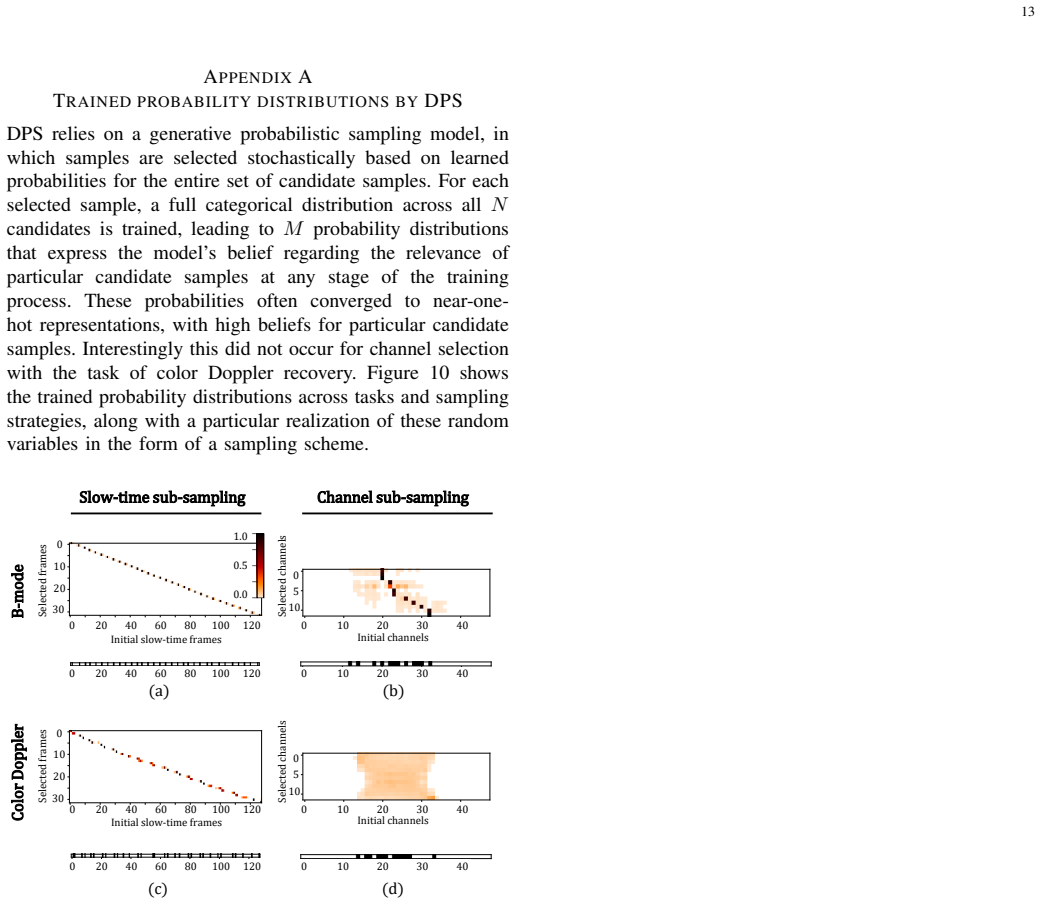
- The same training procedure adapts the pattern to the task: B-mode recovery drives near-uniform slow-time sampling, Doppler recovery drives ensemble-like clustered sampling, and channel sub-sampling drives center-weighted arrays.
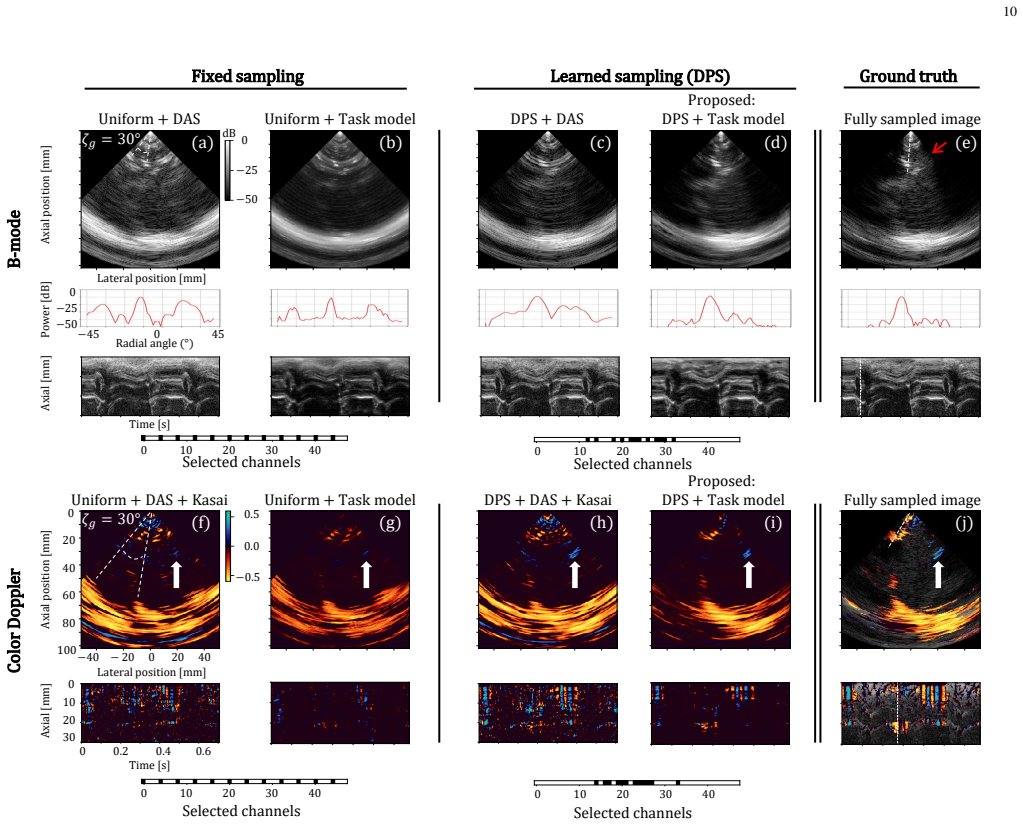
- Jointly trained sampling plus task model outperforms fixed sampling with a trained model, and for Doppler it avoids the strong aliasing seen when interpolating frames before applying the Kasai auto-correlator.
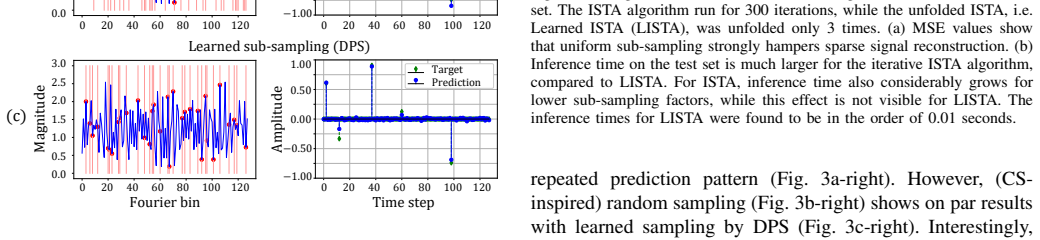
- The unfolded learned-ISTA task model recovers sparse signals from partial Fourier measurements faster than 300-iteration ISTA by a factor over 1000, with better MSE at high sub-sampling factors.
- Learned sparse arrays can match a hand-designed full-sum-coarray array in B-mode MSE, suggesting DPS discovers known good array geometries from data.
Reading between the lines
- Beyond the paper's claims, the same sub-sampling formalism would transfer naturally to MRI k-space or sparse-view CT, since those modalities already acquire partial Fourier or projection measurements; the partial-Fourier experiment is the closest evidence.
- Because the reported masks are single stochastic realizations of trained distributions, a seed-variability study would tell whether the learned pattern itself is stable; the paper does not report this, so the realized mask should be read as one sample, not as the unique optimum.
- One could test the method's sensitivity to the straight-through surrogate by training with several temperature schedules or entropy penalty weights; if performance is strongly schedule-dependent, the relaxation's behavior, not the sampling concept, may be the limiting factor.
Signed reviews
Editorial analysis
A structured set of objections, weighed in public.
Referee Report
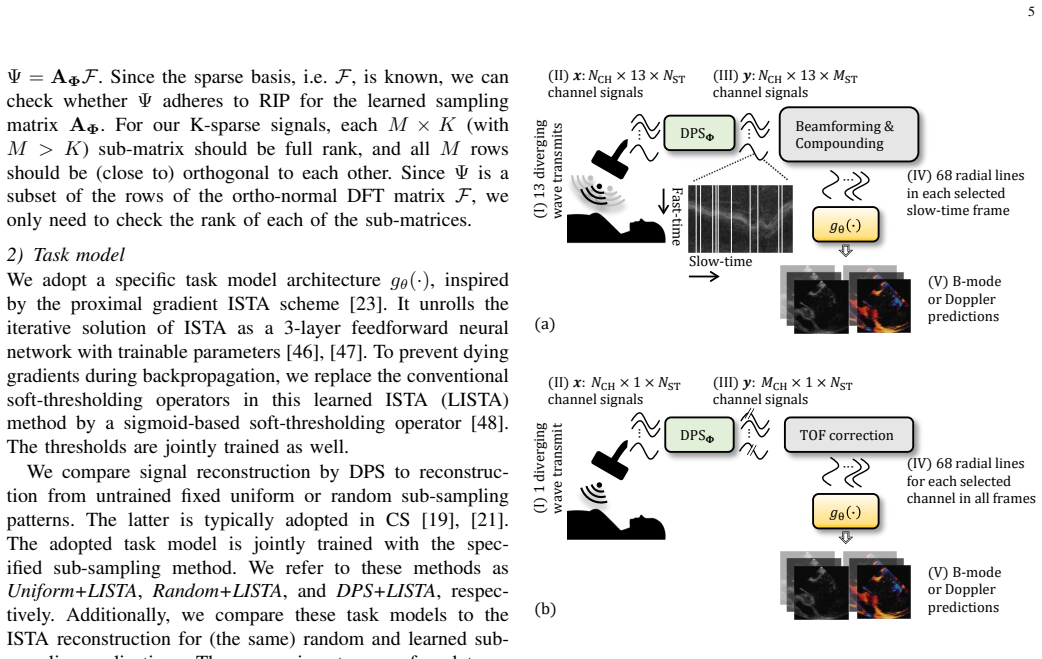
Summary. The paper proposes Deep Probabilistic Sub-sampling (DPS), a framework that jointly learns a categorical distribution over candidate measurement indices and a neural task model in an end-to-end fashion. Sampling is performed without replacement via a Gumbel-max trick with masking, and gradients are obtained through a straight-through Gumbel-Softmax surrogate with temperature annealing. The method is validated on three settings: sparse signal recovery from partial Fourier measurements, slow-time sub-sampling for ultrasound B-mode and color Doppler imaging, and channel sub-sampling for sparse array design. The authors report that DPS yields task-specific patterns, that learned patterns are comparable or superior to uniform and random fixed sampling when combined with the learned task model, and that the resulting fixed patterns are hardware-implementable.
Significance. If the reported results are robust, the work is significant: it offers a practical way to learn hard, task-driven sub-sampling masks with a trainable downstream network, avoiding the hardware challenges of randomly weighted linear measurement schemes. The method is clearly described with pseudocode and the masking mechanism for sampling without replacement is coherent. The use of in-vivo porcine ultrasound data and the comparison with a hand-designed full-sum-coarray sparse array are strong points, as is the interpretable finding that B-mode and Doppler tasks induce qualitatively different learned sampling patterns. The main limitations are the reliance on single stochastic realizations for some reported patterns and the absence of error bars or repeated-run statistics in the quantitative comparisons.
major comments (3)
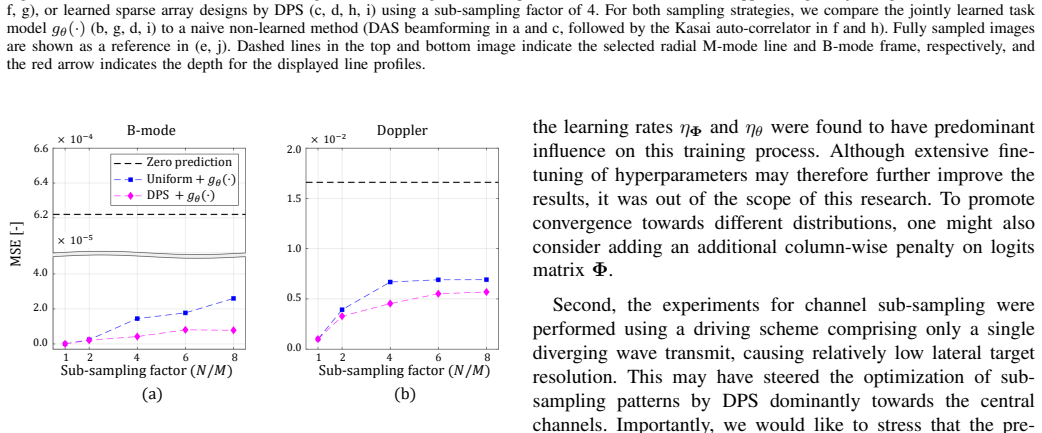
- [Section V-C / Fig. 8 / Appendix A] The central claim that DPS produces a fixed, hardware-implementable pattern that outperforms uniform sampling is not established for channel sub-sampling with color Doppler. Appendix A explicitly reports that the learned probability distributions for this task did not converge to near-one-hot (Fig. 10d), yet the quantitative DPS results in Fig. 8b and the qualitative images in Fig. 7 are based on a single stochastic realization of those distributions. Different realizations can yield different sparse arrays with different grating-lobe behavior and different Doppler MSE, so the reported advantage over uniform sampling may be realization-specific. Please report the mean and spread of test MSE over multiple draws from the trained distributions, and specify the procedure by which a single deployment pattern would be selected from a non-concentrated distribution.
- [Section III-D, Eq. (11)] The entropy penalty LS is computed from the unmasked probabilities πm defined in Eq. (5), while the actual forward sampling in Eq. (7) uses masked logits wm−1 + φm to enforce sampling without replacement. Penalizing the unmasked entropy does not guarantee that the conditional distribution used at row m is concentrated after earlier rows have removed candidates. This mismatch plausibly contributes to the non-convergence reported in Appendix A for channel Doppler and should be fixed or analyzed; otherwise the training objective does not directly promote the one-hot patterns on which the 'fixed pattern' claim rests.
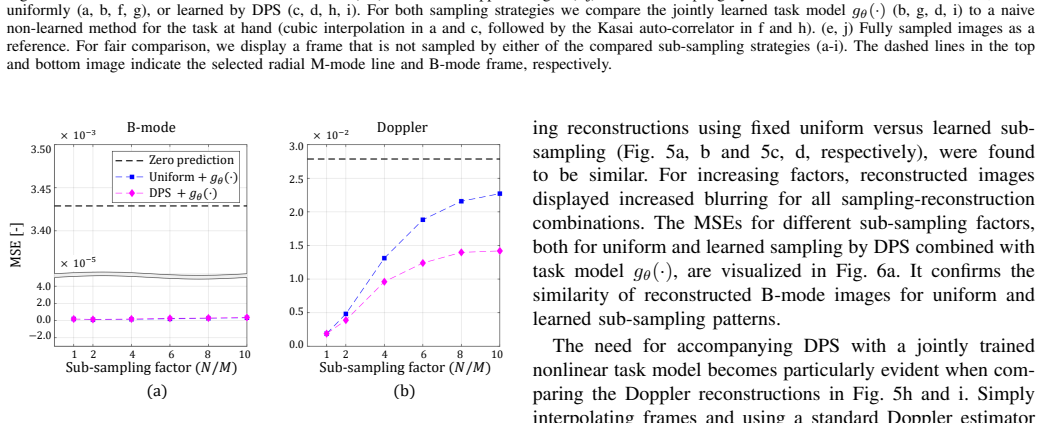
- [Figs. 4, 6, 8] All quantitative comparisons are reported as point estimates without error bars, confidence intervals, or significance tests. Because DPS training is stochastic (Gumbel noise, mini-batch sampling) and the final evaluation itself uses a random realization, the observed differences between DPS and Random+LISTA or between DPS and Uniform+task-model could be within run-to-run variability. Please report results over at least three independent training runs and multiple test realizations for the main comparisons.
minor comments (4)
- [Section IV-B1] The transducer system is referred to as 'Verasonics Vantrage'; this appears to be a typo for 'Verasonics Vantage'.
- [Fig. 9 caption] The caption contains a duplicated MSE value ('MSE: 2.1e-62.1e-6') and the typo 'task model.s'; both should be corrected.
- [Section III-B, Eq. (8)] The notation ∇φm am := ∇φm E[softmaxτ(...)] is nonstandard because the left-hand side denotes a gradient of a hard one-hot sample. Please clarify that this is the surrogate gradient used in backpropagation, not the true gradient of am.
- [Section V-A] The statement that the learned sensing matrix 'showed to be RIP-compliant' should specify how the check was performed, for example whether all M×K submatrices were tested and what numerical criterion was used.
Circularity Check
No significant circularity: DPS optimizes a sampling distribution against fully-sampled task targets, and all comparisons are external.
full rationale
The paper's derivation chain is self-contained. DPS defines the measurement vector as y = A_Phi x (Eq. 1), the task target as z = f(x) (Eq. 2), and the prediction as z_hat = g_theta(y) (Eq. 3). The training objective (Eqs. 12-14) minimizes the MSE between z_hat and the fully-sampled target z, plus an entropy penalty on the sampling distribution. The targets are computed independently of the learned pattern: for Doppler they come from the Kasai auto-correlator applied to fully sampled data, and for B-mode from the envelope of fully sampled beamformed data. The learned sub-sampling matrix is therefore optimized against external task labels, not against a quantity derived from the pattern itself. The paper also evaluates against untrained uniform sampling, random sampling, and a hand-designed full-sum-coarray sparse array, so the claimed improvements are externally anchored. The only self-citations (Refs. [28], [49]) are prior methodological or architectural work and are not load-bearing: the paper provides its own equations, algorithm, and training details. The Appendix A caveat that channel-Doppler distributions did not converge to near-one-hot is a robustness/limitation issue, not circularity. There is no fitted parameter renamed as a prediction, no uniqueness theorem imported from the authors, and no ansatz smuggled in via citation. Accordingly, the circularity score is 0.
Assumptions & free parameters
free parameters (7)
- temperature schedule (tau) =
5.0 to 0.5
- entropy penalty multiplier mu =
1e-7 to 1e-8, increasing per epoch
- L2 penalty multiplier lambda =
0, 1e-5, 1e-5
- learning rates eta_Phi and eta_theta =
5e-3/1e-3, 2e-3/1e-4
- logits initialization quartic coefficients (alpha, beta) =
alpha = -2.73e-7, beta = -2.73e-3
- Gaussian noise scale on logits initialization =
sigma = 0.01
- number of training iterations and mini-batch sizes =
96000, 640000, 192000
assumptions (5)
- domain assumption The Gumbel-Softmax relaxation, Eq. (8), provides a differentiable surrogate that, combined with the annealing schedule, yields optimal or near-optimal sub-sampling patterns for the hard, non-differentiable forward operation in Eq. (7).
- domain assumption The convolutional task model architecture is sufficiently expressive and generalizes to the test distribution.
- domain assumption The in-vivo porcine data, acquired with a single ultrasound setup, is representative enough for the learned patterns to be useful in the target deployment scenario.
- domain assumption The non-learned baselines (ISTA, cubic interpolation, DAS, Kasai) are implemented sufficiently well to provide a fair comparison.
- domain assumption The sparse signal model for the synthetic partial Fourier experiment is representative of real compressed sensing scenarios.
invented entities (1)
-
Deep Probabilistic Sub-sampling (DPS) layer
Cite this review
Pith. "Pith review of Learning Sub-Sampling and Signal Recovery with Applications in Ultrasound Imaging." pith.science (2026). https://pith.science/paper/H6DEDCO5
@misc{pith2026190805764,
  author       = {Pith},
  title        = {Pith review of: Learning Sub-Sampling and Signal Recovery with Applications in Ultrasound Imaging},
  year         = {2026},
  howpublished = {\url{https://pith.science/paper/H6DEDCO5}},
  note         = {Machine review of arXiv:1908.05764}
}
read the original abstract
Limitations on bandwidth and power consumption impose strict bounds on data rates of diagnostic imaging systems. Consequently, the design of suitable (i.e. task- and data-aware) compression and reconstruction techniques has attracted considerable attention in recent years. Compressed sensing emerged as a popular framework for sparse signal reconstruction from a small set of compressed measurements. However, typical compressed sensing designs measure a (non)linearly weighted combination of all input signal elements, which poses practical challenges. These designs are also not necessarily task-optimal. In addition, real-time recovery is hampered by the iterative and time-consuming nature of sparse recovery algorithms. Recently, deep learning methods have shown promise for fast recovery from compressed measurements, but the design of adequate and practical sensing strategies remains a challenge. Here, we propose a deep learning solution termed Deep Probabilistic Sub-sampling (DPS), that learns a task-driven sub-sampling pattern, while jointly training a subsequent task model. Once learned, the task-based sub-sampling patterns are fixed and straightforwardly implementable, e.g. by non-uniform analog-to-digital conversion, sparse array design, or slow-time ultrasound pulsing schemes. The effectiveness of our framework is demonstrated in-silico for sparse signal recovery from partial Fourier measurements, and in-vivo for both anatomical image and tissue-motion (Doppler) reconstruction from sub-sampled medical ultrasound imaging data.
Figures


Figures from the paper (7 more)


Reference graph
Works this paper leans on
-
[1]
E. Y . Sidky and X. Pan, “Image reconstruction in circular cone-beam computed tomography by constrained, total-variation minimization,” Physics in Medicine & Biology , vol. 53, no. 17, p. 4777, 2008
work page 2008
-
[2]
G.-H. Chen, J. Tang, and S. Leng, “Prior image constrained compressed sensing (PICCS): a method to accurately reconstruct dynamic CT images from highly undersampled projection data sets,”Medical physics, vol. 35, no. 2, pp. 660–663, 2008
work page 2008
-
[3]
Compressed sensing based cone- beam computed tomography reconstruction with a first-order method
K. Choi, J. Wang, L. Zhu et al. , “Compressed sensing based cone- beam computed tomography reconstruction with a first-order method.” Medical physics, vol. 37, no. 9, pp. 5113–5125, 2010
work page 2010
-
[4]
Low-dose CT reconstruction via edge-preserving total variation regularization,
Z. Tian, X. Jia, K. Yuan et al. , “Low-dose CT reconstruction via edge-preserving total variation regularization,” Physics in Medicine & Biology, vol. 56, no. 18, p. 5949, 2011
work page 2011
-
[5]
Compressed sens- ing for ultrasound computed tomography,
R. van Sloun, A. Pandharipande, M. Mischi et al. , “Compressed sens- ing for ultrasound computed tomography,” IEEE Trans. Biomed. Eng , vol. 62, no. 6, pp. 1660–1664, 2015
work page 2015
-
[6]
O. Lorintiu, H. Liebgott, M. Alessandrini et al. , “Compressed sensing reconstruction of 3D ultrasound data using dictionary learning and line- wise subsampling,” IEEE Trans. Med. Imag., vol. 34, no. 12, pp. 2467– 2477, 2015
work page 2015
-
[7]
Xampling in ultrasound imaging,
N. Wagner, Y . C. Eldar, A. Feuer et al. , “Xampling in ultrasound imaging,” in Medical Imaging 2011: Ultrasonic Imaging, Tomography, and Therapy, vol. 7968. Int. Society for Optics and Photonics, 2011, p. 796818
work page 2011
-
[8]
Sparse MRI: The application of compressed sensing for rapid MR imaging,
M. Lustig, D. Donoho, and J. M. Pauly, “Sparse MRI: The application of compressed sensing for rapid MR imaging,” Magnetic Resonance in Medicine: An Official Journal of the Int. Society for Magnetic Resonance in Medicine, vol. 58, no. 6, pp. 1182–1195, 2007
work page 2007
Show all 60 references
-
[9]
Compressed sensing MRI,
M. Lustig, D. L. Donoho, J. M. Santos et al. , “Compressed sensing MRI,” IEEE signal processing magazine , vol. 25, no. 2, p. 72, 2008
2008
-
[10]
Acuson freestyle series ultrasound systems,
“Acuson freestyle series ultrasound systems,” https://www. siemens-healthineers.com/nl/ultrasound/ultrasound-point-of-care/ acuson-freestyle-ultrasound-machine, accessed: 2020-01-24
2020
-
[11]
Butterfly iq,
“Butterfly iq,” https://www.butterflynetwork.com/iq, accessed: 2020-01- 24
2020
-
[12]
Ultrasound probe,
M. De Jonge, C. T. McNulty, D. Elgena et al. , “Ultrasound probe,” Apr. 23 2019, US Patent App. 29/623,977
2019
-
[13]
3D ultrafast ultrasound imaging in vivo,
J. Provost, C. Papadacci, J. E. Arango et al. , “3D ultrafast ultrasound imaging in vivo,” Physics in Medicine & Biology , vol. 59, no. 19, pp. L1–L13, 2014
2014
-
[14]
Ultrafast imaging in biomedical ultrasound,
M. Tanter and M. Fink, “Ultrafast imaging in biomedical ultrasound,” IEEE Trans. Ultrason., Ferroelectr., Freq. Control , vol. 61, no. 1, pp. 102–119, 2014
2014
-
[15]
2-D phased array ultrasound imaging system with distributed phasing,
J. D. Larson III, “2-D phased array ultrasound imaging system with distributed phasing,” Jul. 20 1993, US Patent 5,229,933
1993
-
[16]
4-D ice: A 2-D array transducer with integrated asic in a 10-fr catheter for real-time 3-D intracardiac echocardiography,
D. Wildes, W. Lee, B. Haider et al., “4-D ice: A 2-D array transducer with integrated asic in a 10-fr catheter for real-time 3-D intracardiac echocardiography,” IEEE Trans. Ultrason., Ferroelectr., Freq. Control , vol. 63, no. 12, pp. 2159–2173, 2016
2016
-
[17]
Stable signal recovery from incomplete and inaccurate measurements,
E. J. Cand `es, J. K. Romberg, and T. Tao, “Stable signal recovery from incomplete and inaccurate measurements,” Communications on Pure and Applied Mathematics: A Journal Issued by the Courant Institute of Mathematical Sciences , vol. 59, no. 8, pp. 1207–1223, 2006
2006
-
[18]
Decoding by linear programming,
E. J. Cand `es and T. Tao, “Decoding by linear programming,” IEEE Trans. Inf. Theory, vol. 51, no. 12, pp. 4203–4215, 2005
2005
-
[19]
Compressive sampling,
E. J. Cand `es, “Compressive sampling,” in Proc. Int. Congress of Mathematicians: Madrid, August 22-30, 2006: invited lectures , 2006, pp. 1433–1452
2006
-
[20]
Near-optimal signal recovery from random projections: Universal encoding strategies?
E. J. Cand `es and T. Tao, “Near-optimal signal recovery from random projections: Universal encoding strategies?” IEEE Trans. Inf. Theory , vol. 52, no. 12, pp. 5406–5425, 2006
2006
-
[21]
Y . C. Eldar and G. Kutyniok, Compressed sensing: theory and applica- tions. Cambridge University Press, 2012
2012
-
[22]
The restricted isometry property and its implications for compressed sensing,
E. J. Cand `es, “The restricted isometry property and its implications for compressed sensing,” Comptes rendus mathematique, vol. 346, no. 9-10, pp. 589–592, 2008. 12
2008
-
[23]
An iterative thresholding algorithm for linear inverse problems with a sparsity constraint,
I. Daubechies, M. Defrise, and C. De Mol, “An iterative thresholding algorithm for linear inverse problems with a sparsity constraint,” Com- munications on Pure and Applied Mathematics: A Journal Issued by the Courant Institute of Mathematical Sciences , vol. 57, no. 11, pp. 1...
2004
-
[24]
A deep learning approach to ultrasound image recovery,
D. Perdios, A. Besson, M. Arditi et al. , “A deep learning approach to ultrasound image recovery,” in 2017 IEEE Int. Ultrasonics Symposium (IUS). IEEE, 2017, pp. 1–4
2017
-
[25]
Reconnet: Non-iterative recon- struction of images from compressively sensed measurements,
K. Kulkarni, S. Lohit, P. Turaga et al., “Reconnet: Non-iterative recon- struction of images from compressively sensed measurements,” in Proc. IEEE Conf. Computer Vision and Pattern Recognition , 2016, pp. 449– 458
2016
-
[26]
Categorical reparametrization with gumbel-softmax,
E. Jang, S. Gu, and B. Poole, “Categorical reparametrization with gumbel-softmax,” stat, vol. 1050, p. 17, 2017
2017
-
[27]
The concrete distribution: A continuous relaxation of discrete random variables,
C. J. Maddison, A. Mnih, and Y . W. Teh, “The concrete distribution: A continuous relaxation of discrete random variables,” arXiv preprint arXiv:1611.00712, 2016
2016 arXiv
-
[28]
Deep probabilistic subsampling for task-adaptive compressed sensing,
I. A. Huijben, B. S. Veeling, and R. J. van Sloun, “Deep probabilistic subsampling for task-adaptive compressed sensing,” in Int. Conf. on Learning Representations , 2020. [Online]. Available: https://openreview.net/forum?id=SJeq9JBFvH
2020
-
[29]
k-t BLAST and k-t SENSE: dynamic MRI with high frame rate exploiting spatiotemporal correlations,
J. Tsao, P. Boesiger, and K. P. Pruessmann, “k-t BLAST and k-t SENSE: dynamic MRI with high frame rate exploiting spatiotemporal correlations,” Magnetic Resonance in Medicine: An Official Journal of the Int. Society for Magnetic Resonance in Medicine , vol. 50, no. 5, pp. 1031–...
2003
-
[30]
Fourier-domain beamforming: the path to compressed ultrasound imaging,
T. Chernyakova and Y . C. Eldar, “Fourier-domain beamforming: the path to compressed ultrasound imaging,” IEEE Trans. Ultrason., Ferroelectr., Freq. Control, vol. 61, no. 8, pp. 1252–1267, 2014
2014
-
[31]
A compressed beamforming framework for ultrafast ultrasound imaging,
A. Besson, R. E. Carrillo, D. Perdios et al., “A compressed beamforming framework for ultrafast ultrasound imaging,” in 2016 IEEE Int. Ultra- sonics Symposium (IUS) . IEEE, 2016, pp. 1–4
2016
-
[32]
Maximally economic sparse arrays and cantor arrays,
C.-L. Liu and P. Vaidyanathan, “Maximally economic sparse arrays and cantor arrays,” in 2017 IEEE 7th Int. Workshop on Computational Advances in Multi-Sensor Adaptive Processing (CAMSAP). IEEE, 2017, pp. 1–5
2017
-
[33]
Sparse doppler sensing based on nested arrays,
R. Cohen and Y . C. Eldar, “Sparse doppler sensing based on nested arrays,” IEEE Trans. Ultrason., Ferroelectr., Freq. Control , vol. 65, no. 12, pp. 2349–2364, 2018
2018
-
[34]
Sparse 2-D arrays for 3-D phased array imaging-design methods,
A. Austeng and S. Holm, “Sparse 2-D arrays for 3-D phased array imaging-design methods,” IEEE Trans. Ultrason., Ferroelectr., Freq. Control, vol. 49, no. 8, pp. 1073–1086, 2002
2002
-
[35]
Sparse convolutional beamforming for ultrasound imaging,
R. Cohen and Y . C. Eldar, “Sparse convolutional beamforming for ultrasound imaging,” IEEE Trans. Ultrason., Ferroelectr., Freq. Control, vol. 65, no. 12, pp. 2390–2406, 2018
2018
-
[36]
A deep learning approach to structured signal recovery,
A. Mousavi, A. B. Patel, and R. G. Baraniuk, “A deep learning approach to structured signal recovery,” in 2015 53rd Annual Allerton Conf. Communication, Control, and Computing (Allerton) . IEEE, 2015, pp. 1336–1343
2015
-
[37]
Learning to invert: Signal recovery via deep convolutional networks,
A. Mousavi and R. G. Baraniuk, “Learning to invert: Signal recovery via deep convolutional networks,” in 2017 IEEE Int. Conf. Acoustics, Speech and Signal Processing (ICASSP) . IEEE, 2017, pp. 2272–2276
2017
-
[38]
Compressed learning: A deep neural network approach,
A. Adler, M. Elad, and M. Zibulevsky, “Compressed learning: A deep neural network approach,” arXiv preprint arXiv:1610.09615 , 2016
2016 arXiv
-
[39]
A deep learning approach to block- based compressed sensing of images,
A. Adler, D. Boublil, M. Elad et al., “A deep learning approach to block- based compressed sensing of images,” arXiv preprint arXiv:1606.01519, 2016
2016 arXiv
-
[40]
Convcsnet: A convolutional com- pressive sensing framework based on deep learning,
X. Lu, W. Dong, P. Wang et al. , “Convcsnet: A convolutional com- pressive sensing framework based on deep learning,” arXiv preprint arXiv:1801.10342, 2018
2018 arXiv
-
[41]
Statistical theory of extreme values and some practical applications,
E. J. Gumbel, “Statistical theory of extreme values and some practical applications,” NBS Applied Mathematics Series , vol. 33, 1954
1954
-
[42]
Adam: A method for stochastic optimization,
D. P. Kingma and J. Ba, “Adam: A method for stochastic optimization,” Int. Conf. Learning Representations , 2014
2014
-
[43]
Keras: Deep learning library for theano and tensorflow,
F. Chollet, “Keras: Deep learning library for theano and tensorflow,” URL: https://keras. io/k , vol. 7, no. 8, p. T1, 2015
2015
-
[44]
Tensorflow: A system for large- scale machine learning,
M. Abadi, P. Barham, J. Chen et al., “Tensorflow: A system for large- scale machine learning,” in 12th{USENIX} Symposium on Operating Systems Design and Implementation ({OSDI} 16), 2016, pp. 265–283
2016
-
[45]
Combination of compressed sensing and parallel imaging for highly accelerated first-pass cardiac perfusion MRI,
R. Otazo, D. Kim, L. Axel et al., “Combination of compressed sensing and parallel imaging for highly accelerated first-pass cardiac perfusion MRI,” Magnetic resonance in medicine , vol. 64, no. 3, pp. 767–776, 2010
2010
-
[46]
Learning fast approximations of sparse coding,
K. Gregor and Y . LeCun, “Learning fast approximations of sparse coding,” in Proc. 27th Int. Conf. Machine Learning . Omnipress, 2010, pp. 399–406
2010
-
[47]
Theoretical linear convergence of unfolded ista and its practical weights and thresholds,
X. Chen, J. Liu, Z. Wang et al. , “Theoretical linear convergence of unfolded ista and its practical weights and thresholds,” in Advances in Neural Inf. Processing Systems , 2018, pp. 9061–9071
2018
-
[48]
Smooth sigmoid wavelet shrinkage for non-parametric estimation,
A. M. Atto, D. Pastor, and G. Mercier, “Smooth sigmoid wavelet shrinkage for non-parametric estimation,” in Int. Conf. Acoustics, Speech and Signal Processing . IEEE, 2008, pp. 3265–3268
2008
-
[49]
Learning Doppler with deep neural networks and its application to intra-cardiac echography,
R. J. Van Sloun, H. Belt, K. Janse et al., “Learning Doppler with deep neural networks and its application to intra-cardiac echography,” in 2018 IEEE Int. Ultrasonics Symposium (IUS) . IEEE, 2018, pp. 1–4
2018
-
[50]
Deep learning in ultrasound imaging,
R. J. van Sloun, R. Cohen, and Y . C. Eldar, “Deep learning in ultrasound imaging,” Proceedings of the IEEE , vol. 108, no. 1, pp. 11–29, 2019
2019
-
[51]
Real-time two-dimensional blood flow imaging using an autocorrelation technique,
C. Kasai, K. Namekawa, A. Koyano et al., “Real-time two-dimensional blood flow imaging using an autocorrelation technique,” IEEE Trans. on sonics and ultrasonics , vol. 32, no. 3, pp. 458–464, 1985
1985
-
[52]
Goodfellow, Y
I. Goodfellow, Y . Bengio, and A. Courville, Deep Learning. MIT Press, 2016, http://www.deeplearningbook.org
2016
-
[53]
Empirical evaluation of rectified activations in convolutional network,
B. Xu, N. Wang, T. Chen et al. , “Empirical evaluation of rectified activations in convolutional network,” arXiv preprint arXiv:1505.00853, 2015
2015 arXiv
-
[54]
High-frame-rate echocardiography using diverging transmit beams and parallel receive beamforming,
H. Hasegawa and H. Kanai, “High-frame-rate echocardiography using diverging transmit beams and parallel receive beamforming,” Journal of medical ultrasonics, vol. 38, no. 3, pp. 129–140, 2011
2011
-
[55]
T. L. Szabo, Diagnostic ultrasound imaging: inside out . Academic Press, 2004
2004
-
[56]
Deep image prior,
D. Ulyanov, A. Vedaldi, and V . Lempitsky, “Deep image prior,” in Pro- ceedings of the IEEE Conf. on Computer Vision and Pattern Recognition, 2018, pp. 9446–9454
2018
-
[57]
Deep learning for fast adaptive beamforming,
B. Luijten, R. Cohen, F. J. de Bruijn et al. , “Deep learning for fast adaptive beamforming,” in 2019 IEEE Int. Conf. Acoustics, Speech and Signal Processing (ICASSP) . IEEE, 2019, pp. 1333–1337
2019
-
[58]
Adaptive ultrasound beamforming using deep learning,
B. Luijten, R. Cohen, F. J. de Bruijn et al. , “Adaptive ultrasound beamforming using deep learning,” arXiv preprint arXiv:1909.10342 , 2019
1909 arXiv
-
[59]
Super- resolution ultrasound imaging,
K. Christensen-Jeffries, O. Couture, P. A. Dayton et al. , “Super- resolution ultrasound imaging,” Ultrasound in Medicine & Biology , 2020
2020
-
[60]
Super-resolution ultra- sound localization microscopy through deep learning,
R. J. van Sloun, O. Solomon, M. Bruce et al., “Super-resolution ultra- sound localization microscopy through deep learning,” arXiv preprint arXiv:1804.07661, 2018. 13 APPENDIX A TRAINED PROBABILITY DISTRIBUTIONS BY DPS DPS relies on a generative probabilistic sampling model, i...
2018 arXiv
Reviewed August 14, 2026 · model on record in the stance chip above.
Discussion (0). Continue with ORCID to comment.