REVIEW 4 major objections 6 minor 1 cited by
RTSR: A Real-Time Super-Resolution Model for AV1 Compressed Content
T0 review · 4 major / 6 minor · reviewed 2026-08-12 · deepseek-v4-flash
Pith's one-line read A deliberately small CNN, RTSR, claims the best trade-off between computational cost and quality among six AV1 video super-resolution models, running 360p-to-1080p upscaling in 0.81 ms/frame.
desk verdict RTSR is a real, low-complexity SR model for AV1 streaming, but the 'best trade-off' claim is 3-of-4 and depends on unverified challenge-provided baselines. read the letter →
The pith
A machine-rendered reading of the paper's core claim, the machinery that carries it, and where it could break.
The reading
What carries the argument
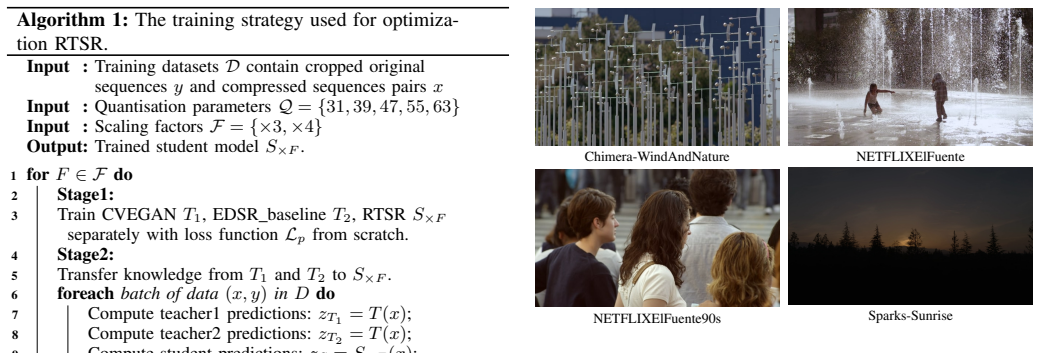
The load-bearing mechanism is the dual-teacher knowledge distillation with Laplacian loss, applied to a deliberately tiny CNN. The student (B=3, C=24) is first trained from scratch on the weighted perceptual loss Lp, then fine-tuned to minimise a total loss that combines the Laplacian loss to ground truth and the Laplacian loss between the student and each teacher's prediction, with alpha=0.1. PixelUnshuffle before the convolution body cuts the per-pixel cost, PixelShuffle performs the upsampling, and chroma is upsampled bicubically. This keeps the model below 2K MACs/pixel while letting it borrow perceptual quality from the two teachers.
What would settle it
Re-run all six models on the same GPU with the same measurement protocol (e.g., the VideoAI tool used for RTSR) and recompute average PSNR-Y, SSIM-Y, and VMAF on the challenge's 19 test sequences; if any competitor achieves equal or higher quality at equal or lower MACs/pixel on identically measured runtime, the claimed Pareto-front position no longer holds.
Extended reading notes
Core claim
The central claim is that RTSR sits beyond the Pareto front—the frontier where no competitor is both lower in complexity and higher in quality—of five competing super-resolution models in three of four PSNR/VMAF-versus-complexity comparisons on the AIM 2024 challenge benchmark. It records the highest PSNR-Y among all six submissions in Track 1 (33.329 dB, vs 32.808 for the next best) and the second-highest in Track 2, while its 1.89K and 1.16K MACs/pixel figures are far below the larger competitors. The architecture is deliberately small—three residual blocks of 24 channels with a PixelUnshuffle-first design—and the quality is driven by a two-stage training procedure: first a perceptual loss, then distillation from CVEGAN and EDSR teachers using Laplacian loss. The authors argue that this combination makes RTSR the practical choice for real-time AV1 super-resolution.
Load-bearing premise
The central 'best trade-off' assertion rests on the accuracy and comparability of the competitor quality and complexity numbers, which were supplied by the AIM challenge organizers and, as the authors note in a footnote, could not be independently verified or re-generated by the authors.
Editorial extensions
If this is right
- At 0.81 ms/frame for 360p-to-1080p on a 3090, RTSR is fast enough for real-time 1080p playback of low-resolution AV1 streams on current GPU hardware.
- The model's complexity (about 0.06M parameters and under 2K MACs/pixel) is low enough that it could likely run on mobile or edge devices, not just data-center GPUs.
- The single model trained across five AV1 QP values (31–63) generalizes across compression strengths without retuning, simplifying deployment.
- RTSR's best-PSNR result in Track 1 (33.329 dB) shows that a deliberately small network can exceed the fidelity of larger competitors when optimized for the target codec.
- Because the teachers and losses are not AV1-specific, the same training pipeline could be transferred to other codecs—a direction the paper names for future work.
Reading between the lines
- The paper's own caveat that PSNR and VMAF are not designed for AI-super-resolved content suggests the ranking could shift under a human perceptual study or an SR-specific metric; a subjective test would be a natural next check.
- The challenge-provided competitor numbers were not independently re-measured by the authors, so a single-GPU re-benchmark with identical measurement tools could move one of the other models onto or across the claimed front.
- The PixelUnshuffle-first, chroma-bicubic design is a reusable template: any restoration task with heavily compressed input and a real-time constraint could borrow the same complexity cut.
- Training one model per scale factor (×3 and ×4) is a practical limitation; a single multi-scale model trained with the same distillation loss could halve storage and deployment complexity, though the paper does not explore this.
Editorial analysis
A structured set of objections, weighed in public.
Referee Report
Summary. The paper proposes RTSR, a compact CNN for real-time super-resolution of AV1-compressed video (360p to 1080p at x3 and 540p to 4K at x4), trained with a dual-teacher knowledge-distillation strategy using CVEGAN and EDSR teachers and a Laplacian-loss objective. The model is evaluated within the AIM 2024 Efficient/Mobile Real-Time Video Super-Resolution challenge, where the authors report 0.062M parameters, under 2K MACs/pixel, runtimes of 0.81 ms/frame (x3) and 2.11 ms/frame (x4) on an RTX 3090, and claim that RTSR exceeds the Pareto front of the other five submitted solutions in three of four quality-complexity panels.
Significance. If the comparative results hold, RTSR is a practically relevant Pareto-optimal point for low-complexity, real-time video super-resolution on AV1 content. The paper's strengths are its deployment-oriented architecture (very low parameter and MAC counts), the explicit training recipe, and the use of a standardized challenge benchmark. The central 'best trade-off' claim is, however, only as strong as the challenge-provided competitor table and the paper's own acknowledged caveat that PSNR and VMAF are less reliable for AI-super-resolved content. The absence of re-measured competitor numbers, error bars, and ablations means the headline conclusion is conditional rather than established.
major comments (4)
- [Section IV, Table I, Fig. 1] The Pareto-front claim is load-bearing and rests entirely on unverified competitor metrics. All non-RTSR quality and complexity values were provided by the AIM challenge organizers, and the authors state they are unable to obtain results generated by other submitted models (Section IV footnote). The decisive margins are small: in Track 2, RTSR leads FSMD by only 0.135 dB in PSNR-Y, and in Track 1 VMAF, RTSR is not on the favorable side (SuperBicubic++ has 1.40 vs 1.89K MACs/pixel and 66.39 vs 55.44 VMAF). If competitor numbers were computed with a different VMAF version, color conversion, or decoded-YUV pipeline than the one used for RTSR, the reported ordering in the PSNR panels could change. Please either re-evaluate all methods under one identical protocol or explicitly label Fig. 1 and the abstract as using challenge-provided, not independently re-measured, competitor values, and soften the 'exceeds the Pareto front' wording accordingly.
- [Section IV, Table I] No uncertainty or significance analysis is reported. The averages in Table I are computed over 19 test sequences and five QPs, but the paper gives no error bars, confidence intervals, or per-content breakdown. The Track 2 PSNR-Y advantage of 0.135 dB over FSMD and the Track 1 VMAF deficit of nearly 11 points could easily be within content-dependent variability, especially given the paper's own statement that PSNR and VMAF are not designed for AI-super-resolved content and have lower reliability for it. Please add per-sequence or per-rate-point statistics, or explicitly frame the results as point estimates from a single challenge test set.
- [Section II-B, Algorithm 1, Eq. (2)] The contribution of the dual-teacher knowledge distillation is never isolated. The authors state that they tested L1, L2, MSE, SSIM, and MS-SSIM losses and found Laplacian loss best, but no ablation table or quantitative comparison is provided. Similarly, alpha=0.1 in Eq. (2) is taken from [29] without sensitivity analysis, and the multi-teacher summation in Eq. (2) is not analyzed (e.g., single-teacher vs dual-teacher). Since the paper's methodological novelty is the KD-based training strategy, please add ablations (no KD, single-teacher, dual-teacher, and loss variants) to demonstrate that each component contributes to the reported trade-off.
- [Table I, Section IV] The runtime column mixes GPU hardware: RTSR is measured on an RTX 3090, while SuperBicubic++ and ETDSv2 are measured on an A100 and FSMD on an RTX 4090. Runtime figures across rows are therefore not directly comparable, and the sentence in Section IV that highlights '0.8 ms per frame for x3 and 2 ms for x4' as evidence of efficiency should either report all runtimes on the same hardware or restrict the efficiency comparison to MACs/pixel, which is hardware-independent.
minor comments (6)
- [Abstract] The sentence beginning 'submitted to the AIM 2024 ...' is missing a verb and reads awkwardly; also, 'AV1' is inconsistently typeset as 'A V1' in multiple places in the PDF text.
- [References] References [4], [6], and [33] contain placeholder text 'Accessed: Enter Date Accessed'; please complete the access dates or remove them.
- [Algorithm 1] Line 12 says 'Compute total loss: Ltotal' but the exact formula for Ltotal is not stated inside the algorithm; please define it explicitly and clarify the summation over the two teachers in Eq. (2).
- [Section III-C, Table I] The text says the method is benchmarked against 'eight reference methods' and that 'the latter six' were provided by the organizers, but Table I contains only five non-anchor competitors in Track 1 and six in Track 2; please reconcile the counts and clarify which results come from the organizers.
- [Table I] The caption and text use inconsistent complexity units: the table reports 'MACs/pixel (K)' while Section III-B mentions 'MACs(G)'; please define the units precisely in the caption and use them consistently.
- [Figure 3] The notation '[48s,48s,Y]' and the handling of the UV channels before bicubic upsampling are unclear; please define s explicitly and describe how the 4:2:0 input is split into Y and UV branches in the figure or caption.
Circularity Check
No significant circularity: the claimed trade-off is an externally benchmarked result, not a reduction to a fitted parameter or self-citation.
full rationale
The RTSR paper is an empirical systems and benchmark paper rather than a derivation from first principles. The model is trained on standard supervised (compressed, original) patch pairs using a perceptually inspired loss and a knowledge-distillation objective (Eqs. 1 and 2); these equations describe the training procedure and are not used to conjure the reported quality or complexity numbers. The central claim, that RTSR offers the best complexity-performance trade-off, is established by comparing the authors' own measured PSNR/SSIM/VMAF and runtime figures against external competitor results provided by the AIM 2024 challenge organizers, as shown in Table I and Figure 1. No reported quantity is obtained by substituting the claimed conclusion into the model, and no fitted parameter is renamed as a prediction. The footnote in Section IV ('We are unable to obtain results generated by other submitted models') raises a legitimate measurement-consistency concern about the external baseline numbers, but this is a comparability risk rather than circularity: the comparison is still against independently provided benchmark data, not forced by the paper's own construction. Self-citations to CVEGAN, MTKD, BVI-AOM, and related prior group work support the training recipe and datasets, but they are cited as prior methods and data sources rather than as the basis of the benchmark outcome, and the evaluation is external. Therefore no circular step can be exhibited, and the score is 0.
Assumptions & free parameters
free parameters (3)
- Perceptual loss weights in Lp (Eq. 1) =
0.3 (L1), 0.2 (SSIM), 0.1 (L2), 0.4 (MS-SSIM)
- Distillation weight alpha in Eq. (2) =
0.1
- Network block count B and channel count C =
B=3, C=24
assumptions (4)
- domain assumption PSNR, SSIM and VMAF are valid proxies for perceptual quality of AI-super-resolved compressed content.
- domain assumption The competitor results and MACs/pixel values supplied by the AIM challenge organizers are accurate and comparable to the authors' own measurements.
- domain assumption Training patches from BVI-DVC, BVI-AOM and LDV3 generalize to the 19 challenge test sequences.
- domain assumption The encoding and downsampling pipeline (SVT-AV1, Lanczos filters) is representative of real streaming deployments.
Cite this review
Pith. "Pith review of RTSR: A Real-Time Super-Resolution Model for AV1 Compressed Content." pith.science (2026). https://pith.science/paper/H6FFAOVE
@misc{pith2026241113362,
  author       = {Pith},
  title        = {Pith review of: RTSR: A Real-Time Super-Resolution Model for AV1 Compressed Content},
  year         = {2026},
  howpublished = {\url{https://pith.science/paper/H6FFAOVE}},
  note         = {Machine review of arXiv:2411.13362}
}
read the original abstract
Super-resolution (SR) is a key technique for improving the visual quality of video content by increasing its spatial resolution while reconstructing fine details. SR has been employed in many applications including video streaming, where compressed low-resolution content is typically transmitted to end users and then reconstructed with a higher resolution and enhanced quality. To support real-time playback, it is important to implement fast SR models while preserving reconstruction quality; however most existing solutions, in particular those based on complex deep neural networks, fail to do so. To address this issue, this paper proposes a low-complexity SR method, RTSR, designed to enhance the visual quality of compressed video content, focusing on resolution up-scaling from a) 360p to 1080p and from b) 540p to 4K. The proposed approach utilizes a CNN-based network architecture, which was optimized for AV1 (SVT)-encoded content at various quantization levels based on a dual-teacher knowledge distillation method. This method was submitted to the AIM 2024 Video Super-Resolution Challenge, specifically targeting the Efficient/Mobile Real-Time Video Super-Resolution competition. It achieved the best trade-off between complexity and coding performance (measured in PSNR, SSIM and VMAF) among all six submissions. The code will be available soon.
Figures


Figures from the paper (1 more)

Forward citations
Cited by 1 Pith paper
-
Compressed Video Super-Resolution based on Hierarchical Encoding
VSR-HE, a per-frame transformer trained with perceptual and GAN losses, reports improved 4x super-resolution quality on HEVC-compressed conferencing video versus bicubic, EDSR, CVEGAN, and SwinIR.
Reference graph
Works this paper leans on
-
[29]
ST-MFNet Mini: Knowledge distillation-driven frame interpolation,
C. Morris, D. Danier, F. Zhang, N. Anantrasirichai, and D. R. Bull, “ST-MFNet Mini: Knowledge distillation-driven frame interpolation,” in 2023 IEEE International Conference on Image Processing (ICIP), pp. 1045–1049, IEEE, 2023
work page 2023
-
[1]
D. Bull and F. Zhang, Intelligent image and video compression: communicating pictures. Academic Press, 2021
work page 2021
-
[2]
CISCO visual networking index: forecast and method- ology, 2017–2022,
CISCO, “CISCO visual networking index: forecast and method- ology, 2017–2022,” November 2018
2017
-
[3]
VVCSoftware VTM
“VVCSoftware VTM.” https://vcgit.hhi.fraunhofer.de/jvet/ VVCSoftware VTM. Accessed: Enter Date Accessed
-
[4]
SVT-A V1
“SVT-A V1.” https://gitlab.com/AOMediaCodec/SVT-A V1. Ac- cessed: Enter Date Accessed
-
[5]
Overview of the high efficiency video coding (HEVC) stan- dard,
G. J. Sullivan, J.-R. Ohm, W.-J. Han, and T. Wiegand, “Overview of the high efficiency video coding (HEVC) stan- dard,” IEEE Transactions on Circuits and Systems for Video Technology, vol. 22, no. 12, pp. 1649–1668, 2012
work page 2012
-
[6]
Accessed: Enter Date Accessed
“VP9.” https://www.webmproject.org/vp9/. Accessed: Enter Date Accessed
-
[7]
DVC: An end-to-end deep video compression framework,
G. Lu, W. Ouyang, D. Xu, X. Zhang, C. Cai, and Z. Gao, “DVC: An end-to-end deep video compression framework,” in Proceedings of the IEEE/CVF conference on computer vision and pattern recognition , pp. 11006–11015, 2019
work page 2019
Show all 37 references
-
[8]
HiNeRV: Video compression with hierarchical encoding based neural representation,
H. M. Kwan, G. Gao, F. Zhang, A. Gower, and D. Bull, “HiNeRV: Video compression with hierarchical encoding based neural representation,” in NeurIPS, 2023
2023
-
[9]
MIMT: Masked image modeling transformer for video compression,
J. Xiang, K. Tian, and J. Zhang, “MIMT: Masked image modeling transformer for video compression,” in International Conference on Learning Representations , 2023
2023
-
[10]
CANF-VC: Conditional Augmented Normalizing Flows for Video Compression,
Y .-H. Ho, C.-P. Chang, P.-Y . Chen, A. Gnutti, and W.-H. Peng, “CANF-VC: Conditional Augmented Normalizing Flows for Video Compression,” European Conference on Computer Vision, 2022
2022
-
[11]
NVRC: Neural video representation compression,
H. M. Kwan, G. Gao, F. Zhang, A. Gower, and D. Bull, “NVRC: Neural video representation compression,” arXiv preprint arXiv:2409.07414, 2024
2024
-
[12]
Neural video compression with feature modulation,
J. Li, B. Li, and Y . Lu, “Neural video compression with feature modulation,” in IEEE/CVF Conference on Computer Vision and Pattern Recognition, CVPR 2024, Seattle, WA, USA, June 17-21, 2024, 2024
2024
-
[13]
Convolutional neural network-based fractional-pixel motion compensation,
N. Yan, D. Liu, H. Li, B. Li, L. Li, and F. Wu, “Convolutional neural network-based fractional-pixel motion compensation,” IEEE Transactions on Circuits and Systems for Video Technol- ogy, vol. 29, no. 3, pp. 840–853, 2018
2018
-
[14]
Enhancing VVC through CNN-based post-processing,
F. Zhang, C. Feng, and D. R. Bull, “Enhancing VVC through CNN-based post-processing,” in 2020 IEEE International Con- ference on Multimedia and Expo (ICME) , pp. 1–6, IEEE, 2020
2020
-
[15]
CVEGAN: a perceptually- inspired gan for compressed video enhancement,
D. Ma, F. Zhang, and D. R. Bull, “CVEGAN: a perceptually- inspired gan for compressed video enhancement,”arXiv preprint arXiv:2011.09190, 2020
2011 arXiv
-
[16]
MFRNet: a new CNN architecture for post-processing and in-loop filtering,
D. Ma, F. Zhang, and D. R. Bull, “MFRNet: a new CNN architecture for post-processing and in-loop filtering,” IEEE Journal of Selected Topics in Signal Processing , vol. 15, no. 2, pp. 378–387, 2020
2020
-
[17]
ViSTRA3: Video coding with deep parameter adaptation and post process- ing,
C. Feng, D. Danier, C. Tan, F. Zhang, and D. Bull, “ViSTRA3: Video coding with deep parameter adaptation and post process- ing,” in 2022 IEEE International Symposium on Circuits and Systems (ISCAS), pp. 824–828, 2022
2022
-
[18]
A video coding method based on neural network for clic2024,
Z. Li, J. Zhang, Y . Wang, X. Zeng, Z. Zhang, Y . Long, M. Jia, and N. Wang, “A video coding method based on neural network for clic2024,” arXiv preprint arXiv:2401.03623 , 2024
2024 arXiv
-
[19]
Towards hybrid-optimization video coding,
S. Huo, D. Liu, H. Zhang, L. Li, S. Ma, F. Wu, and W. Gao, “Towards hybrid-optimization video coding,” ACM Computing Surveys, vol. 56, no. 9, pp. 1–36, 2024
2024
-
[20]
Enhancing versatile video coding efficiency via post-processing of decoded frames using residual network integration in deep convolutional neural networks,
M. K. I. Ibraheem and A. V . Dvorkovich, “Enhancing versatile video coding efficiency via post-processing of decoded frames using residual network integration in deep convolutional neural networks,” in 2024 26th International Conference on Digital Signal Processing and its App...
2024
-
[21]
Enhanced deep residual networks for single image super-resolution,
B. Lim, S. Son, H. Kim, S. Nah, and K. Mu Lee, “Enhanced deep residual networks for single image super-resolution,” in Proceedings of the IEEE conference on computer vision and pattern recognition workshops , pp. 136–144, 2017
2017
-
[22]
Compressing deep image super-resolution models,
Y . Jiang, J. Nawała, F. Zhang, and D. Bull, “Compressing deep image super-resolution models,” in 2024 Picture Coding Symposium (PCS), pp. 1–5, IEEE, 2024
2024
-
[23]
MTKD: Multi- teacher knowledge distillation for image super-resolution,
Y . Jiang, C. Feng, F. Zhang, and D. Bull, “MTKD: Multi- teacher knowledge distillation for image super-resolution,” arXiv preprint arXiv:2404.09571 , 2024
2024 arXiv
-
[24]
AIM 2024 challenge on efficient video super-resolution for av1 compressed content,
M. V . Conde, Z. Lei, W. Li, C. Bampis, I. Katsavounidis, and R. Timofte, “AIM 2024 challenge on efficient video super-resolution for av1 compressed content,” arXiv preprint arXiv:2409.17256, 2024
2024 arXiv
-
[25]
FAKD: Feature- affinity based knowledge distillation for efficient image super- resolution,
Z. He, T. Dai, J. Lu, Y . Jiang, and S.-T. Xia, “FAKD: Feature- affinity based knowledge distillation for efficient image super- resolution,” in 2020 IEEE International Conference on Image Processing (ICIP), pp. 518–522, IEEE, 2020
2020
-
[26]
Context-aware synthesis for video frame interpolation,
S. Niklaus and F. Liu, “Context-aware synthesis for video frame interpolation,” in Proceedings of the IEEE conference on computer vision and pattern recognition , pp. 1701–1710, 2018
2018
-
[27]
PyTorch: An imperative style, high-performance deep learning library,
A. Paszke, S. Gross, F. Massa, A. Lerer, J. Bradbury, G. Chanan, T. Killeen, Z. Lin, N. Gimelshein, L. Antiga, et al., “PyTorch: An imperative style, high-performance deep learning library,” Advances in neural information processing systems , vol. 32, 2019
2019
-
[28]
Adam: A method for stochastic optimization,
D. P. Kingma and J. Ba, “Adam: A method for stochastic optimization,” arXiv preprint arXiv:1412.6980 , 2014
2014 arXiv
-
[30]
BVI-DVC: A training database for deep video compression,
D. Ma, F. Zhang, and D. R. Bull, “BVI-DVC: A training database for deep video compression,” IEEE Transactions on Multimedia, vol. 24, pp. 3847–3858, 2021
2021
-
[31]
BVI-AOM: A new training dataset for deep video compression optimization,
J. Nawała, Y . Jiang, F. Zhang, X. Zhu, J. Sole, and D. Bull, “BVI-AOM: A new training dataset for deep video compression optimization,” arXiv preprint arXiv:2408.03265 , 2024
2024 arXiv
-
[32]
VMAF: Toward a Practical Perceptual Video Quality Metric
Netflix, “VMAF: Toward a Practical Perceptual Video Quality Metric.” https://netflixtechblog.com/ toward-a-practical-perceptual-video-quality-metric-653f208b9652,
-
[33]
https://github.com/mv-lab/VideoAI-Speedrun
“https://github.com/mv-lab/VideoAI-Speedrun.” https://github. com/mv-lab/VideoAI-Speedrun. Accessed: Enter Date Ac- cessed
-
[34]
A database and model for the visual quality assessment of super-resolution videos,
F. Zhou, W. Sheng, Z. Lu, and G. Qiu, “A database and model for the visual quality assessment of super-resolution videos,” IEEE Transactions on Broadcasting , 2024
2024
-
[35]
A study of subjective video quality at various spatial resolutions,
A. Mackin, M. Afonso, F. Zhang, and D. Bull, “A study of subjective video quality at various spatial resolutions,” in 2018 25th IEEE International Conference on Image Processing (ICIP), pp. 2830–2834, IEEE, 2018
2018
-
[36]
SRQM: a video quality metric for spatial resolution adaptation,
A. Mackin, M. Afonso, F. Zhang, and D. Bull, “SRQM: a video quality metric for spatial resolution adaptation,” in 2018 Picture Coding Symposium (PCS) , pp. 283–287, IEEE, 2018
2018
-
[2024]
Accessed: August 15, 2024
2024
Reviewed August 12, 2026 · model on record in the stance chip above.
Discussion (0). Continue with ORCID to comment.