REVIEW 3 major objections 5 minor 47 references
Non-perturbative thermal QCD at very high temperatures: computational strategy and hadronic screening masses
T0 review · 3 major / 5 minor · reviewed 2026-08-12 · deepseek-v4-flash
Pith's one-line read A first non-perturbative lattice computation of hadronic screening masses in three-flavour QCD from 1 to 160 GeV shows the known next-to-leading-order perturbative formulas are insufficient across the entire range.
desk verdict A solid proceedings summarizing a first-class lattice program, but the claim that NLO perturbation theory fails is tied to a fixed renormalization-scale convention and needs a scale-robustness check before it stands as stated. read the letter →
The pith
A machine-rendered reading of the paper's core claim, the machinery that carries it, and where it could break.
The reading
What carries the argument
The argument is carried by a computational strategy for simulating thermal QCD without placing the pion mass and the temperature on the same lattice. Step-scaling techniques define a non-perturbative running coupling in a finite volume, fixing the lines of constant physics at a lattice spacing set by the temperature; shifted boundary conditions remove the need for a zero-temperature subtraction and, via effective-field-theory arguments, keep finite-volume effects exponentially small. The screening masses are extracted from the exponential falloff of spatial two-point correlation functions in the zero-topological-charge sector, and the temperature dependence is analysed with the two-loop running coupling $\hat g^2(T)$ at scale $\mu=2\pi T$ with $\Lambda_{\overline{\rm MS}}=341$ MeV. On the perturbative side, the baryonic next-to-leading-order prediction is obtained by solving a $(2+1)$-dimensional quantum-mechanical eigenvalue problem for the three-quark system in the dimensionally reduced effective theory (electrostatic QCD plus non-relativistic QCD), with the static potentials $V_\pm(r)$ as input.
What would settle it
Compute the topological-charge distribution on the largest spatial-volume lattices at $T\simeq1$ GeV, where the paper's boxes have $LT$ between 20 and 50, and compare screening masses extracted with and without the $Q=0$ restriction; if configurations with $|Q|>0$ occur with probability near or above $10^{-3}$, the continuum screening masses would shift by more than their quoted permille accuracy.
Extended reading notes
Core claim
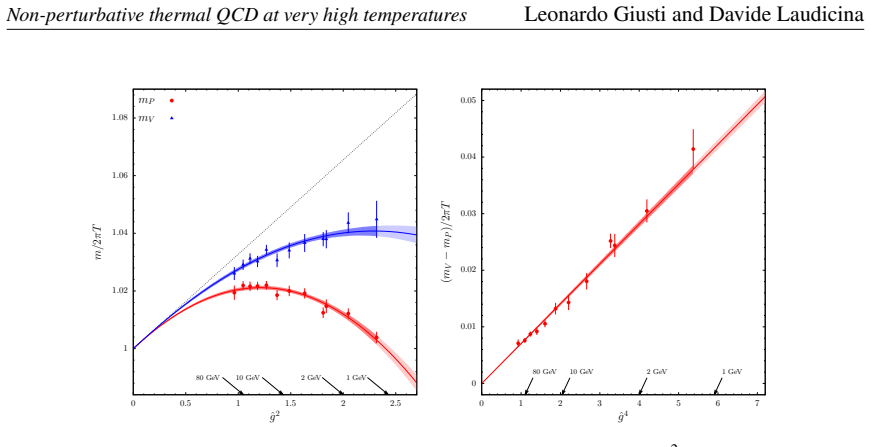
The central discovery is that, in $N_f=3$ QCD, hadronic screening masses computed non-perturbatively with continuum-limit extrapolations and few-permille accuracy from $T=1$ GeV to $T\simeq160$ GeV do not follow their next-to-leading-order perturbative predictions. The pseudoscalar mass is described over the whole range by $m_P/(2\pi T)=p_0+p_2\hat g^2+p_3\hat g^3+p_4\hat g^4$, with $p_0=1$ and $p_2=0.0327$ fixed to perturbation theory and fitted $p_3=0.0038(22)$, $p_4=-0.0161(17)$; the vector channel adds a spin-dependent term $s_4\hat g^4$ with $s_4=0.00704(14)$, so the vector--pseudoscalar splitting is nonzero up to 160 GeV. Positive and negative parity nucleon screening masses are degenerate throughout, as expected from chiral symmetry restoration. The nucleon screening mass is parameterized as $m_{N+}/(3\pi T)=b_0+b_2\hat g^2+b_3\hat g^3+b_4\hat g^4$, with $b_0=1$ and $b_2=0.046$ fixed and $b_3=0.026(4)$, $b_4=-0.021(3)$. On this basis the paper concludes that higher-order terms in the running coupling remain relevant across the whole range and that next-to-leading-order perturbation theory is not sufficient. The paper also notes that other parameterizations of the baryonic data are possible and would move the fitted NLO coefficient away from the perturbative value, so the quoted cubic and quartic coefficients are tied to the chosen polynomial ansatz.
Load-bearing premise
The load-bearing premise is that restricting all simulations to the zero-topological-charge sector is safe down to $T\simeq1$ GeV; if the probability of nonzero topology is not several orders of magnitude below the permille level, the extracted screening masses could carry an unquantified bias.
Editorial extensions
If this is right
- If the paper is right, next-to-leading-order perturbation theory cannot be used to predict screening masses at any temperature from 1 to 160 GeV; the quartic term is needed even at the top of the range.
- The observed $\hat g^4$ scaling of the vector--pseudoscalar splitting, with a nonzero coefficient at the highest simulated temperature, means spin-dependent effects missed by the next-to-leading-order computation are visible across the whole range.
- For the nucleon, the fitted polynomial gives $m_{N+}/(3\pi T)=1+0.046\,\hat g^2+0.026\,\hat g^3-0.021\,\hat g^4$, with positive and negative parity masses degenerate over the entire interval.
- The same combination of step scaling and shifted boundary conditions opens the way to non-perturbative results for other thermal observables, such as the equation of state, up to the electroweak scale at moderate computational cost.
- The data reinforce the paper's conclusion that perturbative thermal QCD has poor convergence at finite temperature even at 160 GeV, so a fully non-perturbative treatment is needed.
Reading between the lines
- If the same pattern carries over to other quantities, electroweak-scale QCD inputs used in early-universe cosmology, such as the equation of state and transport coefficients, may also deviate from their perturbative estimates.
- The fitted coefficients $p_3$, $p_4$, $b_3$, $b_4$ are concrete targets for a future full next-to-next-to-leading-order calculation in the three-dimensional effective theory; agreement would validate dimensional reduction at these scales, while disagreement would point to contributions outside that theory.
- The step-scaling plus shifted-boundary combination is not obviously specific to QCD and could be adapted to other asymptotically free gauge theories, or to QCD with different flavour numbers, where electroweak-scale thermodynamics may be needed.
- The paper's zero-topology restriction could be checked by measuring the topological susceptibility on the same lattices at $T\simeq1$ GeV, since the safety argument is semi-classical rather than a direct lattice measurement at this exact setup.
Editorial analysis
A structured set of objections, weighed in public.
Referee Report
Summary. The paper reports a strategy for non-perturbative lattice QCD at very high temperatures (T ≈ 1–160 GeV) by combining Schrödinger-functional step-scaling renormalization with shifted boundary conditions. It presents the hadronic screening spectrum (mesons and baryons) at twelve temperatures with continuum extrapolations, and compares the results with the NLO perturbative expressions in eqs. (13) and (16), evaluated with the two-loop coupling ĝ²(2πT) defined in eq. (17). The paper claims that the NLO terms alone cannot describe the data and that higher-order (ĝ³ and ĝ⁴) contributions are required over the entire temperature range. It also reports the first quantitative NLO calculation of the baryonic screening mass in the three-dimensional effective theory, cross-checked by two independent numerical methods in appendix A.
Significance. The computational strategy is a substantial methodological advance: it avoids the scale-separation problem of standard thermal lattice simulations and yields permille-level continuum screening masses across more than two orders of magnitude in temperature. If the interpretive claim is robust, these results provide the first non-perturbative evidence on the slow convergence of the weak-coupling expansion for screening masses at electroweak-scale temperatures, and the NLO baryonic result in eq. (16) is a useful new perturbative input. The paper is honest about the parameterization dependence of its fits (Section 5.2), but for that same reason the central claim needs additional robustness tests before publication.
major comments (3)
- [Secs. 5.1–5.2, eqs. (13), (16), (17)–(21)] The central claim that the NLO expressions are insufficient is calibrated to ĝ² evaluated at μ = 2πT. Since eq. (17) is the two-loop running coupling, changing the renormalization scale to μ = πT or 4πT shifts ĝ² by O(g⁴); translating this shift to the screening-mass ratio changes the effective quartic coefficient by roughly 0.003–0.005 for an order-of-magnitude change in μ. This is a substantial fraction of the fitted coefficients p₄ = −0.0161(17) and b₄ = −0.021(3), and several times their statistical errors. The paper fixes p₂ and b₂ to the perturbative values and never varies the scale, so the statement that higher-order terms are required is not yet established independently of this convention. Please refit with μ = πT and 4πT (and, if possible, with p₂ and b₂ left free) and report whether the need for g³/g⁴ terms persists; if different reasonable scale choices change the significance or sign of the quartic terms, the conclusion should be weakened accordingly.
- [Sec. 5.2, eq. (21); Sec. 5.1.1, eq. (18)] The fits impose the NLO coefficients p₂ and b₂ rather than determining them from the data. The paper itself notes that other parameterizations of the baryonic data make b₂ disagree with eq. (16), which means the reported b₃, b₄ (and similarly p₃, p₄) are conditional on the assumed validity of the NLO coefficient—precisely the object under test. A more robust analysis would fit p₂ and b₂ freely and compare models with and without g³/g⁴ terms using an information criterion or an F-test; at minimum, the free-fit results and the resulting χ² values should be reported so the reader can see whether the NLO coefficient is actually compatible with the data when not enforced.
- [Sec. 3.4] The restriction to the zero-topological-charge sector is justified by a dilute-instanton-gas estimate, but no numerical check is provided at the lowest simulated temperature T ≈ 1 GeV. Since the simulated theory has massless quarks, the continuum topological susceptibility is expected to vanish, but at finite lattice spacing with Wilson fermions the suppression of nonzero topology can be weaker, and a residual O(a) or finite-volume contamination would not be removed by the continuum extrapolation. This is an unverified assumption in the data pipeline for the lowest-temperature points, which help determine p₄ and b₄. The authors should either provide a direct check (for example, measuring the topological charge distribution at the smallest T, or comparing screening masses with and without the zero-topology restriction) or quantify the expected contamination at T ≈ 1 GeV.
minor comments (5)
- [Eq. (9)] The definition I₁(x₃,L) ≡ (1 − lim_{x₃→∞}) C_O(x₃) is not mathematically well-formed as written: taking the limit before subtracting from C_O(x₃) would give a constant rather than the x₃-dependent residue described in the text. Presumably the intended definition is a normalized residue such as I₁ = 1 − C_O(x₃)/lim_{x₃→∞} C_O(x₃).
- [Sec. 5.1.2, text after eq. (20)] The reported covariance ratios contain index mismatches: cov(p₃,s₄)/[σ(p₃)σ(p₄)] should presumably use σ(s₄) in the denominator, and cov(p₄,s₄)/[σ(p₄)σ(p₄)] should presumably be cov(p₄,s₄)/[σ(p₄)σ(s₄)].
- [Sec. 5.1.1] Typo: “necessery” should be “necessary”.
- [Abstract and Sec. 6] The abstract says “the known leading behaviour in the coupling constant,” but eqs. (13) and (16) give the next-to-leading (O(g²)) correction after the free-theory term; the wording should be “first non-trivial interacting contribution” or “next-to-leading” for consistency with the body.
- [Sec. 3.4] The estimate is phrased for “three light degenerate flavours of mass m,” while the simulations are described elsewhere as having exactly massless quarks; the instanton-gas argument should be stated for the massless case actually simulated, or the discrepancy should be explained.
Circularity Check
No significant circularity: the lattice screening masses are independent non-perturbative measurements, and the perturbative expressions they are compared with are external inputs, not fitted outputs.
full rationale
The central claim is that continuum-extrapolated lattice screening masses over a wide temperature range cannot be described by the known next-to-leading-order perturbative expressions in eqs. (13) and (16). These expressions are independent inputs: eq. (13) is the established result of Laine and Vepsalainen [9], while eq. (16) is a dedicated perturbative calculation summarized in appendix A and cross-checked by two independent numerical methods, both returning the same digits. The lattice data themselves are direct measurements of spatial correlation functions, and the analysis does not fit the NLO coefficients to the data; instead it fixes p0 and p2 to the perturbative values and fits the cubic and quartic terms. This is a comparison of data with perturbation theory, not a derivation of perturbation theory from the data. The coupling ghat^2 and Lambda_MS come from the independent non-perturbative determination of the Alpha collaboration [43], and they are not adjusted to make the comparison agree. The many self-citations, including refs. [7], [8], and [10], refer to prior work by the same collaboration, but that work contains the actual lattice and perturbative calculations whose content is either reproduced or independently checkable; it is not an unverified assertion used as the sole justification for the central result. The restriction to the zero-topological-charge sector is a physical approximation justified by semiclassical arguments and lattice checks, not a circular step. The possible sensitivity of the NLO comparison to the renormalization scale is a systematic uncertainty in interpreting the result, not an instance of the paper's inputs being equivalent to its outputs. The derivation chain is therefore self-contained with respect to circularity concerns.
Assumptions & free parameters
free parameters (5)
- p3 =
0.0038(22)
- p4 =
-0.0161(17)
- s4 =
0.00704(14)
- b3 =
0.026(4)
- b4 =
-0.021(3)
assumptions (6)
- domain assumption The three-dimensional effective theories EQCD and NRQCD describe thermal QCD at high temperatures, with the action given in eqs. (1) and (4) (Section 2).
- domain assumption Shifted boundary conditions with T = 1/(L0 sqrt(1+xi^2)) correctly realize the thermal ensemble (Section 3.2).
- domain assumption Finite-volume effects are exponentially suppressed with LT for LT between 20 and 50 (Section 3.3).
- domain assumption The zero-topological-charge sector captures the full theory at all simulated temperatures (Section 3.4).
- domain assumption The 2-loop running coupling g^2(T) defined in eq. (17) with Lambda_MS = 341 MeV from Ref [43] provides the correct expansion parameter for perturbation theory.
- ad hoc to paper The polynomial ansatze in eqs. (18), (20), and (21), including a g^3 term, are the appropriate parameterization of the temperature dependence.
Cite this review
Pith. "Pith review of Non-perturbative thermal QCD at very high temperatures: computational strategy and hadronic screening masses." pith.science (2026). https://pith.science/paper/H6SHPPGQ
@misc{pith2026241114127,
  author       = {Pith},
  title        = {Pith review of: Non-perturbative thermal QCD at very high temperatures: computational strategy and hadronic screening masses},
  year         = {2026},
  howpublished = {\url{https://pith.science/paper/H6SHPPGQ}},
  note         = {Machine review of arXiv:2411.14127}
}
abstract
We discuss a recently introduced strategy to study non-perturbatively thermal QCD up to temperatures of the order of the electro-weak scale, combining step scaling techniques and shifted boundary conditions. The former allow to renormalize the theory for a range of scales which spans several orders of magnitude with a moderate computational cost. Shifted boundary conditions remove the need for the zero temperature subtraction in the Equation of State. As a consequence, the simulated lattices do not have to accommodate two very different scales, the pion mass and the temperature, at the very same spacing. Effective field theory arguments guarantee that finite volume effects can be kept under control safely. With this strategy the first computation of the hadronic screening spectrum has been carried out over more than two orders of magnitude in the temperature, from $T\sim 1$ GeV up to $\sim 160$ GeV. This study is complemented with the first quantitative computation of the baryonic screening mass at next-to-leading order in the three-dimensional effective theory describing QCD at high temperatures. Both for the mesonic and the baryonic screening masses, the known leading behaviour in the coupling constant is found to be not sufficient to explain the non-perturbative data over the entire range of temperatures. These findings shed further light on the limited applicability of the perturbative approach at finite temperature, even at the electro-weak scale.
Figures

Reference graph
Works this paper leans on
-
[7]
M. Dalla Brida, L. Giusti, T. Harris, D. Laudicina, and M. Pepe,Non-perturbative thermal QCD at all temperatures: the case of mesonic screening masses, JHEP04(2022) 034, [arXiv:2112.05427]
arXiv 2022
- [8]
-
[1]
P. H. Ginsparg,First Order and Second Order Phase Transitions in Gauge Theories at Finite Temperature,Nucl. Phys. B170(1980) 388–408
work page 1980
-
[2]
Appelquist and R
T. Appelquist and R. D. Pisarski,High-Temperature Yang-Mills Theories and Three-Dimensional Quantum Chromodynamics,Phys. Rev. D23(1981) 2305
1981
-
[3]
A. D. Linde,Infrared Problem in Thermodynamics of the Yang-Mills Gas,Phys. Lett. B96 (1980) 289–292
work page 1980
-
[4]
E. Braaten and A. Nieto,Free energy of QCD at high temperature, Phys. Rev. D53 (1996) 3421–3437, [hep-ph/9510408]
arXiv 1996
-
[5]
K. Kajantie, M. Laine, K. Rummukainen, and Y. Schröder,Pressure of hot qcd up to 𝑔6ln(1/𝑔),Phys. Rev. D67 (May, 2003) 105008
work page 2003
-
[6]
L. Giusti and M. Pepe,Equation of state of the SU(3) Yang–Mills theory: A precise determination from a moving frame,Phys. Lett.B769(2017) 385–390, [arXiv:1612.00265]
arXiv 2017
Show all 47 references
-
[9]
Laine and M
M. Laine and M. Vepsalainen,Mesonic correlation lengths in high temperature QCD, JHEP 02 (2004) 004, [hep-ph/0311268]
2004 arXiv
-
[10]
Giusti, M
L. Giusti, M. Laine, D. Laudicina, M. Pepe, and P. Rescigno,Baryonic thermal screening mass at NLO, JHEP06(2024) 205, [arXiv:2405.03975]
2024 arXiv
-
[11]
Laine and A
M. Laine and A. Vuorinen,Basics of Thermal Field Theory, vol. 925. Springer, 2016
2016
-
[12]
J. I. Kapusta,Quantum Chromodynamics at High Temperature,Nucl. Phys. B148(1979) 461–498
1979
-
[13]
Laine and Y
M. Laine and Y. Schröder,Two-loop QCD gauge coupling at high temperatures, JHEP03 (2005) 067, [hep-ph/0503061]
2005 arXiv
-
[14]
Ghişoiu, J
I. Ghişoiu, J. Möller, and Y. Schröder,Debye screening mass of hot Yang-Mills theory to three-loop order,JHEP 11(2015) 121, [arXiv:1509.08727]
2015 arXiv
-
[15]
Huang and M
S.-z. Huang and M. Lissia,The Dimensionally reduced effective theory for quarks in high temperature QCD, Nucl. Phys. B480 (1996) 623–654, [hep-ph/9511383]
1996 arXiv
-
[16]
W. E. Caswell and G. P. Lepage,Effective Lagrangians for bound state problems in QED, QCD, and other field theories,Phys. Lett. B167 (1986) 437–442. 13 Non-perturbative thermal QCD at very high temperatures Leonardo Giusti and Davide Laudicina
1986
-
[17]
Brambilla, A
N. Brambilla, A. Pineda, J. Soto, and A. Vairo,Potential NRQCD: an effective theory for heavy quarkonium, Nucl. Phys. B566 (2000) 275, [hep-ph/9907240]
2000 arXiv
-
[18]
Lüscher, P
M. Lüscher, P. Weisz, and U. Wolff,A numerical method to compute the running coupling in asymptotically free theories, Nucl. Phys.B359 (1991) 221–243
1991
-
[19]
Jansen et al.,Non-perturbative renormalization of lattice QCD at all scales, Phys
K. Jansen et al.,Non-perturbative renormalization of lattice QCD at all scales, Phys. Lett. B372(1996) 275–282, [hep-lat/9512009]
1996 arXiv
-
[20]
Lüscher, R
M. Lüscher, R. Sommer, P. Weisz, and U. Wolff,A precise determination of the running coupling in the SU(3) Yang-Mills theory, Nucl. Phys.B413(1994) 481–502, [hep-lat/9309005]
1994 arXiv
-
[21]
Fritzsch and A
P. Fritzsch and A. Ramos,Studying the gradient flow coupling in the Schrödinger functional, PoSLattice2013 (2014) 319, [arXiv:1308.4559]
2014 arXiv
-
[22]
Dalla Brida, P
ALPHACollaboration, M. Dalla Brida, P. Fritzsch, T. Korzec, A. Ramos, S. Sint, and R. Sommer,Determination of the QCDΛ-parameter and the accuracy of perturbation theory at high energies, Phys. Rev. Lett.117(2016), no. 18 182001, [arXiv:1604.06193]
2016 arXiv
-
[23]
Dalla Brida, P
ALPHACollaboration, M. Dalla Brida, P. Fritzsch, T. Korzec, A. Ramos, S. Sint, and R. Sommer,Slow running of the Gradient Flow coupling from 200 MeV to 4 GeV in𝑁f = 3 QCD, Phys. Rev. D95(2017), no. 1 014507, [arXiv:1607.06423]
2017 arXiv
-
[24]
Dalla Brida, P
ALPHACollaboration, M. Dalla Brida, P. Fritzsch, T. Korzec, A. Ramos, S. Sint, and R. Sommer,A non-perturbative exploration of the high energy regime in𝑁f = 3 QCD,Eur. Phys. J. C78 (2018), no. 5 372, [arXiv:1803.10230]
2018 arXiv
-
[25]
Giusti and H
L. Giusti and H. B. Meyer,Thermodynamic potentials from shifted boundary conditions: the scalar-field theory case, JHEP11(2011) 087, [arXiv:1110.3136]
2011 arXiv
-
[26]
Giusti and H
L. Giusti and H. B. Meyer,Thermal momentum distribution from path integrals with shifted boundary conditions, Phys. Rev. Lett.106 (2011) 131601, [arXiv:1011.2727]
2011 arXiv
-
[27]
Giusti and H
L. Giusti and H. B. Meyer,Implications of Poincare symmetry for thermal field theories in finite-volume,JHEP 01(2013) 140, [arXiv:1211.6669]
2013 arXiv
-
[28]
Giusti and M
L. Giusti and M. Pepe,Equation of state of a relativistic theory from a moving frame, Phys. Rev. Lett.113(2014) 031601, [arXiv:1403.0360]
2014 arXiv
-
[29]
Bresciani, M
M. Bresciani, M. Dalla Brida, L. Giusti, M. Pepe, and F. Rapuano,Non-perturbative renormalization of the QCD flavour-singlet local vector current,Phys. Lett. B835 (2022) 137579, [arXiv:2203.14754]
2022
-
[30]
Dalla Brida, L
M. Dalla Brida, L. Giusti, and M. Pepe,Non-perturbative definition of the QCD energy-momentum tensor on the lattice,JHEP04 (2020) 043, [arXiv:2002.06897]
2020 arXiv
-
[31]
Bresciani, M
M. Bresciani, M. Dalla Brida, L. Giusti, and M. Pepe,The Equation of State of QCD up to the Electro-Weak scale, in41st International Symposium on Lattice Field Theory, 2024. 14 Non-perturbative thermal QCD at very high temperatures Leonardo Giusti and Davide Laudicina
2024
-
[32]
P. B. Arnold and L. G. Yaffe,The NonAbelian Debye screening length beyond leading order, Phys. Rev. D52(1995) 7208–7219, [hep-ph/9508280]
1995 arXiv
-
[33]
Laine and M
M. Laine and M. Vepsalainen,On the smallest screening masses in hot QCD, JHEP09 (2009) 023, [arXiv:0906.4450]
2009 arXiv
-
[34]
H. B. Meyer,Finite Volume Effects in Thermal Field Theory, JHEP07(2009) 059, [arXiv:0905.1663]
2009 arXiv
-
[35]
Giusti and M
L. Giusti and M. Lüscher,Topological susceptibility at𝑇 >𝑇c from master-field simulations of the SU(3) gauge theory,Eur. Phys. J. C79(2019), no. 3 207, [arXiv:1812.02062]
2019 arXiv
-
[36]
Bonati, M
C. Bonati, M. D’Elia, M. Mariti, G. Martinelli, M. Mesiti, F. Negro, F. Sanfilippo, and G. Villadoro,Axion phenomenology and𝜃-dependence from𝑁𝑓 = 2+ 1 lattice QCD,JHEP 03 (2016) 155, [arXiv:1512.06746]
2016 arXiv
-
[37]
Borsanyi et al.,Calculation of the axion mass based on high-temperature lattice quantum chromodynamics, Nature539 (2016), no
S. Borsanyi et al.,Calculation of the axion mass based on high-temperature lattice quantum chromodynamics, Nature539 (2016), no. 7627 69–71, [arXiv:1606.07494]
2016 arXiv
-
[38]
D. J. Gross, R. D. Pisarski, and L. G. Yaffe,QCD and Instantons at Finite Temperature, Rev. Mod. Phys.53(1981) 43
1981
-
[39]
Laudicina, M
D. Laudicina, M. Dalla Brida, L. Giusti, T. Harris, and M. Pepe,QCD mesonic screening masses and restoration of chiral symmetry at high T, PoSLATTICE2022(2023) 182, [arXiv:2212.02167]
2023 arXiv
-
[40]
V. Koch, E. V. Shuryak, G. E. Brown, and A. D. Jackson,The Propagation of quarks in the spatial direction in hot QCD, Phys. Rev. D46 (1992) 3169, [hep-ph/9204236]. [Erratum: Phys.Rev.D 47, 2157 (1993)]
1992 arXiv
-
[41]
T. H. Hansson and I. Zahed,Hadronic correlators in hot QCD,Nucl. Phys. B374 (1992) 277–287
1992
-
[42]
T. H. Hansson, M. Sporre, and I. Zahed,Baryonic and gluonic correlators in hot QCD,Nucl. Phys. B427 (1994) 545–560, [hep-ph/9401281]
1994 arXiv
-
[43]
Bruno, M
ALPHACollaboration, M. Bruno, M. Dalla Brida, P. Fritzsch, T. Korzec, A. Ramos, S. Schaefer, H. Simma, S. Sint, and R. Sommer,QCD Coupling from a Nonperturbative Determination of the Three-FlavorΛ Parameter,Phys. Rev. Lett.119 (2017), no. 10 102001, [arXiv:1706.03821]
2017 arXiv
-
[44]
Datta, S
S. Datta, S. Gupta, M. Padmanath, J. Maiti, and N. Mathur,Nucleons near the QCD deconfinement transition,JHEP02 (2013) 145, [arXiv:1212.2927]
2013 arXiv
-
[45]
Rohrhofer, Y
C. Rohrhofer, Y. Aoki, G. Cossu, H. Fukaya, C. Gattringer, L. Y. Glozman, S. Hashimoto, C. B. Lang, and K. Suzuki,Symmetries of the Light Hadron Spectrum in High Temperature QCD, PoSLATTICE2019(2020) 227, [arXiv:1912.00678]. 15 Non-perturbative thermal QCD at very high tempera...
2020 arXiv
-
[46]
JLQCDCollaboration, S. Aoki, Y. Aoki, G. Cossu, H. Fukaya, S. Hashimoto, T. Kaneko, C. Rohrhofer, and K. Suzuki,Study of the axial𝑈(1) anomaly at high temperature with lattice chiral fermions, Phys. Rev. D103 (2021), no. 7 074506, [arXiv:2011.01499]
2021 arXiv
-
[47]
B. B. Brandt, A. Francis, M. Laine, and H. B. Meyer,A relation between screening masses and real-time rates, JHEP05(2014) 117, [arXiv:1404.2404]. 16
2014 arXiv
Reviewed August 12, 2026 · model on record in the stance chip above.
Discussion (0). Continue with ORCID to comment.