REVIEW 3 major objections 4 minor 83 references
The stacking sequence of vanadium layers in V1/3NbS2 determines the magnetic easy axis and the anomalous Hall tensor, while both polytypes remain altermagnets.
Reviewed by Pith at T0; open to challenge. T0 means a machine referee read the full paper against a public rubric. the ladder, T0–T4 →
T0 review · deepseek-v4-flash
2026-08-01 03:04 UTC pith:H6UJFGAA
load-bearing objection Solid multi-probe study: the stacking-controlled easy-axis and AHE story holds up; the RKKY interpretation is a two-parameter fit to noisy exchange constants and should be read as suggestive. the 3 major comments →
Stacking-dependent anisotropic altermagnetism in V_(1/3)NbS₂
The pith
A machine-rendered reading of the paper's core claim, the machinery that carries it, and where it could break.
Core claim
The authors establish that V1/3NbS2 forms two distinct polytypes, AB and ABC, with identical NbS2 host layers but different stacking of the intercalated vanadium triangular lattices. Both polytypes order as quasi-collinear A-type antiferromagnets—ferromagnetic layers coupled antiferromagnetically—but the Néel vector points along the a-axis in the AB form and lies in the a*–c plane in the ABC form, making the easy axes perpendicular. The two polytypes also differ in symmetry: the noncentrosymmetric AB structure allows an anomalous Hall conductivity σxy, while the centrosymmetric ABC structure does not; instead the ABC structure permits σyz. These differences persist even though the fitted exc
What carries the argument
The central model is a spin-1 Heisenberg Hamiltonian with exchange couplings J1–J7 assumed isotropic and identical across polytypes, plus a single-ion anisotropy tensor Dn̂ whose easy-axis direction differs between polytypes. The exchange constants are determined by fitting linear spin-wave theory to the full inelastic neutron scattering data, and the resulting J(R) curve is described by an oscillatory RKKY function with Fermi wavevector kF ≈ 0.38 Å⁻¹. Magnetic space group analysis of the two spin structures then yields which components of the anomalous Hall tensor are symmetry-allowed: σxy for the AB stacking and σyz for the ABC stacking.
Load-bearing premise
The exchange couplings between vanadium spins are assumed to be isotropic and identical in both stackings; only the direction of the easy-axis anisotropy is allowed to differ.
What would settle it
Grow single crystals that are purely AB or purely ABC stacked and measure the magnon dispersion of each separately with inelastic neutron scattering; if the exchange constants J1–J7 extracted from the two polytypes differ by more than the reported uncertainties, the shared-exchange assumption fails. Alternatively, measure the full Hall tensor of a pure ABC single crystal: symmetry dictates that σxy must vanish while σyz is nonzero, so observing a comparable σxy in a clean ABC crystal would falsify the assignment.
If this is right
- The stacking sequence of intercalant layers is a bulk control knob for magnetic anisotropy and anomalous Hall response in layered van der Waals solids.
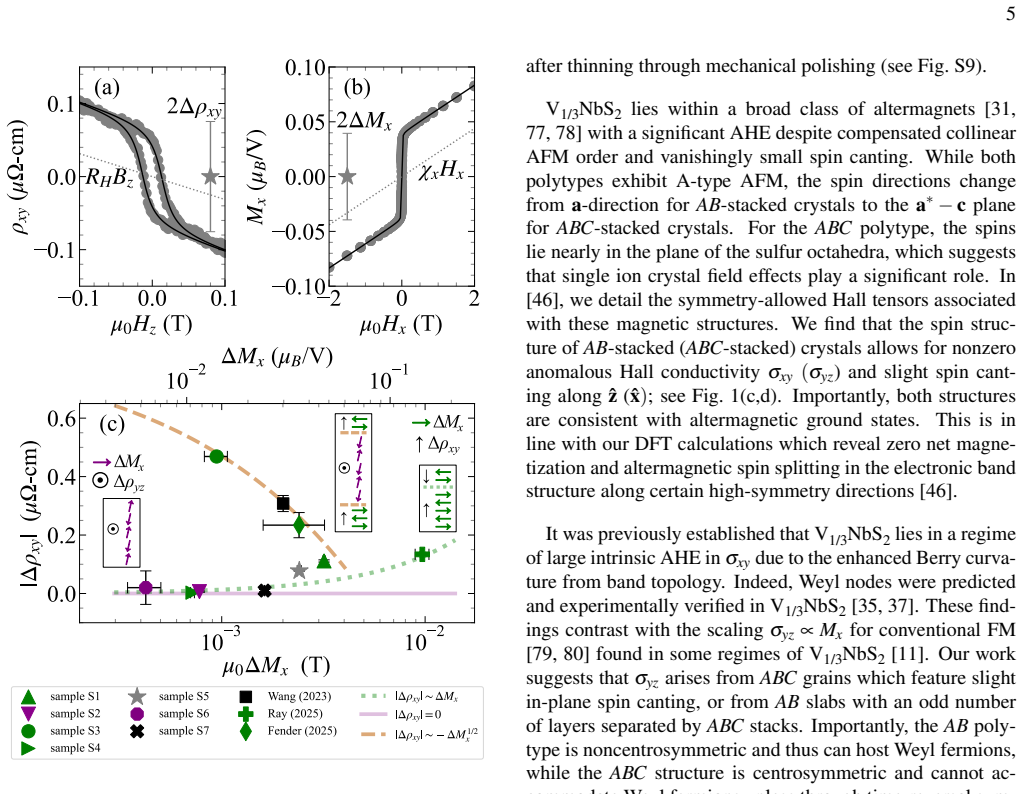
- Coexistence of AB and ABC polytypes explains the wide sample-to-sample scatter in magnetization and anomalous Hall resistivity reported for nominally identical V1/3NbS2 crystals.
- A pure ABC-stacked crystal should exhibit a distinct anomalous Hall conductivity σyz, with zero σxy, whereas a pure AB crystal shows the opposite.
- Altermagnetic order itself is robust to stacking changes: both polytypes remain A-type altermagnets with large Berry-curvature responses, so the same material family can host different topological responses depending on stacking.
- Intercalation staging, already used to tune charge-density-wave and superconducting orders, can be extended to program magnetic and magnetotransport properties in three-dimensional bulk crystals.
Where Pith is reading between the lines
- The same stacking engineering principle may apply to other intercalated transition-metal dichalcogenides, where intercalant layer registry could select between different magnetic ground states or topological phases without changing chemical composition.
- The odd-layer domain mechanism the authors invoke provides a bulk analog of the odd-even layer-number effects seen in exfoliated antiferromagnets, suggesting that thickness-dependent anomalous Hall response may appear in bulk crystals with stacking faults even without exfoliation.
- The assumption that exchange interactions are identical across polytypes can be tested directly by computing the full anisotropic exchange tensors for the two stackings; if they differ substantially, the conclusion that only the easy-axis direction changes would need to be revised, and the role of stacking would be entangled with modified exchange.
- The predicted dichotomy in Hall tensors suggests that specifically measuring the full Hall conductivity tensor of a single-domain ABC crystal—rather than the more common σxy measurement—would provide a stringent test of the symmetry assignment.
Editorial analysis
A structured set of objections, weighed in public.
Referee Report
Summary. The paper reports two distinct polytypes of the intercalated transition-metal dichalcogenide V1/3NbS2, differing in the stacking sequence of the vanadium triangular lattices (AB vs ABC). Combining single-crystal x-ray and neutron diffraction, magnetization, and Hall-effect measurements, the authors show that the two polytypes have perpendicular magnetic easy axes and different anomalous Hall responses. Inelastic neutron scattering on an ensemble of co-aligned crystals is analyzed with linear spin-wave theory to extract exchange constants J1–J7, which exhibit an oscillatory dependence on interatomic distance. The authors fit these to the RKKY form (Eq. 2), obtaining k_F = 0.382(3) Å⁻¹ and J_K = 91(7) meV, and conclude that carrier-mediated RKKY interactions stabilize quasi-collinear A-type altermagnetic order in both polytypes, with the easy-axis direction set by stacking-dependent single-ion anisotropy. The paper also proposes models linking lamellar domains and stacking faults to the observed sample-to-sample variation in remanent magnetization and anomalous Hall resistivity.
Significance. If the central claims hold, this work establishes the detailed stacking sequence of intercalant layers as a bulk degree of freedom that controls both magnetic anisotropy and Berry-curvature-driven transport in an altermagnet, which is a significant step toward stacking engineering of bulk van der Waals magnets. The experimental evidence for two polytypes with distinct easy axes and Hall responses is strong and internally consistent: the diffraction selection rules, the two-step magnetic transition in the ABC polytype, and the bifurcation in the Δρ_xy vs ΔM_x plot all support the structural and magnetic dichotomy. The authors also provide a commendably thorough analysis pipeline, including simultaneous refinement of the ensemble composition, a pixel-by-pixel likelihood fit of ~2 million data points, and DFT support for altermagnetic band splitting. The empirical mean-field predictions for T_N and χ are in reasonable agreement with experiment. However, the specific claim that RKKY exchange—rather than some other short-range mechanism—is responsible for the observed oscillatory J_n pattern is not yet uniquely established; the model-selection evidence is weak, and the isotropic-exchang
major comments (3)
- [Eq. (2), Fig. 4, SM 'RKKY interactions'] The RKKY identification rests on fitting a two-parameter oscillatory form to seven exchange constants, two of which (J5, J6) are statistically consistent with zero and J3 has a large relative uncertainty. The SM openly states that the anisotropic RKKY model for an ellipsoidal Fermi surface has no self-consistent solution and that the isotropic model is adopted as 'a natural approximation' of a multi-sheet Fermi surface. No comparison is made against alternative interaction forms (e.g., superexchange with exponential decay, or a simple power-law decay). Thus the data do not uniquely establish RKKY as the mediating mechanism. Since the abstract's central claim is that oscillatory RKKY interactions stabilize the observed orders, this needs stronger support—either a model-selection analysis or an independent prediction of k_F from the Fermi surface—or the claim should be softened to 'consist
- [Eq. (1) and SM Fig. S4] The authors approximate J1–J7 as isotropic and identical across the two polytypes, allowing only the easy-axis direction D̂_n to differ (main text after Eq. 1). However, SM Fig. S4 explicitly states that J7 is the first bond that differs geometrically between AB and ABC stacking, and Eq. (S12) shows that the A-point magnon energy depends on J7. Fitting a single J7 to an ensemble that contains both polytypes averages over this difference, and the observed physical linewidth at the A-point (1.2(2) meV) is itself attributed to differences in exchange parameters between polytypes. The conclusion that the perpendicular easy axes arise solely from the direction of single-ion anisotropy is therefore not yet justified. The DFT values in Table I indeed differ between AB and ABC for J5, J6, and J7. A test with polytype-dependent exchange tensors—or at least a discussion of how the fitted parameter
- [Abstract and concluding paragraphs] The phrasing that RKKY interactions 'stabilize quasi-collinear A-type altermagnetic orders in both polytypes though with perpendicular easy axes' conflates the isotropic RKKY exchange, which selects the A-type magnetic order but has no preferred axis, with the single-ion anisotropy that sets the easy-axis direction. In the analysis, the easy-axis direction is input from diffraction, not predicted by the RKKY fit. The causal wording in the abstract and conclusions overstates what the RKKY evidence supports. The exchange interactions can explain the stability of A-type order, but the perpendicular easy axes are an input, not an output, of the theory.
minor comments (4)
- [SM Eq. (S11)] The formula for ℏω±(q) contains the term |D_q|^2 − |D_q|^2, which is identically zero; this is likely a typographical error. Please check and correct the intended expression.
- [Abstract] Grammar: 'dramatically impact' should be 'dramatically affect' or 'dramatically impacts.'
- [Table I] The DFT columns do not list uncertainties; please clarify whether these are deterministic values or include numerical estimates, and if so, state them.
- [Main text, 'A-type AFM' discussion] The term 'the a∗−c plane' is used without a concise definition of a∗ for readers; a brief reminder of the orthogonal coordinate system near first use would improve readability.
Circularity Check
No significant circularity: central structural/transport claims are independently measured; RKKY is a post-hoc fit with candid limitations, and self-citations are not load-bearing.
full rationale
The derivation chain is not circular. The two-polytype structural and magnetic characterization rests on independent single-crystal X-ray/neutron diffraction (Figs. 1-2 and SM), which identifies AB vs ABC stacking and orthogonal easy axes; the Hall and magnetization data (Fig. 5, Figs. S7-S9) independently distinguish the transport responses. The exchange parameters J1-J7 are obtained by a Poisson-likelihood fit of 1/S spin-wave theory to the full 4D inelastic neutron dataset under an explicitly stated approximation that the isotropic exchanges are identical across polytypes and only the easy-axis direction differs (main text after Eq. 1). The RKKY interpretation (Eq. 2, Fig. 4) is a post-hoc two-parameter fit to those seven J_n values; it is a model-selection/interpretation step, not a prediction forced by construction, and the paper candidly reports in the SM that the anisotropic RKKY model 'has no self-consistent solution' and that the isotropic form is adopted as 'a natural approximation' of a multi-sheet Fermi surface. Consistency checks—Curie-Weiss and Néel temperatures, carrier density n=k_F^3/3π^2 versus Hall density, and J_K versus the Edwards et al. 50 meV scale—use independent inputs and are not baked into the spin-wave fit. The self-citations (Ray et al. [11]; Ghosh et al. [35]) provide context and prior claims but are not load-bearing: the present diffraction and transport measurements independently establish the observations those references describe. No equation reduces to its own input by definition, and no fitted parameter is renamed as an external prediction.
Axiom & Free-Parameter Ledger
free parameters (6)
- Isotropic exchange couplings J1..J7 =
-0.21(8), +0.9(2), +0.4(3), -0.08(5), -0.1(1), -0.01(6), +0.21(8) meV
- Single-ion anisotropy D =
0.03(5) meV
- Molar fraction of AB polytype in ensemble =
0.45(7)
- ABC magnetic moment components my, mz =
my=0.7(2), mz=1.3(1) muB
- RKKY Fermi wavevector kF =
0.382(3) Å^-1
- RKKY prefactor A (equivalently JK) =
A=310(50) meV·Å^4; JK=91(7) meV
axioms (5)
- domain assumption Heisenberg Hamiltonian Eq. 1 with isotropic J1-J7 and a single-ion anisotropy tensor Dn captures the magnetic interactions.
- domain assumption Linear spin wave theory (1/S expansion) is valid for S=1 V3+ moments.
- domain assumption The isotropic free-electron RKKY form (Eq. 2) approximates the true multi-sheet Fermi surface.
- standard math Magnetic space group assignments determine the allowed Hall tensors.
- domain assumption DFT meta-GGA (R2SCAN) total energy mapping gives reliable exchange parameters and anisotropy.
Cite this review
Pith. "Pith review of Stacking-dependent anisotropic altermagnetism in V$_{1/3}$NbS$_2$." pith.science (2026). https://pith.science/paper/H6UJFGAA
@misc{pith2026260725213,
  author       = {Pith},
  title        = {Pith review of: Stacking-dependent anisotropic altermagnetism in V$_1/3$NbS$_2$},
  year         = {2026},
  howpublished = {\url{https://pith.science/paper/H6UJFGAA}},
  note         = {Machine review of arXiv:2607.25213}
}
read the original abstract
We report profound impacts of the stacking sequence of triangular lattices of magnetic transition metal ions intercalated between the layers of the van der Waals material NbS$_2$. Using single crystal x-ray and neutron diffraction, and transport and magnetization measurements, we show there are two distinct polytypes of $\rm V_{1/3}NbS_2$ with disparate easy axes of magnetization and different anomalous Hall responses. Self-consistent analysis of inelastic neutron scattering data provides evidence for oscillatory RKKY interactions that extend to 1 nm and stabilize quasi-collinear A-type altermagnetic orders in both polytypes though with perpendicular easy axes. The detailed stacking sequence of a bulk polytype crystal dramatically impact its macroscopic anomalous Hall response and magnetism, which suggests a new path to engineer the bulk properties of a layered three dimensional solid.
Figures



Reference graph
Works this paper leans on
-
[1]
D. E. Moncton, J. D. Axe, and F. J. DiSalvo, Neutron scattering study of the charge-density wave transitions in 2H−TaSe 2 and 2H−NbSe 2, Phys. Rev. B16, 801 (1977)
1977
-
[2]
C.-W. Chen, J. Choe, and E. Morosan, Charge density waves in strongly correlated electron systems, Reports on Progress in Physics79, 084505 (2016)
2016
-
[3]
Hwang, W
J. Hwang, W. Ruan, Y . Chen, S. Tang, M. F. Crom- mie, Z.-X. Shen, and S.-K. Mo, Charge density waves in two-dimensional transition metal dichalcogenides, Reports on Progress in Physics87, 044502 (2024)
2024
-
[4]
Morosan, H
E. Morosan, H. W. Zandbergen, B. Dennis, J. Bos, Y . Onose, T. Klimczuk, A. Ramirez, N. Ong, and R. J. Cava, Supercon- ductivity in CuxTiSe2, Nature Physics2, 544 (2006)
2006
-
[5]
Guguchia, F
Z. Guguchia, F. V on Rohr, Z. Shermadini, A. T. Lee, S. Baner- jee, A. R. Wieteska, C. A. Marianetti, B. A. Frandsen, H. Luetkens, Z. Gong, S. C. Cheung, C. Baines, A. Shengelaya, G. Taniashvili, A. N. Pasupathy, E. Morenzoni, S. J. L. Billinge, A. Amato, R. J. Cava, R. Khasanov, and Y . J. Uemura, Signa- tures of the topological s +− superconducting orde...
2017
-
[6]
C. Heil, S. Poncé, H. Lambert, M. Schlipf, E. R. Margine, and F. Giustino, Origin of Superconductivity and Latent Charge Density Wave in NbS2, Phys. Rev. Lett.119, 087003 (2017)
2017
-
[7]
Witteveen, K
C. Witteveen, K. Górnicka, J. Chang, M. Månsson, T. Klim- czuk, and F. O. von Rohr, Polytypism and superconductivity in the NbS2 system, Dalton Trans.50, 3216 (2021)
2021
-
[8]
Guguchia, A
Z. Guguchia, A. Kerelsky, D. Edelberg, S. Banerjee, F. von Rohr, D. Scullion, M. Augustin, M. Scully, D. A. Rhodes, Z. Shermadini, H. Luetkens, A. Shengelaya, C. Baines, E. Morenzoni, A. Amato, J. C. Hone, R. Khasanov, S. J. L. Billinge, E. Santos, A. N. Pasupathy, and Y . J. Uemura, Mag- netism in semiconducting molybdenum dichalcogenides, Sci- ence Adva...
2018
-
[9]
K. S. Burch, D. Mandrus, and J.-G. Park, Magnetism in two- dimensional van der Waals materials, Nature563, 47 (2018)
2018
-
[10]
C. M. Pasco, I. El Baggari, E. Bianco, L. F. Kourkoutis, and T. M. McQueen, Tunable Magnetic Transition to a Sin- glet Ground State in a 2D van der Waals Layered Trimerized Kagomé Magnet, ACS Nano13, 9457 (2019)
2019
-
[11]
M. K. Ray, M. Fu, Y . Chen, T. Chen, T. Nomoto, S. Sakai, M. Kitatani, M. Hirayama, S. Imajo, T. Tomita, A. Sakai, D. Nishio-Hamane, G. T. McCandless, M.-T. Suzuki, Z. Xu, Y . Zhao, T. Fennell, Y . Kohama, J. Y . Chan, R. Arita, C. Bro- holm, and S. Nakatsuji, Zero-field Hall effect emerging from a non-Fermi liquid in a collinear antiferromagnet V1/3NbS2,...
2025
-
[12]
Razpopov, S
A. Razpopov, S. Mozaffari, T. Matsuoka, M. Cothrine, N. Huang, M. Chi, R. Valentí, and D. Mandrus,α-RuCl 3 in- tercalated into graphite: a new three-dimensional platform for exotic quantum phases (2025)
2025
-
[13]
Sivadas, S
N. Sivadas, S. Okamoto, X. Xu, C. J. Fennie, and D. Xiao, Stacking-Dependent Magnetism in Bilayer CrI 3, Nano Letters 18, 7658 (2018)
2018
-
[14]
Bedoya-Pinto, J.-R
A. Bedoya-Pinto, J.-R. Ji, A. K. Pandeya, P. Gargiani, M. Valvi- dares, P. Sessi, J. M. Taylor, F. Radu, K. Chang, and S. S. P. Parkin, Intrinsic 2D-XY ferromagnetism in a van der Waals monolayer, Science374, 616 (2021)
2021
-
[15]
B. Yang, Y . M. Goh, S. H. Sung, G. Ye, S. Biswas, D. A. S. Kaib, R. Dhakal, S. Yan, C. Li, S. Jiang, F. Chen, H. Lei, R. He, R. Valentí, S. M. Winter, R. Hovden, and A. W. Tsen, Magnetic anisotropy reversal driven by structural symmetry-breaking in monolayerα-RuCl 3, Nature Materials22, 50 (2023)
2023
-
[16]
Y . Deng, Y . Yu, Y . Song, J. Zhang, N. Z. Wang, Z. Sun, Y . Yi, Y . Z. Wu, S. Wu, J. Zhu, J. Wang, X. H. Chen, and Y . Zhang, Gate-tunable room-temperature ferromagnetism in two-dimensional Fe3GeTe2, Nature563, 94 (2018), publisher: Nature Publishing Group
2018
-
[17]
S.-Y . Xu, Q. Ma, H. Shen, V . Fatemi, S. Wu, T.-R. Chang, G. Chang, A. M. M. Valdivia, C.-K. Chan, Q. D. Gibson, J. Zhou, Z. Liu, K. Watanabe, T. Taniguchi, H. Lin, R. J. Cava, L. Fu, N. Gedik, and P. Jarillo-Herrero, Electrically switchable Berry curvature dipole in the monolayer topological insulator WTe2, Nature Physics14, 900 (2018)
2018
-
[18]
K.-X. Zhang, S. Cheon, H. Kim, P. Park, Y . An, S. Son, J. Cui, J. Keum, J. Choi, Y . Jo, H. Ju, J.-S. Lee, Y . Lee, M. Avdeev, A. Kleibert, H.-W. Lee, and J.-G. Park, Current-driven collec- tive control of helical spin texture in van der Waals antiferro- magnet (2025), arXiv:2503.00319 [cond-mat.mtrl-sci]
Pith/arXiv arXiv 2025
-
[19]
Z. Fei, B. Huang, P. Malinowski, W. Wang, T. Song, J. Sanchez, W. Yao, D. Xiao, X. Zhu, A. F. May, W. Wu, D. H. Cobden, J.- H. Chu, and X. Xu, Two-dimensional itinerant ferromagnetism in atomically thin Fe3GeTe2, Nature Materials17, 778 (2018)
2018
-
[20]
S. Yang, X. Xu, Y . Zhu, R. Niu, C. Xu, Y . Peng, X. Cheng, X. Jia, Y . Huang, X. Xu, J. Lu, and Y . Ye, Odd-Even Layer- Number Effect and Layer-Dependent Magnetic Phase Dia- grams in MnBi2Te4, Phys. Rev. X11, 011003 (2021)
2021
-
[21]
Y . Deng, Y . Yu, M. Z. Shi, Z. Guo, Z. Xu, J. Wang, X. H. Chen, and Y . Zhang, Quantum anomalous Hall effect in intrinsic mag- netic topological insulator MnBi2Te4, Science367, 895 (2020)
2020
-
[22]
Gao, Y .-F
A. Gao, Y .-F. Liu, J.-X. Qiu, B. Ghosh, T. V . Trevisan, Y . On- ishi, C. Hu, T. Qian, H.-J. Tien, S.-W. Chen, M. Huang, D. Bérubé, H. Li, C. Tzschaschel, T. Dinh, Z. Sun, S.-C. Ho, S.-W. Lien, B. Singh, K. Watanabe, T. Taniguchi, D. C. Bell, H. Lin, T.-R. Chang, C. R. Du, A. Bansil, L. Fu, N. Ni, P. P. Orth, Q. Ma, and S.-Y . Xu, Quantum metric nonlinea...
2023
-
[23]
C. Fox, Y . Mao, X. Zhang, Y . Wang, and J. Xiao, Stacking Or- der Engineering of Two-Dimensional Materials and Device Ap- plications, Chemical Reviews124, 1862 (2024)
2024
-
[24]
A. R. Beal, The First Row Transition Metal Intercalation Com- plexes of Some Metallic Group V A Transition Metal Dichalco- genides, inIntercalated Layered Materials, edited by F. Lévy (Springer Netherlands, Dordrecht, 1979) pp. 251–305
1979
-
[25]
A. V . Kolobov and J. Tominaga,Two-dimensional transition- metal dichalcogenides, V ol. 239 (Springer, 2016)
2016
-
[26]
Parkin and R
S. Parkin and R. Friend, 3dtransition-metal intercalates of the niobium and tantalum dichalcogenides. I. Magnetic properties, Philosophical Magazine B41, 65 (1980)
1980
-
[27]
P. Park, W. Cho, C. Kim, Y . An, Y .-G. Kang, M. Avdeev, R. Sibille, K. Iida, R. Kajimoto, K. H. Lee, W. Ju, E.-J. Cho, H.-J. Noh, M. J. Han, S.-S. Zhang, C. D. Batista, and J.-G. Park, Tetrahedral triple-Qmagnetic ordering and large sponta- neous Hall conductivity in the metallic triangular antiferromag- net Co1/3TaS2, Nature Communications14, 8346 (2023)
2023
-
[28]
J. Zhou, J. Zhou, Z. Wan, Q. Qian, H. Ren, X. Yan, B. Zhou, A. Zhang, X. Pan, W. Fang, Y . Ping, Z. Sofer, Y . Huang, and X. Duan, A cation-exchange approach to tunable magnetic in- tercalation superlattices, Nature643, 683 (2025)
2025
-
[29]
T. Chen, T. Tomita, S. Minami, M. Fu, T. Koretsune, M. Ki- tatani, I. Muhammad, D. Nishio-Hamane, R. Ishii, F. Ishii, et al., Anomalous transport due to Weyl fermions in the chiral antiferromagnets Mn 3 X, X= Sn, Ge, Nature communications 8 12, 572 (2021)
2021
-
[30]
Šmejkal, A
L. Šmejkal, A. H. MacDonald, J. Sinova, S. Nakatsuji, and T. Jungwirth, Anomalous Hall antiferromagnets, Nature Re- views Materials7, 482 (2022)
2022
-
[31]
Šmejkal, J
L. Šmejkal, J. Sinova, and T. Jungwirth, Emerging research landscape of altermagnetism, Physical Review X12, 040501 (2022)
2022
-
[32]
Wang, X.-P
H. Wang, X.-P. Ma, X.-Y . Zeng, J. Gong, J.-F. Lin, X.-Y . Wang, Z.-Y . Dai, K. Han, Y .-T. Wang, and T.-L. Xia, Anomalous Hall effect and topological Hall effect in the noncollinear antiferro- magnet V0.3 NbS2, Physical Review B107, 134436 (2023)
2023
-
[33]
X. Chen, Y . Liu, P. Liu, Y . Yu, J. Ren, J. Li, A. Zhang, and Q. Liu, Unconventional magnons in collinear magnets dictated by spin space groups, Nature640, 349 (2025)
2025
-
[34]
H. Zhu, J. Li, X. Chen, Y . Yu, and Q. Liu, Magnetic ge- ometry to quantum geometry nonlinear transports (2025), arXiv:2406.03738 [cond-mat.mtrl-sci]
Pith/arXiv arXiv 2025
-
[35]
S. Ghosh, C. Lygouras, Z. Feng, M. Fu, S. Nakatsuji, and N. Drichko, Raman spectroscopic evidence for linearly dispersed nodes and magnetic ordering in the topological semimetal V1/3NbS2 (2025), arXiv:2504.04590 [cond-mat.str- el]
Pith/arXiv arXiv 2025
-
[36]
K. Lu, D. Sapkota, L. DeBeer-Schmitt, Y . Wu, H. B. Cao, N. Mannella, D. Mandrus, A. A. Aczel, and G. J. MacDougall, Canted antiferromagnetic order in the monoaxial chiral magnets V1/3TaS2 and V1/3NbS2, Phys. Rev. Mater.4, 054416 (2020)
2020
-
[37]
Inoshita, M
T. Inoshita, M. Hirayama, N. Hamada, H. Hosono, and S. Mu- rakami, Topological semimetal phases manifested in transition metal dichalcogenides intercalated with 3dmetals, Phys. Rev. B100, 121112 (2019)
2019
-
[38]
A. E. Hall, D. D. Khalyavin, P. Manuel, D. A. Mayoh, F. Or- landi, O. A. Petrenko, M. R. Lees, and G. Balakrishnan, Mag- netic structure investigation of the intercalated transition metal dichalcogenide V1/3NbS2, Phys. Rev. B103, 174431 (2021)
2021
-
[39]
Hawkhead, T
Z. Hawkhead, T. J. Hicken, N. P. Bentley, B. M. Huddart, S. J. Clark, and T. Lancaster, Band-filling-controlled mag- netism from transition metal intercalation in N 1/3NbS2 re- vealed with first-principles calculations, Physical Review Ma- terials7, 114002 (2023)
2023
-
[40]
N. P. Bentley, T. L. Breeze, A. Hernández-Melián, T. J. Hicken, B. M. Huddart, F. L. Pratt, A. E. Hall, D. A. Mayoh, G. Balakr- ishnan, S. J. Clark, and T. Lancaster, Magnetism inM 1/3NbS2 (M= Fe, V , Mn): insight into intercalated transition-metal dichalcogenides usingµSR (2025), arXiv:2506.06111 [cond- mat.str-el]
arXiv 2025
-
[41]
S. S. Fender, N. Schnitzer, W. Fang, L. Bhatt, D. Huang, A. Malik, O. Gonzalez, V . Sunko, L. S. Xie, D. A. Muller, et al., Unconventional superlattice ordering in intercalated tran- sition metal dichalcogenide V1/3NbS2, Journal of the American Chemical Society147, 32315 (2025)
2025
-
[42]
D. A. Mayoh, J. Bouaziz, A. E. Hall, J. B. Staunton, M. R. Lees, and G. Balakrishnan, Giant topological and planar Hall effect in Cr1/3NbS2, Phys. Rev. Res.4, 013134 (2022)
2022
-
[43]
P. Park, W. Cho, C. Kim, Y . An, K. Iida, R. Kajimoto, S. Matin, S.-S. Zhang, C. D. Batista, and J.-G. Park, Spin dynamics of triple-Qmagnetic orderings in a triangular lattice: Implications for multi-Qorderings in general two-dimensional lattices, Phys. Rev. X15, 031032 (2025)
2025
-
[44]
Tenasini, E
G. Tenasini, E. Martino, N. Ubrig, N. J. Ghimire, H. Berger, O. Zaharko, F. Wu, J. F. Mitchell, I. Martin, L. Forró, and A. F. Morpurgo, Giant anomalous Hall effect in quasi-two- dimensional layered antiferromagnet Co 1/3NbS2, Phys. Rev. Res.2, 023051 (2020)
2020
-
[45]
V . F. S. and, Neutron scattering lengths and cross sections, Neu- tron News3, 26 (1992)
1992
-
[46]
See Supplemental Material at [] which includes Refs. [47-69] for details on single crystal X-ray diffraction, magnetic space group symmetry, neutron diffraction, neutron spectroscopy, spin wave analysis, RKKY interactions, Luttinger-Tisza the- ory, magnetization and mean-field theory, statistical defects, and density functional theory calculations
-
[47]
G. M. Sheldrick, Crystal structure refinement with SHELXL, Crystal Structure Communications71, 3 (2015)
2015
-
[48]
A. L. Spek, checkCIF validation ALERTS: what they mean and how to respond, Structure Reports76, 1 (2020)
2020
-
[49]
De Graef, Visualization of time-reversal symmetry in mag- netic point groups, Metallurgical and Materials Transactions A 41, 1321 (2010)
M. De Graef, Visualization of time-reversal symmetry in mag- netic point groups, Metallurgical and Materials Transactions A 41, 1321 (2010)
2010
-
[50]
Perez-Mato, S
J. Perez-Mato, S. Gallego, E. Tasci, L. Elcoro, G. de la Flor, and M. Aroyo, Symmetry-based computational tools for magnetic crystallography, Annual Review of Materials Research45, 217 (2015)
2015
-
[51]
G. E. Granroth, A. I. Kolesnikov, T. E. Sherline, J. P. Clancy, K. A. Ross, J. P. C. Ruff, B. D. Gaulin, and S. E. Nagler, SE- QUOIA: A Newly Operating Chopper Spectrometer at the SNS, Journal of Physics: Conference Series251, 012058 (2010)
2010
-
[52]
A. T. Boothroyd,Principles of Neutron Scattering from Con- densed Matter(Oxford University Press, 2020)
2020
-
[53]
Rodríguez-Carvajal, Recent advances in magnetic structure determination by neutron powder diffraction, Physica B: Con- densed Matter192, 55 (1993)
J. Rodríguez-Carvajal, Recent advances in magnetic structure determination by neutron powder diffraction, Physica B: Con- densed Matter192, 55 (1993)
1993
-
[54]
Toth and B
S. Toth and B. Lake, Linear spin wave theory for single-Q in- commensurate magnetic structures, Journal of Physics: Con- densed Matter27, 166002 (2015), publisher: IOP Publishing
2015
-
[55]
T. R. Reeder, P. Titum, J. Kindervater, V . J. Stewart, Q. Ye, J. A. Rodriguez-Rivera, Y . Qiu, N. Maliszewskyj, T. M. Mc- Queen, and C. L. Broholm, Time evolution of a pumped molecular magnet—A time-resolved inelastic neutron scatter- ing study, Proceedings of the National Academy of Sciences 122, e2415300121 (2025)
2025
-
[56]
Frodesen, O
A. Frodesen, O. Skjeggestad, and H. Toefte,Probability and statistics in particle physics(Universitetsforlaget., 1979)
1979
-
[57]
Scheie, P
A. Scheie, P. Laurell, P. A. McClarty, G. E. Granroth, M. B. Stone, R. Moessner, and S. E. Nagler, Spin-exchange hamil- tonian and topological degeneracies in elemental gadolinium, Phys. Rev. B105, 104402 (2022)
2022
-
[58]
C. J. Lygouras, H.-Y . Yang, X. Yao, J. Gaudet, Y . Hao, H. Cao, J. A. Rodriguez-Rivera, A. Podlesnyak, S. Blügel, P. Nikolic, F. Tafti, and C. L. Broholm, Magnetic excita- tions and interactions in the Weyl ferrimagnet NdAlSi (2024), arXiv:2412.20743 [cond-mat.str-el]
Pith/arXiv arXiv 2024
-
[59]
Huberman, R
T. Huberman, R. Coldea, R. A. Cowley, D. A. Tennant, R. L. Leheny, R. J. Christianson, and C. D. Frost, Two-magnon ex- citations observed by neutron scattering in the two-dimensional spin- 5 2 Heisenberg antiferromagnet Rb2MnF4, Phys. Rev. B72, 014413 (2005)
2005
-
[60]
Story, P
T. Story, P. J. T. Eggenkamp, C. H. W. Swüste, H. J. M. Swagten, W. J. M. de Jonge, and L. F. Lemmens, Ruderman- Kittel-Kasuya-Yosida exchange interaction in many-valley IV- VI semimagnetic semiconductors, Phys. Rev. B45, 1660 (1992)
1992
-
[61]
Korean Chem
Lee, Kee Hag and Lee, Ji Young and Lee, Changhoon and Whangbo, Myung-Hwan, Evaluating the Curie-Weiss tempera- ture of a magnetic system composed of nonequivalent magnetic ions in terms of spin exchange constants, Bull. Korean Chem. Soc35, 1277 (2014). 9
2014
-
[62]
P. E. Blöchl, Projector augmented-wave method, Physical Re- view B50, 17953 (1994), publisher: American Physical Soci- ety
1994
-
[63]
Kresse and D
G. Kresse and D. Joubert, From ultrasoft pseudopotentials to the projector augmented-wave method, Physical Review B59, 1758 (1999), publisher: American Physical Society
1999
-
[64]
Kresse and J
G. Kresse and J. Hafner, Ab initio molecular dynamics for liq- uid metals, Phys. Rev. B47, 558 (1993)
1993
-
[65]
J. W. Furness, A. D. Kaplan, J. Ning, J. P. Perdew, and J. Sun, Accurate and numerically efficient r2SCAN meta-generalized gradient approximation, The journal of physical chemistry let- ters11, 8208 (2020)
2020
-
[66]
J. K. Glasbrenner, I. Mazin, H. O. Jeschke, P. Hirschfeld, R. Fernandes, and R. Valentí, Effect of magnetic frustration on nematicity and superconductivity in iron chalcogenides, Nature Physics11, 953 (2015)
2015
-
[67]
D. A. Kaib, K. Riedl, A. Razpopov, Y . Li, S. Backes, I. I. Mazin, and R. Valentí, Electronic and magnetic properties of the RuX3 (X= Cl, Br, I) family: two siblings—and a cousin?, npj Quan- tum Materials7, 75 (2022)
2022
-
[68]
Razpopov, D
A. Razpopov, D. A. Kaib, S. Backes, L. Balents, S. D. Wilson, F. Ferrari, K. Riedl, and R. Valentí, A j eff= 1/2 kitaev material on the triangular lattice: the case of NaRuO2, npj Quantum Ma- terials8, 36 (2023)
2023
-
[69]
Blaha, K
P. Blaha, K. Schwarz, G. K. Madsen, D. Kvasnicka, J. Luitz, et al., wien2k, An augmented plane wave+ local orbitals pro- gram for calculating crystal properties60, 155 (2001)
2001
-
[70]
V . C. Morano, Z. Maesen, S. E. Nikitin, J. Lass, D. G. Maz- zone, and O. Zaharko, Absence of Altermagnetic Magnon Band Splitting in MnF2, Phys. Rev. Lett.134, 226702 (2025)
2025
-
[71]
Q. Faure, D. Bounoua, V . Balédent, A. Gukasov, V . O. Gar- lea, A. Ribeiro, J. G. Rau, S. Petit, and P. McClarty, Alter- magnetism revealed by polarized neutrons in MnF 2 (2025), arXiv:2509.07087 [cond-mat.str-el]
Pith/arXiv arXiv 2025
-
[72]
A. K. Singh, N. Heinsdorf, A. A. Mancilla, J. Bannies, A. Maity, A. I. Kolesnikov, M. Matsuda, M. B. Stone, M. Franz, J. Gaudet, and A. M. Hallas, Chiral Spin-Split Magnons in the Metallic Altermagnet CrSb (2025), arXiv:2511.16086 [cond- mat.mtrl-sci]
Pith/arXiv arXiv 2025
-
[73]
Riedl, D
K. Riedl, D. Amoroso, S. Backes, A. Razpopov, T. P. T. Nguyen, K. Yamauchi, P. Barone, S. M. Winter, S. Picozzi, and R. Valentí, Microscopic origin of magnetism in monolayer 3dtransition metal dihalides, Physical Review B106, 035156 (2022)
2022
-
[74]
Friedman and J
Z. Friedman and J. Felsteiner, On the solution of the Luttinger- Tisza problem for magnetic systems, Philosophical Magazine 29, 957 (1974)
1974
-
[75]
Edwards, O
B. Edwards, O. Dowinton, A. E. Hall, P. a. E. Murgatroyd, S. Buchberger, T. Antonelli, G.-R. Siemann, A. Rajan, E. A. Morales, A. Zivanovic, C. Bigi, R. V . Belosludov, C. M. Polley, D. Carbone, D. A. Mayoh, G. Balakrishnan, M. S. Bahramy, and P. D. C. King, Giant valley-Zeeman coupling in the surface layer of an intercalated transition metal dichalcogeni...
2023
-
[76]
M. A. Ruderman and C. Kittel, Indirect exchange coupling of nuclear magnetic moments by conduction electrons, Phys. Rev. 96, 99 (1954)
1954
-
[77]
Šmejkal, R
L. Šmejkal, R. González-Hernández, T. Jungwirth, and J. Sinova, Crystal time-reversal symmetry breaking and spon- taneous hall effect in collinear antiferromagnets, Science ad- vances6, eaaz8809 (2020)
2020
-
[78]
Cheong and F.-T
S.-W. Cheong and F.-T. Huang, Altermagnetism classification, npj Quantum Materials10, 38 (2025)
2025
-
[79]
Nakatsuji, N
S. Nakatsuji, N. Kiyohara, and T. Higo, Large anomalous Hall effect in a non-collinear antiferromagnet at room temperature, Nature527, 212 (2015)
2015
-
[80]
C. Zeng, Y . Yao, Q. Niu, and H. H. Weitering, Linear Mag- netization Dependence of the Intrinsic Anomalous Hall Effect, Phys. Rev. Lett.96, 037204 (2006)
2006
discussion (0)
Sign in with ORCID, Apple, or X to comment. Anyone can read and Pith papers without signing in.