Structure-Preserving Quantum Method of Lines for Evolutionary PDEs with Mixed Boundary Conditions
Pith reviewed 2026-06-28 09:44 UTC · model grok-4.3
The pith
A method-of-lines discretization for evolutionary PDEs preserves stability under mixed boundaries by lifting them with Coons interpolation and applying similarity transforms before quantum ODE solution.
A machine-rendered reading of the paper's core claim, the machinery that carries it, and where it could break.
Core claim
By lifting boundaries with Coons interpolation and boundary-aware discretization, the semi-discrete systems obtained from the method of lines for parabolic and hyperbolic PDEs are stable; a diagonal similarity transform then guarantees the parabolic generator has a positive semi-definite Hermitian part, allowing solution by the linear combination of Hamiltonian simulation, while hyperbolic problems are rewritten as equivalent first-order systems solved by Hamiltonian simulation, all with explicit quantum circuit realizations and complexity bounds that include discretization and quadrature errors.
What carries the argument
Coons interpolation for boundary lifting combined with a diagonal similarity transform that enforces positive semi-definiteness of the Hermitian part of the semi-discrete generator.
If this is right
- The resulting quantum algorithms admit explicit block-encoding constructions and circuit implementations.
- End-to-end complexity bounds are obtained that incorporate both spatial discretization error and quadrature error.
- The same constructions apply to inhomogeneous heat equations and Klein-Gordon equations with the listed boundary types.
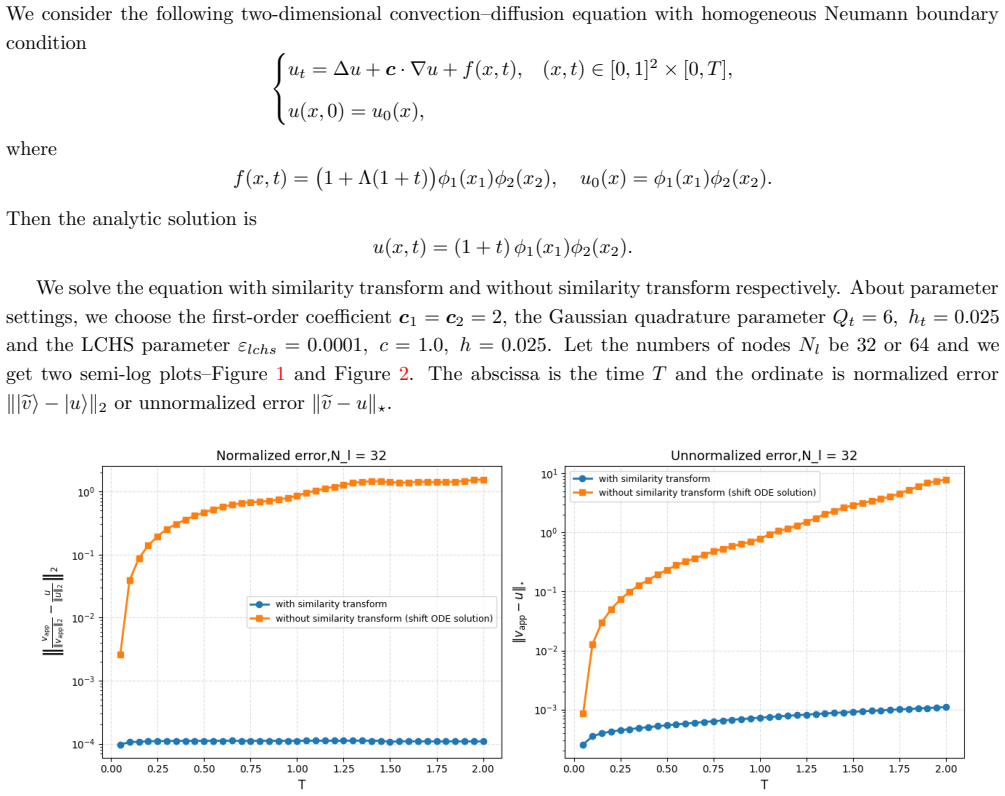
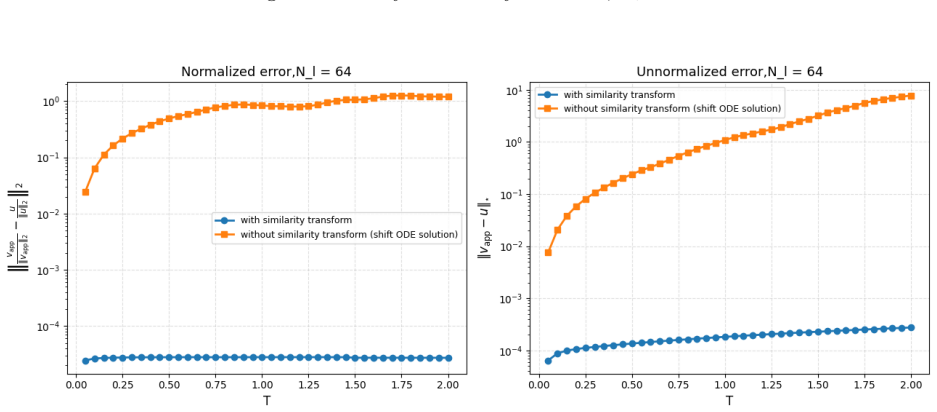
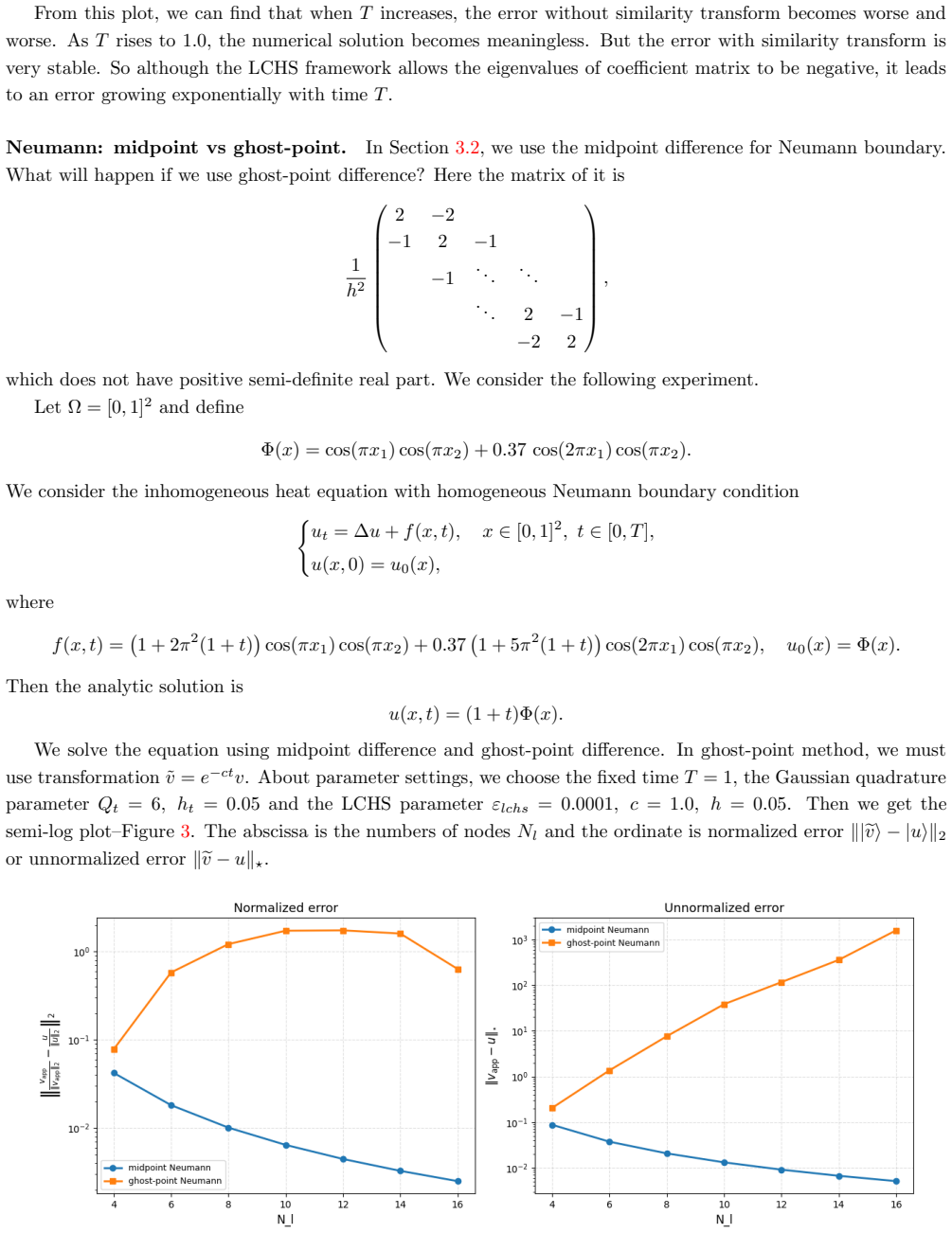
- Classical numerical experiments confirm that the semi-discrete systems remain stable under the stated discretizations.
Where Pith is reading between the lines
- The same lifting and transform steps may extend to time-dependent coefficients provided the resulting generator still satisfies the Hermitian-part condition after each time step.
- The approach could be combined with existing quantum linear-system solvers when the source term is itself the output of another quantum subroutine.
- If the stability survives, the method offers a route to quantum simulation of higher-dimensional evolutionary PDEs without auxiliary error-correction overhead for boundary artifacts.
Load-bearing premise
The combination of Coons interpolation and the diagonal similarity transform produces semi-discrete systems whose stability properties survive the quantum encoding without introducing errors that invalidate the claimed complexity bounds.
What would settle it
A quantum simulation of the semi-discrete parabolic system on a simple convection-diffusion problem with mixed boundaries in which the solution norm grows or the observed runtime exceeds the stated complexity bound because of boundary-induced instability.
Figures
read the original abstract
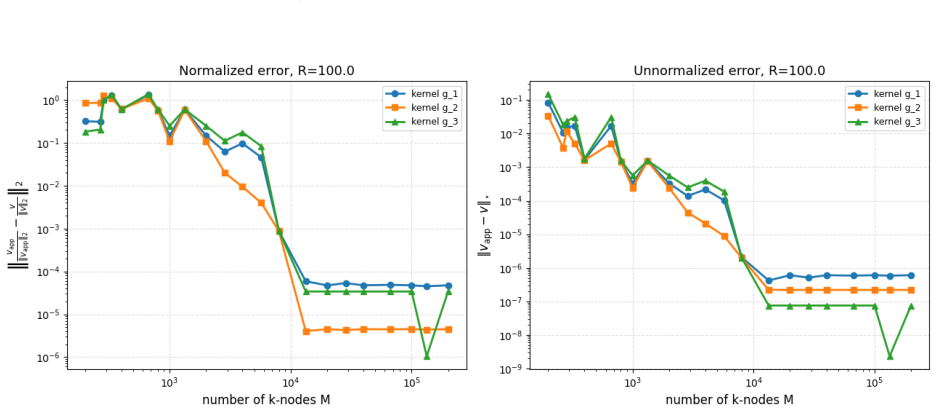
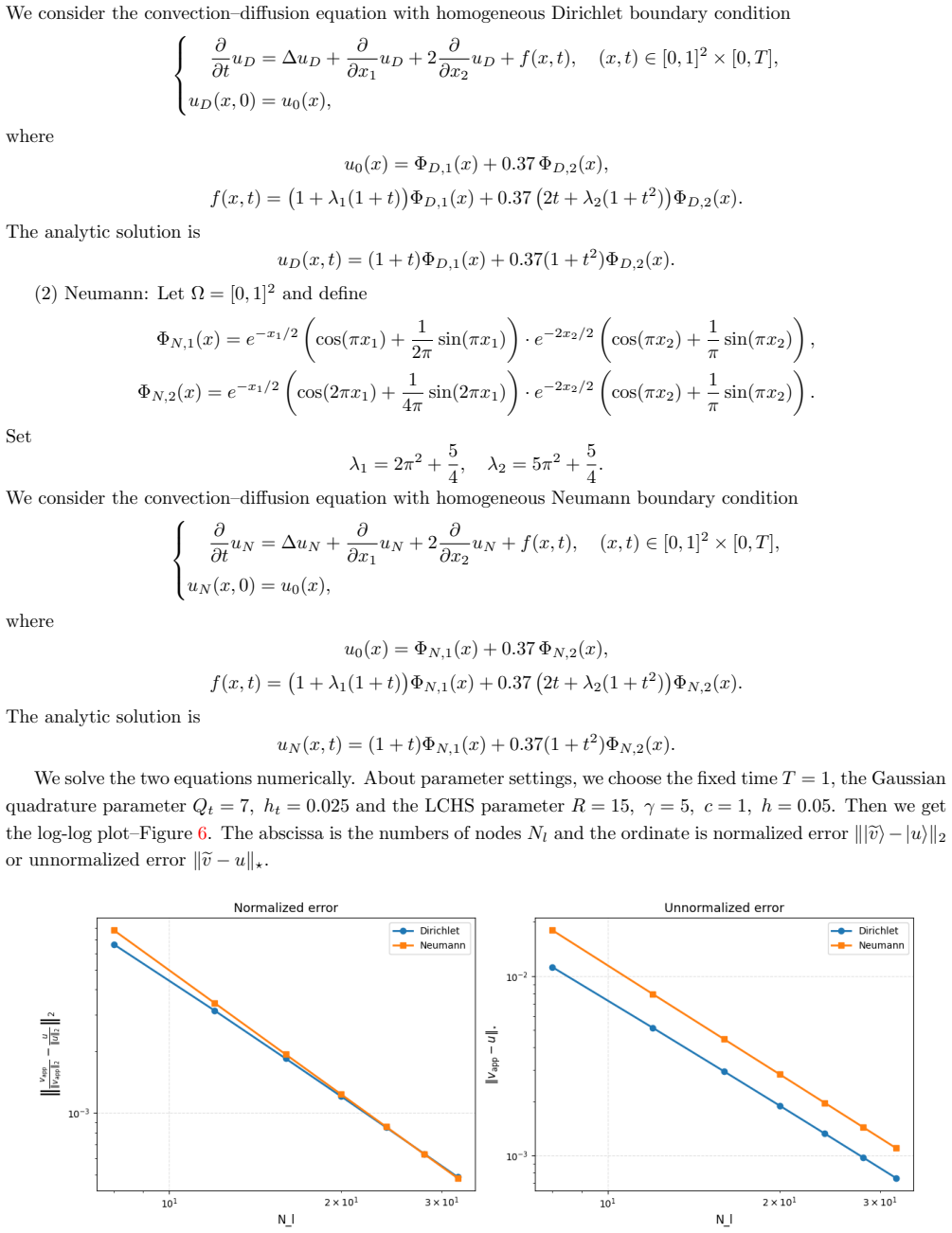
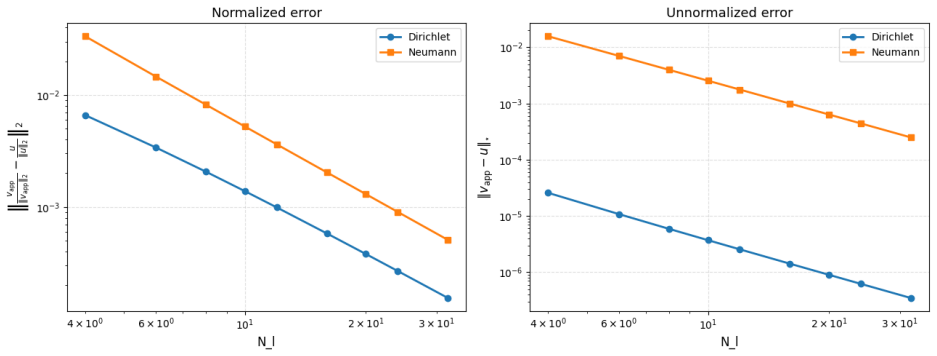
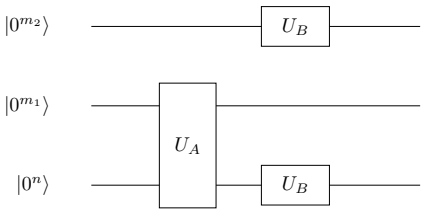
We give detailed analysis and circuit design of structure-preserving quantum algorithms for second-order linear evolutionary PDEs, including parabolic equations and hyperbolic equations with mixed Dirichlet, Neumann, and periodic boundary conditions and source terms. While prior quantum algorithms usually neglect the stability problem from the PDE-to-ODE reduction, our method-of-lines approach investigates the boundary lifting via Coons interpolation and boundary-aware discretization, so that the resulting semi-discrete systems are stable and compatible with efficient quantum ODE primitives. For the parabolic problem, we use a diagonal similarity transform to ensure the semi-discrete generator must have a positive semi-definite Hermitian part, and then solve the resulting ODE system by the optimal linear combination of Hamiltonian simulation (LCHS). For the hyperbolic problem, we rewrite the semi-discrete equation as an equivalent first-order system and solve it by Hamiltonian simulation. We implement our quantum algorithms with explicit block-encoding constructions and circuit implementations, as well as demonstrating the end-to-end complexity bounds together with spatial and quadrature error estimates. We conduct classical numerical experiments on the convection-diffusion equation, inhomogeneous heat equation, and Klein-Gordon equation to validate our structure-preserving analysis and algorithmic constructions.
Editorial analysis
A structured set of objections, weighed in public.
Referee Report
Summary. The paper develops a method-of-lines framework for quantum simulation of linear second-order evolutionary PDEs (parabolic and hyperbolic) subject to mixed Dirichlet/Neumann/periodic boundary conditions and source terms. Boundary lifting is performed via Coons interpolation combined with boundary-aware spatial discretization to produce stable semi-discrete ODE systems; a diagonal similarity transform is applied in the parabolic case to guarantee that the generator has positive semi-definite Hermitian part, after which the system is solved by linear combination of Hamiltonian simulation (LCHS). Hyperbolic problems are recast as equivalent first-order systems solved by standard Hamiltonian simulation. Explicit block-encoding constructions, circuit implementations, end-to-end complexity bounds, spatial/quadrature error estimates, and classical numerical experiments on the convection-diffusion, inhomogeneous heat, and Klein-Gordon equations are reported.
Significance. If the stability properties and error bounds survive the quantum encoding step, the work supplies a missing rigorous link between classical structure-preserving discretizations and quantum ODE primitives, addressing a common limitation in earlier quantum PDE solvers. The explicit constructions and classical validation experiments constitute concrete strengths that would make the contribution useful to the quantum algorithms community.
minor comments (1)
- [Abstract] The abstract is information-dense; a short enumerated list of the main technical contributions would improve readability for readers scanning the paper.
Simulated Author's Rebuttal
We thank the referee for the detailed summary of our manuscript and the positive assessment of its significance. The recommendation is listed as 'uncertain,' but the report contains no specific major comments or points requiring clarification. We therefore have no individual comments to address point-by-point. If the referee has additional concerns not captured in this report, we would be pleased to respond to them in a revised version.
Circularity Check
No significant circularity detected
full rationale
The paper presents a pipeline of classical method-of-lines discretization (Coons interpolation for boundary lifting, boundary-aware schemes, diagonal similarity transform for parabolic case to enforce positive semi-definite Hermitian part, first-order rewriting for hyperbolic case) followed by application of standard quantum primitives (LCHS, Hamiltonian simulation, block encodings). The abstract and context provide no equations or steps where a claimed prediction or result reduces by construction to a fitted input, self-definition, or load-bearing self-citation chain. Stability and complexity claims rest on the classical analysis and external quantum primitives, with no internal reduction exhibited. This is the common case of an independent derivation chain.
Axiom & Free-Parameter Ledger
Reference graph
Works this paper leans on
-
[1]
Quantum algorithm for linear systems of equations
Aram W Harrow, Avinatan Hassidim, and Seth Lloyd. Quantum algorithm for linear systems of equations. Physical Review Letters, 103(15):150502, 2009
2009
-
[2]
Quantum algorithm and circuit design solving the Poisson equation.New Journal of Physics, 15:013021, 2013
Yudong Cao, Anmer Daskin, Steven Frankel, and Sabre Kais. Quantum algorithm and circuit design solving the Poisson equation.New Journal of Physics, 15:013021, 2013
2013
-
[3]
Quantum algorithms and the finite element method.Physical Review A, 93(3):032324, 2016
Ashley Montanaro and Sam Pallister. Quantum algorithms and the finite element method.Physical Review A, 93(3):032324, 2016
2016
-
[4]
Childs, Jin-Peng Liu, and Aaron Ostrander
Andrew M. Childs, Jin-Peng Liu, and Aaron Ostrander. High-precision quantum algorithms for partial differ- ential equations.Quantum, 5:574, 2021
2021
-
[5]
Guang Hao Low and Isaac L. Chuang. Optimal Hamiltonian simulation by quantum signal processing.Physical Review Letters, 118(1):010501, 2017
2017
-
[6]
Quantum singular value transformation and beyond: exponential improvements for quantum matrix arithmetics
Andr´ as Gily´ en, Yuan Su, Guang Hao Low, and Nathan Wiebe. Quantum singular value transformation and beyond: exponential improvements for quantum matrix arithmetics. InProceedings of the 51st Annual ACM SIGACT Symposium on Theory of Computing, pages 193–204, 2019
2019
-
[7]
Linear combination of Hamiltonian simulation for nonunitary dynamics with optimal state preparation cost.Physical Review Letters, 131(15):150603, 2023
Dong An, Jin-Peng Liu, and Lin Lin. Linear combination of Hamiltonian simulation for nonunitary dynamics with optimal state preparation cost.Physical Review Letters, 131(15):150603, 2023
2023
-
[8]
Quantum algorithm for linear non-unitary dynamics with near- optimal dependence on all parameters.Communications in Mathematical Physics, 407(1):19, 2026
Dong An, Andrew M Childs, and Lin Lin. Quantum algorithm for linear non-unitary dynamics with near- optimal dependence on all parameters.Communications in Mathematical Physics, 407(1):19, 2026
2026
- [9]
-
[10]
Quantum simulation of partial differential equations via Schrodingerisation
Shi Jin, Nana Liu, and Yue Yu. Quantum simulation of partial differential equations via Schrodingerisation. Physical Review Letters, 133(23):230602, 2024
2024
-
[11]
Quantum simulation of partial differential equations via Schrodingerisation: technical details.Physical Review A, 108(3):032603, 2023
Shi Jin, Nana Liu, and Yue Yu. Quantum simulation of partial differential equations via Schrodingerisation: technical details.Physical Review A, 108(3):032603, 2023
2023
-
[12]
Quantum circuits for partial differential equations via Schrodingerisation.Quantum, 8:1563, 2024
Junpeng Hu, Shi Jin, Nana Liu, and Lei Zhang. Quantum circuits for partial differential equations via Schrodingerisation.Quantum, 8:1563, 2024
2024
-
[13]
Quantum circuits for the heat equation with physical boundary conditions via Schrodingerization.Journal of Computational Physics, 538:114138, 2025
Shi Jin, Nana Liu, and Yue Yu. Quantum circuits for the heat equation with physical boundary conditions via Schrodingerization.Journal of Computational Physics, 538:114138, 2025. 55
2025
-
[14]
Quantum simulation of Maxwell’s equations via Schrodingerisation
Chuwen Ma, Shi Jin, and Nana Liu. Quantum simulation of Maxwell’s equations via Schrodingerisation. ESAIM: Mathematical Modelling and Numerical Analysis, 58(5):1853–1879, 2024
2024
- [15]
-
[16]
On Schrodingerization-based quantum algorithms for linear dynamical systems with inhomogeneous terms.SIAM Journal on Numerical Analysis, 63(4):1861–1885, 2025
Shi Jin, Nana Liu, and Chuwen Ma. On Schrodingerization-based quantum algorithms for linear dynamical systems with inhomogeneous terms.SIAM Journal on Numerical Analysis, 63(4):1861–1885, 2025
2025
-
[17]
Dominic W. Berry. High-order quantum algorithm for solving linear differential equations.Journal of Physics A: Mathematical and Theoretical, 47(10):105301, 2014
2014
-
[18]
Berry, Andrew M
Dominic W. Berry, Andrew M. Childs, Aaron Ostrander, and Guoming Wang. Quantum algorithm for linear differential equations with exponentially improved dependence on precision.Communications in Mathematical Physics, 356(3):1057–1081, 2017
2017
-
[19]
Childs and Jin-Peng Liu
Andrew M. Childs and Jin-Peng Liu. Quantum spectral methods for differential equations.Communications in Mathematical Physics, 375(2):1427–1457, 2020
2020
-
[20]
Berry and Pedro C
Dominic W. Berry and Pedro C. S. Costa. Quantum algorithm for time-dependent differential equations using Dyson series.Quantum, 8:1369, 2024
2024
-
[21]
Explicit block encodings of boundary value problems for many-body elliptic operators.Quantum, 9:1764, 2025
Tyler Kharazi, Ahmad M Alkadri, Jin-Peng Liu, Kranthi K Mandadapu, and K Birgitta Whaley. Explicit block encodings of boundary value problems for many-body elliptic operators.Quantum, 9:1764, 2025
2025
-
[22]
Time-marching based quantum solvers for time-dependent linear differential equations.Quantum, 7:955, 2023
Di Fang, Lin Lin, and Yu Tong. Time-marching based quantum solvers for time-dependent linear differential equations.Quantum, 7:955, 2023
2023
-
[23]
Quantum differential equation solvers: Limitations and fast-forwarding.Communications in Mathematical Physics, 406(8):189, 2025
Dong An, Jin-Peng Liu, Daochen Wang, and Qi Zhao. Quantum differential equation solvers: Limitations and fast-forwarding.Communications in Mathematical Physics, 406(8):189, 2025
2025
-
[24]
Songqinghao Yang and Jin-Peng Liu. Circuit-efficient randomized quantum simulation of non-unitary dynamics with observable-driven and symmetry-aware designs.arXiv preprint arXiv:2509.08030, 2025
-
[25]
Quantum algorithm for partial differential equations of nonconservative systems with spatially varying parameters.Physical Review Applied, 23(1):014063, 2025
Yuki Sato, Hiroyuki Tezuka, Ruho Kondo, and Naoki Yamamoto. Quantum algorithm for partial differential equations of nonconservative systems with spatially varying parameters.Physical Review Applied, 23(1):014063, 2025
2025
-
[26]
Rui Lu, Hao-En Li, Zicheng Liu, and Jin-Peng Liu. Infinite-dimensional extension of the linear combination of Hamiltonian simulation: Theorems and applications.arXiv preprint arXiv:2502.19688, 2025
-
[27]
Toward end-to-end quantum simulation of rapidly distorted turbulence.Journal of Computational Physics, page 114888, 2026
Zhaoyuan Meng, Leyu Chen, Jin-Peng Liu, and Guowei He. Toward end-to-end quantum simulation of rapidly distorted turbulence.Journal of Computational Physics, page 114888, 2026
2026
-
[28]
Xiantao Li. From linear differential equations to unitaries: A moment-matching dilation framework with near-optimal quantum algorithms.arXiv preprint arXiv:2507.10285, 2025
-
[29]
Quantum algorithm for simulating the wave equation
Pedro CS Costa, Stephen Jordan, and Aaron Ostrander. Quantum algorithm for simulating the wave equation. Physical Review A, 99(1):012323, 2019
2019
-
[30]
Hamiltonian simulation for hyperbolic partial differential equations by scalable quantum circuits.Physical Review Research, 6(3):033246, 2024
Yuki Sato, Ruho Kondo, Ikko Hamamura, Tamiya Onodera, and Naoki Yamamoto. Hamiltonian simulation for hyperbolic partial differential equations by scalable quantum circuits.Physical Review Research, 6(3):033246, 2024. 56
2024
-
[31]
Quantum algorithm for solving the advection equation using Hamiltonian simulations.Physical Review A, 110(1):012430, 2024
Yuki Sato, Hiroyuki Tezuka, Ruho Kondo, and Naoki Yamamoto. Quantum algorithm for solving the advection equation using Hamiltonian simulations.Physical Review A, 110(1):012430, 2024
2024
-
[32]
Krovi, Nuno F
Jin-Peng Liu, Herman Øie Kolden, Hari K. Krovi, Nuno F. Loureiro, Konstantina Trivisa, and Andrew M. Childs. Efficient quantum algorithm for dissipative nonlinear differential equations.Proceedings of the National Academy of Sciences, 118(35):e2026805118, 2021
2021
-
[33]
Improved quantum algorithms for linear and nonlinear differential equations.Quantum, 7:913, 2023
Hari Krovi. Improved quantum algorithms for linear and nonlinear differential equations.Quantum, 7:913, 2023
2023
-
[34]
Efficient quantum algorithm for nonlinear reaction–diffusion equations and energy estimation.Communications in Mathematical Physics, 404(2):963–1020, 2023
Jin-Peng Liu, Dong An, Di Fang, Jiasu Wang, Guang Hao Low, and Stephen Jordan. Efficient quantum algorithm for nonlinear reaction–diffusion equations and energy estimation.Communications in Mathematical Physics, 404(2):963–1020, 2023
2023
-
[35]
Pedro C. S. Costa, Philipp Schleich, Mauro E. S. Morales, and Dominic W. Berry. Further improving quan- tum algorithms for nonlinear differential equations via higher-order methods and rescaling.npj Quantum Information, 11(1), 2025
2025
-
[36]
Quantum algorithms for nonlinear dynamics: Revisiting Carleman linearization with no dissipative conditions.SIAM Journal on Scientific Computing, 47(2):A943– A970, 2025
Hsuan-Cheng Wu, Jingyao Wang, and Xiantao Li. Quantum algorithms for nonlinear dynamics: Revisiting Carleman linearization with no dissipative conditions.SIAM Journal on Scientific Computing, 47(2):A943– A970, 2025
2025
-
[37]
David Jennings, Kamil Korzekwa, Matteo Lostaglio, Andrew T Sornborger, Yigit Subasi, and Guoming Wang. Quantum algorithms for general nonlinear dynamics based on the Carleman embedding.arXiv preprint arXiv:2509.07155, 2025
-
[38]
Xiangyu Li, Ahmet Burak Catli, Ho Kiat Lim, Matthew Pocrnic, Dong An, Jin-Peng Liu, and Nathan Wiebe. Efficient quantum simulation for nonlinear stochastic differential equations.arXiv preprint arXiv:2603.12398, 2026
-
[39]
Quantum Algorithms for Nonlinear Differential Equations via Pivot-Shifted Carleman Linearization
Ke Wang, Zikang Jia, Shravan Veerapaneni, and Zhiyan Ding. Quantum algorithms for nonlinear differential equations via pivot-shifted Carleman linearization.arXiv preprint arXiv:2605.20071, 2026
work page internal anchor Pith review Pith/arXiv arXiv 2026
-
[40]
Quantum algorithm for nonlinear differential equations.arXiv preprint arXiv:2011.06571, 2020
Seth Lloyd, Giacomo De Palma, Can Gokler, Bobak Kiani, Zi-Wen Liu, Milad Marvian, Felix Tennie, and Tim Palmer. Quantum algorithm for nonlinear differential equations.arXiv preprint arXiv:2011.06571, 2020
-
[41]
Quantum homotopy perturbation method for nonlinear dissi- pative ordinary differential equations.New Journal of Physics, 23(12):123035, 2021
Cheng Xue, Yu-Chun Wu, and Guo-Ping Guo. Quantum homotopy perturbation method for nonlinear dissi- pative ordinary differential equations.New Journal of Physics, 23(12):123035, 2021
2021
-
[42]
HAM-Schrodingerisation: a generic framework of quantum simulation for any nonlinear PDEs
Shijun Liao. HAM-Schrodingerisation: a generic framework of quantum simulation for any nonlinear PDEs. arXiv preprint arXiv:2406.15821, 2024
-
[43]
Quantum homotopy analysis method with quantum-compatible linearization for nonlinear partial differential equations.Science China Physics, Mechanics & Astronomy, 68:104702, 2025
Cheng Xue, Xiao-Fan Xu, Xi-Ning Zhuang, Tai-Ping Sun, Yun-Jie Wang, Ming-Yang Tan, Chuang-Chao Ye, Huan-Yu Liu, Yu-Chun Wu, Zhao-Yun Chen, and Guo-Ping Guo. Quantum homotopy analysis method with quantum-compatible linearization for nonlinear partial differential equations.Science China Physics, Mechanics & Astronomy, 68:104702, 2025
2025
-
[44]
Koopman–von Neumann approach to quantum simulation of nonlinear classical dynamics.Physical Review Research, 2:043102, 2020
Ilon Joseph. Koopman–von Neumann approach to quantum simulation of nonlinear classical dynamics.Physical Review Research, 2:043102, 2020
2020
-
[45]
Quantum algorithms for nonlinear partial differential equations.Chinese Annals of Mathematics, Series B, 2024
Shi Jin and Nana Liu. Quantum algorithms for nonlinear partial differential equations.Chinese Annals of Mathematics, Series B, 2024
2024
-
[46]
Time complexity analysis of quantum algorithms via linear representations for nonlinear ODEs and PDEs.Journal of Computational Physics, 2023
Shi Jin and Nana Liu. Time complexity analysis of quantum algorithms via linear representations for nonlinear ODEs and PDEs.Journal of Computational Physics, 2023. 57
2023
-
[47]
David Jennings, Kamil Korzekwa, Matteo Lostaglio, and Guoming Wang. Quantum Koopman algorithms. arXiv preprint arXiv:2605.19054, 2026
work page internal anchor Pith review Pith/arXiv arXiv 2026
-
[48]
Quantum algorithms for Young measures: applications to nonlinear partial differential equations
Shi Jin, Nana Liu, Maria Lukacova-Medvidova, and Yuhuan Yuan. Quantum algorithms for Young measures: applications to nonlinear partial differential equations.arXiv preprint arXiv:2604.11825, 2026
work page internal anchor Pith review Pith/arXiv arXiv 2026
-
[49]
Childs and Nathan Wiebe
Andrew M. Childs and Nathan Wiebe. Hamiltonian simulation using linear combinations of unitary operations. Quantum Information and Computation, 12(11&12):901–924, 2012. A Proof of Theorem 3, Theorem 4 and Theorem 12 Proof of Theorem 3.Letu 1, u2 be two solutions and setv=u 1 −u 2. We only need to provev= 0. By linearity, we know thatvsatisfies the equatio...
2012
-
[50]
Then we verify the conditions thatv 2 meets. For the inhomogeneous term and initial value, we have ∂v2 ∂t =Lv 1 + ˆf+ X ∅̸=B⊆S2 (−1)|B|Interp′ B(x, t) t =Lv 2 − L X ∅̸=B⊆S2 (−1)|B|Interp′ B(x, t) + ˆf+ X ∅̸=B⊆S2 (−1)|B|Interp′ B(x, t) t =Lv 2 + ˜f(x, t), 59 v2(x,0) =v 1(x,0) + X ∅̸=B⊆S2 (−1)|B|Interp′ B(x,0) = ˜u0(x). ForlinS 1, si...
discussion (0)
Sign in with ORCID, Apple, or X to comment. Anyone can read and Pith papers without signing in.