REVIEW 3 major objections 5 minor 33 references
Your VLM Already Knows When: Training-Free Temporal Grounding by Asking Yes or No
T0 review · 3 major / 5 minor · reviewed 2026-08-12 · deepseek-v4-flash
Pith's one-line read Frozen video-language models already know when events happen — the failure is the question format, not perception.
desk verdict A real and interesting training-free temporal grounding method, but the headline 'interface, not perception' claim is undercut by a mismatched input control. read the letter →
The pith
A machine-rendered reading of the paper's core claim, the machinery that carries it, and where it could break.
The reading
What carries the argument
The central object is the interface swap: replace generative timestamp regression with a discriminative coarse-to-fine scan of binary "Does this clip show {query}? Answer Yes or No" questions, consuming only first-token yes/no probabilities as a within-video ranking. The load-bearing identity is the geometry bound IoU = min(W,g)/max(W,g), which predicts that a fixed window of width W cannot meet R@0.5 for events with ground-truth width g outside [W/2,2W], regardless of how well the peak is localized. The scan is carried by a pluggable frozen measurement layer (four backbones), an NMS peak-selection step with joint coarse/fine geometric-mean scoring, and a fixed-width window with a per-corpus width setting. Ranking rather than calibration is what the models satisfy, and the geometry bound explains residual failures before any model runs, organizing the two-axis analysis.
What would settle it
Run the direct timestamp prompt on the identical 36-frame input the scan uses (12 clip-centred 3-frame probes presented as one video). If R@0.5 jumps toward the 53–57% range, the interface is not the bottleneck; if it stays near 3–28%, the paper's reading is supported. Alternatively, hold the scan to 16 frames total (one frame per temporal location, no shared clips) and check whether the +28 to +50 pp gain survives.
Extended reading notes
Core claim
The central claim is that the same frozen weights that regress timestamps at single-digit recall can separately discriminate event clips under binary VQA, so the bottleneck is the generative timestamp format rather than the model's knowledge. Decimal timestamps conditioned on a language query are largely absent from pre-training corpora, so the model falls back on language priors and produces plausible but ungrounded values with high confidence; binary VQA sidesteps the missing format, and consuming only the ranking of answers across clips is a weaker requirement than calibration. FV-Action operationalizes this by running a uniform coarse scan of binary questions, keeping the top candidate peaks under non-maximum suppression, re-examining each with a fine scan, combining the two resolutions with a geometric mean, and emitting a fixed-width window centred on the winning peak. On Charades-STA it reaches 56.8% R@0.5, above the same backbone's native grounding pipeline (53.6%) and above every prior training-free method, while improving over direct prediction on ActivityNet Captions and QVHighlights. The residual failures are decomposed into a perception axis that moves with the backbone and a geometry axis that is analytically predictable from the ratio of the output-window and event widths.
Load-bearing premise
The claim that the gain comes from the interface assumes both arms give the model comparable evidence; the regression arm sees one 16-frame video while the scan sees 12 clip-centred probes of 3 frames each (36 frames total), and the paper's own ablation shows extra frames per probe improve accuracy — so if richer evidence contributes to the gain, the pure interface effect is smaller than claimed.
Editorial extensions
If this is right
- Same backbone, same frozen weights: switching from timestamp regression to binary VQA scanning yields +28 to +50 pp R@0.5 on Charades-STA across InternVL2-8B, Qwen2.5-VL-7B, LLaVA-NeXT-Video-7B, and mPLUG-Owl3-7B.
- FV-Action reaches 56.8% R@0.5 on Charades-STA with no temporal supervision, surpassing the same backbone's native grounding pipeline (53.6%) and the best prior training-free result (40.0%).
- Confident failures are systematic, not epistemic: 77–80% of wrong timestamp predictions carry low output entropy, and entropy-based error detection stays below a random classifier (F1<0.36), so the remedy is not better uncertainty handling but a different output format.
- Residual accuracy is governed by two separable axes: backbone per-clip discriminability (measurable by an oracle-gap diagnostic before deployment) and window-event geometry (predictable from the ratio alone).
- The scan inherits future backbone improvements: any gain in frozen-VLM per-clip discrimination converts directly into grounding accuracy with no retraining.
Reading between the lines
- The paper's frame-per-probe ablation (raising from 3 to 5 frames gains 5.7 pp R@0.5) implies part of the interface gain may be conflated with richer per-probe evidence; a strictly controlled regression arm using the same 12 clip-centred probes as the scan, prompted for timestamps, would separate the pure interface effect from the evidence effect.
- If "interface, not perception" generalizes, then any structured-output task where VLMs underperform — bounding-box regression, duration estimation, count prediction — could be re-expressed as a scan of binary questions, provided the model can rank candidate answers.
- The geometry bound suggests that a query-conditioned window width, which the paper names as its own future direction, could recover long-tail events on ActivityNet and QVHighlights; a testable extension is to predict W from the query text's action or object words.
- The oracle-gap diagnostic could be standardized as a cheap model-selection probe: run a few hundred binary questions on a small video sample and predict which frozen backbone will deploy better on a new corpus, without running the full localization pipeline.
Editorial analysis
A structured set of objections, weighed in public.
Referee Report
Summary. The paper argues that multimodal LLMs' poor temporal grounding under direct timestamp prompting is a failure of the task interface, not of perception. It supports this with a diagnostic study showing that TVG-tuned models are confidently wrong on timestamp regression, an oracle discrimination test showing that frozen VLMs can separate ground-truth clips from negatives via binary VQA, and a training-free method (FV-Action) that scans a frozen VLM with yes/no questions and ranks the answers. On Charades-STA, FV-Action reaches 56.8% R@0.5 with Qwen2.5-VL-7B, outperforming the same backbone's native pipeline and prior training-free methods. The paper further decomposes residual failures into a perception axis (backbone-dependent clip discriminability) and a geometry axis (a fixed output window's analytically bounded overlap).
Significance. If the central claim holds, the paper would establish that frozen VLMs already contain substantial temporal grounding ability that is masked by the timestamp-output format, and that a ranking-based binary-VQA readout is a simple, training-free way to recover it. The paper has genuine strengths: the oracle discrimination test (AUROC 0.782 for InternVL2-8B) provides independent evidence for the perception side; the four-backbone consistency of the interface gains is impressive; and the geometric bound min(W,g)/max(W,g) is a clean, falsifiable prediction that correctly describes where fixed-window methods must fail. The extensive negative results and ablations are also transparent and useful. However, the central controlled comparison is currently not controlled: the two arms of Table 6 receive different input evidence, and the paper itself shows that this evidence difference changes accuracy substantially. The claim 'interface, not perception' is therefore an overstatement of what the present experiments establish, even though the direction of the effect is plausible.
major comments (3)
- [§4.1, Table 6, §5.6] The 'identical input' control is not identical. The regression arm makes one forward pass over 16 frames at 16 temporal locations, while the VQA arm runs the full FV-Action pipeline with Kc=12 coarse probes and Np×Kf=24 fine probes, each reading 3 frames, for at least 108 total frames and 36 distinct probe centers on Charades-STA. The caption's claim that both rows 'use identical input (16 uniformly sampled frames)' is therefore inaccurate. Section 5.6 shows this is not a cosmetic asymmetry: increasing frames per probe from 3 to 5 with a wider extent improves R@0.5 by 5.7pp on the full test set, and the paper attributes this to 'the evidence each probe sees.' Because the VQA arm receives richer per-probe evidence and more distinct locations, the 28–50pp gap in Table 6 confounds the output interface with the input evidence. The direction of the effect may be right, but the magnitude and the 'interface, not perception' attribution are not established until a matched-input comparison is run, e.g., presenting the same 16 frames to both arms or using the same probe structure with identical frame sets.
- [§3.3 vs §4.1 and §5.6] The paper is internally inconsistent about F, the frames per probe. Section 3.3 states that 'Each clip is represented by F=5 frames' and that this setting 'sit[s] at a measured optimum,' while Section 4.1's implementation details and all reported results use 'F=3 frames are sampled around the clip centre.' Section 5.6 then reports that raising F to 5 while widening the probe extent improves R@0.5 from 56.7 to 62.3 (+5.7pp) on the full Charades-STA test set. The deployed configuration is therefore not the described optimum, the headline numbers are for a suboptimal variant, and readers cannot tell which configuration produced Table 6. This inconsistency must be resolved, and the main results should be re-reported under the configuration described in the method section.
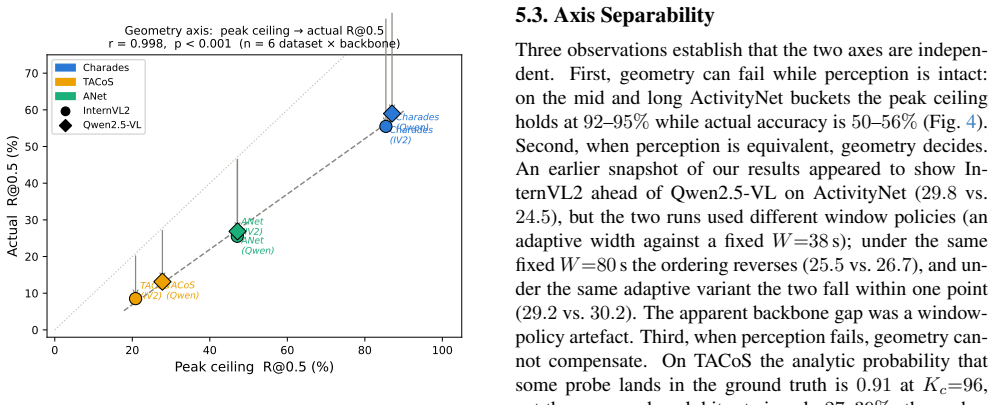
- [§3.5, Table 13, §4.1] The width W is a test-set-tuned hyperparameter on ActivityNet and TACoS, which undercuts the 'no tuning' and 'training-free' framing. The paper states that on Charades-STA and QVHighlights W equals the training-split mean event length, but for ActivityNet and TACoS the deployed values (80s and 20s) are not the training means (35.5s and 32s); they are chosen because the sensitivity sweep in Section 5.6 shows they lie on a plateau, with the training-mean alternative losing 3.1pp and about 1.7pp respectively. That is selection on the eval split. The geometric analysis in Figures 3–5 is consequently a post-hoc explanation of a configuration chosen on the test set, rather than a prediction made before any model runs. The r=0.998 in Figure 5 is also partly tautological, since the 'peak ceiling' is computed from the same actual peak positions that determine final R@0.5. Please rephrase the claims of prediction and add a validation-based selection procedure or justify the test-set choice explicitly as a reported design decision.
minor comments (5)
- [Fig. 1, Table 6] The captions of Figure 1 and Table 6 both say 'same input frames' or 'identical input'; these should be corrected to describe the actual inputs after addressing the corresponding major comment.
- [Throughout] The model name is spelled inconsistently as 'LLaV A-NeXT-Video' in several places; the standard form is LLaVA-NeXT-Video.
- [§5.3] The first observation begins with 'An earlier snapshot of our results appeared to show...'; this historical anecdote should be removed in favor of the controlled comparison under identical window policy that follows.
- [Figures 4–5] The term 'peak ceiling' is used in the figures before it is formally defined in the text; please define it in the caption or in the text before first use.
- [§4.1] The statement that the two arms cover the timeline 'at a similar granularity' ignores the 24 fine-scan probes; please state the full probe and frame counts for the VQA arm so that the comparison is transparent.
Circularity Check
Geometry and peak-ceiling analyses contain definitional and fitted 'predictions,' while the central frozen-backbone interface comparison is empirical and independent.
-
self definitional
[Sec. 3.5, Eq. (5)]
"If the peak is perfectly centred on an event of width g, the overlap is IoU(W, g) = min(W, g)/max(W, g), so IoU≥0.5 requires g∈[W/2,2W], and outside this band R@0.5 is zero regardless of how well the peak is localised."
The 'geometry prediction' is an unpacking of the evaluation metric itself. R@0.5 is defined as the fraction of predictions with temporal IoU ≥ 0.5, and IoU for a fixed centered window is, by definition, min(W,g)/max(W,g). The feasible band g∈[W/2,2W] is a direct algebraic consequence of these definitions, not a measured property of any model. Calling it a 'testable prediction' presents a necessary truth as though it were a falsifiable outcome; the bucket collapse outside the band follows by construction from the scoring rule, independent of the VLM's behavior.
-
fitted input called prediction
[Sec. 5.2, Figure 5]
"Aggregating over all six dataset and backbone combinations, the peak ceiling predicts final R@0.5 with r= 0.998 (Fig. 5); the residual to the diagonal is the geometry loss."
The 'peak ceiling' is computed from the actual located peak positions produced by FV-Action on the test set, and final R@0.5 is computed from the same peak positions plus the same fixed window W. Both series are deterministic functions of the same measured outputs, so the near-perfect correlation is forced by construction rather than being an independent prediction of a theory. The analysis is a consistency check—'if we keep the located peaks and apply the fixed-window overlap, we recover approximately the reported R@0.5'—not a prediction of R@0.5 from quantities measured before the method runs.
1 more flagged steps
-
fitted input called prediction
[Sec. 3.5, Sec. 5.2, Figure 3]
"On the two long-video corpora no single training statistic reproduces the deployed values ... the values sit on the broad plateau that the sensitivity sweep in Sec. 5.6 makes explicit ... The analytic bound predicts failure before any model runs. ActivityNet, W=80s"
The ActivityNet geometry 'prediction' (Figure 3) uses W=80s, a value that is selected or at least confirmed by the test-set sensitivity sweep reported in Sec. 5.6 and Table 13. The feasible band [W/2,2W] is a direct function of this chosen W, so the observed collapse of ground-truth buckets below 40s is partly manufactured by the hyperparameter choice on the same test set that is then said to be 'predicted.' The authors disclose the sweep and report a broad plateau, which lowers the severity, but the bound is not a parameter-free forecast: its agreement with the bucket collapse is statistically tied to the test-informed choice of W.
full rationale
The paper's central empirical claim—that frozen backbones jump from timestamp regression to binary VQA scanning by 28–50 R@0.5 points—is a genuinely external, training-free comparison against public checkpoints and standard benchmarks. It does not reduce to the paper's own inputs or to a self-citation chain: no load-bearing self-citation or imported uniqueness theorem is present, and the method introduces no trained parameters. The main circularity concerns are confined to the analysis sections. Equation (5) is a definitional identity of the IoU metric, so the 'analytically predictable geometry axis' is a tautology about the scoring rule rather than a novel derivation. The r=0.998 peak-ceiling correlation is forced because both the ceiling and the reported R@0.5 are computed from the same measured peak positions and the same W. The ActivityNet W=80 hyperparameter is test-swept, so the geometric 'prediction' on that corpus is partially fitted. Separately, Table 6's 'identical input (16 uniformly sampled frames)' caption is inconsistent with the implementation (12 coarse probes x 3 frames = 36 frames for the scan arm; Sec. 5.6 shows F=3-to-5 changes R@0.5 by +5.7pp). That is a real confound in the controlled comparison and a correctness risk, but it is an experimental-validity issue rather than a circular derivation, so it does not itself raise the circularity score. Overall, the interface claim is independently meaningful, while the geometry and peak-ceiling 'predictions' partially reduce to definitions and test-informed choices, giving a score of 4.
Assumptions & free parameters
free parameters (8)
- Window width W =
8 s (Charades-STA), 20 s (TACoS), 80 s (ActivityNet), 25 s (QVHighlights)
- Coarse probe budget Kc =
12, 16, 96 per corpus
- Fine-scan radius rf =
8 s, 25 s, 25 s, 30 s
- Fine clips Kf =
8
- Candidate peaks Np =
3
- Joint-score alpha =
0.5
- Frames per probe F =
3 in reported experiments (method text says 5)
- Input resolution =
448x448
assumptions (7)
- domain assumption The binary VQA question "Does this clip show {query}?" is a valid per-clip probe for the temporal grounding query.
- domain assumption First-token P(Yes) scores need only be ordinally correct within a video, not calibrated.
- ad hoc to paper The same-temporal-resolution argument equates 16 direct frames and 12 probe centers with 3 frames each.
- domain assumption Video-frame sampling with F=3 and 448x448 resolution is sufficient to measure per-clip event presence.
- ad hoc to paper Deployed W on ActivityNet and TACoS, chosen from a test-set sweep, sits on a defensible plateau and is not test-set overfitting.
- domain assumption Missing YouTube videos in ActivityNet and QVHighlights are missing at random, so evaluating only available videos is unbiased.
- domain assumption Native Qwen2.5-VL baseline numbers (53.6 R@0.5, 28.5 R@0.7) imported from OmniVTG [33] use the same frozen weights and protocol as FV-Action.
Cite this review
Pith. "Pith review of Your VLM Already Knows When: Training-Free Temporal Grounding by Asking Yes or No." pith.science (2026). https://pith.science/paper/H7KFSWOK
@misc{pith2026260808315,
  author       = {Pith},
  title        = {Pith review of: Your VLM Already Knows When: Training-Free Temporal Grounding by Asking Yes or No},
  year         = {2026},
  howpublished = {\url{https://pith.science/paper/H7KFSWOK}},
  note         = {Machine review of arXiv:2608.08315}
}
abstract
Multimodal LLMs that recognise events reliably still fail to say when they happen. Prompted for timestamps, strong VLMs reach as little as $3.8\%$ R@0.5 on Charades-STA, and $77$ to $80\%$ of their wrong predictions carry low output entropy: the models are confidently wrong, and entropy-based error detection stays below a random classifier. We show that this failure lives in the task interface, not in perception. Holding the weights fixed, replacing timestamp regression with a coarse-to-fine scan of binary questions, whose first-token probabilities are consumed only as a ranking, raises R@0.5 by $28$ to $50$ points across four frozen backbones. The residual failures decompose into two measurable axes: a perception axis that moves with the backbone, and a geometry axis that is analytically predictable from the ratio of the output-window and event widths. FV-Action, the training-free method built on this analysis, reaches $56.8\%$ R@0.5 on Charades-STA, above the same backbone's native grounding pipeline and the strongest training-free result on this benchmark; it surpasses every TVG-trained model evaluated zero-shot on TACoS, and improves over direct prediction on ActivityNet Captions and QVHighlights, with no temporal supervision at any stage.
Figures


Figures from the paper (2 more)

Reference graph
Works this paper leans on
-
[1]
Qwen2.5- vl technical report, 2025
Shuai Bai, Keqin Chen, Xuejing Liu, Jialin Wang, Wenbin Ge, Sibo Song, Kai Dang, Peng Wang, Shi- jie Wang, Jun Tang, Humen Zhong, Yuanzhi Zhu, Mingkun Yang, Zhaohai Li, Jianqiang Wan, Pengfei Wang, Wei Ding, Zheren Fu, Yiheng Xu, Jiabo Ye, Xi Zhang, Tianbao Xie, Zesen Cheng, Hang Zhang, Zhibo Yang, Haiyang Xu, and Junyang Lin. Qwen2.5- vl technical report...
work page 2025
-
[2]
Shimin Chen, Xiaohan Lan, Yitian Yuan, Zequn Jie, and Lin Ma. Timemarker: A versatile video-llm for long and short video understanding with supe- rior temporal localization ability.arXiv preprint arXiv:2411.18211, 2024. 3, 9, 10
arXiv 2024
-
[3]
Zhe Chen, Weiyun Wang, Yue Cao, Yangzhou Liu, Zhangwei Gao, Erfei Cui, Jinguo Zhu, Shenglong Ye, Hao Tian, Zhaoyang Liu, et al. Expanding perfor- mance boundaries of open-source multimodal models with model, data, and test-time scaling.arXiv preprint arXiv:2412.05271, 2024. 1, 3
arXiv 2024
-
[4]
Internvl: Scal- ing up vision foundation models and aligning for generic visual-linguistic tasks
Zhe Chen, Jiannan Wu, Wenhai Wang, Weijie Su, Guo Chen, Sen Xing, Muyan Zhong, Qinglong Zhang, Xizhou Zhu, Lewei Lu, et al. Internvl: Scal- ing up vision foundation models and aligning for generic visual-linguistic tasks. InProceedings of the IEEE/CVF conference on computer vision and pattern recognition, pages 24185–24198, 2024. 4, 9
work page 2024
-
[5]
Xiongwen Deng, Haoyu Tang, Han Jiang, Qinghai Zheng, and Jihua Zhu. Boundary-aware temporal dy- namic pseudo-supervision pairs generation for zero- shot natural language video localization. InProceed- ings of the AAAI Conference on Artificial Intelligence, pages 2717–2725, 2025. 3, 9, 10
work page 2025
-
[6]
LLM4VG: Large Language Models Evaluation for Video Grounding
Wei Feng, Xin Wang, Hong Chen, Zeyang Zhang, Houlun Chen, Zihan Song, Yuwei Zhou, Yuekui Yang, Haiyang Wu, and Wenwu Zhu. Llm4vg: Large lan- guage models evaluation for video grounding.arXiv preprint arXiv:2312.14206, 2023. 3, 9
work page Pith review arXiv 2023
-
[7]
Tall: Temporal activity localization via lan- guage query
Jiyang Gao, Chen Sun, Zhenheng Yang, and Ram Nevatia. Tall: Temporal activity localization via lan- guage query. InProceedings of the IEEE interna- tional conference on computer vision, pages 5267– 5275, 2017. 1, 2, 5
work page 2017
-
[8]
Trace: Temporal grounding video llm via causal event modeling.arXiv preprint arXiv:2410.05643, 2024
Yongxin Guo, Jingyu Liu, Mingda Li, Qingbin Liu, Xi Chen, and Xiaoying Tang. Trace: Temporal grounding video llm via causal event modeling.arXiv preprint arXiv:2410.05643, 2024. 3, 9
arXiv 2024
Show all 33 references
-
[9]
Vtg-llm: Integrating timestamp knowledge into video llms for enhanced video tempo- ral grounding
Yongxin Guo, Jingyu Liu, Mingda Li, Dingxin Cheng, Xiaoying Tang, Dianbo Sui, Qingbin Liu, Xi Chen, and Kevin Zhao. Vtg-llm: Integrating timestamp knowledge into video llms for enhanced video tempo- ral grounding. InProceedings of the AAAI Conference on Artificial Intelligence...
2025
-
[10]
Vtimellm: Empower llm to grasp video moments
Bin Huang, Xin Wang, Hong Chen, Zihan Song, and Wenwu Zhu. Vtimellm: Empower llm to grasp video moments. InProceedings of the IEEE/CVF Confer- ence on Computer Vision and Pattern Recognition, pages 14271–14280, 2024. 3, 9, 10
2024
-
[11]
Lita: Language instructed temporal- localization assistant
De-An Huang, Shijia Liao, Subhashree Radhakrish- nan, Hongxu Yin, Pavlo Molchanov, Zhiding Yu, and Jan Kautz. Lita: Language instructed temporal- localization assistant. InEuropean Conference on Computer Vision, pages 202–218. Springer, 2024. 1, 2
2024
-
[12]
Granalign: Granularity-aware alignment framework for zero-shot video moment retrieval
Mingyu Jeon, Sunjae Yoon, Jonghee Kim, and Jun- yeong Kim. Granalign: Granularity-aware alignment framework for zero-shot video moment retrieval. In Proceedings of the AAAI Conference on Artificial In- telligence, pages 5287–5295, 2026. 3, 7, 9, 10
2026
-
[13]
Dense-captioning events in videos
Ranjay Krishna, Kenji Hata, Frederic Ren, Li Fei-Fei, and Juan Carlos Niebles. Dense-captioning events in videos. InProceedings of the IEEE international con- ference on computer vision, pages 706–715, 2017. 1, 2, 5
2017
-
[14]
Se- mantic uncertainty: Linguistic invariances for uncer- tainty estimation in natural language generation.arXiv preprint arXiv:2302.09664, 2023
Lorenz Kuhn, Yarin Gal, and Sebastian Farquhar. Se- mantic uncertainty: Linguistic invariances for uncer- tainty estimation in natural language generation.arXiv preprint arXiv:2302.09664, 2023. 3
2023 arXiv
-
[15]
Detecting moments and highlights in videos via natural language queries.Advances in Neural Information Processing Systems, 34:11846–11858, 2021
Jie Lei, Tamara L Berg, and Mohit Bansal. Detecting moments and highlights in videos via natural language queries.Advances in Neural Information Processing Systems, 34:11846–11858, 2021. 2, 6, 7
2021
-
[16]
Videochat-flash: Hi- erarchical compression for long-context video model- ing.arXiv preprint arXiv:2501.00574, 2024
Xinhao Li, Yi Wang, Jiashuo Yu, Xiangyu Zeng, Yuhan Zhu, Haian Huang, Jianfei Gao, Kunchang Li, Yinan He, Chenting Wang, et al. Videochat-flash: Hi- erarchical compression for long-context video model- ing.arXiv preprint arXiv:2501.00574, 2024. 9
2024 arXiv
-
[17]
Evaluating object hallucina- tion in large vision-language models
Yifan Li, Yifan Du, Kun Zhou, Jinpeng Wang, Xin Zhao, and Ji-Rong Wen. Evaluating object hallucina- tion in large vision-language models. InProceedings of the 2023 conference on empirical methods in natu- ral language processing, pages 292–305, 2023. 3
2023
-
[18]
Univer- sal video temporal grounding with generative multi- modal large language models.Advances in Neu- ral Information Processing Systems, 38:64426–64455,
Zeqian Li, Shangzhe Di, Zhonghua Zhai, Weilin Huang, Yanfeng Wang, and Weidi Xie. Univer- sal video temporal grounding with generative multi- modal large language models.Advances in Neu- ral Information Processing Systems, 38:64426–64455,
-
[19]
Univtg: Towards unified video-language temporal grounding
Kevin Qinghong Lin, Pengchuan Zhang, Joya Chen, Shraman Pramanick, Difei Gao, Alex Jinpeng Wang, Rui Yan, and Mike Zheng Shou. Univtg: Towards unified video-language temporal grounding. InPro- ceedings of the IEEE/CVF international conference on computer vision, pages 2794–280...
2023
-
[20]
Enrich and detect: Video temporal ground- ing with multimodal llms
Shraman Pramanick, Effrosyni Mavroudi, Yale Song, Rama Chellappa, Lorenzo Torresani, and Triantafyllos Afouras. Enrich and detect: Video temporal ground- ing with multimodal llms. InProceedings of the IEEE/CVF International Conference on Computer Vi- sion, pages 24297–24308, 2...
2025
-
[21]
Momentor: Advancing video large language model with fine-grained temporal reasoning.arXiv preprint arXiv:2402.11435, 2024
Long Qian, Juncheng Li, Yu Wu, Yaobo Ye, Hao Fei, Tat-Seng Chua, Yueting Zhuang, and Siliang Tang. Momentor: Advancing video large language model with fine-grained temporal reasoning.arXiv preprint arXiv:2402.11435, 2024. 3, 9, 10
2024 arXiv
-
[22]
Chatvtg: Video temporal grounding via chat with video dialogue large language models
Mengxue Qu, Xiaodong Chen, Wu Liu, Alicia Li, and Yao Zhao. Chatvtg: Video temporal grounding via chat with video dialogue large language models. In Proceedings of the IEEE/CVF Conference on Com- puter Vision and Pattern Recognition, pages 1847– 1856, 2024. 3, 9, 10
2024
-
[23]
Grounding action descriptions in videos
Michaela Regneri, Marcus Rohrbach, Dominikus Wetzel, Stefan Thater, Bernt Schiele, and Manfred Pinkal. Grounding action descriptions in videos. Transactions of the Association for Computational Linguistics, 1:25–36, 2013. 1, 2, 6
2013
-
[24]
Timechat: A time-sensitive multimodal large language model for long video understanding
Shuhuai Ren, Linli Yao, Shicheng Li, Xu Sun, and Lu Hou. Timechat: A time-sensitive multimodal large language model for long video understanding. InPro- ceedings of the IEEE/CVF Conference on Computer Vision and Pattern Recognition, pages 14313–14323,
-
[25]
Hawkeye: Train- ing video-text llms for grounding text in videos.arXiv preprint arXiv:2403.10228, 2024
Yueqian Wang, Xiaojun Meng, Jianxin Liang, Yuxuan Wang, Qun Liu, and Dongyan Zhao. Hawkeye: Train- ing video-text llms for grounding text in videos.arXiv preprint arXiv:2403.10228, 2024. 3, 9, 10
2024 arXiv
-
[26]
Time-r1: Post- training large vision language model for temporal video grounding.Advances in Neural Information Processing Systems, 38:83330–83364, 2026
Ye Wang, Ziheng Wang, Boshen Xu, Yang Du, Kejun Lin, Zihan Xiao, Zihao Yue, Jianzhong Ju, Liang Zhang, Dingyi Yang, et al. Time-r1: Post- training large vision language model for temporal video grounding.Advances in Neural Information Processing Systems, 38:83330–83364, 2026. ...
2026
-
[27]
Negative sample matters: A renais- sance of metric learning for temporal grounding
Zhenzhi Wang, Limin Wang, Tao Wu, Tianhao Li, and Gangshan Wu. Negative sample matters: A renais- sance of metric learning for temporal grounding. In Proceedings of the AAAI Conference on Artificial In- telligence, pages 2613–2623, 2022. 2, 9, 10
2022
-
[28]
Zero-shot video moment retrieval via off-the-shelf multimodal large language models
Yifang Xu, Yunzhuo Sun, Benxiang Zhai, Ming Li, Wenxin Liang, Yang Li, and Sidan Du. Zero-shot video moment retrieval via off-the-shelf multimodal large language models. InProceedings of the AAAI Conference on Artificial Intelligence, pages 8978– 8986, 2025. 3, 9, 10
2025
-
[29]
mplug-owl3: Towards long image-sequence under- standing in multi-modal large language models
Jiabo Ye, Haiyang Xu, Haowei Liu, Anwen Hu, Ming Yan, Qi Qian, Ji Zhang, Fei Huang, and Jingren Zhou. mplug-owl3: Towards long image-sequence under- standing in multi-modal large language models. InIn- ternational Conference on Learning Representations, pages 98891–98913, 2025...
2025
-
[30]
Time- suite: Improving mllms for long video understanding via grounded tuning
Xiangyu Zeng, Kunchang Li, Chenting Wang, Xin- hao Li, Tianxiang Jiang, Ziang Yan, Songze Li, Yan- song Shi, Zhengrong Yue, Yi Wang, et al. Time- suite: Improving mllms for long video understanding via grounded tuning. InInternational Conference on Learning Representations, pa...
2025
-
[31]
Learning 2d temporal adjacent networks for moment localization with natural language
Songyang Zhang, Houwen Peng, Jianlong Fu, and Jiebo Luo. Learning 2d temporal adjacent networks for moment localization with natural language. InPro- ceedings of the AAAI conference on artificial intelli- gence, pages 12870–12877, 2020. 2, 9, 10
2020
-
[32]
Llava-next: A strong zero-shot video under- standing model, 2024
Yuanhan Zhang, Bo Li, haotian Liu, Yong jae Lee, Liangke Gui, Di Fu, Jiashi Feng, Ziwei Liu, and Chun- yuan Li. Llava-next: A strong zero-shot video under- standing model, 2024. 4, 9
2024
-
[33]
Omnivtg: A large-scale dataset and training paradigm for open-world video tempo- ral grounding
Minghang Zheng, Zihao Yin, Yi Yang, Yuxin Peng, and Yang Liu. Omnivtg: A large-scale dataset and training paradigm for open-world video tempo- ral grounding. InProceedings of the IEEE/CVF Con- ference on Computer Vision and Pattern Recognition, pages 24620–24629, 2026. 1, 2, 3...
2026
Reviewed August 12, 2026 · model on record in the stance chip above.
Discussion (0). Continue with ORCID to comment.