REVIEW 6 major objections 6 minor 45 references
AnimeColor: Reference-based Animation Colorization with Diffusion Transformers
T0 review · 6 major / 6 minor · reviewed 2026-08-06 · deepseek-v4-flash
Pith's one-line read A diffusion-transformer framework with two color-control modules beats six existing methods on reference-based animation colorization.
desk verdict A competent, well-ablated DiT colorization system whose SOTA claim is plausible but needs data-curation and baseline-training details before it's bulletproof. read the letter →
The pith
A machine-rendered reading of the paper's core claim, the machinery that carries it, and where it could break.
The reading
What carries the argument
The framework uses three mechanisms working together. First, sketch latents are concatenated with the noised video latents as input to a pre-trained DiT (CogVideoX-2B), so the model treats sketches as part of its context. Second, a High-level Color Extractor (HCE) encodes the reference image with RADIO and condenses the features with a Q-Former into 32 learnable color tokens that guide the DiT through cross-attention. Third, a Low-level Color Guider (LCG), a trainable copy of the DiT, produces fine-grained reference-image features that are merged with the denoising stream's vision and text tokens via self-attention. A four-stage training procedure first learns sketch control, then HCE, then LCG, then jointly fine-tunes the denoiser to integrate both color signals.
What would settle it
Inspect the data-curation code or pipeline for the 100,000 training clips: if Open-Sora was used to generate rather than filter the footage, re-run AnimeColor and the strongest baselines on a test set of hand-drawn production frames; the central claim is refuted if the PSNR, FVD, and user-study margins shrink or reverse on that real animation test set.
Extended reading notes
Core claim
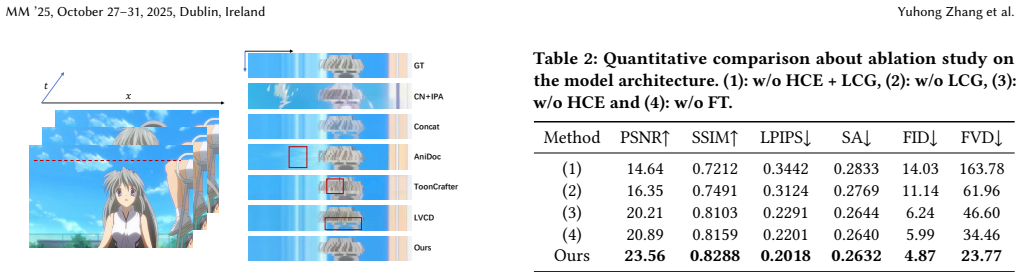
The central discovery, stated on the paper's own terms, is that a DiT-based video diffusion model can be adapted for reference-based animation colorization by injecting sketch structure through latent concatenation and reference color through two attention-level control modules. The authors report that this design outperforms three U-Net-based reference colorization methods (AniDoc, ToonCrafter, LVCD), a ControlNet-plus-IP-Adapter workflow, and a DiT baseline that concatenates the reference image with the sketches, on color accuracy, sketch alignment, temporal consistency, and perceptual quality. Their ablation studies attribute the biggest color-accuracy gain to the Low-level Color Guider and show that the four-stage training schedule further improves temporal stability.
Load-bearing premise
The load-bearing premise is that the 100,000 training clips are real, representative anime footage; the paper says they were 'systematically curated using Open-Sora' but does not state whether Open-Sora generated or filtered them, so if they are synthetic, the reported gains over baselines may not transfer to hand-drawn production animation.
Editorial extensions
If this is right
- Sketch conditioning by latent concatenation is better suited to DiT than ControlNet-style encoder-decoder adapters, needing fewer parameters and improving sketch alignment (the SA metric).
- Separating geometric control (sketches) from color control (reference image) avoids the confusing artifacts produced when the reference image and sketches are concatenated together into the input noise.
- The Low-level Color Guider contributes the largest measured gain: removing it drops PSNR from 23.56 to 16.35 and raises FVD from 23.77 to 61.96 in the ablation.
- The fourth-stage joint fine-tuning improves temporal consistency and color stability over the same architecture without it, confirming that separate module training alone is not enough.
Reading between the lines
- If the same HCE/LCG conditioning were applied to other DiT video models, it could generalize to sketch-guided video editing or in-betweening beyond anime colorization, since nothing in the design is anime-specific.
- Because the LCG is a trainable copy of the entire DiT, the method roughly doubles the denoiser's parameters and inference cost; part of the reported quality gap over single-stream baselines may come from this extra capacity rather than from the guidance mechanism itself.
- The fixed test set of 1,800 clips is drawn from the same curation pipeline as training, so the reported margins are in-distribution; a cross-dataset evaluation on independently sourced animation would test actual generalization.
- The framework's ability to colorize natural-image references suggests the color-reference modules encode palette and lighting rather than object identity, which could make the approach useful for stylistic transfer across domains.
Editorial analysis
A structured set of objections, weighed in public.
Referee Report
Summary. The paper proposes AnimeColor, a reference-based animation colorization framework built on a Diffusion Transformer (DiT) backbone (CogVideoX-2B). Sketch latents are concatenated with the noised video latent as the conditioning input, a High-level Color Extractor (HCE) using RADIO plus a Q-Former supplies semantic color tokens via cross-attention, and a Low-level Color Guider (LCG), implemented as a trainable copy of the DiT, contributes fine-grained color tokens through self-attention. A four-stage training strategy first trains sketch-guided generation, then HCE, then LCG, and finally fine-tunes the denoising DiT jointly. The authors report quantitative comparisons (PSNR, SSIM, LPIPS, SA, FID, FVD) against AniDoc, ToonCrafter, LVCD, a ControlNet+IP-Adapter workflow, and a self-trained Concat baseline, along with ablations and a user study, and claim state-of-the-art performance and industrial applicability.
Significance. If the empirical claims are sustained, the paper makes a useful systems contribution: it demonstrates that DiT-based video diffusion with in-context sketch conditioning can be adapted to reference-based animation colorization, and that separating high-level semantic color control from low-level fine-grained color control, together with stage-wise training, improves color accuracy and temporal consistency. The paper contains multiple ablations, a user study, and consistent gains on most metrics over several baselines, which are genuine strengths. However, the load-bearing evaluation protocol is not fully specified: the role of Open-Sora in dataset curation is ambiguous, baseline training conditions are undocumented, the test protocol uses the first frame of each clip as the reference (making the task a self-reconstruction), and no significance testing or error bars are provided. These issues make the headline state-of-the-art claim provisional.
major comments (6)
- [Section 4.1] The description 'systematically curate them using Open-Sora' is ambiguous, and since Open-Sora is a video generation model rather than a curation tool, it likely means the 100,000 training clips were either generated or heavily processed by a generative model. If the training data are synthetic, the reported gains over baselines trained on real animation may not transfer to production anime, directly undermining the abstract's 'practical solution for industrial applications' claim. Please state explicitly whether Open-Sora generated or filtered the clips, describe the data source and any manual filtering, and discuss the implications for real-world deployment.
- [Section 4.2, Table 1] Only the Concat baseline is described as trained by the authors; for AniDoc, ToonCrafter, LVCD, and CN+IPA, the paper does not report whether they were fine-tuned on the same training distribution, which checkpoints were used, or the exact inference settings. Without this information, the numeric gaps in Table 1 (e.g., FVD 23.77 vs. 71.63 for LVCD) could reflect base-model capacity or domain shift rather than the proposed HCE/LCG/sketch-concatenation design. For a fair state-of-the-art comparison, the authors should document each baseline's weights, adaptation procedure, and evaluation conditions, and ideally retrain or fine-tune the baselines under matched conditions.
- [Section 4.1, test protocol] The test set uses the first frame of each video clip as the reference image, so the generated frames are compared against the remaining original frames of the same clip. This makes the quantitative evaluation a self-reconstruction task and does not measure the more practical setting of colorizing a new sketch with an independent reference image. This protocol may inflate similarity metrics and limits the external validity of the claims. Please add an evaluation where the reference image is not drawn from the target clip, or clearly state and justify the reconstruction-only setup.
- [Section 3.3, Eq. (4)] The text states that LCG concatenates low-level reference tokens with vision and text tokens for self-attention, but Eq. (4) shows Self-Attention(Concat(F_text, F_vision, F_H)), where F_H is the high-level reference token from HCE, not low-level tokens. The mechanism by which the trainable DiT copy extracts fine-grained color representations from the reference image is not specified, and it is unclear how Stage 3 can train LCG while the denoising DiT is frozen. Please provide a precise forward-pass description of LCG, including the role of the reference image latent and the exact token sequence entering self-attention.
- [Table 3, ablation on sketch conditional model] In Table 3, the proposed sketch conditional model ('Ours') reports FVD 163.78, which is substantially worse than both ControlNet Variation 1 (106.93) and ControlNet Variation 2 (136.11), yet the text claims the proposed method 'surpasses other methods on nearly all metrics, particularly on the SA metric.' The FVD regression is not discussed. Either correct the claim or provide an explanation for why the proposed design is preferable despite this metric.
- [Tables 1-4] No error bars, confidence intervals, or significance tests are reported anywhere. Several headline differences are small relative to the scale of the metrics—for instance, LPIPS is 0.2018 vs. 0.2004 for LVCD in Table 1, and in Table 4 the RADIO-based HCE is worse on PSNR, SSIM, and SA while better on LPIPS, FID, and FVD. Without multiple runs or statistical testing, the paper cannot support fine-grained superiority claims such as 'slightly higher' or 'significantly outperforms.' Please report variance across seeds or runs and, where possible, appropriate significance measures.
minor comments (6)
- [Section 4.2.2] The sketch-alignment metric SA is described as 'RMSE between the sketches of the generated frames and the original input sketches,' but the paper does not specify how sketches are obtained from generated frames or whether the comparison is performed in the sketch-extraction space. Please define the extraction method and the exact computation.
- [Section 4.2.3] The user study says participants compare 'five different methods,' but Table 1 lists six methods including Concat. Please clarify which methods were included in the user study and why Concat was excluded, if it was.
- [Table 1] In the abstract and Section 4.2.2, the paper claims superiority on 'most metrics,' but LPIPS for the proposed method (0.2018) is slightly worse than LVCD (0.2004). Please acknowledge this explicitly and discuss whether the difference is meaningful.
- [Section 3.2, Eqs. (1)-(2)] The notation is inconsistent: Eq. (1) defines F_sum and F_spa from RADIO, but Eq. (2) uses F_RADIO without defining how it is obtained from F_sum and F_spa. Please clarify the aggregation through the MLP layers and define all symbols used in the equations.
- [Section 4.1] The implementation details state that 'CogvideoX-2B' is used as the baseline, but the model name is typically written as CogVideoX-2B; please standardize the capitalization. Also, the details of sketch-latent concatenation (channel-wise concatenation, dimension matching, and handling of varying resolutions) are not given and would help reproducibility.
- [Throughout] There are several minor typos and inconsistencies in method names, such as 'Tooncrafter' vs. 'ToonCrafter' and 'Anidoc' vs. 'AniDoc,' and the phrase 'Finetune' appears in Table 2 as 'FT' without a formal definition in the table caption. Please proofread and harmonize the terminology.
Circularity Check
No circularity: the paper derives its SOTA claim from held-out quantitative comparisons, internal ablations, and a user study, none of which reduce to the method's own definitions.
full rationale
AnimeColor is an empirical systems paper. The claimed contributions (HCE, LCG, sketch concatenation, multi-stage training) are evaluated against external baselines on a held-out set of 1,800 clips, and the ablations remove modules and retrain, producing independent internal comparisons. The reference image being the first frame of each test clip is a standard task formulation for reference-based colorization and does not make the prediction a fitted quantity, since the model is not optimized on the test clips. The description of the 100,000-clip training set as 'systematically curate[d] using Open-Sora' (Section 4.1) is ambiguous about whether Open-Sora generated or filtered the data, and the paper does not state whether AniDoc, ToonCrafter, and LVCD were fine-tuned on the same distribution; however, these are concerns about benchmarking fairness and generalizability, not circularity. No equation in the paper is defined in terms of the quantities it is used to predict, no fitted parameter is renamed as a prediction, and no load-bearing claim rests on a self-citation. The single citation of the authors' own prior work ([34] LayerAnimate) appears only in related work and is not used to justify the central result. The derivation chain is therefore self-contained with respect to circularity.
Assumptions & free parameters
free parameters (4)
- Number of learnable color tokens N in Q-Former =
32
- Training iterations per stage =
50K, 25K, 30K, 50K
- Learning rate =
2e-5
- Batch size =
16
assumptions (6)
- standard math Standard diffusion model epsilon-prediction objective, as in Eq. 5-8
- domain assumption The CogVideoX VAE latent space preserves enough structural and color information for colorization
- domain assumption XDoG-extracted sketches are a faithful proxy for animation line art
- domain assumption The 100,000-clip training set is representative of real animation, with Open-Sora used for curation rather than generation
- domain assumption A single reference frame provides sufficient color information for the entire video
- ad hoc to paper The four-stage training strategy effectively decouples geometric and color controls
Cite this review
Pith. "Pith review of AnimeColor: Reference-based Animation Colorization with Diffusion Transformers." pith.science (2026). https://pith.science/paper/H7KM5GOK
@misc{pith2026250720158,
  author       = {Pith},
  title        = {Pith review of: AnimeColor: Reference-based Animation Colorization with Diffusion Transformers},
  year         = {2026},
  howpublished = {\url{https://pith.science/paper/H7KM5GOK}},
  note         = {Machine review of arXiv:2507.20158}
}
read the original abstract
Animation colorization plays a vital role in animation production, yet existing methods struggle to achieve color accuracy and temporal consistency. To address these challenges, we propose \textbf{AnimeColor}, a novel reference-based animation colorization framework leveraging Diffusion Transformers (DiT). Our approach integrates sketch sequences into a DiT-based video diffusion model, enabling sketch-controlled animation generation. We introduce two key components: a High-level Color Extractor (HCE) to capture semantic color information and a Low-level Color Guider (LCG) to extract fine-grained color details from reference images. These components work synergistically to guide the video diffusion process. Additionally, we employ a multi-stage training strategy to maximize the utilization of reference image color information. Extensive experiments demonstrate that AnimeColor outperforms existing methods in color accuracy, sketch alignment, temporal consistency, and visual quality. Our framework not only advances the state of the art in animation colorization but also provides a practical solution for industrial applications. The code will be made publicly available at \href{https://github.com/IamCreateAI/AnimeColor}{https://github.com/IamCreateAI/AnimeColor}.
Figures


Figures from the paper (8 more)



Reference graph
Works this paper leans on
-
[1]
Andreas Blattmann, Tim Dockhorn, Sumith Kulal, Daniel Mendelevitch, Maciej Kilian, Dominik Lorenz, Yam Levi, Zion English, Vikram Voleti, Adam Letts, et al. 2023. Stable video diffusion: Scaling latent video diffusion models to large datasets. arXiv preprint arXiv:2311.15127 (2023)
arXiv 2023
-
[2]
Yu Cao, Xiangqiao Meng, PY Mok, Tong-Yee Lee, Xueting Liu, and Ping Li. 2024. AnimeDiffusion: anime diffusion colorization. IEEE Transactions on Visualization and Computer Graphics (2024)
work page 2024
-
[3]
Caroline Chan, Fredo Durand, and Phillip Isola. 2022. Learning to generate line drawings that convey geometry and semantics. (2022)
work page 2022
-
[4]
Haoxin Chen, Menghan Xia, Yingqing He, Yong Zhang, Xiaodong Cun, Shaoshu Yang, Jinbo Xing, Yaofang Liu, Qifeng Chen, Xintao Wang, et al. 2023. Videocrafter1: Open diffusion models for high-quality video generation. arXiv preprint arXiv:2310.19512 (2023)
arXiv 2023
-
[5]
Shu-Yu Chen, Jia-Qi Zhang, Lin Gao, Yue He, Shihong Xia, Min Shi, and Fang-Lue Zhang. 2020. Active colorization for cartoon line drawings. IEEE Transactions on Visualization and Computer Graphics 28, 2 (2020), 1198–1208
work page 2020
-
[6]
Yuekun Dai, Shangchen Zhou, Qinyue Li, Chongyi Li, and Chen Change Loy
-
[7]
Prafulla Dhariwal and Alexander Nichol. 2021. Diffusion models beat gans on image synthesis. Advances in neural information processing systems 34 (2021), 8780–8794
2021
-
[8]
Zhi Dou, Ning Wang, Baopu Li, Zhihui Wang, Haojie Li, and Bin Liu. 2021. Dual color space guided sketch colorization. IEEE Transactions on Image Processing 30 (2021), 7292–7304
work page 2021
Show all 45 references
-
[9]
Yuwei Guo, Ceyuan Yang, Anyi Rao, Zhengyang Liang, Yaohui Wang, Yu Qiao, Maneesh Agrawala, Dahua Lin, and Bo Dai. 2023. Animatediff: Animate your personalized text-to-image diffusion models without specific tuning. arXiv preprint arXiv:2307.04725 (2023)
2023 arXiv
-
[10]
Martin Heusel, Hubert Ramsauer, Thomas Unterthiner, Bernhard Nessler, and Sepp Hochreiter. 2017. Gans trained by a two time-scale update rule converge to a local nash equilibrium. Advances in neural information processing systems 30 (2017)
2017
-
[11]
Lianghua Huang, Wei Wang, Zhi-Fan Wu, Yupeng Shi, Huanzhang Dou, Chen Liang, Yutong Feng, Yu Liu, and Jingren Zhou. 2024. In-context lora for diffusion transformers. arXiv preprint arXiv:2410.23775 (2024)
2024 arXiv
-
[12]
Zhitong Huang, Mohan Zhang, and Jing Liao. 2024. LVCD: reference-based lineart video colorization with diffusion models. ACM Transactions on Graphics (TOG) 43, 6 (2024), 1–11
2024
-
[13]
Hyunsu Kim, Ho Young Jhoo, Eunhyeok Park, and Sungjoo Yoo. 2019. Tag2pix: Line art colorization using text tag with secat and changing loss. In Proceedings of the IEEE/CVF international conference on computer vision . 9056–9065
2019
-
[14]
Alexander Kirillov, Eric Mintun, Nikhila Ravi, Hanzi Mao, Chloe Rolland, Laura Gustafson, Tete Xiao, Spencer Whitehead, Alexander C Berg, Wan-Yen Lo, et al
-
[15]
Junnan Li, Dongxu Li, Silvio Savarese, and Steven Hoi. 2023. Blip-2: Bootstrapping language-image pre-training with frozen image encoders and large language models. In International conference on machine learning . PMLR, 19730–19742
2023
-
[16]
Zhimin Li, Jianwei Zhang, Qin Lin, Jiangfeng Xiong, Yanxin Long, Xinchi Deng, Yingfang Zhang, Xingchao Liu, Minbin Huang, Zedong Xiao, et al. 2024. Hunyuan- DiT: A Powerful Multi-Resolution Diffusion Transformer with Fine-Grained Chinese Understanding. arXiv preprint arXiv:240...
2024 arXiv
-
[17]
Yihao Meng, Hao Ouyang, Hanlin Wang, Qiuyu Wang, Wen Wang, Ka Leong Cheng, Zhiheng Liu, Yujun Shen, and Huamin Qu. 2024. AniDoc: Animation Creation Made Easier. arXiv preprint arXiv:2412.14173 (2024)
2024 arXiv
-
[18]
Maxime Oquab, Timothée Darcet, Théo Moutakanni, Huy Vo, Marc Szafraniec, Vasil Khalidov, Pierre Fernandez, Daniel Haziza, Francisco Massa, Alaaeldin El- Nouby, et al. 2023. Dinov2: Learning robust visual features without supervision. arXiv preprint arXiv:2304.07193 (2023)
2023 arXiv
-
[19]
Alibaba pai. 2024. CogVideoX-Fun. https://github.com/aigc-apps/CogVideoX-Fun
2024
-
[20]
Alec Radford, Jong Wook Kim, Chris Hallacy, Aditya Ramesh, Gabriel Goh, Sandhini Agarwal, Girish Sastry, Amanda Askell, Pamela Mishkin, Jack Clark, et al. 2021. Learning transferable visual models from natural language supervision. In International conference on machine learni...
2021
-
[21]
Mike Ranzinger, Greg Heinrich, Jan Kautz, and Pavlo Molchanov. 2024. AM- RADIO: Agglomerative Vision Foundation Model Reduce All Domains Into One. In Proceedings of the IEEE/CVF Conference on Computer Vision and Pattern Recog- nition. 12490–12500
2024
-
[22]
Robin Rombach, Andreas Blattmann, Dominik Lorenz, Patrick Esser, and Björn Ommer. 2022. High-resolution image synthesis with latent diffusion models. In Proceedings of the IEEE/CVF conference on computer vision and pattern recognition . 10684–10695
2022
-
[23]
Min Shi, Jia-Qi Zhang, Shu-Yu Chen, Lin Gao, Yu-Kun Lai, and Fang-Lue Zhang
-
[24]
Harrish Thasarathan, Kamyar Nazeri, and Mehran Ebrahimi. 2019. Automatic temporally coherent video colorization. In 2019 16th conference on computer and robot vision (CRV). IEEE, 189–194
2019
-
[25]
Thomas Unterthiner, Sjoerd van Steenkiste, Karol Kurach, Raphaël Marinier, Marcin Michalski, and Sylvain Gelly. 2019. FVD: A new metric for video genera- tion. ICLR 2019 Workshop DeepGenStruct (2019)
2019
-
[26]
Ashish Vaswani. 2017. Attention is all you need. arXiv preprint arXiv:1706.03762 (2017)
2017 arXiv
-
[27]
Ning Wang, Muyao Niu, Zhi Dou, Zhihui Wang, Zhiyong Wang, Zhaoyan Ming, Bin Liu, and Haojie Li. 2023. Coloring anime line art videos with transformation region enhancement network. Pattern Recognition 141 (2023), 109562
2023
-
[28]
Holger Winnemöller, Jan Eric Kyprianidis, and Sven C Olsen. 2012. XDoG: An eXtended difference-of-Gaussians compendium including advanced image stylization. Computers & Graphics 36, 6 (2012), 740–753
2012
-
[29]
Xiaoyu Xiang, Ding Liu, Xiao Yang, Yiheng Zhu, and Xiaohui Shen. 2021. Anime2Sketch: A Sketch Extractor for Anime Arts with Deep Networks. https: //github.com/Mukosame/Anime2Sketch
2021
-
[30]
Jinbo Xing, Hanyuan Liu, Menghan Xia, Yong Zhang, Xintao Wang, Ying Shan, and Tien-Tsin Wong. 2024. Tooncrafter: Generative cartoon interpolation. ACM Transactions on Graphics (TOG) 43, 6 (2024), 1–11
2024
-
[31]
Jiaqi Xu, Xinyi Zou, Kunzhe Huang, Yunkuo Chen, Bo Liu, MengLi Cheng, Xing Shi, and Jun Huang. 2024. EasyAnimate: A High-Performance Long Video Gener- ation Method based on Transformer Architecture.arXiv preprint arXiv:2405.18991 (2024)
2024
-
[32]
Lin Xu, Yilin Zhao, Daquan Zhou, Zhijie Lin, See Kiong Ng, and Jiashi Feng. 2024. Pllava: Parameter-free llava extension from images to videos for video dense captioning. arXiv preprint arXiv:2404.16994 (2024)
2024 arXiv
-
[33]
Dingkun Yan, Liang Yuan, Erwin Wu, Yuma Nishioka, Issei Fujishiro, and Suguru Saito. 2024. Colorizediffusion: Adjustable sketch colorization with reference image and text. arXiv preprint arXiv:2401.01456 (2024)
2024 arXiv
-
[34]
Yuxue Yang, Lue Fan, Zuzen Lin, Feng Wang, and Zhaoxiang Zhang. 2025. Lay- erAnimate: Layer-specific Control for Animation. arXiv preprint arXiv:2501.08295 (2025)
2025 arXiv
-
[35]
Zhuoyi Yang, Jiayan Teng, Wendi Zheng, Ming Ding, Shiyu Huang, Jiazheng Xu, Yuanming Yang, Wenyi Hong, Xiaohan Zhang, Guanyu Feng, et al . 2024. Cogvideox: Text-to-video diffusion models with an expert transformer. arXiv preprint arXiv:2408.06072 (2024)
2024 arXiv
-
[36]
Hu Ye, Jun Zhang, Sibo Liu, Xiao Han, and Wei Yang. 2023. Ip-adapter: Text compatible image prompt adapter for text-to-image diffusion models. arXiv preprint arXiv:2308.06721 (2023)
2023 arXiv
-
[37]
Yifeng Yu, Jiangbo Qian, Chong Wang, Yihong Dong, and Baisong Liu. 2024. Animation line art colorization based on the optical flow method. Computer Animation and Virtual Worlds 35, 1 (2024), e2229
2024
-
[38]
Lvmin Zhang, Chengze Li, Tien-Tsin Wong, Yi Ji, and Chunping Liu. 2018. Two- stage sketch colorization. ACM Transactions on Graphics (TOG) 37, 6 (2018), 1–14
2018
-
[39]
Lvmin Zhang, Anyi Rao, and Maneesh Agrawala. 2023. Adding conditional con- trol to text-to-image diffusion models. InProceedings of the IEEE/CVF International Conference on Computer Vision . 3836–3847
2023
-
[40]
Qian Zhang, Bo Wang, Wei Wen, Hai Li, and Junhui Liu. 2021. Line art correlation matching feature transfer network for automatic animation colorization. In Proceedings of the IEEE/CVF Winter Conference on Applications of Computer Vision . 3872–3881
2021
-
[41]
Zangwei Zheng, Xiangyu Peng, Tianji Yang, Chenhui Shen, Shenggui Li, Hongxin Liu, Yukun Zhou, Tianyi Li, and Yang You. 2024. Open-sora: Democratizing efficient video production for all. arXiv preprint arXiv:2412.20404 (2024)
2024 arXiv
-
[42]
Changqing Zou, Haoran Mo, Chengying Gao, Ruofei Du, and Hongbo Fu. 2019. Language-based colorization of scene sketches. ACM Transactions on Graphics (TOG) 38, 6 (2019), 1–16
2019
-
[2022]
IEEE Transactions on Visualization and Computer Graphics 29, 6 (2022), 2965–2979
Reference-based deep line art video colorization. IEEE Transactions on Visualization and Computer Graphics 29, 6 (2022), 2965–2979
2022
-
[2023]
In Proceedings of the IEEE/CVF International Conference on Computer Vision
Segment anything. In Proceedings of the IEEE/CVF International Conference on Computer Vision. 4015–4026
-
[2024]
In Proceedings of the IEEE/CVF Conference on Computer Vision and Pattern Recognition
Learning Inclusion Matching for Animation Paint Bucket Colorization. In Proceedings of the IEEE/CVF Conference on Computer Vision and Pattern Recognition. 25544–25553
Reviewed August 6, 2026 · model on record in the stance chip above.
Discussion (0). Sign in to comment.