REVIEW 2 major objections 5 minor 1 cited by
Interpretation and diversity of exoplanetary material orbiting white dwarfs
T0 review · 2 major / 5 minor · reviewed 2026-08-14 · deepseek-v4-flash
Pith's one-line read Nine polluted white dwarfs are accreting rocky, volatile-poor asteroidal debris from differentiated bodies, including a mantle-like planetesimal with a small iron core and one system where accretion ceased about five million years ago.
desk verdict A careful nine-star abundance study that confirms the rocky-accretion consensus and offers one credible post-accretion system; the timing claim is model-dependent but not fragile enough to sink the paper. read the letter →
The pith
A machine-rendered reading of the paper's core claim, the machinery that carries it, and where it could break.
The reading
What carries the argument
The argument rests on the three-phase model of photospheric metal abundance evolution driven by element-dependent diffusion (sinking) timescales. During constant accretion, abundances rise and approach steady-state values; once accretion stops, element ratios diverge exponentially because elements leave the photosphere at different rates. Coupled to this is a logit-transformed reduced chi-squared comparison between the observed abundances and a database of solar-system materials (Earth components, meteorite groups, comets), which prevents a dominant element from manufacturing false consistency. The paper uses the differential sinking of magnesium versus calcium and iron to read the timing of the 2216−657 system: since Mg lingers longest, its dominance marks a post-accretion phase about five calcium sinking timescales after the event.
What would settle it
Compute the diffusion (sinking) timescales for magnesium, calcium, and iron with an independent public model for a helium-atmosphere white dwarf at around 9190 K and $\log g \sim 8.05$, the parameters of 2216−657; if the Mg/Ca and Mg/Fe sinking-time ratios differ substantially from the values used here, the post-accretion interpretation and the inferred age of about 5 Myr are not settled. A long-baseline search for changes in the Mg/Fe ratio of 2216−657 could test the predicted exponential divergence, though the relevant timescales are millions of years.
Extended reading notes
Core claim
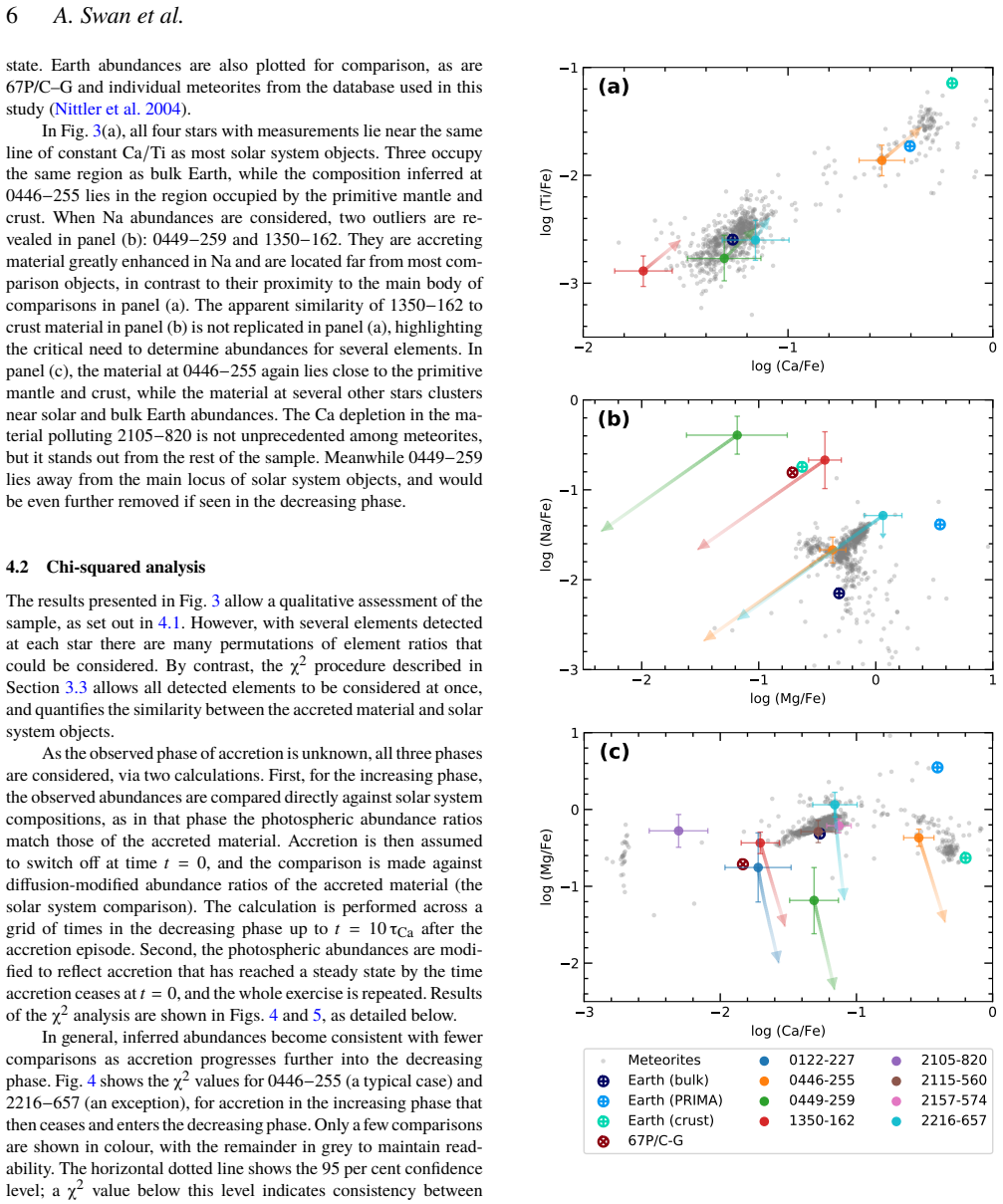
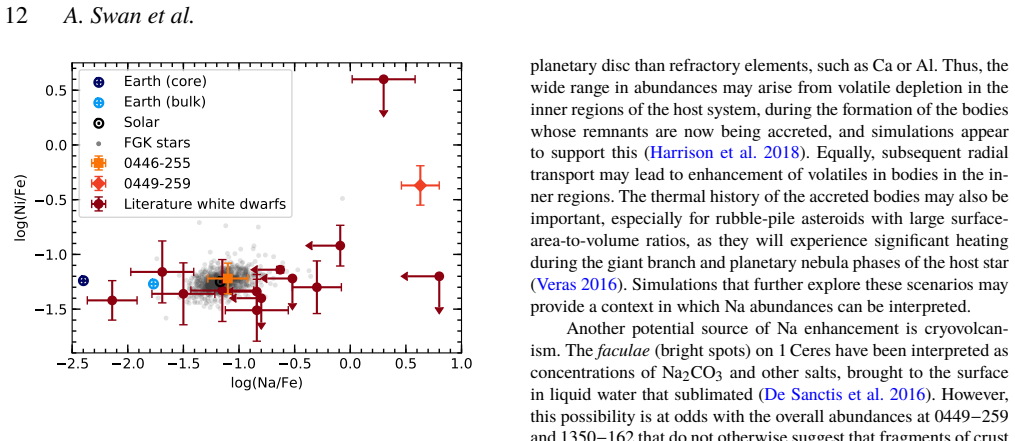
The central claim is that the photospheric metals in all nine white dwarfs were delivered by accretion of rocky, volatile-poor asteroidal debris whose parent bodies were differentiated, in line with the consensus model for white dwarf pollution. The most metal-rich object, WD 0446−255, shows fourteen detected elements whose relative abundances match a mixture of mantle rock with a small fraction of iron–nickel core material, implying the accretion of a differentiated minor planet with a small core. At WD 2216−657 the element ratios are best explained by accretion that ceased about 5 Myr ago: magnesium, which sinks about 2.5 times more slowly than calcium and iron, has come to dominate the photosphere. The paper also reports unusual sodium enhancements at two stars and a severe calcium deficiency at another, and argues these reflect genuine diversity in the source planetesimals rather than observational artifacts.
Load-bearing premise
The load-bearing premise is that magnesium really does sink out of these white-dwarf atmospheres about 2.5 times more slowly than calcium and iron; if independent diffusion models disagree with that relative ratio, the post-accretion identification and 5 Myr timing for 2216−657 would collapse.
Editorial extensions
If this is right
- If the claims hold, white dwarf pollution spectroscopy is a reliable route to the bulk compositions of exoplanetary bodies, and most such bodies in these systems are rocky and volatile-poor.
- The results for 0446−255 imply that differentiated rocky planetesimals with small iron–nickel cores exist around white dwarfs, and that the accreted mass of about $10^{23}\,\mathrm{g}$ is comparable to small asteroids or icy moons like Enceladus.
- A decreasing-phase system such as 2216−657 rules out exponentially decaying accretion histories, because those would keep abundance ratios near steady-state values rather than letting Mg diverge, and it places a lower limit near $10^{23}\,\mathrm{g}$ on the parent body mass in the paper's accretion-model context.
- The Mg/Fe ratio, when Ca/Fe looks normal, can serve as a preliminary diagnostic for post-accretion systems, allowing more such systems to be identified from fewer detected elements.
- The logit-transformed comparison should be used for abundance consistency tests; without it, false consistencies with meteorite compositions extend too far into the post-accretion phase, as the re-analysis of a known polluted white dwarf illustrates.
Reading between the lines
- Editorial extension: if the Mg/Fe diagnostic is as reliable as this analysis suggests, large spectroscopic surveys of polluted white dwarfs could identify many more post-accretion systems from spectra with only a few detected metals, turning rare objects into a population sample.
- Editorial extension: the sodium-rich stars may be fossil signatures of earlier accretion events of crust-like material, because sodium sinks slowly; the paper raises this possibility but leaves quantitative modelling for future work, and detecting phosphorus, sulfur, or other moderately volatile elements would test it.
- Editorial extension: if the strongly calcium-poor star really accreted pallasite-like core–mantle boundary material, white dwarf spectra would be probing the internal layering of exoplanetesimals, not just their bulk composition—a scenario that predicts distinctive co-variation of siderophile and lithophile elements in other such stars.
Signed reviews
Editorial analysis
A structured set of objections, weighed in public.
Referee Report
Summary. Drawing on medium-resolution X-shooter spectroscopy of nine metal-polluted white dwarfs (with supplementary Keck/HIRES and HST/COS data for some stars), this paper derives photospheric abundances from model atmospheres and converts them to accreted compositions under the standard constant-accretion, three-phase diffusion model. A logit-transformed reduced chi-squared test is introduced to compare the inferred compositions with solar system materials. The authors conclude that all nine stars are accreting rocky, volatile-poor asteroidal material; that 0446-255 best matches a mantle-like planetesimal with a small Fe-Ni core; that 0449-259, 1350-162 and 2105-820 show notable Na excesses or Ca depletion; and that 2216-657 is observed in the post-accretion (decreasing) phase, with accretion having ceased about 5 Myr ago. Extensive attention is given to error propagation, upper limits, and systematic uncertainties.
Significance. The paper's broad conclusion is in line with the field consensus and is supported by multiple refractory-element ratios. Its main new contributions are the logit-based comparison method, the well-characterized 0446-255 composition with 14 detected metals, and the identification of 2216-657 as a rare post-accretion system. The authors are unusually explicit about limitations: Appendix A3 documents model-dependent diffusion timescales and shows that independent re-analyses of the same stars can change the chi-squared consistency conclusions. The logit method is validated on simulated data and on G29-38, and the comparisons use external benchmark compositions rather than being fit to the model, which reduces circularity concerns. If the post-accretion timing holds, 2216-657 will be a useful anchor for accretion-history modelling.
major comments (2)
- [§4.3, 2216-657; Table 1] The post-accretion identification and the quoted 5 Myr timing rest on the relative sinking times of Mg versus Ca and Fe, but the paper never tabulates tau_Mg/tau_Ca or tau_Mg/tau_Fe at the star's parameters (Teff about 9190 K, log g about 8.05). Table 1 lists only tau_Ca, and the statement that Mg sinks around 2.5 times more slowly than the other detected elements appears in prose without an associated uncertainty. Please provide these ratios, with their Monte Carlo or formal errors, and show how the recovered post-accretion time changes when independent diffusion timescales (e.g., the Montreal tables discussed in Appendix A3) are used. A factor of about 1.2 in the ratio would alter the inferred time by roughly 20 per cent, which would be acceptable, but the current text does not allow the reader to verify that this is the relevant uncertainty.
- [§4.3, 2216-657 sanity check; §Appendix A3] The random-abundance sanity check is computed with the same diffusion model that produces the presumed Mg/Fe enhancement, so it cannot independently test whether an unusual accreted composition could mimic the observed ratios. Given the inter-model discrepancies quoted in Appendix A3 (up to a factor of six in absolute sinking times for He-atmosphere stars, with element-to-element ratios usually within about 1.2), the authors should re-run the 2216-657 analysis with an independent diffusion-time table, or at minimum perturb the Mg/Ca and Mg/Fe ratios to the extremes of the model scatter. This would convert the post-accretion identification from a model-contingent inference into a quantitatively robust one.
minor comments (5)
- [§3.3, Eq. (1)] Please clarify exactly which elements enter the mass-fraction normalization for each star-comparison pair. The text says fractions are measured with respect to only the observed metals, but for comparisons such as 67P/C-G (no Ti or Ni) and pallasites (no Na or Ti) the effective denominator changes; a sentence stating that only the common detected elements are used, and whether the missing-element treatment was tested, would remove ambiguity.
- [§4.3, 0449-259] There is a typo, 'thisisduetothetheunusualNaabundance', with a duplicated 'the'; please correct it.
- [§5.2] The sentence containing 'abundances have have diverged' has a duplicated 'have'; please correct it.
- [Figure 5 caption] The caption ends with '(Section 4.2.' and is missing the closing parenthesis; please fix the incomplete reference.
- [§4.3, 0122-227] The phrase 'uncertain (1)' appears to be an orphan footnote marker; if no footnote is intended, please remove the '(1)' or convert it to a proper citation.
Circularity Check
No circularity: the diffusion framework is an external prior, the logit method is validated on simulations and G29-38, and the compositional conclusions are outputs of fits against independent solar-system benchmarks.
full rationale
The paper's central inference chain is self-contained against external benchmarks. Photospheric abundances are fitted from spectra using model atmospheres (Koester 2010) and converted to accreted compositions using diffusion time-scales (Koester 2009); these are prior frameworks developed outside this data set, and the paper does not fit them to its own targets. The comparison against solar-system objects uses external databases (Nittler et al. 2004; Lodders & Fegley 1998; Rudnick & Gao 2003; Bardyn et al. 2017; Wang et al. 2018), and the logit transform is validated on simulated data and on the published G29-38 abundances, so the method is not calibrated on the same stars it is used to interpret. The mantle-like composition of 0446-255 (crust:mantle:core = 0:96:4 in the increasing phase and 9:80:11 in steady state) is the output of a chi-square minimization, not an input condition. The post-accretion identification of 2216-657 is a forward-model interpretation using the three-phase accretion model of Section 3.1; the Mg enhancement is converted to a cessation time via external sinking-time ratios, and the paper explicitly reports the cross-model disagreement in Appendix A3 as a limitation rather than suppressing it. No equation or fitted parameter is renamed as a prediction, and no load-bearing step reduces by construction to its own inputs. The self-citations to Koester and Hollands are to prior, independently developed model and comparison data, not to an unverified uniqueness theorem; they are therefore real evidence rather than circular support.
Assumptions & free parameters
free parameters (1)
- Crust/mantle/core mixture fractions for 0446-255 =
0:96:4 (increasing phase); 9:80:11 (steady state)
assumptions (5)
- domain assumption White dwarf atmosphere models (Koester 2010) and atomic line data from NIST/VALD3 accurately reproduce the observed spectra.
- domain assumption The three-phase accretion model with constant accretion rate and abrupt cessation correctly maps photospheric abundances to accreted material abundances.
- domain assumption Diffusion or sinking timescales from Koester (2009) are accurate in their element-to-element ratios.
- domain assumption The meteorite database and Earth component compositions bracket the possible range of exoplanetary material.
- standard math The logit transform makes proportional abundance uncertainties approximately Gaussian.
Cite this review
Pith. "Pith review of Interpretation and diversity of exoplanetary material orbiting white dwarfs." pith.science (2026). https://pith.science/paper/HA45KNLW
@misc{pith2026190808047,
  author       = {Pith},
  title        = {Pith review of: Interpretation and diversity of exoplanetary material orbiting white dwarfs},
  year         = {2026},
  howpublished = {\url{https://pith.science/paper/HA45KNLW}},
  note         = {Machine review of arXiv:1908.08047}
}
read the original abstract
Nine metal-polluted white dwarfs are observed with medium-resolution optical spectroscopy,where photospheric abundances are determined and interpreted through comparison against solar system objects. An improved method of making such comparisons is presented that overcomes potential weaknesses of prior analyses, with the numerous sources of error considered to highlight the limitations on interpretation. The stars are inferred to be accreting rocky, volatile-poor asteroidal materials with origins in differentiated bodies, in line with the consensus model. The most heavily polluted star in the sample has 14 metals detected, and appears to be accreting material from a rocky planetesimal, whose composition is mantle-like with a small Fe-Ni core component. Some unusual abundances are present: one star is strongly depleted in Ca, while two others show Na abundances elevated above bulk Earth, speculated either to reflect diversity in the formation conditions of the source material, or to be traces of past accretion events. Another star shows clear signs that accretion ceased around 5 Myr ago,causing Mg to dominate the photospheric abundances, as it has the longest diffusion time of the observed elements. Observing such post-accretion systems allows constraints to be placed on models of the accretion process.
Figures


Figures from the paper (3 more)


Forward citations
Cited by 1 Pith paper
-
Magnetically guided accretion and extremely slow rotation in a metal-enriched white dwarf
WD 1532+129 rotates once every ~289 days — the slowest directly measured spin of any white dwarf — and its accreted metals sit in patches at both magnetic poles.
Reference graph
Works this paper leans on
-
[1]
write newline
" write newline "" before.all 'output.state := FUNCTION fin.entry write newline FUNCTION new.block output.state before.all = 'skip after.block 'output.state := if FUNCTION new.sentence output.state after.block = 'skip output.state before.all = 'skip after.sentence 'output.state := if if FUNCTION not #0 #1 if FUNCTION and 'skip pop #0 if FUNCTION or pop #1...
-
[2]
Allard N. F., Kielkopf J. F., Blouin S., Dufour P., Gad \' e a F. X., Leininger T., Guillon G., 2018, @doi [A & A] 10.1051/0004-6361/201834067 , 619, A152
-
[3]
Andrae R., Schulze-Hartung T., Melchior P., 2010, preprint ( @eprint arXiv 1012.3754 )
arXiv 2010
-
[4]
Bardyn A., et al., 2017, @doi [MNRAS] 10.1093/mnras/stx2640 , 469, S712
-
[5]
Barstow M. A., Barstow J. K., Casewell S. L., Holberg J. B., Hubeny I., 2014, @doi [MNRAS] 10.1093/mnras/stu216 , 440, 1607
-
[6]
B., Bildsten L., 2018, @doi [ApJ] 10.3847/2041-8213/aac492 , 859, L19
Bauer E. B., Bildsten L., 2018, @doi [ApJ] 10.3847/2041-8213/aac492 , 859, L19
-
[7]
B., Bildsten L., 2019, @doi [ApJ] 10.3847/1538-4357/ab0028 , 872, 96
Bauer E. B., Bildsten L., 2019, @doi [ApJ] 10.3847/1538-4357/ab0028 , 872, 96
-
[8]
B \' e dard A., Bergeron P., Fontaine G., 2017, @doi [ApJ] 10.3847/1538-4357/aa8bb6 , 848, 11
Show all 106 references
-
[9]
Bergfors C., Farihi J., Dufour P., Rocchetto M., 2014, @doi [MNRAS] 10.1093/mnras/stu1565 , 444, 2147
2014 doi
-
[10]
F., Salim S., Rich R
Blouin S., Dufour P., Allard N. F., Salim S., Rich R. M., Koopmans L. V. E., 2019, @doi [ApJ] 10.3847/1538-4357/ab0081 , 872, 188
2019 doi
-
[11]
V., Rafikov R
Bochkarev K. V., Rafikov R. R., 2011, @doi [ApJ] 10.1088/0004-637X/741/1/36 , 741, 36
2011 doi
-
[12]
C., O'Brien D
Bond J. C., O'Brien D. P., Lauretta D. S., 2010, @doi [ApJ] 10.1088/0004-637X/715/2/1050 , 715, 1050
2010 doi
-
[14]
W., Farihi J., Redfield S., Bachman S., Parsons S
Cauley P. W., Farihi J., Redfield S., Bachman S., Parsons S. G., G \" a nsicke B. T., 2018, @doi [ApJ] 10.3847/2041-8213/aaa3d9 , 852, L22
2018 doi
-
[15]
C., et al., 2016, preprint ( @eprint arXiv 1612.05560 )
Chambers K. C., et al., 2016, preprint ( @eprint arXiv 1612.05560 )
2016 arXiv
-
[16]
D., Kalirai J
Cummings J. D., Kalirai J. S., Tremblay P.-E., Ramirez-Ruiz E., Choi J., 2018, @doi [ApJ] 10.3847/1538-4357/aadfd6 , 866, 21
2018 doi
-
[17]
Cunningham T., Tremblay P.-E., Freytag B., Ludwig H.-G., Koester D., 2019, @doi [MNRAS] 10.1093/mnras/stz1759 , 488, 2503
2019 doi
-
[18]
C., et al., 2016, @doi [Nature] 10.1038/nature18290 , 536, 54
De Sanctis M. C., et al., 2016, @doi [Nature] 10.1038/nature18290 , 536, 54
2016 doi
-
[19]
H., 2006, @doi [ApJ] 10.1086/508132 , 652, 636
Debes J. H., 2006, @doi [ApJ] 10.1086/508132 , 652, 636
2006 doi
-
[20]
H., Walsh K
Debes J. H., Walsh K. J., Stark C., 2012, @doi [ApJ] 10.1088/0004-637X/747/2/148 , 747, 148
2012 doi
-
[21]
Dufour P., et al., 2007, @doi [ApJ] 10.1086/518468 , 663, 1291
2007 doi
-
[22]
509, 20th European Workshop on White Dwarfs
Dufour P., Blouin S., Coutu S., Fortin-Archambault M., Thibeault C., Bergeron P., Fontaine G., 2017, in Tremblay P.-E., Gaensicke B., Marsh T., eds, Vol. 509, 20th European Workshop on White Dwarfs. Astronomical Society of the Pacific, p. 3
2017
-
[23]
Dupuis J., Fontaine G., Pelletier C., Wesemael F., 1992, @doi [ApJS] 10.1086/191728 , 82, 505
1992 doi
-
[24]
Dupuis J., Fontaine G., Pelletier C., Wesemael F., 1993, @doi [ApJS] 10.1086/191746 , 84, 73
1993 doi
-
[25]
Rev.] 10.1016/j.newar.2016.03.001 , 71, 9
Farihi J., 2016, @doi [New Astron. Rev.] 10.1016/j.newar.2016.03.001 , 71, 9
2016 doi
-
[26]
A., Redfield S., Dufour P., Hambly N
Farihi J., Barstow M. A., Redfield S., Dufour P., Hambly N. C., 2010, @doi [MNRAS] 10.1111/j.1365-2966.2010.16426.x , 404, 2123
2010
-
[27]
Farihi J., Dufour P., Napiwotzki R., Koester D., 2011, @doi [MNRAS] 10.1111/j.1365-2966.2011.18325.x , 413, 2559
2011
-
[28]
T., Koester D., G \" a nsicke B
Farihi J., Gansicke B. T., Koester D., G \" a nsicke B. T., Koester D., 2013, @doi [Science] 10.1126/science.1239447 , 342, 218
2013 doi
-
[29]
C., Greaves J
Farihi J., Wyatt M. C., Greaves J. S., Bonsor A., Sibthorpe B., Pani \' c O., 2014, @doi [MNRAS] 10.1093/mnras/stu1545 , 444, 1821
2014 doi
-
[30]
Fontaine G., Brassard P., Bergeron P., 2001, @doi [PASP] 10.1086/319535 , 113, 409
2001 doi
-
[31]
E., 2015, in Dufour P., Bergeron P., Fontaine G., eds, Vol
Fontaine G., Brassard P., Dufour P., Tremblay P. E., 2015, in Dufour P., Bergeron P., Fontaine G., eds, Vol. 493, 19th European Workshop on White Dwarfs. Astronomical Society of the Pacific, p. 113
2015
-
[32]
Friedrich S., Koester D., Christlieb N., Reimers D., Wisotzki L., 2000, A & A, 363
2000
-
[33]
Gaia Collaboration et al., 2016, @doi [A & A] 10.1051/0004-6361/201629272 , 595, A1
2016 doi
-
[34]
Gaia Collaboration Brown A. G. A., Vallenari A., Prusti T., de Bruijne J. H. J., 2018, @doi [A & A] 10.1051/0004-6361/201833051 , 616, A1
2018 doi
-
[35]
T., Koester D., Farihi J., Girven J., Parsons S
G \" a nsicke B. T., Koester D., Farihi J., Girven J., Parsons S. G., Breedt E., 2012, @doi [MNRAS] 10.1111/j.1365-2966.2012.21201.x , 424, 333
2012
-
[36]
P., Tremblay P.-E., Jordan S., G \" a nsicke B
Gentile Fusillo N. P., Tremblay P.-E., Jordan S., G \" a nsicke B. T., Kalirai J. S., Cummings J., 2018, @doi [MNRAS] 10.1093/mnras/stx2584 , 473, 3693
2018 doi
-
[37]
S., Farihi J., G \" a nsicke B
Girven J., Brinkworth C. S., Farihi J., G \" a nsicke B. T., Hoard D. W., Marsh T. R., Koester D., 2012, @doi [ApJ] 10.1088/0004-637X/749/2/154 , 749, 154
2012 doi
-
[38]
Harrison J. H. D., Bonsor A., Madhusudhan N., 2018, @doi [MNRAS] 10.1093/mnras/sty1700 , 479, 3814
2018 doi
-
[39]
H., Hopp J., 2014, in 77th Annual Meteoritical Society Meeting
Henke S., Gail H.-P., Trieloff M., Schwarz W. H., Hopp J., 2014, in 77th Annual Meteoritical Society Meeting
2014
-
[40]
R., Timmes F., Young P
Hinkel N. R., Timmes F., Young P. A., Pagano M. D., Turnbull M. C., 2014, @doi [AJ] 10.1088/0004-6256/148/3/54 , 148, 54
2014 doi
-
[41]
Hollands M., Koester D., Alekseev V., Herbert E., G \" a nsicke B., 2017, @doi [MNRAS] 10.1093/mnras/stx250 , 467, stx250
2017 doi
-
[42]
A., G \" a nsicke B
Hollands M. A., G \" a nsicke B. T., Koester D., 2018, @doi [MNRAS] 10.1093/mnras/sty592 , 477, 93
2018 doi
-
[43]
C., Cook D
Hunt A. C., Cook D. L., Lichtenberg T., Reger P. M., Ek M., Golabek G. J., Sch \" o nb \" a chler M., 2018, @doi [Earth Planet. Sci. Lett.] 10.1016/J.EPSL.2017.11.034 , 482, 490
2018 doi
-
[44]
K., Christoforidis A., Kissel J., 1988, Nature, 332, 691
Jessberger E. K., Christoforidis A., Kissel J., 1988, Nature, 332, 691
1988
-
[45]
Jura M., 2003, @doi [ApJ] 10.1086/374036 , 584, L91
2003 doi
-
[46]
D., 2014, @doi [Annu
Jura M., Young E. D., 2014, @doi [Annu. Rev. Earth Planet. Sci.] 10.1146/annurev-earth-060313-054740 , 42, 45
2014 doi
-
[47]
Jura M., Farihi J., Zuckerman B., 2009, @doi [AJ] 10.1088/0004-6256/137/2/3191 , 137, 3191
2009 doi
-
[48]
D., 2013, @doi [ApJ] 10.1088/2041-8205/775/2/L41 , 775, L41
Jura M., Xu S., Young E. D., 2013, @doi [ApJ] 10.1088/2041-8205/775/2/L41 , 775, L41
2013 doi
-
[49]
Kawka A., Vennes S., 2014, @doi [MNRAS] 10.1093/mnrasl/slu004 , 439, L90
2014 doi
-
[50]
Kawka A., Vennes S., Ferrario L., Paunzen E., 2019, @doi [MNRAS] 10.1093/mnras/sty3048 , 482, 5201
2019 doi
-
[51]
J., Bromley B
Kenyon S. J., Bromley B. C., 2017, @doi [ApJ] 10.3847/1538-4357/aa7b85 , 844, 116
2017 doi
-
[52]
O., et al., 2016, @doi [MNRAS] 10.1093/mnras/stv2526 , 455, 3413
Kepler S. O., et al., 2016, @doi [MNRAS] 10.1093/mnras/stv2526 , 455, 3413
2016 doi
-
[53]
Klein B., Jura M., Koester D., Zuckerman B., Melis C., 2010, @doi [ApJ] 10.1088/0004-637X/709/2/950 , 709, 950
2010 doi
-
[54]
Klein B., Jura M., Koester D., Zuckerman B., 2011, @doi [ApJ] 10.1088/0004-637X/741/1/64 , 741, 64
2011 doi
-
[55]
Koester D., 2009, @doi [A & A] 10.1051/0004-6361/200811468 , 498, 517
2009 doi
-
[56]
Koester D., 2010, Mem. Soc. Astron. Ital., 81, 921
2010
-
[57]
O., 2015, @doi [A & A] 10.1051/0004-6361/201527169 , 583
Koester D., Kepler S. O., 2015, @doi [A & A] 10.1051/0004-6361/201527169 , 583
2015 doi
-
[58]
Koester D., Wolff B., 2000, A & A, 357, 587
2000
-
[59]
F., 1998, A & A, 338, 612
Koester D., Dreizler S., Weidemann V., Allard N. F., 1998, A & A, 338, 612
1998
-
[60]
Koester D., Rollenhagen K., Napiwotzki R., Voss B., Christlieb N., Homeier D., Reimers D., 2005, @doi [A & A] 10.1051/0004-6361:20041927 , 432, 1025
2005 doi
-
[61]
T., Dufour P., 2011, @doi [A & A] 10.1051/0004-6361/201116816 , 530, A114
Koester D., Girven J., G \" a nsicke B. T., Dufour P., 2011, @doi [A & A] 10.1051/0004-6361/201116816 , 530, A114
2011 doi
-
[62]
T., Farihi J., 2014, @doi [A & A] 10.1051/0004-6361/201423691 , 566, A34
Koester D., G \" a nsicke B. T., Farihi J., 2014, @doi [A & A] 10.1051/0004-6361/201423691 , 566, A34
2014 doi
-
[63]
A., 2018, NIST Atomic Spectra Database , @doi 10.18434/T4W30F
Kramida A., Ralchenko Y., Reader J., Team N. A., 2018, NIST Atomic Spectra Database , @doi 10.18434/T4W30F
2018 doi
-
[64]
D., Bagnulo S., Valyavin G
Landstreet J. D., Bagnulo S., Valyavin G. G., Fossati L., Jordan S., Monin D., Wade G. A., 2012, @doi [A & A] 10.1051/0004-6361/201219829 , 545, A30
2012 doi
-
[65]
Laverick M., Lobel A., Merle T., Royer P., Martayan C., David M., Hensberge H., Thienpont E., 2018, @doi [A & A] 10.1051/0004-6361/201731933 , 612, A60
2018 doi
-
[66]
Lodders K., 2003, @doi [ApJ] 10.1086/375492 , 591, 1220
2003 doi
-
[67]
Oxford University Press
Lodders K., Fegley B., 1998, The planetary scientist's companion . Oxford University Press
1998
-
[68]
L \' o pez-Valdivia R., Bertone E., Ch \' a vez M., 2017, @doi [MNRAS] 10.1093/mnras/stx249 , 467, 2412
2017 doi
-
[69]
C., et al., 2005, @doi [ApJ] 10.1086/426387 , 619, L1
Martin D. C., et al., 2005, @doi [ApJ] 10.1086/426387 , 619, L1
2005 doi
-
[70]
P., Sion E
McCook G. P., Sion E. M., 1999, ApJS, 121, 1
1999
-
[71]
Melis C., et al., 2012, @doi [ApJ] 10.1088/2041-8205/751/1/L4 , 751, L4
2012 doi
-
[72]
T., Kuchner M
Mullally F., Kilic M., Reach W. T., Kuchner M. J., von Hippel T., Burrows A., Winget D. E., 2007, @doi [ApJS] 10.1086/511858 , 171, 206
2007 doi
-
[73]
Murga M., Zhu G., M \' e nard B., Lan T.-W., 2015, @doi [MNRAS] 10.1093/mnras/stv1277 , 452, 511
2015 doi
-
[74]
H., Trieloff M., Hopp J., Spohn T., 2018, @doi [Icarus] 10.1016/J.ICARUS.2018.03.024 , 311, 146
Neumann W., Henke S., Breuer D., Gail H.-P., Schwarz W. H., Trieloff M., Hopp J., Spohn T., 2018, @doi [Icarus] 10.1016/J.ICARUS.2018.03.024 , 311, 146
2018 doi
-
[75]
E., 2015, @doi [A & A] 10.1051/0004-6361/201526269 , 579, A52
Nissen P. E., 2015, @doi [A & A] 10.1051/0004-6361/201526269 , 579, A52
2015 doi
-
[76]
R., McCoy T
Nittler L. R., McCoy T. J., Clark P. E., Murphy M. E., Trombka J. I., Jarosewich E., 2004, Antarctic Meteor. Res., 17, 231
2004
-
[77]
K., et al., 2004, @doi [Nature] 10.1038/nature02948 , 431, 660
Okamoto Y. K., et al., 2004, @doi [Nature] 10.1038/nature02948 , 431, 660
2004 doi
-
[78]
Paquette C., Pelletier C., Fontaine G., Michaud G., 1986, @doi [ApJS] 10.1086/191112 , 61, 197
1986 doi
-
[79]
\' A ., Lindegren L., 2014, @doi [ApJ] 10.1088/0004-637X/797/1/14 , 797, 14
Perryman M., Hartman J., Bakos G. \' A ., Lindegren L., 2014, @doi [ApJ] 10.1088/0004-637X/797/1/14 , 797, 14
2014 doi
-
[80]
E., Kupka F., Ryabchikova T
Piskunov N. E., Kupka F., Ryabchikova T. A., Weiss W. W., Jeffery C. S., 1995, Astronomy and Astrophysics Supplement Series, 112, 525
1995
-
[81]
Raddi R., et al., 2015, @doi [MNRAS] 10.1093/mnras/stv701 , 450, 2083
2015 doi
-
[82]
R., 2011, @doi [ApJ] 10.1088/2041-8205/732/1/L3 , 732, L3
Rafikov R. R., 2011, @doi [ApJ] 10.1088/2041-8205/732/1/L3 , 732, L3
2011 doi
-
[83]
J., Redfield S., Kessler-Silacci J
Redfield S., 2006, in Kannappan S. J., Redfield S., Kessler-Silacci J. E., Landriau M., Drory N., eds, New Horizons in Astronomy: Frank N. Bash Symposium 2005. Astronomical Society of the Pacific, p. 79
2006
-
[84]
L., Gao S., 2003, in , Vol
Rudnick R. L., Gao S., 2003, in , Vol. 3, Treatise on Geochemistry. Elsevier, pp 1--64, @doi 10.1016/B0-08-043751-6/03016-4
2003 doi
-
[85]
L., Stempels H
Ryabchikova T., Piskunov N., Kurucz R. L., Stempels H. C., Heiter U., Pakhomov Y., Barklem P. S., 2015, @doi [Physica Scripta] 10.1088/0031-8949/90/5/054005 , 90, 054005
2015 doi
-
[86]
P., Henry T
Subasavage J. P., Henry T. J., Bergeron P., Dufour P., Hambly N. C., Beaulieu T. D., 2007, @doi [AJ] 10.1086/518739 , 134, 252
2007 doi
-
[87]
A., Wickramasinghe D
Tout C. A., Wickramasinghe D. T., Liebert J., Ferrario L., Pringle J. E., 2008, @doi [MNRAS] 10.1111/j.1365-2966.2008.13291.x , 387, 897
2008
-
[88]
Tremblay P.-E., Fontaine G., Freytag B., Steiner O., Ludwig H.-G., Steffen M., Wedemeyer S., Brassard P., 2015, @doi [ApJ] 10.1088/0004-637X/812/1/19 , 812, 19
2015 doi
-
[89]
S., G \" a nsicke B
Tremblay P.-E., Cummings J., Kalirai J. S., G \" a nsicke B. T., Gentile-Fusillo N., Raddi R., 2016, @doi [MNRAS] 10.1093/mnras/stw1447 , 461, 2100
2016 doi
-
[90]
C., 2019, MNRAS (submitted)
Turner S., Wyatt M. C., 2019, MNRAS (submitted)
2019
-
[91]
Vanderburg A., et al., 2015, @doi [Nature] 10.1038/nature15527 , 526, 546
2015 doi
-
[92]
Veras D., 2016, @doi [Royal Society Open Science] 10.1098/rsos.150571 , 3, 150571
2016 doi
-
[93]
Vernet J., et al., 2011, @doi [A & A] 10.1051/0004-6361/201117752 , 536, A105
2011 doi
-
[94]
S., et al., 1994, in Crawford D
Vogt S. S., et al., 1994, in Crawford D. L., Craine E. R., eds, Vol. 2198, Instrumentation in Astronomy VIII. International Society for Optics and Photonics, pp 362--375, @doi 10.1117/12.176725
1994 doi
-
[95]
J., Kilic M., Mullally F., Reach W
Vonhippel von Hippel T., Kuchner M. J., Kilic M., Mullally F., Reach W. T., 2007, @doi [ApJ] 10.1086/518108 , 662, 544
2007 doi
-
[96]
S., Lineweaver C
Wang H. S., Lineweaver C. H., Ireland T. R., 2018, @doi [Icarus] 10.1016/j.icarus.2017.08.024 , 299, 460
2018 doi
- [97]
-
[98]
Wolf C., et al., 2018, @doi [Publ. Astron. Soc. Aust.] 10.1017/pasa.2018.5 , 35, e010
2018 doi
-
[99]
Wolff B., Koester D., Liebert J., 2002, @doi [A & A] 10.1051/0004-6361:20020194 , 385, 995
2002 doi
-
[100]
C., Farihi J., Pringle J
Wyatt M. C., Farihi J., Pringle J. E., Bonsor A., 2014, @doi [MNRAS] 10.1093/mnras/stu183 , 439, 3371
2014 doi
-
[101]
Xu S., Jura M., Klein B., Koester D., Zuckerman B., 2013, @doi [ApJ] 10.1088/0004-637X/766/2/132 , 766, 132
2013 doi
-
[102]
Xu S., Jura M., Koester D., Klein B., Zuckerman B., 2014, @doi [ApJ] 10.1088/0004-637X/783/2/79 , 783, 79
2014 doi
-
[103]
D., Klein B., Jura M., 2017, @doi [ApJ] 10.3847/2041-8213/836/1/L7 , 836, L7
Xu S., Zuckerman B., Dufour P., Young E. D., Klein B., Jura M., 2017, @doi [ApJ] 10.3847/2041-8213/836/1/L7 , 836, L7
2017 doi
-
[104]
I., Scott E
Yang J., Goldstein J. I., Scott E. R. D., 2010, @doi [Geochim. Cosmochim. Acta] 10.1016/j.gca.2010.04.016 , 74, 4471
2010 doi
-
[105]
M., Kovetz A., 2005, @doi [ApJ] 10.1086/428435 , 623, 398
Yaron O., Prialnik D., Shara M. M., Kovetz A., 2005, @doi [ApJ] 10.1086/428435 , 623, 398
2005 doi
-
[106]
M., Jura M., 2007, @doi [ApJ] 10.1086/522223 , 671, 872
Zuckerman B., Koester D., Melis C., Hansen B. M., Jura M., 2007, @doi [ApJ] 10.1086/522223 , 671, 872
2007 doi
-
[107]
Zuckerman B., Koester D., Dufour P., Melis C., Klein B., Jura M., 2011, @doi [ApJ] 10.1088/0004-637X/739/2/101 , 739, 101
2011 doi
Reviewed August 14, 2026 · model on record in the stance chip above.
Discussion (0). Continue with ORCID to comment.