REVIEW 3 major objections 6 minor 52 references
Text embedding models can be great data engineers
T0 review · 3 major / 6 minor · reviewed 2026-08-07 · deepseek-v4-flash
Pith's one-line read Frozen text embeddings can replace most of the data-engineering pipeline for time-series classification.
desk verdict New combination, shaky attribution: the v2.0 gains likely come from the supervised VIB, not the text embeddings, but the idea is novel enough to merit a serious revision. read the letter →
The pith
A machine-rendered reading of the paper's core claim, the machinery that carries it, and where it could break.
The reading
What carries the argument
The machinery has three parts. First, the raw-format representation (RFR): each temporal view is split into M chunks, each chunk is serialized into a text string, and a frozen text-embedding function maps it to a vector. Second, a per-view variational information bottleneck (VIB) encoder parameterizes a Gaussian latent distribution over the embedding, uses the reparameterization trick to sample codes, and trains with cross-entropy plus a KL-divergence penalty to a standard normal prior; this is the component that compresses away noise and variance. Third, a transformer autoencoder is pretrained to reconstruct the fused sequences and then fine-tuned to classify, with per-view probabilities combined by a product-of-experts fusion. The entropy-equivalence claim, that text embeddings of serialized raw series carry as much information as engineered numeric features, is the stated reason the first component can replace the whole data-engineering chain.
What would settle it
A concrete test: on each dataset, rerun ADEPT v2.0 after replacing the serialized numeric values with random numbers in the same format, keeping labels, chunking, VIB, and transformer training unchanged. If accuracy stays near the reported levels, the text embedder's reading of the actual numbers is not what carries the signal; if accuracy collapses to chance, the text-embedding transfer claim is supported.
Extended reading notes
Core claim
The paper's central claim is that the entropy of embeddings of a raw serialized time series is equivalent, or in many cases superior, to that of numerically dense feature vectors produced by a conventional data-engineering pipeline; therefore a frozen general-purpose text embedder can serve as the representation layer for raw multivariate time-series classification. ADEPT v2.0 realizes this by chunking each series, serializing each chunk into a character string of timestamps and channel readings, embedding that string with a frozen text-embedding model, compressing the embeddings through a variational information bottleneck trained per view with a classification loss plus a KL penalty, and classifying the fused codes with a transformer. In the paper's experiments, the pipeline reaches 97.83% on PLAsTiCC light curves, 73.68% on SelfRegulationSCP2 EEG, 88.49% on Bitcoin 2023 next-day movement, and 74.35% on the HRI hydropower fault task. The VIB step is load-bearing: ADEPT v1.0 without it scores 95.98%, 58.97%, 45.40%, and 45.00% on the same tasks, so the raw text embeddings alone are not enough.
Load-bearing premise
The load-bearing premise is that serializing numbers into text and embedding that text preserves the temporal and cross-channel information that hand-engineered features are built to capture; the paper asserts this equivalence but never measures it.
Editorial extensions
If this is right
- Conventional steps such as imputation, normalization, outlier removal, and feature selection can be skipped for many multivariate time-series classification tasks without sacrificing accuracy.
- Because categorical and numeric channels are embedded in one serialized string, there is no need to design separate encodings for mixed-type sensor and event data.
- The large gap between ADEPT v1.0 and v2.0 implies that a supervised variational bottleneck is required to turn noisy frozen embeddings into usable representations.
- The same frozen-embedding-plus-bottleneck recipe can be dropped into other classifier families such as MLPs or SVMs, and can run with on-premise embedders where data cannot leave the facility.
- End-to-end automation of the representation step removes the weeks-long manual iteration cycle typical of pipeline design for new domains.
Reading between the lines
- Inference: The entropy-equivalence premise could be made quantitative by measuring mutual information between serialized-text embeddings and the original numeric series; if that number is low, the performance would have to be credited to the label-trained VIB rather than to the text embedder.
- Inference: The same recipe should be testable on regression and forecasting, not just classification; the transfer claim, if true, is about representation rather than about the classification head.
- Inference: The very low v1.0 accuracy on Bitcoin suggests that raw text embeddings can pick up surface formatting regularities; a controlled ablation with shuffled or masked numbers would reveal whether the embedder is exploiting numeric content or textual patterns.
- Inference: The HRI top-2 accuracy of 97.5% hints that the bottleneck preserves enough structure for ranked decision support, which could matter in maintenance settings; calibrating these top-k confidences for human-in-the-loop use is a natural extension.
Editorial analysis
A structured set of objections, weighed in public.
Referee Report
Summary. The paper proposes ADEPT, a pipeline that serializes raw multivariate time series into text, embeds the chunks with a frozen pretrained text embedding model, optionally compresses the embeddings with a variational information bottleneck (VIB), and then classifies with a transformer. Two versions are compared: v1.0 (text embeddings plus transformer) and v2.0 (adding VIB). Experiments cover astronomy (PLAsTiCC), EEG (SelfRegulationSCP2), Bitcoin price trend, and hydropower fault data. The paper reports that v2.0 achieves 97.83%, 73.68%, 88.49%, and 74.35% accuracy on these tasks, beating cited literature baselines on three of four, and claims that general-purpose text embeddings can replace data engineering steps for time series classification.
Significance. If the claim were established, the paper would be a useful contribution: it would show that frozen text embedding models, originally trained for natural language, can serve as generic representation backbones for heterogeneous time series, potentially reducing manual feature engineering in several applied domains. The paper also explores a sensible design idea, namely using a VIB layer to denoise high-dimensional text embeddings. The diversity of the four evaluated datasets is a strength, and the paper is generally clearly written. However, the current evidence does not isolate the contribution of the text embedding model itself. The v1.0 results are near or below competitive baselines, while v2.0's gains coincide with the addition of a label-trained VIB. Without a control that replaces the pretrained embedder with a random or non-semantic encoder, the central assertion that text embeddings are 'great data engineers' is not yet supported. The paper also compares against published accuracies from other papers rather than a shared, rerun experimental protocol, which weakens the quantitative claims.
major comments (3)
- [Section 5, Table 1, Eq. (8)] The central claim that frozen text embeddings, without feature engineering, are powerful raw time-series representations is not supported by the ablation shown in Table 1. ADEPT v1.0, which uses text embeddings directly, scores 58.97% on SelfRegulationSCP2, 45.40% on Bitcoin, and 45.00% on HRI, while ADEPT v2.0, which adds a VIB encoder trained with the label-dependent loss in Eq. (8), jumps to 73.68%, 88.49%, and 74.35%. Because the VIB encoder is trained with the classification loss, the performance gains could be due to the supervised learned encoder rather than to any semantic or structural prior in pretrained text embeddings. A necessary control is to replace the frozen text embedder with a random projection or a randomly initialized fixed encoder, keeping the VIB and transformer identical, and show that ADEPT v2.0 with pretrained text embeddings still outperforms that control. Without such an ablation, the paper's title-level claim that text embedding models are great data engineers is not established.
- [Section 1 and Abstract] The load-bearing premise of the paper, stated in Section 1, is that 'the entropy of embeddings corresponding to textually dense raw format representation of timeseries can be intuitively viewed as equivalent (or in many cases superior) to that of numerically dense vector representations obtained by data engineering pipelines.' This equivalence is never defined, measured, or independently demonstrated. The VIB step explicitly compresses the text embeddings and is trained with labels, so any entropy reduction or task-relevant structure may come from the VIB rather than from the text embedding model. The paper should either provide an operational definition and measurement of the claimed entropy equivalence or substantially weaken the causal interpretation and present ADEPT v2.0 as a full learned pipeline rather than as evidence that text embeddings alone can leapfrog data engineering.
- [Tables 1a–1d, Section 4] The benchmark comparisons are not apples-to-apples. The accuracies for CATS, AMPEL, ORACLE, MiniRocket, MHCAN, TSEM, RLSTM, EDL, and DQN are taken from their respective papers, which use different datasets, preprocessing choices, and train/test splits. For example, the PLAsTiCC results in [10, 33, 45] are reported on their own evaluation setups, and the paper does not show that the same 7,848 light curves and the same split are used. The claim of '>10%' improvement over the best benchmark on PLAsTiCC is therefore not a controlled comparison. The authors should either rerun the baselines on the exact same train/validation/test splits used for ADEPT, or clearly present the comparison as a cross-paper reference and avoid direct percentage-improvement claims.
minor comments (6)
- [Appendix D versus Section 3] Appendix D repeatedly mentions 'clustering pretraining' for the transformer classifier, but the methodology in Section 3.4 describes only an autoencoder pretraining stage (Eq. 11) and a classification fine-tuning stage (Eq. 12); the clustering objective is never defined. Please add the missing definition or remove the term.
- [Algorithm 2, Eq. (11)] Algorithm 2's autoencoder loss is written with a normalization factor of 1/(3N) and a denominator of M^2E, while Eq. (11) uses 1/(K·N) and 2ME. These are inconsistent; please align the notation and the constants.
- [References [4] and [5]] References [4] and [5] appear to be duplicate entries for the same TSFEL library, with different author lists and page numbers. Please merge them into a single correct citation.
- [Appendix B.2, Table 1b] Appendix B.2 states that SelfRegulationSCP2 has eight scalp channels, but Table 1b and the main text describe the input as 7-channel EEG. Please reconcile this discrepancy.
- [Appendix B.4, Table 6] Appendix B.4 says the HRI dataset has 390 events split chronologically into 80%/10%/10%, which would give 39 test events, but Table 6 lists 41 event IDs. Please clarify the actual test set size.
- [General] The paper states it provides an 'end-to-end automated implementation' but does not include code, data, or a reproducibility statement. Given the heavy reliance on proprietary or API-based embedding models, a reproducibility appendix with exact prompts, serialization formats, and random seeds would be valuable.
Circularity Check
No significant circularity: the paper is an empirical benchmark study; its headline claim is supported by held-out test accuracy, not by construction, and no load-bearing step reduces to its own inputs or to self-citations.
full rationale
The paper's central assertion, that general-purpose text embeddings can serve as powerful raw time-series representations, is an empirical claim evaluated on held-out test splits (e.g., 97.83% on PLAsTiCC, 73.68% on SelfRegulationSCP2, 88.49% on Bitcoin 2023, 74.35% on HRI). The VIB encoder is trained with labels through Eq. 8, but that is ordinary supervised training followed by test-set evaluation, not a fitted input renamed as a prediction. The 'entropy equivalence' stated in Section 1 is a motivating analogy, not a formal premise: no equation in the methodology derives accuracy from it, and no first-principles result is claimed from it. There are no load-bearing self-citations: the cited works are external baselines and standard references, and the authors do not invoke a prior 'uniqueness theorem' or ansatz from their own earlier work to force the framework. The absence of a random-embedding control is a legitimate attribution/ablation concern, and the entropy-equivalence statement is unmeasured, but neither constitutes circularity under the required definition: the empirical results are not equivalent to the inputs by construction. The paper's contributions are testable and externally benchmarked, so the correct circularity finding is none.
Assumptions & free parameters
free parameters (5)
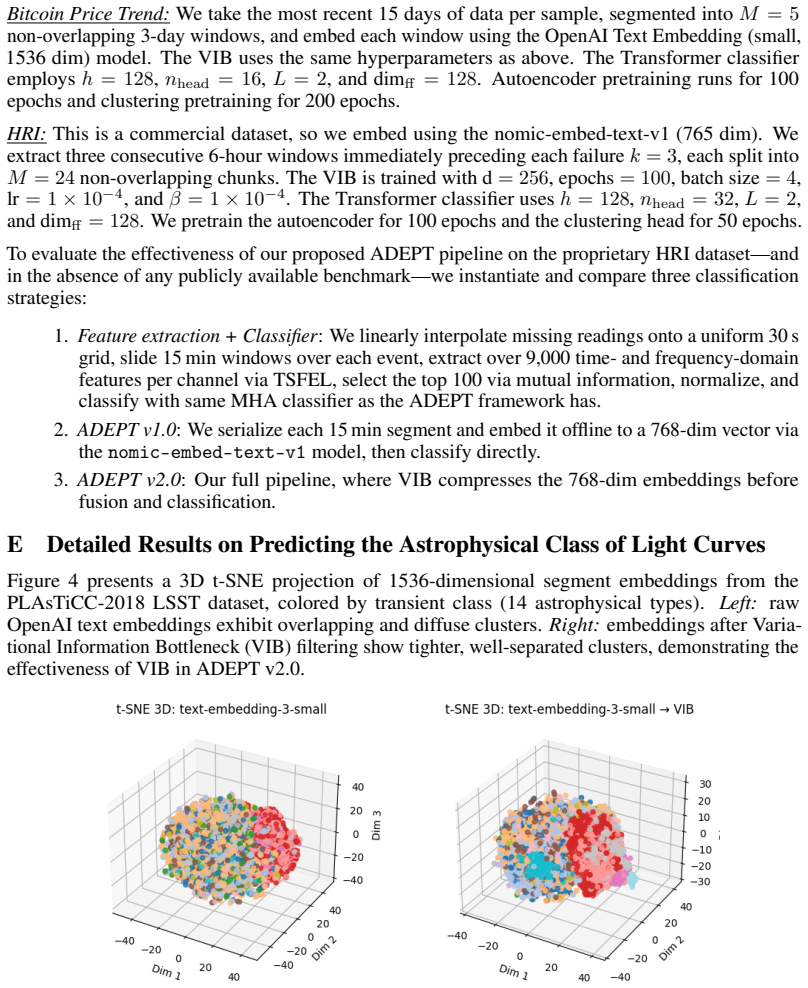
- chunk count M per dataset =
10 (PLAsTiCC), 24 (SelfRegulationSCP2), 5 (Bitcoin), 24 (HRI)
- VIB bottleneck dimension d =
256
- VIB trade-off weight beta =
1e-4
- Transformer hyperparameters =
h=128, nhead=32 or 16, layers=2, dimff=128
- number of pretraining and classification epochs =
EVIB=100, EAE=50/100, ECL=50/200
assumptions (4)
- ad hoc to paper Frozen text embedding models trained on natural language preserve the temporal and cross-channel structure of serialized numeric time series.
- ad hoc to paper The entropy of text embeddings of raw text representations is equivalent or superior to the entropy of engineered numeric feature vectors for classification.
- domain assumption Accuracy values reported in prior papers for CATS, AMPEL, ORACLE, MiniRocket, MHCAN, TSEM, RLSTM, EDL, and DQN can be compared to ADEPT numbers without rerunning those methods under identical splits.
- domain assumption The OpenAI and nomic embedding APIs produce stable, reproducible embeddings over time.
Cite this review
Pith. "Pith review of Text embedding models can be great data engineers." pith.science (2026). https://pith.science/paper/HAR74GUX
@misc{pith2026250514802,
  author       = {Pith},
  title        = {Pith review of: Text embedding models can be great data engineers},
  year         = {2026},
  howpublished = {\url{https://pith.science/paper/HAR74GUX}},
  note         = {Machine review of arXiv:2505.14802}
}
read the original abstract
Data engineering pipelines are essential - albeit costly - components of predictive analytics frameworks requiring significant engineering time and domain expertise for carrying out tasks such as data ingestion, preprocessing, feature extraction, and feature engineering. In this paper, we propose ADEPT, an automated data engineering pipeline via text embeddings. At the core of the ADEPT framework is a simple yet powerful idea that the entropy of embeddings corresponding to textually dense raw format representation of time series can be intuitively viewed as equivalent (or in many cases superior) to that of numerically dense vector representations obtained by data engineering pipelines. Consequently, ADEPT uses a two step approach that (i) leverages text embeddings to represent the diverse data sources, and (ii) constructs a variational information bottleneck criteria to mitigate entropy variance in text embeddings of time series data. ADEPT provides an end-to-end automated implementation of predictive models that offers superior predictive performance despite issues such as missing data, ill-formed records, improper or corrupted data formats and irregular timestamps. Through exhaustive experiments, we show that the ADEPT outperforms the best existing benchmarks in a diverse set of datasets from large-scale applications across healthcare, finance, science and industrial internet of things. Our results show that ADEPT can potentially leapfrog many conventional data pipeline steps thereby paving the way for efficient and scalable automation pathways for diverse data science applications.
Figures


Figures from the paper (8 more)




Reference graph
Works this paper leans on
-
[1]
Information dropout: Learning optimal representations through noisy computation
Alessandro Achille and Stefano Soatto. Information dropout: Learning optimal representations through noisy computation. IEEE Transactions on Pattern Analysis and Machine Intelligence, 40(12):2897–2905, 2018
work page 2018
-
[2]
Deep variational information bottleneck
Alexander A Alemi, Ian Fischer, Joshua V Dillon, and Kevin Murphy. Deep variational information bottleneck. arXiv preprint arXiv:1612.00410, 2016
arXiv 2016
-
[3]
Qi An, Saifur Rahman, Jingwen Zhou, and James Jin Kang. A comprehensive review on machine learning in healthcare industry: classification, restrictions, opportunities and challenges.Sensors, 23(9):4178, 2023
work page 2023
-
[4]
TSFEL: Time series feature extraction library
Marília Barandas, Duarte Folgado, Letícia Fernandes, Sara Santos, Mariana Abreu, Patrícia Bota, Hui Liu, Tanja Schultz, and Hugo Gamboa. TSFEL: Time series feature extraction library. SoftwareX, 11:100456, 2020
work page 2020
-
[5]
TSFEL: Time series feature extraction library
Pablo Barandas, Víctor de la Iglesia, et al. TSFEL: Time series feature extraction library. SoftwareX, 11:100453, 2020
work page 2020
-
[6]
Financial time series forecasting-a deep learning approach
Alexiei Dingli and Karl Sant Fournier. Financial time series forecasting-a deep learning approach. International Journal of Machine Learning and Computing, 7(5):118–122, 2017
work page 2017
-
[7]
Information transmission with additional noise
R Dobrushin and Boris Tsybakov. Information transmission with additional noise. IRE Transactions on Information Theory, 8(5):293–304, 1962
work page 1962
-
[8]
Systematic literature review of preprocessing techniques for imbalanced data
Ebubeogu Amarachukwu Felix and Sai Peck Lee. Systematic literature review of preprocessing techniques for imbalanced data. Iet Software, 13(6):479–496, 2019
work page 2019
Show all 52 references
-
[9]
Springenberg, Manuel Blum, and Frank Hutter
Matthias Feurer, Aaron Klein, Katharina Eggensperger, Jost H. Springenberg, Manuel Blum, and Frank Hutter. Efficient and robust automated machine learning. In Advances in Neural Information Processing Systems, volume 28, 2015
2015
-
[10]
Transient classifiers for fink-benchmarks for lsst
BMO Fraga, CR Bom, A Santos, E Russeil, M Leoni, J Peloton, EEO Ishida, A Möller, and S Blondin. Transient classifiers for fink-benchmarks for lsst. Astronomy & Astrophysics, 692:A208, 2024
2024
-
[11]
The information bottleneck problem and its applications in machine learning
Ziv Goldfeld and Yury Polyanskiy. The information bottleneck problem and its applications in machine learning. IEEE Journal on Selected Areas in Information Theory, 1(1):19–38, 2020
2020
-
[12]
Audioclip: Extending clip to image, text and audio
Andrey Guzhov, Federico Raue, Jörn Hees, and Andreas Dengel. Audioclip: Extending clip to image, text and audio. In ICASSP 2022-2022 IEEE International Conference on Acoustics, Speech and Signal Processing (ICASSP), pages 976–980. IEEE, 2022
2022
-
[13]
Distributional structure
Zellig S Harris. Distributional structure. Word, 10(2-3):146–162, 1954
1954
-
[14]
beta-vae: Learning basic visual concepts with a constrained variational framework
Irina Higgins, Loic Matthey, Arka Pal, Christopher Burgess, Xavier Glorot, Matthew Botvinick, Shakir Mohamed, and Alexander Lerchner. beta-vae: Learning basic visual concepts with a constrained variational framework. In International Conference on Learning Representations, 2017
2017
-
[15]
A survey of outlier detection methodologies
Victoria Hodge and Jim Austin. A survey of outlier detection methodologies. Artificial Intelligence Review, 22:85–126, 2004
2004
-
[16]
A framework for extracting urban functional regions based on multiprototype word embeddings using points-of- interest data
Sheng Hu, Zhanjun He, Liang Wu, Li Yin, Yongyang Xu, and Haifu Cui. A framework for extracting urban functional regions based on multiprototype word embeddings using points-of- interest data. Computers, Environment and Urban Systems, 80:101442, 2020
2020
-
[17]
Multilevel temporal-spectral fusion network for multivariate time series classification
Xulin Huang, Shizhe Ding, Xinru Zhang, Jingyan Sui, Yue Yu, and Bu Dongbo. Multilevel temporal-spectral fusion network for multivariate time series classification. In2024 International Joint Conference on Neural Networks (IJCNN), pages 1–7. IEEE, 2024
2024
-
[18]
HRI Dataset
Hydropower Research Institute. HRI Dataset. https://www.hridata.org, 2025. 10
2025
-
[19]
Large-scale representation learning from visually grounded untranscribed speech
Gabriel Ilharco, Yuan Zhang, and Jason Baldridge. Large-scale representation learning from visually grounded untranscribed speech. arXiv preprint arXiv:1909.08782, 2019
1909 arXiv
-
[20]
Autokeras: An automl library for deep learning
Haifeng Jin, François Chollet, Qingquan Song, and Xia Hu. Autokeras: An automl library for deep learning. Journal of Machine Learning Research, 24(6):1–6, 2023
2023
-
[21]
Dimensionality reduction for fast similarity search in large time series databases
Eamonn Keogh, Kaushik Chakrabarti, Michael Pazzani, and Sharad Mehrotra. Dimensionality reduction for fast similarity search in large time series databases. Knowledge and Information Systems, 3:263–286, 2001
2001
-
[22]
Representation learning of clinical multivariate time series with random filter banks
Alireza Keshavarzian, Hojjat Salehinejad, and Shahrokh Valaee. Representation learning of clinical multivariate time series with random filter banks. In ICASSP 2023-2023 IEEE International Conference on Acoustics, Speech and Signal Processing (ICASSP), pages 1–5. IEEE, 2023
2023
-
[23]
Time series classification of cryptocurrency price trend based on a recurrent lstm neural network
Do-Hyung Kwon, Ju-Bong Kim, Ju-Sung Heo, Chan-Myung Kim, and Youn-Hee Han. Time series classification of cryptocurrency price trend based on a recurrent lstm neural network. Journal of Information Processing Systems, 15(3):694–706, 2019
2019
-
[24]
H2o automl: Scalable automatic machine learning
Erin LeDell and Said Poirier. H2o automl: Scalable automatic machine learning. In AutoML Workshop at the 37th International Conference on Machine Learning, 2020
2020
-
[25]
Detecting outliers: Do not use standard deviation around the mean, use absolute deviation around the median
Christophe Leys, Christophe Ley, Olivier Klein, Philippe Bernard, and Laurent Licata. Detecting outliers: Do not use standard deviation around the mean, use absolute deviation around the median. Journal of Experimental Social Psychology, 49(4):764–766, 2013
2013
-
[26]
Feature selection: A data perspective
Jundong Li, Kewei Cheng, Suhang Wang, Fred Morstatter, Robert P Trevino, Jiliang Tang, and Huan Liu. Feature selection: A data perspective. ACM Computing Surveys (CSUR), 50(6):1–45, 2017
2017
-
[27]
Missing value imputation: a review and analysis of the literature (2006–2017)
Wei-Chao Lin and Chih-Fong Tsai. Missing value imputation: a review and analysis of the literature (2006–2017). Artificial Intelligence Review, 53:1487–1509, 2020
2006
-
[28]
Cubic spline interpolation
Sky McKinley and Megan Levine. Cubic spline interpolation. College of the Redwoods , 45(1):1049–1060, 1998
1998
-
[29]
Howto100m: Learning a text-video embedding by watching hundred million narrated video clips
Antoine Miech, Dimitri Zhukov, Jean-Baptiste Alayrac, Makarand Tapaswi, Ivan Laptev, and Josef Sivic. Howto100m: Learning a text-video embedding by watching hundred million narrated video clips. In Proceedings of the IEEE/CVF international conference on computer vision, pages ...
2019
-
[30]
Enhanced bitcoin price direction forecasting with dqn
Azamjon Muminov, Otabek Sattarov, and Daeyoung Na. Enhanced bitcoin price direction forecasting with dqn. IEEE Access, 12:29093–29112, 2024
2024
-
[31]
Unsupervised embedding of trajectories captures the latent structure of scientific migration
Dakota Murray, Jisung Yoon, Sadamori Kojaku, Rodrigo Costas, Woo-Sung Jung, Staša Miloje- vi´c, and Yong-Yeol Ahn. Unsupervised embedding of trajectories captures the latent structure of scientific migration. Proceedings of the National Academy of Sciences, 120(52):e2305414120, 2023
2023
-
[32]
Delineating urban functional use from points of interest data with neural network embedding: A case study in greater london
Haifeng Niu and Elisabete A Silva. Delineating urban functional use from points of interest data with neural network embedding: A case study in greater london. Computers, Environment and Urban Systems, 88:101651, 2021
2021
-
[33]
Ampel workflows for lsst: Modular and reproducible real-time photometric classification
Jakob Nordin, Valery Brinnel, Jakob van Santen, Simeon Reusch, and Marek Kowalski. Ampel workflows for lsst: Modular and reproducible real-time photometric classification. arXiv preprint arXiv:2501.16511, 2025
2025 arXiv
-
[34]
Nomic embed: Training a reproducible long context text embedder
Zach Nussbaum, John X Morris, Brandon Duderstadt, and Andriy Mulyar. Nomic embed: Training a reproducible long context text embedder. arXiv preprint arXiv:2402.01613, 2024
2024 arXiv
-
[35]
Olson, Nathan Bartley, Ryan J
Randal S. Olson, Nathan Bartley, Ryan J. Urbanowicz, and Jason H. Moore. Evaluation of a tree-based pipeline optimization tool for automating data science. In Proceedings of the Genetic and Evolutionary Computation Conference, pages 485–492, Denver, Colorado, USA, 2016. 11
2016
-
[36]
text-embedding-3-small
OpenAI. text-embedding-3-small. Computer software, Retrieved from https://platform.openai.com/docs/guides/embeddings, 2023. [Accessed May 15, 2025]
2023
-
[37]
Tsem: Temporally-weighted spatiotemporal explainable neural network for multivariate time series
Anh-Duy Pham, Anastassia Kuestenmacher, and Paul G Ploeger. Tsem: Temporally-weighted spatiotemporal explainable neural network for multivariate time series. In Future of Information and Communication Conference, pages 183–204. Springer, 2023
2023
-
[38]
Convolutional neural net- work fault classification based on time-series analysis for benchmark wind turbine machine
Reihane Rahimilarki, Zhiwei Gao, Nanlin Jin, and Aihua Zhang. Convolutional neural net- work fault classification based on time-series analysis for benchmark wind turbine machine. Renewable Energy, 185:916–931, 2022
2022
-
[39]
Modelling data pipelines
Aiswarya Raj, Jan Bosch, Helena Holmström Olsson, and Tian J Wang. Modelling data pipelines. In 2020 46th Euromicro conference on software engineering and advanced applications (SEAA), pages 13–20. IEEE, 2020
2020
-
[40]
Time-series cryptocurrency forecasting using ensemble deep learning
K Rama Rao, M Lakshmi Prasad, G Ravi Kumar, R Natchadalingam, Mohammad Manzoor Hussain, and Pundru Chandra Shaker Reddy. Time-series cryptocurrency forecasting using ensemble deep learning. In 2023 International Conference on Circuit Power and Computing Technologies (ICCPCT), ...
2023
-
[41]
Word embeddings for the analysis of ideological placement in parliamentary corpora
Ludovic Rheault and Christopher Cochrane. Word embeddings for the analysis of ideological placement in parliamentary corpora. Political analysis, 28(1):112–133, 2020
2020
-
[42]
Predicting high-level human judgment across diverse behavioral domains
Russell Richie, Wanling Zou, and Sudeep Bhatia. Predicting high-level human judgment across diverse behavioral domains. Collabra: Psychology, 5(1):50, 2019
2019
-
[43]
Gaussian processes for time-series modelling
Stephen Roberts, Michael Osborne, Mark Ebden, Steven Reece, Neale Gibson, and Suzanne Aigrain. Gaussian processes for time-series modelling. Philosophical Transactions of the Royal Society A: Mathematical, Physical and Engineering Sciences, 371(1984):20110550, 2013
1984
-
[44]
Automl: A systematic review on automated machine learning with neural architecture search
Imrus Salehin, Md Shamiul Islam, Pritom Saha, SM Noman, Azra Tuni, Md Mehedi Hasan, and Md Abu Baten. Automl: A systematic review on automated machine learning with neural architecture search. Journal of Information and Intelligence, 2(1):52–81, 2024
2024
-
[45]
Oracle: A real-time, hierarchical, deep-learning photometric classifier for the lsst
Ved G Shah, Alex Gagliano, Konstantin Malanchev, Gautham Narayan, LSST Dark Energy Sci- ence Collaboration, et al. Oracle: A real-time, hierarchical, deep-learning photometric classifier for the lsst. arXiv preprint arXiv:2501.01496, 2025
2025
-
[46]
Videobert: A joint model for video and language representation learning
Chen Sun, Austin Myers, Carl V ondrick, Kevin Murphy, and Cordelia Schmid. Videobert: A joint model for video and language representation learning. In Proceedings of the IEEE/CVF international conference on computer vision, pages 7464–7473, 2019
2019
-
[47]
Survey: Time-series data preprocessing: A survey and an empirical analysis
Amal Tawakuli, Bastian Havers, Vincenzo Gulisano, Daniel Kaiser, and Thomas Engel. Survey: Time-series data preprocessing: A survey and an empirical analysis. Journal of Engineering Research, 2024
2024
-
[48]
up”) or decrease (“down
Peng Wang, Ke Wang, Yafei Song, and Xiaodan Wang. Autoldt: a lightweight spatio-temporal decoupling transformer framework with automated machine learning method for time series classification. Scientific Reports, 14:29801, 2024. 12 A ADEPT v2.0 Algorithm The full pseducode of ...
2024
-
[49]
Feature extraction + Classifier: We linearly interpolate missing readings onto a uniform 30 s grid, slide 15 min windows over each event, extract over 9,000 time- and frequency-domain features per channel via TSFEL, select the top 100 via mutual information, normalize, and cla...
-
[50]
ADEPT v1.0: We serialize each 15 min segment and embed it offline to a 768-dim vector via the nomic-embed-text-v1 model, then classify directly
-
[51]
negativity
ADEPT v2.0: Our full pipeline, where VIB compresses the 768 -dim embeddings before fusion and classification. E Detailed Results on Predicting the Astrophysical Class of Light Curves Figure 4 presents a 3D t-SNE projection of 1536-dimensional segment embeddings from the PLAsTi...
2018
-
[7009]
Table 5: Per-class performance on the HRI dataset
suffer from zero recall. Table 5: Per-class performance on the HRI dataset. Class Precision Recall F 1–score 3620 1.00 0.40 0.57 3710 0.50 0.50 0.50 4560 1.00 0.50 0.67 7009 0.00 0.00 0.00 7030 1.00 1.00 1.00 7050 1.00 1.00 1.00 7099 0.43 1.00 0.60 7110 0.89 0.76 0.82 9696 0.7...
Reviewed August 7, 2026 · model on record in the stance chip above.
Discussion (0). Continue with ORCID to comment.