REVIEW 3 major objections 6 minor 43 references
Thresholded quantum LIDAR in turbolent media
T0 review · 3 major / 6 minor · reviewed 2026-08-06 · deepseek-v4-flash
Pith's one-line read Thresholded photon-counting LIDAR at the single-photon level can tolerate turbulent propagation and imperfect multiplexed detectors, the paper argues.
desk verdict A modest but sound simulation study extending thresholded LIDAR to multiplexed detectors and lognormal scintillation; the reader's normalization objection is a misreading. read the letter →
The pith
A machine-rendered reading of the paper's core claim, the machinery that carries it, and where it could break.
The reading
What carries the argument
The mechanism is the threshold decision rule on photon counts or detector clicks in a single time bin: the signal bin contains a coherent (or scintillated) state superposed on thermal noise, while a noise-only bin contains only thermal light, and the two distributions respond differently to a count threshold S. The mathematical apparatus is Mandel's formula (5), which turns the lognormal intensity distribution P(q) of Eq. (3) into the signal's photon-number distribution; the convolution (1) of signal and noise statistics; and, for realistic detectors, the click statistics of multiplexed APD arrays taken from [31]. The performance measure is the probability P of correctly identifying the signal bin after nc repeated pulses, computed by a majority vote over the nc binary threshold outcomes.
What would settle it
Evaluate whether Eq. (3) integrates to 1 and has first moment qbar; a normalized lognormal should satisfy both. If the printed density instead gives total integral qbar and mean $qbar^{2}$ $e^{{σ^2}}$, then Figs. 4 and 5 are not comparing constant average flux, and rerunning the simulations with a properly normalized density (including the 1/q Jacobian factor) would settle whether the robustness conclusion survives.
Extended reading notes
Core claim
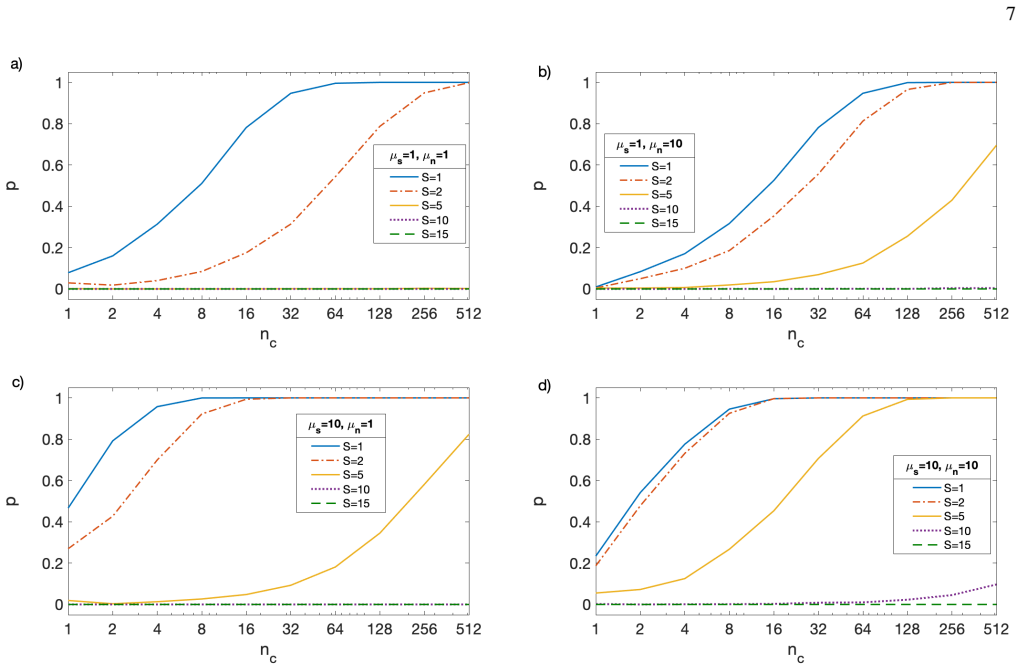
The paper sets out to establish that the working principle of thresholded quantum LIDAR survives two real-world complications: replacement of ideal number-resolving detectors by multiplexed single-photon detectors, and propagation of the signal through a turbulent medium. Its simulations show that an ideal detector reaches near-certain success within nc=2–16 pulses for three of four signal/noise regimes, while a realistic 16-APD multiplexed detector with efficiency η=0.1 and dark-count probability pd=$10^{{-4}}$ makes S=1 optimal and still reaches near-certain identification in nc=16 pulses for high signal and nc=64 for low signal with high noise. When scintillation with lognormal variance up to σ=1.5 is included, the required number of repetitions rises at most about fourfold, and the paper reads this as evidence that the detection scheme remains effective despite turbulence. In its own words, even less performing technology can result in a useful detection scheme, and the chief cost of scintillation is increased laser power rather than loss of discriminability.
Load-bearing premise
The load-bearing premise is that Eq. (3) correctly describes the lognormal probability density of the scintillating signal intensity, so that holding qbar fixed keeps the average photon flux constant across turbulence strengths; if that density is not properly normalized, the comparison across values of σ is not controlled.
Editorial extensions
If this is right
- Practical LIDAR could use compact multiplexed APD arrays rather than cryogenic number-resolving detectors, since click/no-click thresholding at S=1 is optimal in the simulated realistic parameters.
- Scintillation need not be treated as a decisive limitation: the paper's numbers show the required number of pulses rises only modestly with lognormal variance when the average flux is held fixed by increasing laser intensity.
- The two-bin decision procedure can be iterated over time bins to perform time-of-flight ranging, so the quoted nc values translate directly into measurement duration and thus into the speed of targets that can be tracked.
- The same hypothesis-testing logic transfers to the spectral domain, where the paper notes that Raman lines can be distinguished from a noise background by the same threshold test.
Reading between the lines
- The binary two-bin test leaves open how the majority-vote rule behaves with many competing noise-only bins in a full ranging scan; extending the simulations to multiple bins is needed before the fourfold repetition penalty can be quoted for real LIDAR.
- Because the realistic detector makes S=1 optimal, the operative resource is thermal noise's tendency to produce zero-click events; this points to re-examining the scheme under Poissonian background light, where click/no-click separation is weaker.
- The repetition counts imply a target-velocity bound: with a jitter-limited bin width near 300 ps, a 64-pulse measurement at a given laser repetition rate sets an upper limit on how fast a target can move before the signal bin shifts, a trade-off the paper does not quantify.
Editorial analysis
A structured set of objections, weighed in public.
Referee Report
Summary. The paper presents a numerical study of thresholded photon-counting LIDAR, extending the scheme of Cohen et al. to two practical complications: detection by multiplexed avalanche photodiode arrays (M-APDs) with finite efficiency and dark counts, and propagation through atmospheric turbulence modeled by lognormal scintillation. The authors simulate a binary decision problem (good vs. bad time bin) and compute, by Monte Carlo, the probability P of correctly identifying the signal bin as a function of the number of repetitions n_c. They report that a simple threshold S=1 (click/no-click) with M-APDs achieves high success probability, and that turbulence has limited impact on performance when the mean received flux is held constant.
Significance. If the results are correct, the paper offers a practically relevant extension of thresholded quantum LIDAR: it indicates that imperfect, multiplexed single-photon detectors can be used with a minimal threshold, and that scintillation need not be a dominant limitation when the average signal flux is maintained. The modeling is standard (lognormal intensity statistics plus Mandel's formula) and the simulation parameters are stated transparently, which is a strength. The paper's quantitative conclusions, however, are undermined by internal inconsistencies in the reported repetition numbers and by an incompletely specified decision rule. These issues must be resolved before the claims can be accepted as stated.
major comments (3)
- [II. Results (real-detector paragraph) and III. Conclusions] The numbers of repetitions quoted in the Conclusions are inconsistent with the Results. In the real-detector paragraph of Sec. II the text states 'we need nc ≥ 64 for the two cases in which the signal is low (LSLN, LSHN)', while Sec. III states 'The introduction of a real detector increases such number to 16 in case of high signal and low noise (HSLN) and to 32 for the case of Signal and Noise comparably low (LSLN).' These statements cannot both be correct. In addition, the turbulence subsection reports a four-fold increase in nc for real detectors, which for LSLN would give nc ≥ 256, not 32. The central claim of robustness is quantitative, so these numbers must be reconciled before the conclusions can be accepted.
- [II. Results, steps 4–6 and Eq. (2)] The decision rule that maps the nc per-pulse tags (b1,b2) to a correct or incorrect identification is not fully specified. The text says a run is successful if 'the majority of the iterations return b1=1 and b2=0', but it does not state how ties are resolved or how runs with many (0,0) or (1,1) outcomes are classified. Since the probability P in Eq. (2) depends directly on this rule, the authors should provide an explicit algorithm, for example comparing the number of (1,0) outcomes with the number of (0,1) outcomes and specifying the tie-break, and apply it consistently to all figures.
- [II. Results, turbulence subsection] In the turbulence analysis the threshold S is kept fixed at the value chosen for the non-turbulent case ('The threshold S is kept constant with respect to our previous analysis'), but it is not shown that this fixed threshold remains optimal, or near-optimal, under lognormal scintillation. Because the paper claims that the scheme is robust to turbulence, the comparison should either re-optimize S for each σ or demonstrate explicitly that the fixed S retains it performance. As written, the apparent robustness could be an artifact of using a threshold tuned to the non-turbulent statistics.
minor comments (6)
- [Title] The title contains a typo: 'turbolent' should be 'turbulent'.
- [Fig. 3 caption] The caption reads 'pd = 1.010 −4', which appears to be a rendering error; it should be pd = 1.0 × 10^-4.
- [II. Results, ideal-detector paragraph] The statement 'No analytical expression is known' for the optimal threshold is too strong; for the known signal and noise distributions a likelihood-ratio threshold can be computed numerically, even if a closed form is not available.
- [Eq. (3)] The denominator in Eq. (3) is typeset ambiguously as '1 σq √ 2π'; writing it as 1/(σ q √(2π)) would avoid misreading. The equation itself is correctly normalized, with mean q̄.
- [II. Results and III. Conclusions] The ideal-detector summary value 'nc ≈ 8' in the Conclusions does not match the detailed results (LSLN: 16, LSHN: 64, HSHN: 8, HSLN: 2). Please harmonize the numbers reported in the text.
- [Data Availability] The Monte Carlo results would be more reproducible if the authors provided the simulation code or at least a detailed pseudo-code algorithm, including the number of trials N and the method used to generate click statistics for the M-APD.
Circularity Check
No significant circularity: the paper is a self-contained Monte Carlo study from stated model distributions; the only self-citation is minor and non-load-bearing.
full rationale
The derivation chain is explicit and self-contained: success probabilities P are computed by Monte Carlo from assumed Poisson/thermal photon statistics, the lognormal scintillation average via Mandel's formula, and the multiplexed click statistics from cited detector models. No parameter is fitted to external data; the threshold S is scanned within the model and selected to minimize the required number of repetitions, which is an in-model design choice rather than a fitted input disguised as a prediction. The scintillation analysis is a genuine transfer test because S is kept fixed from the non-turbulent analysis, not re-optimized under turbulence. The only self-citation is Ref. [42] (Bartley et al., co-authored by M. Barbieri), used to support the statement that M ~ 10 multiplexing is typically adopted; this is contextual and not load-bearing for the central robustness claim. No equation reduces to its input by construction, and no cited uniqueness or ansatz is imported from the authors' own prior work. The paper therefore has no significant circularity; any concerns about Eq. (3) normalization are correctness issues, not circularity.
Assumptions & free parameters
free parameters (8)
- Threshold S =
LSLN S=1, LSHN 1<S<5, HSHN S=10, HSLN S=5 (ideal); S=1 for real detector
- Signal mean photon number mu_s =
1 or 10
- Noise mean photon number mu_n =
1 or 10
- Quantum efficiency eta =
0.1
- Dark count probability pd =
1e-4
- Multiplexing number M =
16
- Turbulence variance sigma =
values up to 1.5
- Monte Carlo trials N =
not specified
assumptions (5)
- domain assumption Background noise is described by a single-mode thermal distribution pn(m) = mu_n^m / (1 + mu_n)^(1+m), or by a Poisson distribution in the multimode limit.
- domain assumption The signal is a coherent state with Poissonian photon statistics, modified only by scintillation.
- standard math Mandel's formula, Eq. (5), correctly converts the scintillation intensity distribution P(q) into photon-number statistics.
- domain assumption Scintillation intensity follows the lognormal distribution given in Eq. (3).
- domain assumption Click statistics for M-APD arrays, including dark counts, are given by the method of Jönsson and Björk (ref 31).
Cite this review
Pith. "Pith review of Thresholded quantum LIDAR in turbolent media." pith.science (2026). https://pith.science/paper/HBB6TYJJ
@misc{pith2026250722622,
  author       = {Pith},
  title        = {Pith review of: Thresholded quantum LIDAR in turbolent media},
  year         = {2026},
  howpublished = {\url{https://pith.science/paper/HBB6TYJJ}},
  note         = {Machine review of arXiv:2507.22622}
}
read the original abstract
Light detection and ranging is a key technology for a number of applications, from relatively simple distance ranging to environmental monitoring. When dealing with low photon numbers an important issue is the improvement of the signal- to-noise-ratio, which is severely affected by external sources whose emission is captured by the detection apparatus. In this paper, we present an extension of the technique developed in [Phys. Rev. Lett. 123, 203601] to the effects caused by the propagation of light through a turbulent media, as well as the detection through photon counting devices bearing imperfections in terms of efficiency and number resolution. Our results indicate that even less performing technology can result in a useful detection scheme.
Figures


Figures from the paper (2 more)


Reference graph
Works this paper leans on
-
[1]
author author P. Weibring , author H. Edner , \ and\ author S. Svanberg ,\ title title Versatile mobile lidar system for environmental monitoring , \ 10.1364/AO.42.003583 journal journal Appl. Opt. \ volume 42 ,\ pages 3583--3594 ( year 2003 ) NoStop
-
[2]
author author J. Riemensberger , author A. Lukashchuk , author M. Karpov , author W. Weng , author E. Lucas , author J. Liu , \ and\ author T. J. \ Kippenberg ,\ title title Massively parallel coherent laser ranging using a soliton microcomb , \ 10.1038/s41586-020-2239-3 journal journal Nature \ volume 581 ,\ pages 164--170 ( year 2020 ) NoStop
-
[3]
author author N. R. \ Council ,\ 10.17226/18733 title Laser Radar: Progress and Opportunities in Active Electro-Optical Sensing \ ( publisher The National Academies Press ,\ address Washington, DC ,\ year 2014 ) NoStop
-
[4]
author author G. Gariepy , author N. Krstaji \'c , author R. Henderson , author C. Li , author R. R. \ Thomson , author G. S. \ Buller , author B. Heshmat , author R. Raskar , author J. Leach , \ and\ author D. Faccio ,\ title title Single-photon sensitive light-in-fight imaging , \ 10.1038/ncomms7021 journal journal Nature Communications \ volume 6 ,\ pa...
-
[5]
author author J. Tachella , author Y. Altmann , author N. Mellado , author A. McCarthy , author R. Tobin , author G. S. \ Buller , author J.-Y. \ Tourneret , \ and\ author S. McLaughlin ,\ title title Real-time 3d reconstruction from single-photon lidar data using plug-and-play point cloud denoisers , \ 10.1038/s41467-019-12943-7 journal journal Nature Co...
-
[6]
author author Z.-P. \ Li , author X. Huang , author P.-Y. \ Jiang , author Y. Hong , author C. Yu , author Y. Cao , author J. Zhang , author F. Xu , , \ and\ author J.-W. \ Pan ,\ title title Super-resolution single-photon imaging at 8.2 kilometers , \ 10.1364/OE.383456 journal journal Opt. Express \ volume 28 ,\ pages 4076--4087 ( year 2020 ) NoStop
-
[7]
author author Z.-P. \ Li , author J.-T. \ Ye , author X. Huang , author P.-Y. \ Jiang , author Y. Cao , author Y. Hong , author C. Yu , author J. Zhang , author Q. Zhang , author C.-Z. \ Peng , author F. Xu , \ and\ author J.-W. \ Pan ,\ title title Single-photon imaging over 200 km , \ 10.1364/OPTICA.408657 journal journal Optica \ volume 8 ,\ pages 344-...
-
[8]
author author J. Rapp , author Y. Ma , author R. M. A. \ Dawson , \ and\ author V. K. \ Goyal ,\ title title High-flux single-photon lidar , \ 10.1364/OPTICA.403190 journal journal Optica \ volume 8 ,\ pages 30--39 ( year 2021 ) NoStop
Show all 43 references
-
[9]
Slepyan , author S
author author G. Slepyan , author S. Vlasenko , author D. Mogilevtsev , \ and\ author A. Boag ,\ title title Quantum radars and lidars concepts, realizations, and perspectives , \ arXiv:2206.12585 \ ( year 2022 ),\ arXiv:2206.12585 NoStop
2022 arXiv
-
[10]
author author S. Lloyd ,\ title title Enhanced sensitivity of photodetection via quantum illumination , \ 10.1126/science.1160627 journal journal Science \ volume 321 ,\ pages 1463--1465 ( year 2008 ) ,\ http://arxiv.org/abs/https://www.science.org/doi/pdf/10.1126/science.1160...
2008 doi
-
[11]
\ Tan , author B
author author S.-H. \ Tan , author B. I. \ Erkmen , author V. Giovannetti , author S. Guha , author S. Lloyd , author L. Maccone , author S. Pirandola , \ and\ author J. H. \ Shapiro ,\ title title Quantum illumination with gaussian states , \ 10.1103/PhysRevLett.101.253601 jo...
-
[12]
author author E. D. \ Lopaeva , author I. Ruo Berchera , author I. P. \ Degiovanni , author S. Olivares , author G. Brida , \ and\ author M. Genovese ,\ title title Experimental realization of quantum illumination , \ 10.1103/PhysRevLett.110.153603 journal journal Phys. Rev. L...
-
[13]
Nair \ and\ author M
author author R. Nair \ and\ author M. Gu ,\ title title Fundamental limits of quantum illumination , \ 10.1364/OPTICA.391335 journal journal Optica \ volume 7 ,\ pages 771--774 ( year 2020 ) NoStop
2020 doi
-
[14]
author author J. H. \ Shapiro ,\ title title The quantum illumination story , \ 10.1109/MAES.2019.2957870 journal journal IEEE Aerospace and Electronic Systems Magazine \ volume 35 ,\ pages 8--20 ( year 2020 ) NoStop
2019
-
[15]
\ Lee , author S
author author T.-W. \ Lee , author S. D. \ Huver , author H. Lee , author L. Kaplan , author S. B. \ McCracken , author C. Min , author D. B. \ Uskov , author C. F. \ Wildfeuer , author G. Veronis , \ and\ author J. P. \ Dowling ,\ title title Optimization of quantum interfero...
-
[16]
Dorner , author R
author author U. Dorner , author R. Demkowicz-Dobrzanski , author B. J. \ Smith , author J. S. \ Lundeen , author W. Wasilewski , author K. Banaszek , \ and\ author I. A. \ Walmsley ,\ title title Optimal quantum phase estimation , \ 10.1103/PhysRevLett.102.040403 journal jour...
-
[17]
Cohen , author E
author author L. Cohen , author E. S. \ Matekole , author Y. Sher , author D. Istrati , author H. S. \ Eisenberg , \ and\ author J. P. \ Dowling ,\ title title Thresholded quantum lidar: Exploiting photon-number-resolving detection , \ 10.1103/PhysRevLett.123.203601 journal jo...
-
[18]
author author K. D. \ Irwin ,\ title title An application of electrothermal feedback for high resolution cryogenic particle detection , \ 10.1063/1.113674 journal journal Applied Physics Letters \ volume 66 ,\ pages 1998--2000 ( year 1995 ) NoStop
1998 doi
-
[19]
Cabrera , author R
author author B. Cabrera , author R. M. \ Clarke , author P. Colling , author A. J. \ Miller , author S. Nam , \ and\ author R. W. \ Romani ,\ title title Detection of single infrared, optical, and ultraviolet photons using superconducting transition edge sensors , \ 10.1063/1...
-
[20]
Rosenberg , author A
author author D. Rosenberg , author A. E. \ Lita , author A. J. \ Miller , \ and\ author S. W. \ Nam ,\ title title Noise-free high-efficiency photon-number-resolving detectors , \ 10.1103/PhysRevA.71.061803 journal journal Phys. Rev. A \ volume 71 ,\ pages 061803 ( year 2005 ) NoStop
-
[21]
author author D. H. \ Smith , author G. Gillett , author M. P. \ de Almeida , author C. Branciard , author A. Fedrizzi , author T. J. \ Weinhold , author A. Lita , author B. Calkins , author T. Gerrits , author H. M. \ Wiseman , author S. W. \ Nam , \ and\ author A. G. \ White...
-
[23]
author author J. P. \ H \"o pker , author T. Gerrits , author A. Lita , author S. Krapick , author H. Herrmann , author R. Ricken , author V. Quiring , author R. Mirin , author S. W. \ Nam , author C. Silberhorn , \ and\ author T. J. \ Bartley ,\ title title Integrated transit...
-
[24]
R R eh\'a c c ek , author Z
author author J. R R eh\'a c c ek , author Z. Hradil , author O. Haderka , author J. Pe r r ina , \ and\ author M. Hamar ,\ title title Multiple-photon resolving fiber-loop detector , \ 10.1103/PhysRevA.67.061801 journal journal Phys. Rev. A \ volume 67 ,\ pages 061801 ( year ...
-
[25]
author author M. J. \ Fitch , author B. C. \ Jacobs , author T. B. \ Pittman , \ and\ author J. D. \ Franson ,\ title title Photon-number resolution using time-multiplexed single-photon detectors , \ 10.1103/PhysRevA.68.043814 journal journal Phys. Rev. A \ volume 68 ,\ pages ...
-
[26]
Achilles , author C
author author D. Achilles , author C. Silberhorn , author C. Sliwa , author K. Banaszek , author I. A. \ Walmsley , author M. J. \ Fitch , author B. C. \ Jacobs , author T. B. \ Pittman , \ and\ author J. D. \ Franson ,\ title title Photon-number-resolving detection using time...
-
[27]
Afek , author A
author author I. Afek , author A. Natan , author O. Ambar , \ and\ author Y. Silberberg ,\ title title Quantum state measurements using multipixel photon detectors , \ 10.1103/PhysRevA.79.043830 journal journal Phys. Rev. A \ volume 79 ,\ pages 043830 ( year 2009 ) NoStop
-
[28]
Sperling , author W
author author J. Sperling , author W. Vogel , \ and\ author G. S. \ Agarwal ,\ title title Sub-binomial light , \ 10.1103/PhysRevLett.109.093601 journal journal Phys. Rev. Lett. \ volume 109 ,\ pages 093601 ( year 2012 a ) NoStop
2012 doi
-
[29]
Kruse , author J
author author R. Kruse , author J. Tiedau , author T. J. \ Bartley , author S. Barkhofen , \ and\ author C. Silberhorn ,\ title title Limits of the time-multiplexed photon-counting method , \ 10.1103/PhysRevA.95.023815 journal journal Phys. Rev. A \ volume 95 ,\ pages 023815 (...
-
[30]
onsson \ and\ author G. Bj\
author author M. J\"onsson \ and\ author G. Bj\"ork ,\ title title Evaluating the performance of photon-number-resolving detectors , \ 10.1103/PhysRevA.99.043822 journal journal Phys. Rev. A \ volume 99 ,\ pages 043822 ( year 2019 ) NoStop
-
[31]
onsson \ and\ author G. Bj\
author author M. J\"onsson \ and\ author G. Bj\"ork ,\ title title Photon-counting distribution for arrays of single-photon detectors , \ 10.1103/PhysRevA.101.013815 journal journal Phys. Rev. A \ volume 101 ,\ pages 013815 ( year 2020 ) NoStop
-
[32]
author author R. Fante ,\ title title Electromagnetic beam propagation in turbulent media , \ 10.1109/PROC.1975.10035 journal journal Proceedings of the IEEE \ volume 63 ,\ pages 1669--1692 ( year 1975 ) NoStop
1975
-
[33]
author author P. W. \ Milonni , author J. H. \ Carter , author C. G. \ Peterson , \ and\ author R. J. \ Hughes ,\ title title Effects of propagation through atmospheric turbulence on photon statistics , \ 10.1088/1464-4266/6/8/018 journal journal Journal of Optics B: Quantum a...
-
[34]
Dios , author J
author author F. Dios , author J. A. \ Rubio , author A. Rodr\' i guez , \ and\ author A. Comer\' o n ,\ title title Scintillation and beam-wander analysis in an optical ground station-satellite uplink , \ 10.1364/AO.43.003866 journal journal Appl. Opt. \ volume 43 ,\ pages 38...
-
[35]
author author A. A. \ Semenov \ and\ author W. Vogel ,\ title title Quantum light in the turbulent atmosphere , \ 10.1103/PhysRevA.80.021802 journal journal Phys. Rev. A \ volume 80 ,\ pages 021802 ( year 2009 ) NoStop
2009 doi
-
[36]
Capraro , author A
author author I. Capraro , author A. Tomaello , author A. Dall'Arche , author F. Gerlin , author R. Ursin , author G. Vallone , \ and\ author P. Villoresi ,\ title title Impact of turbulence in long range quantum and classical communications , \ 10.1103/PhysRevLett.109.200502 ...
-
[37]
Bohmann , author J
author author M. Bohmann , author J. Sperling , author A. Semenov , \ and\ author W. Vogel ,\ title title Atmospheric quantum channels for nonclassical and entangled light , \ in\ 10.1364/QIM.2017.QT6A.22 booktitle Quantum Information and Measurement (QIM) 2017 \ ( publisher O...
2017 doi
-
[38]
author author A. E. \ Lita , author A. J. \ Miller , \ and\ author S. W. \ Nam ,\ title title Counting near-infrared single-photons with 95\ 10.1364/OE.16.003032 journal journal Opt. Express \ volume 16 ,\ pages 3032--3040 ( year 2008 ) NoStop
-
[39]
author author P. C. \ Humphreys , author B. J. \ Metcalf , author T. Gerrits , author T. Hiemstra , author A. E. \ Lita , author J. Nunn , author S. W. \ Nam , author A. Datta , author W. S. \ Kolthammer , \ and\ author I. A. \ Walmsley ,\ title title Tomography of photon-numb...
-
[40]
author author J. P. \ H\" o pker , author V. B. \ Verma , author T. Gerrits , author A. E. \ Lita , author R. Ricken , author V. Quiring , author R. P. \ Mirin , author S. W. \ Nam , author C. Silberhorn , \ and\ author T. J. \ Bartley ,\ title title Integrated superconducting...
-
[41]
Sperling , author W
author author J. Sperling , author W. Vogel , \ and\ author G. S. \ Agarwal ,\ title title True photocounting statistics of multiple on-off detectors , \ 10.1103/PhysRevA.85.023820 journal journal Phys. Rev. A \ volume 85 ,\ pages 023820 ( year 2012 b ) NoStop
-
[42]
author author T. J. \ Bartley , author G. Donati , author X.-M. \ Jin , author A. Datta , author M. Barbieri , \ and\ author I. A. \ Walmsley ,\ title title Direct observation of sub-binomial light , \ 10.1103/PhysRevLett.110.173602 journal journal Phys. Rev. Lett. \ volume 11...
-
[43]
Avenhaus , author H
author author M. Avenhaus , author H. B. \ Coldenstrodt-Ronge , author K. Laiho , author W. Mauerer , author I. A. \ Walmsley , \ and\ author C. Silberhorn ,\ title title Photon number statistics of multimode parametric down-conversion , \ 10.1103/PhysRevLett.101.053601 journa...
-
[44]
Zhu \ and\ author J
author author X. Zhu \ and\ author J. Kahn ,\ title title Free-space optical communication through atmospheric turbulence channels , \ 10.1109/TCOMM.2002.800829 journal journal IEEE Transactions on Communications \ volume 50 ,\ pages 1293--1300 ( year 2002 ) NoStop
2002
Reviewed August 6, 2026 · model on record in the stance chip above.
Discussion (0). Sign in to comment.