REVIEW 2 major objections 5 minor 107 references
Design Considerations for a Ground-Based Search for Transiting Planets around L and T Dwarfs
T0 review · 2 major / 5 minor · reviewed 2026-08-14 · deepseek-v4-flash
Pith's one-line read A 2-meter-class telescope with an H-band detector, dithering among 5-7 L and T dwarfs per night for 360-480 nights, has an over-80% chance of detecting at least one transiting Earth-sized planet.
desk verdict Useful design study with a sound qualitative recommendation, but the headline yields ignore systematics the authors themselves measure, so treat the 80% success rate as an idealized upper limit. read the letter →
The pith
A machine-rendered reading of the paper's core claim, the machinery that carries it, and where it could break.
The reading
What carries the argument
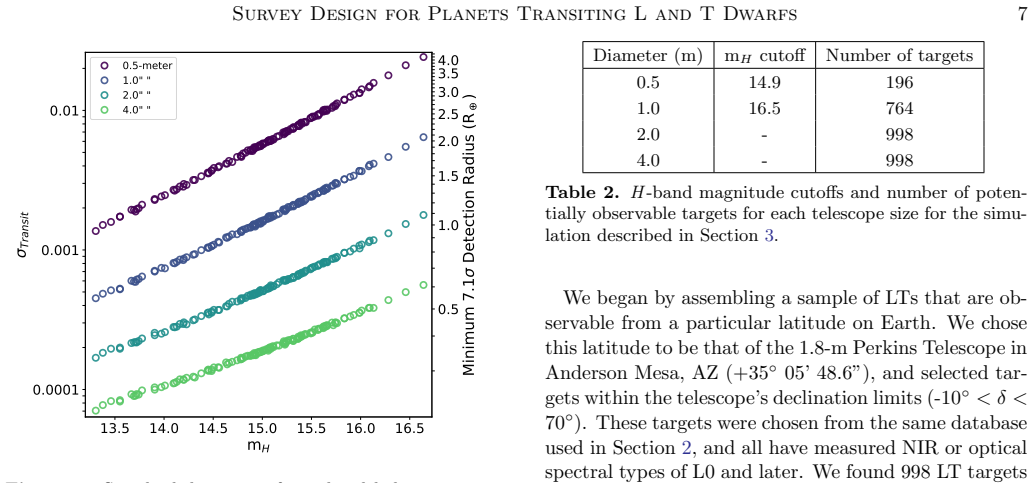
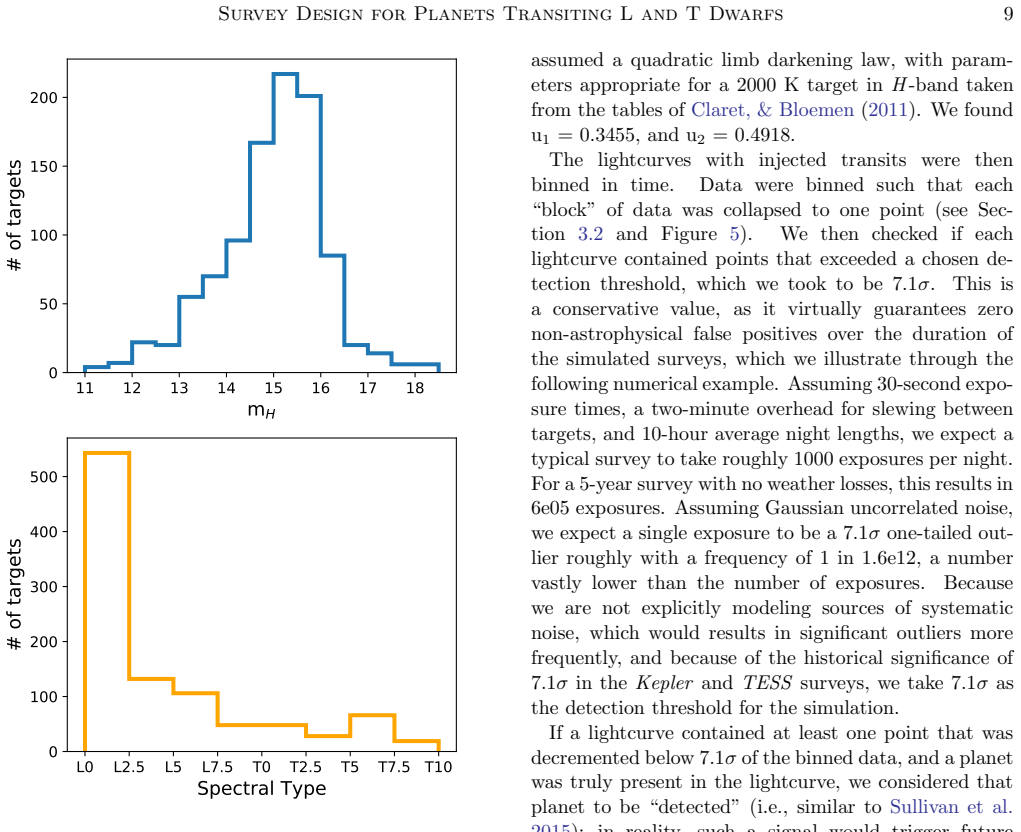
Two linked pieces carry the argument. The first is the CCD-equation photometric model: signal-to-noise is target signal divided by the quadrature sum of Poisson noise from the target, sky, dark current, and read noise, applied to six detector concepts (red-optical z-prime, and high- and low-dark-current NIR J/H/Ks bands) with real reference-star fields around 132 L/T dwarfs. It shows that a low-dark-current H-band detector gives the lowest one-hour scatter because L/T dwarfs are brightest there, reaching a median 7.1-sigma minimum detectable radius of roughly 0.57 Earth radii on a 2-m telescope. The second is a Monte Carlo survey simulator: 998 observable L/T targets, synthetic planetary systems drawn from Kepler M dwarf occurrence rates, host masses and radii from evolutionary models, transit shapes injected with the BATMAN code, photometry binned into blocks set by the dithering cadence, and a planet counted as detected when a binned point falls 7.1 sigma below the baseline. The 7.1-sigma threshold is chosen, as in large-scale transit surveys, to make non-astrophysical false positives essentially impossible, but it also means the design relies on detecting a single deep block rather than a full multi-transit lightcurve.
What would settle it
Observe a sample of roughly 30-50 L/T dwarfs with a 2-meter-class telescope in H band using the recommended five-night dithering cadence, and measure the distribution of binned lightcurve scatter and the frequency of greater-than-1% excursions; if a substantial tail appears from flat-field placement or intrinsic variability, the assumed 7.1-sigma sensitivity to 1% transits fails and the predicted over-80% survey success rate is not attainable.
Extended reading notes
Core claim
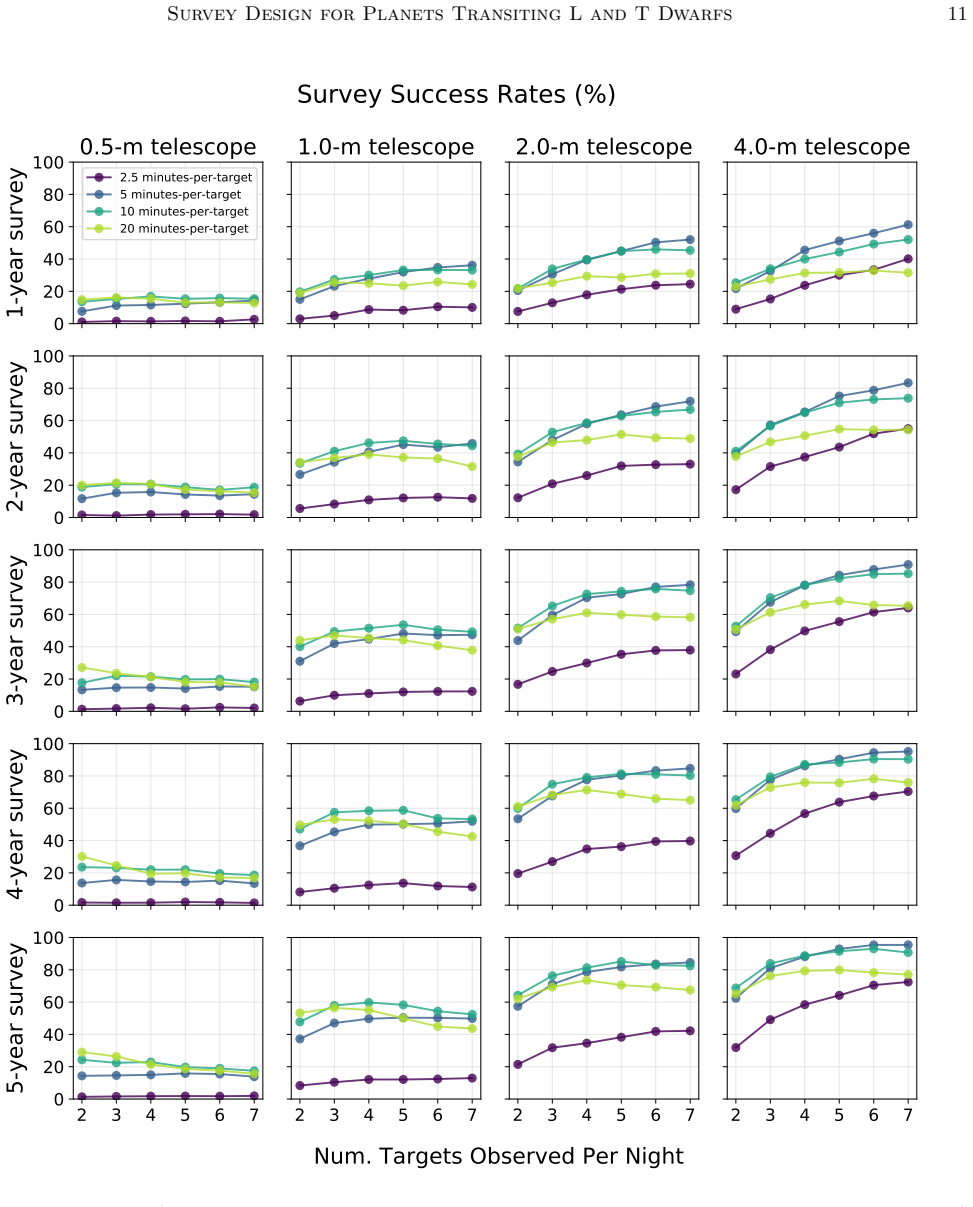
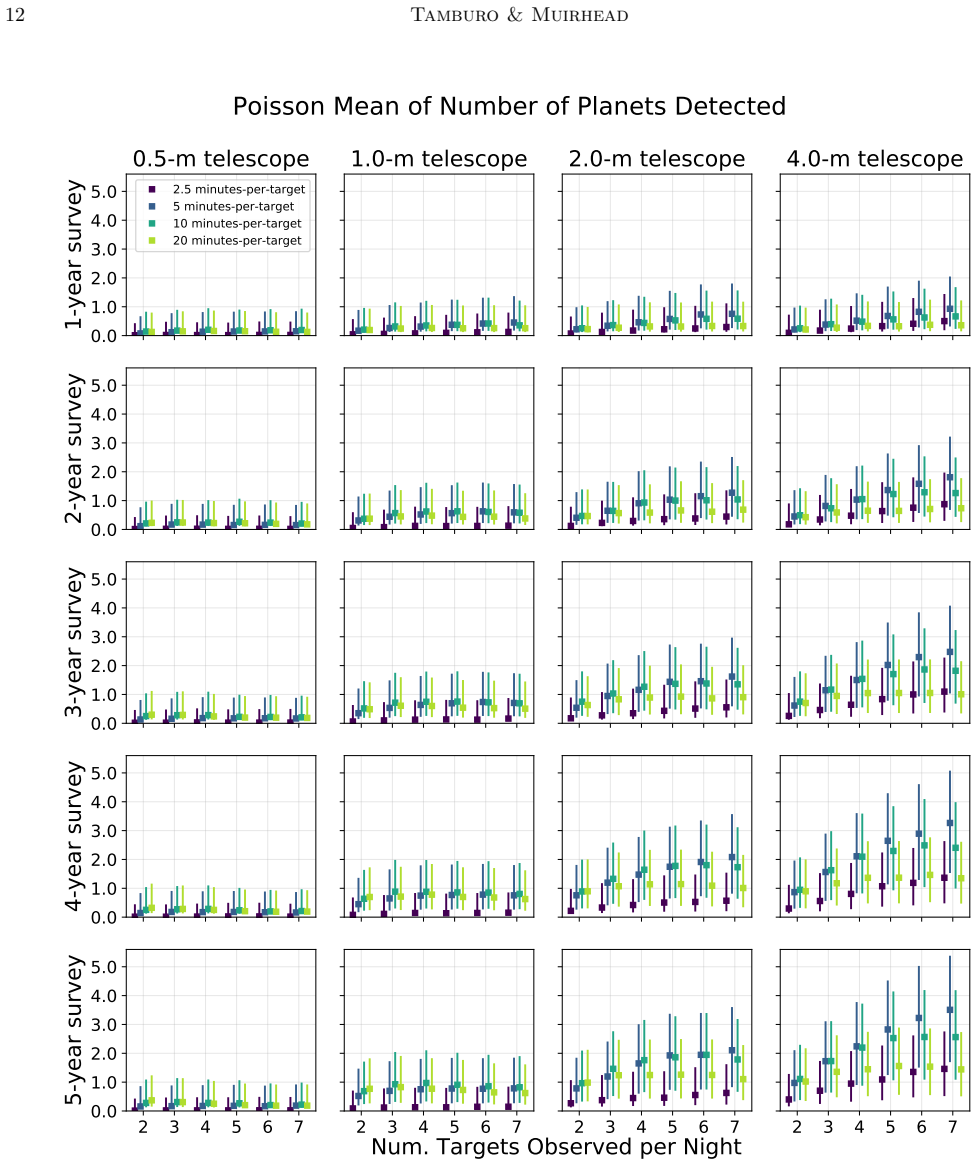
The paper claims that the first thorough transit search of L and T dwarfs can be carried out from the ground with a single modest telescope, and specifies the design that maximizes yield. On the basis of simulated photometry for real L/T targets and Monte Carlo surveys of synthetic planetary systems, it recommends a 2-meter-class telescope with a low-dark-current near-infrared camera observing in H band, 360-480 observing nights (about 120 per year with 30% lost to weather), five to seven targets per night with a dithering cadence of 5-10 minutes per target, and five nights per target group. Under the assumption that L/T dwarfs host planets at the Kepler-measured M dwarf rate, this design has over an 80% chance of detecting at least one planet and yields about two detections on average; a specific four-year, 2-m, six-targets-per-night configuration has a fitted Poisson mean of 1.88 detections. The paper argues these would typically be 1-2 Earth-radius planets on roughly 4-day orbits receiving about a third of Earth's insolation, making them attractive targets for atmospheric follow-up. It also stresses that the yield is conservative, since occurrence rates appear to rise toward later spectral types.
Load-bearing premise
The survey-success numbers assume the photometry is limited by uncorrelated Gaussian noise from the CCD equation, with no component from L/T dwarf variability or imperfect dithering flat-fielding, even though the paper's own Section 4 shows those systematics can be as large as an Earth-sized transit.
Editorial extensions
If this is right
- A 1-m telescope is insufficient for most of the sample, while a 4-m telescope adds only marginal success over a 2-m, so the efficient niche is a 2-meter-class facility.
- A survey longer than about four years yields diminishing returns because the brightest observable targets have already been scheduled for five nights, so the fifth year adds little.
- Dithering between five and seven targets per night outperforms staring at one target, and 5-10 minutes per visit beats both shorter and longer cadences because it balances time baseline against phase coverage.
- Typical detections will be sub-2-Earth-radius planets on short periods, receiving roughly a third of Earth's insolation, making them potentially habitable-zone objects suitable for atmospheric follow-up.
- If occurrence rates rise toward later spectral types, as the paper argues, the expected number of detections roughly doubles.
Reading between the lines
- Because the simulations treat noise as uncorrelated Gaussian scatter, the stated 80% success rate is likely an upper bound; the paper's own dithering test shows flat-field placement jumps of over 3% when uncontrolled, and L/T variability affects 3-24% of targets at the 2% level, both comparable to a 1% Earth transit.
- The block-based detection method means most candidates will be single-transit events with unknown periods; the paper notes that period estimation from a single transit in non-continuous photometry is unproven, so the realistic near-term product may be a candidate list requiring follow-up rather than confirmed planets.
- If the occurrence-rate trend toward later spectral types holds, the same design could yield three to four planets rather than two, making a dedicated 2-m NIR survey competitive with space-based transit searches for the lowest-mass hosts.
- The detector comparison suggests that adding an H-band camera to existing red-optical ultracool-dwarf surveys is the most direct way to extend them into the L/T regime, since z-prime photometry is insensitive to sub-Earth planets for half the sample.
Signed reviews
Editorial analysis
A structured set of objections, weighed in public.
Referee Report
Summary. The paper presents a design study for a ground-based transit survey targeting L and T dwarfs. It first simulates photometric precision in several optical and near-infrared bandpasses using the CCD equation, and concludes that a low-dark-current H-band NIR detector on a 2-meter-class telescope provides the best sensitivity to Earth-sized transits. It then builds a forward Monte Carlo survey around a catalog of 998 spectroscopically confirmed L/T dwarfs, injecting planets according to Kepler M dwarf occurrence rates, simulating weather losses, and testing different dithering strategies, survey durations, and telescope sizes. The central quantitative claims are that an optimal survey uses a 2-m telescope, 360-480 observing nights, and 5-7 targets per night with 5-10 minute dithering, yielding over an 80% chance of detecting at least one planet and roughly 2 planets on average. Section 4 then discusses practical limitations including dithering flat-field instability, L/T dwarf photometric variability, single-transit follow-up, and false positives.
Significance. If the quantitative yields were robust, this would be a genuinely useful design study: a single modest ground-based telescope could conduct the first thorough transit search of L/T dwarfs and likely find several Earth-sized candidates, with important implications for exoplanet demographics and JWST follow-up. The paper's strengths are the explicit comparison of detector architectures, the realistic target sample, the transparent forward-modeling framework, and an unusually honest Section 4 that measures and reports the principal systematics. The recommended instrument and telescope combination is sensible and likely robust. However, the headline success rates and expected yields are computed from a noise model that excludes the systematics quantified later in the paper, so the abstract's 'over 80%' and 'around 2 planets' should be read as idealized upper limits rather than expected survey outcomes.
major comments (2)
- [§3.1, §3.2, §4.1, §4.2] The survey simulation models photometric noise only as uncorrelated Gaussian scatter from the CCD equation, and defines a detection as a single 7.1 sigma binned point. This is the load-bearing assumption for the abstract's claim of over 80% success and about 2 planets. The systematics the authors themselves quantify in Section 4 act at exactly this scale. For a median mH about 15 target on a 2-m telescope, the 3-minute block noise is about 0.21% when the 1-hour, 7.1 sigma minimum radius of 0.57 R_Earth from Figure 2 is scaled to the six-exposure blocks used in Section 3.2. Section 4.1 reports 0.2% RMS flat-field stability even with careful target placement, and Section 4.2 quotes greater than 0.2% variability for 80% of L3-L9.5 dwarfs (Metchev et al. 2015). Adding two such 0.2% terms in quadrature raises the block noise to about 0.35%; the median detected planet radius is 1.51 R_Earth (Figure 8d), corresponding to a transit depth of about 2.3% around a 0.88 R_Jup host, so the typical detection SNR falls from about 11 to 6.6, below the 7.1 sigma threshold. A large fraction of the detections that drive the claimed success rates would be lost. The qualitative caveat in Section 2.4 and the discussion in Section 4 do not replace propagating these systematics through the Monte Carlo.
- [§3.1, §3.2, §4.3] The detection criterion is a single binned point that crosses 7.1 sigma below the baseline; the simulation does not require the candidate signal to appear in multiple blocks, on multiple nights, or with the periodicity expected of a transit. Section 4.3 correctly states that most planets would produce only a single transit during the five-night observing windows, and Section 4.2 notes that non-periodic variability can mimic transits in non-continuous photometry. Since the success rates in Figures 6 and 7 are built on this single-block criterion, the yields are optimistic even apart from the systematics issue raised above. The assertion that 7.1 sigma 'virtually guarantees zero non-astrophysical false positives' holds only under the Gaussian-noise assumption, which is not the regime the paper itself documents.
minor comments (5)
- [§4.1] The text describes an observing run in May 2018 but dates the Mimir observation of 2MASS 1337 as UT 25 May 2016; please reconcile this discrepancy.
- [§1.1] The reference 'Udalksi et al. (2015)' is a typo for 'Udalski et al. (2015).'
- [§2.4] The caveat that the analysis neglects systematic noise would be more useful if accompanied by a quantitative estimate of how much the minimum detection radii increase under the systematics listed in Section 4.
- [Figure 8] Please check the panel-by-panel caption descriptions against the figure panels; as printed, the ordering of the labels in the text and the figure is confusing.
- [Abstract] The meaning of '360-480 observing nights' is clear only after reading Section 3; consider stating this as '3-4 years at about 120 usable nights per year' in the abstract.
Circularity Check
No significant circularity: the survey-yield prediction is a forward Monte Carlo calculation from external occurrence rates, detector noise, and geometry, with no fitted parameter renamed as a prediction.
full rationale
The paper's central yield claim (over 80% chance of at least one planet, ~2 planets on average for a 2-m-class survey) is obtained by an explicit forward simulation: planets are drawn from the external Kepler M-dwarf occurrence rates of Dressing & Charbonneau (2015), orbital geometries are assigned randomly, transit events are injected into photometry whose scatter comes from the CCD equation, and detections are counted when binned points cross a stated 7.1-sigma threshold. No parameter is fitted to the final success rate, and no output quantity is defined in terms of the inputs in a way that makes the result true by construction. The occurrence-rate assumption is explicitly flagged as an assumption, and the paper tests sensitivity to it by doubling the rates, showing that the yield scales roughly linearly. The self-citation to Hardegree-Ullman et al. (2019) appears only in that sensitivity discussion and is not load-bearing for the main derivation; the central calculation rests on the independent Dressing & Charbonneau rates. Section 4 identifies unmodeled systematics such as dithering flat-field instability and L/T variability, and the paper acknowledges these as limitations; omitting them affects the realism and robustness of the predicted yields, but that is a correctness or modeling-risk concern, not circularity. The derivation chain is self-contained with respect to its stated inputs and does not reduce to its own conclusions.
Assumptions & free parameters
free parameters (5)
- 7.1 sigma detection threshold =
7.1
- Weather loss fraction =
30%
- Dithering overhead =
2 minutes
- Nights per target group =
5 nights
- Mutual inclination scatter =
0.3 degrees
assumptions (6)
- domain assumption Kepler M dwarf occurrence rates from Dressing & Charbonneau (2015) apply to L and T dwarfs.
- domain assumption Host radii and masses follow Baraffe et al. (2015) evolutionary models via the Faherty et al. (2016) Teff-spectral-type relation and a uniform age draw between 0.0005 and 10 Gyr.
- domain assumption Photometric noise is uncorrelated and Gaussian as described by the CCD equation.
- standard math Standard Gaussian error propagation and Poisson statistics for source, sky, dark current, and read noise.
- ad hoc to paper A single 7.1 sigma binned point identifies a planet detection.
- domain assumption All simulated planets have zero orbital eccentricity.
Cite this review
Pith. "Pith review of Design Considerations for a Ground-Based Search for Transiting Planets around L and T Dwarfs." pith.science (2026). https://pith.science/paper/HCCB5QY2
@misc{pith2026190803593,
  author       = {Pith},
  title        = {Pith review of: Design Considerations for a Ground-Based Search for Transiting Planets around L and T Dwarfs},
  year         = {2026},
  howpublished = {\url{https://pith.science/paper/HCCB5QY2}},
  note         = {Machine review of arXiv:1908.03593}
}
abstract
We present design considerations for a ground-based survey for transiting exoplanets around L and T dwarfs, spectral classes that have yet to be thoroughly probed for planets. We simulate photometry for L and T targets with a variety of red-optical and near-infrared detectors, and compare the scatter in the photometry to anticipated transit depths. Based on these results, we recommend the use of a low-dark-current detector with H-band NIR photometric capabilities. We then investigate the potential for performing a survey for Earth-sized planets for a variety of telescope sizes. We simulate planetary systems around a set of spectroscopically confirmed L and T dwarfs using measured M dwarf planet occurrence rates from $\textit{Kepler}$, and simulate their observation in surveys ranging in duration from 120 to 600 nights, randomly discarding 30% of nights to simulate weather losses. We find that an efficient survey design uses a 2-meter-class telescope with a NIR instrument and 360-480 observing nights, observing multiple L and T targets each night with a dithering strategy. Surveys conducted in such a manner have over an 80% chance of detecting at least one planet, and detect around 2 planets, on average. The number of expected detections depends on the true planet occurrence rate, however, which may in fact be higher for L and T dwarfs than for M dwarfs.
Figures


Figures from the paper (6 more)



Reference graph
Works this paper leans on
-
[1]
, " * write output.state after.block = add.period write newline
ENTRY address archivePrefix author booktitle chapter doi edition editor eprint howpublished institution journal key month number organization pages publisher school series title misctitle type volume year version url label extra.label sort.label short.list INTEGERS output.state before.all mid.sentence after.sentence after.block FUNCTION init.state.consts ...
-
[2]
write newline
" write newline "" before.all 'output.state := FUNCTION format.url url empty "" new.block "" url * "" * if FUNCTION format.eprint eprint empty "" archivePrefix empty "" archivePrefix "arXiv" = new.block " " eprint * " " * new.block " " eprint * " " * if if if FUNCTION format.doi doi empty "" " " doi * " " * if FUNCTION format.pid doi empty eprint empty ""...
-
[3]
+3*EL8 '*x WG?wW/5 s xy / _v5z))4F |lњj >3 2>wfʠ]B* o z◁x-___5_z^ 5/ ^ ݺ, /] ]<Gݻܜ ' 7_ώ v( /=zF;kOg\ˁ Wtj1Aiֈц;uWs ]7P baE;M T*ueѭ:k]ڇ 5ҥ 8Ě<
thebibliography [1] 20pt to REFERENCES 6pt =0pt 10pt plus 3pt =0pt =0pt =1pt plus 1pt =0pt =0pt -12pt =13pt plus 1pt =20pt =13pt plus 1pt \@M =10000 =-1.0em =0pt =0pt 0pt =0pt =1.0em @enumiv\@empty 10000 10000 `\.\@m \@noitemerr \@latex@warning Empty `thebibliography' environment \@ifnextchar \@reference \@latexerr Missing key on reference command Each re...
2017
-
[4]
D., Allende Prieto, C., et al.\ 2015, ApJS, 219, 12
Alam, S., Albareti, F. D., Allende Prieto, C., et al.\ 2015, ApJS, 219, 12
2015
-
[6]
E., Lewis, N
Batalha, N. E., Lewis, N. K., Line, M. R. et al., 2018, ApJL, 856, L34
2018
-
[7]
Bailer-Jones, C. A. L., & Lamm, M.\ 2003, MNRAS, 339, 477
2003
-
[8]
& Johnson, J
Ballard, S. & Johnson, J. A. 2016, ApJ, 816, 66
2016
-
[9]
2015, A&A, 577, A42
Baraffe, I., Homeier, D., Allard, F., et al. 2015, A&A, 577, A42
2015
Show all 107 references
-
[10]
C., Burgasser, A
Bardalez Gagliuffi, D. C., Burgasser, A. J., Schmidt, S. J., et al. 2019, arXiv e-prints, arXiv:1906.04166
2019 arXiv
-
[11]
& Heller, R
Barnes, R. & Heller, R. 2013, AsBio, 13, 279
2013
-
[12]
R., Selsis, F., Morales, J.-C
Belu, A. R., Selsis, F., Morales, J.-C. et al., 2011, A&A, 525, A83
2011
-
[13]
R., Selsis, F., Raymond, S
Belu, A. R., Selsis, F., Raymond, S. N., et al. 2013, ApJ, 768, 125
2013
-
[14]
K., Irwin, J., Charbonneau, D., et al.\ 2012, AJ, 144, 145
Berta, Z. K., Irwin, J., Charbonneau, D., et al.\ 2012, AJ, 144, 145
2012
-
[15]
K., Irwin, J., Charbonneau, D
Berta-Thompson, Z. K., Irwin, J., Charbonneau, D. et al., 2015, Nature, 527, 204
2015
-
[16]
N., & Leconte, J
Bolmont, E., Raymond, S. N., & Leconte, J. 2011, A&A, 535, A94
2011
-
[17]
H., Bloom, J
Blake, C. H., Bloom, J. S., Latham, D. W., et al.\ 2008, PASP, 120, 860
2008
-
[18]
Bolmont, E., Selsis, F., Owen, J. E. et al., 2017, MNRAS, 464, 3728
2017
-
[19]
J., Koch, D., Basri, G
Borucki, W. J., Koch, D., Basri, G. et al., 2010, Science, 327, 5968
2010
-
[20]
et al., 2017, SPECULOOS Exoplanet Search and Its Prototype on TRAPPIST, p.130, doi:10.1007/978-3-319-30648-3 \_ 130-1
Burdanov, A., Delrez, L, Gillon, M. et al., 2017, SPECULOOS Exoplanet Search and Its Prototype on TRAPPIST, p.130, doi:10.1007/978-3-319-30648-3 \_ 130-1
2017 doi
-
[21]
J.\ 2001, Ph.D
Burgasser, A. J.\ 2001, Ph.D. Thesis
2001
-
[22]
J., Geballe, T
Burgasser, A. J., Geballe, T. R., Leggett, S. K. et al., 2006, ApJ, 637, 1067
2006
-
[23]
J., Blake, C
Burgasser, A. J., Blake, C. H., Gelino, C. R., et al.\ 2016, ApJ, 827, 25
2016
-
[24]
Hubbard, W
Burrows, A., Marley, M. Hubbard, W. B. et al., 1997, ApJ, 491, 856
1997
-
[25]
2011, ApJ, 736, 47
Burrows, A., Heng, K., & Nampaisarn, T. 2011, ApJ, 736, 47
2011
-
[26]
M., Latham, D
Charbonneau, D., Brown, T. M., Latham, D. W., & Mayor, M. 2000, ApJL, 529, L45
2000
-
[27]
M., Noyes R
Charbonneau, D., Brown T. M., Noyes R. W., & Gilliland R. L. 2002, ApJ, 568, 377
2002
-
[28]
K., Burke, C
Charbonneau, D., Berta, Z. K., Burke, C. J. et al., 2009, Nature, 462, 891
2009
-
[29]
Chauvin, G., Lagrange, A.-M., Dumas, C., et al.\ 2004, A&A, 425, L29
2004
-
[30]
Chauvin, G., Lagrange, A.-M., Dumas, C., et al.\ 2005, A&A, 438, L25
2005
-
[31]
Chiu, K., Fan, X>, Leggett, S. K. et al., 2006, AJ, 131, 2722
2006
-
[32]
Clemens, D. P. Pinnick, A. F., Pavel, M. D., & Taylor, B. W. 2012, ApJS, 200, 19
2012
-
[33]
Claret, A., & Bloemen, S.\ 2011, A&A, 529, A75
2011
-
[34]
P., Sarcia, D., Grabau, A
Clemens, D. P., Sarcia, D., Grabau, A. et al., 2007, PASP, 119, 862
2007
-
[35]
A., & Megeath, S
Cohen, M., Wheaton, W. A., & Megeath, S. T.\ 2003, AJ, 126, 1090
2003
-
[36]
et al., 2015, ApJ, 802, 28
Croll, B., Albert, L., Jayawardhana, R. et al., 2015, ApJ, 802, 28
2015
-
[37]
M., Skrutskie, M
Cutri, R. M., Skrutskie, M. F., van Dyk, S., et al.\ 2003, VizieR Online Data Catalog, II/246
2003
-
[38]
et al., 2018, Proc
Delrez, L., Gillon, M., Queloz, D. et al., 2018, Proc. SPIE 10700, Ground-based and Airborne Telescopes VII, 107001I
2018
-
[39]
A., Irwin, J
Dittmann, J. A., Irwin, J. M., Charbonneau, D. et al., 2017, Nature, 544, 333
2017
-
[40]
J., Rom\' a n-Z\' u \ n iga, C., Ballesteros-Paredes, J
Downes, J. J., Rom\' a n-Z\' u \ n iga, C., Ballesteros-Paredes, J. et al., 2015, MNRAS, 450, 3490
2015
-
[41]
Dressing, C. D. & Charbonneau, D. 2013, ApJ, 767, 95
2013
-
[42]
Dressing, C. D. & Charbonneau, D. 2015, ApJ, 807, 45
2015
-
[43]
Dupuy, T. J. & Liu, M. C. 2012, ApJS, 201, 19
2012
-
[44]
J., Liu, M
Dupuy, T. J., Liu, M. C., & Ireland, M. J.\ 2014, ApJ, 790, 133
2014
-
[45]
J., Liu, M
Dupuy, T. J., Liu, M. C., Allers, K. N. et al., 2018, AJ, 156, 2
2018
-
[46]
et al., 1997, The Messenger, 87, 27
Epchtein, N., de Batz, B., Capoani, L. et al., 1997, The Messenger, 87, 27
1997
-
[47]
R., Saumaon, D., Leggett, S
Geballe, T. R., Saumaon, D., Leggett, S. K. et al., 2001, ApJ, 556, 373
2001
-
[48]
R., Knapp, G
Geballe, T. R., Knapp, G. R., Leggett, S. K. et al., 2002, 564, 466
2002
-
[49]
K., Riedel, A
Faherty, J. K., Riedel, A. R., Cruz, K. L., et al. 2016, ApJS, 225, 10
2016
-
[50]
Fontanive, C., Biller, B., Bonavita, M., et al.\ 2018, MNRAS, 479, 2702
2018
-
[51]
J., Ninkov, Z., & Garnett, J
Forrest, W. J., Ninkov, Z., & Garnett, J. D. 1989, Proceedings of the Third Infrared Detector Technology Workshop, ed. C. R. McCreight (NASA Technical Memorandum No. 102209), 157
1989
-
[52]
E., et al.\ 1996, AJ, 111, 1748
Fukugita, M., Ichikawa, T., Gunn, J. E., et al.\ 1996, AJ, 111, 1748
1996
-
[53]
2014, List of All UltraCool Dwarfs, https://jgagneastro.wordpress.com/list-of-ultracool-dwarfs/
Gagne, J. 2014, List of All UltraCool Dwarfs, https://jgagneastro.wordpress.com/list-of-ultracool-dwarfs/
2014
-
[54]
et al., 2013, EPJ Web Conf
Gillon, M., Jehin, E., Fumel, A. et al., 2013, EPJ Web Conf. 47, 03001 (2013)
2013
-
[55]
Gillon, M., Triaud, A. H. M. J., Jehin, E., et al.\ 2013, A&A, 555, L5
2013
-
[56]
M., et al.\ 2016, Nature, 533, 221
Gillon, M., Jehin, E., Lederer, S. M., et al.\ 2016, Nature, 533, 221
2016
-
[57]
H., Demory, B.-O
Gillon, M., Triaud, A. H., Demory, B.-O. et al., 2017, Nature, 542, 456
2017
-
[58]
P., Udalski, A., & Jung, Y
Han, C, Bennett, D. P., Udalski, A., & Jung, Y. K. 2016, ApJ, 825, 1
2016
-
[59]
K., Cushing, M
Hardegree-Ullman, K. K., Cushing, M. C., Muirhead, P. S., et al.\ 2019, arXiv e-prints, arXiv:1905.05900
2019 arXiv
-
[60]
K., Hallinan, G., Milburn, J
Harding, L. K., Hallinan, G., Milburn, J. et al., 2016, MNRAS, 457, 3
2016
-
[61]
Y., Triaud, A
He, M. Y., Triaud, A. H. M. J., & Gillon, M. 2017, MNRAS, 464, 2687
2017
-
[62]
L., Hall, D
Hodapp, K.-W., Hora, J. L., Hall, D. N. B. et al., 1996, New Astronomy, 1, 177
1996
-
[63]
& Lin, D
Ida, S. & Lin, D. N. C. 2004, ApJ, 603, 388
2004
-
[64]
& Falco, E
Irwin, J., Charbonneau, D., Nutzman, P. & Falco, E. 2009, in IAU Symposium, Vol. 253, Transiting Planets, ed. F. Pont, D. Sasselov, & M. J. Holman, 37-43
2009
-
[65]
K., Burke, C
Irwin, J., Berta, Z. K., Burke, C. J., et al.\ 2011, ApJ, 727, 56
2011
-
[66]
Jackman, J. A. G., Wheatley, P. J., Bayliss, D., et al. 2019, MNRAS, 485, L136
2019
-
[67]
M., Caldwell, D
Jenkins, J. M., Caldwell, D. A., & Borucki, W. J.\ 2002, ApJ, 564, 495
2002
-
[68]
K., Udalski, A., Gould, A
Jung, Y. K., Udalski, A., Gould, A. et al., 2018, AJ, 155, 5
2018
-
[69]
D., Henry, T
Kirkpatrick, J. D., Henry, T. J., & Irwin, M. J. 1997, AJ, 113, 4
1997
-
[70]
D., Reid, I
Kirkpatrick, J. D., Reid, I. N., Liebert, J. et al., 1999, ApJ, 519, 802
1999
-
[71]
2015, PASP, 127, 1161
Kreidberg, L. 2015, PASP, 127, 1161
2015
-
[72]
Kumar, S. S. 1963, ApJ, 137, 1121
1963
-
[73]
Luger, R., Lustig-Yaeger, J., & Agol, E.\ 2017, ApJ, 851, 94
2017
-
[74]
Luhman, K. L. & Mamajek, E. E. 2012, ApJ, 758, 1
2012
-
[75]
Mace, G. N. 2014, PhD thesis, University of California, Los Angeles
2014
-
[76]
W., Terrien, R
Mahadevan, S., Ramsey, L. W., Terrien, R. et al., 2014, Proc. SPIE, 9147, 91471G
2014
-
[77]
E.\ 2005, ApJ, 634, 1385
Mamajek, E. E.\ 2005, ApJ, 634, 1385
2005
-
[78]
A., Astudillo-Defru, N., et al.\ 2019, AJ, 157, 32
Ment, K., Dittmann, J. A., Astudillo-Defru, N., et al.\ 2019, AJ, 157, 32
2019
-
[79]
A., Heinze, A., Apai, D
Metchev, S. A., Heinze, A., Apai, D. et al., 2015, ApJ, 799, 154
2015
-
[80]
V., Kreidberg, L., Rustamkulov, Z
Morley, C. V., Kreidberg, L., Rustamkulov, Z. et al., 2017, ApJ, 850, 121
2017
-
[81]
S., Johnson, J
Muirhead, P. S., Johnson, J. A., Apps, K. et al., 2012, ApJ, 747, 144
2012
-
[82]
D., Pascucci, I., & Apai, D.\ 2015, ApJ, 814, 130
Mulders, G. D., Pascucci, I., & Apai, D.\ 2015, ApJ, 814, 130
2015
-
[83]
& Charbonneau, D
Nutzman, P. & Charbonneau, D. 2008, PASP, 120, 317
2008
-
[84]
T., Charbonneau, D., Alonso, R., et al.\ 2007, ApJ, 662, 658
O'Donovan, F. T., Charbonneau, D., Alonso, R., et al.\ 2007, ApJ, 662, 658
2007
-
[85]
P., Armstrong, D
Osborn, H. P., Armstrong, D. J., Brown, D. J. A. et al., 2016, MNRAS, 457, 2273
2016
-
[86]
Payne, M. J. & Lodato, G. 2007, MNRAS, 381, 1597
2007
-
[87]
L., Skillen, I., Collier Cameron, A
Pollacco, D. L., Skillen, I., Collier Cameron, A. et al., 2006, PASP, 118, 848
2006
-
[88]
et al., 2004, Proc
Puget, P., Stadler, E., Doyon, R. et al., 2004, Proc. SPIE, 5492, 978
2004
-
[89]
& Artigau, \' E
Radigan, J., Jayawardhana, R., Lafreni\` e re, D. & Artigau, \' E . 2011, in Astronomical Society of the Pacific Conference Series, 488, 16th Cambridge Workshop on Cool Stars, Stellar Systems, and the Sun, ed. C. Johns-Krull, M. K. Browning, & A. A. West, 187
2011
-
[90]
et al., 2014, ApJ, 750, 105
Radigan, J., Jayawardhana, R., Lafreniere, D. et al., 2014, ApJ, 750, 105
2014
-
[91]
2014, ApJ, 797, 2
Radigan, J. 2014, ApJ, 797, 2
2014
-
[92]
R., Winn, J
Ricker, G. R., Winn, J. N., Vanderspek, R. et al., 2015, Journal of Astronomical Telescopes, Instruments, and Systems, 1, 014003
2015
-
[93]
C., Mann, A
Rizzuto, A. C., Mann, A. W., Vanderburg, A. et al., 2017, AJ, 154, 6
2017
-
[94]
Ross, M. N. & Schubert, G. 1987, Nature, 325, 6100
1987
-
[95]
N., & Schubert, G
Ross, M. N., & Schubert, G. 1989, Icarus, 78, 1
1989
-
[96]
2018, Proc
Shapiro, C., Huff, E., & Smith, R. 2018, Proc. SPIE, 10709, 1070936
2018
-
[97]
F., Cutri, R
Skrutskie, M. F., Cutri, R. M., Stiening, R. et al., 2006, AJ, 131, 1163
2006
-
[98]
A., et al.\ 2007, ApJ, 669, 1279
Seager, S., Kuchner, M., Hier-Majumder, C. A., et al.\ 2007, ApJ, 669, 1279
2007
-
[99]
2013, ApJ, 767, 77
Sorahana, S., Yamamura, I., & Murakami, H. 2013, ApJ, 767, 77
2013
-
[100]
C., Marley, M
Stephens, D. C., Marley, M. S., Noll, K. S., et al.\ 2001, ApJ, 556, L97
2001
-
[101]
W., Croll, B
Sullivan, P. W., Croll, B. & Simcoe, R. A. 2014, Proc. SPIE, 9154, 91541F
2014
-
[102]
W., Winn, J
Sullivan, P. W., Winn, J. N., Berta-Thompson, Z. K., et al.\ 2015, ApJ, 809, 77
2015
-
[103]
G., McAlister, H
Tsay, W.-S., Bagnuolo, W. G., McAlister, H. A. et al., 1990, PASP, 102, 1339
1990
-
[104]
K., Han, C
Udalski, A., Jung, Y. K., Han, C. et al., 2015, ApJ, 812, 1
2015
-
[105]
S., Gillon, M
Van Grootel, V., Fernandes, C. S., Gillon, M. et al., 2018, ApJ, 853, 30
2018
-
[106]
L., Eisenhardt, P
Wright, E. L., Eisenhardt, P. R. M., Mainzer, A. K. et al., 2010, AJ, 140, 1868
2010
-
[107]
Yoder, C. F. 1979, Nature, 279, 5716
1979
-
[108]
G., Adelman, J., Anderson, J
York, D. G., Adelman, J., Anderson, J. E. Jr. et al., 2000, AJ, 120, 1579
2000
Reviewed August 14, 2026 · model on record in the stance chip above.
Discussion (0). Continue with ORCID to comment.