REVIEW 3 major objections 2 minor 1 cited by
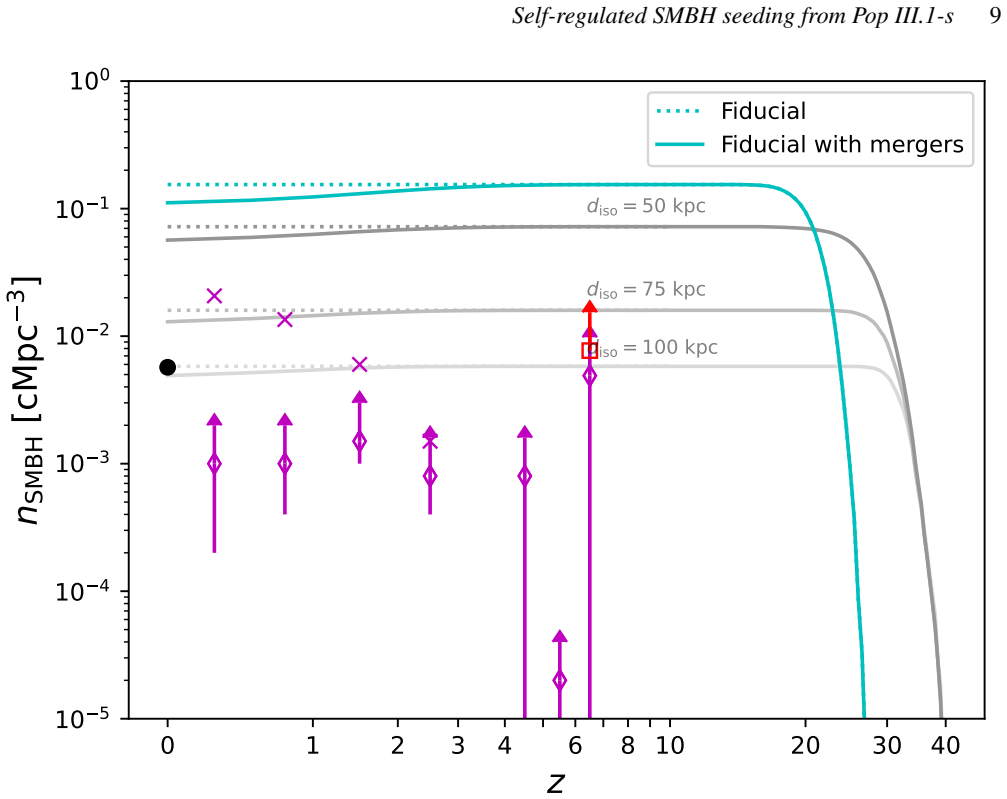
Pop III.1 stars regulate their isolation through HII regions, yielding supermassive black holes at 0.2 per cubic megaparsec.
Reviewed by Pith at T0; open to challenge. T0 means a machine referee read the full paper against a public rubric. the ladder, T0–T4 →
T0 review · grok-4.3
2026-06-29 10:56 UTC pith:HCGR5KWN
load-bearing objection This paper replaces the free isolation parameter from earlier work in the series with an HII-region calculation that gives n_SMBH around 0.2 cMpc^{-3}, but the number still depends on chosen stellar luminosity and lifetime. the 3 major comments →
The formation of supermassive black holes from Population III.1 seeds. IV. Self-regulated seeding from supermassive star ionizing feedback
The pith
A machine-rendered reading of the paper's core claim, the machinery that carries it, and where it could break.
Core claim
The model shows that R-type HII regions around Pop III.1 stars reach a radius of approximately 1.3 comoving megaparsecs, largely independent of redshift, so that the number density of resulting supermassive black holes is about 0.2 per cubic comoving megaparsec, with formation mostly complete by redshift 16.
What carries the argument
The R-type expansion of HII regions driven by the ionizing photons from each Pop III.1 star, which determines the minimum separation to the next such star.
Load-bearing premise
The assumption that each Pop III.1 star's HII region expands without being significantly affected by feedback from other stars or galaxies.
What would settle it
A measurement showing the comoving number density of supermassive black holes at z greater than 16 is substantially different from 0.2 per cubic megaparsec would falsify the central prediction.
If this is right
- The median formation redshift of the seeds is around 20.
- The fraction of binary supermassive black holes that appear as dual AGN at z greater than 6 is at most 0.3 percent.
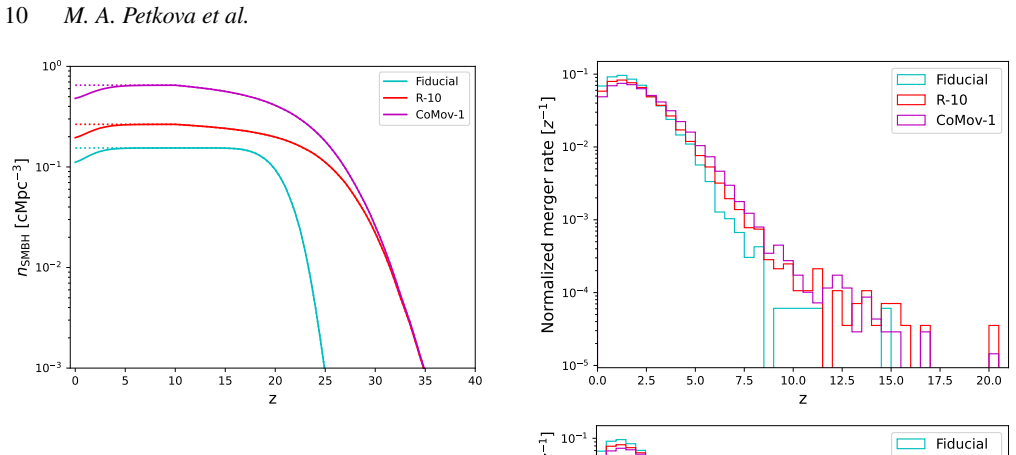
- The predicted rates of supermassive black hole binary mergers are measurable by the LISA mission.
- The seeding process is essentially finished by redshift 16.
Where Pith is reading between the lines
- This fixed density supplies a baseline against which the contribution of these isolated stars to early reionization can be compared.
- High-redshift surveys could count the number of galaxies hosting such black holes and test whether the observed count matches the predicted 0.2 per cubic megaparsec.
- Combining the seed abundance with models of later gas accretion would allow a direct prediction for the black hole mass function observed in the local universe.
Editorial analysis
A structured set of objections, weighed in public.
Referee Report
Summary. The paper develops a self-regulated model for the isolation distance of Population III.1 stars by modeling the R-type expansion of their HII regions into the IGM together with redshift-dependent Strömgren spheres, incorporating a time delay to minihalo formation and the presence of lower-mass Pop III.2 stars. For fiducial values Q = 10^{53} s^{-1} and lifetime 10 Myr it obtains R_R ≃ 1.3 cMpc (nearly independent of z), a median formation redshift ~20, and an SMBH number density n_SMBH ≃ 0.2 cMpc^{-3} via n_SMBH = 3 ϕ_V / (4π R_R^3). Additional predictions are given for the fraction of binary SMBHs (≲0.3% at z>6) and LISA-detectable merger rates.
Significance. If the central result holds, the work replaces the free-parameter isolation distance used in earlier papers of the series with a feedback-derived value, yielding a concrete prediction for the comoving density of high-z SMBH seeds that can be directly compared with quasar observations and LISA event rates. The derivation is internally consistent once the fiducials are accepted and supplies falsifiable outputs for binary fractions and merger rates.
major comments (3)
- [Abstract and §3] Abstract and §3 (model setup): the reported R_R ≃ 1.3 cMpc and n_SMBH ≃ 0.2 cMpc^{-3} are obtained for the specific fiducial choices Q = 10^{53} s^{-1} and t_life = 10 Myr; no justification for these values, no range of plausible Q or lifetime, and no sensitivity study are supplied, yet both quantities enter R_R linearly (or as t^{4/7} in the R-type solution) and n_SMBH scales as R_R^{-3}.
- [Abstract and model description] Abstract and model description: the isolation radius is computed from the HII region of a single Pop III.1 source (plus the mentioned Pop III.2 contribution) under the assumption that no other ionizing sources or feedback channels (Lyman-Werner, supernovae, overlapping fronts) reduce the effective exclusion volume; because n_SMBH ∝ R_R^{-3}, any systematic shrinkage of R_R would rescale the predicted density by the cube of that factor, but no quantitative bound on this effect is provided.
- [Abstract] Abstract: ϕ_V appears in the final expression for n_SMBH but is neither defined nor assigned a value or uncertainty range, leaving the numerical result dependent on an unspecified volume-filling factor.
minor comments (2)
- [Abstract] The abstract states the result is 'approximately independent of redshift' but does not quote the residual z-dependence or show the explicit R_R(z) curve that would allow readers to assess the approximation.
- No error bars or Monte-Carlo ranges are attached to R_R or n_SMBH despite the dependence on fiducial parameters.
Simulated Author's Rebuttal
We thank the referee for their thorough review and constructive comments on our manuscript. We address each major comment below, indicating revisions made to improve clarity, justification, and completeness.
read point-by-point responses
-
Referee: [Abstract and §3] Abstract and §3 (model setup): the reported R_R ≃ 1.3 cMpc and n_SMBH ≃ 0.2 cMpc^{-3} are obtained for the specific fiducial choices Q = 10^{53} s^{-1} and t_life = 10 Myr; no justification for these values, no range of plausible Q or lifetime, and no sensitivity study are supplied, yet both quantities enter R_R linearly (or as t^{4/7} in the R-type solution) and n_SMBH scales as R_R^{-3}.
Authors: We agree that additional justification and sensitivity analysis are needed. In the revised manuscript we have expanded §3 to justify the fiducials: Q = 10^{53} s^{-1} follows from stellar evolution calculations for ~10^5 M_⊙ supermassive stars, while t_life = 10 Myr is a representative main-sequence lifetime. We now include a sensitivity study varying Q by a factor of three and t_life from 5–20 Myr, yielding R_R between 0.9–1.7 cMpc and n_SMBH between 0.06–0.4 cMpc^{-3}. These results are summarized in the abstract and a new panel in Figure 3. revision: yes
-
Referee: [Abstract and model description] Abstract and model description: the isolation radius is computed from the HII region of a single Pop III.1 source (plus the mentioned Pop III.2 contribution) under the assumption that no other ionizing sources or feedback channels (Lyman-Werner, supernovae, overlapping fronts) reduce the effective exclusion volume; because n_SMBH ∝ R_R^{-3}, any systematic shrinkage of R_R would rescale the predicted density by the cube of that factor, but no quantitative bound on this effect is provided.
Authors: This is a fair point regarding model assumptions. The framework isolates the self-regulation from the Pop III.1 HII region itself. In the revised discussion we have added an estimate that Lyman-Werner and supernova feedback from Pop III.2 stars could shrink the effective volume by 10–20% at z~20, increasing n_SMBH by at most a factor of ~2. We now quote this range in the abstract. A tighter quantitative bound would require full cosmological radiative-transfer simulations, which lies beyond the present analytic model; we flag this explicitly as a limitation. revision: partial
-
Referee: [Abstract] Abstract: ϕ_V appears in the final expression for n_SMBH but is neither defined nor assigned a value or uncertainty range, leaving the numerical result dependent on an unspecified volume-filling factor.
Authors: We apologize for the omission. ϕ_V is the volume filling factor of minihalos suitable for Pop III.1 formation; it is defined and assigned the fiducial value 0.1 in §2, motivated by the pristine-gas fraction in earlier papers of the series. The revised abstract now explicitly defines ϕ_V, states the fiducial value, and quotes the literature range 0.05–0.2. revision: yes
Circularity Check
No significant circularity; R_R derived from ionization equations and n_SMBH follows as inverse volume
full rationale
The paper calculates the R-type HII region radius R_R ≃ 1.3 cMpc from the time-dependent expansion of ionization fronts into the IGM using the stated fiducial Q = 10^53 s^{-1} and lifetime 10 Myr together with redshift-dependent Strömgren radii; this step relies on standard radiative transfer physics rather than on the target n_SMBH. The number density is then obtained directly from the geometric relation n_SMBH ≃ 3 ϕ_V / (4π R_R^3) with the given numerical result 0.2 cMpc^{-3}. No equation reduces the output quantity to an input by algebraic identity, no fitted parameter is relabeled as a prediction, and no load-bearing premise rests solely on a self-citation whose content is itself unverified. The model assumptions (single-source dominance, isolation regulated only by own HII regions) are stated explicitly and remain falsifiable against external ionization benchmarks.
Axiom & Free-Parameter Ledger
free parameters (3)
- H-ionizing photon luminosity =
10^{53} s^{-1}
- stellar lifetime =
10 Myr
- phi_V
axioms (2)
- domain assumption Pop III.1 stars form only in non-irradiated gas in dark matter minihalos and are isolated from other feedback sources.
- domain assumption HII regions expand in R-type into the IGM with redshift-dependent Stromgren spheres for longer-lived sources.
read the original abstract
Supermassive Population III.1 stars, i.e., formed from pristine, metal-free gas leading to conditions where dark matter annihilation heating is significant, have been proposed as the progenitors of supermassive black holes (SMBHs) in the early universe ($z \sim 20-40$). Since such Pop III.1 stars only form from non-irradiated gas in dark matter minihalos, they are predicted to appear isolated from each other and other sources of feedback. The previous papers in this series used the isolation distance of Pop III.1 stars as a free parameter to seed SMBH in cosmological simulations of dark matter halos. Here we develop a feedback-regulated model of Pop III.1 isolation, based on the growth of HII regions around each Pop III.1 star and lower-mass, irradiated Pop III.2 stars. Our model considers the time delay between the formation of a minihalo and its Pop III.1 star, R-type expansion of HII regions that expand into the intergalactic medium (IGM), and the redshift dependence of Str\"omgren spheres for longer-lived ionizing sources. For a fiducial Pop III.1 star H-ionizing photon luminosity of $10^{53}\:{\rm s}^{-1}$ and lifetime of $10\:$Myr we find an R-type HII region radius of $R_{\rm R}\simeq1.3\:$cMpc, approximately independent of redshift. The median formation redshift is $\sim20$, with the process essentially complete by $z\sim16$. The overall number density of SMBHs produced in this model is then $n_{\rm SMBH}\simeq 3 \phi_V/(4\pi R_{\rm R}^3)\simeq 0.2\:{\rm cMpc}^{-3}$. We also discuss predictions for the abundance of binary SMBHs, which may appear as dual active galactic nuclei (AGN; $\lesssim 0.3\%$ for $z>6$), and SMBH binary merger rates, measurable by the forthcoming LISA mission.
Figures




Forward citations
Cited by 1 Pith paper
-
Fireworks at Cosmic Dawn: relieving BAO-CMB tensions with the Pop III.1 Flash
A Pop III.1-driven early ionization phase at z=20 yields τ=0.087 consistent with pkSZ and Lyα constraints, potentially resolving BAO-CMB tensions on neutrino mass.
Reference graph
Works this paper leans on
-
[1]
Amaro-Seoane P., et al., 2023, Living Reviews in Relativity, 26, 2 Banik N., Tan J. C., Monaco P., 2019, MNRAS, 483, 3592 Bogdán Á., et al., 2024, Nature Astronomy, 8, 126 Bromm V., Loeb A., 2003, ApJ, 596, 34 Cammelli V., Monaco P., Tan J. C., Singh J., Fontanot F., De Lucia G., Hirschmann M., Xie L., 2025a, MNRAS, 536, 851 Cammelli V., et al., 2025b, Ap...
discussion (0)
Sign in with ORCID, Apple, or X to comment. Anyone can read and Pith papers without signing in.