REVIEW 4 major objections 5 minor 2 references
Navigating the Reality Gap: On-Device Continual Adaptation of ASR for Clinical Telephony
T0 review · 4 major / 5 minor · reviewed 2026-08-03 · deepseek-v4-flash
Pith's one-line read When a strong multilingual ASR model is adapted on-device to noisy rural telephony, replaying a small buffer of hard target-domain and clean general-domain samples provides the core benefit, cutting word error rate from 40.94% to 33.94% whi
desk verdict Useful engineering result on on-device ASR adaptation, but the abstract claims a negative-λ EWC effect the body never tests, and the strategy comparisons are confounded. read the letter →
The pith
A machine-rendered reading of the paper's core claim, the machinery that carries it, and where it could break.
The reading
What carries the argument
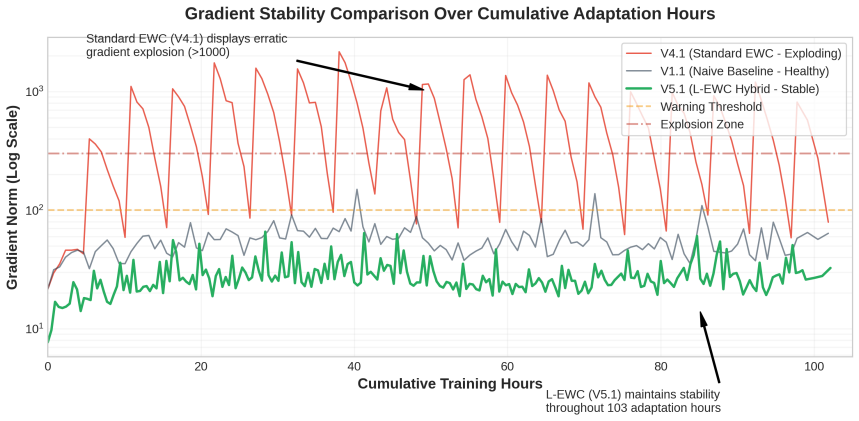
The central mechanism is a dual-buffer experience replay: a target-domain buffer stores 'hard' examples (high CTC loss) and random samples from recent clinical segments, while a general-domain buffer holds gender-balanced clean Hindi from Kathbath. During each segment, the incoming clinical stream is mixed with these buffers, and only LoRA adapters (rank 24, on query and value projections of a frozen IndicWav2Vec) are trained. The paper also uses an Absolute-Fisher importance estimate (mean absolute gradient) for EWC to avoid gradient explosion, but shows replay is the workhorse and EWC is a secondary stabilizer.
What would settle it
Run the same LoRA plus multi-domain replay pipeline on a genuine clinical telephony corpus (e.g., recorded doctor-patient consultations in Hindi) with clinician-verified transcripts, and compare the WER against the 33.94% reported here; if the relative improvement over the unadapted baseline is materially below 17.1% — or if forgetting exceeds the reported +2.66 absolute points — the central claim that this strategy bridges the clinical reality gap is undercut.
Extended reading notes
Core claim
On the Gram Vaani corpus of spontaneous 8 kHz Hindi helpline speech (agricultural and health content), the authors measure a 40.94% WER for the unadapted IndicWav2Vec model, establish that all four continual-learning paradigms reduce target WER to roughly 34–35%, and find that Multi-Domain Experience Replay (300 hard target-domain samples plus 300 clean general-domain samples per segment) achieves the best target WER (33.94%) while reducing catastrophic forgetting by 55% relative to naive fine-tuning. They further observe that EWC, even with an Absolute-Fisher importance estimate, does not improve final performance beyond replay and can create a 'LoRA-regularization bottleneck' that raises t
Load-bearing premise
The whole transfer argument rests on Gram Vaani helpline speech (agricultural/health content, upsampled from 8 kHz) being a faithful stand-in for clinical telephony; if real doctor-patient audio behaves differently, the measured 17.1% relative improvement may not carry over, and the pipeline also assumes a steady stream of corrected clinician transcripts, which the authors concede may be sparse in under-staffed clinics.
Editorial extensions
If this is right
- On-device LoRA plus multi-domain replay yields the best reported trade-off for this proxy: 33.94% WER against the 40.94% baseline, with only 2.66 absolute-point forgetting on clean Hindi.
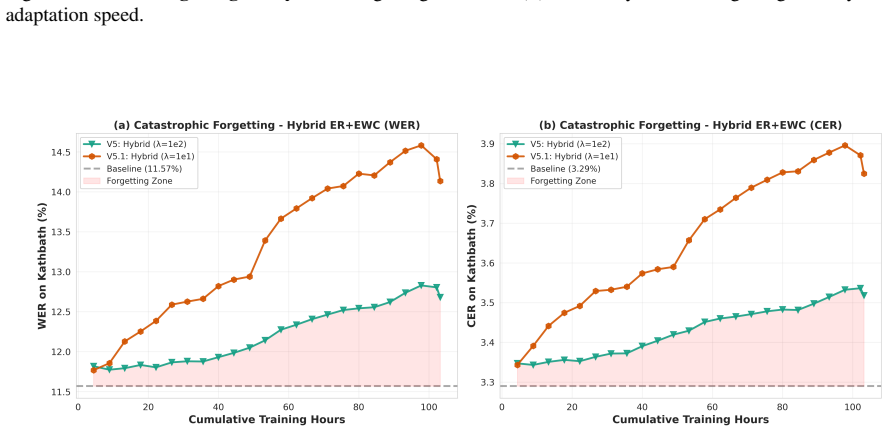
- EWC regularization, even with linearized Fisher importance, does not lower final error and can slightly worsen adaptation (the hybrid variant reaches 34.51% WER); its role is limited to tightening stability boundaries.
- A domain-specific 4-gram language model cannot substitute for acoustic adaptation: baseline plus LM scores 34.96% WER versus 30.26% for adapted plus LM, showing acoustic mismatch is the primary bottleneck.
- The 8 kHz telephony mismatch creates an 'acoustic bottleneck' around 34% WER; further gains will require front-end processing or linguistic context, not just more of the same adaptation.
Reading between the lines
- The abstract's claim that negative λ acts as a directional plasticity signal under replay is not demonstrated by any experiment in the body, which only tests λ>0; this remains an unverified hypothesis that would need explicit λ<0 runs.
- If the Gram Vaani proxy is not representative of true clinical telephony (e.g., real doctor-patient calls with medical terminology, overlapping speech, or different noise), the 17.1% gain may not transfer; a direct evaluation on a clinical corpus is the natural next test.
- The success of replay suggests that in low-resource clinical settings, collecting a small, curated buffer of hard examples from the target domain may be more valuable than sophisticated regularization; this could be tested by varying buffer composition and size.
Signed reviews
Editorial analysis
A structured set of objections, weighed in public.
Referee Report
Summary. The paper addresses the 'reality gap' between clean-condition ASR and noisy, 8 kHz telephonic speech encountered in rural Indian helplines, using Gram Vaani as a proxy for clinical telephony. The authors quantify a 40.94% baseline WER with IndicWav2Vec, then evaluate a progression of on-device continual adaptation strategies under LoRA: naive fine-tuning (V1.1), single- and multi-domain experience replay (V2.1, V3.1), EWC with Absolute Fisher importance (V4.5), and a hybrid ER+EWC framework (V5.1). The body-level result is that Multi-Domain ER provides the strongest adaptation, giving 33.94% target WER (17.1% relative improvement) and reducing catastrophic forgetting by 55% relative to naive fine-tuning, while EWC only modulates stability-plasticity dynamics without changing final performance. A separate LM spot check shows acoustic adaptation remains necessary even with a domain-specific 4-gram language model.
Significance. If the central comparison were cleanly identified, the paper would make a useful empirical contribution: it provides a reproducible, privacy-preserving continual-adaptation recipe for low-resource telephony ASR, with a held-out evaluation on the official Gram Vaani evaluation set, detailed hyperparameter tables, algorithmic pseudocode, and hardware benchmarks. The finding that data-level replay matters more than parameter-level regularization in this LoRA-based regime is practically valuable. However, the body's main comparisons are confounded by simultaneous changes in LoRA rank and EWC regularization strength, and the abstract's central mechanistic claim about negative λ has no corresponding experiment in the body. The clinical framing is also broader than the evidence supports, as the authors themselves concede in Section 8. The engineering result may be sound, but the paper as written does not cleanly establish its headline claims.
major comments (4)
- [§4.2.2, Table 4] The central comparison between Naive (V1.1) and Multi-Domain ER (V3.1) changes two variables at once: the naive baseline uses LoRA rank r=16/α=32, while all other strategies use r=24/α=48. The text in §4.2.2 explicitly says the rank was increased 'to accommodate the dual-task nature of rehearsal.' Thus the 34.00%→33.94% target-WER improvement and the forgetting reduction from 5.93 to 2.66 absolute WER could be partly a capacity effect, and the conclusion that replay is the driver is not cleanly identified. A naive fine-tuning control at r=24/α=48 is required to attribute the gains to replay.
- [§5.3, Table 4] The hybrid V5.1 uses λ=100 while EWC-only V4.5 uses λ=10. The paper interprets V5.1's higher target WER (34.51% vs. 33.94%) as evidence that 'EWC can oppose replay-driven updates' and that LoRA plus EWC creates a 'bottleneck,' but a 10× larger λ alone could produce exactly this plasticity loss without any interaction effect. Without matching λ or sweeping λ within the hybrid, the interaction claim in §5.3 and the conclusion that 'EWC modulates stability-plasticity dynamics without altering final performance' are not supported.
- [Abstract vs. Sections 3–5] The abstract states as a central finding that negative λ (λ<0) acts as a directional control signal and that a scheduled λ enables phase-dependent control of stability and plasticity. No experiment in the body uses negative λ or a λ schedule. Section 5.7.1 only explores positive values (λ≥10). This is a load-bearing claim of the abstract that is entirely absent from the methods and results; it should either be removed or supported by the missing experiments.
- [§8.1, §8.2, §8.4] The clinical-telephony framing is broader than the evidence. Section 8.1 admits WER/CER do not weight clinical significance; Section 8.2 admits the continual learning loop assumes a stream of corrected clinician transcripts that may be sparse; Section 8.4 limits the study to rural Hindi. Given the title and abstract repeatedly refer to 'clinical telephony' and 'patient speech,' the conclusions should be scoped as proxy-study results. This is not a rejection of the engineering contribution, but it is a substantive limitation on the deployment claims made in §5.6 and the conclusion.
minor comments (5)
- [References] Chiu et al. 2018a and 2018b are identical references; one should be removed. Also, the title 'Indicsuperb' in reference Javed et al. 2023 should be 'IndicSUPERB' for consistency.
- [Author block] The author block contains an email address 'f20230609@pilani.bits-pilani.ac.in' that appears to be a stray artifact from submission; it should be removed or moved to a footnote.
- [§5.7.2] The warmup comparison (100-step vs. 10-step) is described in prose but not tied to any table or figure, and the claimed '<0.05% difference' lacks supporting evidence in the reported results. Please add a small table or state which runs are being compared.
- [Figures] Figures 1 and 3 are referenced for the stability-plasticity analysis, but the axis labels and legend entries (e.g., which curve corresponds to V3.1) are difficult to read in the provided text. Please improve figure clarity and explicitly report the final values plotted.
- [§3.3] Equation (3) defines Absolute Fisher using accumulated absolute gradients, but the text does not specify whether the gradients are averaged over the replay buffer, the current stream, or both. Algorithm 1 says D_train, which already includes buffer samples; please clarify the exact data used for importance estimation.
Circularity Check
No circularity: the headline results are measured on held-out evaluation partitions; the confounds and abstract/body mismatch are validity concerns, not circular derivation.
full rationale
No significant circularity found. The paper's central claims are experimental measurements on held-out data: target WER is reported on the official GV_Eval_3h partition and forgetting on the full Kathbath validation set (Section 4.1.2, Table 1), not quantities that are equal to fitted parameters by construction. The 17.1% relative improvement and 55% forgetting reduction are measured outcomes relative to a fixed pre-trained baseline. The replay buffer does mine 'hard' examples using the target-domain CTC loss (Algorithm 2; Eq. 2), but that loss is used only to select training samples; the reported target WER is computed on the disjoint held-out evaluation set, so the result is not definitionally forced. The mechanism claims in Section 5.3 rest on comparisons that vary LoRA rank (V1.1 uses r=16/alpha=32 while V2.1/V3.1/V4.5/V5.1 use r=24/alpha=48) and on different EWC strengths (V4.5 lambda=10 vs V5.1 lambda=100), which is a confound/internal-validity issue rather than circularity. The abstract's lambda<0 claim has no corresponding body experiment, and the paper itself flags the clinical-proxy, clinician-supervision, and language-scope limitations (Sections 8.1, 8.2, 8.4); these are support or external-validity gaps, not circular derivations. No load-bearing self-citation appears: cited prior work (Hu et al. 2022; Chaudhry et al. 2019; Benzing 2021; Javed et al. 2022, 2025) is external to the current author list and is used to attribute standard methods, not to supply an unverified uniqueness theorem or to forbid alternative explanations. The derivation chain is therefore self-contained as an empirical study and does not reduce to its inputs.
Assumptions & free parameters
free parameters (5)
- EWC regularization strength λ =
10 (V4.5 EWC-only); 100 (V5.1 hybrid)
- LoRA rank r and scaling α =
r=16, α=32 (Naive V1.1); r=24, α=48 (all others)
- Replay buffer size and composition =
400 target (V2.1); 300 target + 300 general (V3.1/V5.1)
- Replay mixing ratio γ (Eq. 2) =
not reported
- Hard-example threshold τ and 60/40 selection rule =
τ not reported; 60% hard / 40% random
assumptions (5)
- domain assumption Gram Vaani helpline audio is a faithful proxy for clinical telephony
- domain assumption A stream of corrected clinician transcripts is available for adaptation
- domain assumption WER/CER quantify clinically relevant transcription quality
- standard math Absolute Fisher diagonal approximates true parameter importance
- standard math LoRA low-rank updates plus frozen base weights preserve pre-trained knowledge
Cite this review
Pith. "Pith review of Navigating the Reality Gap: On-Device Continual Adaptation of ASR for Clinical Telephony." pith.science (2026). https://pith.science/paper/HCNJR4MI
@misc{pith2026251216401,
  author       = {Pith},
  title        = {Pith review of: Navigating the Reality Gap: On-Device Continual Adaptation of ASR for Clinical Telephony},
  year         = {2026},
  howpublished = {\url{https://pith.science/paper/HCNJR4MI}},
  note         = {Machine review of arXiv:2512.16401}
}
abstract
Automatic Speech Recognition (ASR) can significantly reduce documentation burden in clinical workflows, but standard models degrade sharply in real-world telephony settings where noisy audio, dialectal variation, and strict data residency constraints prevent cloud-based adaptation. We study this "reality gap" using Gram Vaani: a telephonic Hindi corpus spanning rural healthcare and agricultural helplines, as the closest available proxy for clinical speech under strict on-device constraints. We show that a robust multilingual model (IndicWav2Vec) degrades from 11.59\% WER on standard clean Hindi to \textbf{41.71\% WER} on this proxy telephony data. We evaluate a progression of on-device adaptation regimes under realistic constraints, from full fine-tuning to parameter-efficient LoRA and stream-based continual learning, across multiple baselines, datasets, and seeds. Focusing on continual learning, our central finding highlights a critical interaction between Experience Replay (ER) and Elastic Weight Consolidation (EWC, parameterized by regularization strength $\lambda$). We show that standard positive EWC ($\lambda > 0$) can oppose replay-driven updates, limiting adaptation. Reversing EWC's strength ($\lambda < 0$) suggests that it can act as a directional control signal under ER-guided adaptation: negative $\lambda$ reinforces replay-driven plasticity, while a scheduled $\lambda$ enables phase-dependent control of stability and plasticity. Across evaluations on multiple datasets, we find that multi-domain replay provides a strong foundation for adaptation, while EWC modulates stability-plasticity dynamics without altering final performance. These results show that effective on-device adaptation depends on understanding how data-driven and parameter-level learning signals interact, rather than choosing methods in isolation.
Figures


Figures from the paper (10 more)


Reference graph
Works this paper leans on
-
[2019]
InInterspeech 2019, pages 3416–3420
Speech audio super-resolution for speech recognition. InInterspeech 2019, pages 3416–3420. Yin-Tse Lin, Bo-Hao Su, Chi-Han Lin, Shih-Chan Kuo, Jyh-Shing Roger Jang, and Chi-Chun Lee. 2023. 8 Noise-robust bandwidth expansion for 8k speech recordings. InInterspeech 2023, pages 5107–5111. Michael McCloskey and Neal J. Cohen. 1989. Catas- trophic interference...
arXiv 2019
-
[2025]
InInterspeech 2025, pages 918–922
NIRANTAR: Continual Learning with New Languages and Domains on Real-world Speech Data. InInterspeech 2025, pages 918–922. Tahir Javed, Kaushal Bhogale, Abhigyan Raman, Pratyush Kumar, Anoop Kunchukuttan, and Mitesh Khapra. 2023. Indicsuperb: A speech processing uni- versal performance benchmark for indian languages. Proceedings of the AAAI Conference on A...
2025
Reviewed August 3, 2026 · model on record in the stance chip above.
Discussion (0). Continue with ORCID to comment.