Minimal Proton-Mass Dark Matter
Pith reviewed 2026-06-26 16:31 UTC · model grok-4.3
The pith
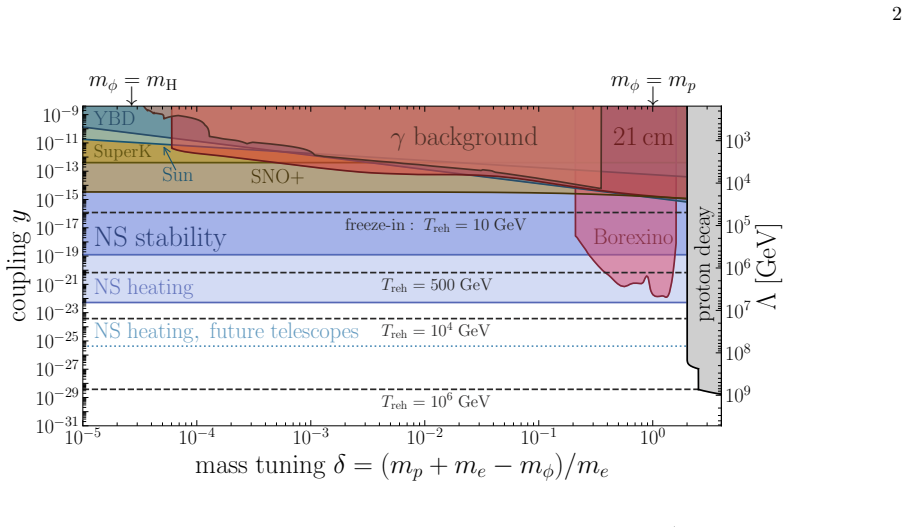
Requiring absolute stability of both the proton and dark matter forces the dark matter mass into a narrow window around the proton mass.
A machine-rendered reading of the paper's core claim, the machinery that carries it, and where it could break.
Core claim
A single complex scalar carrying baryon and lepton number interacts through a dimension-7 semileptonic portal. Below the confinement scale the portal generates a low-energy Yukawa coupling with the proton and electron. Requiring absolute stability of both the proton and the scalar then forces the scalar mass into a narrow window around the proton mass.
What carries the argument
The dimension-7 semileptonic portal operator that induces a low-energy Yukawa coupling between the scalar, the proton, and the electron.
If this is right
- Proton burning occurs inside stars at observable rates.
- Hydrogen decay produces heating in brown dwarfs and neutron stars.
- Nucleon-decay-like signatures appear in direct-detection experiments.
- UV-dominated freeze-in produces the observed relic abundance.
- Multiple independent observables can test the model despite its minimal field content.
Where Pith is reading between the lines
- The mass coincidence may address part of the observed similarity between dark-matter and baryon densities.
- Searches for rare proton decays or anomalous heating in compact objects could directly probe the allowed mass window.
- The lack of an extra stabilizing symmetry makes the longevity of the dark matter depend entirely on the structure of the portal.
Load-bearing premise
The dimension-7 semileptonic portal is the leading interaction and proton stability alone protects the dark matter without any additional exact symmetry.
What would settle it
Discovery of a dark matter particle whose mass lies well outside the narrow window around the proton mass, or the absence of the predicted proton-burning rates in stars and heating signals in neutron stars.
Figures
read the original abstract
We present a minimal dark matter scenario: a single complex scalar carrying baryon and lepton number, with no new exact stabilizing symmetry. Its leading interaction is a dimension-7 semileptonic portal that, below confinement, generates a low-energy Yukawa coupling with the proton and electron. Requiring absolute stability of both the proton and dark matter forces the dark matter mass into a narrow window around the proton mass, which may be anthropically selected. Despite its minimal field content, the model can be probed by many observables: proton burning in stars, hydrogen decay, brown dwarfs and neutron star heating, and nucleon decay-like signatures in direct detection. UV-dominated freeze-in produces the observed relic abundance. This framework provides a unique testable example of dark matter arising from a minimal extension of the Standard Model.
Editorial analysis
A structured set of objections, weighed in public.
Referee Report
Summary. The paper proposes a minimal dark matter scenario consisting of a single complex scalar carrying baryon and lepton number, with no new exact stabilizing symmetry. Its leading interaction is a dimension-7 semileptonic portal that generates a low-energy Yukawa coupling to the proton and electron below confinement. Requiring absolute stability of both the proton and the dark matter candidate restricts the dark matter mass to a narrow window around the proton mass (potentially anthropically selected). The observed relic abundance is achieved via UV-dominated freeze-in, and the model predicts multiple signatures including proton burning in stars, hydrogen decay, neutron star heating, and nucleon decay-like signals in direct detection.
Significance. If the central assumptions hold, the work provides a distinctive, testable example of dark matter arising from a minimal SM extension by directly linking DM stability and mass scale to proton stability without additional symmetries. The anthropic selection possibility for the mass window and the breadth of observable probes (astrophysical and direct detection) would make the result significant for dark matter phenomenology and baryon-number violating processes.
major comments (2)
- [Abstract] Abstract: the stability argument and freeze-in production are stated without explicit derivation, coupling values, or error estimates; the central claim of the narrow mass window and relic density therefore rests on unshown steps.
- [Model setup] The assumption that the dimension-7 semileptonic portal is the leading interaction (with no lower-dimensional operators or additional exact stabilizing symmetry) is load-bearing for the claim that proton stability alone protects the DM candidate; this requires explicit justification or a UV completion argument to support the mass window.
minor comments (2)
- Clarify the precise numerical range of the allowed mass window and the value of the dimension-7 operator coefficient needed for the observed relic density.
- Define notation for the dark matter field and the portal operator at first use.
Simulated Author's Rebuttal
We thank the referee for the thorough review and valuable feedback. We address each major comment below and will make revisions to improve clarity and completeness where the points identify gaps in the presentation.
read point-by-point responses
-
Referee: [Abstract] Abstract: the stability argument and freeze-in production are stated without explicit derivation, coupling values, or error estimates; the central claim of the narrow mass window and relic density therefore rests on unshown steps.
Authors: We agree the abstract is highly condensed and does not contain derivations or numerical values. The stability constraint leading to the narrow mass window around the proton mass is derived in Section 2 by enumerating decay channels forbidden only when m_DM lies within ~few MeV of m_p. The UV freeze-in calculation, including the temperature dependence and the resulting relic density for the dimension-7 coupling, appears in Section 4 with explicit integrals and benchmark values (coupling ~10^{-9}–10^{-10} for the observed abundance). We will revise the abstract to reference these sections and include approximate numerical statements for the mass window and coupling range. revision: yes
-
Referee: [Model setup] The assumption that the dimension-7 semileptonic portal is the leading interaction (with no lower-dimensional operators or additional exact stabilizing symmetry) is load-bearing for the claim that proton stability alone protects the DM candidate; this requires explicit justification or a UV completion argument to support the mass window.
Authors: The manuscript already lists all gauge-invariant operators up to dimension 7 consistent with the assigned B and L charges of the scalar and shows that any lower-dimensional operator either violates SM gauge invariance, induces rapid proton decay (already excluded), or would require an additional exact symmetry that we explicitly do not introduce. We will expand this discussion with an explicit enumeration table of forbidden lower-dimensional operators and add a short paragraph sketching a possible UV completion (e.g., tree-level exchange of a heavy vector-like fermion that generates the dimension-7 operator after integration). revision: yes
Circularity Check
No significant circularity
full rationale
The paper's central derivation—that absolute stability of both proton and DM candidate restricts the DM mass to a narrow window around m_p—follows directly from kinematic thresholds on the dim-7-induced decays (p → DM + e and DM → p + e). This is a model assumption plus phase-space constraint, not a self-definition, fitted input renamed as prediction, or reduction to self-citation. The relic density is stated to arise from UV freeze-in, with the operator coefficient implicitly chosen to match the observed value; this is standard parameter adjustment rather than a claimed first-principles prediction that collapses to the input. No load-bearing self-citations, uniqueness theorems imported from the authors' prior work, or smuggled ansatze appear in the derivation chain. The framework is self-contained once the leading-operator assumption is granted.
Axiom & Free-Parameter Ledger
free parameters (1)
- dimension-7 operator coefficient
axioms (2)
- domain assumption No new exact stabilizing symmetry is added beyond the Standard Model gauge symmetries.
- domain assumption The dimension-7 semileptonic portal is the leading interaction.
invented entities (1)
-
complex scalar carrying baryon and lepton number
no independent evidence
Reference graph
Works this paper leans on
-
[1]
Alexander et al.,Dark Sectors 2016 Workshop: Community Report, 8, 2016,1608.08632
J. Alexander et al.,Dark Sectors 2016 Workshop: Community Report, 8, 2016,1608.08632
Pith/arXiv arXiv 2016
-
[2]
Cooley et al.,Report of the Topical Group on Particle Dark Matter for Snowmass 2021,2209.07426
J. Cooley et al.,Report of the Topical Group on Particle Dark Matter for Snowmass 2021,2209.07426
arXiv 2021
- [3]
-
[4]
L. J. Hall, K. Jedamzik, J. March-Russell and S. M. West,Freeze-In Production of FIMP Dark Matter, JHEP03(2010) 080 [0911.1120]
Pith/arXiv arXiv 2010
-
[5]
F. Elahi, C. Kolda and J. Unwin,UltraViolet Freeze-in, JHEP03(2015) 048 [1410.6157]. [7]Super-KamiokandeCollaboration, Y. Fukuda et al., The Super-Kamiokande detector,Nucl. Instrum. Meth. A501(2003) 418. [8]SNO+Collaboration, A. Allega et al.,Improved search for invisible modes of nucleon decay in water with the SNO+detector,Phys. Rev. D105(2022) 112012 [...
Pith/arXiv arXiv 2015
-
[6]
Y. Aoki, T. Izubuchi, E. Shintani and A. Soni,Improved lattice computation of proton decay matrix elements, Phys. Rev. D96(2017) 014506 [1705.01338]
Pith/arXiv arXiv 2017
-
[7]
Proton decay is constrained by visible decaysp→e +Xin Super-Kamiokande [7] asτ >7.9×10 32 yr only if the positron has energy above the Cherenkov threshold ECh ≃0.775 MeV
The proton decay rate in our model is τ −1 = y2 64πm3p (m2 p +m 2 e −m 2 ϕ)λ1/2(m2 p, mϕ, me), whereλ(a, b, c)≡[a−(b+c) 2][a−(b−c) 2]. Proton decay is constrained by visible decaysp→e +Xin Super-Kamiokande [7] asτ >7.9×10 32 yr only if the positron has energy above the Cherenkov threshold ECh ≃0.775 MeV. Otherwise, the bound by SNO+ [8] on invisible proto...
-
[8]
B. W. Lee and S. Weinberg,Cosmological Lower Bound on Heavy Neutrino Masses,Phys. Rev. Lett.39(1977) 165
1977
-
[9]
P. Bandyopadhyay, E. J. Chun and J.-C. Park, Right-handed sneutrino dark matter inU(1) ′ seesaw models and its signatures at the LHC,JHEP06(2011) 129 [1105.1652]
Pith/arXiv arXiv 2011
-
[10]
M. Farina, D. Pappadopulo, J. T. Ruderman and G. Trevisan,Phases of Cannibal Dark Matter,JHEP12 (2016) 039 [1607.03108]
Pith/arXiv arXiv 2016
-
[11]
J. A. Dror, E. Kuflik and W. H. Ng,Codecaying Dark Matter,Phys. Rev. Lett.117(2016) 211801 [1607.03110]
Pith/arXiv arXiv 2016
-
[12]
J. M. Cline, H. Liu, T. Slatyer and W. Xue,Enabling Forbidden Dark Matter,Phys. Rev. D96(2017) 083521 [1702.07716]
Pith/arXiv arXiv 2017
-
[13]
Berlin,WIMPs with GUTs: Dark Matter Coannihilation with a Lighter Species,Phys
A. Berlin,WIMPs with GUTs: Dark Matter Coannihilation with a Lighter Species,Phys. Rev. Lett. 119(2017) 121801 [1704.08256]
Pith/arXiv arXiv 2017
-
[14]
E. D. Kramer, E. Kuflik, N. Levi, N. J. Outmezguine and J. T. Ruderman,Heavy Thermal Dark Matter from a New Collision Mechanism,Phys. Rev. Lett.126 (2021) 081802 [2003.04900]
arXiv 2021
-
[15]
R. Frumkin, E. Kuflik, I. Lavie and T. Silverwater, Roadmap to Thermal Dark Matter beyond the Weakly Interacting Dark Matter Unitarity Bound,Phys. Rev. Lett.130(2023) 171001 [2207.01635]
arXiv 2023
-
[16]
Khalaf, E
M. Khalaf, E. Kuflik, A. Lenoci, H. Murayama and E. Vitagliano,Freeze-out from Assisted Decays,To appear(2026)
2026
-
[17]
E. G. Adelberger et al.,Solar fusion cross sections II: the pp chain and CNO cycles,Rev. Mod. Phys.83 (2011) 195 [1004.2318]. [21]IAU Inter-Division A-G Working Group on Nominal Units for Stellar & Planetary AstronomyCollaboration, E. E. Mamajek et al.,IAU 2015 Resolution B3 on Recommended Nominal Conversion Constants for Selected Solar and Planetary Prop...
Pith/arXiv arXiv 2011
-
[18]
N. Vinyoles, A. M. Serenelli, F. L. Villante, S. Basu, J. Bergstr¨ om, M. C. Gonzalez-Garcia, M. Maltoni, C. Pe˜ na-Garay and N. Song,A new Generation of Standard Solar Models,Astrophys. J.835(2017) 202 [1611.09867]
Pith/arXiv arXiv 2017
-
[19]
P. Gondolo and G. G. Raffelt,Solar neutrino limit on axions and keV-mass bosons,Phys. Rev. D79(2009) 107301 [0807.2926]
Pith/arXiv arXiv 2009
-
[20]
N. Vinyoles, A. Serenelli, F. L. Villante, S. Basu, J. Redondo and J. Isern,New axion and hidden photon constraints from a solar data global fit,JCAP10(2015) 015 [1501.01639]
Pith/arXiv arXiv 2015
-
[21]
S. K. Leggett, P. Tremblin, T. L. Esplin, K. L. Luhman and C. V. Morley,The Y-type Brown Dwarfs: Estimates of Mass and Age from New Astrometry, Homogenized Photometry, and Near-infrared Spectroscopy,Astrophys. J.842(2017) 118 [1704.03573]
Pith/arXiv arXiv 2017
-
[22]
E. L. Wright et al.,The Wide-field Infrared Survey Explorer (WISE): Mission Description and Initial On-orbit Performance,Astron. J.140(2010) 1868 [1008.0031]
Pith/arXiv arXiv 2010
-
[23]
J. C. Beam´ ın, V. D. Ivanov, A. Bayo, K. Muˇ zi´ c, H. M. J. Boffin, F. Allard, D. Homeier, D. Minniti, M. Gromadzki, R. Kurtev, N. Lodieu, E. L. Martin and R. A. Mendez,Temperature constraints on the coldest brown dwarf known: WISE 0855-0714,Astronomy and Astrophysics570(2014) L8 [1408.5424]
Pith/arXiv arXiv 2014
-
[24]
C. G. Tinney, J. K. Faherty, J. D. Kirkpatrick, M. Cushing, C. V. Morley and E. L. Wright,The Luminosities of the Coldest Brown Dwarfs,Astrophys. J.796(2014) 39 [1410.0746]
Pith/arXiv arXiv 2014
-
[25]
K. L. Luhman,Discovery of a 250 k brown dwarf at 2 pc from the sun,The Astrophysical Journal Letters786 (2014) L18
2014
-
[26]
M. J. Rowland, C. V. Morley, B. E. Miles, G. Suarez, J. K. Faherty, A. J. Skemer, S. A. Beiler, M. R. Line, G. L. Bjoraker, J. J. Fortney et al.,Protosolar d-to-h abundance and one part per billion ph3 in the coldest brown dwarf,The Astrophysical Journal Letters977 (2024) L49
2024
-
[27]
Leggett,The coldest known y dwarfs: Estimates of their effective temperatures,The Astrophysical Journal 7 1002(2026) 113
S. Leggett,The coldest known y dwarfs: Estimates of their effective temperatures,The Astrophysical Journal 7 1002(2026) 113
2026
-
[28]
G. Baym, D. H. Beck, P. Geltenbort and J. Shelton, Testing dark decays of baryons in neutron stars,Phys. Rev. Lett.121(2018) 061801 [1802.08282]
Pith/arXiv arXiv 2018
-
[29]
D. McKeen, A. E. Nelson, S. Reddy and D. Zhou, Neutron stars exclude light dark baryons,Phys. Rev. Lett.121(2018) 061802 [1802.08244]
Pith/arXiv arXiv 2018
-
[30]
Y. Liu, Z. Liu, M. Pospelov and S. Reddy,Constraints on Symmetric Dark Matter from Neutron Star Capture and Collapse,2508.04961
-
[31]
M. Divaris and C. C. Moustakidis,Neutron Dark Decay in Neutron Stars: The Role of the Symmetry Energy, 2508.21754
-
[32]
T. Brugeat and C. Smith,Dark-matter induced neutron-antineutron oscillations,JHEP01(2025) 132 [2412.06434]
arXiv 2025
-
[33]
M. Bastero-Gil, T. Huertas-Roldan and D. Santos, Neutron decay anomaly, neutron stars, and dark matter, Phys. Rev. D110(2024) 083003 [2403.08666]
arXiv 2024
-
[34]
W. Husain and A. W. Thomas,Novel neutron decay mode inside neutron stars,J. Phys. G50(2023) 015202 [2206.11262]
arXiv 2023
-
[35]
L. Brandes, W. Weise and N. Kaiser,Evidence against a strong first-order phase transition in neutron star cores: Impact of new data,Phys. Rev. D108(2023) 094014 [2306.06218]
arXiv 2023
-
[36]
B. Fore, N. Kaiser, S. Reddy and N. C. Warrington, Mass of charged pions in neutron-star matter,Phys. Rev. C110(2024) 025803 [2301.07226]
arXiv 2024
-
[37]
D. F. G. Fiorillo, ´A. Gil Muyor, H.-T. Janka, G. G. Raffelt and E. Vitagliano,Axion-photon conversion in transient compact stars: Systematics, constraints, and opportunities,JCAP03(2026) 053 [2509.13322]
Pith/arXiv arXiv 2026
-
[38]
A. Akmal, V. R. Pandharipande and D. G. Ravenhall, The Equation of state of nucleon matter and neutron star structure,Phys. Rev. C58(1998) 1804 [nucl-th/9804027]
Pith/arXiv arXiv 1998
- [39]
- [40]
-
[41]
S. Guillot, G. G. Pavlov, C. Reyes, A. Reisenegger, L. Rodriguez, B. Rangelov and O. Kargaltsev,Hubble Space Telescope Nondetection of PSR J2144–3933: The Coldest Known Neutron Star,Astrophys. J.874(2019) 175 [1901.07998]
Pith/arXiv arXiv 2019
-
[42]
The LUVOIR Team,The LUVOIR Mission Concept Study Final Report,arXiv e-prints(2019) arXiv:1912.06219 [1912.06219]
arXiv 2019
-
[43]
J. R. Peterson,Dark energy studies with lsst image simulations, final report, tech. rep., Purdue Univ., West Lafayette, IN (United States), 07, 2016. 10.2172/1272167
-
[44]
H. T. Diehl,The dark energy survey and operations: Year 6 – the finale, tech. rep., SLAC National Accelerator Laboratory (SLAC), Menlo Park, CA (United States); Fermi National Accelerator Laboratory (FNAL), Batavia, IL (United States), 01, 2020. 10.2172/1596042
-
[45]
J. Green et al.,Wide-Field InfraRed Survey Telescope (WFIRST) Final Report,arXiv e-prints(2012) arXiv:1208.4012 [1208.4012]
Pith/arXiv arXiv 2012
-
[46]
D. McKeen and M. Pospelov,How Long Does the Hydrogen Atom Live?,Universe9(2023) 473 [2003.02270]. [51]BorexinoCollaboration, M. Agostini et al.,A test of electric charge conservation with Borexino,Phys. Rev. Lett.115(2015) 231802 [1509.01223]. [52]JUNOCollaboration, A. Abusleme et al.,Radioactivity control strategy for the JUNO detector,JHEP11(2021) 102 [...
arXiv 2023
-
[47]
N. B. Bekhti et al.,HI4PI: a full-sky H i survey based on EBHIS and GASS,Astron. Astrophys.594(2016) [1610.06175]
Pith/arXiv arXiv 2016
-
[48]
S. Porras-Bedmar, M. Meyer and D. Horns,Novel bounds on decaying axionlike particle dark matter from the cosmic background,Phys. Rev. D110(2024) 103501 [2407.10618]
arXiv 2024
-
[49]
F. Cima and F. D’Eramo,Probing non-minimal dark sectors via the 21 cm line at cosmic dawn,JCAP02 (2026) 020 [2507.10664]. [57]Hyper-KamiokandeCollaboration, K. Abe et al., Hyper-Kamiokande Design Report,1805.04163
arXiv 2026
-
[50]
Similar signals from dark-matter-induced nucleon destruction have been discussed in Refs. [59–61]
-
[51]
H. Davoudiasl, D. E. Morrissey, K. Sigurdson and S. Tulin,Baryon Destruction by Asymmetric Dark Matter,Phys. Rev. D84(2011) 096008 [1106.4320]
Pith/arXiv arXiv 2011
-
[52]
J. Huang and Y. Zhao,Dark Matter Induced Nucleon Decay: Model and Signatures,JHEP02(2014) 077 [1312.0011]
Pith/arXiv arXiv 2014
-
[53]
N. F. Bell, P. Cox, J. L. Newstead and M. B. G. Verde, Dark matter induced nucleon decay through the neutron portal,Phys. Rev. D113(2026) 055033 [2511.18722]
arXiv 2026
-
[54]
R. D. Peccei,Chiral lagrangian calculation of pion-nucleon scattering lengths,Phys. Rev.176(1968) 1812
1968
-
[55]
Pich,Chiral perturbation theory,Reports on Progress in Physics58(1995) 563–609
A. Pich,Chiral perturbation theory,Reports on Progress in Physics58(1995) 563–609
1995
-
[56]
E. Epelbaum, J. Gegelia, U.-G. Meißner and D.-L. Yao, Baryon chiral perturbation theory extended beyond the low-energy region,Eur. Phys. J. C75(2015) 499 [1510.02388]
Pith/arXiv arXiv 2015
-
[57]
Bhattacharya et al.,QCD Phase Transition with Chiral Quarks and Physical Quark Masses,Phys
T. Bhattacharya et al.,QCD Phase Transition with Chiral Quarks and Physical Quark Masses,Phys. Rev. Lett.113(2014) 082001 [1402.5175]
Pith/arXiv arXiv 2014
-
[58]
M. Laine and M. Meyer,Standard Model thermodynamics across the electroweak crossover,JCAP 07(2015) 035 [1503.04935]
Pith/arXiv arXiv 2015
-
[59]
Page,NSCool: Neutron star cooling code, Astrophysics Source Code Library, record ascl:1609.009, Sept., 2016
D. Page,NSCool: Neutron star cooling code, Astrophysics Source Code Library, record ascl:1609.009, Sept., 2016
2016
-
[60]
L. Brandes and W. Weise,Constraints on Phase Transitions in Neutron Star Matter,Symmetry16 (2024) 111 [2312.11937]
arXiv 2024
-
[61]
J. M. Berryman, S. Gardner and M. Zakeri,How macroscopic limits on neutron-star baryon loss yield microscopic limits on non-standard-model baryon decay, Phys. Rev. D109(2024) 023021 [2305.13377]
arXiv 2024
-
[62]
B. L. Friman and O. V. Maxwell,Neutron Star Neutrino Emissivities,Astrophys. J.232(1979) 541
1979
-
[63]
S. Bottaro, A. Caputo and D. F. G. Fiorillo,Neutrino 8 emission in cold neutron stars: Bremsstrahlung and modified urca rates reexamined,JCAP11(2024) 015 [2406.18640]
arXiv 2024
-
[64]
D. F. G. Fiorillo, A. Lella, C. A. J. O’Hare and E. Vitagliano,Leading Bounds on Micrometer to Picometer Fifth Forces from Neutron Star Cooling, Phys. Rev. Lett.135(2025) 211003 [2506.19906]. [73]NANOGravCollaboration, H. T. Cromartie et al., Relativistic Shapiro delay measurements of an extremely massive millisecond pulsar,Nature Astron.4(2019) 72 [1904.06759]
arXiv 2025
-
[65]
Fonseca et al.,Refined Mass and Geometric Measurements of the High-mass PSR J0740+6620, Astrophys
E. Fonseca et al.,Refined Mass and Geometric Measurements of the High-mass PSR J0740+6620, Astrophys. J. Lett.915(2021) L12 [2104.00880]
arXiv 2021
-
[66]
T. E. Riley et al.,A NICER View of the Massive Pulsar PSR J0740+6620 Informed by Radio Timing and XMM-Newton Spectroscopy,Astrophys. J. Lett.918 (2021) L27 [2105.06980]
arXiv 2021
-
[67]
D. Gonzalez and A. Reisenegger,Internal Heating of Old Neutron Stars: Contrasting Different Mechanisms, Astron. Astrophys.522(2010) A16 [1005.5699]
Pith/arXiv arXiv 2010
-
[68]
Iwamoto,Axion Emission from Neutron Stars,Phys
N. Iwamoto,Axion Emission from Neutron Stars,Phys. Rev. Lett.53(1984) 1198
1984
-
[69]
D. F. G. Fiorillo, A. Lella, G. G. Raffelt, N. Selimovic and E. Vitagliano,Production of Leptophilic Bosons in Ultradegenerate Relativistic Matter,2605.24081
-
[70]
D. F. G. Fiorillo, A. Lella, G. G. Raffelt, N. Selimovic and E. Vitagliano,Neutron Star Bounds on Muonic Fifth Forces from Picometer to Kilometer Scales, 2605.24094. S1 Supplemental Material for the Letter:Minimal Proton-Mass Dark Matter In this Supplemental Material, we provide results complementing the content of the main text. In Section A, we collect ...
-
[71]
(S7) to numerically compute rates when three out of four particles are at equilibrium with the early universe plasma
+ cosθ 2s p λ(s, m1, m2) p λ(s, m3, m4).(S9) Unless specified otherwise, we use Eq. (S7) to numerically compute rates when three out of four particles are at equilibrium with the early universe plasma. II. Matrix elements, rates and cross sections Below, we list key quantities for all the binary scatterings considered in this work. The low energy Lagrangi...
-
[72]
depending on whether the external state is a proton or a neutron, respectively. Assumingm ϕ ≃m p, the scattering rate in them e ≪T≪ mπ temperature range and at next-to-next-to-leading order inm π/mp is given by γme≪T≪m π ϕπ↔N e ≃ g2 πN Ny2f2 N m9/2 π T 3 1024π4m7/2 p e −mp −mπ T 1− 7 2 mπ mp + 63 8 m2 π m2p .(S22) where we tookm N ≃m p for simplicity. Fro...
-
[73]
(S108) using Monte Carlo techniques
We show in Section E how to compute integrals like in Eq. (S108) using Monte Carlo techniques. In our notation, the proton conversion rate for the process P are obtained as γP =C m→n[|MP|2f1 . . . fm(1±f m+1). . .(1±f m+n)],(S109) i.e. the collision integral is evaluated over the squared matrix element times the phase space distribution of initial state p...
-
[74]
As before one performs a transformation, depending on the most adequate sampling, for momentadp i =j idxi
+eEX p e∆ 2(eE2 X −c 2 Y p2 X) .(S144) The difference with the in-vacuum case amounts to the substitutionE X → eEX andm i →m ∗ i . As before one performs a transformation, depending on the most adequate sampling, for momentadp i =j idxi. To evaluate the integral we randomly generate triples (x i, ci, ϕi) fori= 1, . . . , m+n−2 and construct their respecti...
discussion (0)
Sign in with ORCID, Apple, or X to comment. Anyone can read and Pith papers without signing in.