REVIEW 4 major objections 6 minor 27 references
TAG-INSTRUCT: Controlled Instruction Complexity Enhancement through Structure-based Augmentation
T0 review · 4 major / 6 minor · reviewed 2026-08-07 · deepseek-v4-flash
Pith's one-line read This paper claims that instruction complexity can be controlled by compressing instructions into a small semantic tag space, expanding that tag set with a policy trained on preference data, and then reconstructing harder instructions, so…
desk verdict Here's the short version: a clean tag-space augmentation pipeline, but the utility score is average response length dressed up as a Shapley value, and the missing 'Long is more' baseline leaves the causal claim untested. read the letter →
The pith
A machine-rendered reading of the paper's core claim, the machinery that carries it, and where it could break.
The reading
What carries the argument
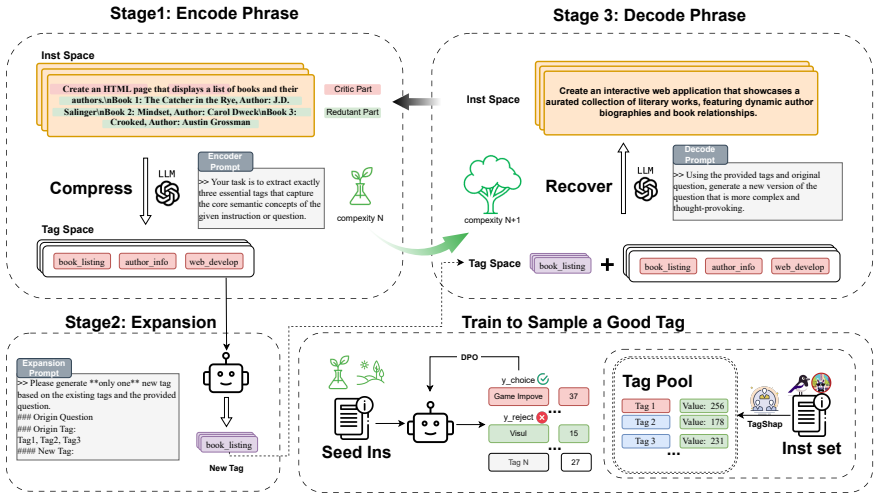
The load-bearing mechanism is the Compress-Operate-Reconstruct pipeline in a discrete tag space. Tags are short semantic labels such as book_listing, author_info, and web_develop; the tag set is expanded by a policy initialized from the teacher model and aligned with DPO, where preference pairs come from a Shapley-value estimate of tag utility (Equation 1: the average response length of instructions containing a tag). This machinery turns 'make this harder' from an unmeasurable prompt-level instruction into a scored, rankable operation on a small set of semantic atoms, and it is what the paper credits for controllability, stability across synthesis frameworks, and gains over raw-text augmentation.
What would settle it
Fine-tune two models on instructions decoded from high-utility and low-utility tags while forcing the paired responses to the same token length (for example, by truncating or generating to a fixed budget), then compare AlpacaEval 2 and Arena-Hard scores; if the gap vanishes, the utility signal is a length effect rather than semantic structure.
Extended reading notes
Core claim
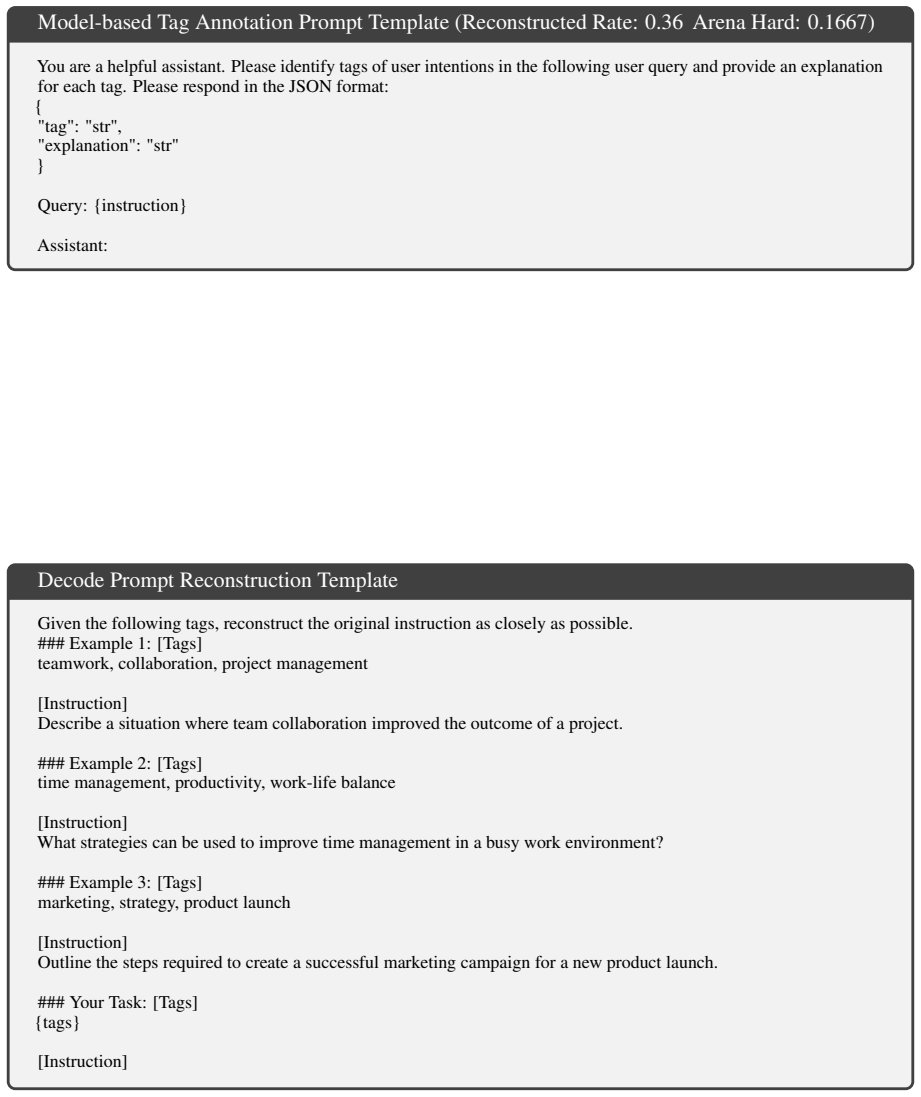
TAG-INSTRUCT's central claim is that complexity augmentation should happen on a compressed representation, not on raw text. An encoder prompt turns each instruction into exactly three semantic tags; a policy model trained with DPO on preference pairs generated from Shapley-value tag scores proposes new tags; and a decoder prompt reconstructs a harder instruction from the original text plus the expanded tag set. The paper scores each candidate tag's utility by the average response length of instructions containing that tag, treating response length as a proxy for instruction quality, and uses these scores to build chosen and rejected pairs for the tag-expansion policy. The reported consequence is that fine-tuning LLaMA-3-8B on 5K such augmented instructions outperforms prompt-based augmentation baselines and large datasets, and that high-utility tag combinations yield better downstream models than random or low-utility combinations even when the instructions themselves are shorter.
Load-bearing premise
The load-bearing premise is that response length is a valid proxy for instruction quality, so tags that predict longer responses are genuinely more useful for training, not merely markers of verbosity.
Editorial extensions
If this is right
- Instruction augmentation can be data-efficient: 5K tag-expanded conversations beat 52K Alpaca-Clean and 192K WizardLM data on the reported benchmarks.
- Tag-space operation yields quantitative control: choosing high-utility tags improves AlpacaEval 2 LC from 11.02% (low-utility) and 14.85% (random) to 20.21% in the tag-combination experiment.
- RL-guided tag expansion dominates prompt-based expansion at matched instruction length, producing longer responses and higher benchmark scores.
- The method transfers to different teacher models and base models, with stronger teachers giving larger gains.
Reading between the lines
- A skeptical reading is that response length, not semantic structure, may be the active ingredient: the paper's reward signal is average response length, and its ablations show longer responses tracking higher scores, so the tag machinery might be an elaborate way to select for longer-output instructions.
- The approximation of Shapley value by per-tag mean response length ignores interactions between tags; a full cooperative estimate that includes subset effects could rank tags differently and possibly improve amplification further.
- A clean test would hold response length fixed while comparing high- and low-utility tags; if the performance gap collapses, the causal claim collapses to a length effect rather than semantic utility.
- The paper's own limitation note flags that response-length utility may mislead in specialized domains like code and math, where concise correct answers are high quality; applying the same pipeline there could prefer verbose tags and degrade results.
Editorial analysis
A structured set of objections, weighed in public.
Referee Report
Summary. The paper proposes TAG-INSTRUCT, a three-stage instruction augmentation method that encodes instructions into a compact tag representation, expands the tag set using a policy trained with DPO, and decodes the expanded tags into a more complex instruction. The policy is trained on preference pairs in which tag utility is measured as the average response length of instructions containing that tag (Equation 1). The authors evaluate on Alpaca-5k with LLaMA-3-8B and LLaMA-3.2-3B as base models and Ministral-8B and Qwen2.5-72B as teachers, reporting AlpacaEval 2.0 Length Control win rate, Arena-Hard, and MT-Bench improvements over Evol-Instruct, Tree-Instruct, Auto-Instruct-Evol, and CodecLM, with the largest gain (42.76% LC) under the Qwen teacher.
Significance. The work targets an important problem, controlled instruction complexity augmentation, and the tag-space operationalization is a plausible way to reduce the search space for augmentation. The authors provide a public code repository and a fairly broad set of ablations, including iterative analyses, prompt-design comparisons, and tag-semantics analysis. However, the central mechanism is currently confounded with response length: the utility signal is defined as average response length, and the experiments do not include the length-based baselines needed to separate structure-based gains from the known 'long is more' effect. The significance of the paper therefore depends on whether the requested controls are added; as written, the evidence supports a correlation with length rather than a causal role for structured tag-space control.
major comments (4)
- [Section 3.4, Eq. (1)] Equation (1) defines phi_i as the average response length of instructions containing tag i, which is not a Shapley value; a Shapley value requires averaging marginal contributions v(S union {z_i}) - v(S) over subsets S. The 'Shapley' terminology is used pervasively in Section 3.4, Section 5.2, and Table 6 to justify the utility estimate, but the actual estimator ignores tag interactions entirely. Please either compute a genuine marginal-contribution estimate or rename the quantity 'average response length' and reframe the contribution accordingly.
- [Section 3.4 and Tables 2 and 4] The paper's causal claim that structured tag-space operations improve complexity beyond response-length effects is untested. Because the reward is response length, and because Tables 2 and 4 show that higher-utility settings generate longer responses (1037.0 versus 1006.7 tokens in Table 2; 967.5 versus 861.4 versus 524.9 tokens in Table 4), the headline gains may be attributable to the well-known 'long is more' effect (Zhao et al., 2024), which the paper cites but never includes as a baseline. Please add a baseline that augments Alpaca-5k with longer teacher responses without tag manipulation, and report response lengths for every method in Tables 1 and 5.
- [Section 4.3 and Table 2] The ablation in Table 2 does not isolate the RL policy. The table header compares 'Prompt-based' with 'RL-based' tag expansion, but the accompanying text describes the comparison as 'RL-based sampling outperformed random sampling.' A random tag-expansion control under otherwise identical conditions is needed to support the claim that RL guidance causes the improvement; the current comparison may reflect prompt quality rather than the learned policy.
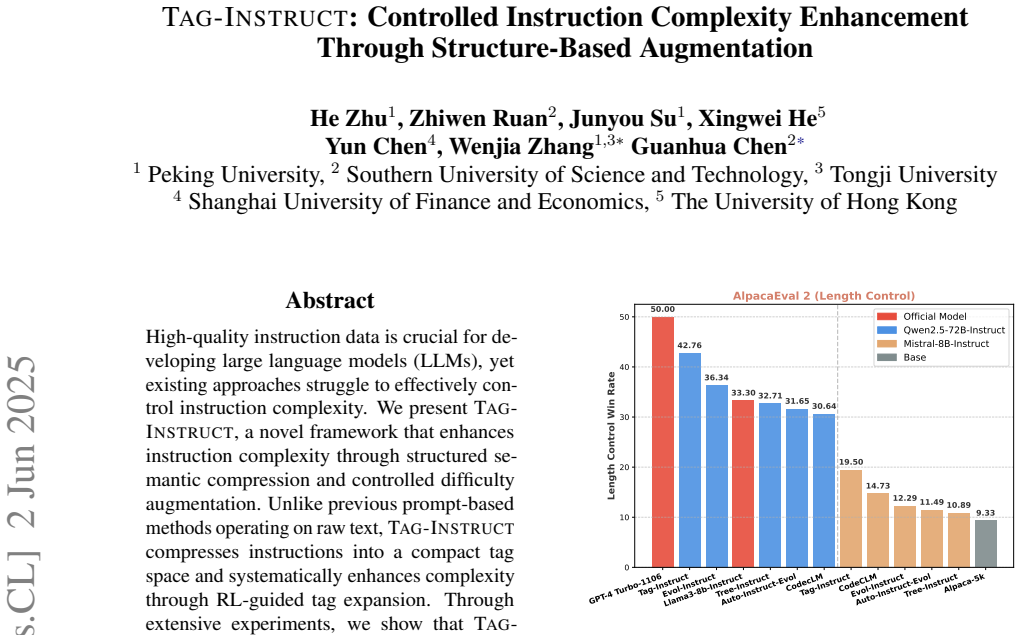
- [Section 4.1 and Tables 1 and 5] All AlpacaEval 2.0 scores are produced with GPT-4o-mini as the judge, whereas the standard AlpacaEval 2.0 protocol uses GPT-4. Because the paper's headline numbers are win rates from this non-standard judge, the results need validation, for example a subset judged by GPT-4 or a report of judge agreement. In addition, the abstract's 'comparable to GPT-4-Turbo' is only loosely supported by Figure 1, where GPT-4-Turbo-1106 reaches 50.00% LC and TAG-INSTRUCT reaches 42.76%.
minor comments (6)
- [Section 4.3] The text says 'RL-based sampling outperformed random sampling,' but Table 2 labels the comparison as 'Prompt-based' versus 'RL-based'; please make the terminology consistent.
- [Figure 3] The y-axis label in Figure 3b reads 'Quality Score (%),' but Arena-Hard is not a percentage and the average of Arena-Hard and AlpacaEval 2.0 is not clearly a percentage; please clarify the normalization.
- [Figure 1] The legend entry 'Tag-InstructEvol-Instruct' appears to concatenate two method names, and the legend ordering is confusing; please separate all entries and use one consistent color scheme.
- [Table 4] The claimed 'monotonic relationship' between tag utility and downstream performance is based on three points with no error bars or repeated runs; please report variance across seeds.
- [Sections 3.3-3.4] The method is described as 'RL-based,' but the actual training uses DPO, which is an offline preference optimization method; please qualify the terminology to avoid implying online reinforcement learning.
- [Limitations] The Limitations section appropriately acknowledges that response length is only a proxy for instruction quality, but this caveat is not reflected in the abstract or conclusion, which present the structure-based mechanism as established.
Circularity Check
Tag utility is defined as average response length (Eq. 1), so the claimed 'Shapley-based' complexity control reduces, in its operative signal, to the known 'Long is more' length effect; the missing length-matched baseline leaves the semantic claim untested.
-
renaming known result
[Section 3.4, Eq. (1); Section 3.3; Section 5.3, Table 4; Limitations]
"Following the suggestions in Zhao et al. (2024) and Shen (2024), we use response length as a proxy for instruction quality v, as it effectively captures both complexity and information density. To address the computational complexity of Shapley value calculation, we approximate the tag utility as the average response length of instructions containing that tag: ϕi = Σ_{j∈D_i^t} |yj| / |D_i^t|, (1) ... This efficiency gain (better performance with shorter prompts) validates that our utility scores capture intrinsic semantic value rather than superficial verbosity."
The tag utility that drives RL-guided tag expansion is not a Shapley value but a first-order statistic: the average response length of instructions containing the tag (Eq. 1). The DPO policy is trained to prefer tags with high values of this statistic (Section 3.3; Appendix D.2-D.4). Therefore 'high-utility tag expansion' is, by construction, selection for tags associated with long responses. Tables 2 and 4 confirm that the selected tags produce longer responses (1037.0 vs 1006.7 and 967.52 vs 861.38 tokens).
full rationale
No load-bearing self-citation chain, uniqueness theorem, or machine-checked dependency is involved. The paper is self-contained against external benchmarks and reports real downstream evaluations (AlpacaEval 2, Arena-Hard, MT-Bench) on held-out instruction-tuning runs. However, the central operational signal is transparently response length: Eq. (1) defines tag utility as the average response length of instructions containing that tag, and the RL policy is optimized to prefer tags with high values of this statistic. The ablations confirm that high-utility tags produce longer responses, and the paper never includes a length-matched baseline or the 'Long is more' baseline it cites. This makes the causal claim 'structured semantic compression improves complexity' partially circular: the selection criterion is length, and the evaluation benchmarks are known to reward length/detail. The Shapley-value framing is also a misnomer because no marginal-contribution computation over tag subsets is performed. These issues are substantive but do not fully collapse the paper's contribution, because the tag-space pipeline, the iterative augmentation, and the external benchmark comparisons add independent content. Score 4 reflects partial circularity/confounding in the central utility definition and the absence of a decisive length-controlled control, while acknowledging that the paper is not a pure self-citation artifact or a definitional tautology.
Assumptions & free parameters
Cite this review
Pith. "Pith review of TAG-INSTRUCT: Controlled Instruction Complexity Enhancement through Structure-based Augmentation." pith.science (2026). https://pith.science/paper/HDS6VKIQ
@misc{pith2026250518557,
  author       = {Pith},
  title        = {Pith review of: TAG-INSTRUCT: Controlled Instruction Complexity Enhancement through Structure-based Augmentation},
  year         = {2026},
  howpublished = {\url{https://pith.science/paper/HDS6VKIQ}},
  note         = {Machine review of arXiv:2505.18557}
}
read the original abstract
High-quality instruction data is crucial for developing large language models (LLMs), yet existing approaches struggle to effectively control instruction complexity. We present TAG-INSTRUCT, a novel framework that enhances instruction complexity through structured semantic compression and controlled difficulty augmentation. Unlike previous prompt-based methods operating on raw text, TAG-INSTRUCT compresses instructions into a compact tag space and systematically enhances complexity through RL-guided tag expansion. Through extensive experiments, we show that TAG-INSTRUCT outperforms existing instruction complexity augmentation approaches. Our analysis reveals that operating in tag space provides superior controllability and stability across different instruction synthesis frameworks.
Figures

Figures from the paper (8 more)




Reference graph
Works this paper leans on
-
[1]
Focus on action-oriented concepts
-
[3]
Focus on action-oriented concepts
Use standard terminology when possible ### Examples: [Input] Describe a situation where team collaboration improved the outcome of a project. [Tags] teamwork_experience, project_outcomes, success_factors [Input] What strategies can be used to improve time management in a busy work environment? [Tags] productivity_methods, workload_optimization, efficiency...
work page 2024
-
[4]
Deepseek-v3 technical report.Preprint, arXiv:2412.19437. Aniket Didolkar, Anirudh Goyal, Nan Rosemary Ke, Siyuan Guo, Michal Valko, Timothy Lillicrap, Danilo Rezende, Yoshua Bengio, Michael Mozer, and San- jeev Arora. 2024. Metacognitive capabilities of llms: An exploration in mathematical problem solving. Preprint, arXiv:2405.12205. Qianlong Du, Chengqin...
arXiv 2024
-
[6]
Rafael Rafailov, Archit Sharma, Eric Mitchell, Stefano Ermon, Christopher D
Qwen2.5 technical report.Preprint, arXiv:2412.15115. Rafael Rafailov, Archit Sharma, Eric Mitchell, Stefano Ermon, Christopher D. Manning, and Chelsea Finn
-
[7]
Nils Reimers and Iryna Gurevych
Direct preference optimization: Your lan- guage model is secretly a reward model.Preprint, arXiv:2305.18290. Nils Reimers and Iryna Gurevych. 2019. Sentence-bert: Sentence embeddings using siamese bert-networks. Preprint, arXiv:1908.10084. Lloyd S Shapley. 1953. A value for n-person games. Contributions to the Theory of Games, 2(28):307– 317. Ming Shen. 2...
arXiv 2019
-
[8]
Weihao Zeng, Can Xu, Yingxiu Zhao, Jian-Guang Lou, and Weizhu Chen
Distilling system 2 into system 1.Preprint, arXiv:2407.06023. Weihao Zeng, Can Xu, Yingxiu Zhao, Jian-Guang Lou, and Weizhu Chen. 2024. Automatic instruc- tion evolving for large language models.Preprint, arXiv:2406.00770. Hao Zhao, Maksym Andriushchenko, Francesco Croce, and Nicolas Flammarion. 2024. Long is more for alignment: A simple but tough-to-beat...
arXiv 2023
-
[12]
Avoid redundant or overlapping tags
-
[13]
Use standard terminology when possible ### Examples: [Input] In the context of climate change adaptation, analyze how urban planning strategies can be modified to create resilient cities. [Tags] urban resilience, climate adaptation, sustainable development [Input] Design a comprehensive employee training program for a multinational corporation addressing ...
Show all 27 references
-
[14]
Think Different Step: List as many meanings as possible across different domains
-
[15]
Merge Step: Reflect on the meanings and combine similar ones into a single, broader concept
-
[16]
video_share
Final Answer: Provide as few meanings as possible, only listing the most essential and distinct ones. ### Examples: [Input] "video_share" [Think Different Step]
-
[17]
A feature to distribute video content
-
[18]
A social media feature to repost videos
-
[19]
A platform for users to collaborate on video creation
-
[20]
Distribute video content
A tool for sharing personal video files [Merge Step] - "Distribute video content" and "repost videos" are closely related→merge them into one - "Collaborate on video creation" and "share personal video files" are related but distinct [Final Answer]
-
[21]
cloud computing
A feature to share videos online That’s all [Input] "cloud computing" [Think Different Step]
-
[22]
A method of delivering computing services over the internet
-
[23]
A platform for storing and processing data remotely
-
[24]
A framework for providing software as a service (SaaS) via the internet
-
[25]
Delivering computing services
A way for businesses to scale infrastructure without owning physical hardware [Merge Step] - "Delivering computing services" and "storing and processing data remotely" are related→merge into one - "Providing software as a service (SaaS)" is distinct from infrastructure and sto...
-
[26]
A method of delivering computing services and storing data remotely over the internet
-
[27]
A framework for providing software as a service (SaaS)
-
[28]
E.3 Tag Combination Building on our quantitative control framework through high-utility tags, we introduce tag combination as a principled approach to instruction synthesis
A way for businesses to scale infrastructure without owning physical hardware That’s all For the tag "{tag}", apply this process and provide the final answer: Figure 10: Template for analyzing tag semantics through divergent thinking and convergent analysis. E.3 Tag Combinatio...
-
[2022]
Preprint, arXiv:2210.11416
Scaling instruction-finetuned language models. Preprint, arXiv:2210.11416. DeepSeek-AI, Aixin Liu, Bei Feng, Bing Xue, Bingx- uan Wang, Bochao Wu, Chengda Lu, and et.al
-
[2023]
Hyung Won Chung, Le Hou, Shayne Longpre, Bar- ret Zoph, Yi Tay, William Fedus, Yunxuan Li, et al
Instruction mining: Instruction data selection for tuning large language models.arXiv preprint arXiv:2307.06290. Hyung Won Chung, Le Hou, Shayne Longpre, Bar- ret Zoph, Yi Tay, William Fedus, Yunxuan Li, et al
-
[2024]
Yihan Cao, Yanbin Kang, Chi Wang, and Lichao Sun
Sentencevae: Enable next-sentence predic- tion for large language models with faster speed, higher accuracy and longer context.Preprint, arXiv:2408.00655. Yihan Cao, Yanbin Kang, Chi Wang, and Lichao Sun
-
[2025]
Ming Li, Yong Zhang, Zhitao Li, Jiuhai Chen, Lichang Chen, Ning Cheng, Jianzong Wang, Tianyi Zhou, and Jing Xiao
Tulu 3: Pushing frontiers in open language model post-training.Preprint, arXiv:2411.15124. Ming Li, Yong Zhang, Zhitao Li, Jiuhai Chen, Lichang Chen, Ning Cheng, Jianzong Wang, Tianyi Zhou, and Jing Xiao. 2024a. From quantity to quality: Boosting llm performance with self-guid...
2023 arXiv
Reviewed August 7, 2026 · model on record in the stance chip above.
Discussion (0). Sign in to comment.